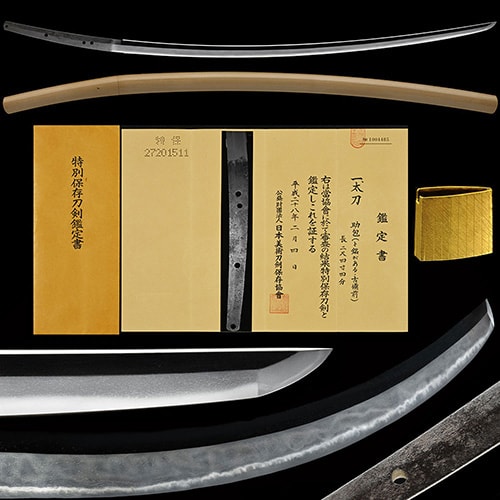
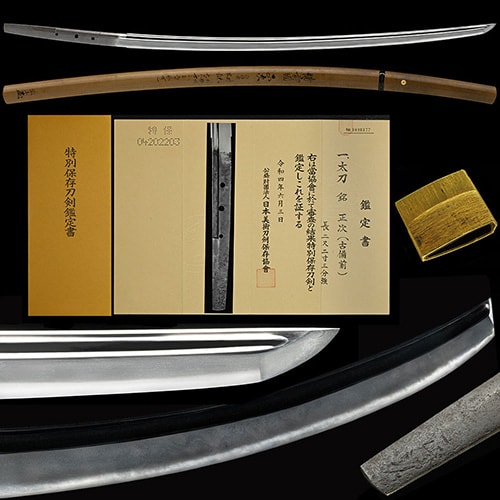
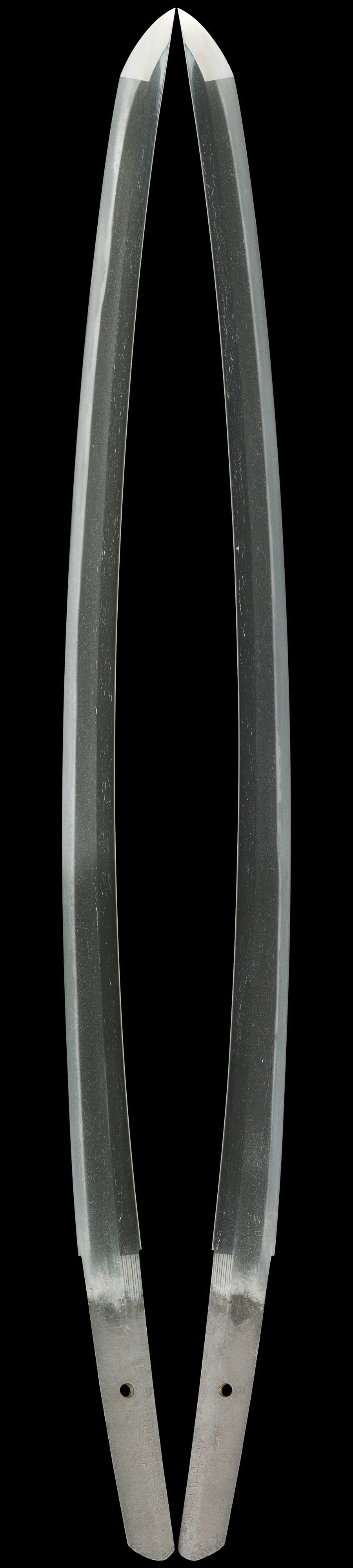
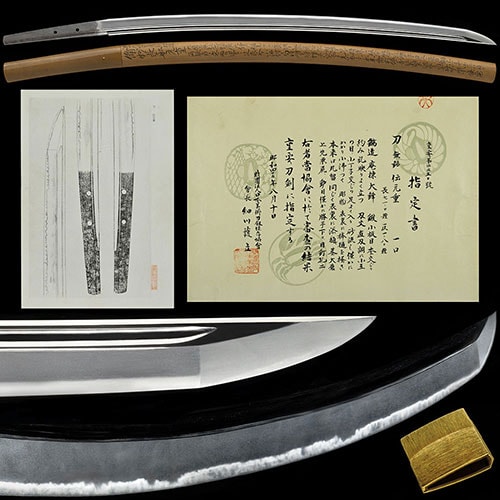
Junkei is one of the enduring identity problems of early , and the question is older than the swords that survive him: since the period his name had been transmitted as the Buddhist name of the first Nagamitsu of , so that for centuries his work was filed under the most famous hand of the mid-. The published sources reject that reading. On the evidence of the workmanship, the calligraphy of the signature and the movement of the chisel, they resolve him instead as a smith working no later than the middle period, and the prewar designations go further still: when the two Important Art Objects were certified, Honma, then in the Ministry of Education, deliberately recognized them as , judging that of the blade presented "there can be no doubt that it is ". He is, in the modern reading, an independent archaic hand whom posterity had mistaken for the man he most resembles.
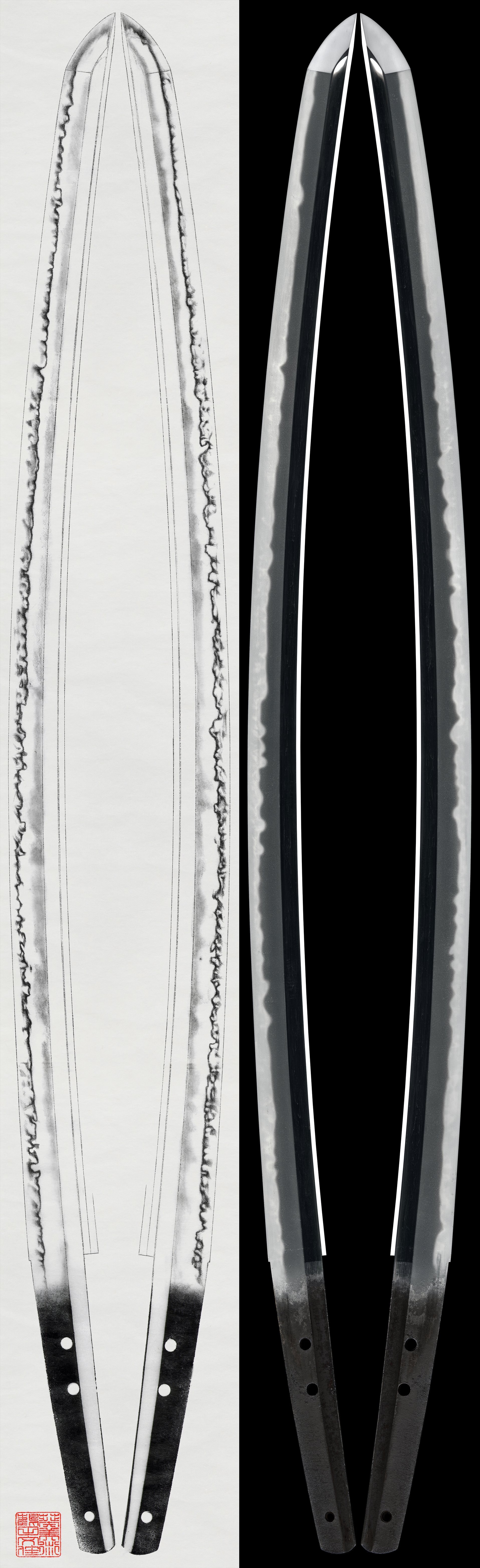
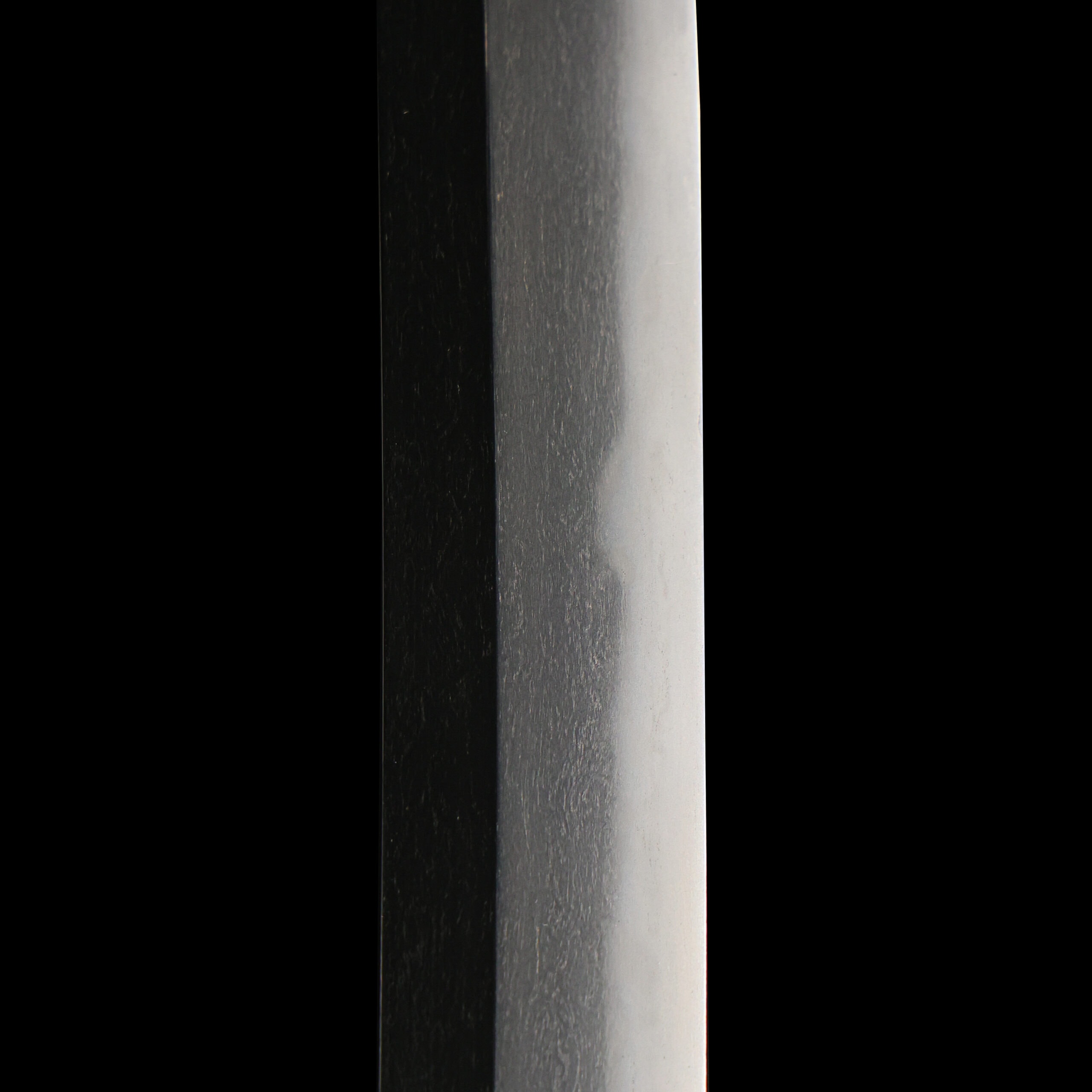
His recognized hand is best read on the signed blades, and it is quiet. Over an of rather large grain that stands and at times flows, on the finer pieces a that still shows its , with adhering, he tempers a moist, shallow on a -leaning base. Into it he sets small and , with and entering well, the notably strong and archaic in feeling, and fine and intertwining the . The runs straight to a small . It is a restrained, old-toned manner, and the published commentary names it as such, calling one such piece a work that "presents one typical example of Junkei". The temper is the calmest of readings, not the flamboyant clove-flower of the later school but a small irregular line carried in the activity rather than in towering clusters.
The is the constant across his record. with , the grain standing and on the wider blades mixed with , recurs on each example, and where the forging tightens into the steel only grows clearer. What it does not carry, on the signed work, is . The point is explicit in the published commentary, which observes of one signed sword that "no is seen in the " and reads the there as a -laden -toned , archaic throughout. This absence is not an incidental note. It is the structural fact on which the whole reattribution turns, because the line he was confused with is a -based, -bearing tradition, and Junkei is neither.
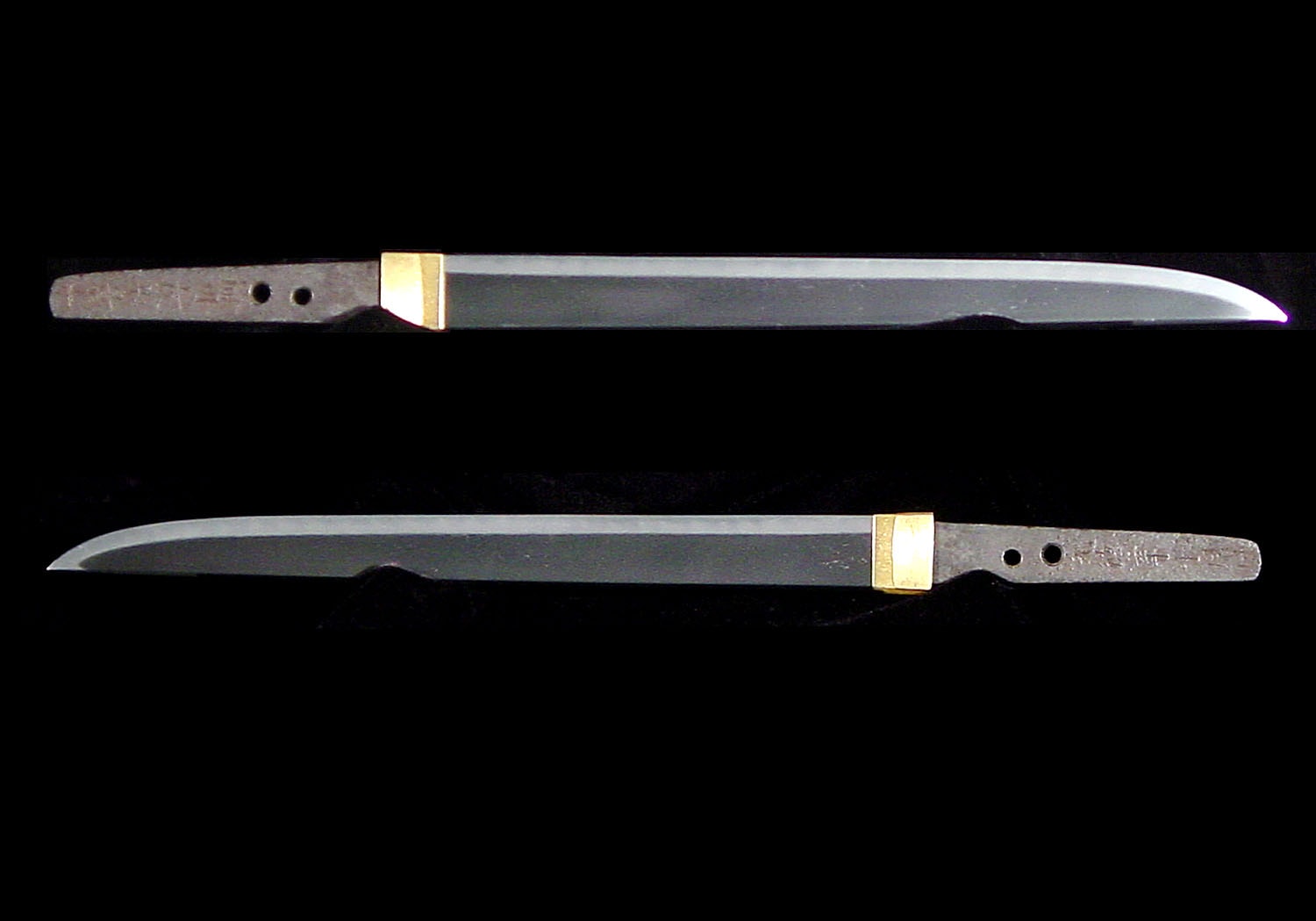
His record divides into two faces. The signed blades, the two Important Art Object and the signed , are the -toned hand just described, the - without . Against them stands the single transmitted as Junkei, greatly shortened, which alone turns toward the showier mid- reading: somewhat wide in body with a leaning to , the mixed with large and , and here a stands distinctly, the temper a mixed with , the deep and forming, the a shallow to a small , with carved through. The two faces are not a contradiction but the span of his attributed work, the signed pieces fixing the personal hand and the extending it toward the school manner.
What separates Junkei from the smith he resembles is exactly what the judges name. Among works given to him there are some that recall Nagamitsu, but, in the words of the published commentary, "generally they differ in being -". The distinction is the whole of the modern argument: the Nagamitsu line is -based and shows ; Junkei's hand is -based and, when signed, shows none. So the resemblance that once collapsed him into Nagamitsu is, on close reading, the very thing that holds him apart, and the early identification as Nagamitsu's Buddhist name falls away. The swordbooks still carry both the -person and different-person theories, but the modern view, taken on workmanship, signature calligraphy and chisel work, is settled on the latter, and he stands as a hand earlier than the period, near the root of the tradition.
For the collector he is a rare early name, and a thin record. Fujishiro grades him Jō-jō . He has no National Treasures; his standing rests instead on two prewar Important Art Objects, both judged , and three blades at the rank, the published commentary calling a signed "precious" even where it shows slight fatigue, because so few of his signed works survive. The recorded blades are held in institutions and long-held collections grounded in their own provenance: one of the Important Art is preserved at the Sano Art Museum in Shizuoka, with examples also recorded at the Mōri Shūsui Museum of Art and the Sword Museum, and the provenance of his blades runs through the Ishikawa and Akashi Matsudaira houses. With only a handful of signed pieces in existence and the bulk of his record locked in Important-Art and museum holdings, a signed Junkei comes to light only seldom; the few in the tier reach the market rarely, and a privately held, signed Junkei is a notable thing for a collector to encounter, a document of a hand that scholarship had to recover from another man's name.