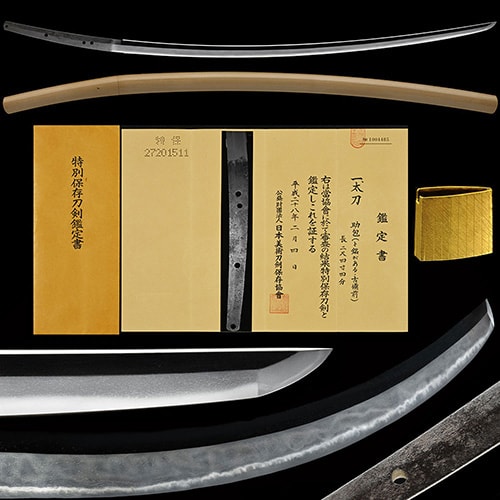
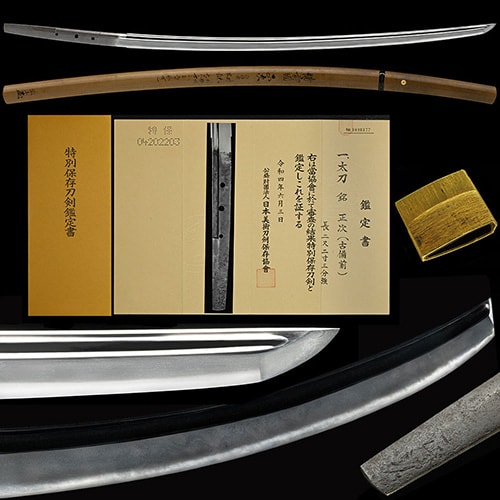
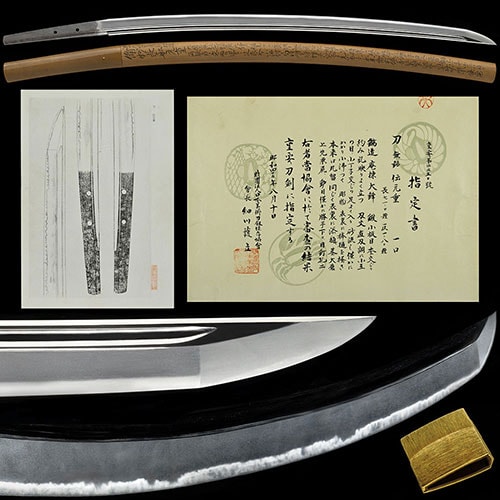
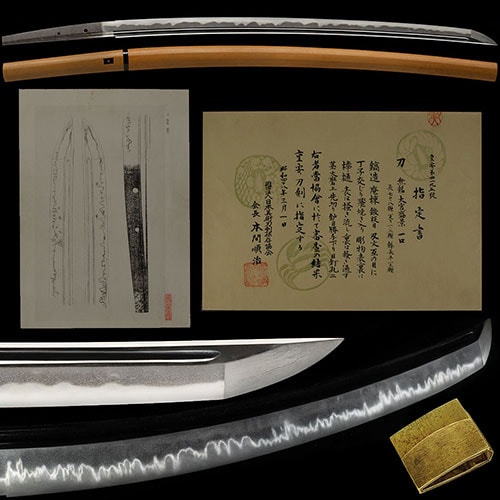
The published sources place Masatsune, together with Tomonari, as "a representative smith of workmanship", the two together counted as the twin pillars of the group. The records that since old times it has been transmitted that there were three generations bearing the name, or possibly even more, their activity spanning from the end of the period through the period, so that "Masatsune" denotes a name-line rather than a single man. Of that line the notes return to one judgment: among the makers his "signed works survive in the greatest number", and moreover, across that body, the workmanship "has no unevenness" in quality.
The characterization the sources weigh most carefully is the comparison with Tomonari. In the conventional assessment, the writes, Tomonari excels in the elegance of the form, exhibiting a graceful, feminine refinement (-buri), and somewhat surpasses Masatsune in the archaic flavor of the ; yet in the meticulousness and excellence of the the judgment goes to Masatsune. In the hardened edge too, the notes say, Masatsune tends to display a greater technical sophistication, so that works which are "more urbane and refined" are often found among his production. The sources mark the signatures as well: where Tomonari occasionally cuts a long inscription such as " no Tomonari," Masatsune "confines himself always to a two-character signature", and one seldom encounters or other carvings on his work.
The single feature the published descriptions return to as his clearest tell is . While Tomonari's , the notes observe, is comparatively inconspicuous, in Masatsune's work it can be seen with considerable clarity; the sources write of one that the "rises with striking clarity". His forging is described as a well-worked mixed with , with adhering well, fine entering, and the mottled of old steel woven through, over which the or stands up distinctly. This, the records, is the quality for which his is well regarded, shown "without the slightest looseness."
On that the published sources describe a temper based on , mixing , , and at times ; and enter well, adheres thickly, and appear in places, and the is bright and clear. The , the notes say, tends to run straight and turn back roundly in , often hardened more deeply than Tomonari's. Read together, the sources call this an "archaic yet highly dignified" manner of workmanship that clearly expresses the distinctive charm of , old in feeling and deep in flavor; where the stand out more than usual, they note, the temper takes on a fresher and more decorative character. As to form, the descriptions record a slender with deep curvature and marked , mostly today yet keeping the classical figure of its age.
The published record reaches its plain measure in the designations behind his name. He is Sai-jo in Fujishiro's grading. The consolidated body of his work numbers five blades that are National Treasures and fifteen that are Important Cultural Properties, with twelve and twenty-two beyond them; thirty-four of his blades stand in the and tiers together. Almost all survive signed in the two characters that the sources make a point of recognition, twenty-one signed against a single unsigned attribution among the works tallied here, and no dated piece comes down, as is usual for the period, so the hand is placed by style rather than by an inscribed year.
The provenance recorded against his blades runs through houses that held the country: the Imperial Family, the Owari Tokugawa Family, the Maeda Family, the Date Family, the Ikeda Family, the Shimazu Family, the Soma Family, and a sword once held by the Shogun Tsunayoshi. The finest are kept now in the Tokyo National Museum, the Tokugawa Art Museum, the Seikado Bunko Art Museum, the Hayashibara Museum of Art, the Kurokawa Research Institute, and the Hikone Castle Museum, with further pieces at the Kyushu National Museum and Jingu. Because the name-line was prolific, a signed Masatsune does on occasion reach a serious collector, a touchstone of the earliest signed .