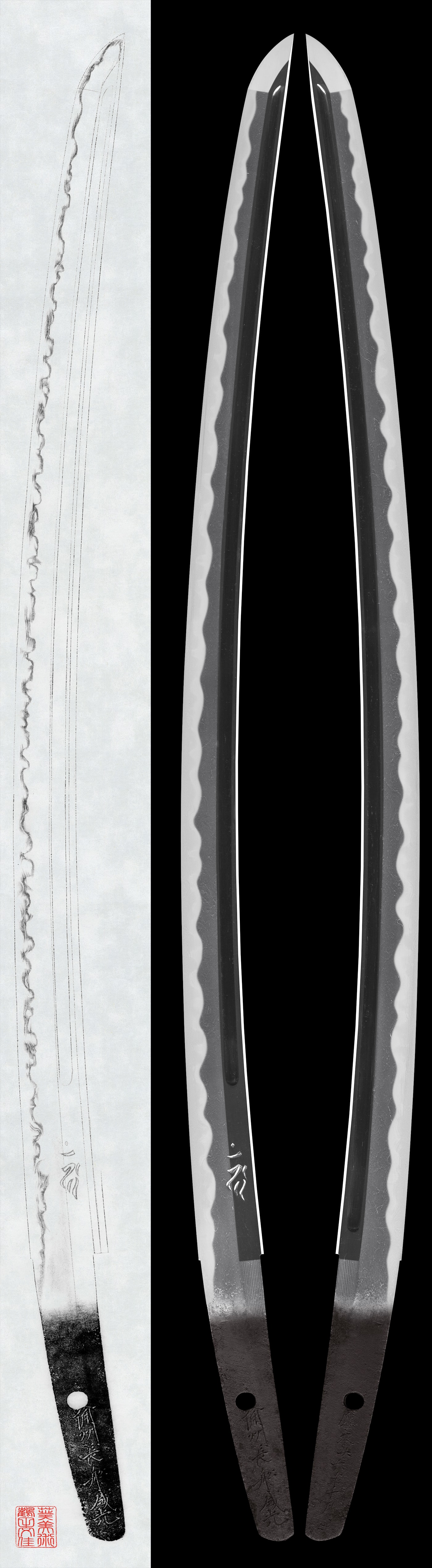
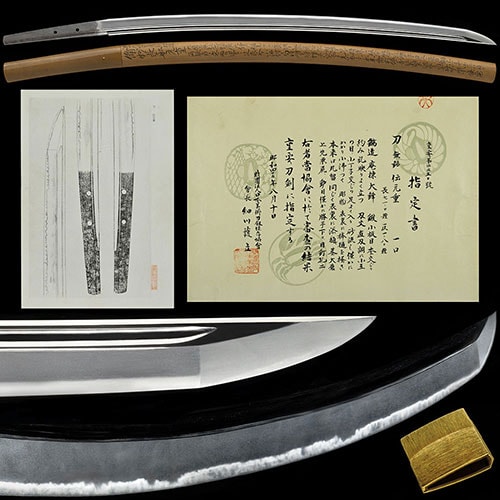
The National Treasure of the Chido Museum in Tsuruoka is a signed Nobufusa (信房作), bestowed on Sakai Tadatsugu by Tokugawa Ieyasu and transmitted in the Shonai Sakai family ever since. It carries the name of one of the first-rank smiths of old . Nobufusa worked in the school at the turn of the into the period, and Fujishiro grades him Sai-jo . The published sources state that two smiths bore the name, one of and one of the early school. The stated rule makes the three-character Nobufusa the norm and the two-character the one, yet the record of the National Treasure states the assignment the other way about; each blade is judged in the end by the antiquity of its and .
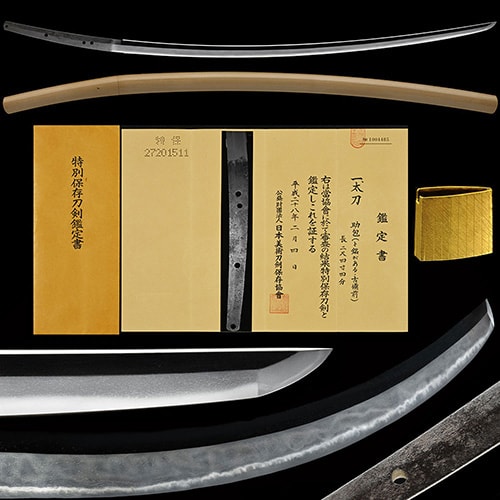
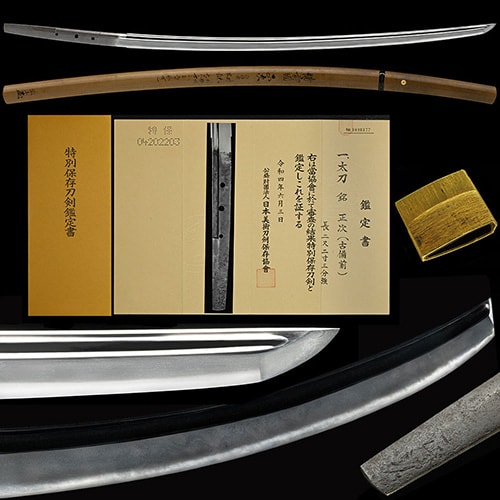
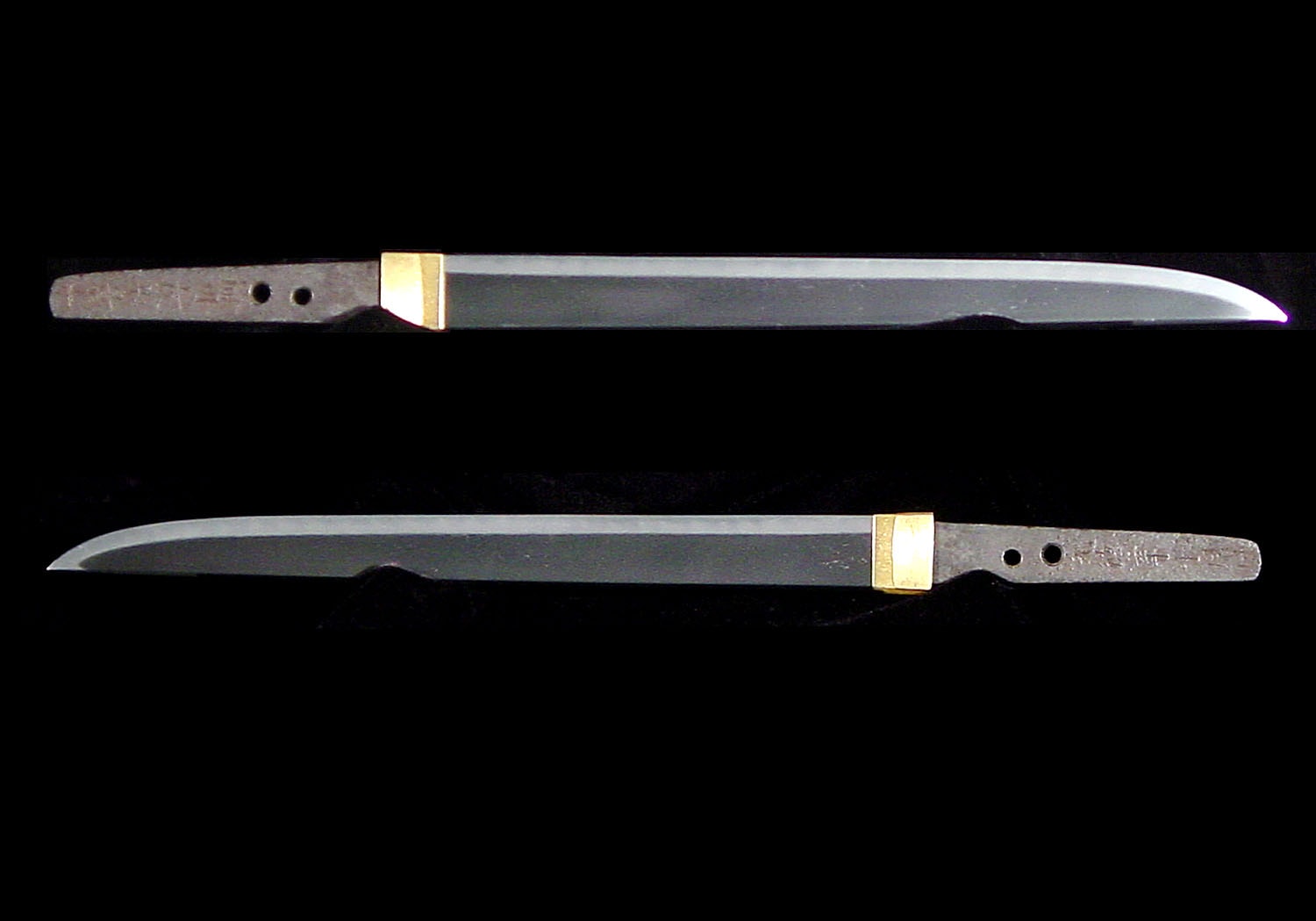
His surviving work is of one prevailing manner, the form first: a slender with a marked difference between base and tip widths, high with pronounced , inclining slightly forward toward a small . Most signed pieces keep an ; of the sanjimei blade passed at the sixty-first session the writes that "the is truly archaic in flavor". A survives as well, rare for the period, descended in the Nabeshima family of the Ogi domain and called valuable as documentary material.
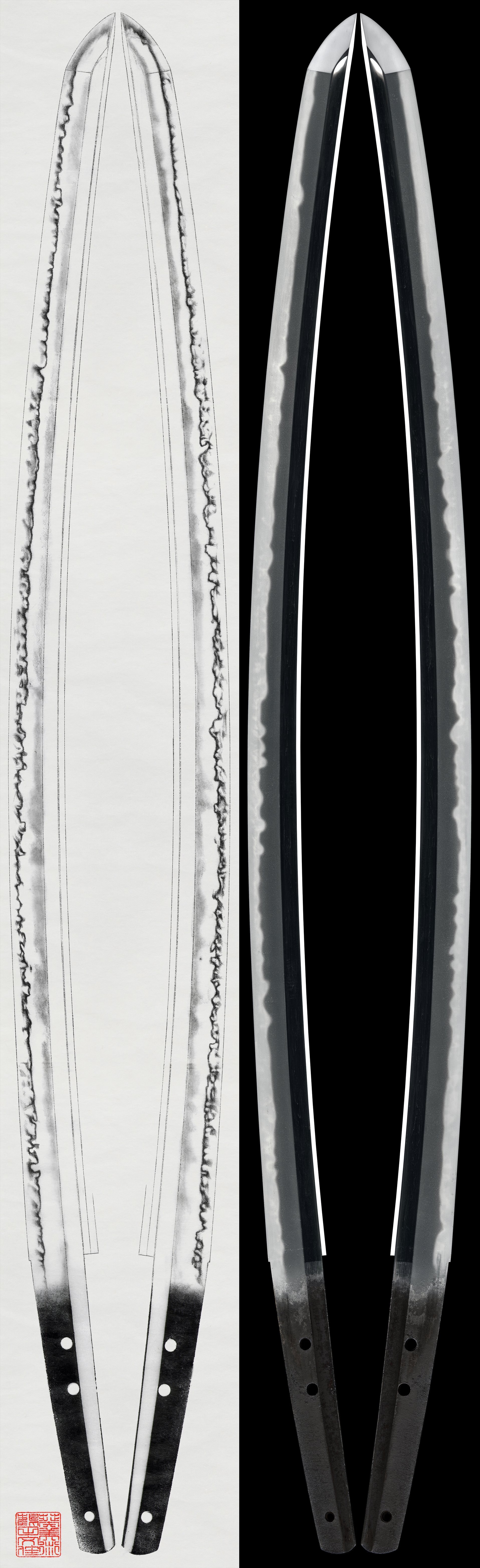
The is an that tends to stand, qualified in his papers as or somewhat standing, with attaching. mixes in at times, rises, and on the a faint casts over the surface. The temper is the old line at its quietest: a tone undulating shallowly into with mixed in, and entering. The lies deep, with and running through, and on several blades the temper is dropped above the in ; of one the sources note that the "unusually shows at the base". The runs to , often with at the tip. The sources place this within the school formula, by which flamboyant is rare in , the base customarily a tone or a shallow , the whole carrying an antique fragrance; his blades answer the formula exactly.
His signatures divide into two registers, the division the central question of Nobufusa scholarship. Of the two-character raised to at the fifth session, the writes that its and are "distinctly more archaic and classically elegant even among works of Nobufusa", and places it with the smith for that archaism; because the cut of that differs from the three-character pieces, whether the two registers are one man is left to future research. Of another they state that "no other example is known with a two-character signature that is this archaic in tone". Honma's note in the Bijutsuhin record keeps the larger question open: the old books made the sanjimei pieces , he moved them to in the Nihonto Bunrui Mokuroku, and after still more archaic two-character blades appeared he left both readings standing. His records twice add the theory that the Nobufusa writing 延 (延房) was the man. One sanjimei keeps a vermilion-script on its and closely matches the of an Important Cultural Property; the pair is called "valuable material for understanding this smith".
Inside his place is marked by his own documented traits. His stands out more than in any other profiled hand of the school, though his papers usually soften it to a tendency. The above the recurs on his blades at the highest rate among those hands, and brushes the on half his pieces. On both of his a -like doubling shows near the base and above the . , named freely in the school formula, is never once recorded on his blades. On one of those the gathers the threads: the work is smallish in scale yet busy in the , and "within this compact, lively style of workmanship there are qualities in which one may recognize the received tradition of Nobufusa".
Almost nothing of Nobufusa can ever change hands. Thirteen works are on official record, the weight sitting at the top: the National Treasure at the Chido Museum, four Important Cultural Properties, among them blades at the and Hie Jinja, a Bijutsuhin once owned by Count Tanaka Mitsuaki, and the signed in the Imperial collection, famous since the period as Jumansoku. The five National Treasure and Important Cultural Property blades are preserved as patrimony and will never trade, the Imperial piece stands outside any market by nature, and further examples rest at Jingu and the Hayashibara Museum of Art. Five blades carry recorded provenance, running through Tokugawa Ieyasu, Sakai Tadatsugu and the Shonai Sakai family, the Nabeshima family, Tokugawa Yoshimune, Ikeda Yoshiyasu and the Imperial Family. What remains within reach is thin: one and five blades, of which only two are unsigned attributions. The published sources themselves observe that signed works survive in but several pieces, and a Nobufusa coming into open hands is among the rarest encounters the field affords.