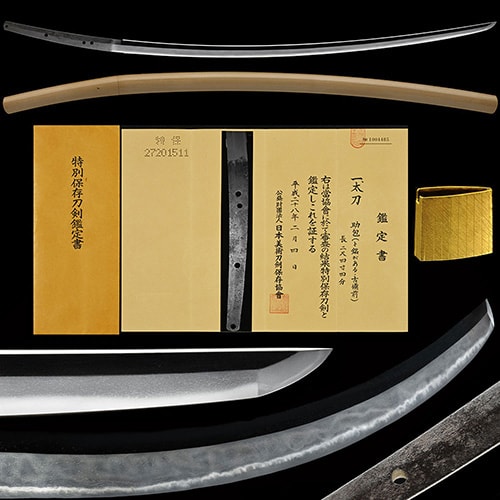
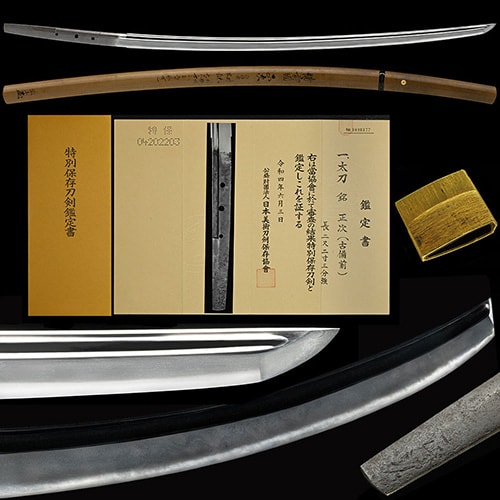
Motochika is a swordsmith of the close of the and the opening of the period, recorded in the under both and Fukuoka , and the published sources call his surviving output scarce, judging him a maker of the early whose blades 'are considered to be by a smith of the early period, and surviving works are few'. His name sits at the threshold where the old tradition passes into the Fukuoka that would flower in the mid-, and it carries a connoisseurship problem with it. The published commentary describes two faces to the recorded work under his signature, one a splendid designated an Important Cultural Property, the other a rich in certified an Important Art Object, and observes that 'the style of the signature is extremely similar in both', leaving open whether they are one hand or several.
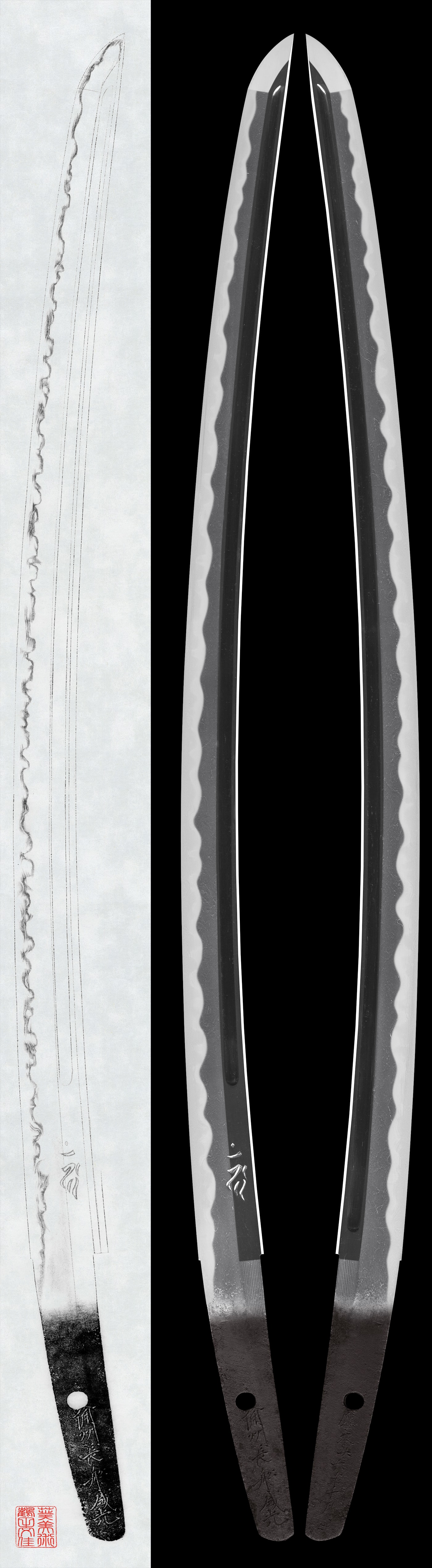
His readable record is the quieter of those two faces, and its hand is the -rich . Over the temper the published sources describe a mixed with and , entering, the gathering well and brightening into the interior of the , with and running frequently and intermittent and along the . This is not the full clove-flower of the later school but the calmer, -active manner of old , the activity carried in the and the rather than in towering clusters. On the signed Important Art Object the temper reads as a in deep with , into which and enter well.
The is the constant beneath that temper. It is an mixed with , tending to stand a little, over which lies a thick and fine , and from which a faint rises, the archaic steel the published sources read as the close of the Fujiwara age and the beginning of the . The falls in a gentle , turning back in on the front and running pointed on the reverse, both sides swept at the tip with . The shape keeps the old bearing of its period, slender with a clear taper, a strong with at the base on the signed and a small , archaic and tasteful even where greatly shortened.
The central scholarly question around him is the relation of his two manners, and the published sources lay it out without closing it. One account holds the blades to be and the flamboyant to be Fukuoka ; another holds them the work of a single maker, the ' an earlier phase and the ō-chōji-midare a later phase'. Because the signatures are so alike across the two groups, whether the related blades are by one hand or by namesakes 'remains a question for further study'. What can be said from the surviving signed work is that his hand is the calm, -laden , and it is by exactly that manner that the school separates him within the old- field, his bright active and set apart from both the plainer smiths and the showy of the to come.
For the collector he is a rare early name with a slight designated record. The Fujishiro appraisers give no grade for him, and his survival runs through a single Important Cultural Property (the flamboyant ), two signed pieces certified Important Art Objects, and the -rich raised to , of which the published sources say that, as a blade, one may 'fully savor the subtle fascination of its '. He has no National Treasures. His blades are heritage held rather than traded: a signed survives as an Imperial heirloom at Tanzan Shrine, and another, certified an Important Art Object, descended through Ikeda Kamesaburō. The Important Cultural Property is patrimony that does not come to market, and even the -rich stands at the top tier; a signed or Motochika in private hands is among the rarer things a collector of early could encounter, and one appears, when it does, only with patience.