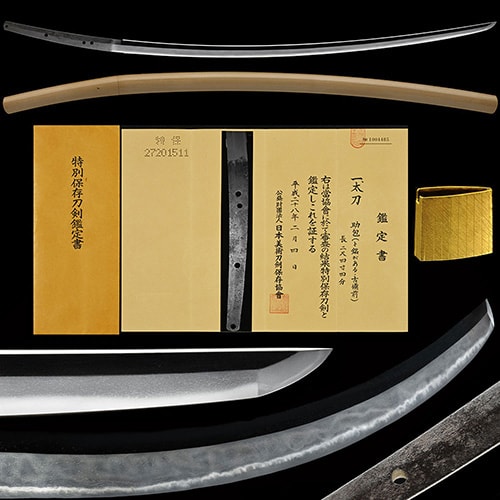
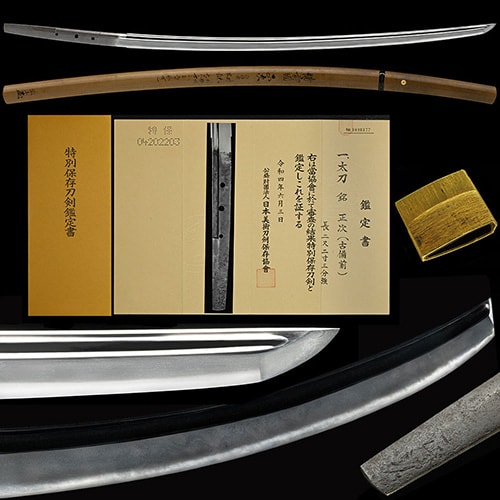
Naritaka is one of the smiths of the turn from the late into the early period, his line within the school not clearly traced. The published sources are candid about how little is fixed: he is counted among the works on the antiquity of his form and his and rather than on any documented descent, and one Important Cultural Property famed as the personal sword of Nasu no Yoichi anchors the small body by which his hand is known. Extant signed work is very scarce, only a handful of , and the published commentary on the blade of 1960 sets the scope plainly: he was a smith of the group, and his surviving blades are extremely few, of which the -tang signed pieces are likely limited to the Nasu family heirloom and that one . From this small but consistent group his manner is read with confidence, and within the commentary judges him a maker of comparatively high skill, one whose level can still be appreciated through the few signed that survive.
The build is the old ideal stated again and again: a slender , with , the curvature high at the waist with evident , running to a small . The published sources call this form elegant in the extreme (典雅) and return to the word old-fragrant for the whole impression. What most individualizes Naritaka among the profiled hands lies in the temper. Over a -toned base whose upper half straightens, the breaks low into and worked in , with and entering; and along the and the there crowd, frequently, and a doubled , with , and playing through. The is the rarest of these in the school, named on a quarter of his blades and effectively absent among his profiled fellows, and the doubled recurs on better than a third, far above the mainline and shared only with the -active register. These are the marks that place his hand, less in the bright current than among the -working old- smiths.
The is read by the forging more than by the reflection. Over an that stands a little, mixing in and the steel well-forged, attaches and enter finely, and a rises clearly, the archaic of old . The published sources describe the blade's and as suffering no loss to its beauty, a bright and splendid result. The is real and clear on his best work, yet it sits below the rate of the -defined hands; his is carried as much by the standing , the and the as by the reflection alone. The runs to a small round turnback, with slight on one face of the early . The whole reads as a careful, restrained hand whose activity gathers along the edge rather than across the .
Within one coherent manner the published record draws a clear register. Most of his signed blades keep to the slender, elegant with the restrained -based temper; the signature is cut in two characters, small, at the very tip of the . Against this runs a more flamboyant variant on the broad, large pieces: on the wide of 1960 the commentary records with a tendency, adhering well and and entering frequently, and notes that on both faces the tempers especially wide and grows vigorously irregular. On the difference of cut between his signatures the published sources are measured: the manner of the differs somewhat from examples seen elsewhere, but this they put down to a difference in the period of making rather than to any doubt. A single carries the attribution Naritaka, of which the judges write frankly that the tradition is not unreasonable in point of period and manner, while conceding that there is no positive feature compelling Naritaka alone.
Naritaka is not among the most famous names of , the published sources concede, yet the commentary ranks him squarely with his fellows: compared with Sukekane and Yoshikane he is in no way inferior. His distinction within the school is carried by his own grounded traits rather than by any borrowed comparison: the standing with its fine and well-risen , broken at the edge by and the doubled , in which the marks of old work show conspicuously and old-fragrant, as the published sources say of the signed . It is on this register, the elegant slender with its -worked edge activity, that he closes the line from the side of skilled but lesser-named hands, judged the equal in workmanship of the smiths beside whom he is set.
The weight of designation behind his name reaches the and tiers and the Important Cultural Property, with a further three certified Jūyō Bijutsuhin in the prewar designations; of his recorded works five carry a provenance. His most famous blade is the Important Art Object handed down as the sword of Nasu no Yoichi Munetaka, the archer of the fan target at Yashima, accompanied by its period black-lacquer mounting and famed as such in the published record; that it has descended in the Nasu family together with its original mounting across roughly eight centuries is called of exceptional documentary value. Another Jūyō Bijutsuhin was given directly by Tokugawa Ieyasu to an ancestor of the Uemura family for service in battle and held there until its certification, while the well-proportioned once owned by Kuroda Naganari was reckoned by the appraiser to surpass it in the quality of its and . Of recorded whereabouts two of his blades are held in public hands, at the Kyoto National Museum and the Otawara City Museum, the rest in private collections. With only a handful of signed surviving and the foremost of them held as heritage with its centuries-old mounting, a signed Naritaka coming into open hands is among the rarer things a collector of old might encounter, and a landmark when one does.