The monasteries that had sustained Yamato lost ground through the Muromachi period, and the schools thinned with them; Sue-Tegai kept the old masame manner alive in quantity. The burning of Tōdaiji’s Great Buddha hall in 1567 closed the temple age.
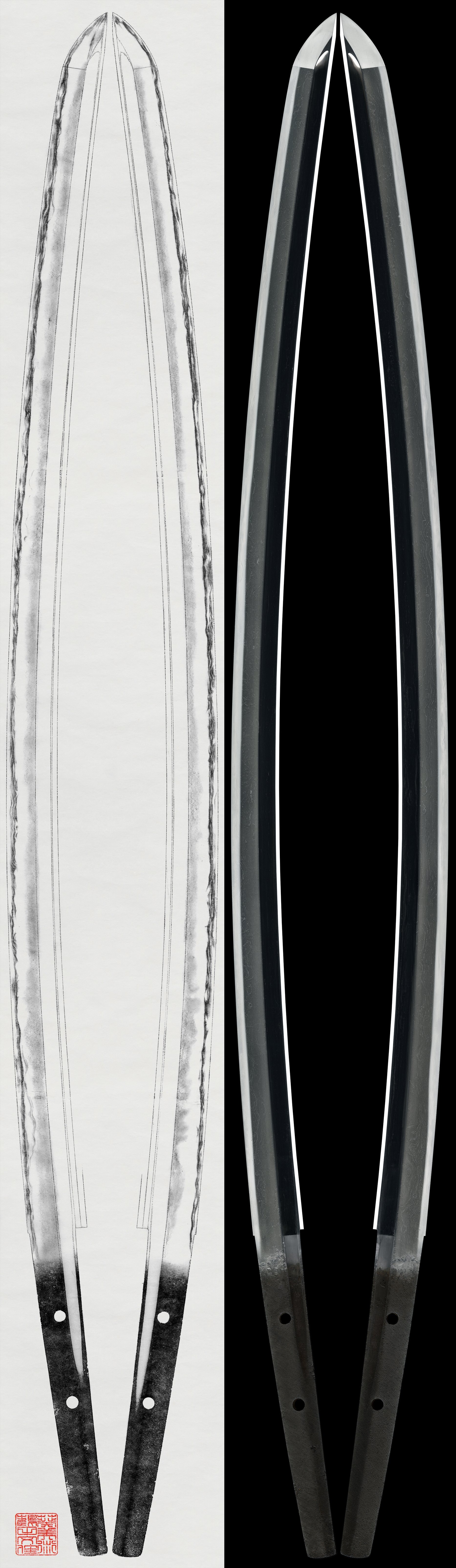
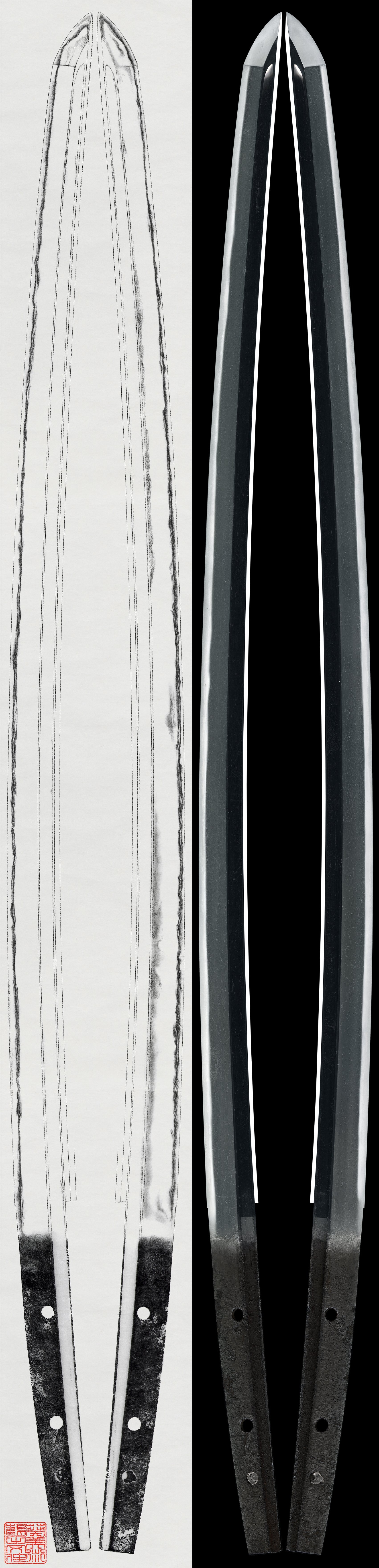
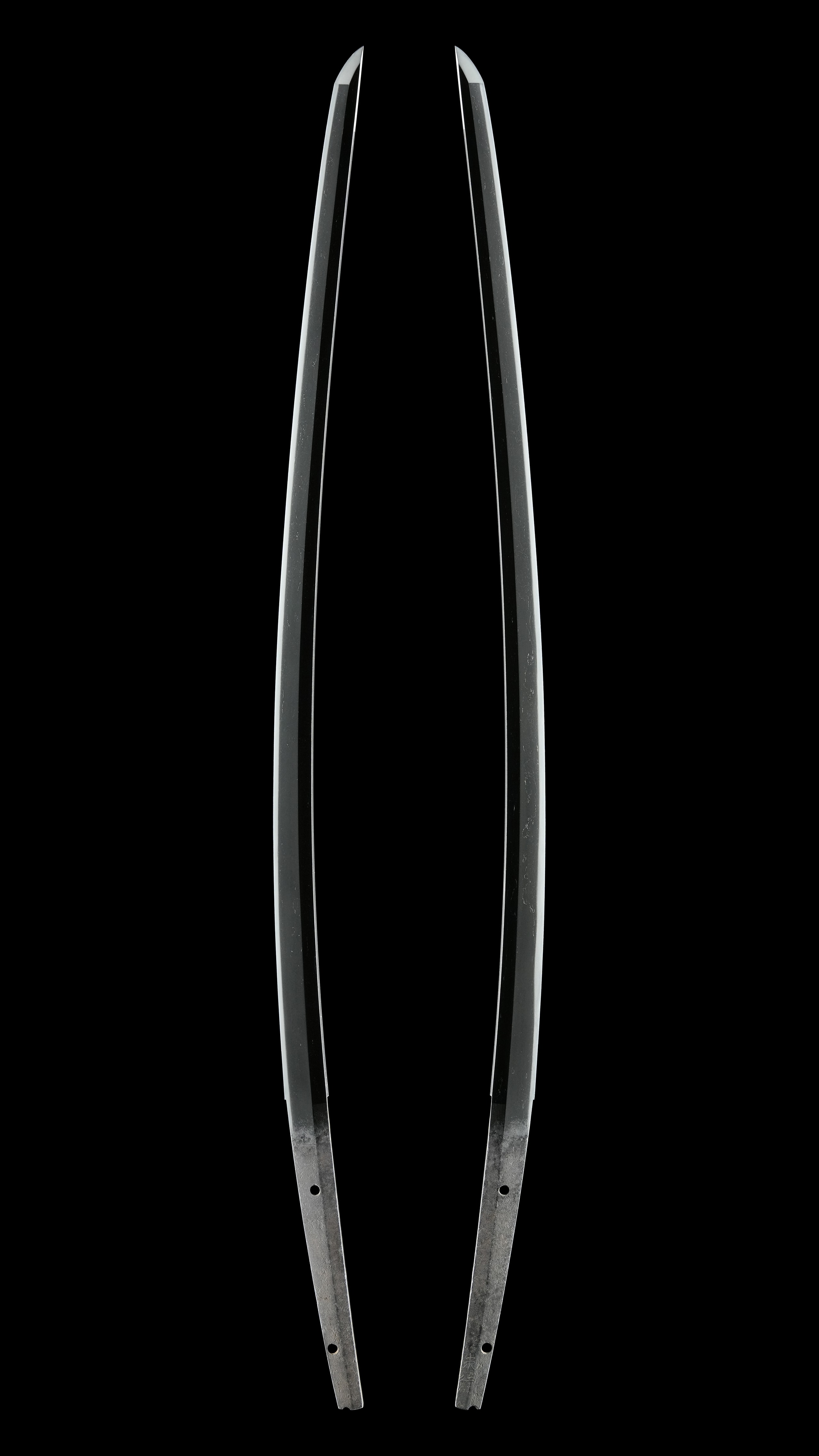
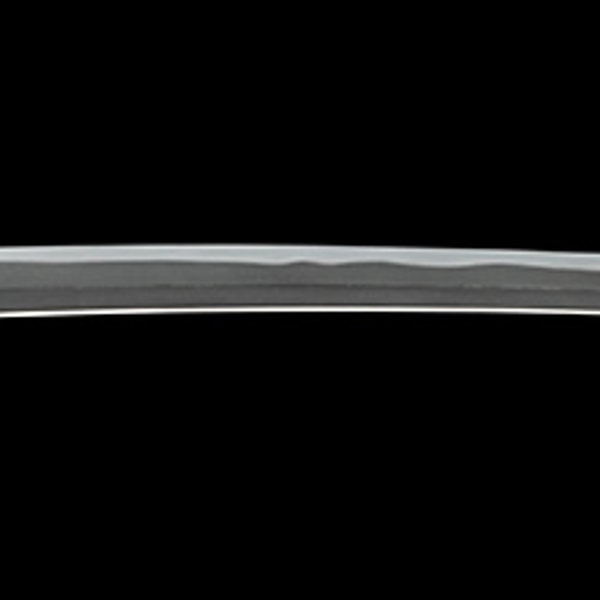
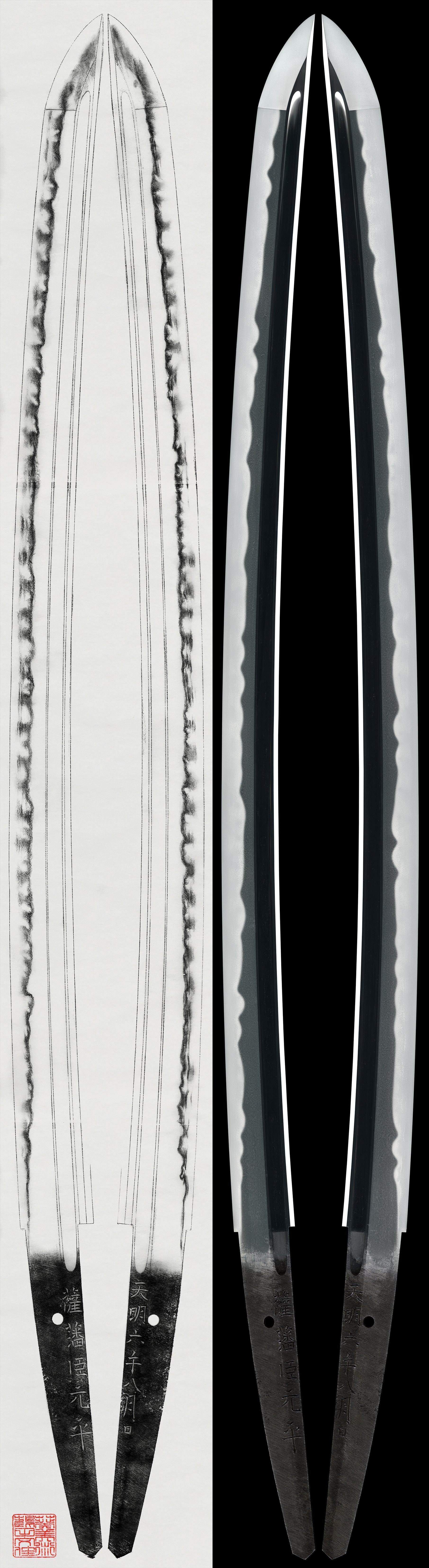
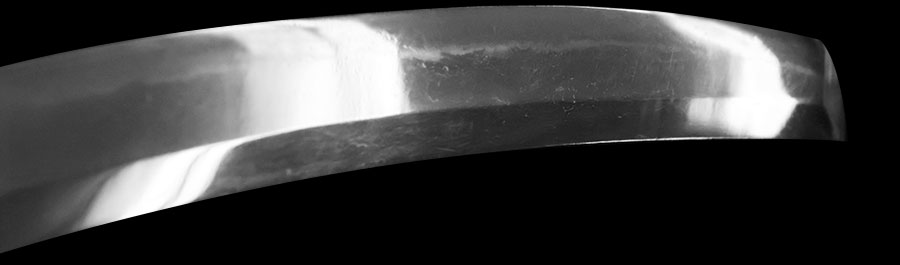
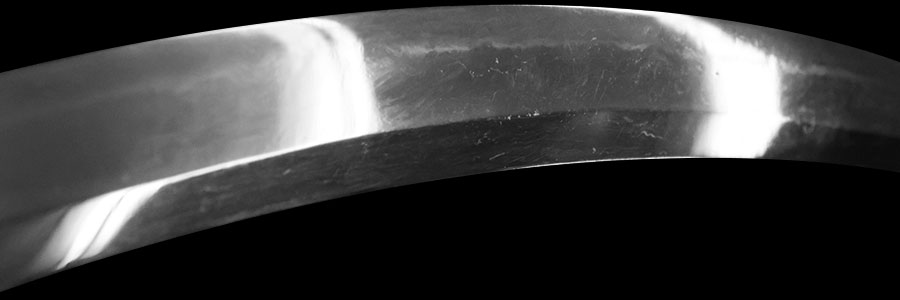
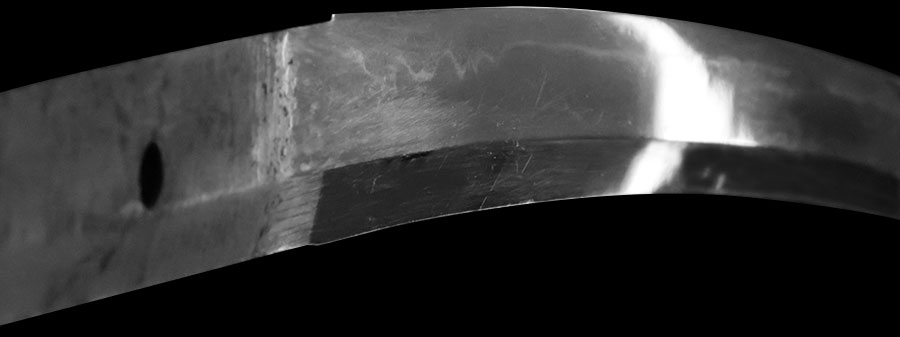
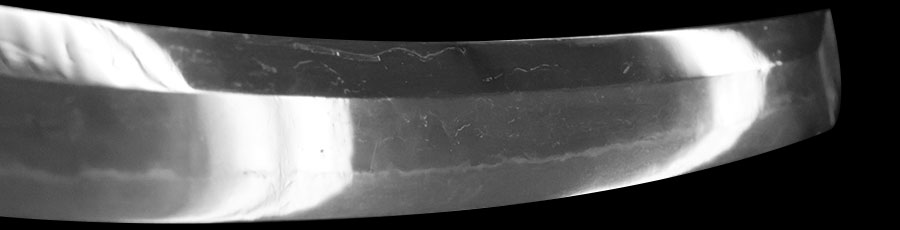
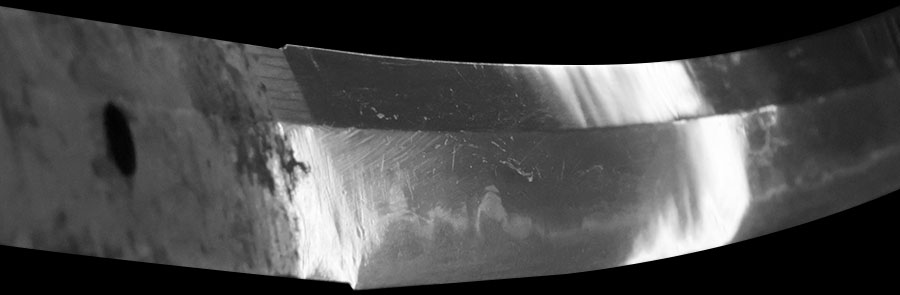
It has arrived, it has arrived! Because the Yamato smiths each belonged to the great temples of Nara and produced swords for them, the temples purchased all the swords; thus, there was no need for general sales. Consequently, *zaimei* works bearing the *tosho* *mei* (brand) are exceptionally rare, making this *katana* by Nanto Ju Nobukiyo-saku precious. Nobukiyo originally came from the Taima school of smiths. At the time this sword was produced in Tenbun 23 (1554) (472 years ago), he was still living in Fujiwara, Nara City, and was likely just beginning to migrate to Kanabo-ga-tsuji in Kamisanjō-chō, Nara City. This is a Nobukiyo from the old era, contemporary with Kanabo Hyoe-no-jo Masatsugu; later generations would assimilate into the Kanabo school. Along with the famous Dotanuki school of Higo (Kumamoto), the Kanabo school was a faction that saw great prosperity in Nara during the Muromachi period. This *katana* is a sword with a precious *nenki* of Tenbun 23. This was one year before the Battle of Kawanakajima, where Uesugi Kenshin and Takeda Shingen fought fiercely. From the fact that the *sugata* of this sword was originally a long *nagasa* of approximately 2 *shaku* 5 *sun* 5 *bu*, we can understand it was a sword specially made for a mounted warrior. However, because a later samurai desperately wanted this sword as his own *sashiryo*, it was shortened to match his swordsmanship. The *sugata* shows a slightly high *shinogi* with a difference between the *moto-mihaba* and *saki-mihaba* and a pronounced *sori*, presenting a grand appearance. The *jigane* is forged in *itame-hada* with fine *ji-nie* attached to the *ji*. The *hamon* is *nioi-deki* with *ko-nie*, featuring *gunome-ba* at the *moto*, transitioning to a *sugu-cho* *notare-ba* toward the *saki*, and the *boshi* is *hakikake*, showing a blade that looks as if it cuts extremely well. This time, we received this *katana* by Nanto Ju Nobukiyo-saku with the Tenbun 23 *nenki* from an old family who has cherished it for generations; their ancestors were dispatched by the domain as *Tondenhei* (settler-soldiers) to Hokkaido and endured the hardships of Hokkaido's development. Because they said, "We have grown old, so please pass this on at a low price to someone who will cherish it," we have taken it on consignment. As you can see, due to many years of age-related changes, the *ji* and *ha* are not clearly visible as is—though they can be seen well if held up to an electric light—but if given a *togi*, it will become a magnificent *koto* masterpiece. On this occasion, through the special kindness of the owner, we are offering it at a super-bargain price. Please enjoy it.
 NihontoWatch
Muromachi · nagasa 70cm · sori 1.8cm















Yamato-den · Yamato · around 1532-1555
1 piece on the market now
Yamato-den · Yamato
10 pieces on the market now
At Taima-dera in Yamato Province, the temple from which the school takes its name, a body of swordsmiths gathered in the late Kamakura period under Kuniyuki, who is transmitted as the founder of the line. The Taima group is counted among the five schools of the Yamato-den, the others being Tegai, Senjuin, Shikkake, and Hosho, and like its siblings it grew out of a monastic milieu in which the smiths worked in dependence upon the temple. That dependent standing is itself a fact of the record, for the published sources tie the scarcity of signed Taima work directly to it; the smiths, attached to the temple, naturally left few signatures, so that the line comes down largely as unsigned pieces fixed by appraisal. Only a small number of signed blades survive, chiefly by Kuniyuki and by Aritoshi, whose dated tachi of Einin 6 (1298) fixes the antiquity of the line and places its production at the close of the Kamakura age. The school continued through the Nanbokucho era and on into the Muromachi period, a northern branch removing to Asako in Echizen under the collective title Asako Taima. The Taima smiths share the full Yamato-den vocabulary, worked in a register that leans further toward nie activity than that of its Yamato siblings. The jigane is a flowing itame that gathers toward the edge into masame, the steel standing somewhat open, with thick ji-nie laid over it and chikei entering the grain frequently; on the finest blades a nie-utsuri rises in the ji, a reflection that on these smiths is a product of nie rather than of the Bizen midare-utsuri. Over this foundation the temper is built on a quiet line, a suguha or suguha-cho waved shallowly into notare and mixed with ko-gunome, small ko-choji, and at times ko-midare, the disorder always slight and worked over the straight base rather than displacing it.
The habuchi frays into hotsure, breaks into kuichigai-ba, doubles into nijuba, and lifts into uchinoke, while within the tempered area the ha-nie lies thick and bright, ashi and yo entering, and kinsuji and sunagashi flashing through repeatedly. Above it the boshi runs straight and is then swept with hakikake, most often finishing in yakizume without a turnback or turning in a small ko-maru. The recurring traits cohere into a recognizable hand: the masame-rich itame, the abundant glittering nie, and the brushed point are the marks by which the school is read, and the school leans toward nie where Tegai and the others keep a tighter, calmer key. Individual smiths inflect the manner: Aritoshi is set apart by a near-constant nijuba unusual even within Yamato, while the Echizen Nobunaga carries an angular gunome-midare and a darkened steel into Hokuriku. Kantei of a Taima blade proceeds from this cluster of Yamato evidence, the masame-leaning itame, the hotsure and nijuba along the habuchi, and the swept hakikake boshi, laid over a suguha base; against the other Yamato schools the appraisers look for the heavier nie activity and the conspicuous ashi and yo within a bright edge that separate Taima from the plainer suguha of Tegai and Senjuin, the togariba tendency of Shikkake, and the dense masame of Hosho. Kuniyuki stands as the progenitor and defining voice of the line, his signed tachi prized as documentary anchors against which the rest is measured; below him Aritoshi, Toshinaga, Tomoyuki, and Tomokiyo are read each by his own grounded traits, their few signed survivals valued first as reference material because so little of the school was ever signed. The greater part of the record is o-suriage mumei, wide-bodied Nanbokucho katana cut greatly down, their attribution argued from the markedly elongated chu-kissaki and from the Taima activity at its strongest, the texts candid that on such a shortened blade no individuality singling out one smith can be discerned even while the piece is held a fine work of the school. Provenance is mostly thin, running through private hands rather than the daimyo houses, with a few institutional holdings and the occasional notable mounting, so that an unsigned Taima blade is the usual encounter and a signed one a landmark of Yamato-den work. Learn more →
| Smith | Era | Designated |
|---|---|---|
| Aritoshi有俊 | 1264-1275 | 41 |
| Nobunaga信長 | 1394-1428 | 6 |
| Tomoyuki友行 | 1278-1288 | 5 |
| Tomokiyo友清 | 1319-1321 | 5 |
| Toshinaga俊長 | 1352-1356 | 5 |
Yamato in the Muromachi period
The monasteries that had sustained Yamato lost ground through the Muromachi period, and the schools thinned with them; Sue-Tegai kept the old masame manner alive in quantity. The burning of Tōdaiji’s Great Buddha hall in 1567 closed the temple age.
We could not find an authenticity certificate on the seller’s listing. Japanese swords and fittings are normally papered by the NBTHK (or the NTHK). Without one, the attribution is the seller’s own assessment and has not been independently verified — treat it with caution and ask the dealer about certification before buying.
For returns due to customer circumstances, the cost is the customer's responsibility. For returns due to our mis-shipment or a defective item, we bear the cost.
¥380,000
It has arrived, it has arrived! Because the Yamato smiths each belonged to the great temples of Nara and produced swords for them, the temples purchased all the swords; thus, there was no need for general sales. Consequently, *zaimei* works bearing the *tosho* *mei* (brand) are exceptionally rare, making this *katana* by Nanto Ju Nobukiyo-saku precious. Nobukiyo originally came from the Taima school of smiths. At the time this sword was produced in Tenbun 23 (1554) (472 years ago), he was still living in Fujiwara, Nara City, and was likely just beginning to migrate to Kanabo-ga-tsuji in Kamisanjō-chō, Nara City. This is a Nobukiyo from the old era, contemporary with Kanabo Hyoe-no-jo Masatsugu; later generations would assimilate into the Kanabo school. Along with the famous Dotanuki school of Higo (Kumamoto), the Kanabo school was a faction that saw great prosperity in Nara during the Muromachi period. This *katana* is a sword with a precious *nenki* of Tenbun 23. This was one year before the Battle of Kawanakajima, where Uesugi Kenshin and Takeda Shingen fought fiercely. From the fact that the *sugata* of this sword was originally a long *nagasa* of approximately 2 *shaku* 5 *sun* 5 *bu*, we can understand it was a sword specially made for a mounted warrior. However, because a later samurai desperately wanted this sword as his own *sashiryo*, it was shortened to match his swordsmanship. The *sugata* shows a slightly high *shinogi* with a difference between the *moto-mihaba* and *saki-mihaba* and a pronounced *sori*, presenting a grand appearance. The *jigane* is forged in *itame-hada* with fine *ji-nie* attached to the *ji*. The *hamon* is *nioi-deki* with *ko-nie*, featuring *gunome-ba* at the *moto*, transitioning to a *sugu-cho* *notare-ba* toward the *saki*, and the *boshi* is *hakikake*, showing a blade that looks as if it cuts extremely well. This time, we received this *katana* by Nanto Ju Nobukiyo-saku with the Tenbun 23 *nenki* from an old family who has cherished it for generations; their ancestors were dispatched by the domain as *Tondenhei* (settler-soldiers) to Hokkaido and endured the hardships of Hokkaido's development. Because they said, "We have grown old, so please pass this on at a low price to someone who will cherish it," we have taken it on consignment. As you can see, due to many years of age-related changes, the *ji* and *ha* are not clearly visible as is—though they can be seen well if held up to an electric light—but if given a *togi*, it will become a magnificent *koto* masterpiece. On this occasion, through the special kindness of the owner, we are offering it at a super-bargain price. Please enjoy it.
NihontoWatchMuromachi · nagasa 70cm · sori 1.8cm
Yamato-den · Yamato · around 1532-1555
1 piece on the market now
Yamato-den · Yamato
10 pieces on the market now
At Taima-dera in Yamato Province, the temple from which the school takes its name, a body of swordsmiths gathered in the late Kamakura period under Kuniyuki, who is transmitted as the founder of the line. The Taima group is counted among the five schools of the Yamato-den, the others being Tegai, Senjuin, Shikkake, and Hosho, and like its siblings it grew out of a monastic milieu in which the smiths worked in dependence upon the temple. That dependent standing is itself a fact of the record, for the published sources tie the scarcity of signed Taima work directly to it; the smiths, attached to the temple, naturally left few signatures, so that the line comes down largely as unsigned pieces fixed by appraisal. Only a small number of signed blades survive, chiefly by Kuniyuki and by Aritoshi, whose dated tachi of Einin 6 (1298) fixes the antiquity of the line and places its production at the close of the Kamakura age. The school continued through the Nanbokucho era and on into the Muromachi period, a northern branch removing to Asako in Echizen under the collective title Asako Taima. The Taima smiths share the full Yamato-den vocabulary, worked in a register that leans further toward nie activity than that of its Yamato siblings. The jigane is a flowing itame that gathers toward the edge into masame, the steel standing somewhat open, with thick ji-nie laid over it and chikei entering the grain frequently; on the finest blades a nie-utsuri rises in the ji, a reflection that on these smiths is a product of nie rather than of the Bizen midare-utsuri. Over this foundation the temper is built on a quiet line, a suguha or suguha-cho waved shallowly into notare and mixed with ko-gunome, small ko-choji, and at times ko-midare, the disorder always slight and worked over the straight base rather than displacing it.
The habuchi frays into hotsure, breaks into kuichigai-ba, doubles into nijuba, and lifts into uchinoke, while within the tempered area the ha-nie lies thick and bright, ashi and yo entering, and kinsuji and sunagashi flashing through repeatedly. Above it the boshi runs straight and is then swept with hakikake, most often finishing in yakizume without a turnback or turning in a small ko-maru. The recurring traits cohere into a recognizable hand: the masame-rich itame, the abundant glittering nie, and the brushed point are the marks by which the school is read, and the school leans toward nie where Tegai and the others keep a tighter, calmer key. Individual smiths inflect the manner: Aritoshi is set apart by a near-constant nijuba unusual even within Yamato, while the Echizen Nobunaga carries an angular gunome-midare and a darkened steel into Hokuriku. Kantei of a Taima blade proceeds from this cluster of Yamato evidence, the masame-leaning itame, the hotsure and nijuba along the habuchi, and the swept hakikake boshi, laid over a suguha base; against the other Yamato schools the appraisers look for the heavier nie activity and the conspicuous ashi and yo within a bright edge that separate Taima from the plainer suguha of Tegai and Senjuin, the togariba tendency of Shikkake, and the dense masame of Hosho. Kuniyuki stands as the progenitor and defining voice of the line, his signed tachi prized as documentary anchors against which the rest is measured; below him Aritoshi, Toshinaga, Tomoyuki, and Tomokiyo are read each by his own grounded traits, their few signed survivals valued first as reference material because so little of the school was ever signed. The greater part of the record is o-suriage mumei, wide-bodied Nanbokucho katana cut greatly down, their attribution argued from the markedly elongated chu-kissaki and from the Taima activity at its strongest, the texts candid that on such a shortened blade no individuality singling out one smith can be discerned even while the piece is held a fine work of the school. Provenance is mostly thin, running through private hands rather than the daimyo houses, with a few institutional holdings and the occasional notable mounting, so that an unsigned Taima blade is the usual encounter and a signed one a landmark of Yamato-den work. Learn more →
| Smith | Era | Designated |
|---|---|---|
| Aritoshi有俊 | 1264-1275 | 41 |
| Nobunaga信長 | 1394-1428 | 6 |
| Tomoyuki友行 | 1278-1288 | 5 |
| Tomokiyo友清 | 1319-1321 | 5 |
| Toshinaga俊長 | 1352-1356 | 5 |
Yamato in the Muromachi period
The monasteries that had sustained Yamato lost ground through the Muromachi period, and the schools thinned with them; Sue-Tegai kept the old masame manner alive in quantity. The burning of Tōdaiji’s Great Buddha hall in 1567 closed the temple age.
We could not find an authenticity certificate on the seller’s listing. Japanese swords and fittings are normally papered by the NBTHK (or the NTHK). Without one, the attribution is the seller’s own assessment and has not been independently verified — treat it with caution and ask the dealer about certification before buying.
For returns due to customer circumstances, the cost is the customer's responsibility. For returns due to our mis-shipment or a defective item, we bear the cost.
¥380,000