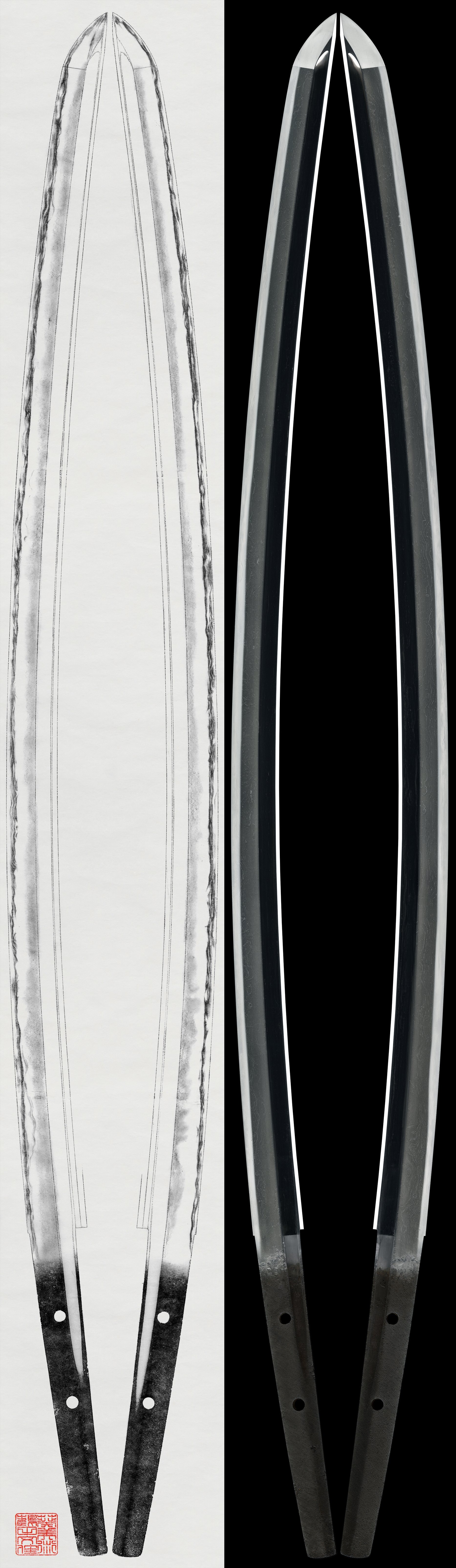
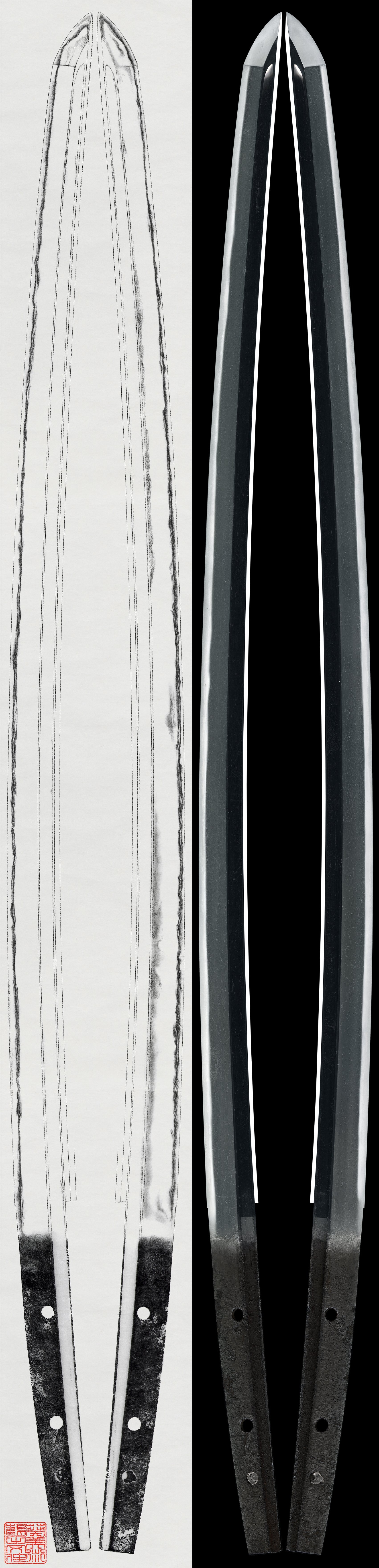
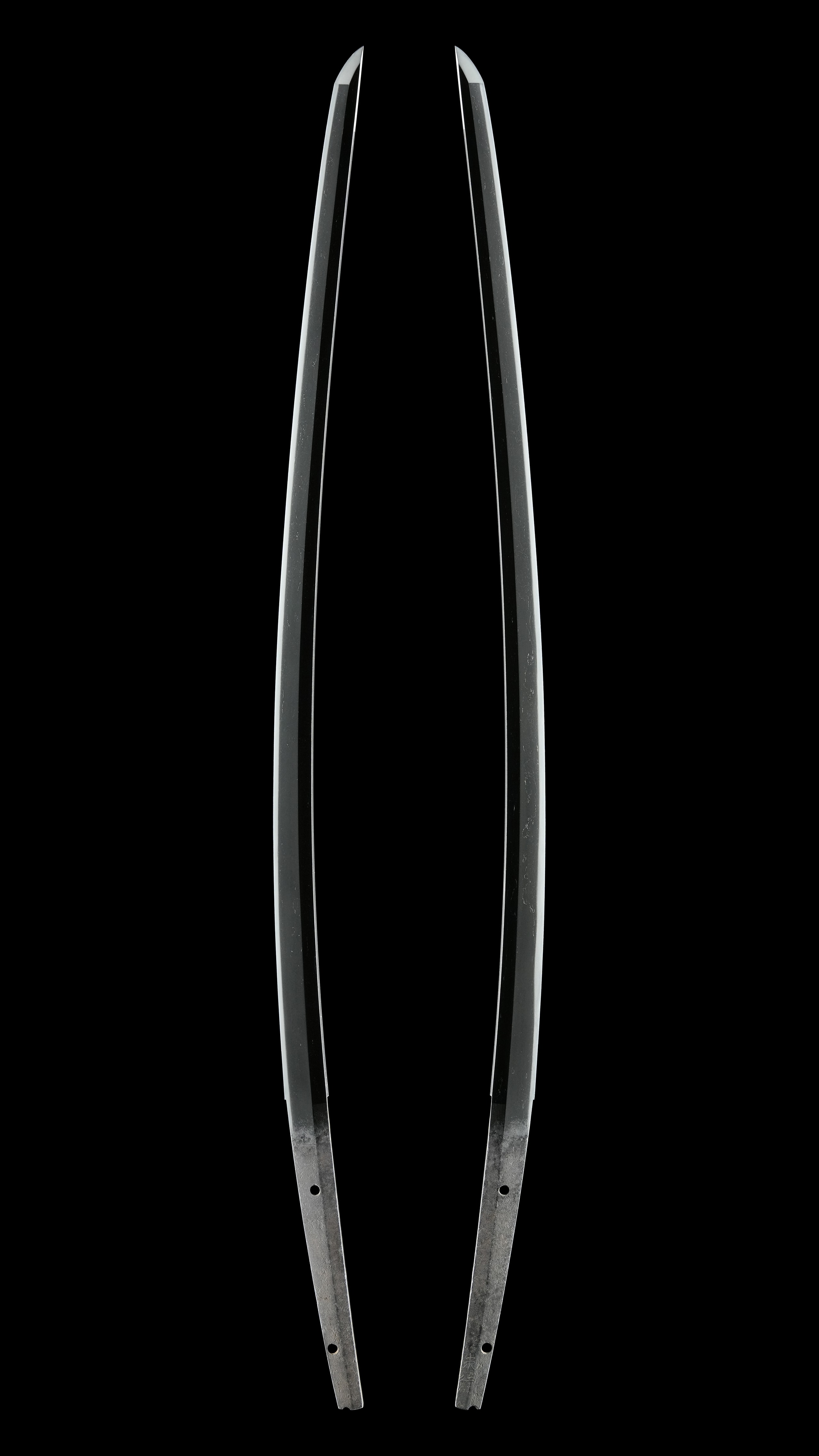
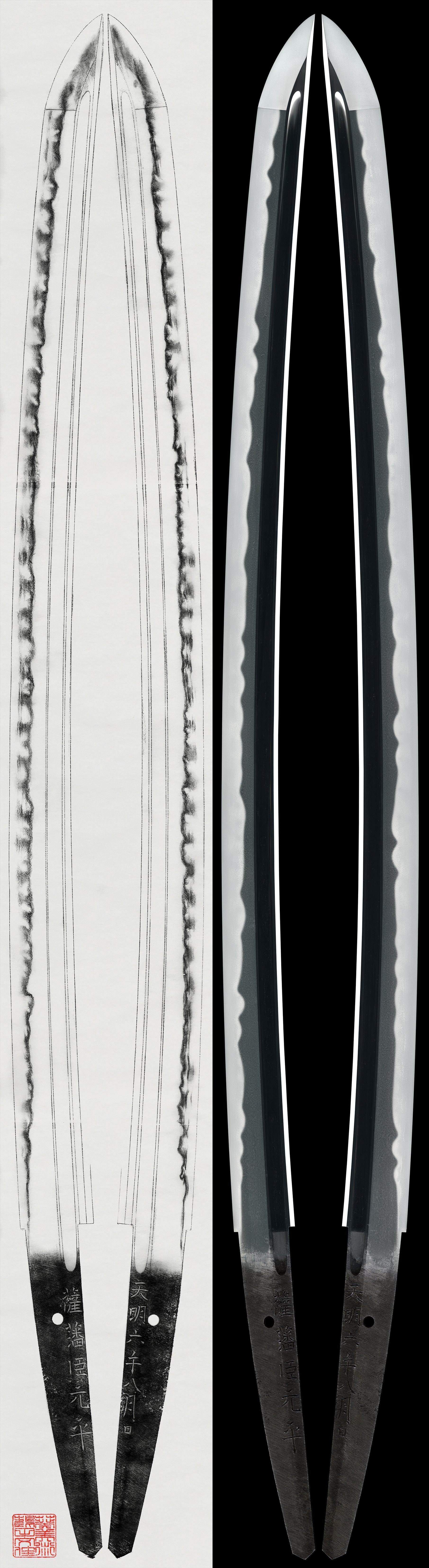
Aritoshi is a swordsmith of the school of Yamato, working in the late period. His real date is fixed not by the reference compendia, which place the name around the Bun'ei era, but by a surviving dated Einin 6 (1298); the published sources note repeatedly that no Bun'ei-dated work has ever been seen, while the Einin piece makes his period of activity clear. The name is recorded across two generations. The first signs in two characters, Aritoshi, and the second in three, Naga Aritoshi, understood as an abbreviation of Nagahyoe-no-jo Aritoshi and placed around the Kenmu years at the threshold of , with one account deriving the Naga from the Hasebe house. The published sources keep the division of the two generations open, calling it a matter that still requires study. He belongs to the Yamato world as and the other hands, a tradition of flowing steel and a .
His is a hand, but a particular one, and the particularity is its tell. Over and over the published commentary settles on the edge: a or , often with a shallow and a little set into it, into which run along the , , and , and, above all, a recurring , the doubled temper line, together with uchi-noke. On the Einin-dated first-generation work this doubling is almost continuous, and the judges single it out as unusual even within Yamato, one being described as 「大和物でも珍らしい程に二重刃の著るしい作」, a piece in which the is conspicuous to a degree rare even among Yamato works. Of his manner as a whole the published sources say plainly that the tightly forged , with not much in evidence, and the carrying its near-constant , make for a style 「当麻物としてはやや異風」, somewhat idiosyncratic for work. That idiosyncrasy is precisely how he is known.
The is the steady foundation beneath that edge. It is an that flows strongly and inclines toward , with thick , fine entering, and at times a standing in the ; where the forging tightens into the grain stills and the recedes, as on the dated piece, while on the broader blades the stands a little and the flow is more open. The construction is the Yamato one, a broad and rather high , the often deep at the hips, and a frequently carved through. Above this the runs straight with vigorous , turning in a small or finishing in a , at times tending toward , and the sometimes carries up into the point as well.
The record divides cleanly in two. On one side stand the few signed works, the documentary core, by which everything else is measured; the published sources prize them, calling the signed 「数少ない有俊在銘中の優品」, a fine example among the small number of signed Aritoshi works, and valuing even a fragment as precious reference material because signed blades are so rare. On the other side stands the body of his record, the attributed to him from era, school and these Yamato tells. The two-generation question runs through the signed and unsigned alike: the manner of the signature differs from blade to blade, and the workmanship divides between a quieter, more archaic register and a busier one, so the judges leave the count of hands open for further study rather than forcing a single line.
Within Yamato he is set apart by exactly what the judges name when they confirm an attribution. His prominent and uchi-noke, riding a flowing - , distinguish his from the plainer and Tegai hands, so that on an unsigned blade rich in those activities the commentary concludes 「有俊と鑑することが最も妥当」, that judging it Aritoshi is the most appropriate conclusion among Yamato makers. The restraint cuts the other way: where the is good but the edge quiet and without his doubled line, the attribution is offered only as plausible. The temper is calm and the impression subdued, and the published sources read that plainness as a virtue rather than a want, calling one a work that, 「いかにも大和物らしい地味な中に味わいの深い作風」, presents within an unmistakably Yamato plainness a deeply flavored and engaging style.
For the collector Aritoshi is a rare and quiet Yamato name rather than a celebrated one. He has no National Treasures and no Important Cultural Properties; the Toko Taikan places his value in the middle ranks. His designated record runs instead through the higher modern tiers, two blades at and the rest, some forty in all, at , and within that number signed pieces can be counted on one hand. His blades are held in institutions with their own established provenance, among them the Chido Museum and the Tokugawa Art Museum, with the remainder in private hands of largely unrecorded whereabouts. Because so few were ever signed and so little of the record can trade, a signed Aritoshi comes to light only seldom; a papered to him is the more usual encounter, and a privately held example of either is a notable thing for a collector to meet, a document of how the school worked at the close of the age.