NihontoWatch MonNihontoWatchBETA
MarketEncyclopedia
NihontoWatch Mon

NihontoWatchBETA

Market
Encyclopedia
Overview·Kantei·Designations·Blade Forms·Signatures·School
OverviewKanteiDesignationsBlade FormsSignaturesSchool
  1. Schools
  2. Taima
  3. Tomoyuki

Taima Tomoyuki

友行

Jūyō
Vol. 24, No. 68 · Katana

Taima Tomoyuki

友行

4 ranked works

ProvinceYamatoEraHoji (1247–1249)PeriodKamakuraSchoolTaimaTraditionYamato-denTypeSwordsmithCodeTOM387
4Jūyō Tōken

Overview

Tomoyuki of the Yamato school comes down through four designated blades, three of them wide cut greatly down and one an unshortened , and on not one of them does his own signature survive. The group was the band of swordsmiths affiliated with -dera in Yamato, flourishing from the middle of the period into the era, and its founder was Kuniyuki, of whom several reliably signed works survive, some inscribed simply . The published sources transmit Tomoyuki as a grandson of Kuniyuki and place him as a smith of the line, noting that other work of his is known, including an example carrying a Bunwa-era date. The scarcity of his signature is itself part of the record: the texts state that the small number of signed works owes to the smiths' dependent standing under the temple, so that the school survives mostly as unsigned pieces fixed by appraisal.

The most constant feature of his hand is the , which runs straight and is then swept with before turning in a small or ending in without a turnback. That swept finish recurs across the corpus, on each of the great and on the alike, and it is the Yamato- trait the appraisers lean on. Over a quiet line he builds his temper. A medium carries and breaks in its lower half into a small , into which enter pointed , and a shallow , the unravelling into with adhering. On the the line narrows to a with a tightened , and appearing. On the widest of the late the activity deepens, the running deep with frequent and entering, the drawing tight above the while showing a slight clouded on the .

The is the Yamato tell. He forges an that flows and, toward the edge, gathers into , so that the steel stands somewhat open, with laid over it throughout and entering the grain of the . It is this mixed into a flowing , taken together with the , and along the edge and the brushed , that the published sources read on the late as 「大和物中当麻の特色」, the character of within the Yamato tradition. On that blade the workmanship of both and is judged good, the published record noting plainly that 「地刃の出来がよく」, and the wide-bodied construction with its extended is what carries the attribution.

The surviving corpus divides by construction rather than by period, and the division is itself a fact about how he is known. The are wide-bodied blades shortened to , their attribution argued from the markedly elongated together with the , for the texts are candid that on a shortened blade 「個性は看取せられない」, no individuality singling out Tomoyuki can be discerned, even while there is no disagreement that the piece is 「南北朝期の同派の優作」, a superior work of the school from the . Against these stands the single , on the and on the , thick in with , which the published sources say 「大和物の特色をよく示し」, clearly displays the features of Yamato workmanship; on it a accompanies a , and 「薙刀樋に添樋」, the companion groove beside the , is named as a trait on construction.

The lineage question is left open, and the candour of the record on this point reflects how thin the documentary base for him is. He survives almost wholly as fixed by appraisal, the texts observing that 「在銘の少ないのはその隷属関係による」, the rarity of signatures following from the temple dependency, and that 「多くは無銘の極めもの」, most pieces are unsigned and transmitted by . No successor line is drawn through him, the surviving body being too thin to extend the school forward. His distinction is best taken not by contrast with the other Yamato lines but by his own grounded traits: the flowing -leaning , the -based temper brushed into a , and on the wide the deep with its and are the marks the appraisers read as and, where the body is wide and the extended, as Tomoyuki in particular, so that 「友行の所伝は首肯される」, the tradition attributing the blade to him may be accepted.

The whole of his recorded output stands at the level of Important Sword and no higher, four blades among that tier, with no National Treasure or Important Cultural Property among them and no recorded provenance through the houses to draw upon. The blades on record pass through private hands in Tokyo, Chiba and Wakayama rather than through any named institution, which is consistent with a smith known almost entirely through unsigned attributions. What a private collector might realistically encounter is therefore confined to that small designated body, the wide cut down from the school's grander blades and the rare with its construction and accompanying grooves. Such pieces are held far more often than traded, and one given to Tomoyuki, valued for fixing so seldom-signed a hand, comes to the open market only on occasion and stands as a sound example of Yamato work when it does.
Kantei

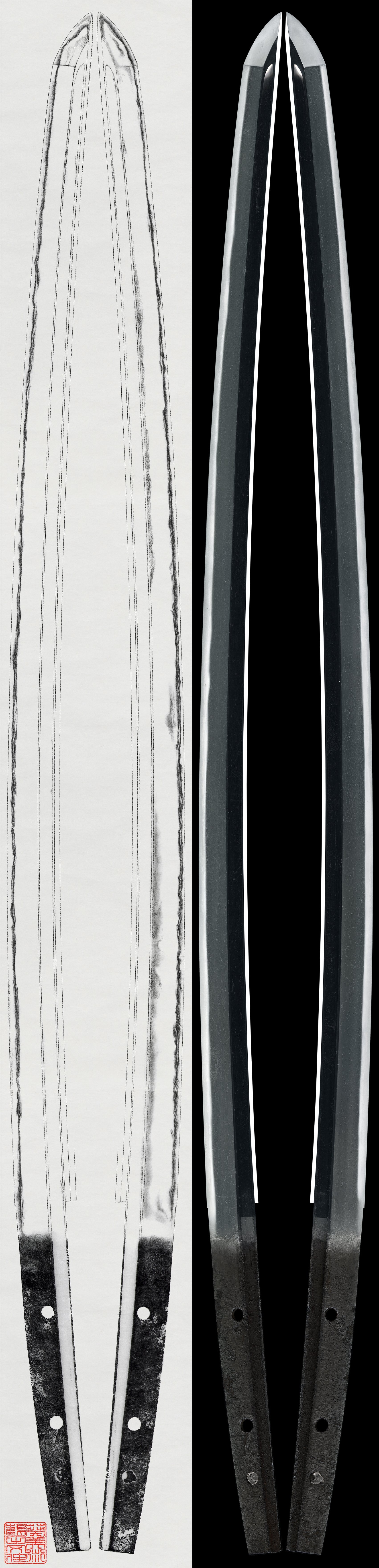
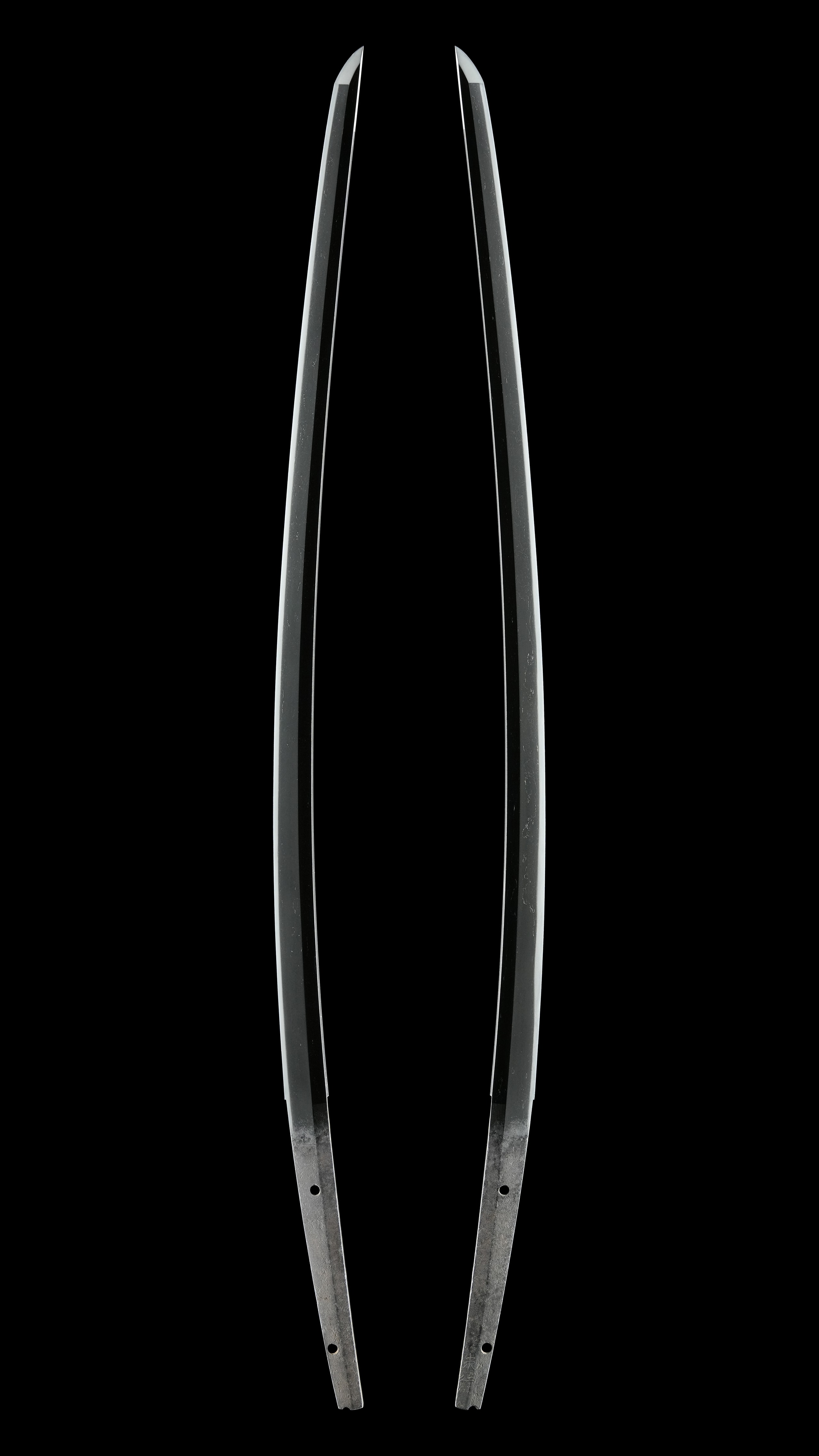
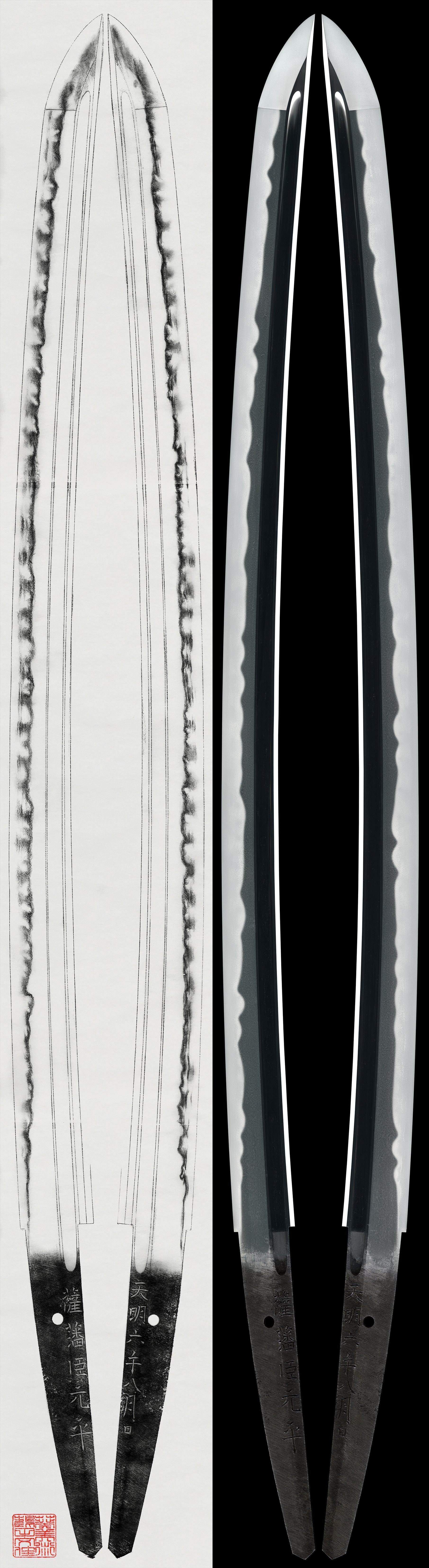
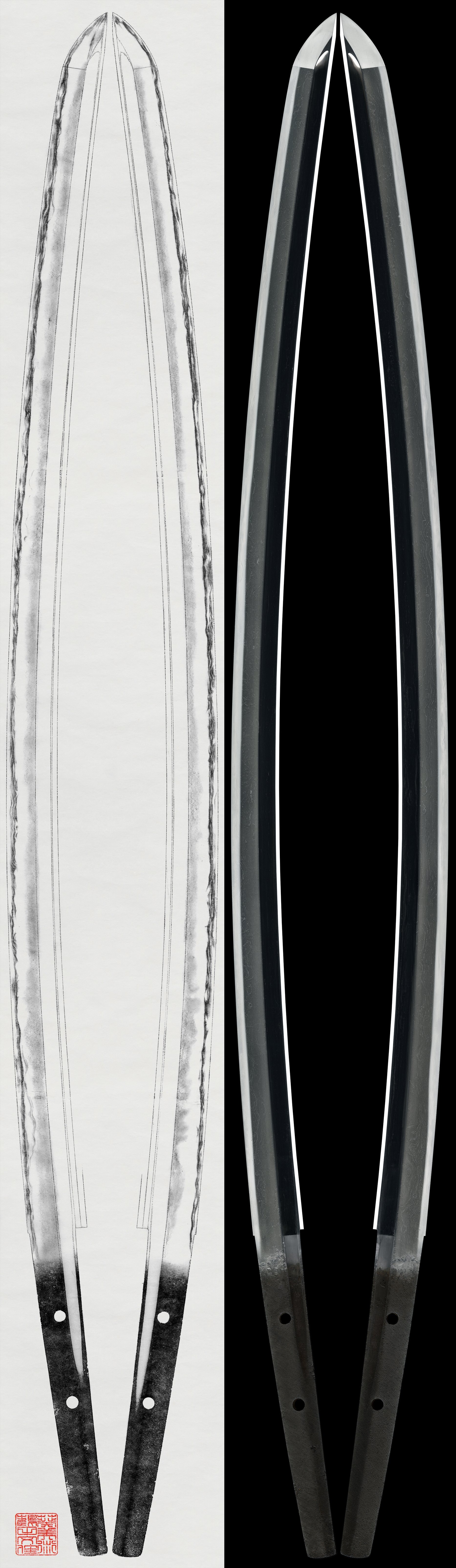
one Taima manner read through the corpus's form split: the Nanbokucho o-suriage mumei katana, wide in the body with an elongated chu-kissaki, on which the Tomoyuki attribution is argued from the construction and the strongest Taima jiba, the nie deepening on the late piece; and the single ubu mumei tanto, kanmuri-otoshi and thick in kasane, where the Yamato construction and a hoso-suguha with a tight nioiguchi show the school plainly

Tomoyuki is a smith of the Yamato school, the band of swordsmiths attached to -dera in Yamato whose founder was Kuniyuki; the published sources transmit Tomoyuki as Kuniyuki's grandson and note that other work of his survives, including an example carrying a Bunwa-era date. Signed pieces of the group are particularly scarce, a scarcity the records tie to the smiths' temple-dependent standing, so that Tomoyuki comes down almost wholly as fixed by , with the occasional . His hand is the school's: a -based temper, a -cho on the that breaks in its lower half into a small with and , running along the and adhering, set over an that flows and gathers toward , with throughout. The runs straight and is brushed into , ended in or turned in a small . On the the body is wide and the elongated, the construction from which, with the , the attribution to Tomoyuki is argued; on the wide-bodied late the deepens, runs frequently and enters.

Diagnostic discriminators

75% of his works

75% of his works

50% of his works

Observation by phase

The Taima manner, a suguha base over masame-leaning itame

The manner the records attribute to him and to the school. The are with , wide in the body and cut down to , the elongated; the is and , thick in , with . The forging is that flows into and, toward the edge, gathers to , standing somewhat open at times, with throughout and entering on the . The temper is fundamentally a -cho: on the it carries and, in the lower half, breaks into a small mixed with , and a shallow , with along the and adhering; on the late wide-bodied the deepens, runs frequently and enters, the tightening above the and showing a slight on the . The narrows to a with a tight , and appearing. The runs straight, is brushed into , and is ended in or turned back in a small .

Sugata 姿
Jigane 地鉄
Hamon 刃文
Bōshi 帽子
The ubu mumei tanto, kanmuri-otoshi— the single ubu tanto, kanmuri-otoshi on the omote and hira-zukuri on the ura, thick in kasane with uchizori, the published sources reading its Yamato character in both construction and jiba; the soe-hi accompanying a naginata-hi is a Taima trait on kanmuri-otoshi work, and the temper narrows to a hoso-suguha with a tight nioiguchi, hotsure and uchinoke appearing, the boshi ending in yakitsume
The Nanbokucho o-suriage mumei katana— wide-bodied Nanbokucho katana cut down to o-suriage, three of the four blades, their Tomoyuki attribution argued from the elongated chu-kissaki and the Taima jiba; on the latest the nie is deep, sunagashi runs frequently, kinsuji enters, and the nioiguchi tightens above the monouchi
Scholarship

On the earliest of the o-suriage mumei katana the published sources are candid that no individuality singling out Tomoyuki can be discerned, yet there is no disagreement that it is a superior work of the Taima group of the Nanbokucho.

On the later katana the wide mihaba and the elongated kissaki are what make the Tomoyuki attribution acceptable, the characteristic features of the Taima school clearly manifest, so that the tradition attributing the blade to him may be accepted.

Designations

Kokuhō—
Jūyō Bunkazai—
Jūyō Bijutsuhin—
Gyobutsu—
Tokubetsu Jūyō—
Jūyō Tōken4

Elite Standing

0.02 across 4 designated works

Top 28% among smiths

Blade Forms

Distribution across 4 ranked works

Signatures

Signature types across 4 ranked works

Currently Available

Taima School

Other artisans of the Taima school

  1. 1.Aritoshi有俊41designated
  2. 2.Nobunaga信長1 for sale6designated
  3. 3.Toshinaga俊長5designated
  4. 4.Tomokiyo友清5designated
  5. 5.Tomoyuki友行5designated
  6. 6.Kuniyuki國行2 for sale3designated
  7. 7.Kunikiyo國清1designated
  8. 8.Mitsusuke光夫1designated
  9. 9.Tomonaga友長1designated
  10. 10.Kuniyuki國行2designated
  11. 11.Tomoyuki友行1designated