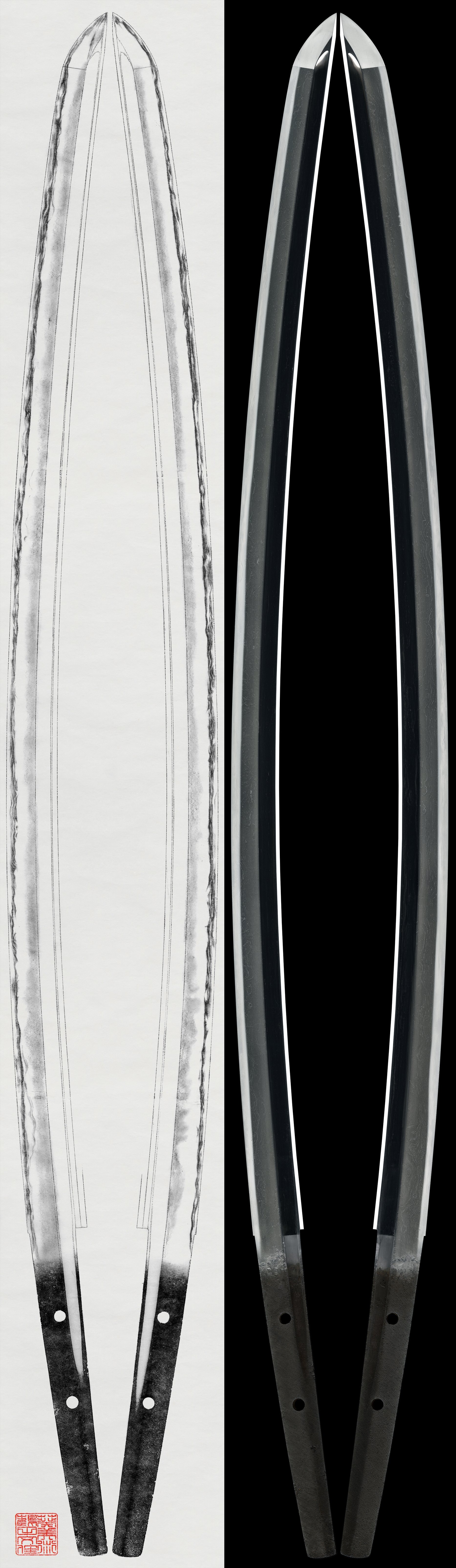
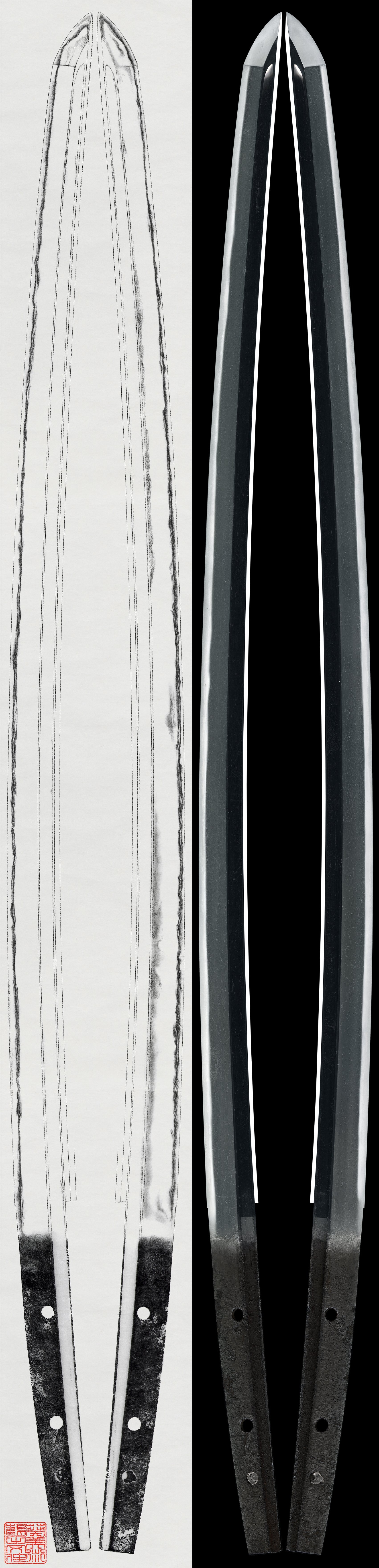
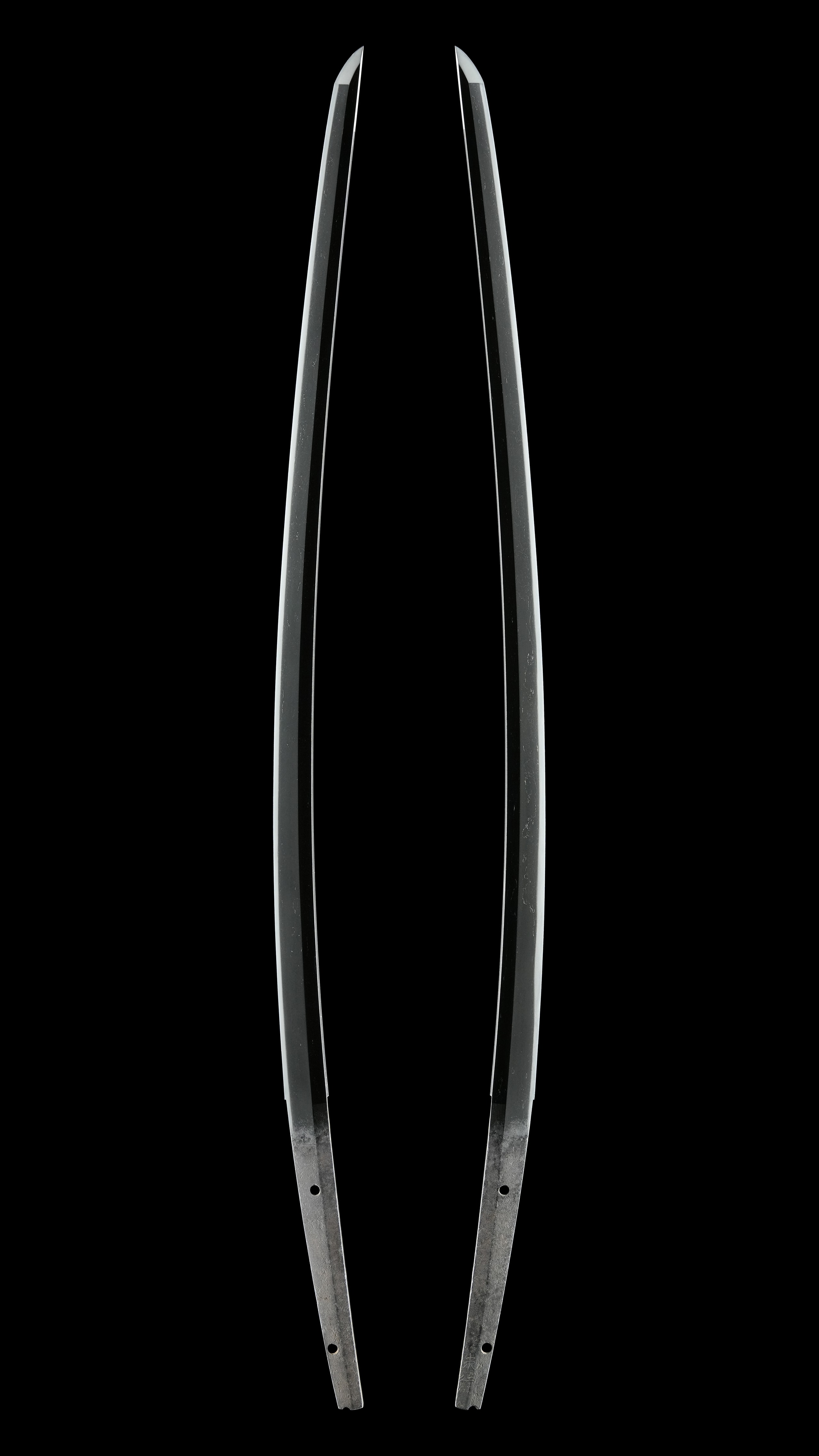
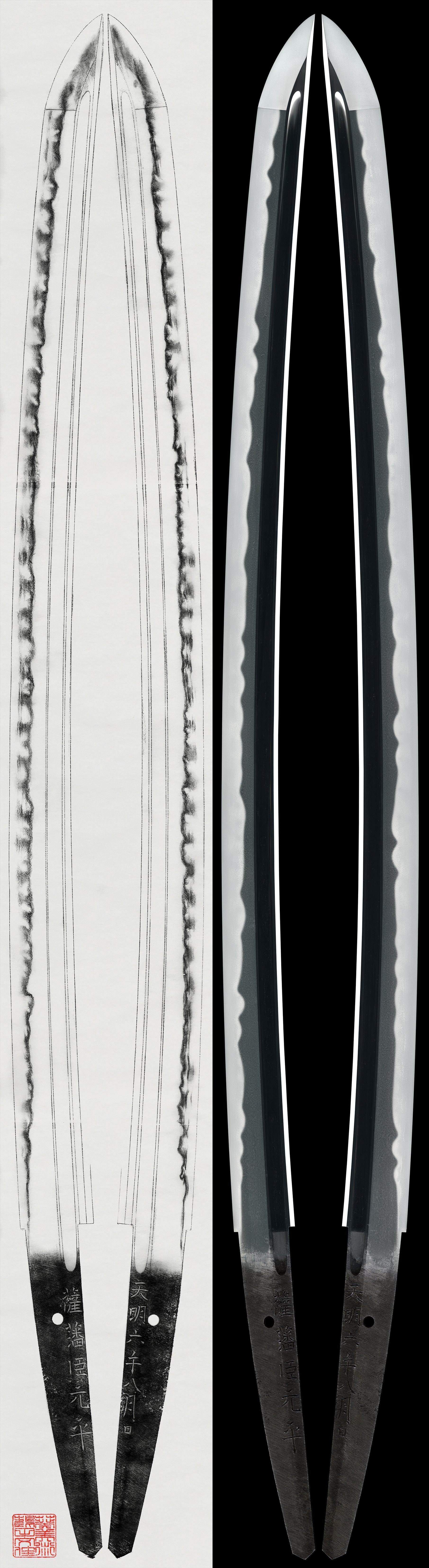
Among the five extant blades carrying the attribution to Tomokiyo, only one is signed: a shortened that keeps the Yamato no Tomo, cut off below the third character, and is recorded in the Kōzan . The published sources call it one of the few signed works of the school and a precious resource for its study, and it is on this single that every one of the attributions to Tomokiyo is argued. Tomokiyo was a swordsmith of the Yamato school active in the period, the school being the contingent of smiths attached to -dera in Yamato whose founder was Kuniyuki and which flourished from the late period through the era. The signature reference works record several smiths of the name across three generations, the first a son of Kuniyuki active around the Gennō era of the late , with -named smiths following in the Ryakuō era and the early Ōei, while the surviving blades fixed by appraisal are read as the Tomokiyo. What the record makes plain about the school is the scarcity of signatures: the smiths, being attached to the temple, naturally left few signed works, so that the line comes down largely as unsigned pieces fixed by .
His is the manner, and the most constant feature across his surviving work is the , which runs straight and is then swept with . On four of the five blades the point is brushed in this way, finishing at times in a , at times in without a turnback, and at times going to a point or rising flame-like, the Yamato- way of stopping the temper that holds across the signed and the alike. Over a quiet line he builds his : a base waved only shallowly into notare, into which small enter, with at times as well, the disorder always slight and worked over the straight line rather than displacing it. The frays into , breaks into , doubles into and lifts into , while and enter the tempered area and the runs deep. Through the the lies thick, with and flashing repeatedly and the bright and clear. It is a restrained temper carried with abundant activity, the quality the appraisers read when they call the pieces a clear showing of Yamato work and above all of the school.
The is the Yamato tell. He forges an that flows overall and, near the edge and in places, gathers into , so that the steel stands somewhat open, with laid thick and dust-fine over it and entering the grain frequently, the steel clear. On the signed the forging tightens, and over it rises a , the reflection that on this smith is a product of rather than of the ; the published sources describe the anchor blade as one that forges an tightly knit with a rising and tempers a into which small are mixed. On the the -leaning forging is most pronounced, the laid in fine dust and the frequent, and it is there that the character is judged most strongly manifest in both and . The temper across the corpus stays a , on the signed mixed with --style , on the later departing at times into a shallow with small , but it never abandons the calm base from which the Yamato activity is read.
The corpus divides by construction rather than by period, and the division is itself a fact about how he comes down to us. The signed is the small fixed point, an early piece in with shallow and an extended , keeping only the partial . Against it stand the , wide-bodied blades cut down to , their attribution argued from the markedly elongated and from the activity at its strongest. Two of these show the Enbun-Jōji construction, broad in the body with little taper from base to point and a great , and the published sources find in that shape a commonality with the signed Tomokiyo that makes the attribution sound. On one of the later the activity departs the quiet base far enough that the judges single it out, writing that compared with the usual appraisals to this smith a variation is seen in the , and that it is a blade of genuine interest. The method by which these blades reach his name is stated without disguise: they show a construction and a closely resembling the signed , so that the present work, in reliance upon that , is to be judged Tomokiyo.
His distinction is best drawn from his own grounded traits rather than by contrast with the other Yamato schools. The flowing -leaning , the thick dust-fine and frequent , the with small brushed into a , and the conspicuous and within a bright, -laden edge are the marks the appraisers read as , and on the elongated wide-bodied as Tomokiyo in particular. He stands among the other names the signature works list yet whose signed blades scarcely survive, known almost wholly through unsigned attributions and the single partial signature, and no successor line is drawn for him, the surviving body too thin to carry the school forward through his hand.
The whole of Tomokiyo's recorded output stands at the highest civilian level of designation, five blades among the Important Sword tier and none higher, with no National Treasure or Important Cultural Property among them, and the Fujishiro appraisal places his workmanship at the jō-jō level. There is no recorded provenance through the houses to draw upon, and no institutional holder is named in the published record, which is consistent with a smith known almost entirely through unsigned attributions and a handful of signed survivals. What a collector might realistically encounter is therefore confined to that small designated body, the wide cut down from the school's grander blades, the single , and above all the signed prized first as documentary evidence of so rare a hand. Such pieces are held far more often than traded; the may from time to time be met with by a patient collector, while the signed that anchors the whole remains among the rarest things a student of the school could hope to handle.