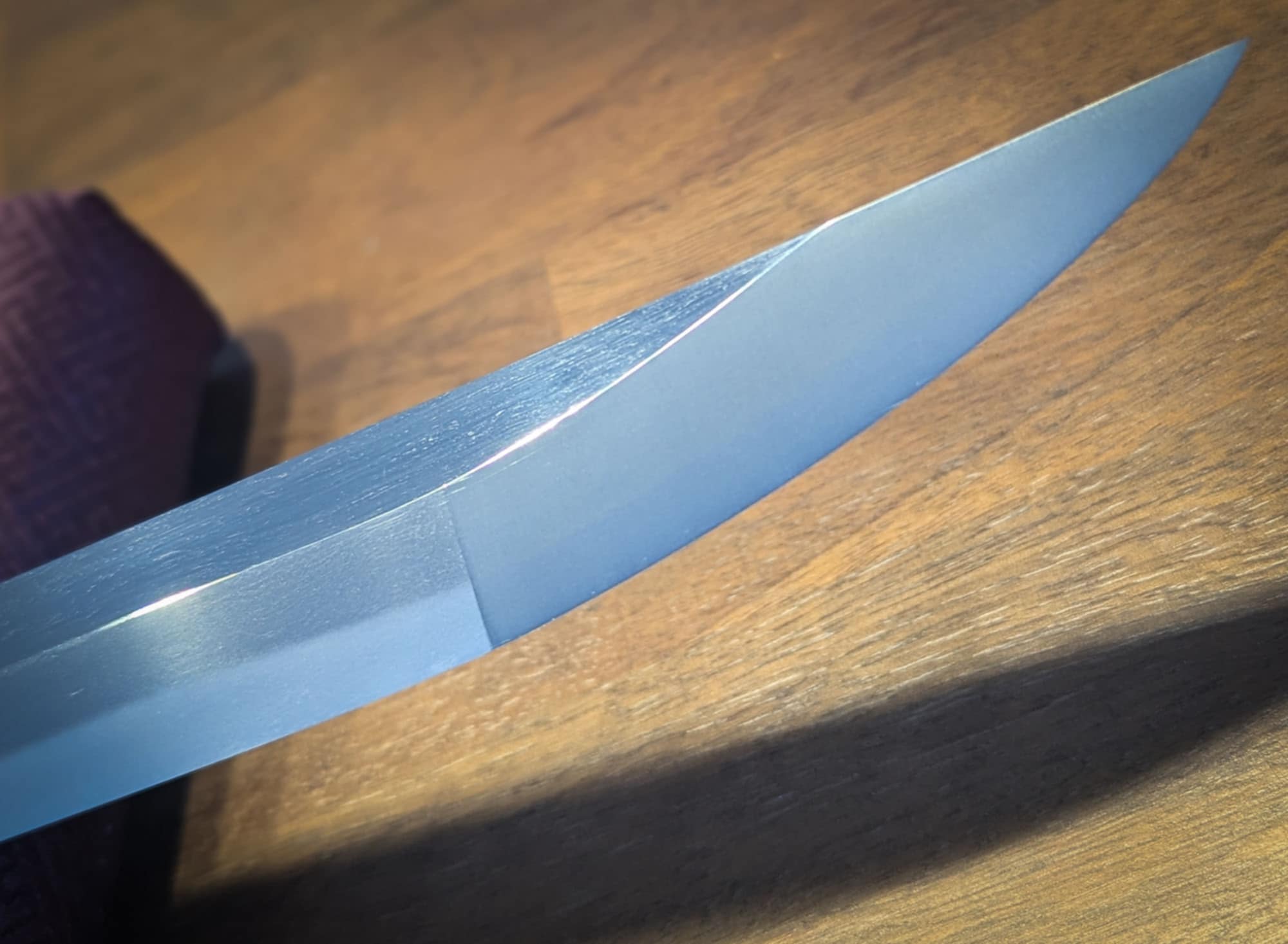
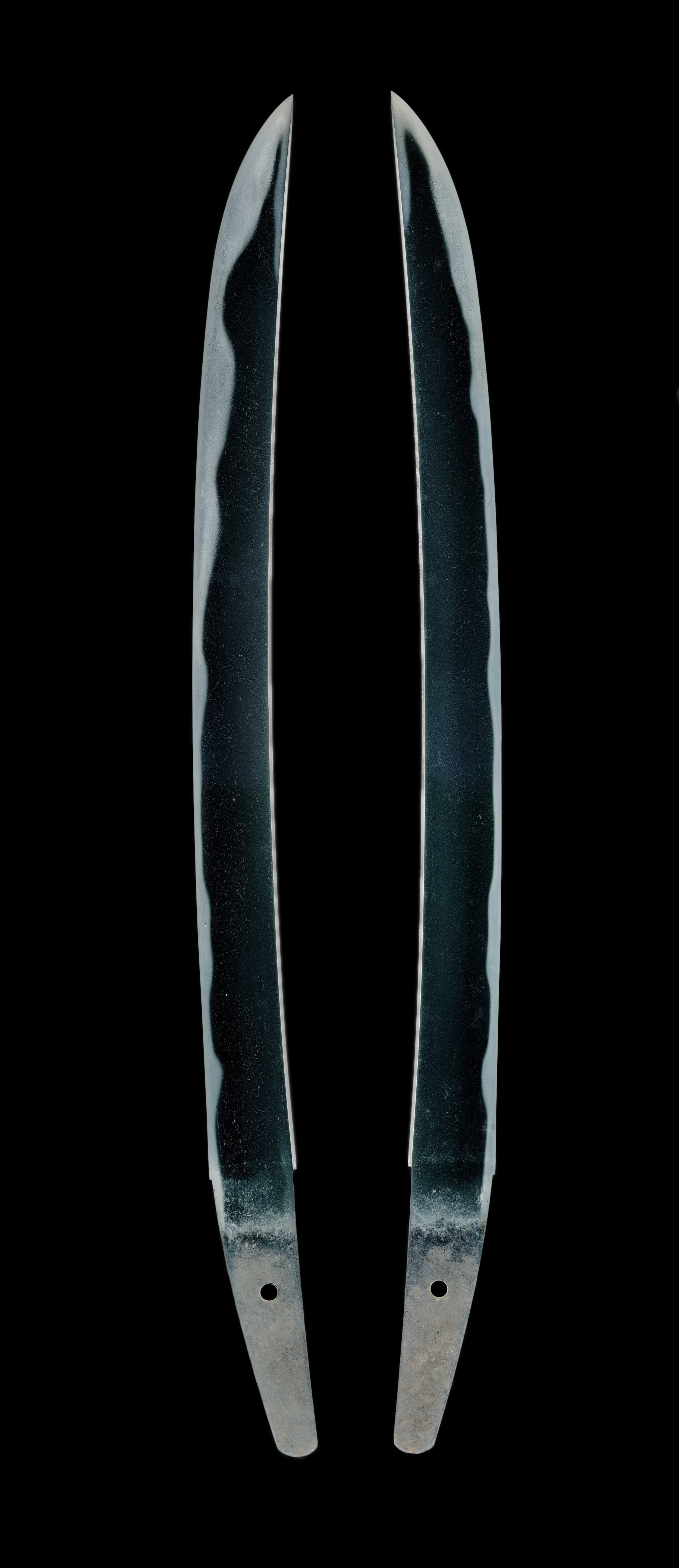
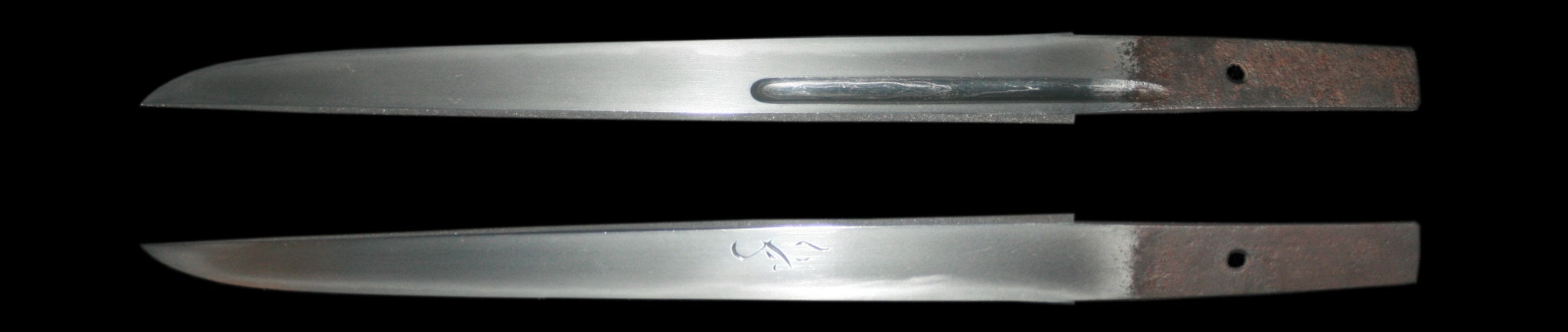
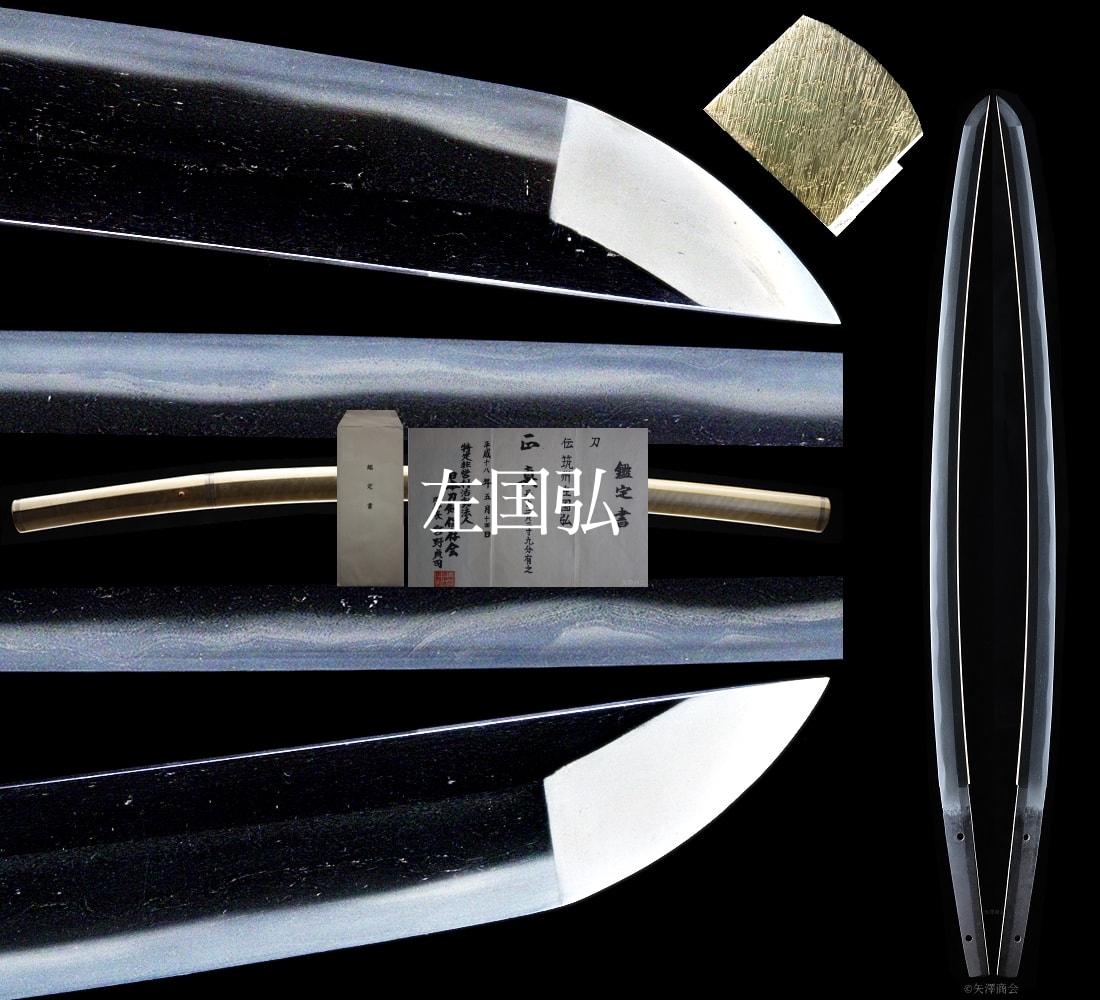
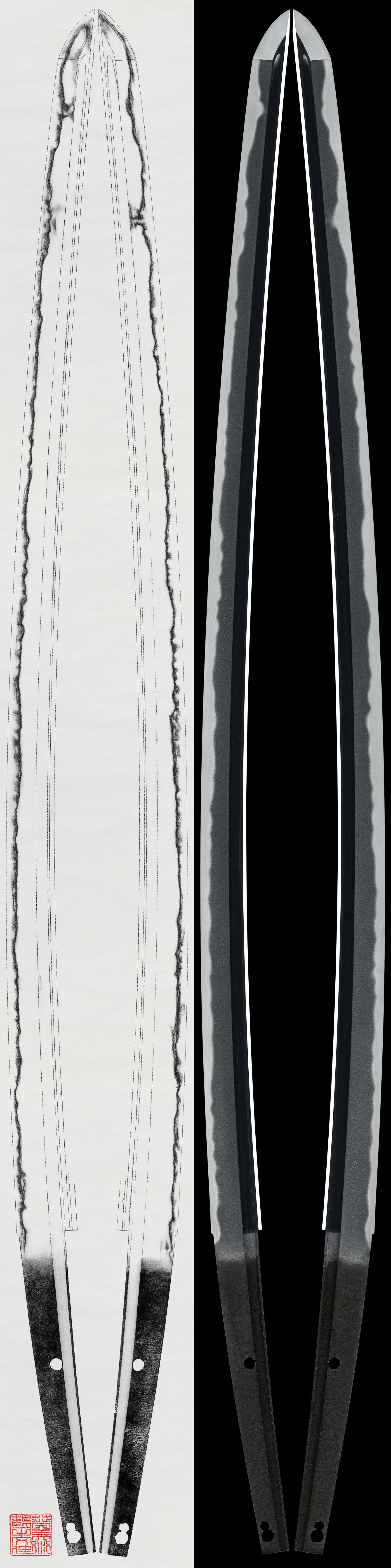
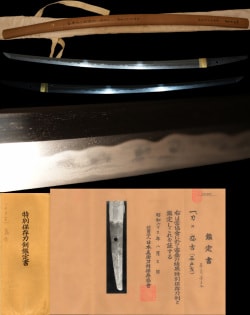
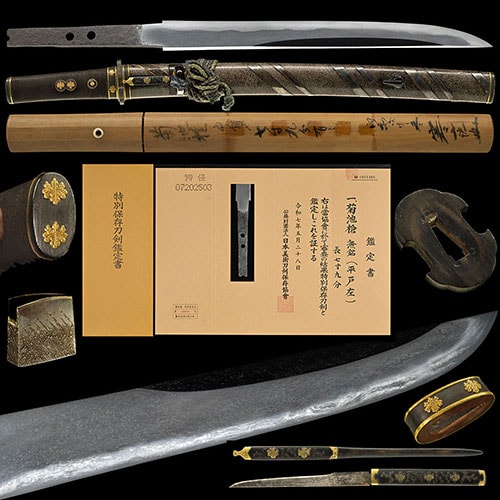
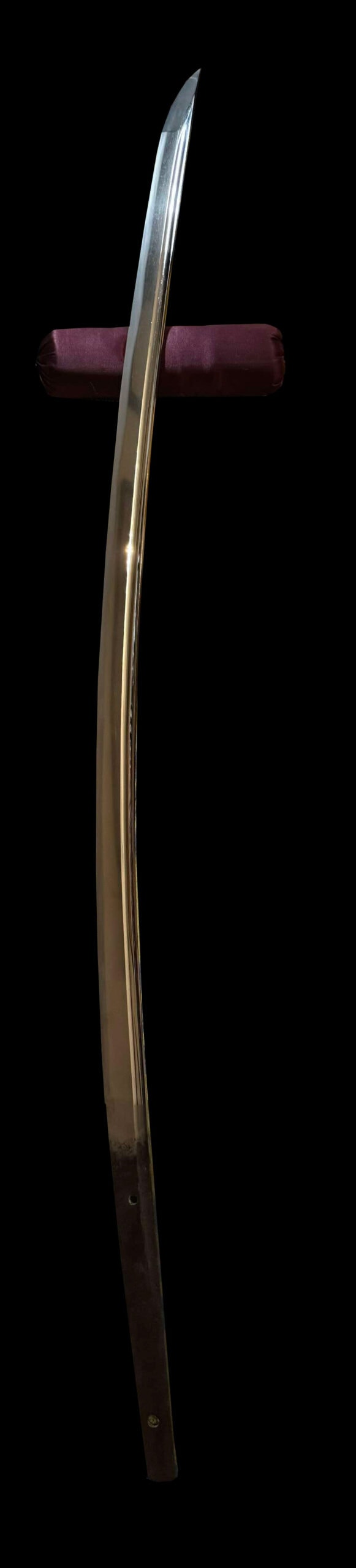
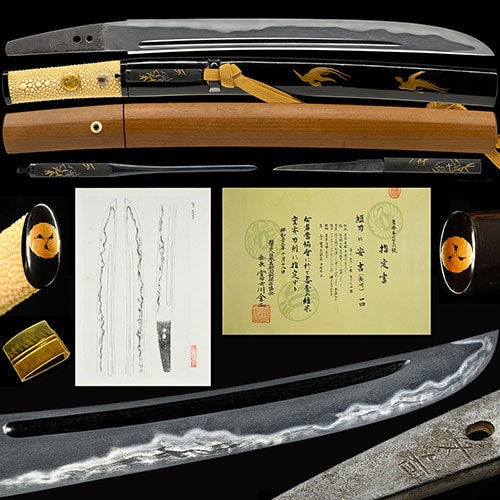
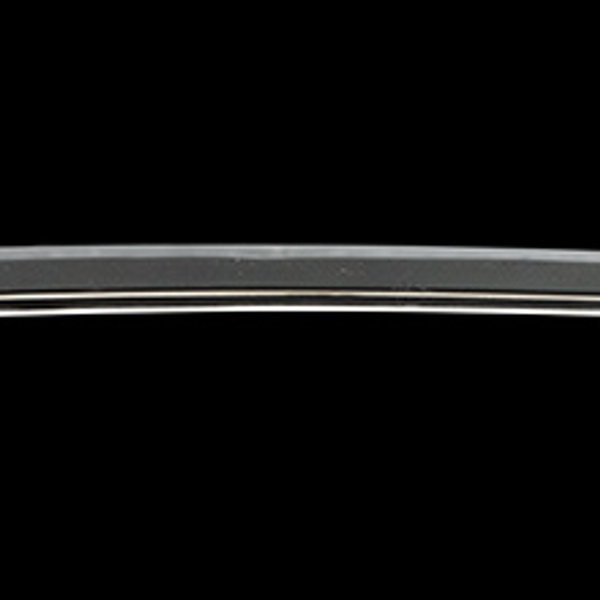
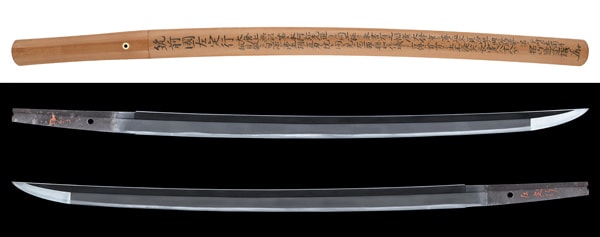
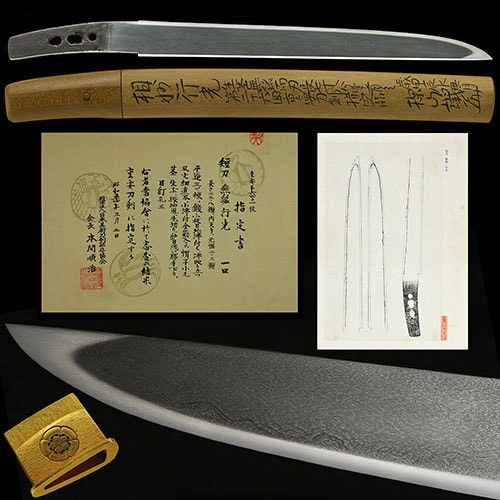
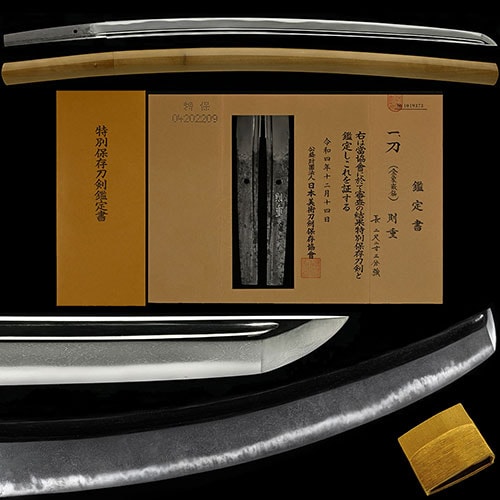
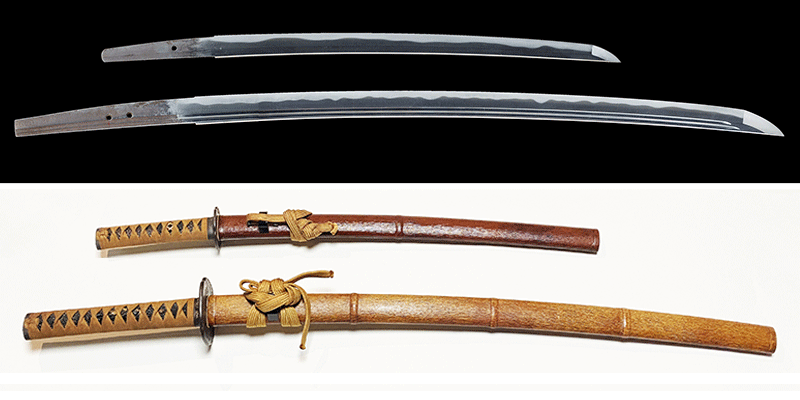
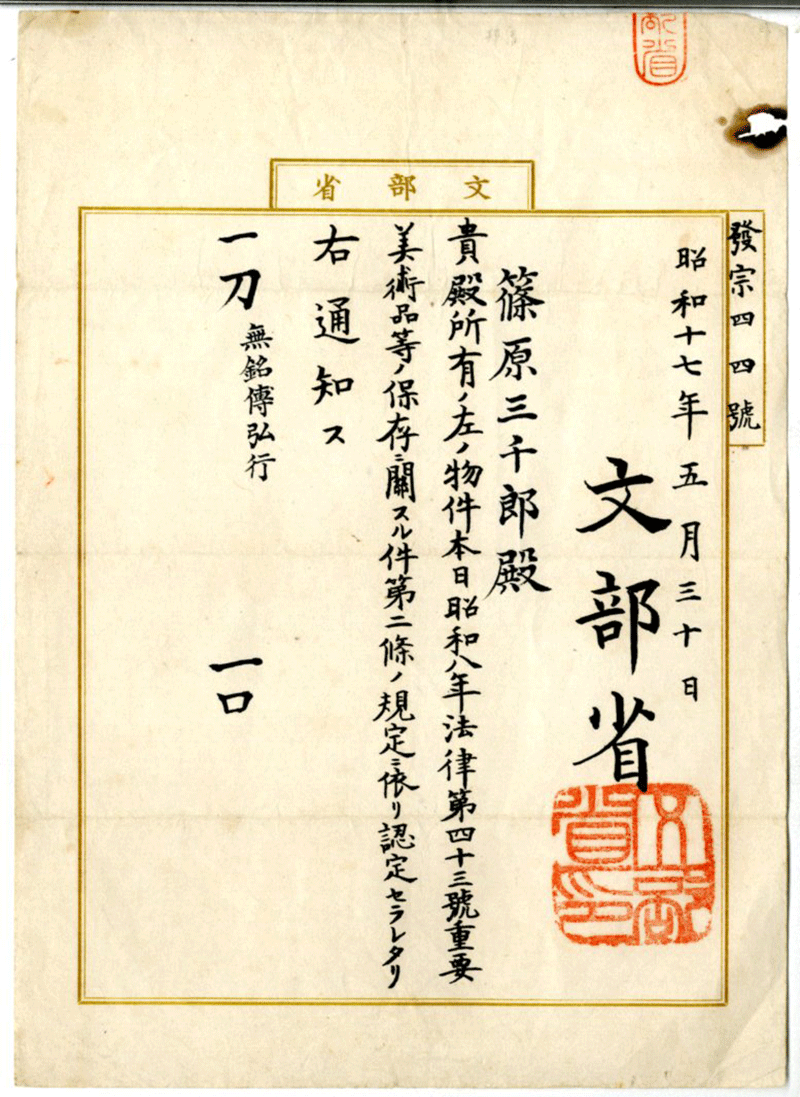
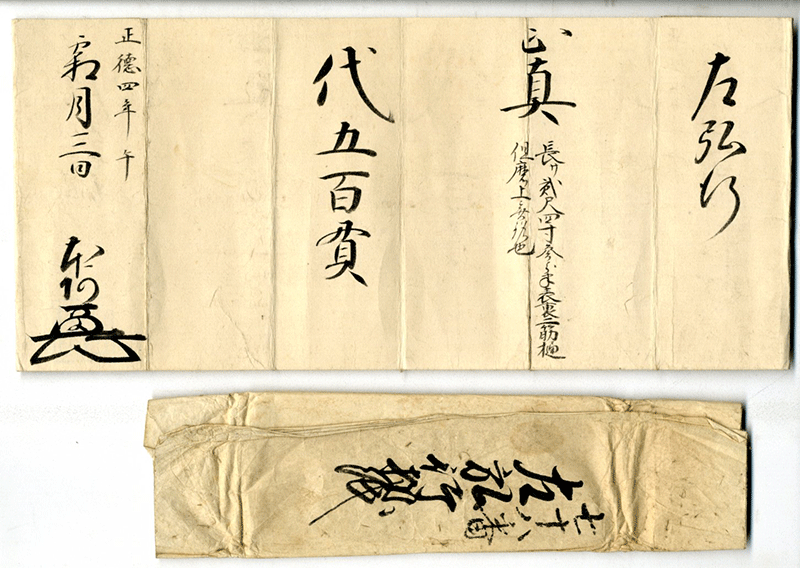
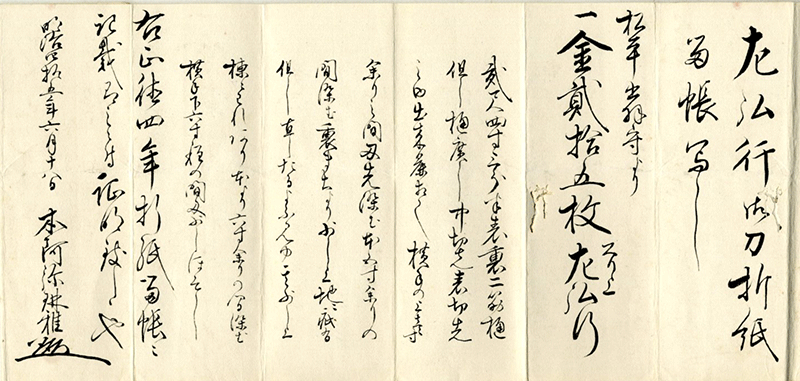
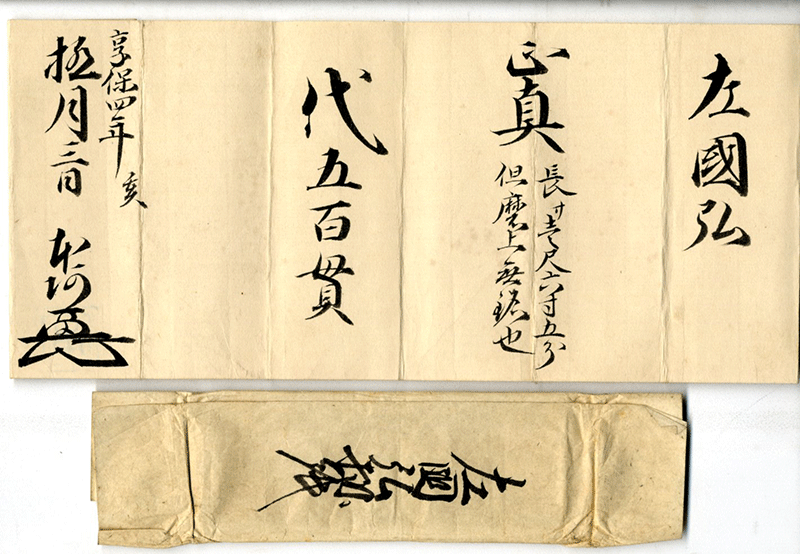
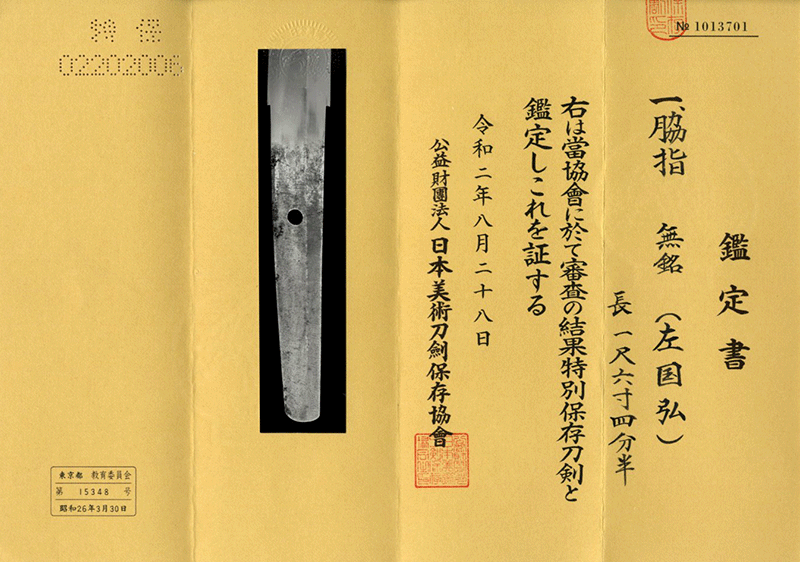
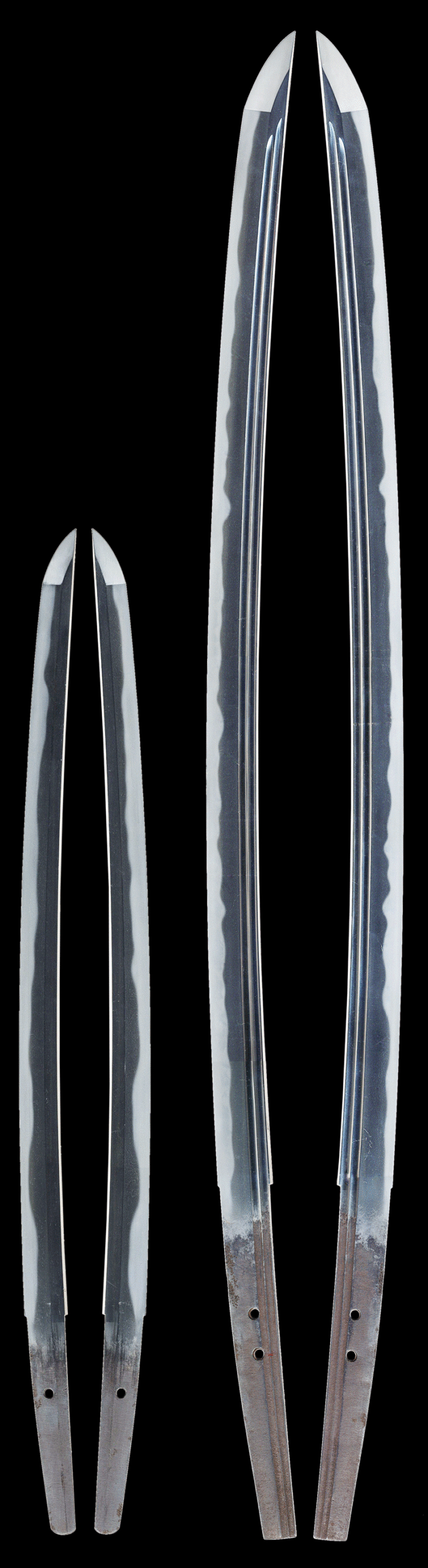
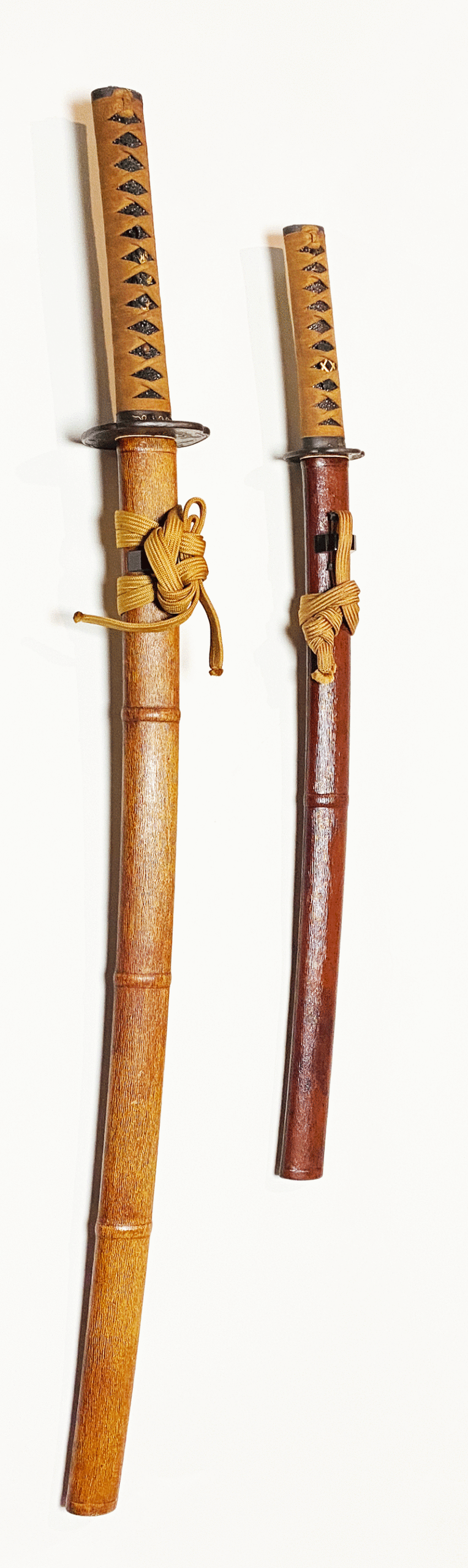
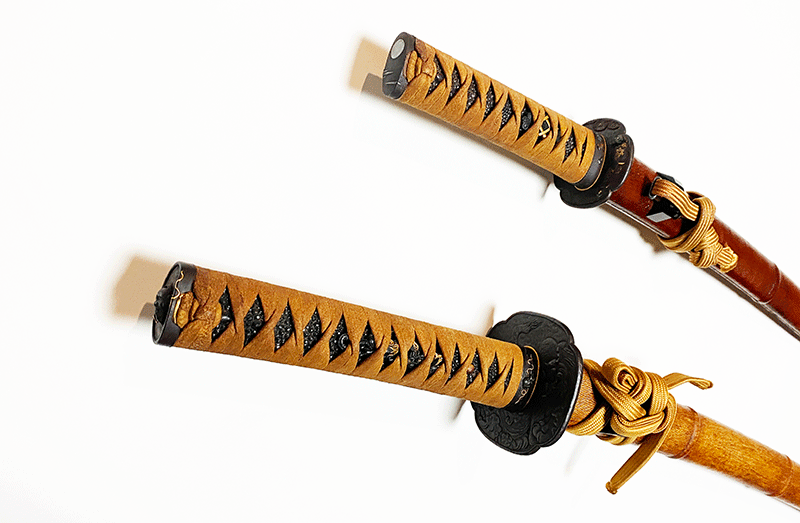
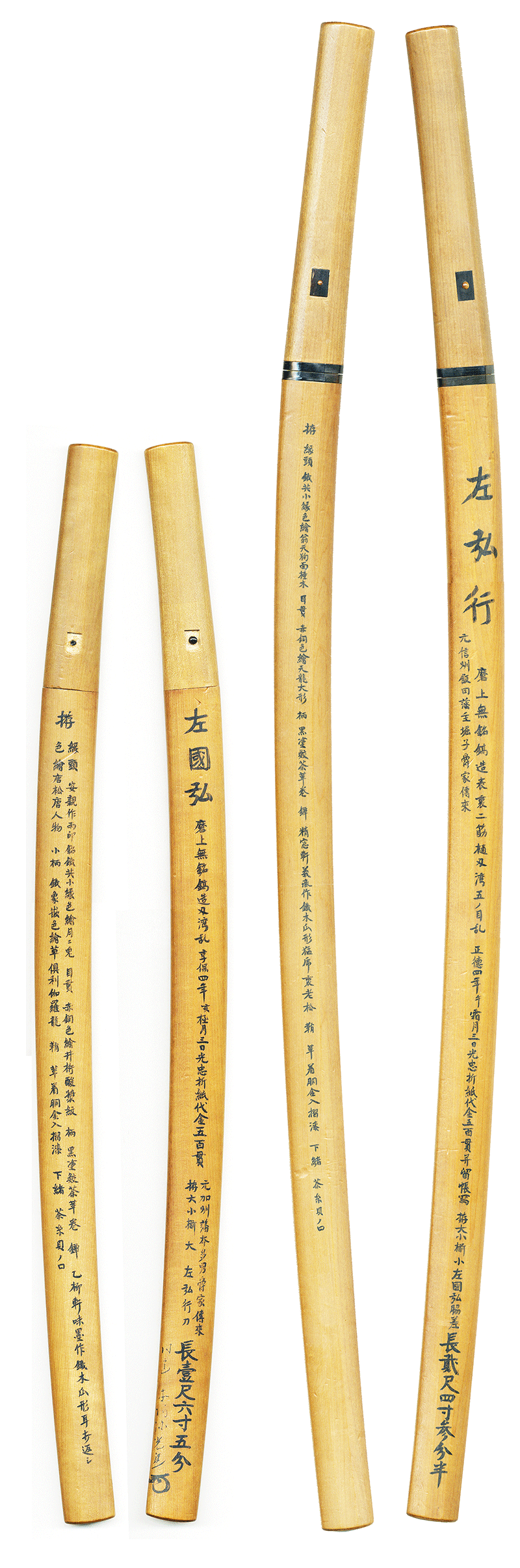
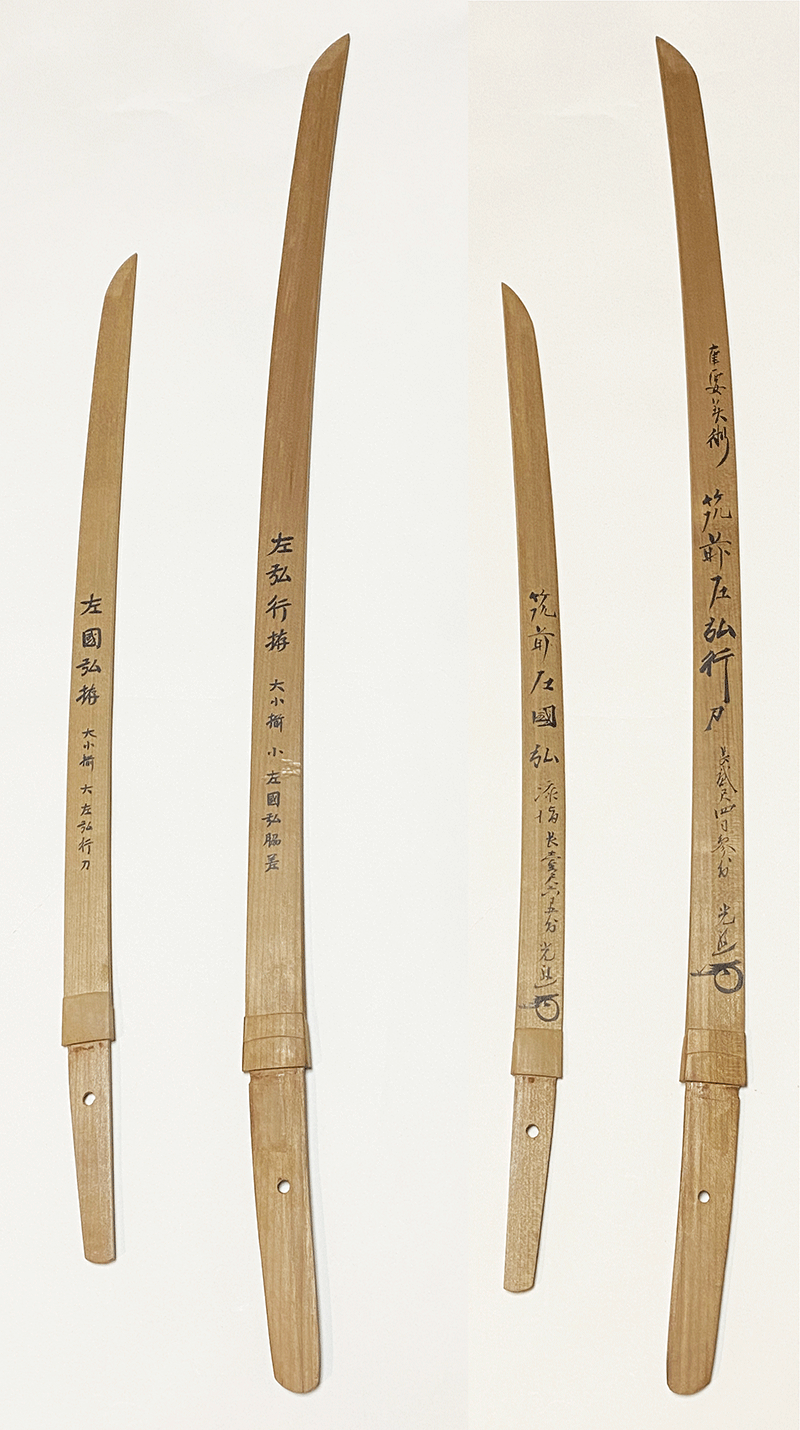
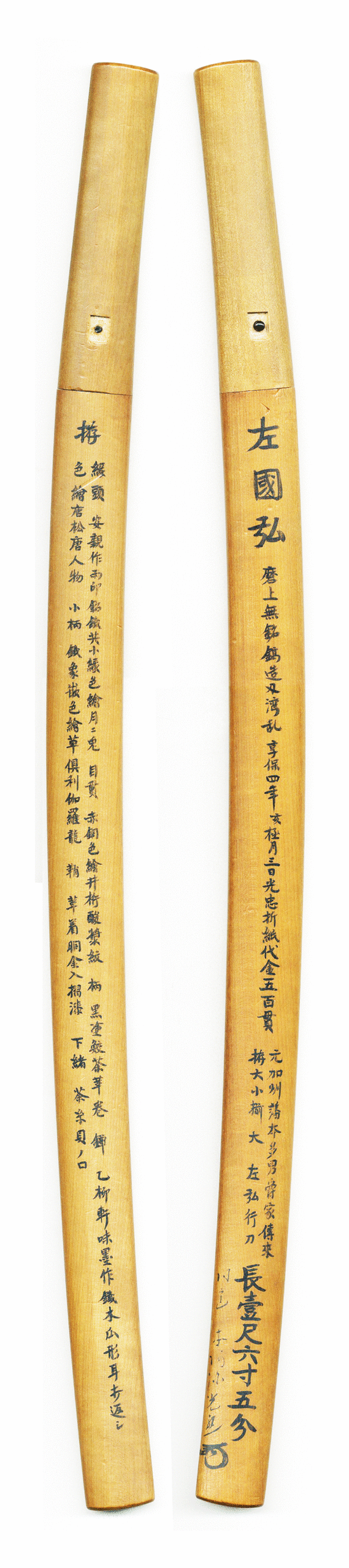
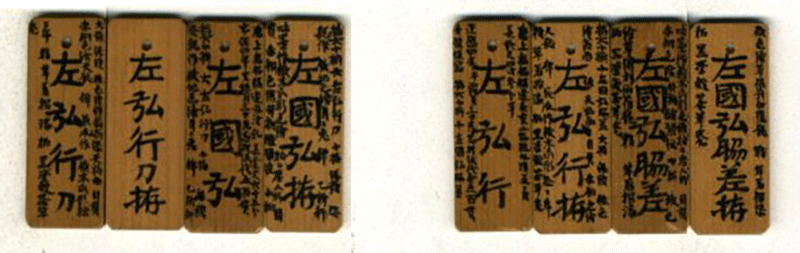
This is a daisho (matching pair of swords) from the Nanbokucho period, comprising a katana by Sa Hiroyuki and a wakizashi by Sa Kunihiro, both from the Chikuzen Samon school. It is designated as an Important Art Object by the Ministry of Education and comes with koshirae. The pair has a distinguished provenance, having been owned by Count Miyoji Ito, the Maeda family of Kaga, and the Hori family of Shinshu.
 NihontoWatch
Samon · Nanbokucho · nagasa 73.6cm · sori 0.6cm

Chikuzen Samonji (Sa school) · Chikuzen · around 1346-1370
Fujishiro Jo saku · Tōken Taikan top 21%
Hiroyuki is a smith of the Chikuzen Sa school, the Samonji lineage, working in the mid-Nanbokucho period around the Shohei era, and transmitted as a son of Yukihiro. He belongs to the group of followers the published sources call Sue-Sa, the smiths carried on from O-Sa after the school's founder. The Sa school emerged in the early Nanbokucho and broke decisively with the older Kyushu manner, in which the ji and ha are subdued and rustic in a restrained suguha; drawing on the Soshu tradition it established a style in which both ji and ha are bright and clear, with chikei and kinsuji intermingled. Hiroyuki worked within that style, and his place is fixed by the few dated and signed records the swordbooks preserve: a work said to bear a Shohei 20 date of 1365, against his father Yukihiro's piece of the Koan years. Signed work by his hand is extremely rare, so almost his whole surviving record is the o-suriage mumei katana, attributed to him from long Nanbokucho tachi later shortened.
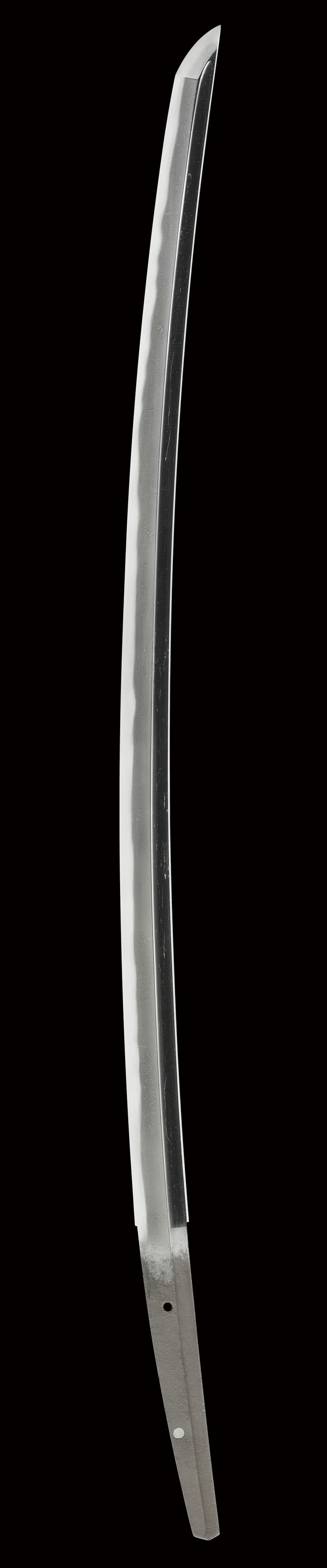
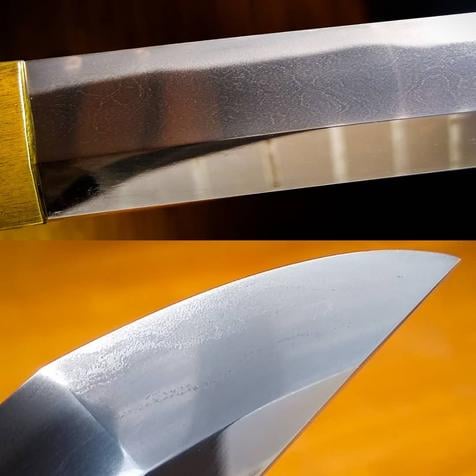
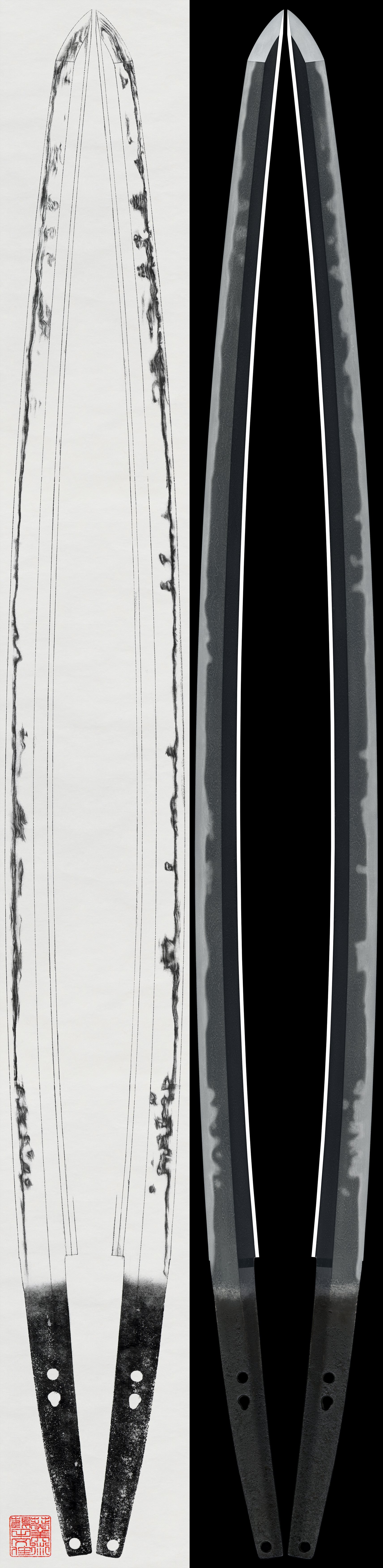
His recognized hand is read most clearly in the temper. Over a wide, shallow-curved blade he forges a line based on suguha that carries a shallow notare, into which gunome, angular gunome, ko-notare, pointed ha and ko-gunome enter, often in a continuous, linked succession kept comparatively small in scale. The nie lies thick and uneven, with coarse nie gathering in clusters, uchi-noke and yubashiri touching the edge, and kinsuji and sunagashi running vigorously through it, the nioiguchi often taking a subdued, shizumi cast. What the published sources name as his tell is precisely this manner: among the Sa group, whose hands are so closely matched that the individual smith is hard to single out, it is the blade whose gunome stands out and runs continuously, and whose temper is comparatively restrained, the rises and falls not standing out strongly, that is read as Hiroyuki. Several of his entries close on the same judgment, that the work is the one 「弘行に最も擬せられるものであり」, most readily likened to Hiroyuki[[c:1]].
The jigane is the constant beneath both faces of his work. He forges a standing itame mixed with mokume and flowing grain, with patches of large itame in places, thickly covered in ji-nie, chikei entering well, the steel taking a somewhat blackish, whitish-misty cast. This is the Soshu-derived Sa jigane, an open, nie-laden steel rather than the bright, tightly packed Bizen jigane with its clear utsuri; where a reflection appears at all it is only a faint nie-utsuri or a whitish tendency. Beside the gunome-prominent line the published sources read a quieter register of the same hand, a chu-suguha with only a shallow notare, ko-gunome and angular elements entering sparingly, the pattern small, fine hotsure along the habuchi, and the nioiguchi subdued. The boshi in his bolder work runs midare-komi, thrusts up and ends pointed with vigorous hakikake; in the calmer register it runs straight to a ko-maru.
The two registers answer to how the blade was authenticated. The bold, gunome-prominent katana carry the school's spirited character, one Tokubetsu Juyo described as a 「放胆で覇気に溢れた出来口」, a bold and spirited workmanship[[c:2]]. The quieter chu-suguha pieces, several bearing gold-powder attributions added by the Hon'ami house, show the wide suguha with hotsure and the subdued nioiguchi the appraisers long read as Hiroyuki. The published sources are candid about the limits of this judgment. They class him among the Sue-Sa, of whom they say that 「作風を区別することは困難である」, that distinguishing the styles of the individual smiths is difficult[[c:3]], and they note that the gold-powder attributions seen on his blades are a Meiji-and-later practice begun by the Hon'ami family. Of one such piece they grant openly that there is a question 「左弘行とまで断定し得るか否か」, whether it can be fixed conclusively as Sa Hiroyuki[[c:4]], while affirming that 「南北朝期の左の一派の作であることには異論がない」, that there is no dissent it is the work of the Nanbokucho Sa school[[c:5]].
What sets Hiroyuki apart is therefore a matter of degree within a closely matched school rather than a private signature. His own evidenced tells, the continuous gunome in a small-patterned, suguha-leaning temper, the standing itame with its blackish nie-laden steel, and the thrusting, pointed boshi, place him beside Yasuyoshi, Yukihiro, Yoshisada, Kunihiro, Hiroyasu and Sadayoshi, the Sue-Sa hands carried on from O-Sa. The published sources hold his skill within that company and affirm his mumei attributions from era and school, naming his comparatively calm, suguha-leaning manner as the side of the Sa tradition that bears his name. He stands one generation below the founder, working the grand Nanbokucho form in the school's bright, nie-rich idiom rather than reaching for the flamboyance of its first masters.
For the collector Hiroyuki is a documented Sa name carried at the higher modern designation tiers. Fujishiro grades him Jo saku. His record runs through two Tokubetsu Juyo katana, one of them carrying a Hon'ami Ringa gold-powder mei, two prewar Juyo Bijutsuhin, and some twenty-nine blades at the Juyo rank, thirty-one in the Tokubetsu Juyo and Juyo tiers together. His blades are rooted in daimyo provenance, the Ii family of Hikone, whose maru-ni-tachibana mounting accompanies one Tokubetsu Juyo, and the Nabeshima family, with further pieces passing through the Tsuchiya house of Tsuchiura and the Tokugawa, and one preserved in a municipal museum collection. Because almost his entire record is mumei and held in long-standing collections, a Hiroyuki seldom comes to market; when one does appear it is from the Juyo and Tokubetsu Juyo tiers, and the patient collector may encounter such a blade from time to time, a sound and forceful document of how the Sa school carried its bright Soshu manner into the second Nanbokucho generation.
Where Hiroyuki stands among comparable artisans: across all of nihontō, and within tradition, era, and period. The tiers (Foremost · Leading · Major · Notable) weigh official designations from the NBTHK and Japan's Agency for Cultural Affairs, together with historical honors of lasting repute such as the Sansaku and Meibutsu-chō.
Select a lens to see how it's measured.
Soshu-den · Chikuzen
Phase: Sue-Sa末左· 1338–1450
16 pieces on the market now
When the single character 左 passed from the founder's hand to those of his pupils and sons, the Sa workshop of Chikuzen entered the chapter the sword books gather under the name Sue-Sa. The NBTHK names the line repeatedly: Yasuyoshi, Yukihiro, Yoshisada, Kunihiro, Hiroyuki, Hiroyasu, Sadayoshi, with Kōan and Sadakuni read among them, each said to have taken up the master's manner. The succession is also a dispersal. Learn more →
| Smith | Era | Designated |
|---|---|---|
| Sa左 | 1334-1338 | 73 |
| Yasuyoshi安吉 | 1346-1370 | 45 |
| Kunihiro國弘 | 1346-1370 | 48 |
| Yoshisada吉貞 | 1345-1359 | 48 |
| Hiroyasu弘安 | 1346-1370 | 24 |
A blade designated by the Japanese government for its high artistic and historical value, a standing comparable to an Important Sword. The designation carries an export restriction: a Jūyō Bijutsuhin is kept within Japan and forfeits its status if it ever leaves the country.
The Important Art Object (Jūyō Bijutsuhin) designation dates to the 1933 Law for the Preservation of Important Works of Fine Arts, passed during the Great Depression to stem the outflow of Japan’s cultural treasures abroad. The systems of Important Cultural Property and National Treasure did not yet cover privately-held works, so accreditation by the Minister of Education marked an object as a quasi-National Treasure that could not be exported. About 8,300 works were accredited before the system closed, roughly 1,000 of them swords. The 1950 Law for the Protection of Cultural Properties superseded it: higher-ranked pieces were promoted to Important Cultural Property, the rest kept their standing Jūyō Bijutsuhin status, and no new designations have been made since.
Customer-initiated returns accepted within two days of arrival; return shipping paid by customer and fees non-refundable. Returns/refunds unavailable for overseas deliveries.
This is a daisho (matching pair of swords) from the Nanbokucho period, comprising a katana by Sa Hiroyuki and a wakizashi by Sa Kunihiro, both from the Chikuzen Samon school. It is designated as an Important Art Object by the Ministry of Education and comes with koshirae. The pair has a distinguished provenance, having been owned by Count Miyoji Ito, the Maeda family of Kaga, and the Hori family of Shinshu.
NihontoWatchSamon · Nanbokucho · nagasa 73.6cm · sori 0.6cm
Chikuzen Samonji (Sa school) · Chikuzen · around 1346-1370
Fujishiro Jo saku · Tōken Taikan top 21%
Hiroyuki is a smith of the Chikuzen Sa school, the Samonji lineage, working in the mid-Nanbokucho period around the Shohei era, and transmitted as a son of Yukihiro. He belongs to the group of followers the published sources call Sue-Sa, the smiths carried on from O-Sa after the school's founder. The Sa school emerged in the early Nanbokucho and broke decisively with the older Kyushu manner, in which the ji and ha are subdued and rustic in a restrained suguha; drawing on the Soshu tradition it established a style in which both ji and ha are bright and clear, with chikei and kinsuji intermingled. Hiroyuki worked within that style, and his place is fixed by the few dated and signed records the swordbooks preserve: a work said to bear a Shohei 20 date of 1365, against his father Yukihiro's piece of the Koan years. Signed work by his hand is extremely rare, so almost his whole surviving record is the o-suriage mumei katana, attributed to him from long Nanbokucho tachi later shortened.
His recognized hand is read most clearly in the temper. Over a wide, shallow-curved blade he forges a line based on suguha that carries a shallow notare, into which gunome, angular gunome, ko-notare, pointed ha and ko-gunome enter, often in a continuous, linked succession kept comparatively small in scale. The nie lies thick and uneven, with coarse nie gathering in clusters, uchi-noke and yubashiri touching the edge, and kinsuji and sunagashi running vigorously through it, the nioiguchi often taking a subdued, shizumi cast. What the published sources name as his tell is precisely this manner: among the Sa group, whose hands are so closely matched that the individual smith is hard to single out, it is the blade whose gunome stands out and runs continuously, and whose temper is comparatively restrained, the rises and falls not standing out strongly, that is read as Hiroyuki. Several of his entries close on the same judgment, that the work is the one 「弘行に最も擬せられるものであり」, most readily likened to Hiroyuki[[c:1]].
The jigane is the constant beneath both faces of his work. He forges a standing itame mixed with mokume and flowing grain, with patches of large itame in places, thickly covered in ji-nie, chikei entering well, the steel taking a somewhat blackish, whitish-misty cast. This is the Soshu-derived Sa jigane, an open, nie-laden steel rather than the bright, tightly packed Bizen jigane with its clear utsuri; where a reflection appears at all it is only a faint nie-utsuri or a whitish tendency. Beside the gunome-prominent line the published sources read a quieter register of the same hand, a chu-suguha with only a shallow notare, ko-gunome and angular elements entering sparingly, the pattern small, fine hotsure along the habuchi, and the nioiguchi subdued. The boshi in his bolder work runs midare-komi, thrusts up and ends pointed with vigorous hakikake; in the calmer register it runs straight to a ko-maru.
The two registers answer to how the blade was authenticated. The bold, gunome-prominent katana carry the school's spirited character, one Tokubetsu Juyo described as a 「放胆で覇気に溢れた出来口」, a bold and spirited workmanship[[c:2]]. The quieter chu-suguha pieces, several bearing gold-powder attributions added by the Hon'ami house, show the wide suguha with hotsure and the subdued nioiguchi the appraisers long read as Hiroyuki. The published sources are candid about the limits of this judgment. They class him among the Sue-Sa, of whom they say that 「作風を区別することは困難である」, that distinguishing the styles of the individual smiths is difficult[[c:3]], and they note that the gold-powder attributions seen on his blades are a Meiji-and-later practice begun by the Hon'ami family. Of one such piece they grant openly that there is a question 「左弘行とまで断定し得るか否か」, whether it can be fixed conclusively as Sa Hiroyuki[[c:4]], while affirming that 「南北朝期の左の一派の作であることには異論がない」, that there is no dissent it is the work of the Nanbokucho Sa school[[c:5]].
What sets Hiroyuki apart is therefore a matter of degree within a closely matched school rather than a private signature. His own evidenced tells, the continuous gunome in a small-patterned, suguha-leaning temper, the standing itame with its blackish nie-laden steel, and the thrusting, pointed boshi, place him beside Yasuyoshi, Yukihiro, Yoshisada, Kunihiro, Hiroyasu and Sadayoshi, the Sue-Sa hands carried on from O-Sa. The published sources hold his skill within that company and affirm his mumei attributions from era and school, naming his comparatively calm, suguha-leaning manner as the side of the Sa tradition that bears his name. He stands one generation below the founder, working the grand Nanbokucho form in the school's bright, nie-rich idiom rather than reaching for the flamboyance of its first masters.
For the collector Hiroyuki is a documented Sa name carried at the higher modern designation tiers. Fujishiro grades him Jo saku. His record runs through two Tokubetsu Juyo katana, one of them carrying a Hon'ami Ringa gold-powder mei, two prewar Juyo Bijutsuhin, and some twenty-nine blades at the Juyo rank, thirty-one in the Tokubetsu Juyo and Juyo tiers together. His blades are rooted in daimyo provenance, the Ii family of Hikone, whose maru-ni-tachibana mounting accompanies one Tokubetsu Juyo, and the Nabeshima family, with further pieces passing through the Tsuchiya house of Tsuchiura and the Tokugawa, and one preserved in a municipal museum collection. Because almost his entire record is mumei and held in long-standing collections, a Hiroyuki seldom comes to market; when one does appear it is from the Juyo and Tokubetsu Juyo tiers, and the patient collector may encounter such a blade from time to time, a sound and forceful document of how the Sa school carried its bright Soshu manner into the second Nanbokucho generation.
Where Hiroyuki stands among comparable artisans: across all of nihontō, and within tradition, era, and period. The tiers (Foremost · Leading · Major · Notable) weigh official designations from the NBTHK and Japan's Agency for Cultural Affairs, together with historical honors of lasting repute such as the Sansaku and Meibutsu-chō.
Select a lens to see how it's measured.
Soshu-den · Chikuzen
Phase: Sue-Sa末左· 1338–1450
16 pieces on the market now
When the single character 左 passed from the founder's hand to those of his pupils and sons, the Sa workshop of Chikuzen entered the chapter the sword books gather under the name Sue-Sa. The NBTHK names the line repeatedly: Yasuyoshi, Yukihiro, Yoshisada, Kunihiro, Hiroyuki, Hiroyasu, Sadayoshi, with Kōan and Sadakuni read among them, each said to have taken up the master's manner. The succession is also a dispersal. Learn more →
| Smith | Era | Designated |
|---|---|---|
| Sa左 | 1334-1338 | 73 |
| Yasuyoshi安吉 | 1346-1370 | 45 |
| Kunihiro國弘 | 1346-1370 | 48 |
| Yoshisada吉貞 | 1345-1359 | 48 |
| Hiroyasu弘安 | 1346-1370 | 24 |
A blade designated by the Japanese government for its high artistic and historical value, a standing comparable to an Important Sword. The designation carries an export restriction: a Jūyō Bijutsuhin is kept within Japan and forfeits its status if it ever leaves the country.
The Important Art Object (Jūyō Bijutsuhin) designation dates to the 1933 Law for the Preservation of Important Works of Fine Arts, passed during the Great Depression to stem the outflow of Japan’s cultural treasures abroad. The systems of Important Cultural Property and National Treasure did not yet cover privately-held works, so accreditation by the Minister of Education marked an object as a quasi-National Treasure that could not be exported. About 8,300 works were accredited before the system closed, roughly 1,000 of them swords. The 1950 Law for the Protection of Cultural Properties superseded it: higher-ranked pieces were promoted to Important Cultural Property, the rest kept their standing Jūyō Bijutsuhin status, and no new designations have been made since.
Customer-initiated returns accepted within two days of arrival; return shipping paid by customer and fees non-refundable. Returns/refunds unavailable for overseas deliveries.