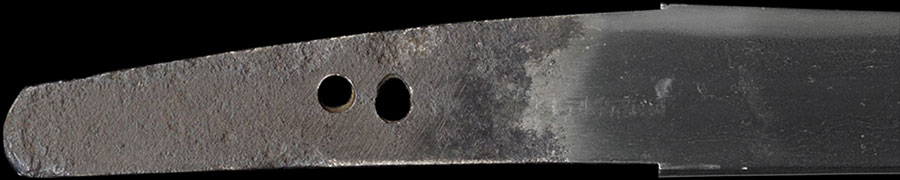
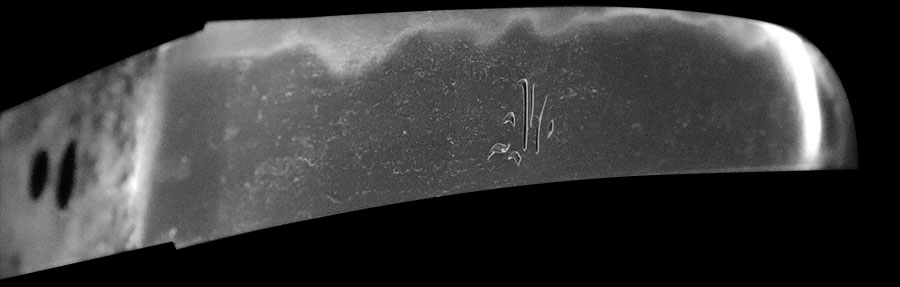
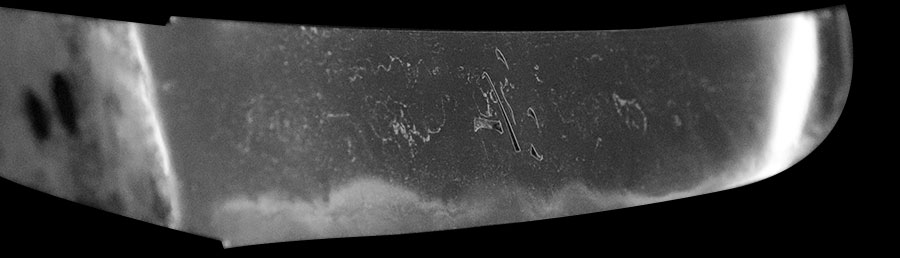
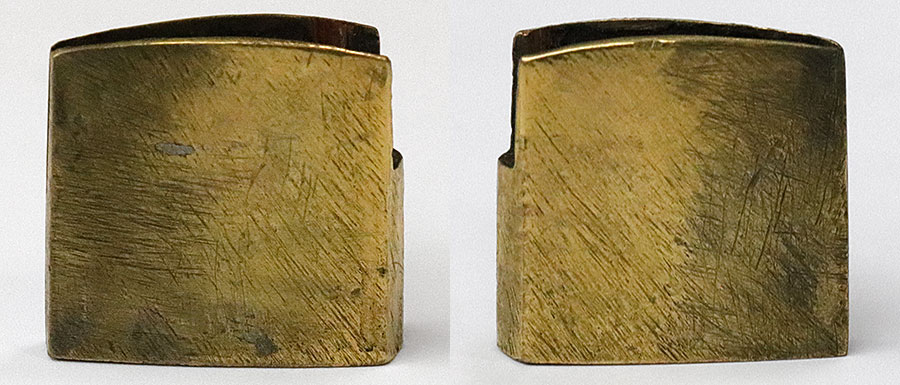
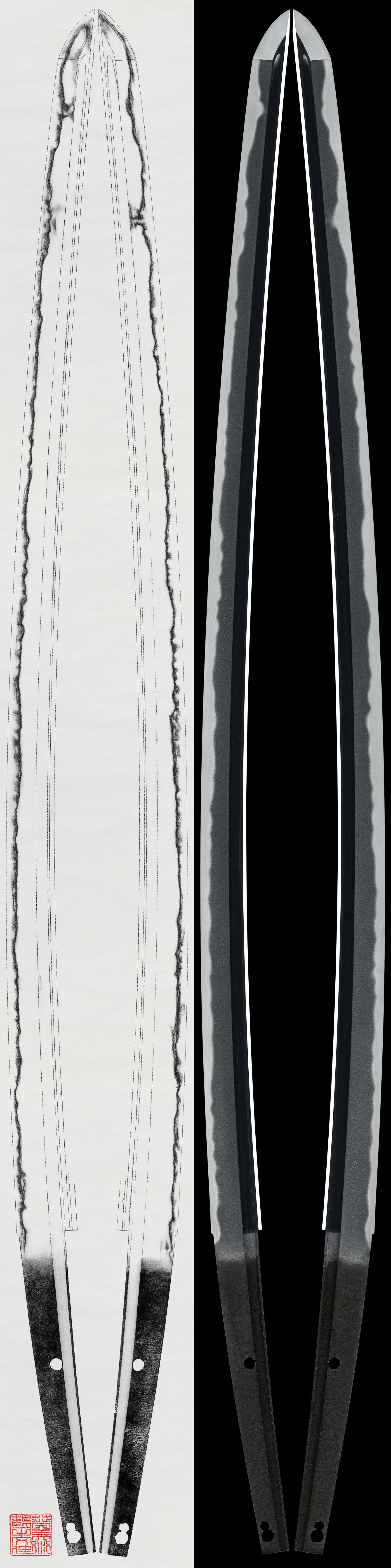
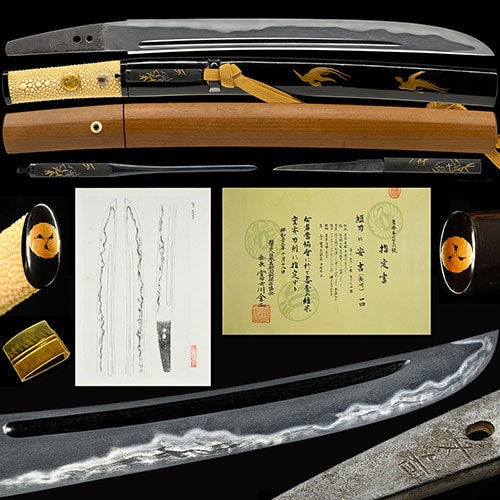
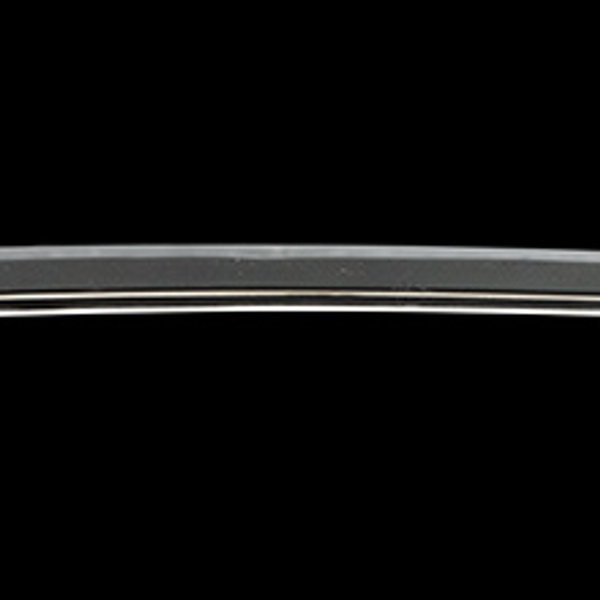
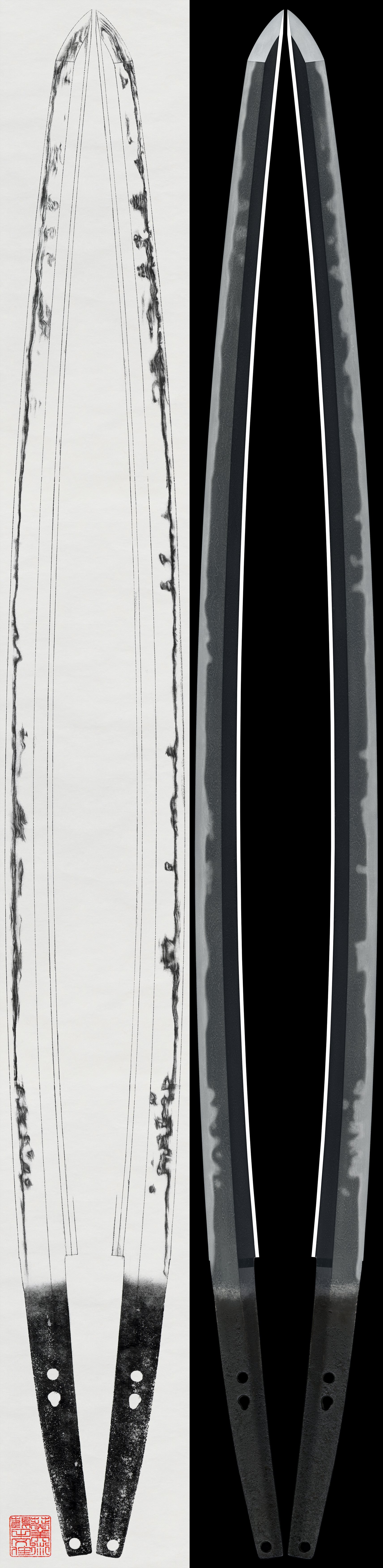
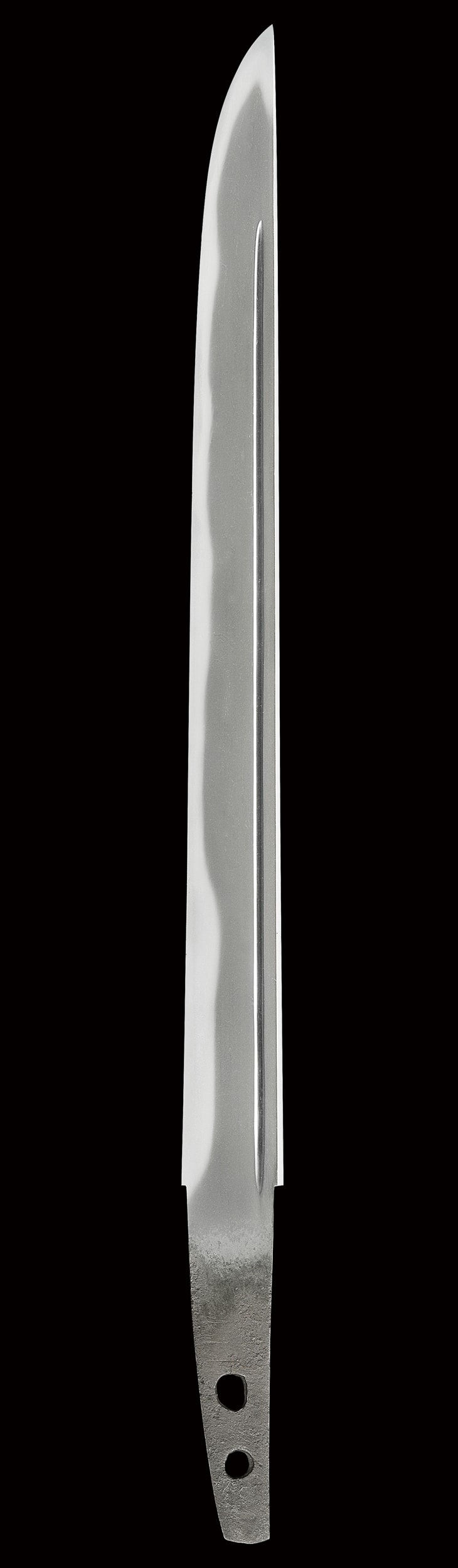
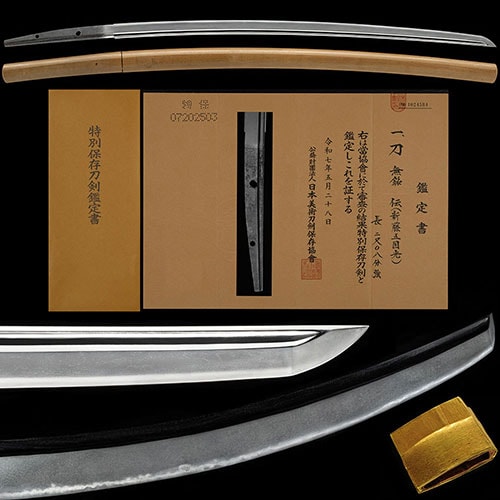
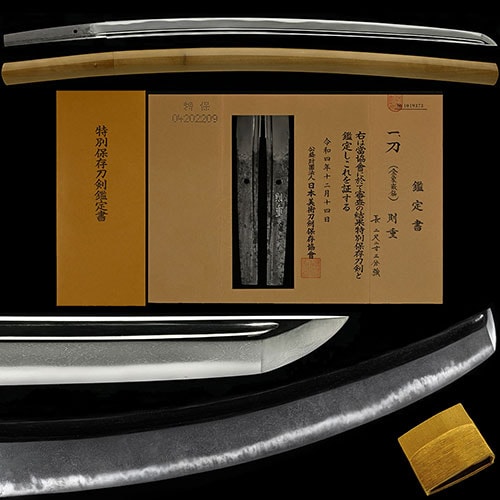
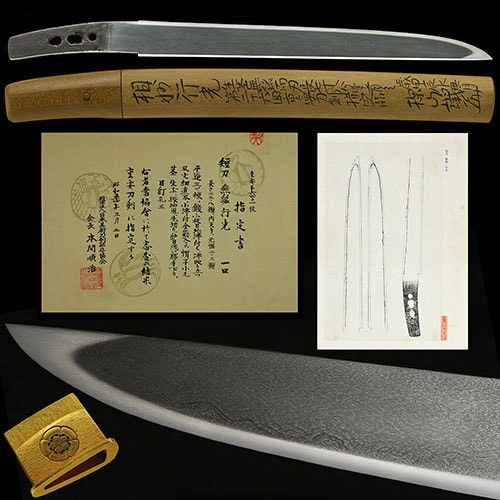
It’s here, it’s here—a famous *tarto* with a connection to the renowned O-Sa has appeared. The smith Sa, whose real name was Saemon Saburo Yasuyoshi, signed his *mei* simply as "Sa." Because of this, he has been called "Samonji" since ancient times. This genius master smith suddenly appeared in Chikuzen (Fukuoka Prefecture) and is famously known as one of the highest-ranking disciples among the *Masamune Jittetsu* (Ten Great Disciples of Masamune). Along with Awataguchi Yoshimitsu, Shintogo Kunimitsu, Norishige, and Osafune Kagemitsu, he left behind masterpieces as a grandmaster of the *tanto*. During the Nanboku-cho period, in the 2nd year of Engen (1336) (688 years ago), Ashikaga Takauji—who had been ordered to be pursued by Kusunoki Masashige and Kitabatake Akiie after defecting from Emperor Go-Daigo's Kenmu Restoration—was defeated in and around Kyoto. He fled by sea to Kyushu. There, over two hundred swordsmiths of the Sa school joined Kikuchi Taketoshi, leader of the Higo Loyalists who sided with Emperor Go-Daigo, to intercept Ashikaga Takauji’s army at Tatarahama (near the Tatara River in Higashi-ku, Fukuoka). However, the Kikuchi army suffered a crushing defeat, and the Samonji school fought bravely alongside them, many dying in battle. The surviving swordsmiths left Hakata and migrated to Hirado in Hizen, Oishi in Chikugo, and Nagato, where they flourished as Hirado Sa, Oishi Sa, and Choshu Sa. In that same year of Engen 2 (1336), the loyal vassal Kusunoki Masashige also died at the Battle of Minatogawa, leading to the establishment of the Muromachi Shogunate by Ashikaga Takauji. This *tanto* is an *ubu mumei* piece appraised as Hirado Sa. Because it follows the lineage of O-Sa, its *sugata* reflects the style of O-Sa; the *mune* is *shin-no-mune*, the *motohaba* is somewhat narrow with *sori*, presenting the excellent *tanto* form characteristic of Sa. The *jigane* is a match for O-Sa, featuring *itame-hada* mixed with *mokume-hada*. The *hamon* is a *notare-midare* mixed with *gunome* with *konie*, showing the characteristic Sa "double-edge" (*nijuba*) near the *boshi*, with *kinsuji* appearing within the blade; it is bright and very clear. The *bonji* engravings on both the *omote* and *ura* of the *jitetsu* are also very pleasing. The representative smith of Hirado Sa, who inherited the lineage of the *tanto* master O-Sa, was Sa Yasuyoshi; this *tanto* could well be appraised as Sa Yasuyoshi. On this occasion, an elderly connoisseur who has thoroughly enjoyed this Sa *tanto* has entrusted it to us, asking that this famous Hirado Sa *tanto* be passed on affordably to a younger generation of Sa enthusiasts. Therefore, we are offering it at a special bargain price. Please enjoy it.
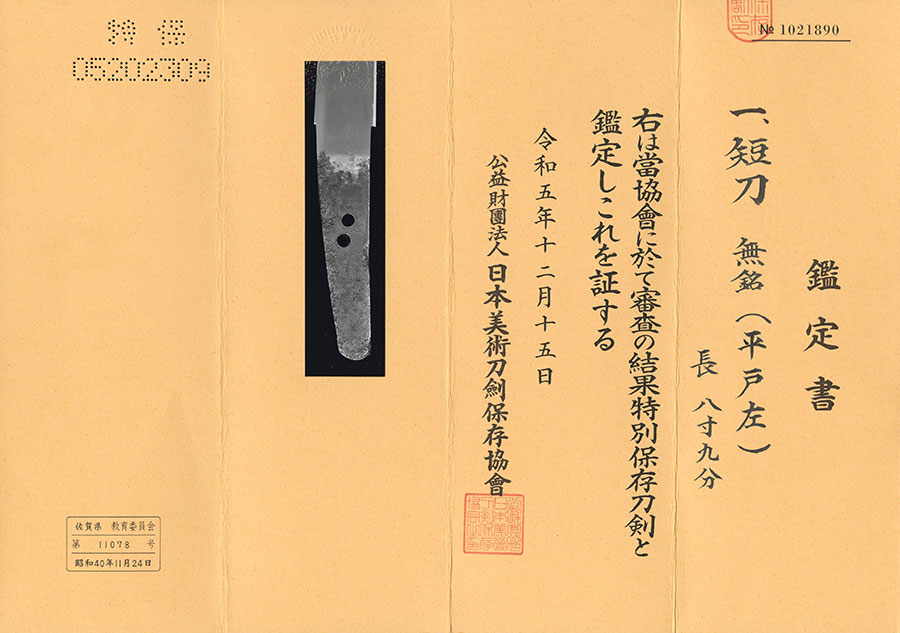
Certificate reading — 無銘(平戸左)
mumei · Nanbokucho · nagasa 27.6cm · sori 0.3cm


Soshu-den · Hizen
2 pieces on the market now
At Hirado in Hizen Province, a body of smiths carried the Sa (Samonji) line of Chikuzen northward and worked it on their own ground, and these are the makers the records group under the name Hirado Sa. The setsumei place their activity from the late Nanbokuchō into the early Muromachi period, with one tachi dated no earlier than Kenmu (1334) and no later than Meitoku (1394), and a tantō set around the Ōei era. Learn more →
| Smith | Era | Designated |
|---|---|---|
| Sadahide貞秀 | 1368-1375 | 0 |
| Moriyuki盛行 | 1394-1428 | 0 |
| Moritsugu守次 | 1394-1428 | 0 |
| Moriyoshi盛吉 | 1444-1449 | 0 |
| Sa左 | 1368-1375 | 0 |
A Hozon-certified blade judged to show notably superior workmanship and a better state of preservation. The bar is higher: re-tempered blades and most unsigned Muromachi/Edo works are excluded.
The NBTHK (Nihon Bijutsu Tōken Hozon Kyōkai, the Society for the Preservation of Japanese Art Swords) is a public-interest incorporated foundation founded in 1948 and supervised by Japan’s Agency for Cultural Affairs (Bunkachō); it is based at the Japanese Sword Museum in Tokyo. Its expert panels physically examine each submitted work (shinsa) and issue a certificate (kanteishō) ranking it by artistic and historical merit. NBTHK papers are the most widely recognized standard of authentication for Japanese swords and fittings.
NBTHK official siteFor returns due to customer circumstances, the cost is the customer's responsibility. For returns due to our mis-shipment or a defective item, we bear the cost.
It’s here, it’s here—a famous *tarto* with a connection to the renowned O-Sa has appeared. The smith Sa, whose real name was Saemon Saburo Yasuyoshi, signed his *mei* simply as "Sa." Because of this, he has been called "Samonji" since ancient times. This genius master smith suddenly appeared in Chikuzen (Fukuoka Prefecture) and is famously known as one of the highest-ranking disciples among the *Masamune Jittetsu* (Ten Great Disciples of Masamune). Along with Awataguchi Yoshimitsu, Shintogo Kunimitsu, Norishige, and Osafune Kagemitsu, he left behind masterpieces as a grandmaster of the *tanto*. During the Nanboku-cho period, in the 2nd year of Engen (1336) (688 years ago), Ashikaga Takauji—who had been ordered to be pursued by Kusunoki Masashige and Kitabatake Akiie after defecting from Emperor Go-Daigo's Kenmu Restoration—was defeated in and around Kyoto. He fled by sea to Kyushu. There, over two hundred swordsmiths of the Sa school joined Kikuchi Taketoshi, leader of the Higo Loyalists who sided with Emperor Go-Daigo, to intercept Ashikaga Takauji’s army at Tatarahama (near the Tatara River in Higashi-ku, Fukuoka). However, the Kikuchi army suffered a crushing defeat, and the Samonji school fought bravely alongside them, many dying in battle. The surviving swordsmiths left Hakata and migrated to Hirado in Hizen, Oishi in Chikugo, and Nagato, where they flourished as Hirado Sa, Oishi Sa, and Choshu Sa. In that same year of Engen 2 (1336), the loyal vassal Kusunoki Masashige also died at the Battle of Minatogawa, leading to the establishment of the Muromachi Shogunate by Ashikaga Takauji. This *tanto* is an *ubu mumei* piece appraised as Hirado Sa. Because it follows the lineage of O-Sa, its *sugata* reflects the style of O-Sa; the *mune* is *shin-no-mune*, the *motohaba* is somewhat narrow with *sori*, presenting the excellent *tanto* form characteristic of Sa. The *jigane* is a match for O-Sa, featuring *itame-hada* mixed with *mokume-hada*. The *hamon* is a *notare-midare* mixed with *gunome* with *konie*, showing the characteristic Sa "double-edge" (*nijuba*) near the *boshi*, with *kinsuji* appearing within the blade; it is bright and very clear. The *bonji* engravings on both the *omote* and *ura* of the *jitetsu* are also very pleasing. The representative smith of Hirado Sa, who inherited the lineage of the *tanto* master O-Sa, was Sa Yasuyoshi; this *tanto* could well be appraised as Sa Yasuyoshi. On this occasion, an elderly connoisseur who has thoroughly enjoyed this Sa *tanto* has entrusted it to us, asking that this famous Hirado Sa *tanto* be passed on affordably to a younger generation of Sa enthusiasts. Therefore, we are offering it at a special bargain price. Please enjoy it.

Certificate reading — 無銘(平戸左)
mumei · Nanbokucho · nagasa 27.6cm · sori 0.3cm


Soshu-den · Hizen
2 pieces on the market now
At Hirado in Hizen Province, a body of smiths carried the Sa (Samonji) line of Chikuzen northward and worked it on their own ground, and these are the makers the records group under the name Hirado Sa. The setsumei place their activity from the late Nanbokuchō into the early Muromachi period, with one tachi dated no earlier than Kenmu (1334) and no later than Meitoku (1394), and a tantō set around the Ōei era. Learn more →
| Smith | Era | Designated |
|---|---|---|
| Sadahide貞秀 | 1368-1375 | 0 |
| Moriyuki盛行 | 1394-1428 | 0 |
| Moritsugu守次 | 1394-1428 | 0 |
| Moriyoshi盛吉 | 1444-1449 | 0 |
| Sa左 | 1368-1375 | 0 |
A Hozon-certified blade judged to show notably superior workmanship and a better state of preservation. The bar is higher: re-tempered blades and most unsigned Muromachi/Edo works are excluded.
The NBTHK (Nihon Bijutsu Tōken Hozon Kyōkai, the Society for the Preservation of Japanese Art Swords) is a public-interest incorporated foundation founded in 1948 and supervised by Japan’s Agency for Cultural Affairs (Bunkachō); it is based at the Japanese Sword Museum in Tokyo. Its expert panels physically examine each submitted work (shinsa) and issue a certificate (kanteishō) ranking it by artistic and historical merit. NBTHK papers are the most widely recognized standard of authentication for Japanese swords and fittings.
NBTHK official siteFor returns due to customer circumstances, the cost is the customer's responsibility. For returns due to our mis-shipment or a defective item, we bear the cost.