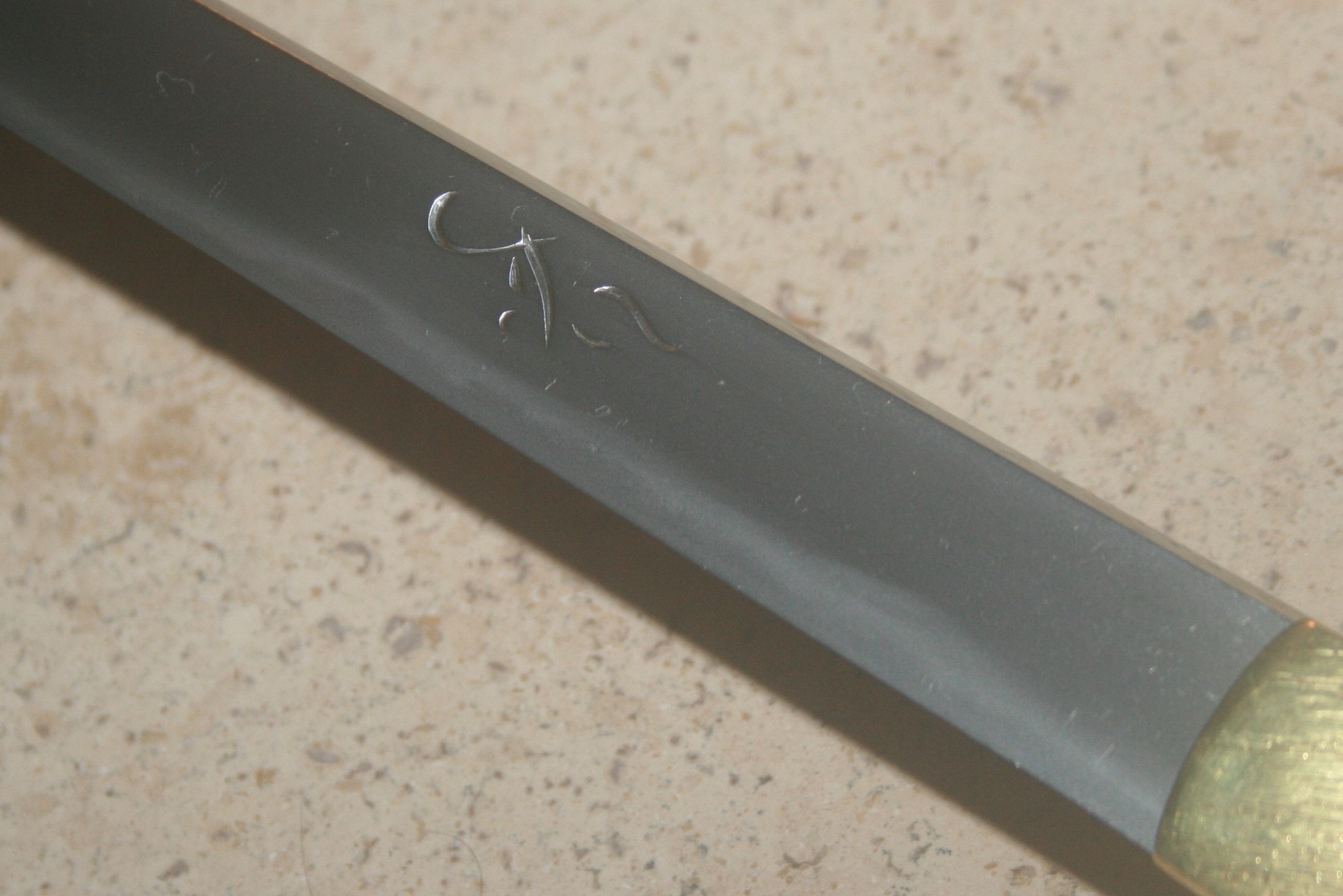
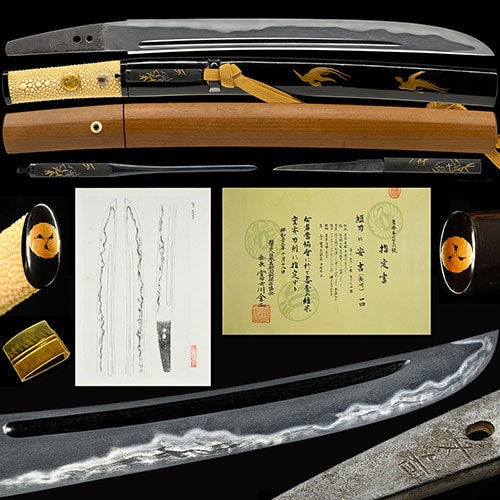
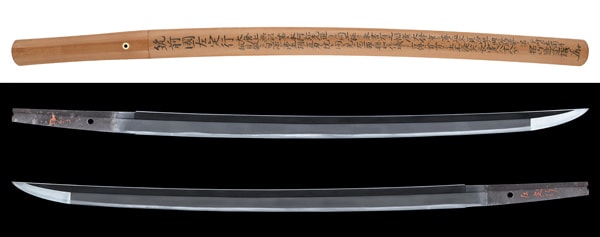
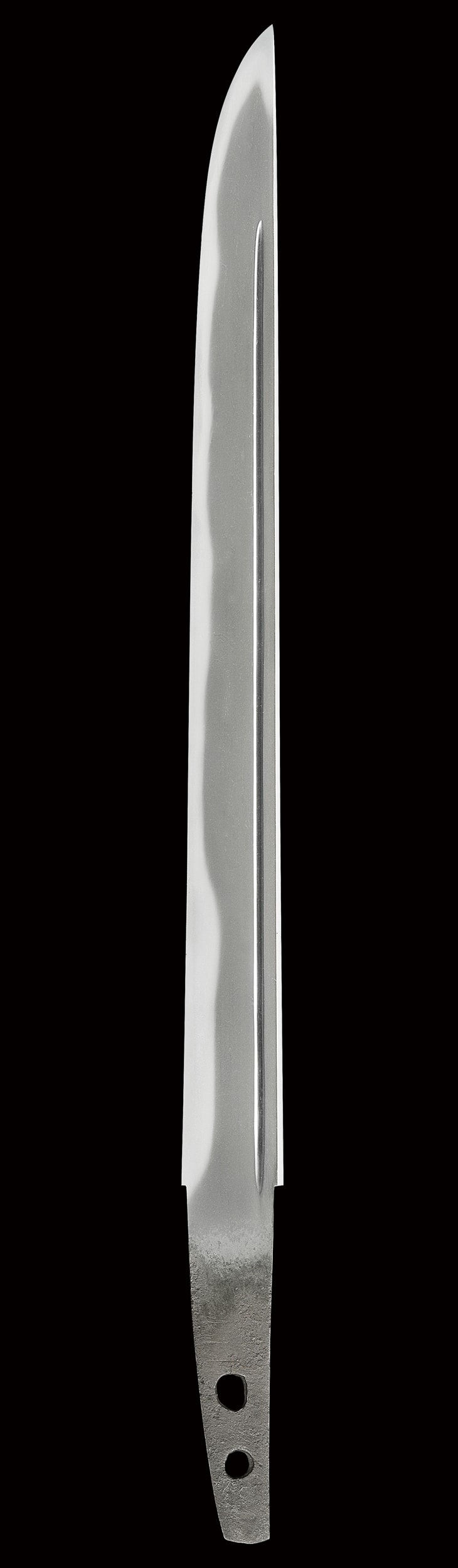
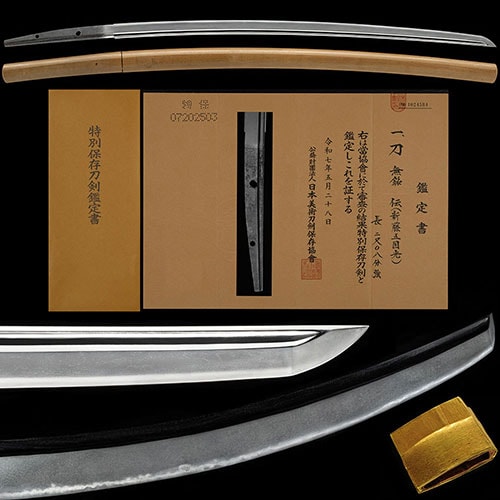
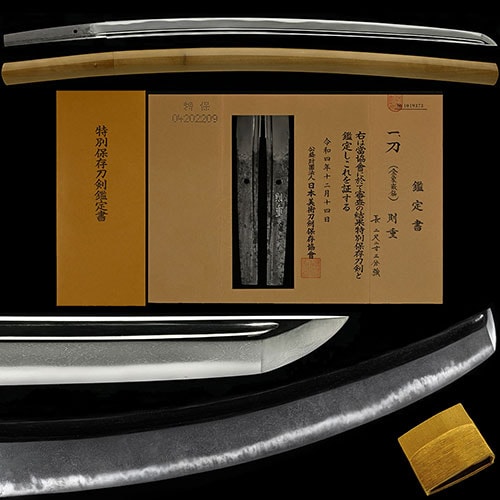
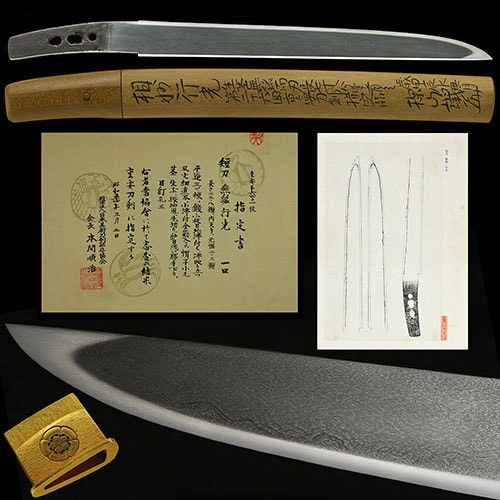
Hiroyasu is a smith of the school, the line of the period, his active years fixed by two dated pieces, a of Shōhei 20 and one recorded in the of Shōhei 13. The published sources transmit him as a son, or by another account a pupil, of Yukihiro, and place him among the smiths carried on from Ō-, the group broadly called the Sue-. By the period the school had emerged in and, casting off the older and somewhat rustic Kyūshū manner, taken in the tradition to establish a style in which both and are bright and clear and run with and . Tradition adds that Hiroyasu later moved to Aki. Signed work survives only as and small , signed being unknown to the judges, so very nearly his whole record is and , drawn from long and cut down into , the attribution carried by the workmanship rather than by a name on the tang.
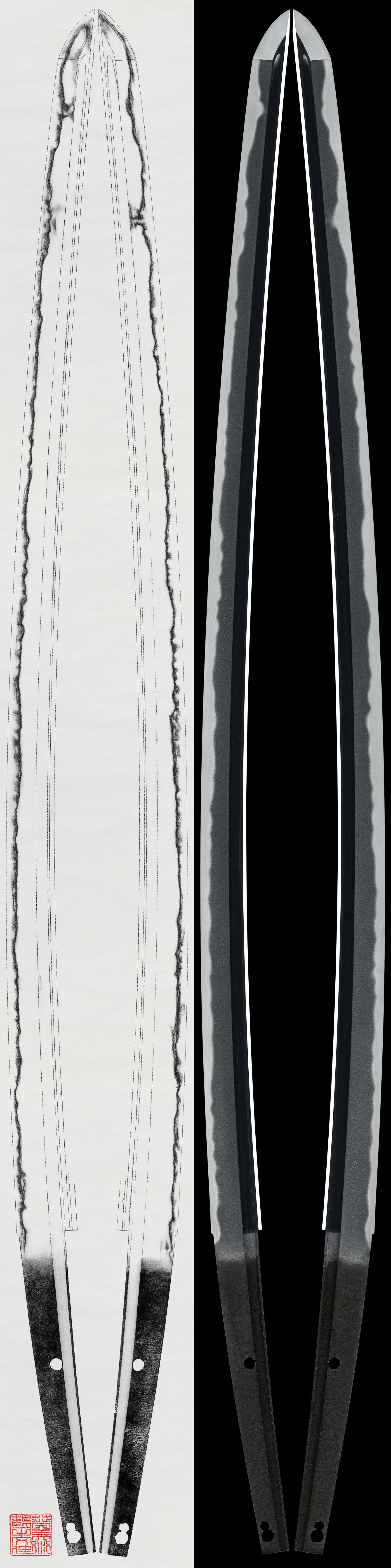
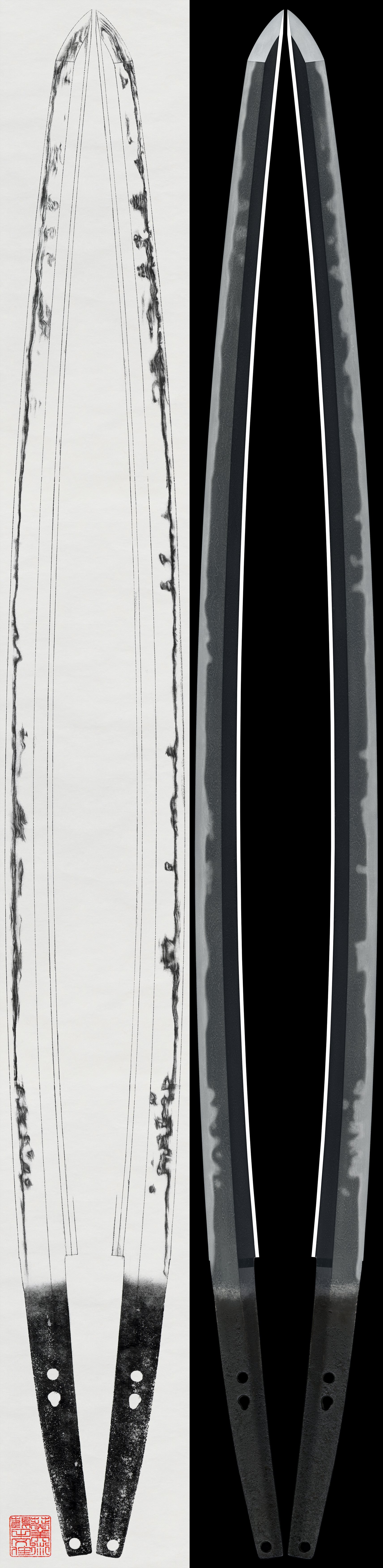
The feature that fixes his name is the on his edge. Among the blades the house judged within the group, it was the ones in which stands out conspicuously that were appraised to Hiroyasu, and the published sources put the point plainly, that among blades seen as the lineage 「特に互の目の目立つものがよく見受けられる」, those in which the is especially prominent are often encountered. His temper is a led by into which , , and a little pointed- enter, the whole kept comparatively small in scale rather than gathered into towering clusters. and run well into it, the lies thick and a little uneven with coarse in places, and runs frequently with threading the line. Small -like touch the edge here and there, an activity the judges find archaic and full of spirit. The runs , thrusts up and ends pointed with vigorous and a deep return.
The is the -derived the whole school shares, and on Hiroyasu it stands open. It is an mixed with , flowing grain and patches of large , the surface standing out rather than lying tight, with thick and entering finely and densely, the steel taking on a faintly blackish cast. This is the dark, active of the hands, not the bright tight and of ; at most a thin -like effect rises in the . The judges prize the clarity of the best of it, noting on one fine that the steel shows no cloudiness and no whitish dullness whatever, 「鉄の濁りや白気がいささかもなく」, while the lies thick and the line is bright. Over so dark and lively a the small-patterned reads as the quieter, more intimate face of the grand idiom the school had only lately taken up.
Within his own record the published sources draw a second manner alongside the first. Some of his work, and especially the pieces tradition has long called Hiroyasu, runs a calmer line, -toned and somewhat compact, the taking a subdued, cast. From olden times appraisals to him were assigned to -group blades showing a gently undulating grown somewhat small, of which the judges write that it 「やや小ずむところに少異がある」, that it differs slightly in being a touch compact. This subdued register sits on certain shortened and on the small signed work, the and , where the of the showy manner is muted and the calm line itself becomes the tell. The two faces are not phases of a career but two readings the school's connoisseurship has fixed to his name, the conspicuous on the one hand and the compact, subdued on the other.
What sets him within the school is what the judges candidly will not claim for him. Theirs is a lineage whose hands are so closely matched that individual judgment is very difficult, and the published sources grant that no single feature singles Hiroyasu out and that his skill is held to fall short of Yasuyoshi, the strongest of the group. He is distinguished instead by his own affirmed traits, the standing, blackish thick in that marks the apart from , the prominent the house reserved to his name, and the thrusting, pointed with its . He stands beside Yukihiro, Yasuyoshi, Yoshisada, Kunihiro, Hiroyuki and Sadayoshi as one of the smiths who carried the manner forward from Ō- into the later fourteenth century, and his blades, where the is thick and the touches the edge, keep something of the archaic flavor the judges call 「古雅な趣を醸し出している」.
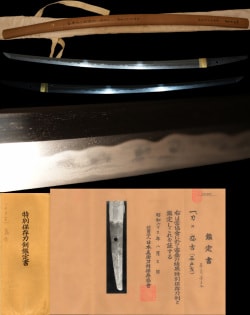
For the collector Hiroyasu is an attainable name among the Sue-, where Ō- himself is not. Fujishiro grades him Jō . He has no National Treasures and no Important Cultural Properties; his record runs instead through three at the rank, two recognized before the war as Jūyō Bijutsuhin, and some nineteen blades at the rank, several carrying old by Kōon, Kōchū and Mitsutada that document the long history of his attribution. His blades passed through and collector hands, the Kuroda, the Hisamatsu-Matsudaira, the Takasu-Matsudaira and other Matsudaira houses among the recorded provenances, with one Jūyō Bijutsuhin now in the Sano Art Museum. About twenty-two blades fall in the and tiers, so a Hiroyasu comes to light from time to time rather than rarely, and a signed or , of which the judges note signed work is extremely few, is the more notable thing for a collector to encounter, valued as much for the study of the group as a whole as for itself.