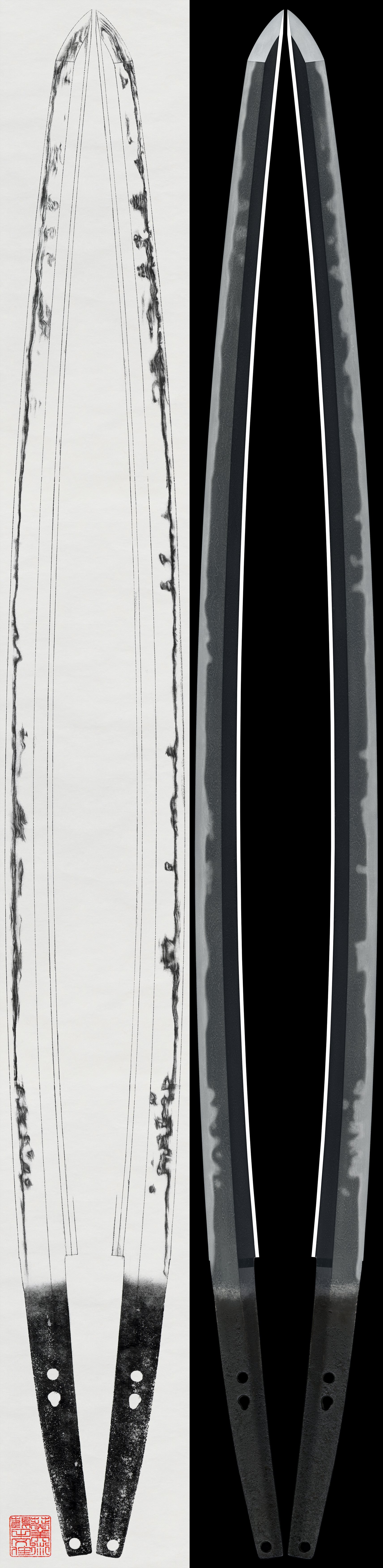
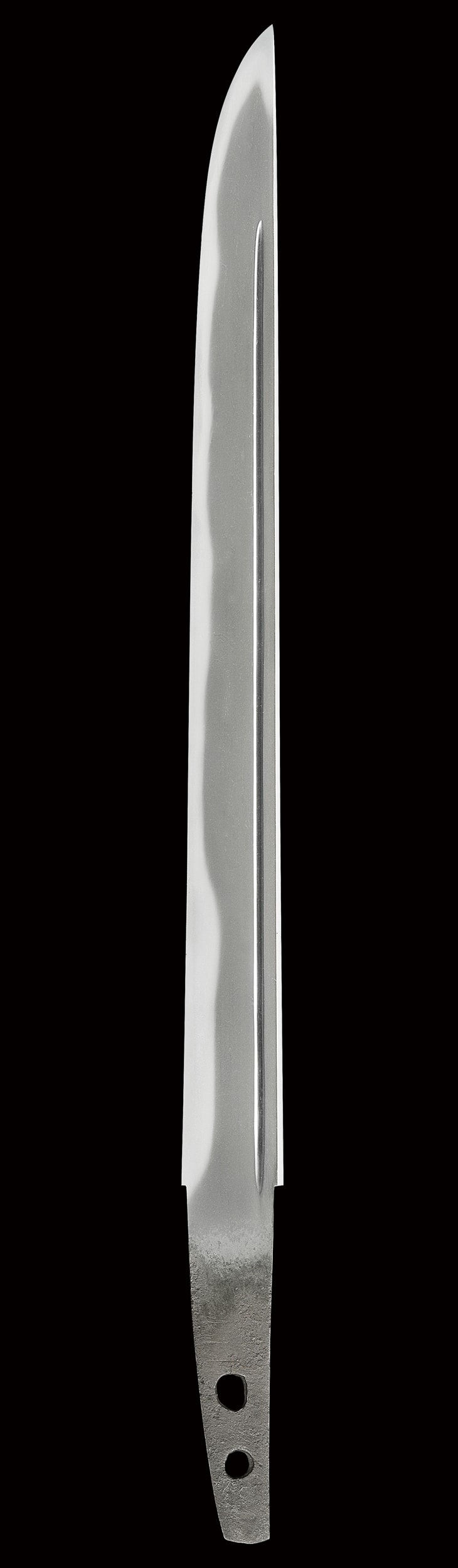
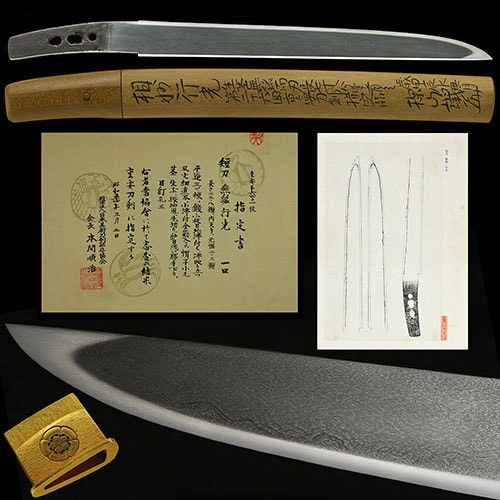
, commonly called O- or , is the smith who carried the manner into Kyushu and stands, by the count of the sword books, among the pupils of Masamune. The published sources read the single character 左 he cut on his tang as an abbreviation of Saemon Saburo, and place him as the grandson of Sairen and the son of Jitsua, the line of smiths descended from the old Kyushu tradition. That tradition, in the words the restates on blade after blade, was one whose 地刃が沈み、鄙びた直刃調のもの, a sunken, rustic inherited from Yamato. Against it O- is the reformer: he broke wholly from his grandfather's and father's manner and is credited with having 垢ぬけした乱れ刃の作域を創作, founding a clear, unprovincial style, and so lifting work to a rank it had never held. Around him a large school formed, his pupils Yasuyoshi, Yukihiro, Yoshisada, Kunihiro, Hiroyasu, Hiroyuki and Sadayoshi each carrying the manner into the years and into the later history of the Kyushu blade. He worked in the Genko and Kemmu years of the early period.
What the change amounts to is a steel that runs bright and clear where the old Kyushu work ran dark. His is an , well knit on the small and standing open on the grand , carrying laid down dust-fine, 地沸微塵, and frequent dark . The published record returns again and again to the judgment, 地刃共に澄んで明るく冴える, that and alike are limpid, bright and lucid, and on the finest pieces the adds that the ji has neither the whiteness nor the blackness of lesser Kyushu steel. Over that he tempers a notare base mixed with and , the deep and the bright, with and entering and fine and drawn throughout the . The reform is summed in a recurring phrase the sources use for his new manner, 地景や金筋の目立つ乱れ主調の新作風を樹立した, an irregular temper led by conspicuous and .
The single feature that most reliably marks his hand sits in the . Across his surviving work the temper of the point thrusts up and runs to a sharp tip with a long brushed return, 突き上げて先が尖って迫力があり, the published sources noting its force and its long even on pieces where they decline to fix the individual hand. On the a faint rises in the , the knits tight, and the keeps a quieter, more even register; on the wide the temper grows fuller, , and appear, the thickens and at times turns rough, and the whole carries what the repeatedly calls a , a martial spirit. The activity is read first in the and in the point, and the bright , free of whiteness, is what tells him from his fellows when the alone will not.
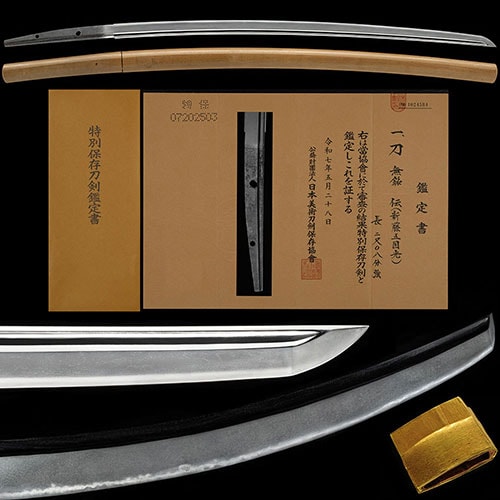
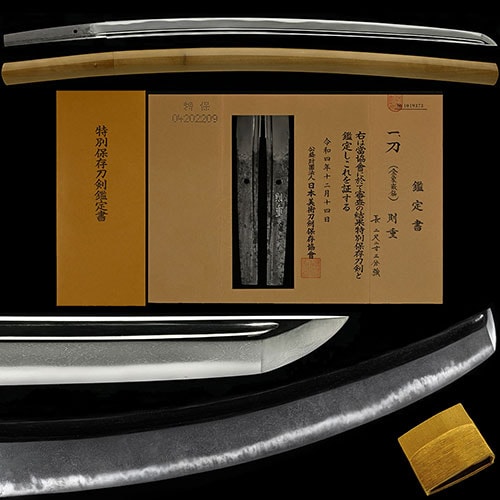
His record divides cleanly into two registers, and the division is the key to reading him. The signed pieces are almost all small , , with little or no , thin and a withered , signed in fine, flowing chisel 左 on the and 筑州住 on the ; these the calls his canonical work, one such described as 左文字の見どころを余すところなく示した典型作, a typical piece showing every point of recognition, another as 相州伝上工の実力を遺憾なく発揮した, the full skill of a first-rate hand. The grand , by contrast, are -, wide in the body with little taper and a extended in the manner, papered as . A third group is read only to the school: a piece marked simply 左, or carrying a red-ink 三木左, often means the broad excellence of the line rather than the master himself, the published sources cautioning that 個名は特定し得ないまでも, even where the individual name cannot be settled, the thrusting, pointed should not be overlooked. The old books' placing of him in Masamune's circle the treats with care, allowing the point remains open while holding the influence on his reform to be plain.
Against his peers the distinction is drawn by his own grounded traits rather than by theirs. His bright, clear and the thrusting set him apart, and the recurring institutional verdict that and run limpid and lucid is the through-line that holds the two registers together as one hand. Within Kyushu the contrast is sharper still, and the sources make it the heart of his importance: where Sairen and Jitsua before him left a sunken, rustic , O-'s is the bright unprovincial style that reorients the whole tradition, his pupils and the later Kyushu smiths working in his light. He is, in the plainest terms the record allows, the smith through whom the manner becomes a Kyushu one.
His is a Sai-jo hand by the Fujishiro rating, and the designations bear the standing out: among the works on record are four National Treasures, foremost the 江雪左文字, the Kosetsu , the only signed of his to survive, with seven Important Cultural Properties and twenty-one at besides, some seventy-seven designated works on record in all. The named run through the great houses: the Onishi , held by the Arima lords of Kurume; the 弾正左文字, the Danjo long treasured by Uesugi Kagekatsu; pieces preserved in the Owari Tokugawa house, where one stood among the highest-graded blades of the collection, in the Date house of Sendai, the Sakai of Himeji, the Tachibana of Yanagawa, the Makino, and the Matsudaira of Shirakawa, one having passed through the hands of Hideyoshi himself. For the private collector the position follows from this history. The National Treasures and Important Cultural Properties are heritage held in public and long-private hands, not things that trade; of the rest the and blades, fifty or so across the recorded tiers, are more findable than the works of the very rarest names, yet a signed or a securely papered comes to market only rarely, and is a landmark of a collection when it does.