Power sat in Kamakura, but taste was still made in Kyōto. The Awataguchi school’s pear-skin steel became a byword for perfection, and the Rai line supplied dignified tachi to the court, senior warriors, and the great temples alike.
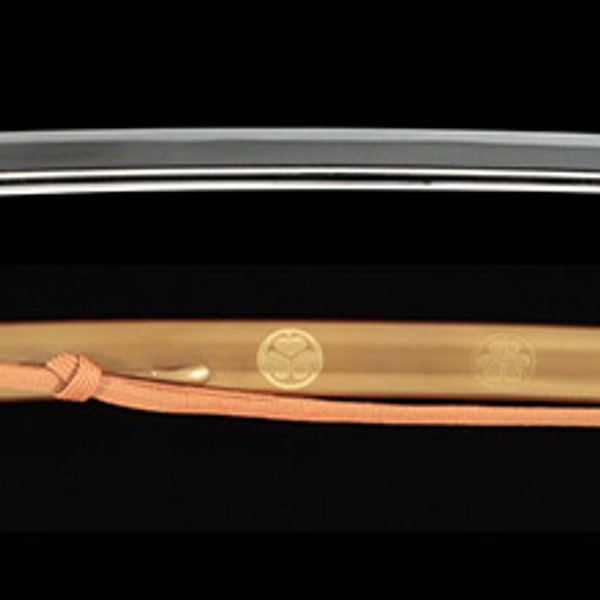
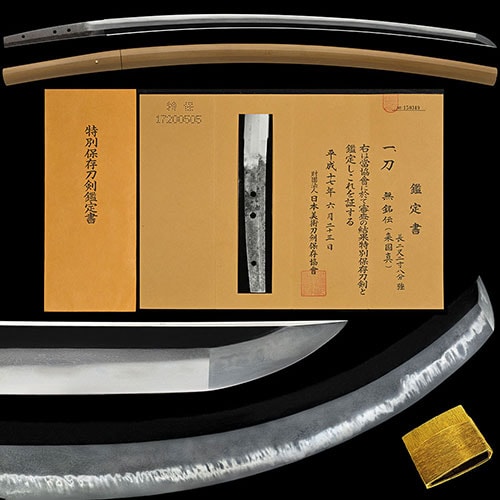
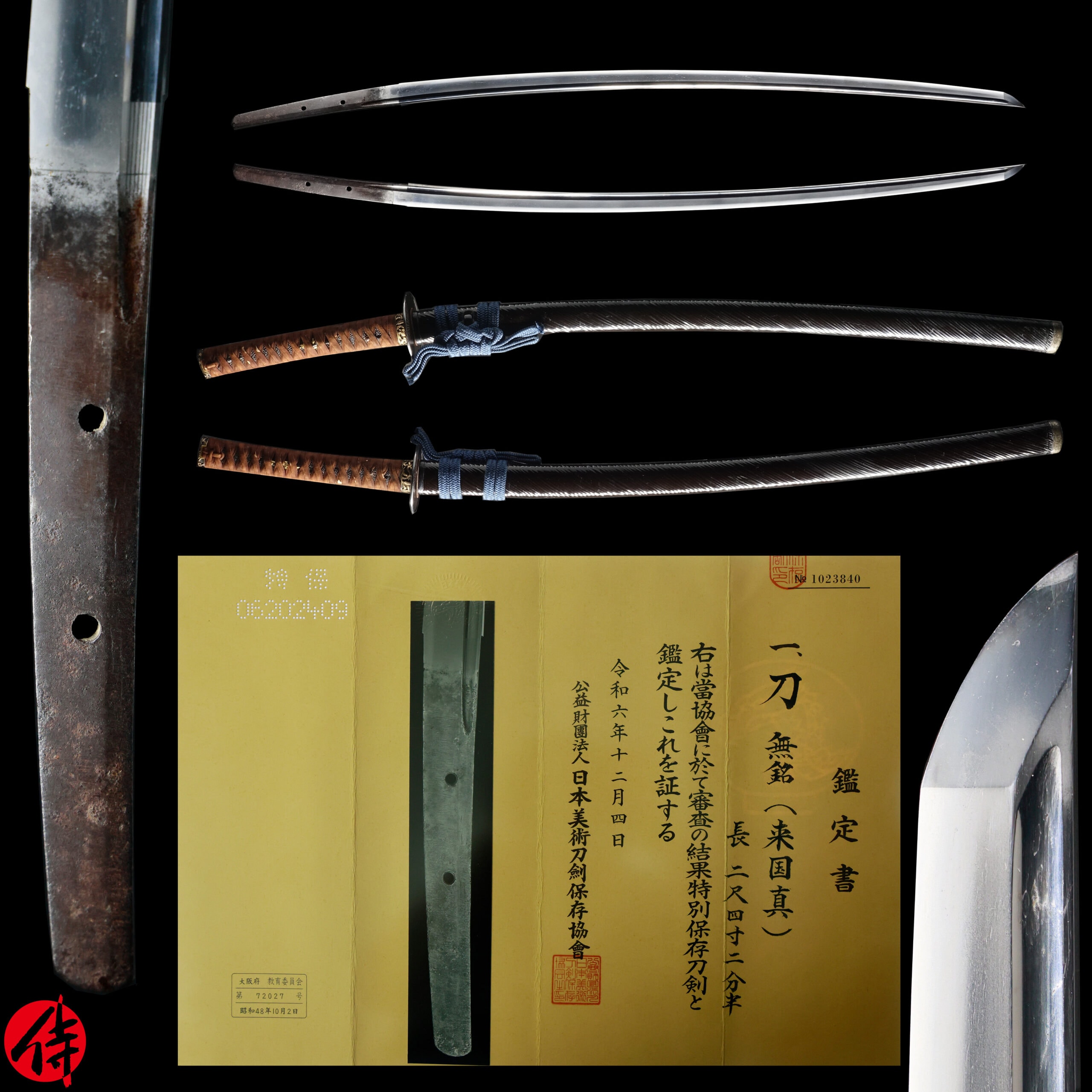
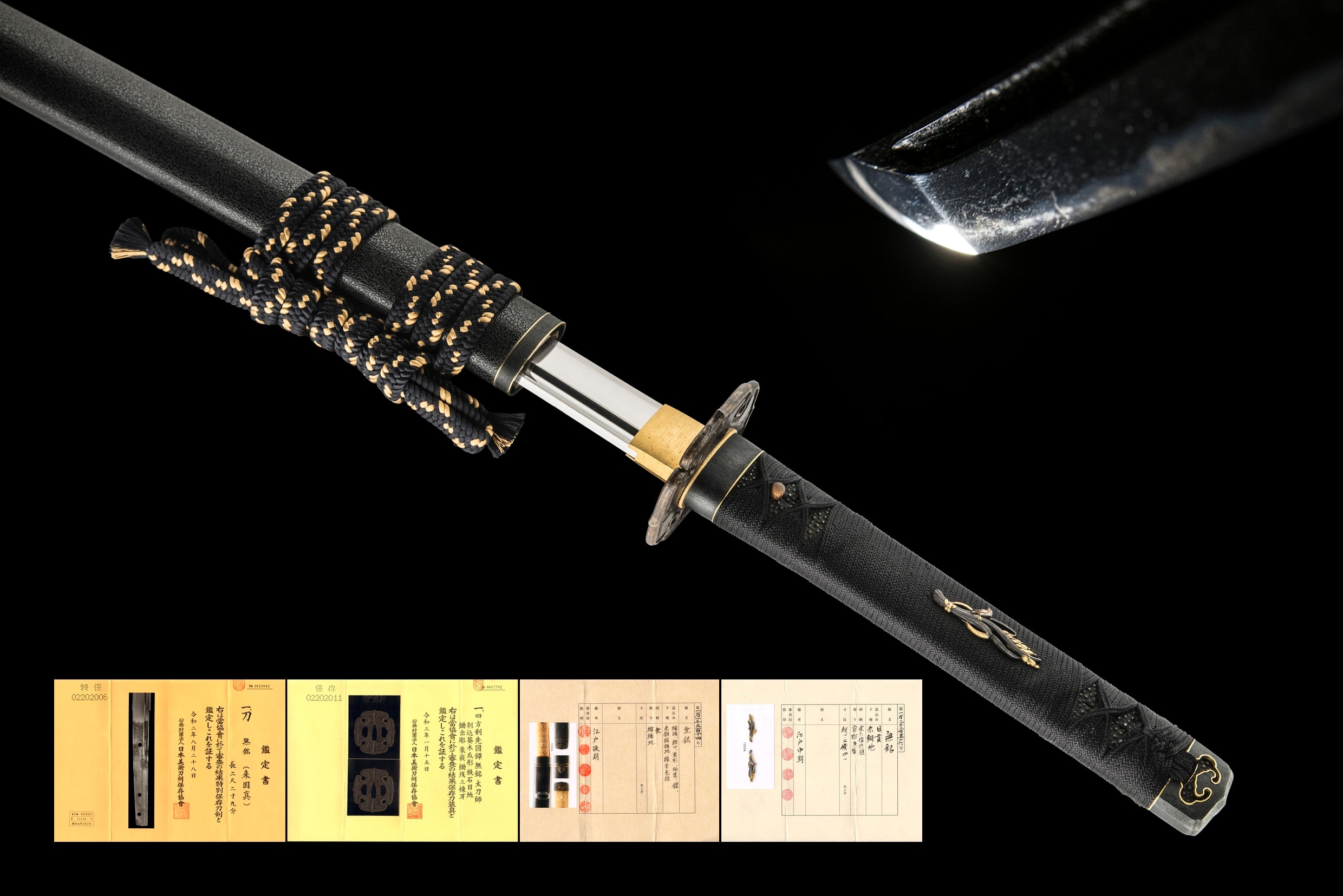
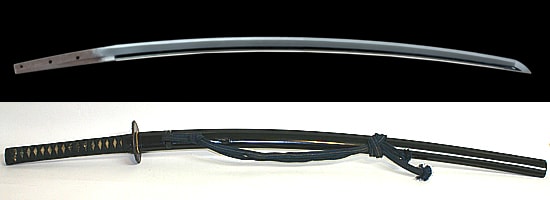
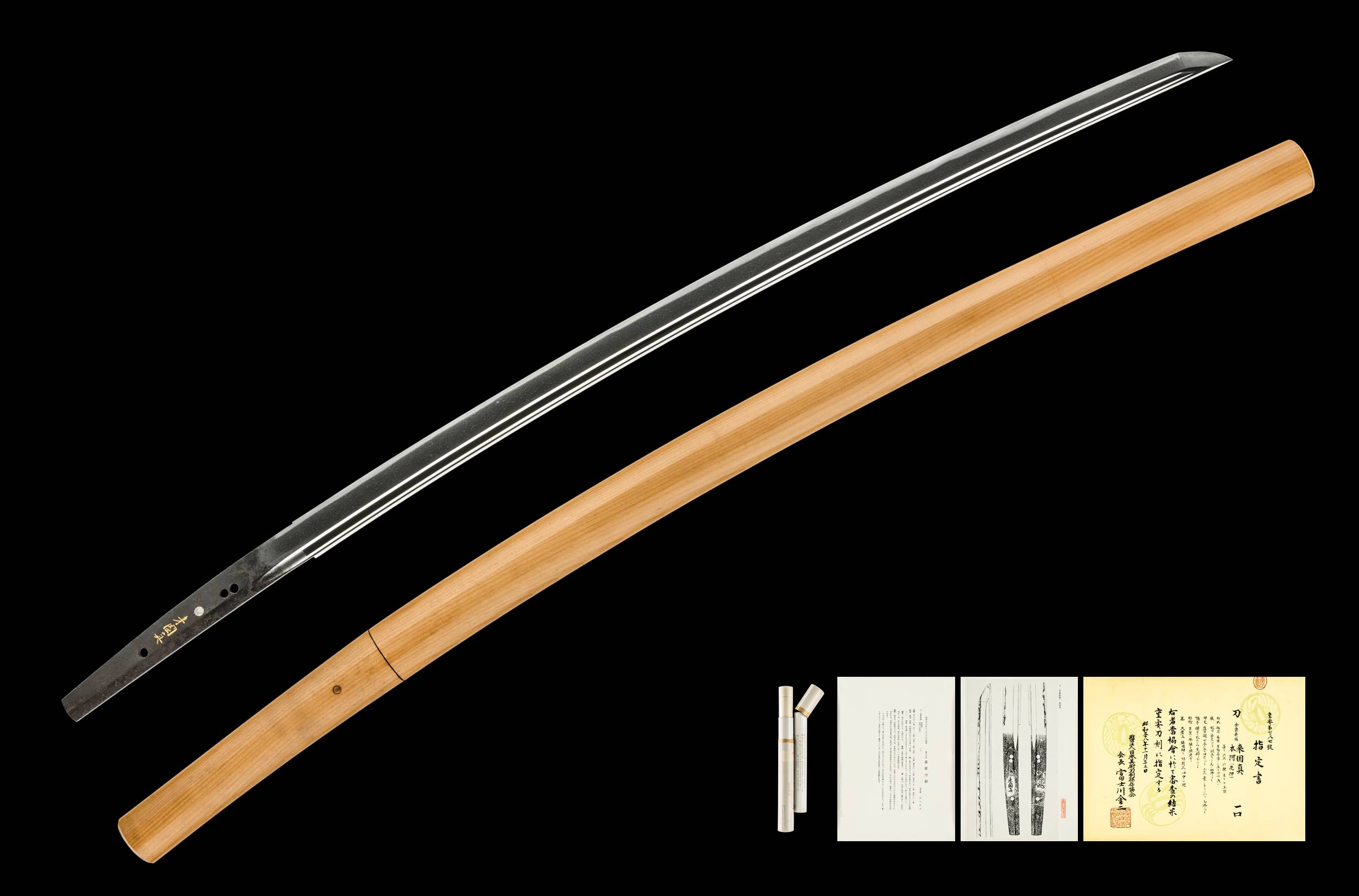
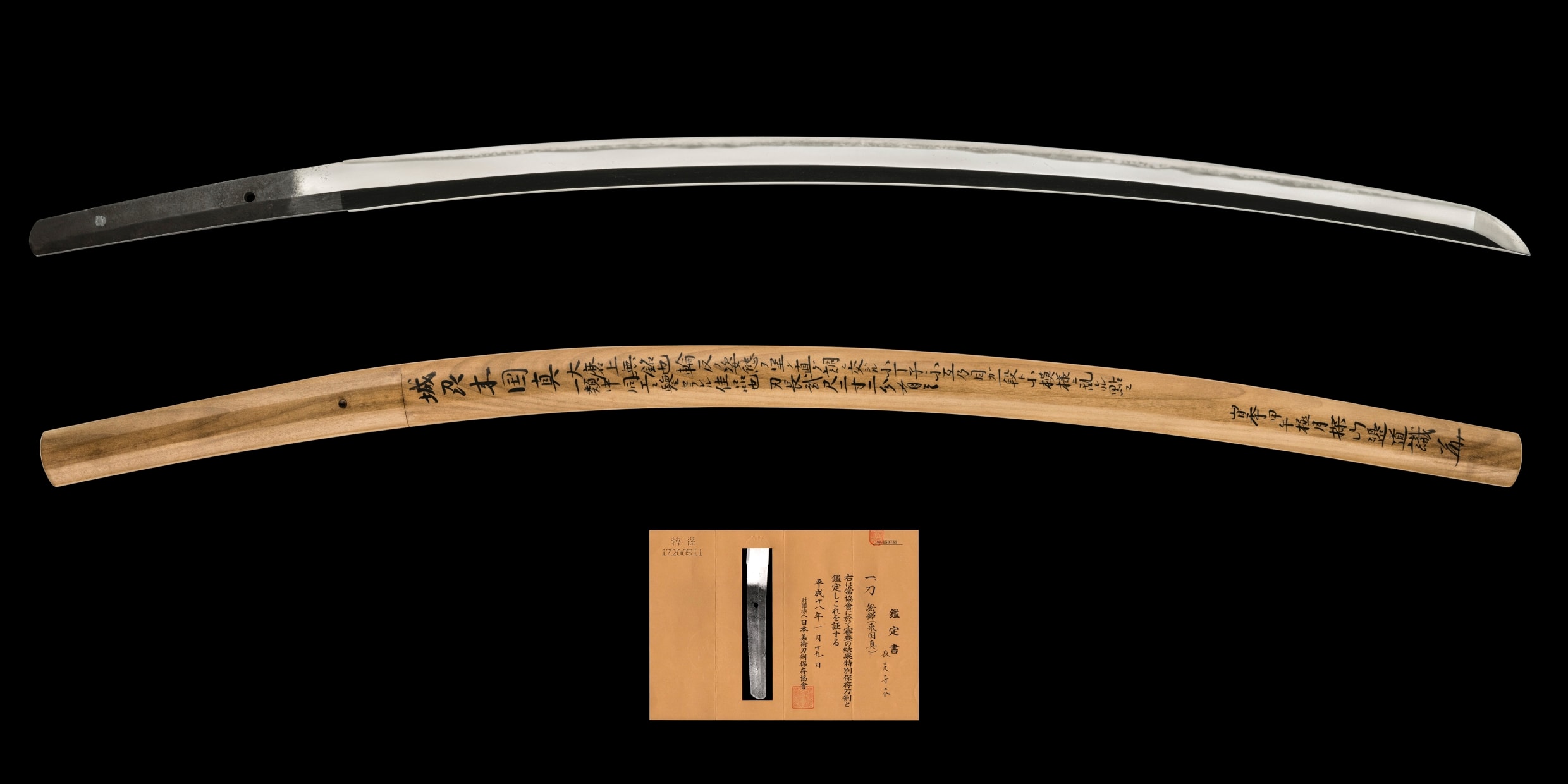
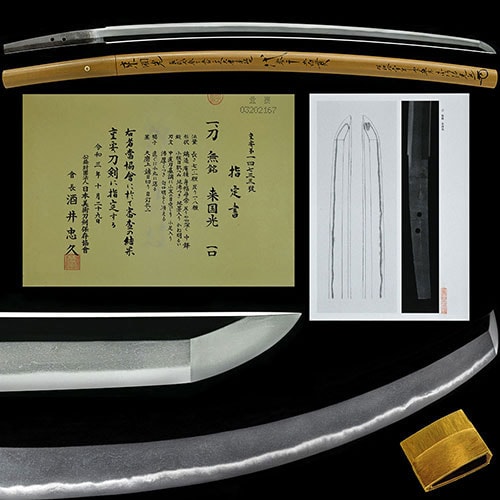
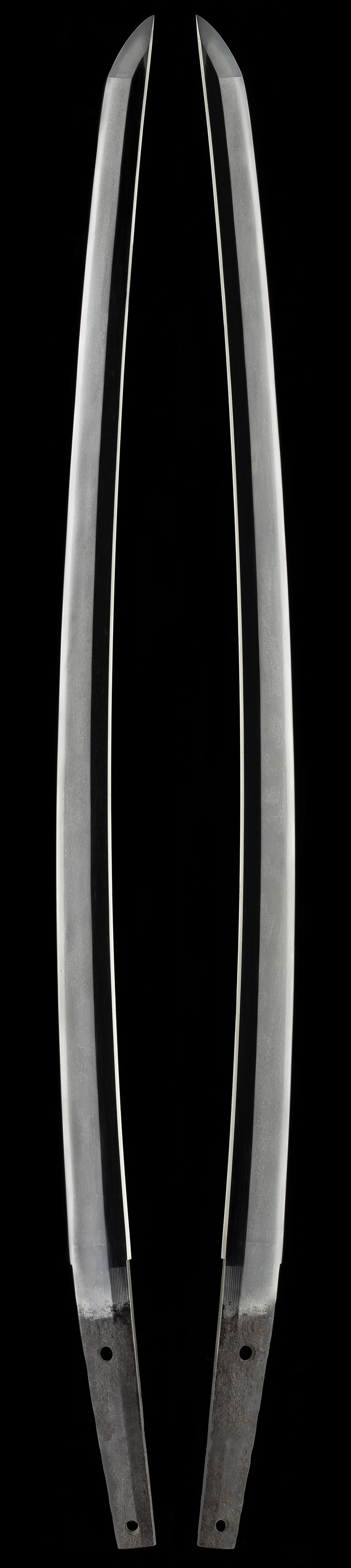
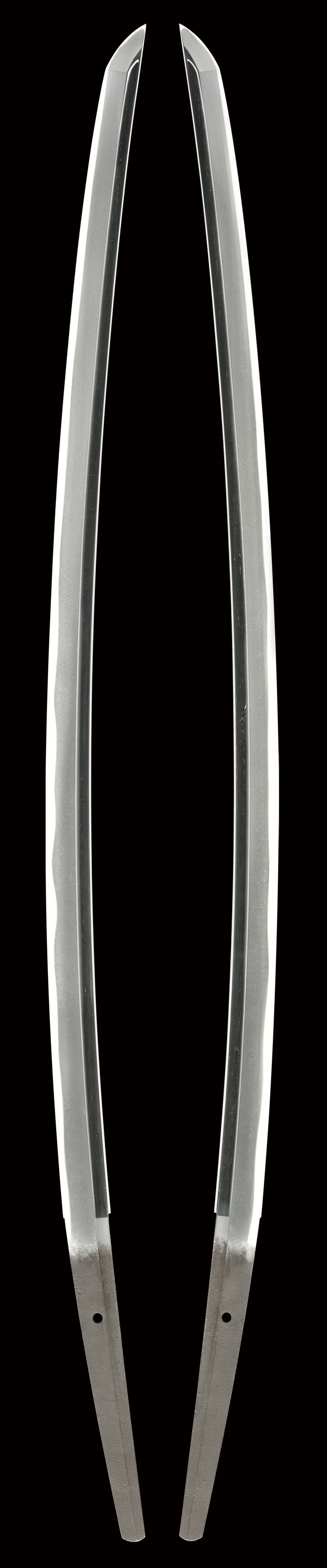
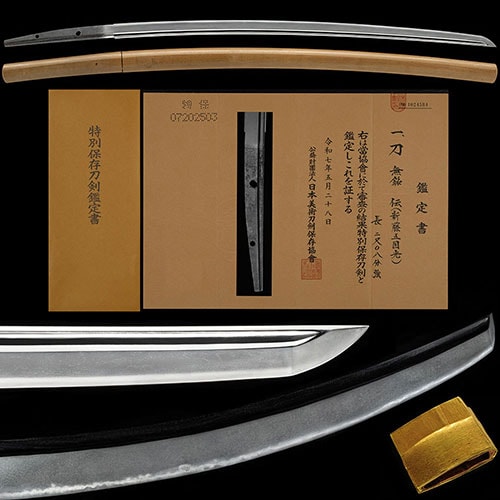
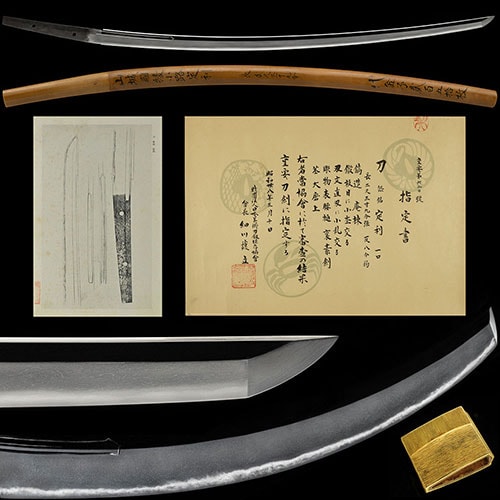
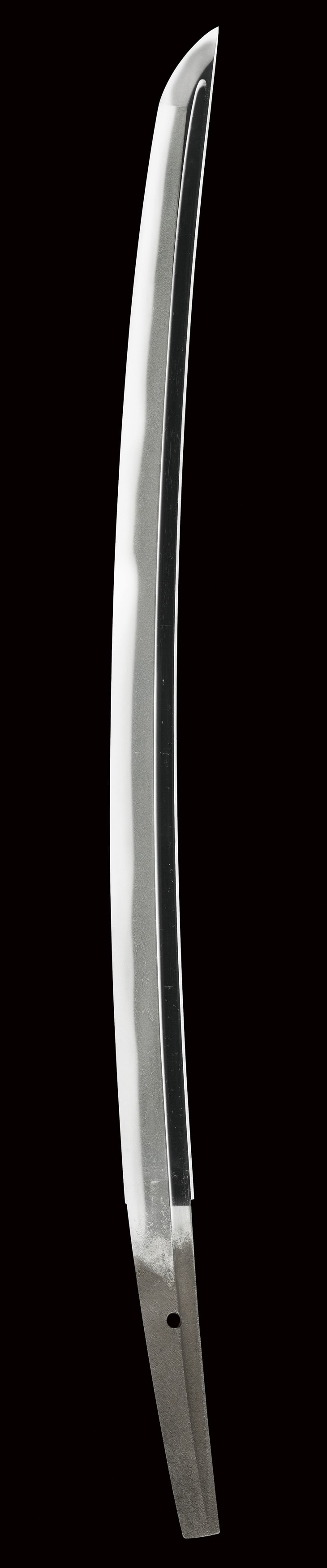
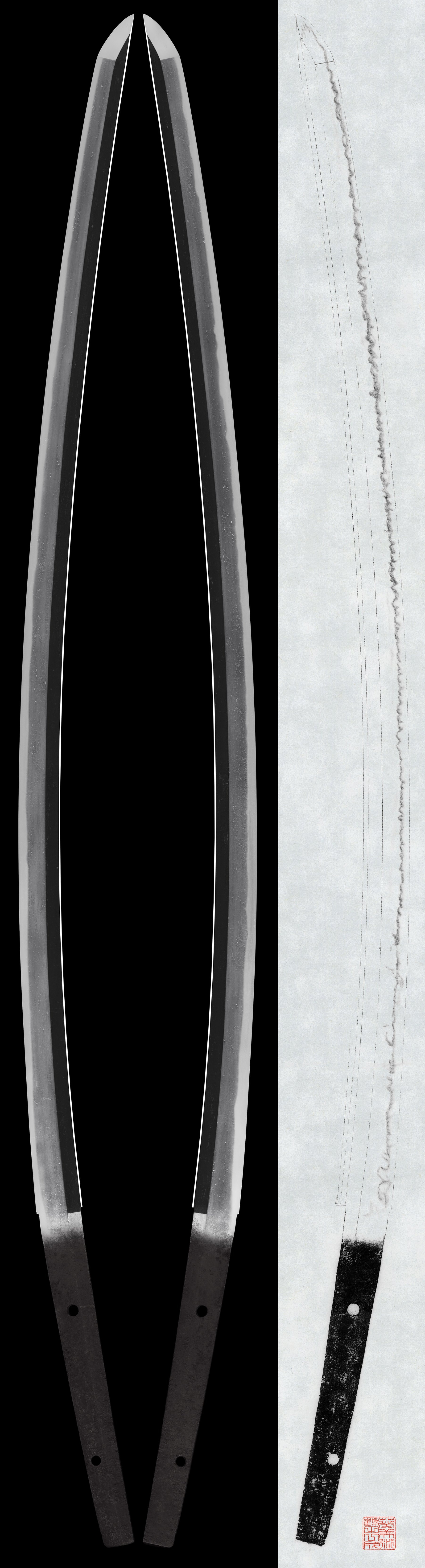
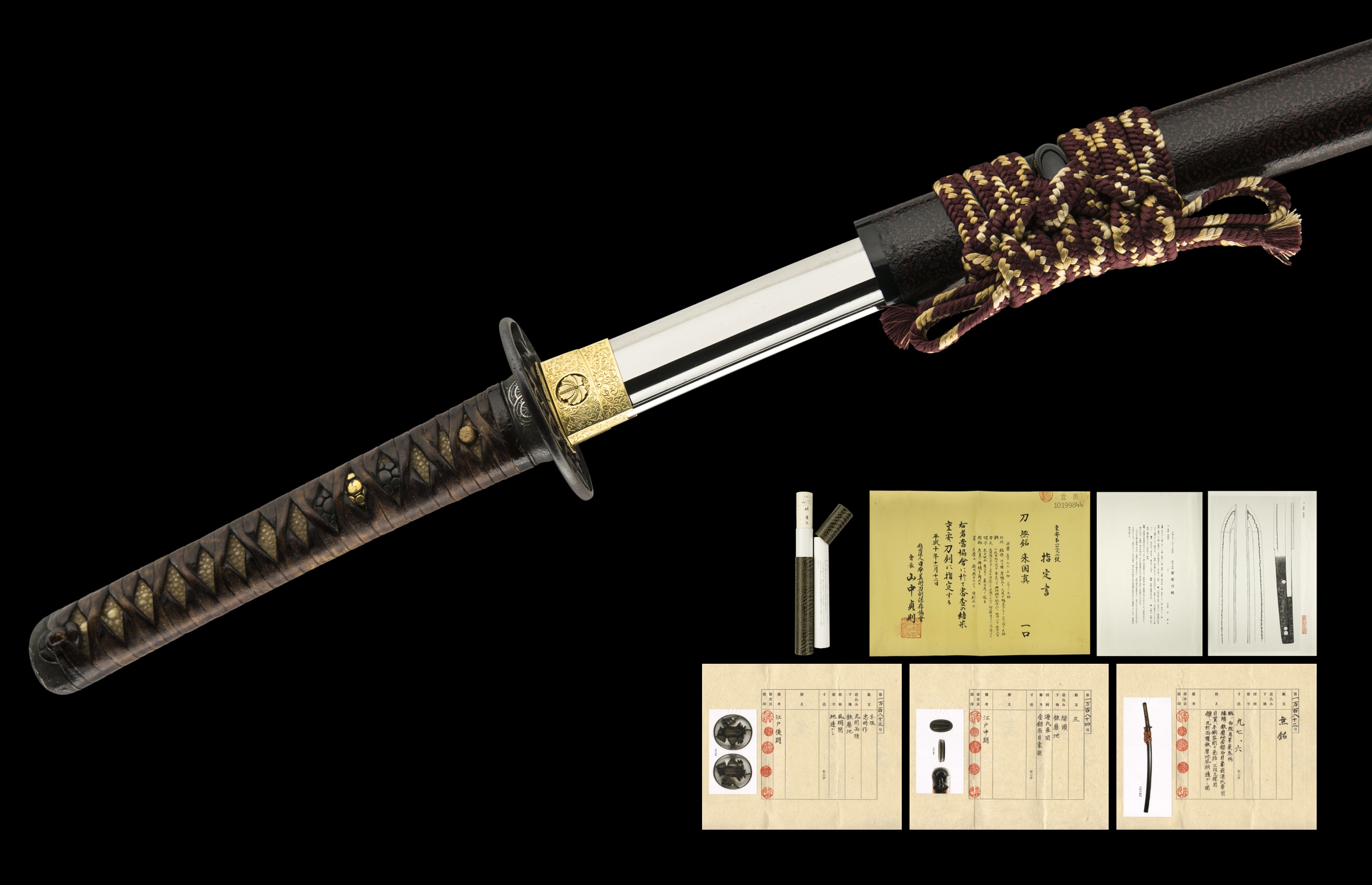
This is a katana attributed to Rai Kunizane, a prominent smith of the Rai school in Yamashiro province during the late Kamakura period. The blade features a wide, muscular torii-zori shape, ko-itame-hada mixed with mokume, and a bright suguha-chô hamon. It is accompanied by an Edo period uchigatana-koshirae with a vermilion saya, a signed Akasaka Tadatoki tsuba, and Misumi school fuchi-kashira.
 NihontoWatch
mumei · Rai School · Kôtô – Late Kamakura Period (shôwa era: 1312~1317) · nagasa 68.5cm · sori 1.9cm
Rai (Yamashiro, Kyoto) · Yamashiro · around 1334-1370
Fujishiro Jo saku
1 piece on the market now
Rai Kunizane is one of the smaller names of the Rai school of Yamashiro, transmitted in the swordbooks as a son or pupil of Rai Kunitoshi, the younger brother of Rai Kunimitsu and the elder brother of Rai Tomokuni, working in Kyoto from the close of the Kamakura period into the Nanbokuchō. His record is almost entirely a question of two faces, and the published sources state the genealogy itself with caution: the Meikan gives him the Shōwa era and lists separately a smith of the same name placed before Kenmu, while the commentary observes that the received descent appears strained in both its workmanship and its chronology, so that a first and a second generation must be assumed from the works themselves. He is, in the end, less a single documented hand than the connoisseurship convention by which a particular kind of refined Rai work has been preserved.
The characteristic Kunizane that a collector meets is the ō-suriage, mumei katana attributed to him from old times, and it is read first in the jihada. Over a well-forged itame, at times a tightly packed ko-itame mixing in mokume and flowing nagare, the grain tends to stand a little, thick ji-nie adheres in fine grains, chikei enter frequently, and on the ji a faint nie-utsuri or pale utsuri often rises. The published sources call this a steel that resembles Rai Kunimitsu yet, in their own words, is “similar to Rai Kunimitsu though falling somewhat short of him”[[c:1]], the standing grain and the quiet nie-utsuri marking the manner that carries the Rai jigane a step into the Nanbokuchō rather than holding to the bright, closely-packed Yamashiro ji of pure Rai.
Over that jigane he sets a suguha-toned line, broad or medium, into which ko-chōji, ko-gunome and a small midare enter. Ashi and yō work abundantly, ko-nie adheres well, the habuchi breaks into fine hotsure and at times a nijūba tendency, and kinsuji and sunagashi run through, the nioiguchi by turns tight and clearly bright. The bōshi runs straight to a small round, or enters midare-komi and sweeps with vigorous hakikake, on the more flamboyant pieces becoming pointed and flame-like. The decisive point of the attribution is one of degree, not of kind: the temper is the calm Rai register, but its midare appears in a smaller-patterned design than Kunimitsu's, and the published commentary turns that very observation into the rule, judging such a work to be “similar to Rai Kunimitsu though slightly lower in rank” and concluding that “within the group it is most appropriate to appraise it, as tradition has it, as the work of this smith”[[c:2]].
The other face is the signed work, and it is the rarer and more puzzling. Signed pieces are exceedingly few, chiefly hira-zukuri wakizashi and tantō, wide in mihaba and sun-nobi for their length, thin in kasane with a shallow sori, the typical Nanbokuchō shape, the three-character signature cut somewhat large below the mekugi-ana. Their forging is itame with mokume, flowing and slightly standing, with ji-nie well adhered, but their temper departs from the mainstream attribution: a suguha tone broken by notare and ko-gunome, the nie in places strongly thick, the edge running into hotsure, uchi-noke, a kuichigai-ba effect, nijūba and yubashiri. Several carry an “all-over” hitatsura-like temper that, in the published sources' phrase, shows “a burnt-looking manner approaching the workmanship of the Hasebe group”[[c:3]]. From this the commentary on the signed tachi and wakizashi concludes that “one is compelled to judge them works of the Nanbokuchō period”[[c:4]], and it is this gap between the calm mumei attributions and the flamboyant signed pieces that sustains the standing question of a first and a second generation of the name.
What sets the Kunizane attribution apart from its neighbours is exactly what the judges name, and they take care to draw it from his own work rather than from the comparand. He stands within the Rai school beside Rai Kunimitsu and Rai Kunitsugu, carrying the Yamashiro manner forward; his is the refined Rai suguha read as a step below Kunimitsu in rank and smaller in the pattern of its midare, the faint nie-utsuri on a slightly standing itame his recurring tell. One signed katana with a Hon'ami gold-inlay breaks instead into a chōji-midare mixed with gunome, the undulations tightly clustered and muneyaki intermingled, which the commentary reads as the Rai tradition of Kunimitsu and Kunitsugu carried with a forceful spirit; the hitatsura-leaning pieces, with tobiyaki and yubashiri gathering toward the monouchi, are where it locates his individuality. The attribution is therefore a careful one, made by stylistic level and bearing within the school rather than by a single inimitable trait.
For the collector he is an accessible Rai name with a quietly distinguished provenance. Fujishiro grades him Jō saku. He has no National Treasures and no Important Cultural Properties; his record runs entirely through the Jūyō rank, twenty-five blades in the Jūyō tier, most of them ō-suriage mumei katana bearing gold-inlaid Hon'ami attributions, the published sources calling several of these especially superior among works attributed to him and sound in both ji and ha. Signed examples are the prize and the scarcity, so few that the commentary on one Jūyō wakizashi calls it “exceedingly valuable material for understanding the workmanship of this so rarely signed smith”[[c:5]]. His blades carry good nikuoki and a documented descent through the daimyō houses, among them the Sakai of Maebashi and Himeji, one katana bestowed on Sakai Tadataka in 1745 as a gift marking the retirement of the eighth shogun Tokugawa Yoshimune and thereafter held by the family, with further pieces transmitted in the Nabeshima and Shimazu houses and examples now in the Ise Jingū Chōkokan, the Tokyo National Museum and the Tokyo Fuji Museum. Because all of his record sits in the tradeable tier, a Kunizane katana is not beyond reach in the way a Kunimitsu of the first rank would be; a signed piece, on the other hand, comes to light only seldom, a notable thing for a collector to encounter and a document of how the Rai school carried itself into the Nanbokuchō.
Where Kunizane stands among comparable artisans: across all of nihontō, and within tradition, era, and period. The tiers (Foremost · Leading · Major · Notable) weigh official designations from the NBTHK and Japan's Agency for Cultural Affairs, together with historical honors of lasting repute such as the Sansaku and Meibutsu-chō.
Select a lens to see how it's measured.
Yamashiro-den · Yamashiro
46 pieces on the market now
A calm, lustrous steel is the first thing the connoisseur's eye is meant to settle on with the Rai school: a finely forged ko-itame (小板目) worked until it is dense and refined, over which the ji-nie lies thickly in minute particles, fine chikei (地景) enter, and a nie-utsuri rises in the ji. This bright, refined jihada, the surface the trade reads as Rai-hada when its softer, looser patches intrude, is the constant beneath every manner the house produced. The school took shape in Kyoto in the mid-Kamakura period around the workshop of Rai Kuniyuki (來國行), the de facto founder of the line, whose chronology is reckoned from the Koan 1 (1278) tachi of his transmitted son. From Kuniyuki the Yamashiro-den tradition of late Kamakura was built, carried by Niji Kunitoshi, the two-character 國俊, traditionally his son and the nearest of the house to his hand; by the three-character Rai Kunitoshi, the first to crown his name with the character Rai, a practice all who followed took from him; and onward through Rai Kunimitsu (來國光), Rai Kunitsugu (來國次) and the lesser names Kunizane, Tomokuni, Kunihide and Mitsukane into the early Nanbokucho period. Whether the two Kunitoshi are one smith or two remains the classic open question of the school, argued from a span of dated work running about forty years from Koan 1 to Genko 1 (1321). What unites the house is a temper of restraint and activity at once, its life carried in the nie rather than in the height of the pattern. Against Kuniyuki's wide, suguha-toned ha and against the refined chu- or hoso-suguha of the three-character line, the smiths mix ko-choji, ko-gunome and small midare; ashi and yo enter densely, often as the Kyoto-style kyo-sakaashi (京逆足) that slants back toward the nakago, the opposite of the Bizen direction; the nioiguchi runs deep and bright, ko-nie attaches thickly, and kinsuji and sunagashi move through the body of the ha. The boshi is the school's most misjudged trait: a ko-maru drawn out by hakikake, the brushed nie of the point continuing the work of the ji below, often falling into midare-komi with a pointing tip. Muneyaki along the back recurs often enough that the records name it a habit of the Rai hand, and carving in the groove, suken or gomabashi with an added side hi, is a practice the texts call peculiar to Rai work. The strength of the nie within the ha, the utsuri rising as a nie-utsuri, and the kyo-sakaashi are precisely the marks that part Niji Kunitoshi's choji-dominant midare, which the old books said resembles the Bizen Ichimonji, from the Ichimonji itself.
Where the early masters keep this calm Kyoto register, the late line bends toward Soshu-den: Kunitsugu, counted among the Ten Brilliant Pupils of Masamune and named Kamakura-Rai, shows the strongest nie of ji and ha in the whole school, a notare mixed with gunome the earlier Rai never had. For a collector the house style is the recognition tool. An unsigned, o-suriage katana settles to Rai when the packed ko-itame, the fine nie over it, the standing utsuri and the kyo-sakaashi read together; the named smith is then fixed by degree. Niji Kunitoshi and the three-character Kunitoshi, both graded Sai-jo saku by Fujishiro, anchor the canon, the latter unusually approachable because his signed work is abundant and roughly half of it tanto, late Yamashiro work in its purest form. Kunimitsu, the most prolific and most versatile of the house, gives the impression of surpassing his father in force; Kunitsugu, graded Jo-jo saku, is the Soshu-facing edge whose signed tachi are scarce. Mitsukane, the Chudo Rai who withdrew to forge on Mt. Hiei, stands apart as the strong pole, his ji-nie laid thicker than Kunitoshi's or Kunimitsu's and likened upward to Awataguchi Yoshimitsu; the smaller Kunizane, Tomokuni and Kunihide carry the jigane a step into the Nanbokucho. The provenance roll is of the first rank, with blades worn by Ieyasu and held beside the Honjo Masamune, meibutsu such as the Aizen Kunitoshi, the Torikai Kunitsugu and the Midare-Mitsukane, and descent through the Owari and Kishu Tokugawa, the Maeda, Uesugi and Shimazu houses. Much sits locked as National Treasure and patrimony, yet the Juyo tier of the major names, and the whole record of the minor hands, remains a goal a serious collector can actually reach. Learn more →
| Smith | Era | Designated |
|---|---|---|
| Kuniyuki國行 | 1259-1260 | 125 |
| Kunitoshi國俊 | 1278-1288 | 79 |
| Kunitsugu國次 | 1311-1327 | 65 |
| Kunimitsu國光 | 1326-1351 | 259 |
| Kunitoshi國俊 | 1288-1319 | 196 |
Yamashiro in the Kamakura period
Power sat in Kamakura, but taste was still made in Kyōto. The Awataguchi school’s pear-skin steel became a byword for perfection, and the Rai line supplied dignified tachi to the court, senior warriors, and the great temples alike.
A blade of top-grade workmanship and condition, formally judged to rank with a nationally recognized Important Art Object (Jūyō Bijutsuhin). Awarded only at the NBTHK’s competitive annual examination.
Of Japan’s roughly 2.5 million registered swords, only 12,307 (about 1 in 203) have ever attained Jūyō.
The NBTHK (Nihon Bijutsu Tōken Hozon Kyōkai, the Society for the Preservation of Japanese Art Swords) is a public-interest incorporated foundation founded in 1948 and supervised by Japan’s Agency for Cultural Affairs (Bunkachō); it is based at the Japanese Sword Museum in Tokyo. Its expert panels physically examine each submitted work (shinsa) and issue a certificate (kanteishō) ranking it by artistic and historical merit. NBTHK papers are the most widely recognized standard of authentication for Japanese swords and fittings.
NBTHK official siteAll swords come with a three-day inspection period beginning from the date of delivery. If not satisfied, the sword may be returned within this period for a full refund of the purchase price. Outside of this period, all sales are final. Swords purchased on a layaway payment plan are not eligible for the three-day inspection period.
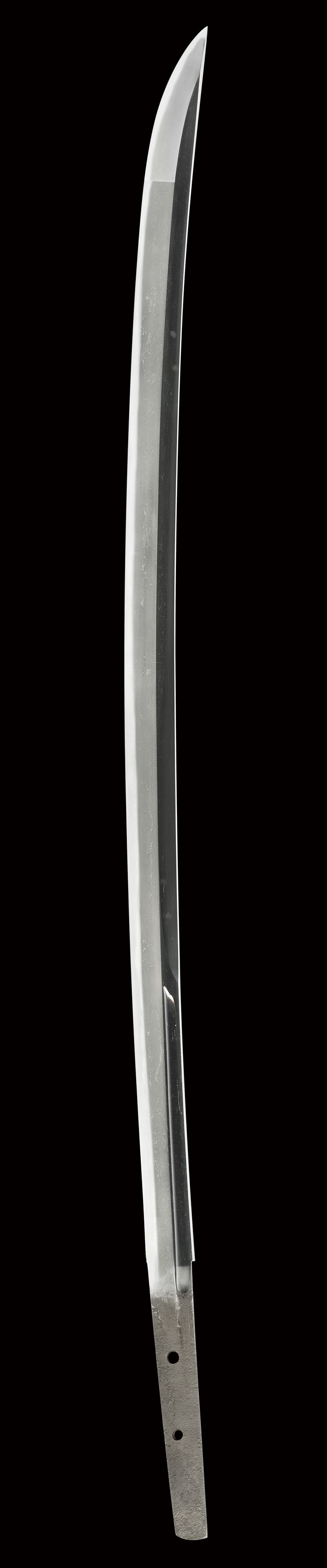
This is a katana attributed to Rai Kunizane, a prominent smith of the Rai school in Yamashiro province during the late Kamakura period. The blade features a wide, muscular torii-zori shape, ko-itame-hada mixed with mokume, and a bright suguha-chô hamon. It is accompanied by an Edo period uchigatana-koshirae with a vermilion saya, a signed Akasaka Tadatoki tsuba, and Misumi school fuchi-kashira.
NihontoWatchmumei · Rai School · Kôtô – Late Kamakura Period (shôwa era: 1312~1317) · nagasa 68.5cm · sori 1.9cm
Rai (Yamashiro, Kyoto) · Yamashiro · around 1334-1370
Fujishiro Jo saku
1 piece on the market now
Rai Kunizane is one of the smaller names of the Rai school of Yamashiro, transmitted in the swordbooks as a son or pupil of Rai Kunitoshi, the younger brother of Rai Kunimitsu and the elder brother of Rai Tomokuni, working in Kyoto from the close of the Kamakura period into the Nanbokuchō. His record is almost entirely a question of two faces, and the published sources state the genealogy itself with caution: the Meikan gives him the Shōwa era and lists separately a smith of the same name placed before Kenmu, while the commentary observes that the received descent appears strained in both its workmanship and its chronology, so that a first and a second generation must be assumed from the works themselves. He is, in the end, less a single documented hand than the connoisseurship convention by which a particular kind of refined Rai work has been preserved.
The characteristic Kunizane that a collector meets is the ō-suriage, mumei katana attributed to him from old times, and it is read first in the jihada. Over a well-forged itame, at times a tightly packed ko-itame mixing in mokume and flowing nagare, the grain tends to stand a little, thick ji-nie adheres in fine grains, chikei enter frequently, and on the ji a faint nie-utsuri or pale utsuri often rises. The published sources call this a steel that resembles Rai Kunimitsu yet, in their own words, is “similar to Rai Kunimitsu though falling somewhat short of him”[[c:1]], the standing grain and the quiet nie-utsuri marking the manner that carries the Rai jigane a step into the Nanbokuchō rather than holding to the bright, closely-packed Yamashiro ji of pure Rai.
Over that jigane he sets a suguha-toned line, broad or medium, into which ko-chōji, ko-gunome and a small midare enter. Ashi and yō work abundantly, ko-nie adheres well, the habuchi breaks into fine hotsure and at times a nijūba tendency, and kinsuji and sunagashi run through, the nioiguchi by turns tight and clearly bright. The bōshi runs straight to a small round, or enters midare-komi and sweeps with vigorous hakikake, on the more flamboyant pieces becoming pointed and flame-like. The decisive point of the attribution is one of degree, not of kind: the temper is the calm Rai register, but its midare appears in a smaller-patterned design than Kunimitsu's, and the published commentary turns that very observation into the rule, judging such a work to be “similar to Rai Kunimitsu though slightly lower in rank” and concluding that “within the group it is most appropriate to appraise it, as tradition has it, as the work of this smith”[[c:2]].
The other face is the signed work, and it is the rarer and more puzzling. Signed pieces are exceedingly few, chiefly hira-zukuri wakizashi and tantō, wide in mihaba and sun-nobi for their length, thin in kasane with a shallow sori, the typical Nanbokuchō shape, the three-character signature cut somewhat large below the mekugi-ana. Their forging is itame with mokume, flowing and slightly standing, with ji-nie well adhered, but their temper departs from the mainstream attribution: a suguha tone broken by notare and ko-gunome, the nie in places strongly thick, the edge running into hotsure, uchi-noke, a kuichigai-ba effect, nijūba and yubashiri. Several carry an “all-over” hitatsura-like temper that, in the published sources' phrase, shows “a burnt-looking manner approaching the workmanship of the Hasebe group”[[c:3]]. From this the commentary on the signed tachi and wakizashi concludes that “one is compelled to judge them works of the Nanbokuchō period”[[c:4]], and it is this gap between the calm mumei attributions and the flamboyant signed pieces that sustains the standing question of a first and a second generation of the name.
What sets the Kunizane attribution apart from its neighbours is exactly what the judges name, and they take care to draw it from his own work rather than from the comparand. He stands within the Rai school beside Rai Kunimitsu and Rai Kunitsugu, carrying the Yamashiro manner forward; his is the refined Rai suguha read as a step below Kunimitsu in rank and smaller in the pattern of its midare, the faint nie-utsuri on a slightly standing itame his recurring tell. One signed katana with a Hon'ami gold-inlay breaks instead into a chōji-midare mixed with gunome, the undulations tightly clustered and muneyaki intermingled, which the commentary reads as the Rai tradition of Kunimitsu and Kunitsugu carried with a forceful spirit; the hitatsura-leaning pieces, with tobiyaki and yubashiri gathering toward the monouchi, are where it locates his individuality. The attribution is therefore a careful one, made by stylistic level and bearing within the school rather than by a single inimitable trait.
For the collector he is an accessible Rai name with a quietly distinguished provenance. Fujishiro grades him Jō saku. He has no National Treasures and no Important Cultural Properties; his record runs entirely through the Jūyō rank, twenty-five blades in the Jūyō tier, most of them ō-suriage mumei katana bearing gold-inlaid Hon'ami attributions, the published sources calling several of these especially superior among works attributed to him and sound in both ji and ha. Signed examples are the prize and the scarcity, so few that the commentary on one Jūyō wakizashi calls it “exceedingly valuable material for understanding the workmanship of this so rarely signed smith”[[c:5]]. His blades carry good nikuoki and a documented descent through the daimyō houses, among them the Sakai of Maebashi and Himeji, one katana bestowed on Sakai Tadataka in 1745 as a gift marking the retirement of the eighth shogun Tokugawa Yoshimune and thereafter held by the family, with further pieces transmitted in the Nabeshima and Shimazu houses and examples now in the Ise Jingū Chōkokan, the Tokyo National Museum and the Tokyo Fuji Museum. Because all of his record sits in the tradeable tier, a Kunizane katana is not beyond reach in the way a Kunimitsu of the first rank would be; a signed piece, on the other hand, comes to light only seldom, a notable thing for a collector to encounter and a document of how the Rai school carried itself into the Nanbokuchō.
Where Kunizane stands among comparable artisans: across all of nihontō, and within tradition, era, and period. The tiers (Foremost · Leading · Major · Notable) weigh official designations from the NBTHK and Japan's Agency for Cultural Affairs, together with historical honors of lasting repute such as the Sansaku and Meibutsu-chō.
Select a lens to see how it's measured.
Yamashiro-den · Yamashiro
46 pieces on the market now
A calm, lustrous steel is the first thing the connoisseur's eye is meant to settle on with the Rai school: a finely forged ko-itame (小板目) worked until it is dense and refined, over which the ji-nie lies thickly in minute particles, fine chikei (地景) enter, and a nie-utsuri rises in the ji. This bright, refined jihada, the surface the trade reads as Rai-hada when its softer, looser patches intrude, is the constant beneath every manner the house produced. The school took shape in Kyoto in the mid-Kamakura period around the workshop of Rai Kuniyuki (來國行), the de facto founder of the line, whose chronology is reckoned from the Koan 1 (1278) tachi of his transmitted son. From Kuniyuki the Yamashiro-den tradition of late Kamakura was built, carried by Niji Kunitoshi, the two-character 國俊, traditionally his son and the nearest of the house to his hand; by the three-character Rai Kunitoshi, the first to crown his name with the character Rai, a practice all who followed took from him; and onward through Rai Kunimitsu (來國光), Rai Kunitsugu (來國次) and the lesser names Kunizane, Tomokuni, Kunihide and Mitsukane into the early Nanbokucho period. Whether the two Kunitoshi are one smith or two remains the classic open question of the school, argued from a span of dated work running about forty years from Koan 1 to Genko 1 (1321). What unites the house is a temper of restraint and activity at once, its life carried in the nie rather than in the height of the pattern. Against Kuniyuki's wide, suguha-toned ha and against the refined chu- or hoso-suguha of the three-character line, the smiths mix ko-choji, ko-gunome and small midare; ashi and yo enter densely, often as the Kyoto-style kyo-sakaashi (京逆足) that slants back toward the nakago, the opposite of the Bizen direction; the nioiguchi runs deep and bright, ko-nie attaches thickly, and kinsuji and sunagashi move through the body of the ha. The boshi is the school's most misjudged trait: a ko-maru drawn out by hakikake, the brushed nie of the point continuing the work of the ji below, often falling into midare-komi with a pointing tip. Muneyaki along the back recurs often enough that the records name it a habit of the Rai hand, and carving in the groove, suken or gomabashi with an added side hi, is a practice the texts call peculiar to Rai work. The strength of the nie within the ha, the utsuri rising as a nie-utsuri, and the kyo-sakaashi are precisely the marks that part Niji Kunitoshi's choji-dominant midare, which the old books said resembles the Bizen Ichimonji, from the Ichimonji itself.
Where the early masters keep this calm Kyoto register, the late line bends toward Soshu-den: Kunitsugu, counted among the Ten Brilliant Pupils of Masamune and named Kamakura-Rai, shows the strongest nie of ji and ha in the whole school, a notare mixed with gunome the earlier Rai never had. For a collector the house style is the recognition tool. An unsigned, o-suriage katana settles to Rai when the packed ko-itame, the fine nie over it, the standing utsuri and the kyo-sakaashi read together; the named smith is then fixed by degree. Niji Kunitoshi and the three-character Kunitoshi, both graded Sai-jo saku by Fujishiro, anchor the canon, the latter unusually approachable because his signed work is abundant and roughly half of it tanto, late Yamashiro work in its purest form. Kunimitsu, the most prolific and most versatile of the house, gives the impression of surpassing his father in force; Kunitsugu, graded Jo-jo saku, is the Soshu-facing edge whose signed tachi are scarce. Mitsukane, the Chudo Rai who withdrew to forge on Mt. Hiei, stands apart as the strong pole, his ji-nie laid thicker than Kunitoshi's or Kunimitsu's and likened upward to Awataguchi Yoshimitsu; the smaller Kunizane, Tomokuni and Kunihide carry the jigane a step into the Nanbokucho. The provenance roll is of the first rank, with blades worn by Ieyasu and held beside the Honjo Masamune, meibutsu such as the Aizen Kunitoshi, the Torikai Kunitsugu and the Midare-Mitsukane, and descent through the Owari and Kishu Tokugawa, the Maeda, Uesugi and Shimazu houses. Much sits locked as National Treasure and patrimony, yet the Juyo tier of the major names, and the whole record of the minor hands, remains a goal a serious collector can actually reach. Learn more →
| Smith | Era | Designated |
|---|---|---|
| Kuniyuki國行 | 1259-1260 | 125 |
| Kunitoshi國俊 | 1278-1288 | 79 |
| Kunitsugu國次 | 1311-1327 | 65 |
| Kunimitsu國光 | 1326-1351 | 259 |
| Kunitoshi國俊 | 1288-1319 | 196 |
Yamashiro in the Kamakura period
Power sat in Kamakura, but taste was still made in Kyōto. The Awataguchi school’s pear-skin steel became a byword for perfection, and the Rai line supplied dignified tachi to the court, senior warriors, and the great temples alike.
A blade of top-grade workmanship and condition, formally judged to rank with a nationally recognized Important Art Object (Jūyō Bijutsuhin). Awarded only at the NBTHK’s competitive annual examination.
Of Japan’s roughly 2.5 million registered swords, only 12,307 (about 1 in 203) have ever attained Jūyō.
The NBTHK (Nihon Bijutsu Tōken Hozon Kyōkai, the Society for the Preservation of Japanese Art Swords) is a public-interest incorporated foundation founded in 1948 and supervised by Japan’s Agency for Cultural Affairs (Bunkachō); it is based at the Japanese Sword Museum in Tokyo. Its expert panels physically examine each submitted work (shinsa) and issue a certificate (kanteishō) ranking it by artistic and historical merit. NBTHK papers are the most widely recognized standard of authentication for Japanese swords and fittings.
NBTHK official siteAll swords come with a three-day inspection period beginning from the date of delivery. If not satisfied, the sword may be returned within this period for a full refund of the purchase price. Outside of this period, all sales are final. Swords purchased on a layaway payment plan are not eligible for the three-day inspection period.