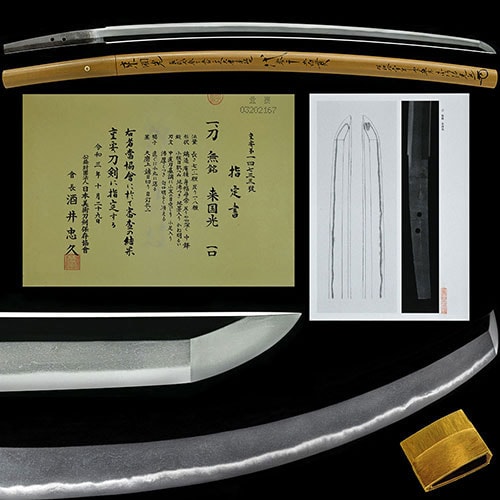
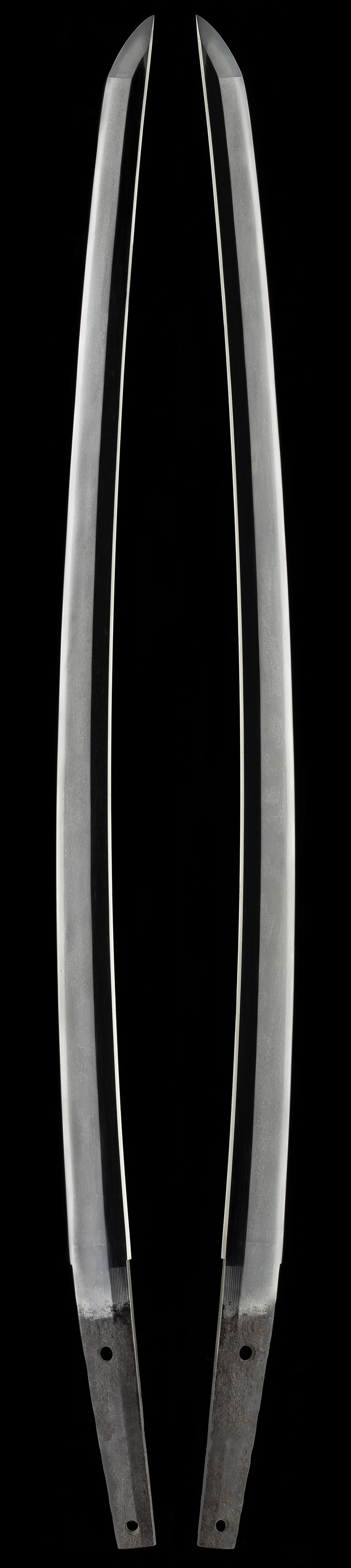
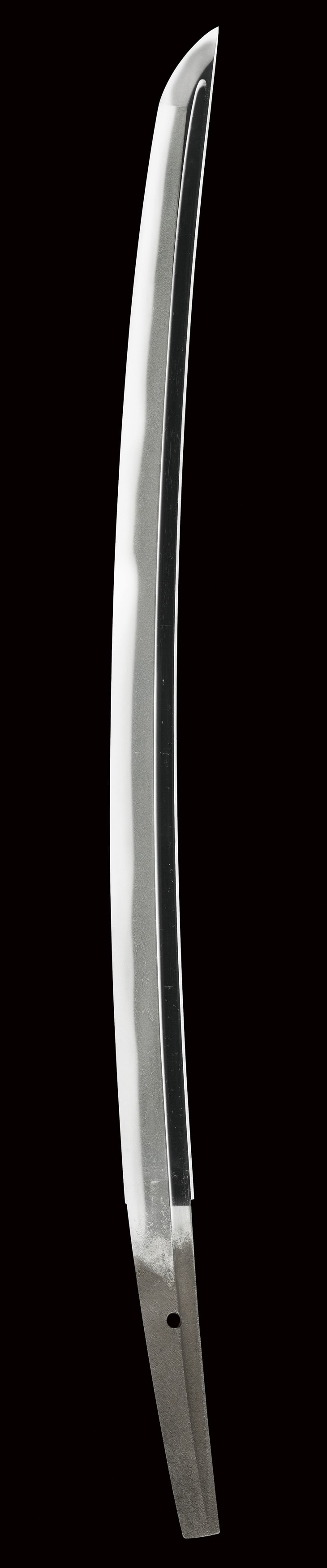
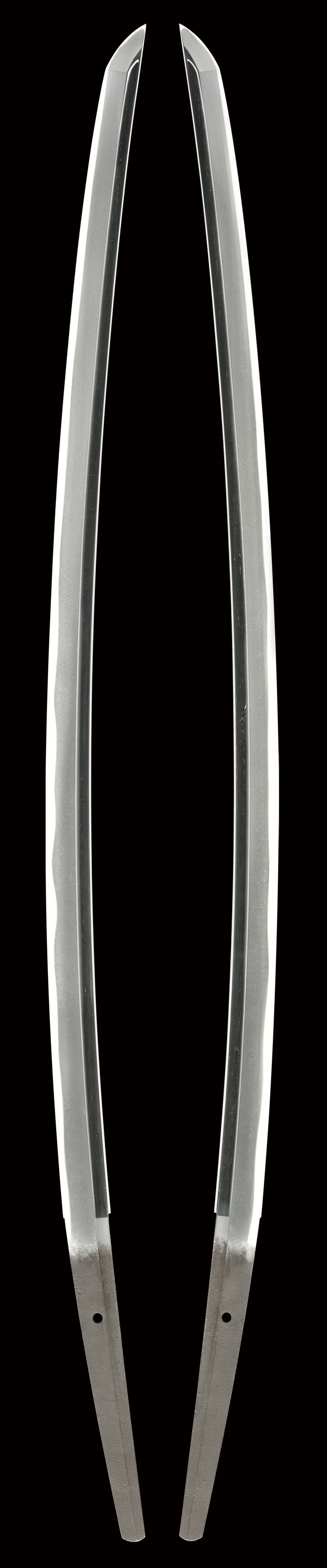
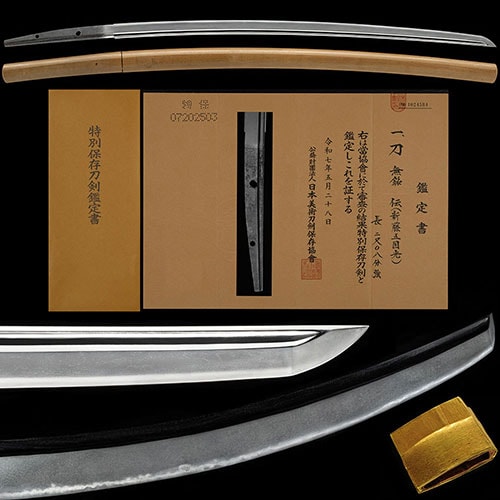
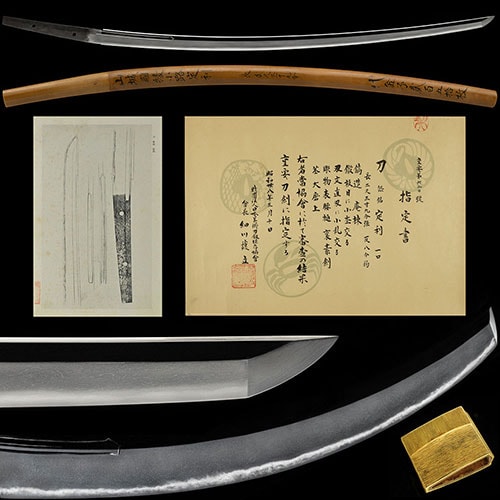
On the recorded in the -cho as the Torikai Kunitsugu (鳥養国次), the writes that the work of Kunitsugu shows "the strongest of and within the whole school", and that single judgment carries the essence of the smith. The published sources place him at the very end of the period, his activity reaching into the first years of , where he stands beside Kunimitsu, his slight senior, as one of the two masters who bring the mainline to its close. His genealogy is unsettled across the published record: the usual account makes him a pupil of Kunitoshi, one account a cousin of Kunimitsu, others the son of Kunitoshi or Kunimitsu's younger brother. From of old he has been counted among the Ten Brilliant Pupils of Masamune (正宗十哲) and carries the name "-", a name the published sources explain by the manner of the work itself.
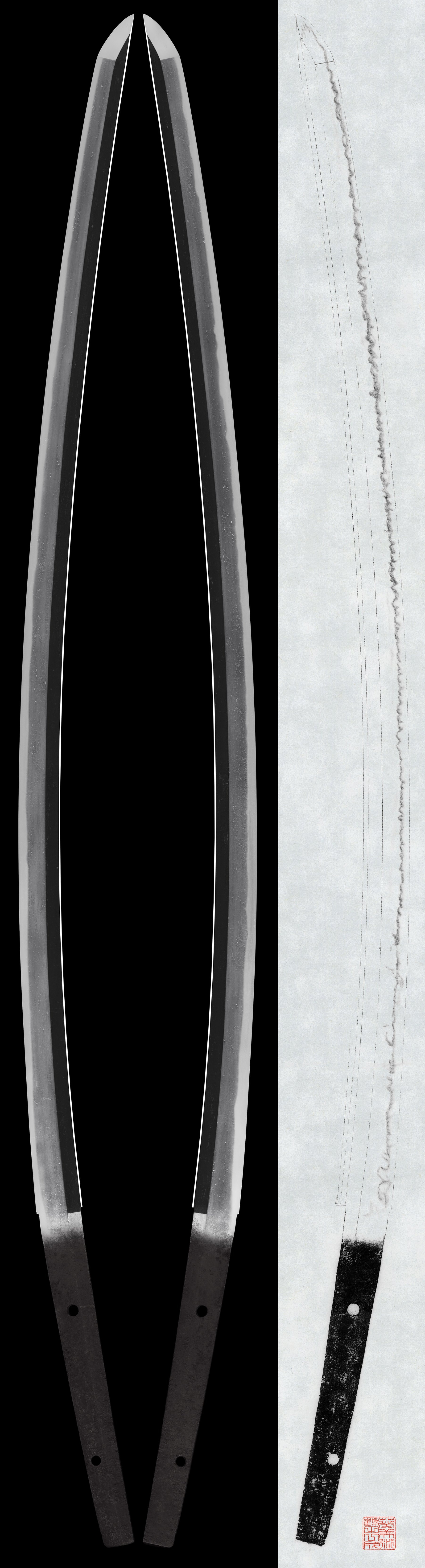
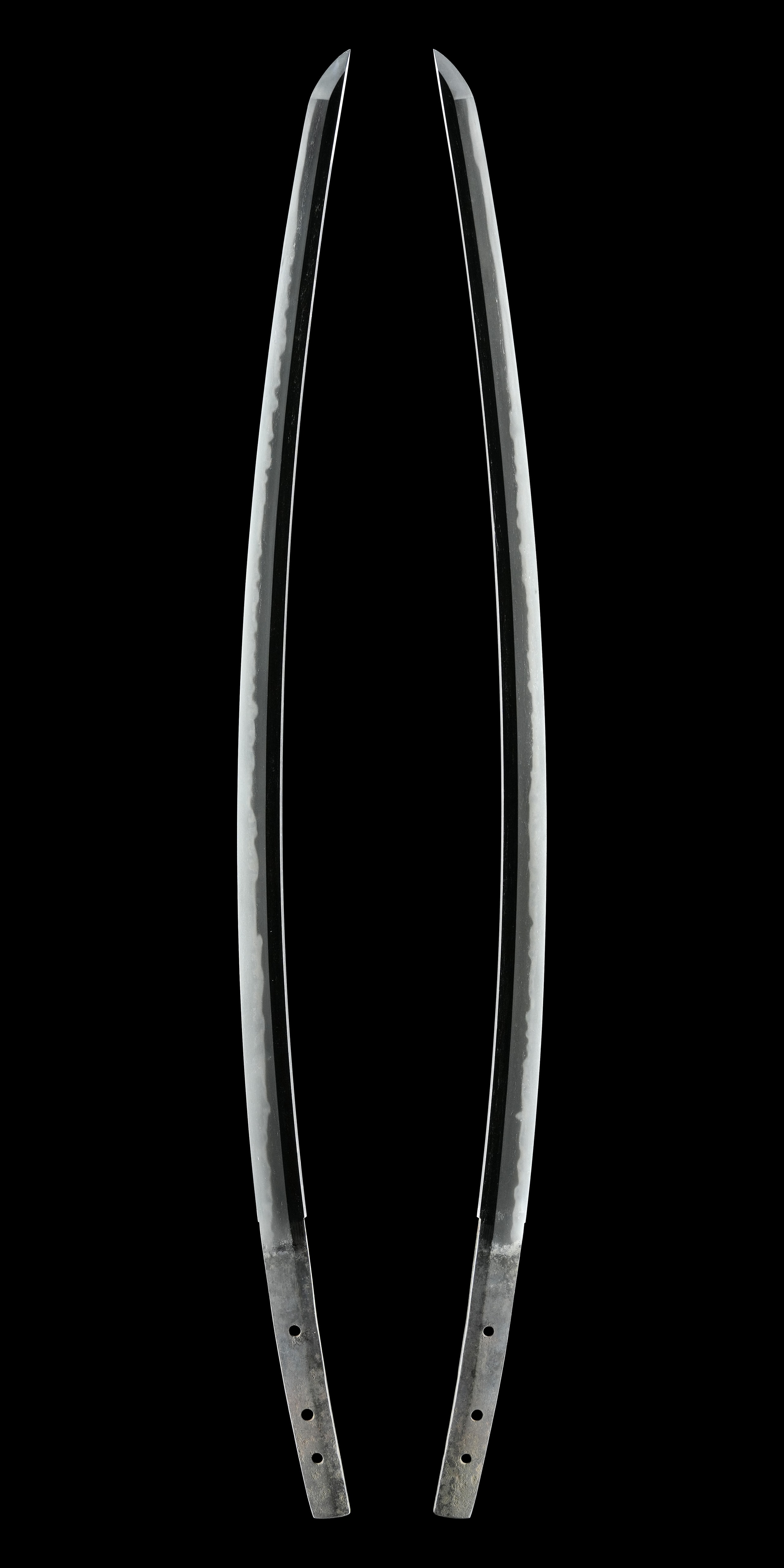
That manner is a the earlier never showed: a -dominant temper of mixed with , the thick and bright, and sweeping through the , drifting along the . The sets thick over and weaves in frequent , in places standing slightly. The recurring verdict of the published sources is that this is a workmanship "strongly shaped by the influence of -", and the comment of Honma recorded against another of his Bijutsuhin holds the line, that within the school the of his and is conspicuously strong. Even an absence points the way: compared with general work, his shows fewer of the soft - patches typical of the school. The of this register runs or with a pointed tendency, often swept with .
Beneath the color the stays . The forging in his finest pieces is a packed , the fine and thick, entering finely, and a pale rising over the , the anchors that keep the work Kyoto. His most numerous surviving class is the wide , often in a deep wa-zori with the extended. On these blades a -toned base mixes and ; and enter long, thick and without pause; the sits deep into the , and run, and -like plays at the edge. The deciding point is stated outright in the published sources: where the and are unusually bright and the strong, "if one fixes on the point that the stand out within the , an attribution to Kunitsugu is judged proper". One is described as reading "just as though the he tempers on his had been rendered on a long blade".
His signed work is nearly all and ; the published sources repeat that surviving are scarce, and that and survive only in the rarest examples. The are signed below the at the center of the with a large, thick-chiseled three-character , while the slender signed with high carry an elongated, finely chiseled, smaller signature that the reads as his early hand, valued for showing the change of his manner over time. A minority of works keeps the older style unaltered, a quiet with , the at ordinary strength; the handed down in the Uesugi house is called "a calm register that holds faithfully to the tradition", and such work is noted as extremely rare for him. Dated pieces are nearly absent: the of Karyaku 2 (1327) is his earliest surviving date, worked, as with other smiths of the period, in ; a of Shokei 1 (1332) also survives, and Gentoku dates are known only from the old sword albums. On the tradition that he studied under Masamune the itself is careful: since Kunimitsu too at times shows the -strong manner, it writes, to affirm the pupil legend from the style alone would be "premature".
The comparison that fixes his place is drawn against Kunimitsu. Kunimitsu also left work beside his traditional , but in his case, the published sources observe, the far outnumber the , and "Kunitsugu is the opposite". One text goes further, judging that he carries the even beyond the -emphasized of his senior, a manner the earlier never had. Among the forebears of the line, Kuniyuki, Niji Kunitoshi, Kunitoshi and Kunimitsu, he is the one who retains the least of the traditional Kyoto style, which is exactly why the old Masamune-pupil account drew attention. The judges also leave him room: various atypical pieces (変り出来) are acknowledged within his work, and his few signed differ among themselves. With Kunimitsu he carries the mainline to its close in early , and the - name marks his position as the school's -facing edge.
Fujishiro grades him Jo-jo . One of his blades is a National Treasure and four are Important Cultural Properties, patrimony preserved wholly outside the market; beneath them stand fourteen and forty , fifty-four blades in those two tiers, out of sixty-five designated works on record, twenty-nine of them signed against thirty-six unsigned. The Torikai Kunitsugu itself was certified Bijutsuhin in 1933. The provenance roll is of the first rank: the published sources single out the famous handed down in the former shogunal house and in the Maeda house; another , recorded in the Tokugawa Jikki, was presented by the shogun Tokugawa Tsunayoshi to Yanagisawa Yoshiyasu in Genroku 15 (1702); a passed from Matsudaira Nobuyasu, Ieyasu's eldest son, to his retainer Hiraiwa Chikayoshi; and descended in the Uesugi, Asano, Okubo, Nabeshima and Ikoma houses and in the Yamauchi of Tosa, whose blade went to the shogunal house as a memorial gift in Kyoho 5 (1720). Of recorded whereabouts today, examples rest in the Tokyo National Museum, the Sano Art Museum and the Hikone Castle Museum. For the collector the picture is that of a major master whose designated works are held far more often than they move: a or of the tier appears from time to time, a signed only rarely, and a piece of the order of the Torikai Kunitsugu can only be awaited as an event.