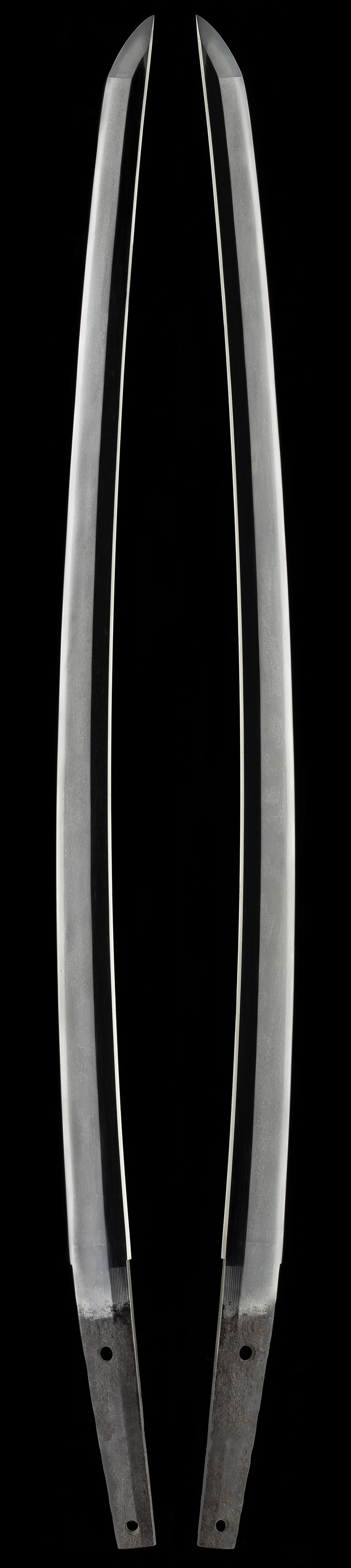
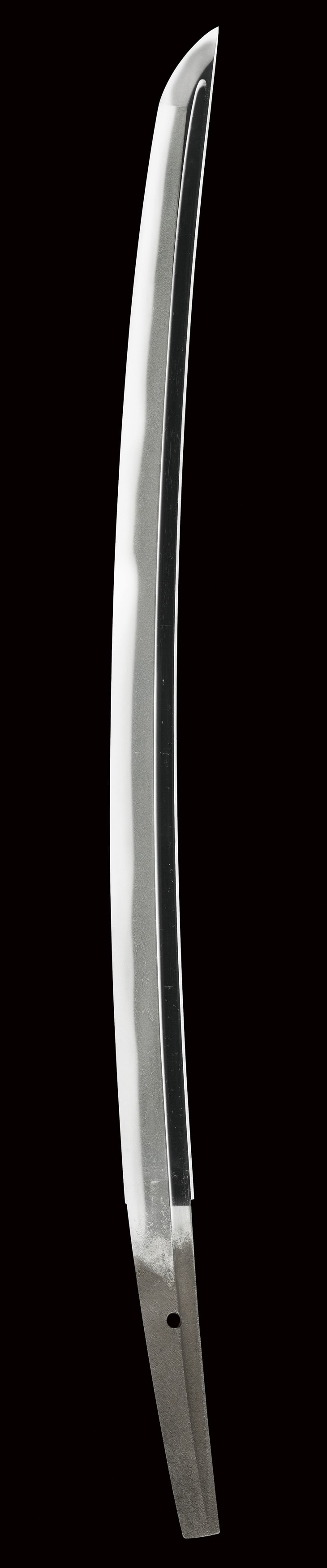
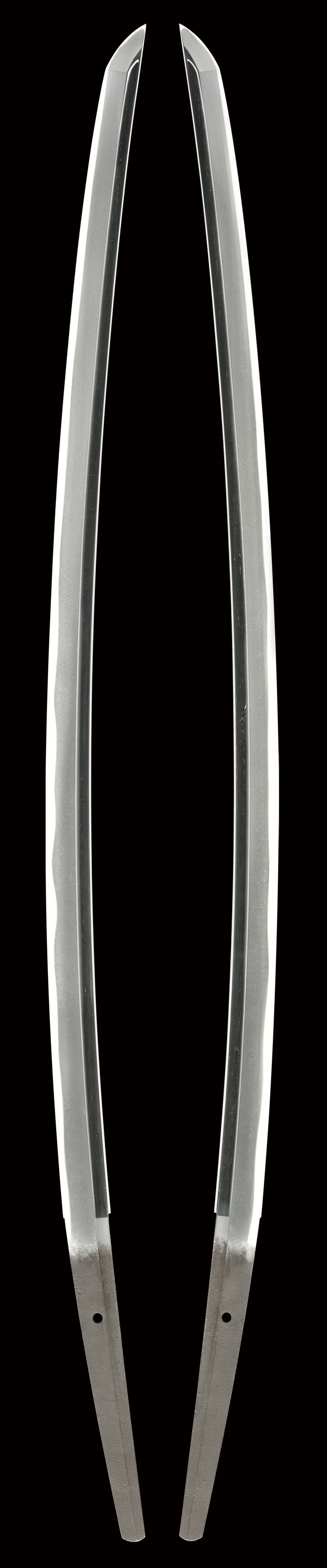
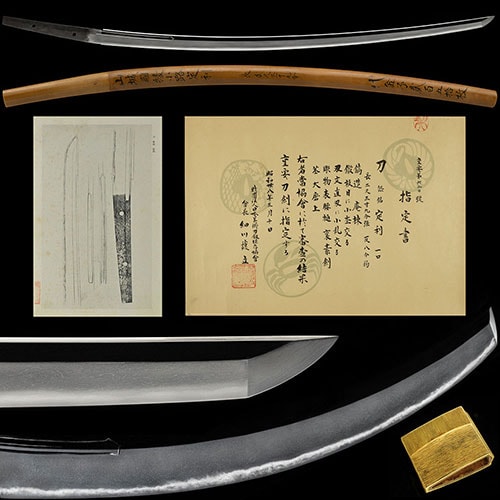
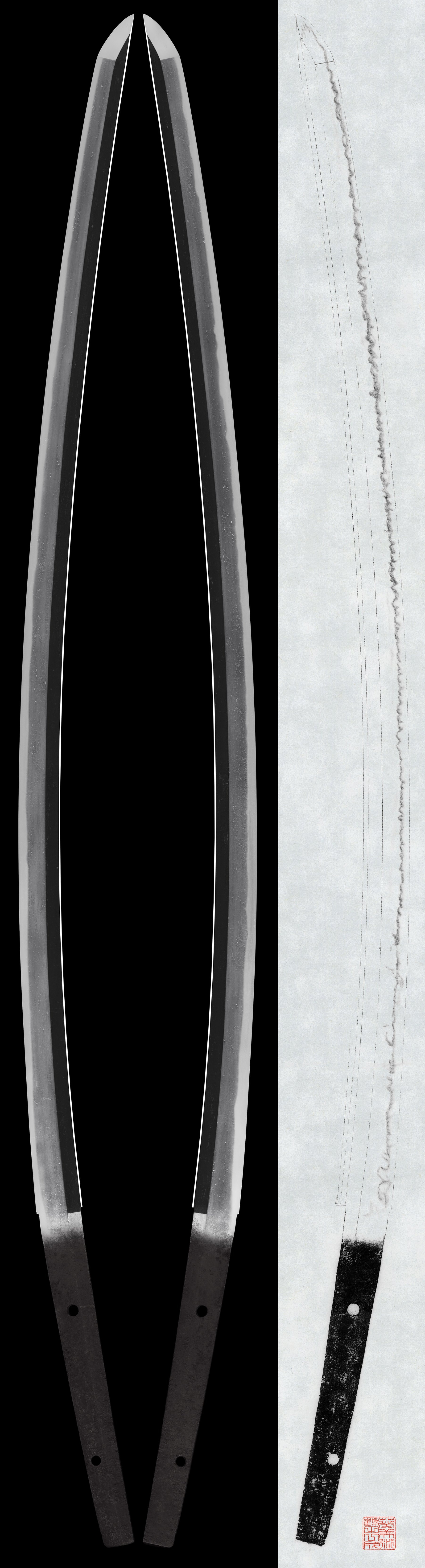
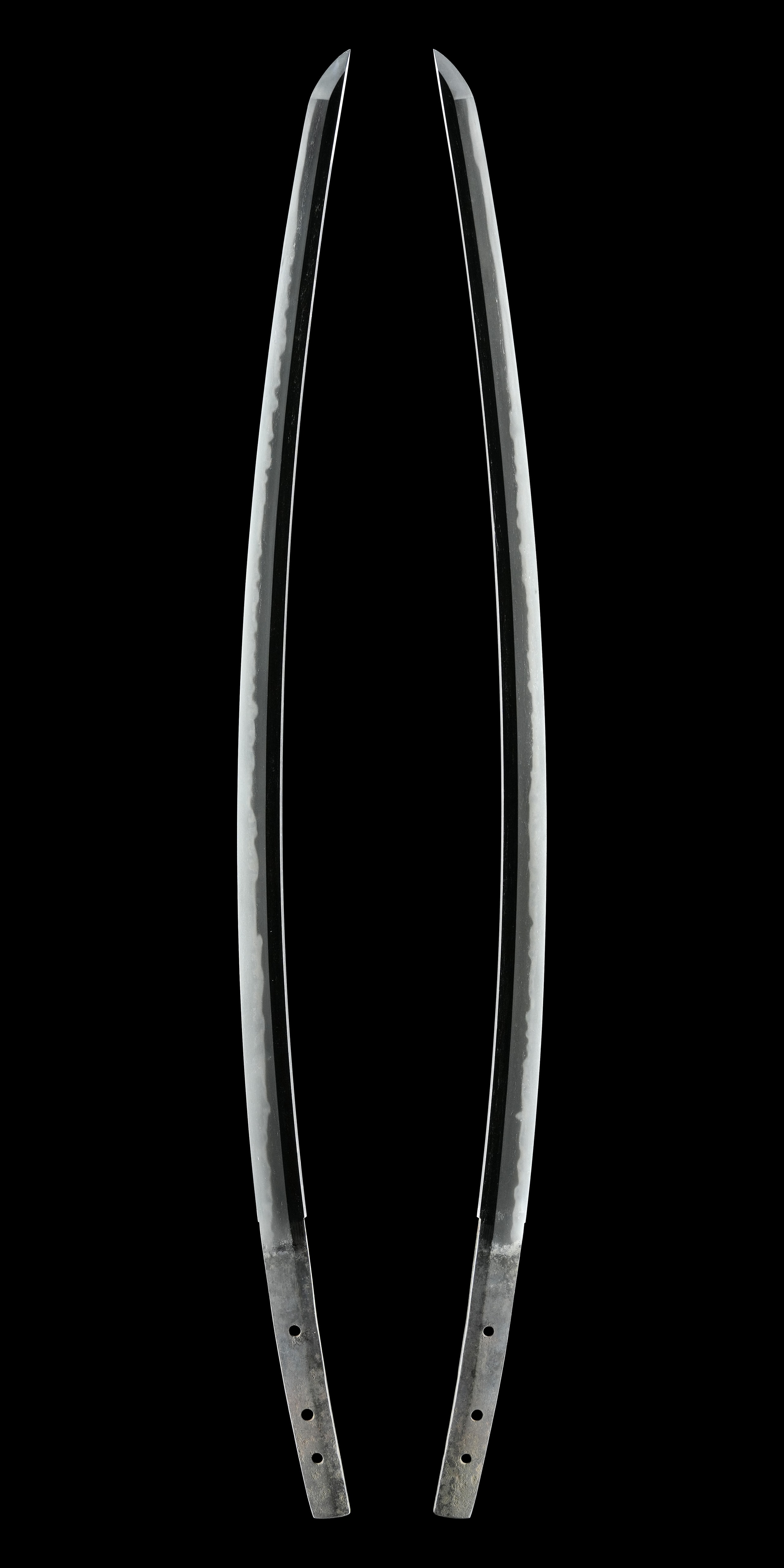
The dated works of Kunimitsu (来国光) run from Karyaku 1 (1326) to 'o 2 (1351), carrying the school of Yamashiro from the close of the period into the early period. By the prevailing tradition he is transmitted as a son of Kunitoshi, by some accounts a pupil, and the published sources observe that the smith with the most surviving works in the school is Kunimitsu himself. Their constant judgment reaches further: he is "the most versatile smith of the school, the one with the widest working range". The notes enumerate that range: beyond the traditional true of the Kyoto line, there are works on a base mixing and , works in with a slight tendency, works in a tone mixed with , and works whose is dominated by , spread across , and of equally varied form.
His most numerous work is the wide, robust , unsigned yet keeping the deep, evenly arched curvature the published record calls , the often a little extended. On these blades the temper is a or within which and stand apart; and enter thickly, and the runs deep, bright and clear. adheres richly, and fine pass through the , and the is with a turnback. The conspicuous presence of within the is the recognition point the sources state outright, the feature that separates his hand from Kunitoshi and Kuniyuki; of one such the writes that these features "clearly manifest the characteristic traits of Kunimitsu."
The is constant beneath all of his manners: a tightly packed under thick, dust-fine , with fine woven in and a standing in the , the steel bright and clear. Here and there a softer patch of appears, the so-called -, which the record treats as a tell of the school rather than a fault. On the Karyaku 2 dated the notes describe the near the taking on a -like appearance, entering as though drooping down toward the tempered edge, an aspect frequently encountered not only in his work but throughout the group.
His carry the two poles of the range most plainly. The small ones with , often bearing the simple, skillful and carvings the record calls most frequent in his work, follow the father so closely, down to the hardening over the , that they pass at first sight for Kunitoshi; a slender blade of this class is read as early work. The large ones run wide, and nearly without , and on them he tempers his , mixed with or -dominant patterns, in a step stronger than on his ; these, the sources write, resemble the work of his junior fellow pupil Kunitsugu, being "tinged with the color of the tradition and filled with bold spirit". The dated Karyaku 2 (1327) shows the manner already formed, and the largest of the class is the Aratami (新身来). The signatures follow the forms: "on the is comparatively small", cut low on the tang toward the , while on a bold three-character is placed below the ; his character for , the record adds, is cut in a form differing from that used by Kunitoshi. A chronology of the is established: those of the Karyaku and Gentoku years have a softness, the enclosing component characteristically rounded, while those of Jowa and 'o harden and the enclosure turns angular. The long working span and these changes of style and signature sustain an argument for a first and a second generation, which the Kokon Kaji Meizukushi divides around Gentoku to Kenmu and around Koei; yet the single-generation view remains strong, and the published sources leave the question as one that should await further study.
Set beside his father, the judges' formula is exact: compared with Kunitoshi he yields a little in the point of dignity, but gives the impression of surpassing him in force. His runs somewhat stronger, and the in the together with the and in the lend the work its vigor. Beside Kuniyuki he lacks the elder smith's expansiveness: the sits a shade tighter, crowd in, and the tends toward a point. The wide can pass at a glance for Kunitsugu, and there the record draws the line in a single sentence: against Kunitsugu his hardening sits a touch lower, and in the sharp with its thrusting tendency the individuality of this smith can be discerned. Even his standard can momentarily suggest the offshoot; of one such blade the notes say it can at first glance be confused with , but on careful examination proves a step superior. With Kunitsugu he carries the -tinged manner that closes the mainline into the period.
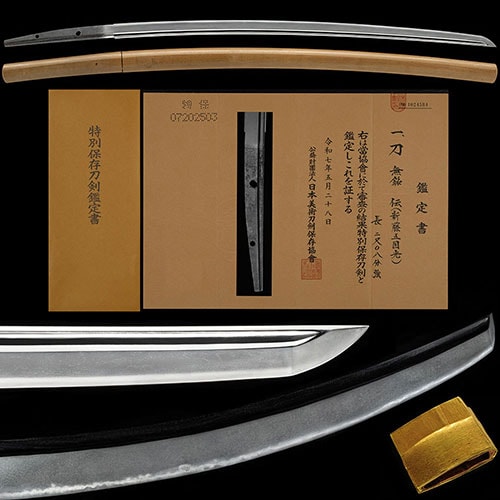
Fujishiro grades him Sai-jo , and 249 designated works stand on record: three National Treasures and twenty Important Cultural Properties, preserved as patrimony in museums, shrines and long-held collections, with twenty-three Bijutsuhin and 197 blades in the and tiers beneath them. Signed and unsigned works survive in nearly equal numbers, the mostly and , the largely and signed. Fifty-seven blades carry recorded provenance, and the roll is of the first rank: a the record calls "a worn by Ieyasu, treasured in the Tokugawa house together with the Honjo Masamune"; heirlooms of the Kishu, Owari and Mito Tokugawa, the Date of Sendai, the Maeda of , and the Kuroda, Shimazu, Asano, Hosokawa, Ikeda and Satake houses, with pieces from the Imperial Family; among the appraisals that follow them is an of Genroku 3 (1690) by Kotsune valuing one Owari Tokugawa blade at 500 . Holders recorded against his blades today include the Tokyo National Museum, the Kyoto National Museum, the Tokugawa Art Museum, the Sano Art Museum and the Seikado Bunko Art Museum. For the private collector he is not wholly beyond reach: blades in the and tiers remain in private hands and one appears on the market from time to time, though for a name of this rank such an appearance is infrequent, and an event when it comes.