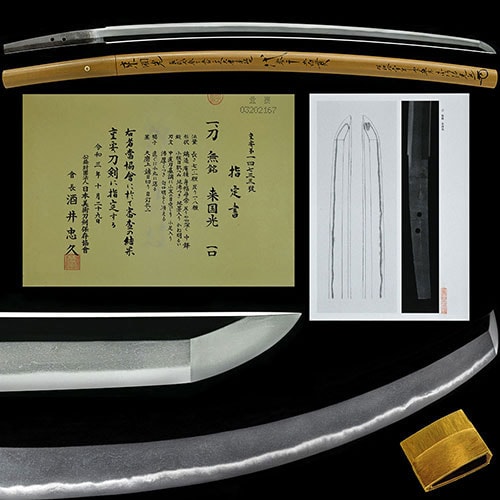
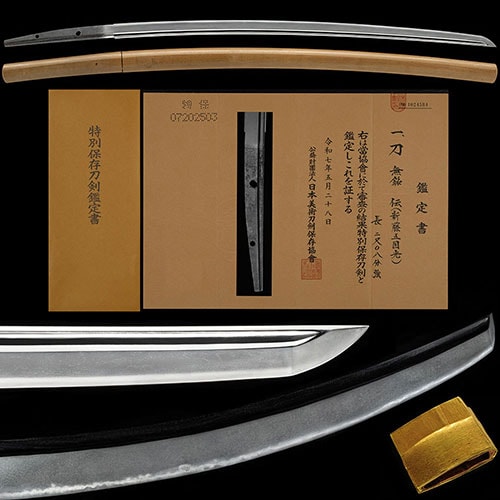
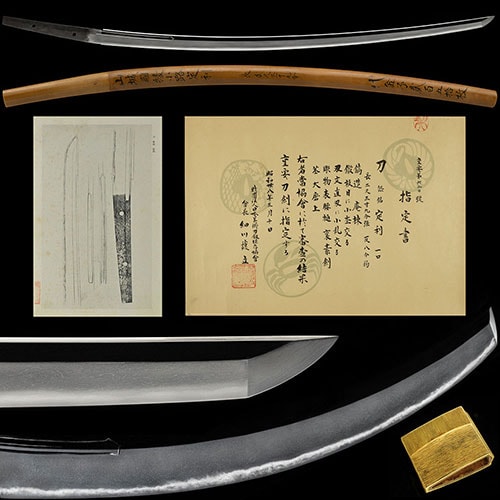
Kunizane is one of the smaller names of the school of Yamashiro, transmitted in the swordbooks as a son or pupil of Kunitoshi, the younger brother of Kunimitsu and the elder brother of Tomokuni, working in Kyoto from the close of the period into the . His record is almost entirely a question of two faces, and the published sources state the genealogy itself with caution: the gives him the Shōwa era and lists separately a smith of the name placed before Kenmu, while the commentary observes that the received descent appears strained in both its workmanship and its chronology, so that a first and a second generation must be assumed from the works themselves. He is, in the end, less a single documented hand than the connoisseurship convention by which a particular kind of refined work has been preserved.
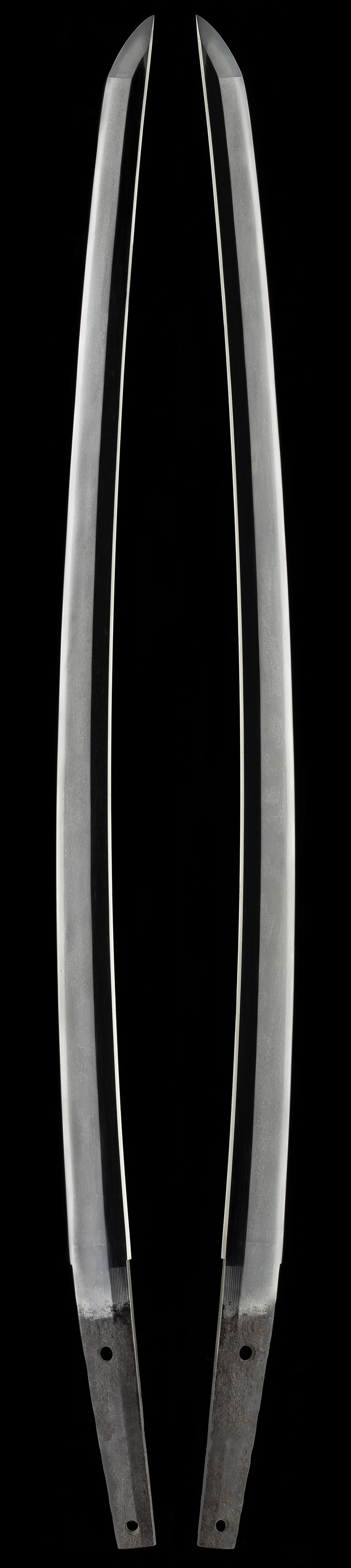
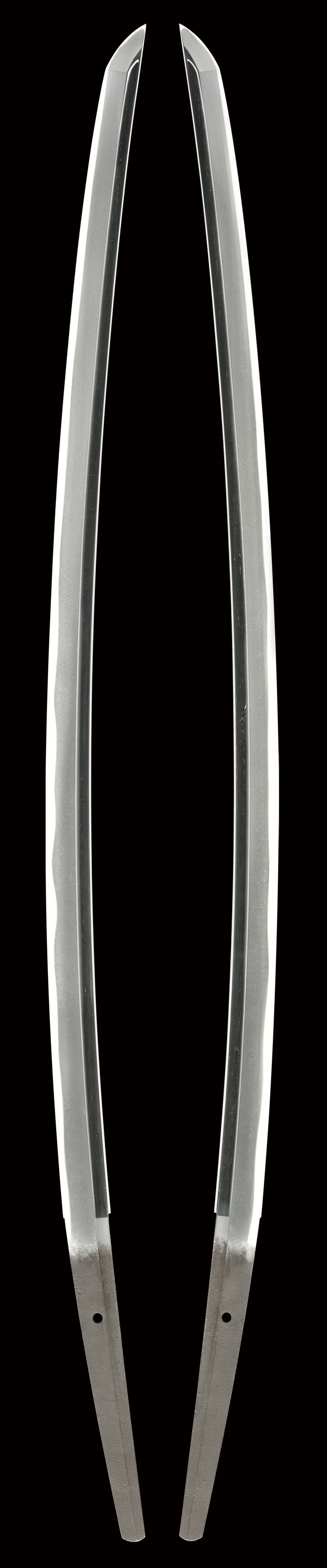
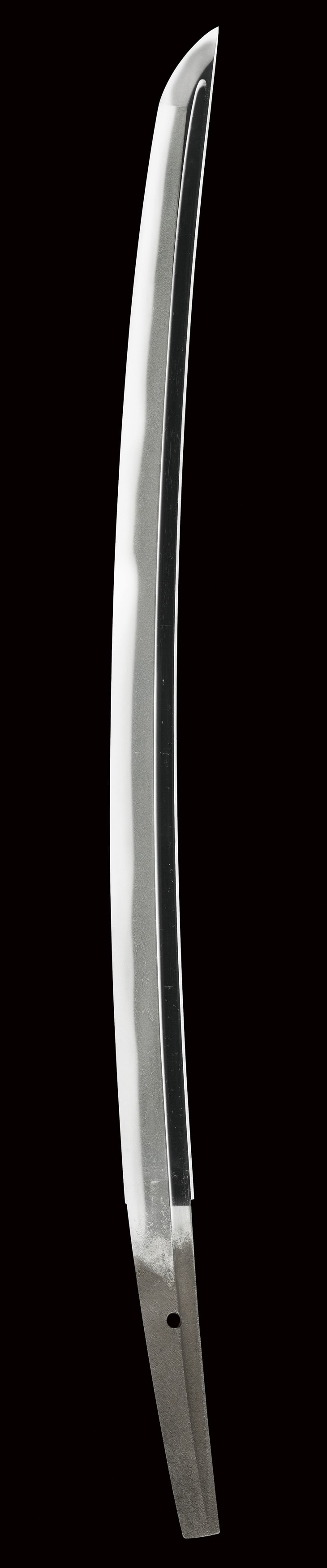
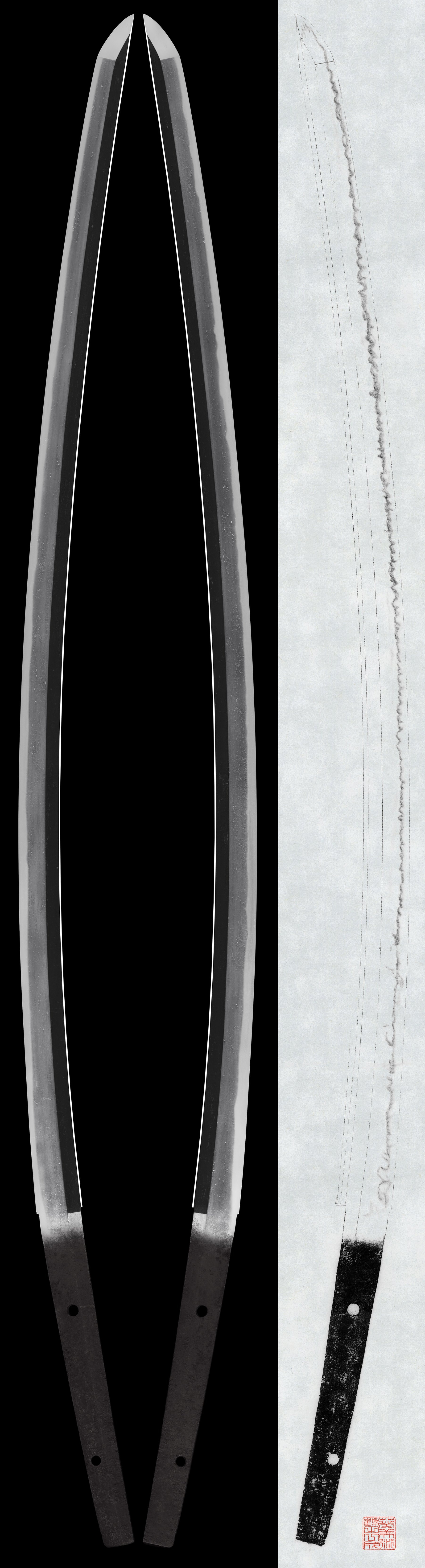
The characteristic Kunizane that a collector meets is the , attributed to him from old times, and it is read first in the . Over a well-forged , at times a tightly packed mixing in and flowing , the grain tends to stand a little, thick adheres in fine grains, enter frequently, and on the a faint or pale often rises. The published sources call this a steel that resembles Kunimitsu yet, in their own words, is “similar to Kunimitsu though falling somewhat short of him”, the standing grain and the quiet marking the manner that carries the a step into the rather than holding to the bright, closely-packed Yamashiro of pure .
Over that he sets a -toned line, broad or medium, into which , and a small enter. and work abundantly, adheres well, the breaks into fine and at times a tendency, and and run through, the by turns tight and clearly bright. The runs straight to a small round, or enters and sweeps with vigorous , on the more flamboyant pieces becoming pointed and flame-like. The decisive point of the attribution is one of degree, not of kind: the temper is the calm register, but its appears in a smaller-patterned design than Kunimitsu's, and the published commentary turns that very observation into the rule, judging such a work to be “similar to Kunimitsu though slightly lower in rank” and concluding that “within the group it is most appropriate to appraise it, as tradition has it, as the work of this smith”.
The other face is the signed work, and it is the rarer and more puzzling. Signed pieces are exceedingly few, chiefly and , wide in and for their length, thin in with a shallow , the typical shape, the three-character signature cut somewhat large below the . Their forging is with , flowing and slightly standing, with well adhered, but their temper departs from the mainstream attribution: a tone broken by and , the in places strongly thick, the edge running into , uchi-noke, a effect, and . Several carry an “all-over” -like temper that, in the published sources' phrase, shows “a burnt-looking manner approaching the workmanship of the Hasebe group”. From this the commentary on the signed and concludes that “one is compelled to judge them works of the period”, and it is this gap between the calm attributions and the flamboyant signed pieces that sustains the standing question of a first and a second generation of the name.
What sets the Kunizane attribution apart from its neighbours is exactly what the judges name, and they take care to draw it from his own work rather than from the comparand. He stands within the school beside Kunimitsu and Kunitsugu, carrying the Yamashiro manner forward; his is the refined read as a step below Kunimitsu in rank and smaller in the pattern of its , the faint on a slightly standing his recurring tell. One signed with a gold-inlay breaks instead into a mixed with , the undulations tightly clustered and intermingled, which the commentary reads as the tradition of Kunimitsu and Kunitsugu carried with a forceful spirit; the -leaning pieces, with and gathering toward the , are where it locates his individuality. The attribution is therefore a careful one, made by stylistic level and bearing within the school rather than by a single inimitable trait.
For the collector he is an accessible name with a quietly distinguished provenance. Fujishiro grades him Jō . He has no National Treasures and no Important Cultural Properties; his record runs entirely through the rank, twenty-five blades in the tier, most of them bearing gold-inlaid attributions, the published sources calling several of these especially superior among works attributed to him and sound in both and . Signed examples are the prize and the scarcity, so few that the commentary on one calls it “exceedingly valuable material for understanding the workmanship of this so rarely signed smith”. His blades carry good and a documented descent through the houses, among them the Sakai of Maebashi and Himeji, one bestowed on Sakai Tadataka in 1745 as a gift marking the retirement of the eighth shogun Tokugawa Yoshimune and thereafter held by the family, with further pieces transmitted in the Nabeshima and Shimazu houses and examples now in the Jingū Chōkokan, the Tokyo National Museum and the Tokyo Museum. Because all of his record sits in the tradeable tier, a Kunizane is not beyond reach in the way a Kunimitsu of the first rank would be; a signed piece, on the other hand, comes to light only seldom, a notable thing for a collector to encounter and a document of how the school carried itself into the .