NihontoWatch Mon

NihontoWatch

MarketAuctions
Encyclopedia
NihontoWatch Mon

NihontoWatch

MarketAuctions
Encyclopedia

Description

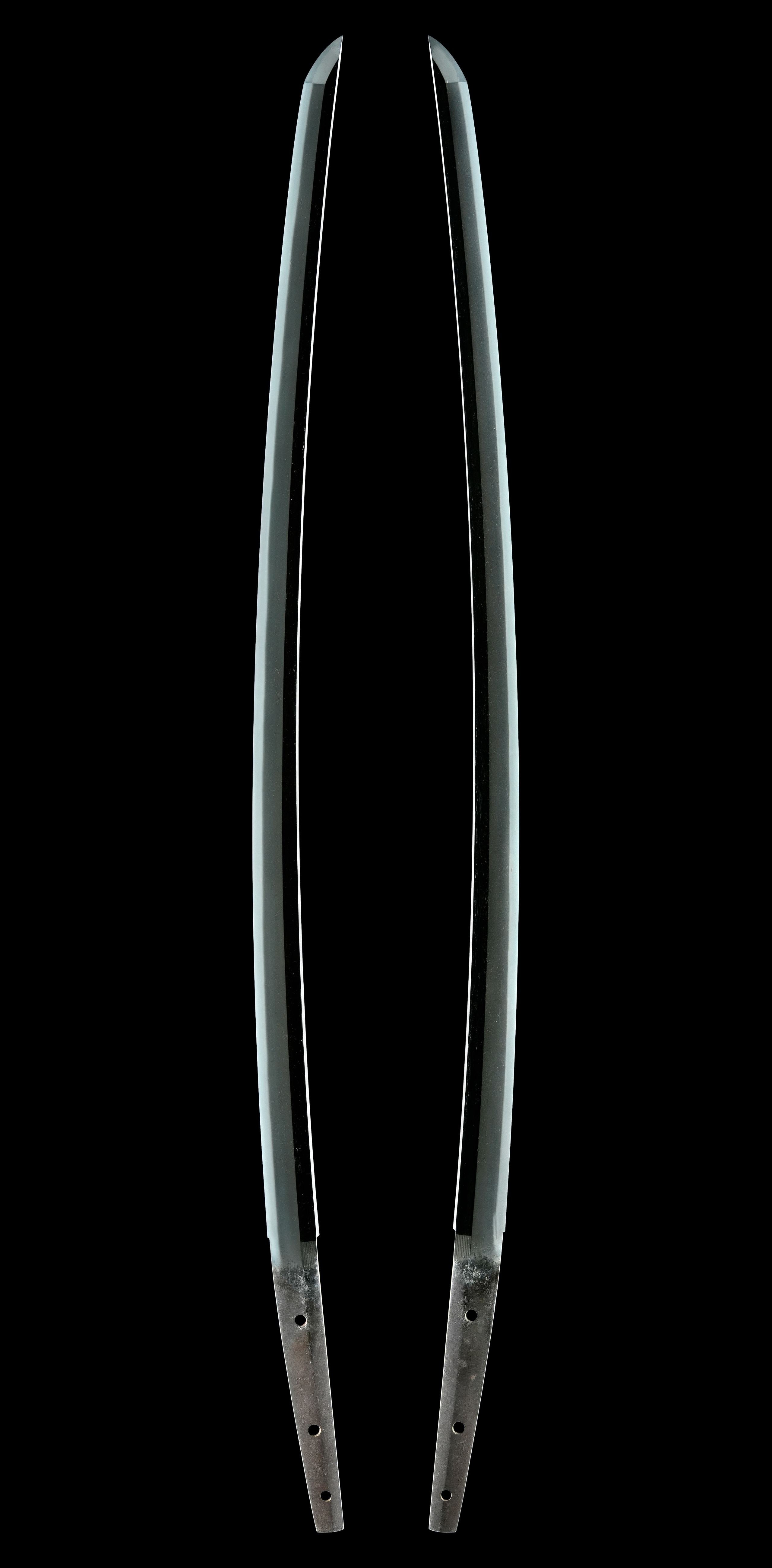
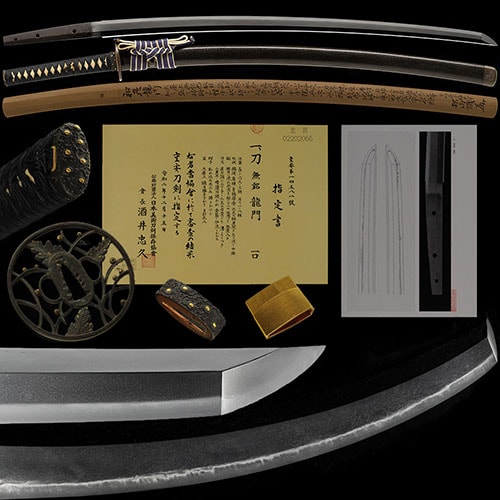
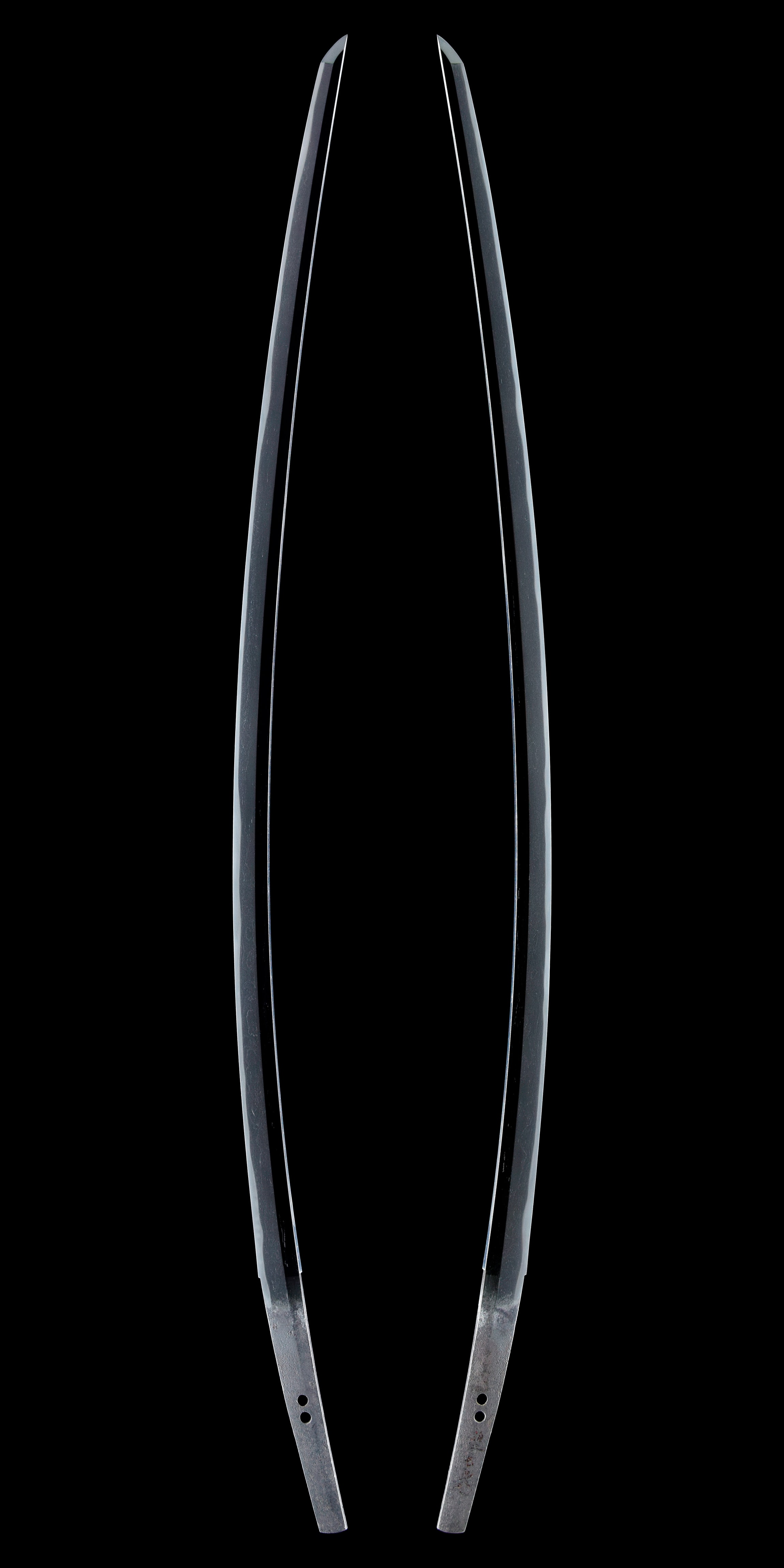
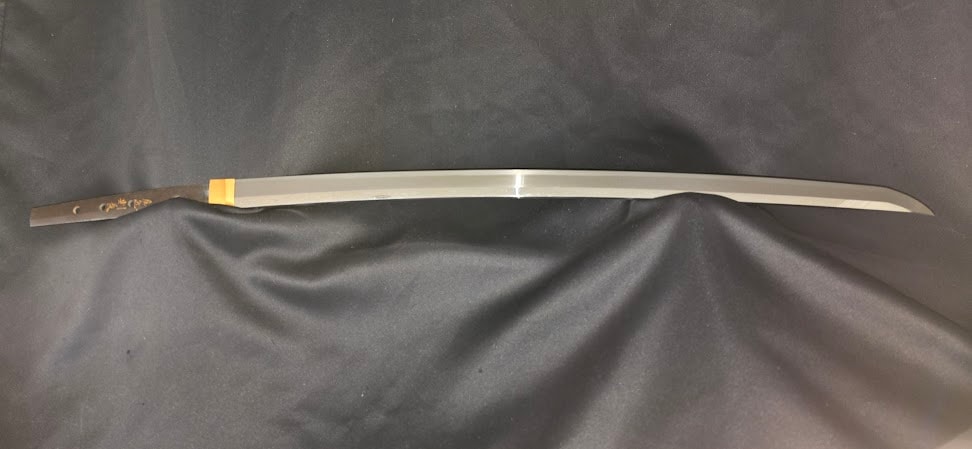
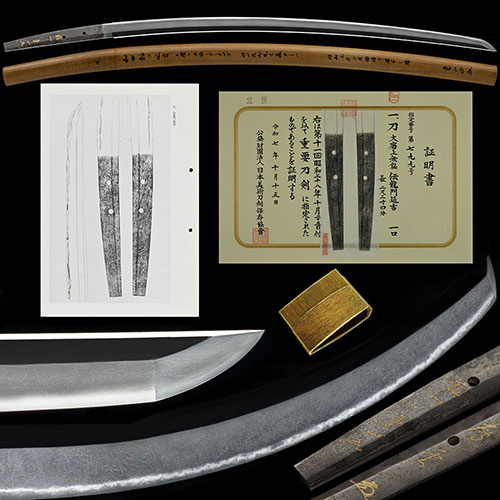
This is a katana by Ryumon Nobuyoshi, designated as a Juyo Token. The blade features a small-midare hamon with uchinoke and kuichigai-kakari, along with kinsuji. It is a dignified masterpiece from the late Kamakura period and was formerly owned by Sugiyama Shigemaru.

NBTHK Setsumei

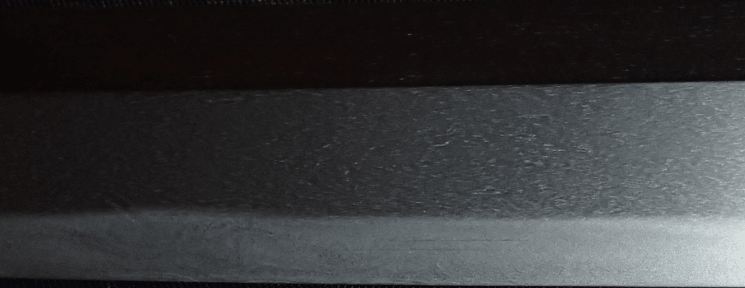
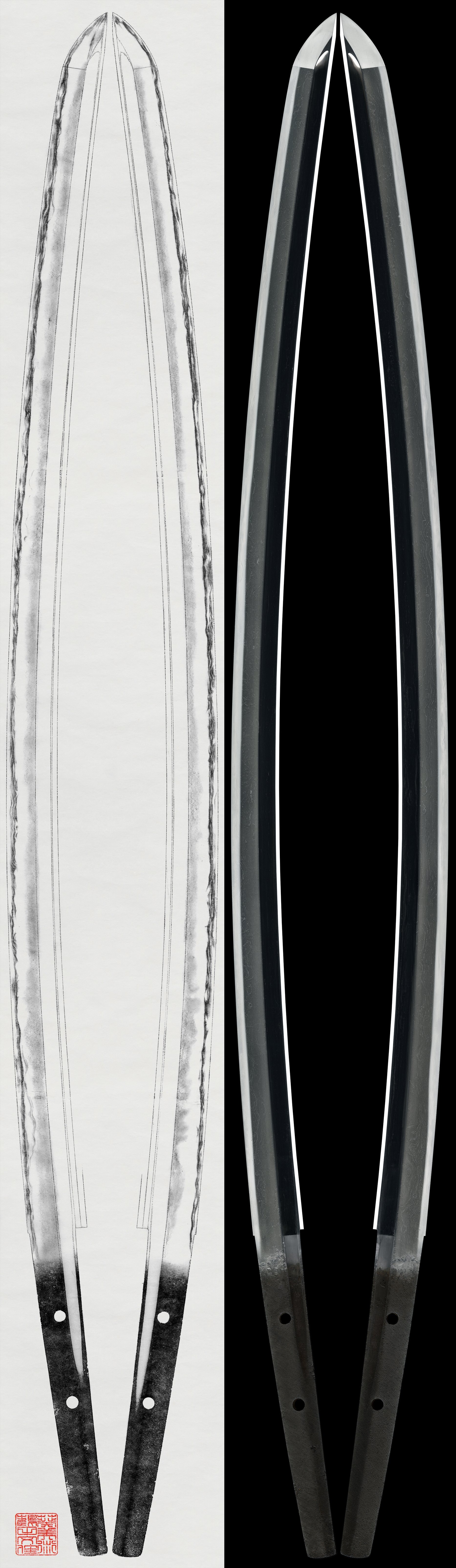
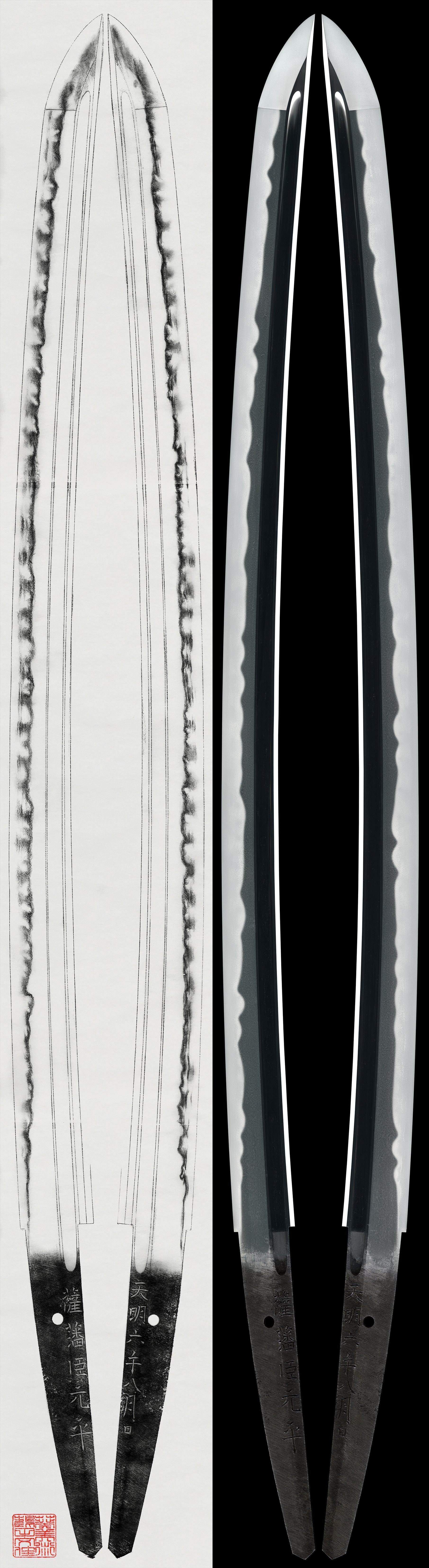
Jūyō-Tōken, 11th Session — Designated October 25, 1963 Katana, mumei: den Ryūmon Enkichi (龍門延吉) Measurements Nagasa 70.9 cm, sori 2.1 cm, motohaba 2.8 cm, sakihaba 1.8 cm, kissaki-nagasa just under 3.0 cm, nakago-nagasa c. 20.4 cm Description Keijō: shinogi-zukuri, iori-mune. Although greatly shortened (ō-suriage), it retains somewhat of a curvature; the chū-kissaki is slightly extended. Kitae: itame-hada mixed with mokume, showing a tendency toward flowing grain (nagare-gokoro), with ji-nie adhering. Hamon: A suguha-chō temper, mixed with ko-notare and ko-midare; with hotsure, sunagashi and kinsuji appearing, and ko-nie adhering. Bōshi: With hakikake, yakitsume; forming nijūba. Horimono: None. Nakago: Greatly shortened (ō-suriage), kiri-jiri; file marks are katte-sagari; two mekugi-ana; unsigned. On the omote there are gold-powder inscriptions (kinpun-gaki) reading “Ryūmon” and “Kunzan” with kaō; on the ura “Usugumo” with kaō. Artisan Den Ryūmon Enkichi Era Late Kamakura period Explanation Ryūmon Enkichi belongs to a branch of the Yamato Taima school in the late Kamakura period. Of works bearing the two-character signature “Enkichi,” comparatively many survive today. As for the manner of the signature, there are two types: one large and freely executed, and another small and ordinary in style. Examples with the smaller signature have, since olden times, sometimes been confused with works of the old Bizen Ko-Ichimonji group. Likewise, in terms of style there are also two types: one in which ko-midare in nie-deki is rather vigorous, and another that, with a suguha-chō basis mixed with small irregularities, has an unmistakably Yamato character. Thus, the range of workmanship is broad. This katana’s jitetsu and hamon at a glance present Yamato workmanship, and the tradition attributing it to Ryūmon can be accepted. Moreover, there are gold-powder inscriptions on the omote reading “Ryūmon” and “Kunzan” (with kaō).

NihontoWatch MonNihontoWatch
MarketAuctionsEncyclopedia
Swords›Yamato-den›Senjuin›Nobuyoshi›Katana: Ryumon Nobuyoshi - Juyo Token
katanaJūyō
Senjuin Nobuyoshi

Katana: Ryumon Nobuyoshi - Juyo Token

mei · Kamakura · nagasa 71cm · sori 2.2cm

SOLD
Senjuin Nobuyoshi — 1 of 2
Senjuin Nobuyoshi — 2 of 2
1 / 2
1 / 2
Senjuin Nobuyoshi — 1 of 2Senjuin Nobuyoshi — 2 of 2
Measurements & details
Smith
Senjuin Nobuyoshi
Type
Katana
School
Senjuin
Period
Around 1288–1293(Shoo)
Province
Yamato
Signature
Signed(31% of this smith's designated works are signed)
Measurements
Nagasa 71cmSori 2.2cmMotohaba 3cmSakihaba 1.9cmKasane 0.61cmWeight 763g
Description

This is a katana by Ryumon Nobuyoshi, designated as a Juyo Token. The blade features a small-midare hamon with uchinoke and kuichigai-kakari, along with kinsuji. It is a dignified masterpiece from the late Kamakura period and was formerly owned by Sugiyama Shigemaru.

NBTHK Zufu Commentary

Juyo #11

AI translation — may contain errors

-, 11th Session — Designated October 25, 1963

, : Ryūmon Enkichi (龍門延吉)

Measurements 70.9 cm, 2.1 cm, 2.8 cm, 1.8 cm, just under 3.0 cm, c. 20.4 cm

Description Keijō: , . Although greatly shortened (), it retains somewhat of a curvature; the is slightly extended. : mixed with , showing a tendency toward flowing grain (), with adhering. : A temper, mixed with and ; with , and appearing, and adhering. : With , ; forming . : None. : Greatly shortened (), ; file marks are ; two ; unsigned. On the there are gold-powder inscriptions (kinpun-gaki) reading “Ryūmon” and “Kunzan” with ; on the “Usugumo” with .

Artisan Ryūmon Enkichi

Era Late period

Explanation Ryūmon Enkichi belongs to a branch of the Yamato school in the late period. Of works bearing the two-character signature “Enkichi,” comparatively many survive today. As for the manner of the signature, there are two types: one large and freely executed, and another small and ordinary in style. Examples with the smaller signature have, since olden times, sometimes been confused with works of the old Ko- group.

Likewise, in terms of style there are also two types: one in which in is rather vigorous, and another that, with a basis mixed with small irregularities, has an unmistakably Yamato character. Thus, the range of workmanship is broad.

This ’s and at a glance present Yamato workmanship, and the tradition attributing it to Ryūmon can be accepted. Moreover, there are gold-powder inscriptions on the reading “Ryūmon” and “Kunzan” (with ).

About the maker

Nobuyoshi

延吉

Yamato Senjuin (Ryūmon) · Yamato · around 1288-1293

Fujishiro Jo-jo saku · Tōken Taikan top 10%

1 piece on the market now

›

Nobuyoshi is the one famous name of the Ryūmon group, a branch of Yamato swordsmiths active from the late Kamakura period into the Nanbokuchō. The published sources are nearly unanimous on his origins: "Nobuyoshi is traditionally said to have been a smith descending from the Senjuin line"[[c:1]], and because he lived at Ryūmon-shō in Yoshino District, on the road that runs from Yoshino through to Uda, he was given the byname Ryūmon Nobuyoshi. The group is said to have included other smiths, with names such as Nagayoshi and Yoshiyuki appearing in the reference works, but only Nobuyoshi became well known, to the degree that, as one Jūyō commentary puts it, "when one speaks of Ryūmon, it refers to Nobuyoshi"[[c:2]]. No dated blade by him survives; the swordbooks place him around the Shōō or Bunpō eras.

The hand that defines him is not one manner but two, and the NBTHK draws the division on nearly every paper. One mode forges "a lively midare, or a suguha-toned temper into which chōji-ashi enter"[[c:3]], with utsuri standing in the jigane and a Bizen character coming forward. The other is a suguha that frays into hotsure, in which "utsuri does not stand and the Yamato color is strongly shown"[[c:4]], quiet and austere in feeling. His finest signed tachi, the wide-bodied piece once held by the Hori viscount and treasured by Inukai Bokudō, is the showy mode at its best: a wide suguha-chō with shallow notare, mixing gunome, chōji, togariba and angular elements, ashi and yō entering, the nioiguchi tightening with ko-nie, nijūba and uchi-noke worked in, with kinsuji and fine sunagashi. The published sources call it "foremost among works by the same hand"[[c:5]].

The jigane is the constant that carries both modes. It is a well-forged itame that flows and inclines to masame, with thick ji-nie laid finely and chikei entering frequently, the masame strengthening toward the edge on the most Yamato of his blades. Over that jigane the utsuri is the variable: on the Bizen-leaning blades a clear midare-utsuri, sometimes a soft nie-utsuri; on the Yamato blades none at all. The bōshi runs straight and finishes in hakikake, often yakizume, sometimes a ko-maru with a short turnback, and across nearly the whole record the nioiguchi is bright and clear. Even in the lively mode the temper stays suguha-based with chōji and gunome set into it rather than opening into a free chōji-midare, so the bright suguha with hotsure and kuichigai-ba is the Yamato root that holds the two manners together.

His signature divides as his workmanship does. Two ways of cutting the right element of the character 延 are observed, a blocky kaisho form resembling an abbreviated 正 and a cursive sōsho form resembling 氏; the published sources record that later writers "call the former Masa-Nobuyoshi and the latter Uji-Nobuyoshi"[[c:6]]. The distinction is not merely calligraphic, for the sources note that blades with the former signature tend to a more tightly knit hada and those with the latter to a more standing grain, and one signed tachi is read as a transitional piece between the two. Signed works are set with a large two-character mei and survive in only a small number, so a genuine in-mei Nobuyoshi is a precious thing to encounter.

What places him is exactly this position between two traditions. His bright midare-utsuri and chōji-ashi set the Bizen-leaning mode apart from the plainer Senjuin and Taima suguha, while the subdued suguha-with-hotsure keeps him within Yamato. The published sources observe that his smaller-signature blades have since old times been confused with Ko-Bizen Ko-Ichimonji work, and that confusion is itself the measure of where he stands. On the mumei katana, which form the bulk of his record, the judges affirm the attribution from the high-shinogi construction, the flowing masame-inclined forging and the bright suguha alone, calling one such blade a full expression of "the characteristic features and merits of Ryūmon Nobuyoshi in both ji and ha."

For the collector he is a rare early Yamato name carried by a single great work. Fujishiro grades him Jō-jō saku. A signed tachi transmitted as an imperial possession of Emperor Go-Mizunoo is a National Treasure, and the published sources say plainly that "the presence of this celebrated masterpiece has contributed greatly to the high reputation of Nobuyoshi"[[c:7]]; two further signed tachi are Important Cultural Properties, one of them preserved at Shitsukiyama Shrine in Yamaguchi. These are heritage held in shrine and institution and are not encountered on the market. His blades carry distinguished provenance recorded on their own papers, the Hori viscount and Inukai Tsuyoshi on the Tokubetsu Jūyō tachi, the Date of Sendai and the Uesugi among the Jūyō. Beyond the locked tier his record runs through one Tokubetsu Jūyō, the Jūyō and the prewar Jūyō Bijutsuhin, some twenty-six blades in the Tokubetsu Jūyō and Jūyō ranks all told, most held rather than traded. A signed example comes to light only seldom and a fine mumei attribution from time to time, so a privately held Ryūmon Nobuyoshi is a notable thing for a collector, a document of how Yamato and Bizen met in one Yoshino hand.

Historical importance

Where Nobuyoshi stands among comparable artisans: across all of nihontō, and within tradition, era, and period. The tiers (Foremost · Leading · Major · Notable) weigh official designations from the NBTHK and Japan's Agency for Cultural Affairs, together with historical honors of lasting repute such as the Sansaku and Meibutsu-chō.

随一
Foremost
屈指
Leading
有数
Major
著名
Notable

Select a lens to see how it's measured.

Designation record
29 designated works
Kokuhō (National Treasure)
1
Jūyō Bunkazai
1
Jūyō Bijutsuhin
1
Tokubetsu Jūyō
1
Jūyō
25
1 work by Nobuyoshi on the market→
Nobuyoshi — full profileYamato Senjuin (Ryūmon) school
About the school

Senjuin

千手院

Yamato-den · Yamato

23 pieces on the market now

›

Among the five schools of the Yamato-den, Senjuin (千手院) is held to be the earliest in origin, its name drawn from the Senjudo, a hall enshrining Senju Kannon (the Thousand-Armed Avalokitesvara) said to have stood at the western foothills of Mt. Wakakusa in Nara. Learn more →

40 recorded smiths231 designated works
Leading smiths
SmithEraDesignated
Nobuyoshi延吉1288-129329
Sukemitsu助光1243-12476
Yoshihiro吉弘1352-13565
Yoshihiro義弘1312-13173
Akimitsu日光1303-13060
Explore the Senjuin school →
NBTHK Certificate
Jūyō Tōken重要刀剣
Important Sword
›

A blade of top-grade workmanship and condition, formally judged to rank with a nationally recognized Important Art Object (Jūyō Bijutsuhin). Awarded only at the NBTHK’s competitive annual examination.

Of Japan’s roughly 2.5 million registered swords, only 12,307 (about 1 in 203) have ever attained Jūyō.

About the NBTHK›

The NBTHK (Nihon Bijutsu Tōken Hozon Kyōkai, the Society for the Preservation of Japanese Art Swords) is a public-interest incorporated foundation founded in 1948 and supervised by Japan’s Agency for Cultural Affairs (Bunkachō); it is based at the Japanese Sword Museum in Tokyo. Its expert panels physically examine each submitted work (shinsa) and issue a certificate (kanteishō) ranking it by artistic and historical merit. NBTHK papers are the most widely recognized standard of authentication for Japanese swords and fittings.

NBTHK official site→
Seller
E
Eirakudo
🇯🇵Ships from Japan
›
✓Verified dealereirakudo.shop
✓Ships worldwide✓English supportWire transferCredit card
Return policy

Returns/exchanges/cancellations not accepted after shipment except for significant defects; if defective, return/exchange possible within 3 days of arrival (return shipping paid by customer).

View all of Eirakudo’s listings→View this item on the dealer’s site→

More works by Senjuin Nobuyoshi

View all →
Toushin
Jūyō
Katana - Jūyō - by Senjuin Nobuyoshi - Mumei (Ryumon)Katana - Jūyō - by Senjuin Nobuyoshi - Mumei (Ryumon)

Katana

BySenjuin Nobuyoshi
Ask

Previously sold by Senjuin Nobuyoshi

Eirakudo
Katana - by Senjuin Nobuyoshi - Ryumon Nobuyoshi - Hozon CertificateKatana - by Senjuin Nobuyoshi - Ryumon Nobuyoshi - Hozon Certificate
Sold

Katana

BySenjuin Nobuyoshi
SOLD
Eirakudo
Jūyō
Katana - Jūyō - by Senjuin Nobuyoshi - Ryumon Nobuyoshi - Juyo TokenKatana - Jūyō - by Senjuin Nobuyoshi - Ryumon Nobuyoshi - Juyo Token
Sold

Katana

BySenjuin Nobuyoshi
SOLD

More from the Senjuin school

View all →
Aoi Art
Jūyō
Katana - Jūyō - by Senjuin - Mumei (Senjuin)Katana - Jūyō - by Senjuin - Mumei (Senjuin)

Katana

BySenjuin
Starting Bid¥4,000,000
Token-Net
Tokuho
Wakizashi - Tokuho - by Mino Senjuin School - Mumei (Echizen Kunihiro)Wakizashi - Tokuho - by Mino Senjuin School - Mumei (Echizen Kunihiro)

Wakizashi

ByMino Senjuin School
¥780,000
Touken Komachi
Tokuho
Katana - Tokuho - by Senjuin School - Senjuin - ShirasayaKatana - Tokuho - by Senjuin School - Senjuin - Shirasaya

Katana

BySenjuin School
¥880,000
Eirakudo
Jūyō
Katana - Jūyō - by Senjuin School - Senjuin - Juyo TokenKatana - Jūyō - by Senjuin School - Senjuin - Juyo Token

Katana

BySenjuin School
¥3,500,000
Ayakashi
Tokuho
Ken - Tokuho - by Senjuin School - Ken: SenjuinKen - Tokuho - by Senjuin School - Ken: Senjuin

Ken

BySenjuin School
¥1,800,000
Eirakudo
Jūyō
Katana - Jūyō - by Senjuin School - Senjuin - Juyo TokenKatana - Jūyō - by Senjuin School - Senjuin - Juyo Token

Katana

BySenjuin School
¥3,900,000
Toushin
Tokuho
Tachi - Tokuho - by Senjuin School - Mumei (Senjyuin) - 1-086Tachi - Tokuho - by Senjuin School - Mumei (Senjyuin) - 1-086

Tachi

BySenjuin School
¥3,520,000
Touken Komachi
Tokuho
Katana - Tokuho - by Senjuin School - Attributed to Senjuin, in ShirasayaKatana - Tokuho - by Senjuin School - Attributed to Senjuin, in Shirasaya

Katana

BySenjuin School
¥800,000

More from the Yamato tradition

View all →
Kusanagi
Tokuho
Katana - Tokuho - by Shikkake Norinaga - Shitagake School Founder, Oowazamono 1st Gen. "Shitagake Norinaga" - Tokubetsu Hozon Token AppraisalKatana - Tokuho - by Shikkake Norinaga - Shitagake School Founder, Oowazamono 1st Gen. "Shitagake Norinaga" - Tokubetsu Hozon Token Appraisal

Katana

ByShikkake Norinaga
¥1,280,000
Goushuya
Tokujū
Katana - Tokuju - by Satsuma Yasuyo - Tokubetsu Juyo Token (One-Leaf Aoi Mon) Shume no Kami Ichihei Fujiwara Ason Yasuyo, Made in Satsushu Kirei-gun on an Auspicious Day in March, Kyoho 12Katana - Tokuju - by Satsuma Yasuyo - Tokubetsu Juyo Token (One-Leaf Aoi Mon) Shume no Kami Ichihei Fujiwara Ason Yasuyo, Made in Satsushu Kirei-gun on an Auspicious Day in March, Kyoho 12

Katana

BySatsuma Yasuyo
Ask
Tsuruginoya
Jūyō
Katana - Jūyō - by Tegai Kanenaga - Tegai KanenagaKatana - Jūyō - by Tegai Kanenaga - Tegai Kanenaga

Katana

ByTegai Kanenaga
¥7,500,000
Aoi Art
Hozon
Wakizashi - Hozon - by Mihara School - Mumei (Mihara school)Wakizashi - Hozon - by Mihara School - Mumei (Mihara school)

Wakizashi

ByMihara School
Starting Bid¥250,000
Aoi Art
Tokuho
Katana - Tokuho - by Tegai School - Mumei (Unsigned) (Tegai) (Koshirae: NBTHK Tokubetsu Kicho Tosogu)Katana - Tokuho - by Tegai School - Mumei (Unsigned) (Tegai) (Koshirae: NBTHK Tokubetsu Kicho Tosogu)

Katana

ByTegai School
¥2,500,000
Choshuya
Jūyō
Katana - Jūyō - by Shikkake School - Unsigned (O-suriage), attributed to ShikkakeKatana - Jūyō - by Shikkake School - Unsigned (O-suriage), attributed to Shikkake

Katana

ByShikkake School
¥3,600,000
Toushin
Tokuho
Tanto - Tokuho - by Tegai School - Tegai KanetoshiTanto - Tokuho - by Tegai School - Tegai Kanetoshi

Tantō

ByTegai School
¥1,100,000
Touken Komachi
Tokuho
Katana - Tokuho - by Tegai Kanenaga - Katana in ShirasayaKatana - Tokuho - by Tegai Kanenaga - Katana in Shirasaya

Katana

ByTegai Kanenaga
¥3,000,000

Swords

  • Katana
  • Wakizashi
  • Tantō
  • Tachi
  • Naginata
  • Yari

Fittings

  • Tsuba
  • Fuchi-Kashira
  • Kozuka
  • Menuki

By Certification

  • Tokujū
  • Jūyō
  • Tokuho
  • Hozon

Resources

  • Dealer Directory
  • Artist Directory
  • Glossary
  • Browse All
Nihontowatch© 2026
TermsPrivacyCookiesAbout

Description

This is a katana by Ryumon Nobuyoshi, designated as a Juyo Token. The blade features a small-midare hamon with uchinoke and kuichigai-kakari, along with kinsuji. It is a dignified masterpiece from the late Kamakura period and was formerly owned by Sugiyama Shigemaru.

NBTHK Setsumei

Jūyō-Tōken, 11th Session — Designated October 25, 1963 Katana, mumei: den Ryūmon Enkichi (龍門延吉) Measurements Nagasa 70.9 cm, sori 2.1 cm, motohaba 2.8 cm, sakihaba 1.8 cm, kissaki-nagasa just under 3.0 cm, nakago-nagasa c. 20.4 cm Description Keijō: shinogi-zukuri, iori-mune. Although greatly shortened (ō-suriage), it retains somewhat of a curvature; the chū-kissaki is slightly extended. Kitae: itame-hada mixed with mokume, showing a tendency toward flowing grain (nagare-gokoro), with ji-nie adhering. Hamon: A suguha-chō temper, mixed with ko-notare and ko-midare; with hotsure, sunagashi and kinsuji appearing, and ko-nie adhering. Bōshi: With hakikake, yakitsume; forming nijūba. Horimono: None. Nakago: Greatly shortened (ō-suriage), kiri-jiri; file marks are katte-sagari; two mekugi-ana; unsigned. On the omote there are gold-powder inscriptions (kinpun-gaki) reading “Ryūmon” and “Kunzan” with kaō; on the ura “Usugumo” with kaō. Artisan Den Ryūmon Enkichi Era Late Kamakura period Explanation Ryūmon Enkichi belongs to a branch of the Yamato Taima school in the late Kamakura period. Of works bearing the two-character signature “Enkichi,” comparatively many survive today. As for the manner of the signature, there are two types: one large and freely executed, and another small and ordinary in style. Examples with the smaller signature have, since olden times, sometimes been confused with works of the old Bizen Ko-Ichimonji group. Likewise, in terms of style there are also two types: one in which ko-midare in nie-deki is rather vigorous, and another that, with a suguha-chō basis mixed with small irregularities, has an unmistakably Yamato character. Thus, the range of workmanship is broad. This katana’s jitetsu and hamon at a glance present Yamato workmanship, and the tradition attributing it to Ryūmon can be accepted. Moreover, there are gold-powder inscriptions on the omote reading “Ryūmon” and “Kunzan” (with kaō).

NihontoWatch MonNihontoWatch
MarketAuctionsEncyclopedia
Swords›Yamato-den›Senjuin›Nobuyoshi›Katana: Ryumon Nobuyoshi - Juyo Token
katanaJūyō
Senjuin Nobuyoshi

Katana: Ryumon Nobuyoshi - Juyo Token

mei · Kamakura · nagasa 71cm · sori 2.2cm

SOLD
Senjuin Nobuyoshi — 1 of 2
Senjuin Nobuyoshi — 2 of 2
1 / 2
1 / 2
Senjuin Nobuyoshi — 1 of 2Senjuin Nobuyoshi — 2 of 2
Measurements & details
Smith
Senjuin Nobuyoshi
Type
Katana
School
Senjuin
Period
Around 1288–1293(Shoo)
Province
Yamato
Signature
Signed(31% of this smith's designated works are signed)
Measurements
Nagasa 71cmSori 2.2cmMotohaba 3cmSakihaba 1.9cmKasane 0.61cmWeight 763g
Description

This is a katana by Ryumon Nobuyoshi, designated as a Juyo Token. The blade features a small-midare hamon with uchinoke and kuichigai-kakari, along with kinsuji. It is a dignified masterpiece from the late Kamakura period and was formerly owned by Sugiyama Shigemaru.

NBTHK Zufu Commentary

Juyo #11

AI translation — may contain errors

-, 11th Session — Designated October 25, 1963

, : Ryūmon Enkichi (龍門延吉)

Measurements 70.9 cm, 2.1 cm, 2.8 cm, 1.8 cm, just under 3.0 cm, c. 20.4 cm

Description Keijō: , . Although greatly shortened (), it retains somewhat of a curvature; the is slightly extended. : mixed with , showing a tendency toward flowing grain (), with adhering. : A temper, mixed with and ; with , and appearing, and adhering. : With , ; forming . : None. : Greatly shortened (), ; file marks are ; two ; unsigned. On the there are gold-powder inscriptions (kinpun-gaki) reading “Ryūmon” and “Kunzan” with ; on the “Usugumo” with .

Artisan Ryūmon Enkichi

Era Late period

Explanation Ryūmon Enkichi belongs to a branch of the Yamato school in the late period. Of works bearing the two-character signature “Enkichi,” comparatively many survive today. As for the manner of the signature, there are two types: one large and freely executed, and another small and ordinary in style. Examples with the smaller signature have, since olden times, sometimes been confused with works of the old Ko- group.

Likewise, in terms of style there are also two types: one in which in is rather vigorous, and another that, with a basis mixed with small irregularities, has an unmistakably Yamato character. Thus, the range of workmanship is broad.

This ’s and at a glance present Yamato workmanship, and the tradition attributing it to Ryūmon can be accepted. Moreover, there are gold-powder inscriptions on the reading “Ryūmon” and “Kunzan” (with ).

About the maker

Nobuyoshi

延吉

Yamato Senjuin (Ryūmon) · Yamato · around 1288-1293

Fujishiro Jo-jo saku · Tōken Taikan top 10%

1 piece on the market now

›

Nobuyoshi is the one famous name of the Ryūmon group, a branch of Yamato swordsmiths active from the late Kamakura period into the Nanbokuchō. The published sources are nearly unanimous on his origins: "Nobuyoshi is traditionally said to have been a smith descending from the Senjuin line"[[c:1]], and because he lived at Ryūmon-shō in Yoshino District, on the road that runs from Yoshino through to Uda, he was given the byname Ryūmon Nobuyoshi. The group is said to have included other smiths, with names such as Nagayoshi and Yoshiyuki appearing in the reference works, but only Nobuyoshi became well known, to the degree that, as one Jūyō commentary puts it, "when one speaks of Ryūmon, it refers to Nobuyoshi"[[c:2]]. No dated blade by him survives; the swordbooks place him around the Shōō or Bunpō eras.

The hand that defines him is not one manner but two, and the NBTHK draws the division on nearly every paper. One mode forges "a lively midare, or a suguha-toned temper into which chōji-ashi enter"[[c:3]], with utsuri standing in the jigane and a Bizen character coming forward. The other is a suguha that frays into hotsure, in which "utsuri does not stand and the Yamato color is strongly shown"[[c:4]], quiet and austere in feeling. His finest signed tachi, the wide-bodied piece once held by the Hori viscount and treasured by Inukai Bokudō, is the showy mode at its best: a wide suguha-chō with shallow notare, mixing gunome, chōji, togariba and angular elements, ashi and yō entering, the nioiguchi tightening with ko-nie, nijūba and uchi-noke worked in, with kinsuji and fine sunagashi. The published sources call it "foremost among works by the same hand"[[c:5]].

The jigane is the constant that carries both modes. It is a well-forged itame that flows and inclines to masame, with thick ji-nie laid finely and chikei entering frequently, the masame strengthening toward the edge on the most Yamato of his blades. Over that jigane the utsuri is the variable: on the Bizen-leaning blades a clear midare-utsuri, sometimes a soft nie-utsuri; on the Yamato blades none at all. The bōshi runs straight and finishes in hakikake, often yakizume, sometimes a ko-maru with a short turnback, and across nearly the whole record the nioiguchi is bright and clear. Even in the lively mode the temper stays suguha-based with chōji and gunome set into it rather than opening into a free chōji-midare, so the bright suguha with hotsure and kuichigai-ba is the Yamato root that holds the two manners together.

His signature divides as his workmanship does. Two ways of cutting the right element of the character 延 are observed, a blocky kaisho form resembling an abbreviated 正 and a cursive sōsho form resembling 氏; the published sources record that later writers "call the former Masa-Nobuyoshi and the latter Uji-Nobuyoshi"[[c:6]]. The distinction is not merely calligraphic, for the sources note that blades with the former signature tend to a more tightly knit hada and those with the latter to a more standing grain, and one signed tachi is read as a transitional piece between the two. Signed works are set with a large two-character mei and survive in only a small number, so a genuine in-mei Nobuyoshi is a precious thing to encounter.

What places him is exactly this position between two traditions. His bright midare-utsuri and chōji-ashi set the Bizen-leaning mode apart from the plainer Senjuin and Taima suguha, while the subdued suguha-with-hotsure keeps him within Yamato. The published sources observe that his smaller-signature blades have since old times been confused with Ko-Bizen Ko-Ichimonji work, and that confusion is itself the measure of where he stands. On the mumei katana, which form the bulk of his record, the judges affirm the attribution from the high-shinogi construction, the flowing masame-inclined forging and the bright suguha alone, calling one such blade a full expression of "the characteristic features and merits of Ryūmon Nobuyoshi in both ji and ha."

For the collector he is a rare early Yamato name carried by a single great work. Fujishiro grades him Jō-jō saku. A signed tachi transmitted as an imperial possession of Emperor Go-Mizunoo is a National Treasure, and the published sources say plainly that "the presence of this celebrated masterpiece has contributed greatly to the high reputation of Nobuyoshi"[[c:7]]; two further signed tachi are Important Cultural Properties, one of them preserved at Shitsukiyama Shrine in Yamaguchi. These are heritage held in shrine and institution and are not encountered on the market. His blades carry distinguished provenance recorded on their own papers, the Hori viscount and Inukai Tsuyoshi on the Tokubetsu Jūyō tachi, the Date of Sendai and the Uesugi among the Jūyō. Beyond the locked tier his record runs through one Tokubetsu Jūyō, the Jūyō and the prewar Jūyō Bijutsuhin, some twenty-six blades in the Tokubetsu Jūyō and Jūyō ranks all told, most held rather than traded. A signed example comes to light only seldom and a fine mumei attribution from time to time, so a privately held Ryūmon Nobuyoshi is a notable thing for a collector, a document of how Yamato and Bizen met in one Yoshino hand.

Historical importance

Where Nobuyoshi stands among comparable artisans: across all of nihontō, and within tradition, era, and period. The tiers (Foremost · Leading · Major · Notable) weigh official designations from the NBTHK and Japan's Agency for Cultural Affairs, together with historical honors of lasting repute such as the Sansaku and Meibutsu-chō.

随一
Foremost
屈指
Leading
有数
Major
著名
Notable

Select a lens to see how it's measured.

Designation record
29 designated works
Kokuhō (National Treasure)
1
Jūyō Bunkazai
1
Jūyō Bijutsuhin
1
Tokubetsu Jūyō
1
Jūyō
25
1 work by Nobuyoshi on the market→
Nobuyoshi — full profileYamato Senjuin (Ryūmon) school
About the school

Senjuin

千手院

Yamato-den · Yamato

23 pieces on the market now

›

Among the five schools of the Yamato-den, Senjuin (千手院) is held to be the earliest in origin, its name drawn from the Senjudo, a hall enshrining Senju Kannon (the Thousand-Armed Avalokitesvara) said to have stood at the western foothills of Mt. Wakakusa in Nara. Learn more →

40 recorded smiths231 designated works
Leading smiths
SmithEraDesignated
Nobuyoshi延吉1288-129329
Sukemitsu助光1243-12476
Yoshihiro吉弘1352-13565
Yoshihiro義弘1312-13173
Akimitsu日光1303-13060
Explore the Senjuin school →
NBTHK Certificate
Jūyō Tōken重要刀剣
Important Sword
›

A blade of top-grade workmanship and condition, formally judged to rank with a nationally recognized Important Art Object (Jūyō Bijutsuhin). Awarded only at the NBTHK’s competitive annual examination.

Of Japan’s roughly 2.5 million registered swords, only 12,307 (about 1 in 203) have ever attained Jūyō.

About the NBTHK›

The NBTHK (Nihon Bijutsu Tōken Hozon Kyōkai, the Society for the Preservation of Japanese Art Swords) is a public-interest incorporated foundation founded in 1948 and supervised by Japan’s Agency for Cultural Affairs (Bunkachō); it is based at the Japanese Sword Museum in Tokyo. Its expert panels physically examine each submitted work (shinsa) and issue a certificate (kanteishō) ranking it by artistic and historical merit. NBTHK papers are the most widely recognized standard of authentication for Japanese swords and fittings.

NBTHK official site→
Seller
E
Eirakudo
🇯🇵Ships from Japan
›
✓Verified dealereirakudo.shop
✓Ships worldwide✓English supportWire transferCredit card
Return policy

Returns/exchanges/cancellations not accepted after shipment except for significant defects; if defective, return/exchange possible within 3 days of arrival (return shipping paid by customer).

View all of Eirakudo’s listings→View this item on the dealer’s site→

More works by Senjuin Nobuyoshi

View all →
Toushin
Jūyō
Katana - Jūyō - by Senjuin Nobuyoshi - Mumei (Ryumon)Katana - Jūyō - by Senjuin Nobuyoshi - Mumei (Ryumon)

Katana

BySenjuin Nobuyoshi
Ask

Previously sold by Senjuin Nobuyoshi

Eirakudo
Katana - by Senjuin Nobuyoshi - Ryumon Nobuyoshi - Hozon CertificateKatana - by Senjuin Nobuyoshi - Ryumon Nobuyoshi - Hozon Certificate
Sold

Katana

BySenjuin Nobuyoshi
SOLD
Eirakudo
Jūyō
Katana - Jūyō - by Senjuin Nobuyoshi - Ryumon Nobuyoshi - Juyo TokenKatana - Jūyō - by Senjuin Nobuyoshi - Ryumon Nobuyoshi - Juyo Token
Sold

Katana

BySenjuin Nobuyoshi
SOLD

More from the Senjuin school

View all →
Aoi Art
Jūyō
Katana - Jūyō - by Senjuin - Mumei (Senjuin)Katana - Jūyō - by Senjuin - Mumei (Senjuin)

Katana

BySenjuin
Starting Bid¥4,000,000
Token-Net
Tokuho
Wakizashi - Tokuho - by Mino Senjuin School - Mumei (Echizen Kunihiro)Wakizashi - Tokuho - by Mino Senjuin School - Mumei (Echizen Kunihiro)

Wakizashi

ByMino Senjuin School
¥780,000
Touken Komachi
Tokuho
Katana - Tokuho - by Senjuin School - Senjuin - ShirasayaKatana - Tokuho - by Senjuin School - Senjuin - Shirasaya

Katana

BySenjuin School
¥880,000
Eirakudo
Jūyō
Katana - Jūyō - by Senjuin School - Senjuin - Juyo TokenKatana - Jūyō - by Senjuin School - Senjuin - Juyo Token

Katana

BySenjuin School
¥3,500,000
Ayakashi
Tokuho
Ken - Tokuho - by Senjuin School - Ken: SenjuinKen - Tokuho - by Senjuin School - Ken: Senjuin

Ken

BySenjuin School
¥1,800,000
Eirakudo
Jūyō
Katana - Jūyō - by Senjuin School - Senjuin - Juyo TokenKatana - Jūyō - by Senjuin School - Senjuin - Juyo Token

Katana

BySenjuin School
¥3,900,000
Toushin
Tokuho
Tachi - Tokuho - by Senjuin School - Mumei (Senjyuin) - 1-086Tachi - Tokuho - by Senjuin School - Mumei (Senjyuin) - 1-086

Tachi

BySenjuin School
¥3,520,000
Touken Komachi
Tokuho
Katana - Tokuho - by Senjuin School - Attributed to Senjuin, in ShirasayaKatana - Tokuho - by Senjuin School - Attributed to Senjuin, in Shirasaya

Katana

BySenjuin School
¥800,000

More from the Yamato tradition

View all →
Kusanagi
Tokuho
Katana - Tokuho - by Shikkake Norinaga - Shitagake School Founder, Oowazamono 1st Gen. "Shitagake Norinaga" - Tokubetsu Hozon Token AppraisalKatana - Tokuho - by Shikkake Norinaga - Shitagake School Founder, Oowazamono 1st Gen. "Shitagake Norinaga" - Tokubetsu Hozon Token Appraisal

Katana

ByShikkake Norinaga
¥1,280,000
Goushuya
Tokujū
Katana - Tokuju - by Satsuma Yasuyo - Tokubetsu Juyo Token (One-Leaf Aoi Mon) Shume no Kami Ichihei Fujiwara Ason Yasuyo, Made in Satsushu Kirei-gun on an Auspicious Day in March, Kyoho 12Katana - Tokuju - by Satsuma Yasuyo - Tokubetsu Juyo Token (One-Leaf Aoi Mon) Shume no Kami Ichihei Fujiwara Ason Yasuyo, Made in Satsushu Kirei-gun on an Auspicious Day in March, Kyoho 12

Katana

BySatsuma Yasuyo
Ask
Tsuruginoya
Jūyō
Katana - Jūyō - by Tegai Kanenaga - Tegai KanenagaKatana - Jūyō - by Tegai Kanenaga - Tegai Kanenaga

Katana

ByTegai Kanenaga
¥7,500,000
Aoi Art
Hozon
Wakizashi - Hozon - by Mihara School - Mumei (Mihara school)Wakizashi - Hozon - by Mihara School - Mumei (Mihara school)

Wakizashi

ByMihara School
Starting Bid¥250,000
Aoi Art
Tokuho
Katana - Tokuho - by Tegai School - Mumei (Unsigned) (Tegai) (Koshirae: NBTHK Tokubetsu Kicho Tosogu)Katana - Tokuho - by Tegai School - Mumei (Unsigned) (Tegai) (Koshirae: NBTHK Tokubetsu Kicho Tosogu)

Katana

ByTegai School
¥2,500,000
Choshuya
Jūyō
Katana - Jūyō - by Shikkake School - Unsigned (O-suriage), attributed to ShikkakeKatana - Jūyō - by Shikkake School - Unsigned (O-suriage), attributed to Shikkake

Katana

ByShikkake School
¥3,600,000
Toushin
Tokuho
Tanto - Tokuho - by Tegai School - Tegai KanetoshiTanto - Tokuho - by Tegai School - Tegai Kanetoshi

Tantō

ByTegai School
¥1,100,000
Touken Komachi
Tokuho
Katana - Tokuho - by Tegai Kanenaga - Katana in ShirasayaKatana - Tokuho - by Tegai Kanenaga - Katana in Shirasaya

Katana

ByTegai Kanenaga
¥3,000,000

Swords

  • Katana
  • Wakizashi
  • Tantō
  • Tachi
  • Naginata
  • Yari

Fittings

  • Tsuba
  • Fuchi-Kashira
  • Kozuka
  • Menuki

By Certification

  • Tokujū
  • Jūyō
  • Tokuho
  • Hozon

Resources

  • Dealer Directory
  • Artist Directory
  • Glossary
  • Browse All
Nihontowatch© 2026
TermsPrivacyCookiesAbout
NihontoWatch Mon

NihontoWatch

MarketAuctions
Encyclopedia
NihontoWatch Mon

NihontoWatch

MarketAuctions
Encyclopedia