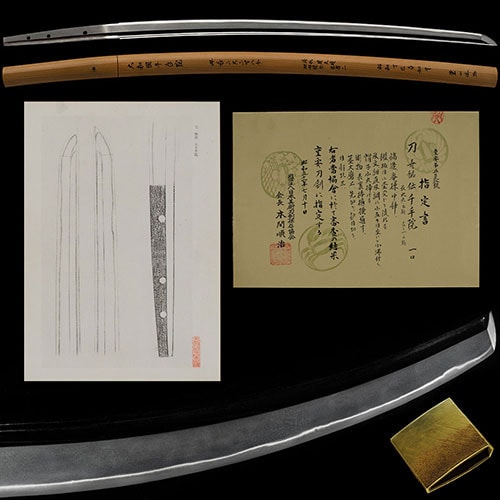
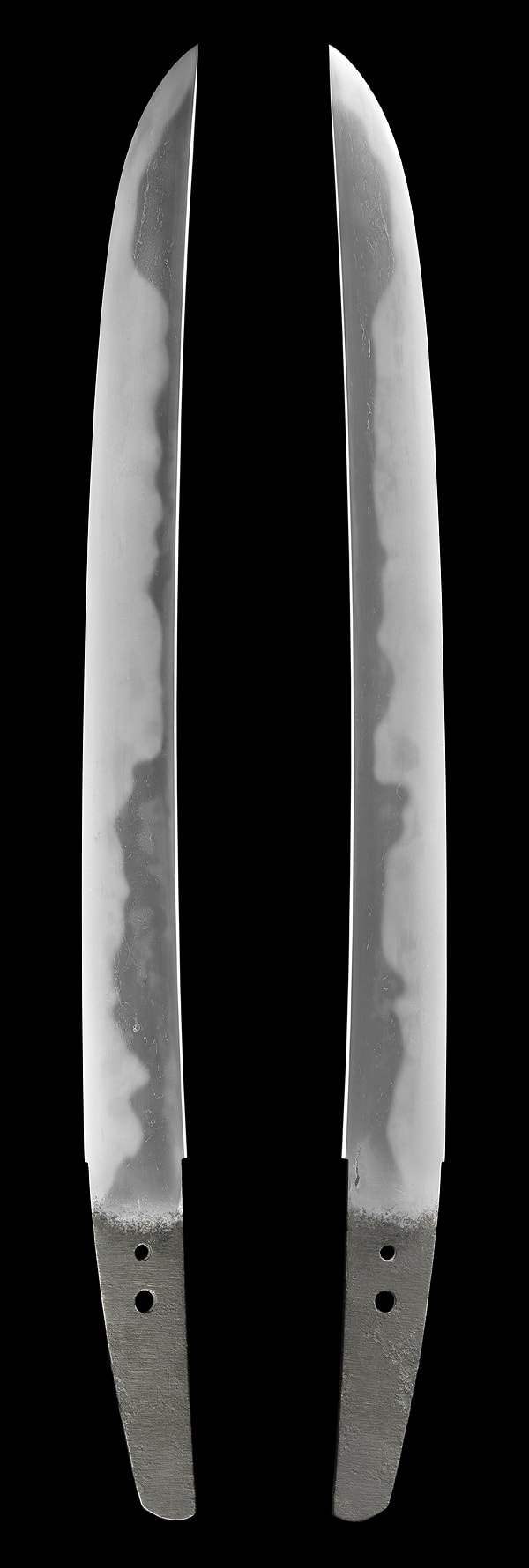
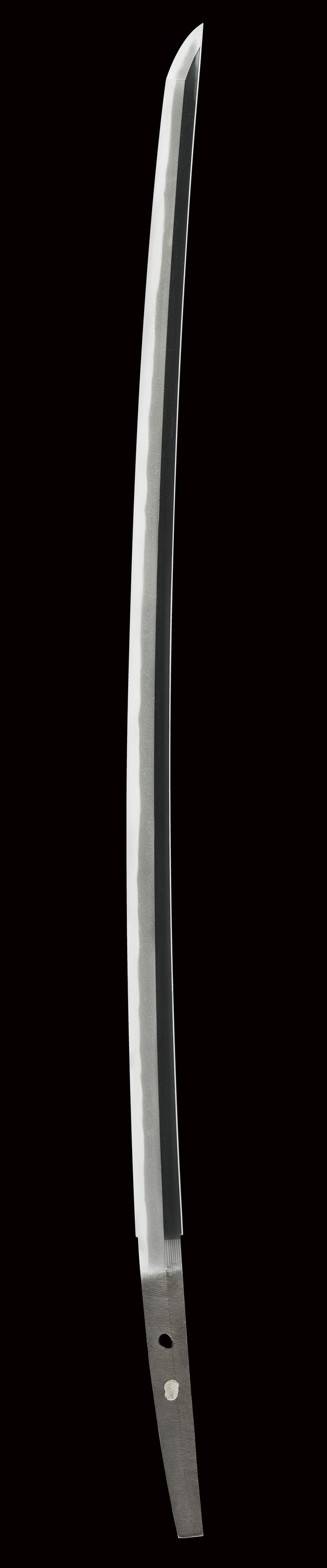
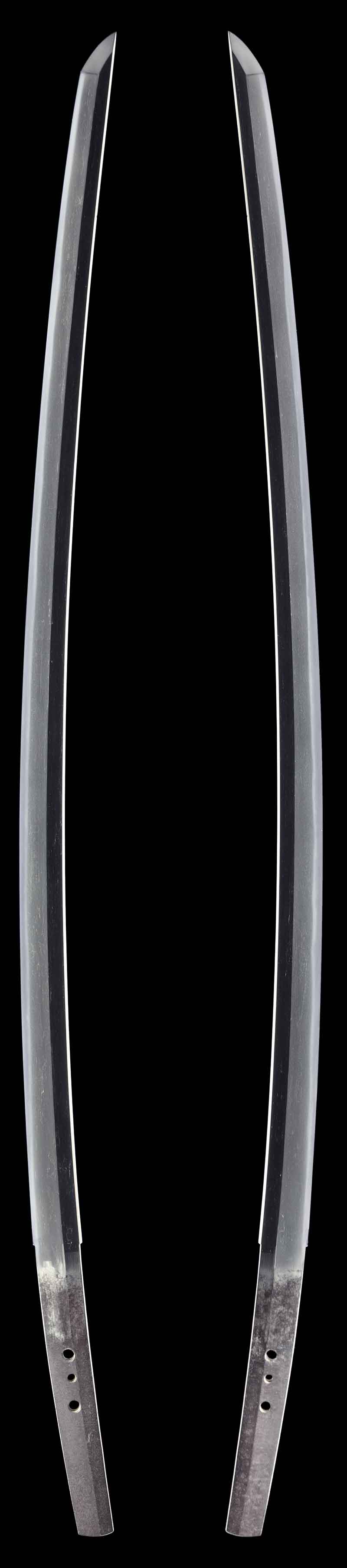
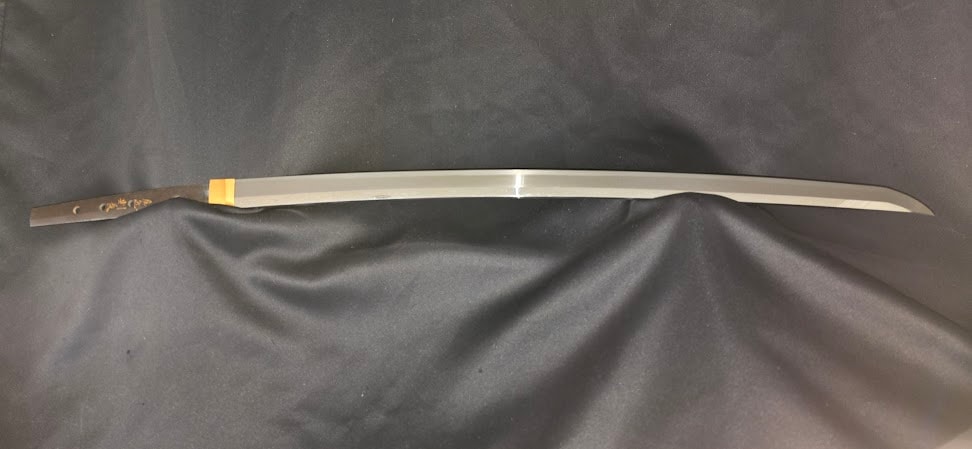
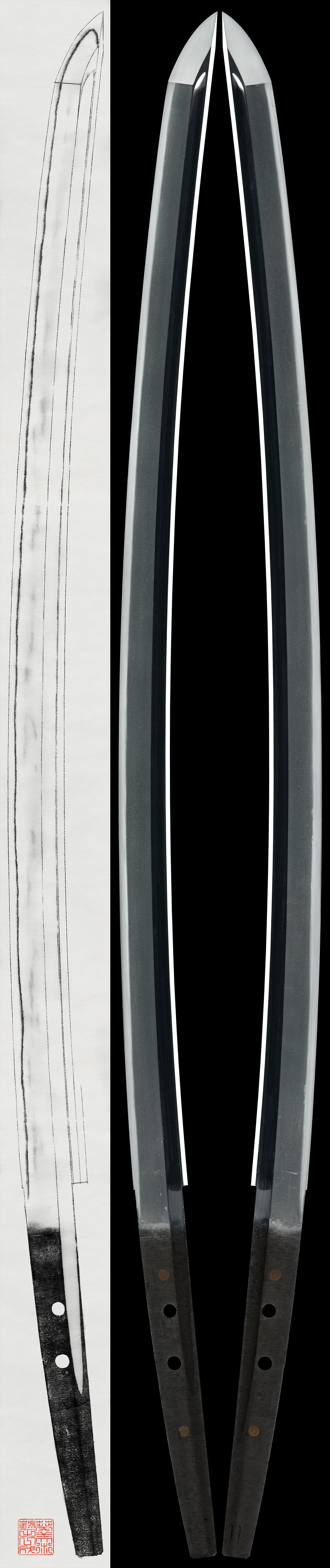
Nobuyoshi is the one famous name of the Ryūmon group, a branch of Yamato swordsmiths active from the late period into the . The published sources are nearly unanimous on his origins: "Nobuyoshi is traditionally said to have been a smith descending from the Senjuin line", and because he lived at Ryūmon-shō in Yoshino District, on the road that runs from Yoshino through to Uda, he was given the byname Ryūmon Nobuyoshi. The group is said to have included other smiths, with names such as Nagayoshi and Yoshiyuki appearing in the reference works, but only Nobuyoshi became well known, to the degree that, as one commentary puts it, "when one speaks of Ryūmon, it refers to Nobuyoshi". No dated blade by him survives; the swordbooks place him around the Shōō or Bunpō eras.
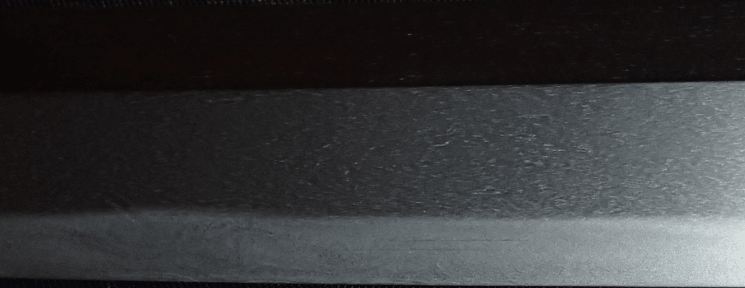
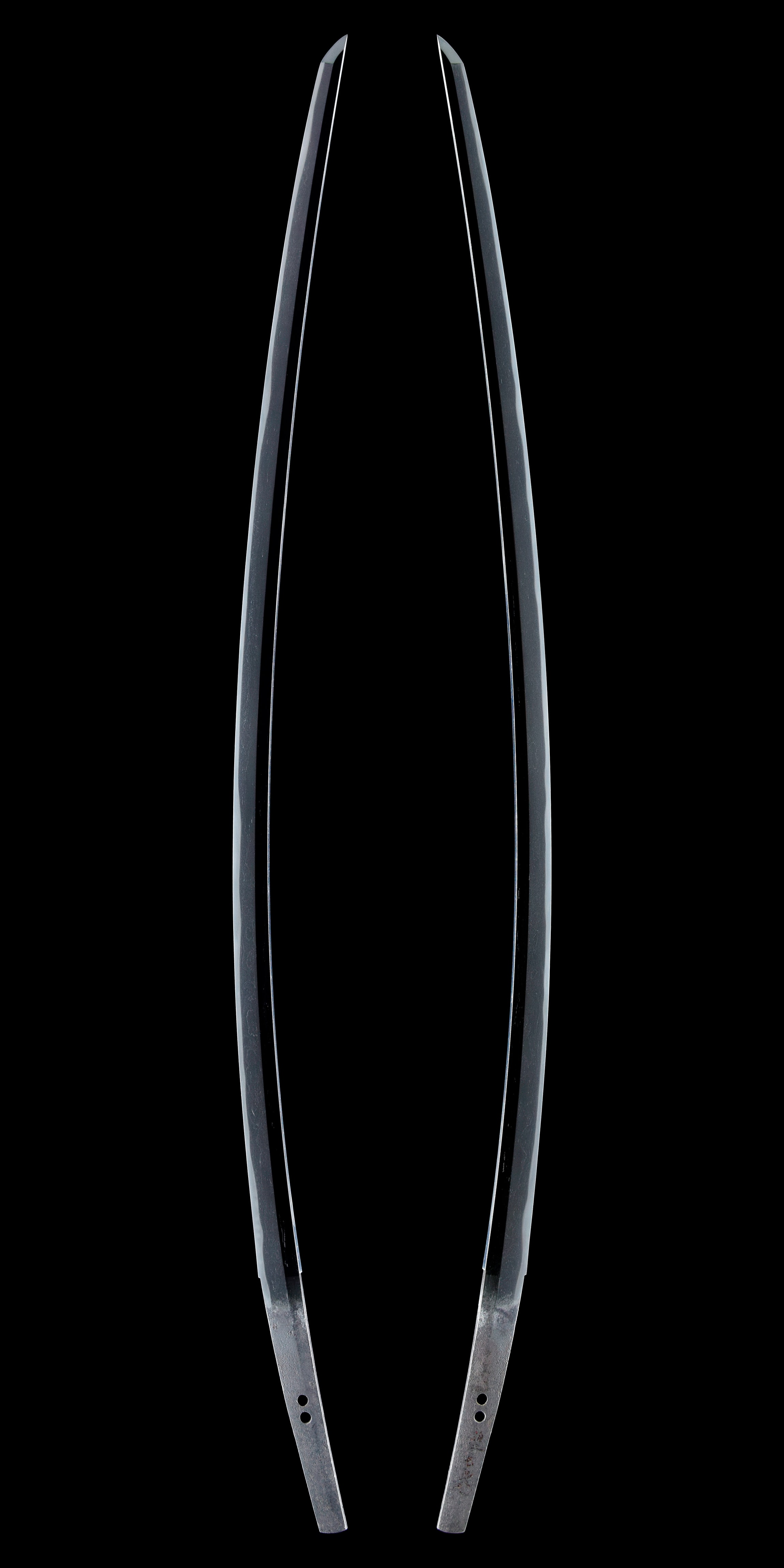
The hand that defines him is not one manner but two, and the draws the division on nearly every paper. One mode forges "a lively , or a -toned temper into which chōji-ashi enter", with standing in the jigane and a Bizen character coming forward. The other is a suguha that frays into hotsure, in which "utsuri does not stand and the Yamato color is strongly shown"4, quiet and austere in feeling. His finest signed tachi, the wide-bodied piece once held by the Hori viscount and treasured by Inukai Bokudō, is the showy mode at its best: a wide suguha-chō with shallow notare, mixing gunome, chōji, togariba and angular elements, ashi and yō entering, the nioiguchi tightening with ko-nie, nijūba and uchi-noke worked in, with kinsuji and fine sunagashi. The published sources call it "foremost among works by the same hand"5.
The jigane is the constant that carries both modes. It is a well-forged itame that flows and inclines to masame, with thick ji-nie laid finely and chikei entering frequently, the masame strengthening toward the edge on the most Yamato of his blades. Over that jigane the utsuri is the variable: on the Bizen-leaning blades a clear midare-utsuri, sometimes a soft nie-utsuri; on the Yamato blades none at all. The bōshi runs straight and finishes in hakikake, often yakizume, sometimes a ko-maru with a short turnback, and across nearly the whole record the nioiguchi is bright and clear. Even in the lively mode the temper stays suguha-based with chōji and gunome set into it rather than opening into a free chōji-midare, so the bright suguha with hotsure and kuichigai-ba is the Yamato root that holds the two manners together.
His signature divides as his workmanship does. Two ways of cutting the right element of the character 延 are observed, a blocky kaisho form resembling an abbreviated 正 and a cursive sōsho form resembling 氏; the published sources record that later writers "call the former Masa-Nobuyoshi and the latter Uji-Nobuyoshi"6. The distinction is not merely calligraphic, for the sources note that blades with the former signature tend to a more tightly knit hada and those with the latter to a more standing grain, and one signed tachi is read as a transitional piece between the two. Signed works are set with a large two-character mei and survive in only a small number, so a genuine in-mei Nobuyoshi is a precious thing to encounter.
What places him is exactly this position between two traditions. His bright midare-utsuri and chōji-ashi set the Bizen-leaning mode apart from the plainer Senjuin and Taimasuguha, while the subdued suguha-with-hotsure keeps him within Yamato. The published sources observe that his smaller-signature blades have since old times been confused with Ko-Bizen Ko-Ichimonji work, and that confusion is itself the measure of where he stands. On the mumeikatana, which form the bulk of his record, the judges affirm the attribution from the high-shinogi construction, the flowing masame-inclined forging and the bright suguha alone, calling one such blade a full expression of "the characteristic features and merits of Ryūmon Nobuyoshi in both ji and ha."
For the collector he is a rare early Yamato name carried by a single great work. Fujishiro grades him Jō-jō saku. A signed tachi transmitted as an imperial possession of Emperor Go-Mizunoo is a National Treasure, and the published sources say plainly that "the presence of this celebrated masterpiece has contributed greatly to the high reputation of Nobuyoshi"7; two further signed tachi are Important Cultural Properties, one of them preserved at Shitsukiyama Shrine in Yamaguchi. These are heritage held in shrine and institution and are not encountered on the market. His blades carry distinguished provenance recorded on their own papers, the Hori viscount and Inukai Tsuyoshi on the Tokubetsu Jūyōtachi, the Date of Sendai and the Uesugi among the Jūyō. Beyond the locked tier his record runs through one Tokubetsu Jūyō, the Jūyō and the prewar Jūyō Bijutsuhin, some twenty-six blades in the Tokubetsu Jūyō and Jūyō ranks all told, most held rather than traded. A signed example comes to light only seldom and a fine mumei attribution from time to time, so a privately held Ryūmon Nobuyoshi is a notable thing for a collector, a document of how Yamato and Bizen met in one Yoshino hand.

Kantei
two workmanship modes of one Ryūmon hand, drawn explicitly by the published sources: a Bizen-leaning mode of lively midare or chōji-ashi suguha with standing utsuri, set against a Yamato mode of subdued suguha with hotsure and no utsuri, both crossed by a two-manner signature, the tightly-forged Masa-Nobuyoshi and the standing-grain Uji-Nobuyoshi
Nobuyoshi, commonly called Ryūmon Nobuyoshi, is the one famous name of the Ryūmon group, a branch said to descend from the Yamato Senjuin school and to have lived at Ryūmon-shō in Yoshino District, late Kamakura into the Nanbokuchō period. The published sources say of him almost without exception that his workmanship divides broadly into two: one a lively midare or a suguha-based temper into which chōji-ashi enter, with utsuri standing in the jigane and a Bizen-like character emerging; the other a suguha with hotsure in which utsuri does not appear and the Yamato color is strongly shown. Across both his ground is a well-forged itame, often flowing and inclining to masame, with thick ji-nie and frequent chikei; his boshi runs straight and finishes in hakikake, often yakizume; and his nioiguchi is consistently bright and clear. His signature too divides in two manners, which later writers came to call Masa-Nobuyoshi and Uji-Nobuyoshi after the way the right element of the character 延 is cut, the tightly-forged blades tending to carry the former and the more standing-grain blades the latter. Signed works are few; a signed tachi reaches National Treasure, two more are Important Cultural Properties, and the bulk of his record is mid-to-late-Kamakuramumei attributions affirmed from the broad Yamato manner with its Bizen admixture.
Diagnostic discriminators
備前気質5
直刃suguha5
柾ごころmasame-gokoro5
Observation by phase
The Bizen-leaning mode (lively midare, chōji-ashi, standing utsuri)
The published sources name as one of his two modes a lively midare, or a suguha-based temper into which chōji-ashi enter, accompanied by utsuri standing in the jigane and a Bizen-like character. His finest signed tachi, the slightly shortened wide-bodied piece once held by the Hori viscount and treasured by Inukai Bokudō, is exactly this hand: a wide suguha-chō with shallow notare mixing gunome, chōji, pointed elements and angular forms, ashi and yō entering, the nioiguchi tightening with ko-nie, nijūba and uchi-noke intermingled, kinsuji and fine sunagashi, all over a well-forged itame with mokume and a nagare tendency, thick ji-nie, chikei, and a clearly standing midare-utsuri. On the mumei attributions of this mode the temper is a chōji-ashi suguha or an outright chōji-midare, the jigane carrying a midare-utsuri or a soft nie-utsuri, the ground steel bright. The published sources call the Tokujū tachi among the very finest of his extant works, robust and ample in nikuoki, and the dignity of the imposing wide-bodied shape with high koshizori is part of the impression.
The Yamato mode (subdued suguha with hotsure, no utsuri)
The other mode the published sources name is a suguha into which hotsure enters, utsuri not standing, the Yamato color shown strongly and the manner subdued. Here the temper is a chū-suguha or fine suguha, the habuchi fraying into hotsure with kuichigai-ba, ko-nie well adhered, fine kinsuji and sunagashi running, the nioiguchi bright. Over a high-shinogi construction the ground is an itame that flows and inclines to masame, standing a little, with thick ji-nie and chikei, the masame strengthening toward the edge. The boshi runs straight, becomes hakikake, often finishing yakizume, sometimes ko-maru with a short turnback. The published sources hold the signed kodachi once an imperial possession and the late-Kamakurasuguhatachi to show the dignified, gentle nioiguchi proper to the Yamato manner, and affirm the many mumeikatana of this mode as Ryūmon work from the construction and the suguhahotsure alone.
The signature register (Masa-Nobuyoshi vs Uji-Nobuyoshi)
Distinct from the workmanship modes, the published sources draw a second division in the signature itself. Two manners of cutting the right element of the character 延 are observed: a blocky, kaisho-like form resembling an abbreviated 正, and a cursive, sōsho-like form resembling 氏; the character 吉 is cut nearly the same in both. Later writers came to call these Masa-Nobuyoshi and Uji-Nobuyoshi. The sources note a correlation with the forging: blades carrying the former signature tend to a more tightly knit hada, those with the latter to a more standing grain. One signed tachi is read as a transitional piece between the two manners. The signed examples are few, set with a large two-character mei, and a genuine in-mei Nobuyoshi is a precious thing to encounter.
Sugata 姿
二字銘niji-mei3
Jigane 地鉄
正延吉手(鍛えよく締まる)Masa-Nobuyoshi te (tightly forged hada)1氏延吉手(肌立つ傾向)Uji-Nobuyoshi te (standing-grain tendency)1
Scholarship
The published sources state almost uniformly that Ryūmon Nobuyoshi descends from the Senjuin school and resided at Ryūmon-shō, that no dated work survives, and that his workmanship divides into the Bizen-leaning utsuri-and-chōji mode and the Yamato suguha-with-hotsure mode. They add that his signature divides in two manners, later named Masa-Nobuyoshi and Uji-Nobuyoshi after the cutting of the character 延, with the tightly-forged blades tending to the former and the standing-grain blades to the latter.3
On the smaller-signature pieces the published sources caution that they have since old times been confused with Ko-Bizen Ko-Ichimonji work, and that the Ryūmon group must have comprised a considerable number of smiths though only Nobuyoshi is widely known; the mumei katana of the lively mode are nonetheless affirmed as Ryūmon work from era, construction and the broad Yamato manner with its Bizen admixture.1
Historical importance
Where Nobuyoshi stands among comparable artisans: across all of nihontō, and within tradition, era, and period. The tiers (Foremost · Leading · Major · Notable) weigh official designations from the NBTHK and Japan's Agency for Cultural Affairs, together with historical honors of lasting repute such as the Sansaku and Meibutsu-chō.
随一
Foremost
屈指
Leading
All nihontō
有数
Major
YamatoKotōLate Kamakura
著名
Notable
Select a lens to see how it's measured.
Designations
Kokuhō1
Jūyō Bunkazai1
Jūyō Bijutsuhin1
Gyobutsu—
Tokubetsu Jūyō1
Jūyō Tōken25
Elite Standing
0.22 across 29 designated works
Top 11% among smiths
Provenance
10 documented provenances across certified works by Nobuyoshi
▸Imperial2
Shogunal—
▸Premier Daimyō1
▸Major Daimyō1
Other Daimyō—
Zaibatsu—
Institutions—
▸Named Collectors6
Provenance Standing
4 works held in elite collections across 10 documented provenances