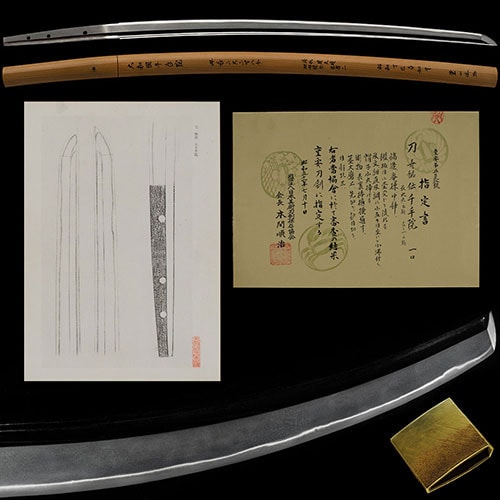
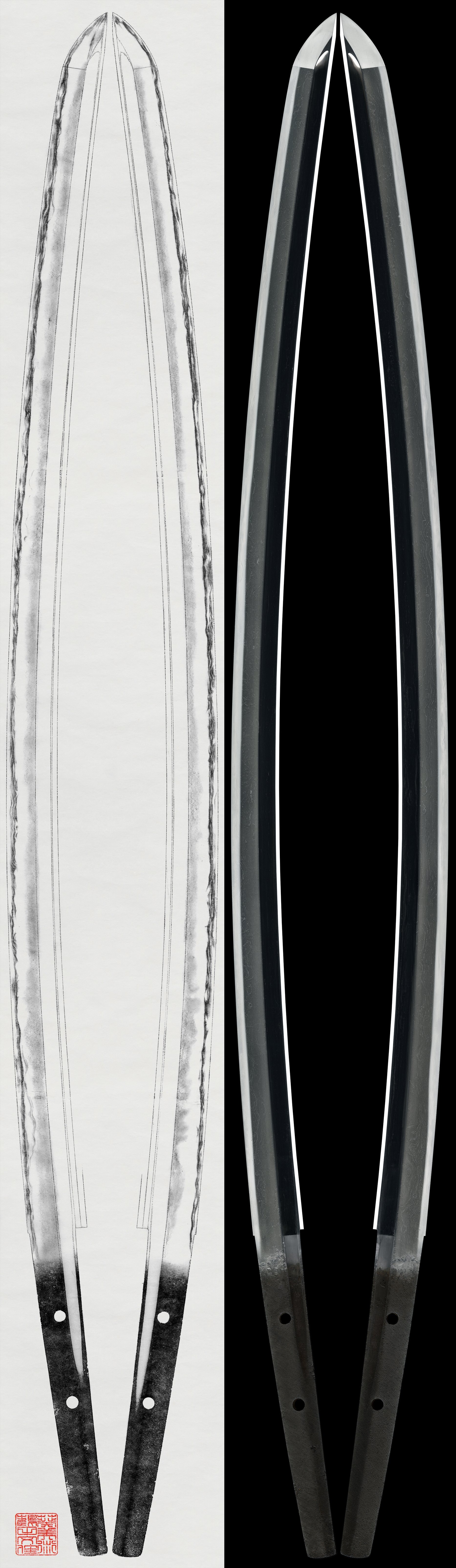
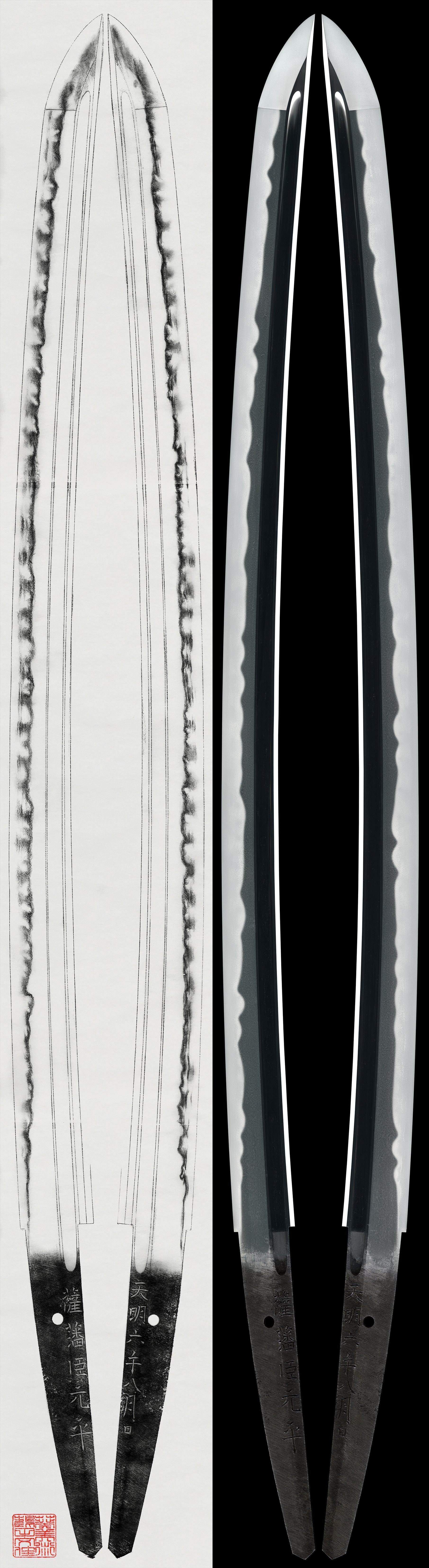
Sukemitsu is a Yamato smith of the late period, recorded in the old signature compendia under the single line "Yamato, Shōan," and a in the Tokyo National Museum carries his written-out date of Shōan 3 (1301), the fixed point from which his small body of work is read. The published sources place him as the earliest of a group of Yamato smiths whose signatures lead with the character (Sukemitsu, Sukehei, Sukenobu, Sukeyoshi), running from the close of into the mid- period, and judge him, though no lineage is stated outright, most probably a smith of the Senjuin school. His name is one of 's standing confusions, because the Sukemitsu most widely known is Sukemitsu of the Yoshioka in ; the published commentary settles the matter on the signature itself, noting that the Yoshioka hand is never met with a two-character , and that "the signature too, a bold two-character , is entirely different from that of Yoshioka Sukemitsu".
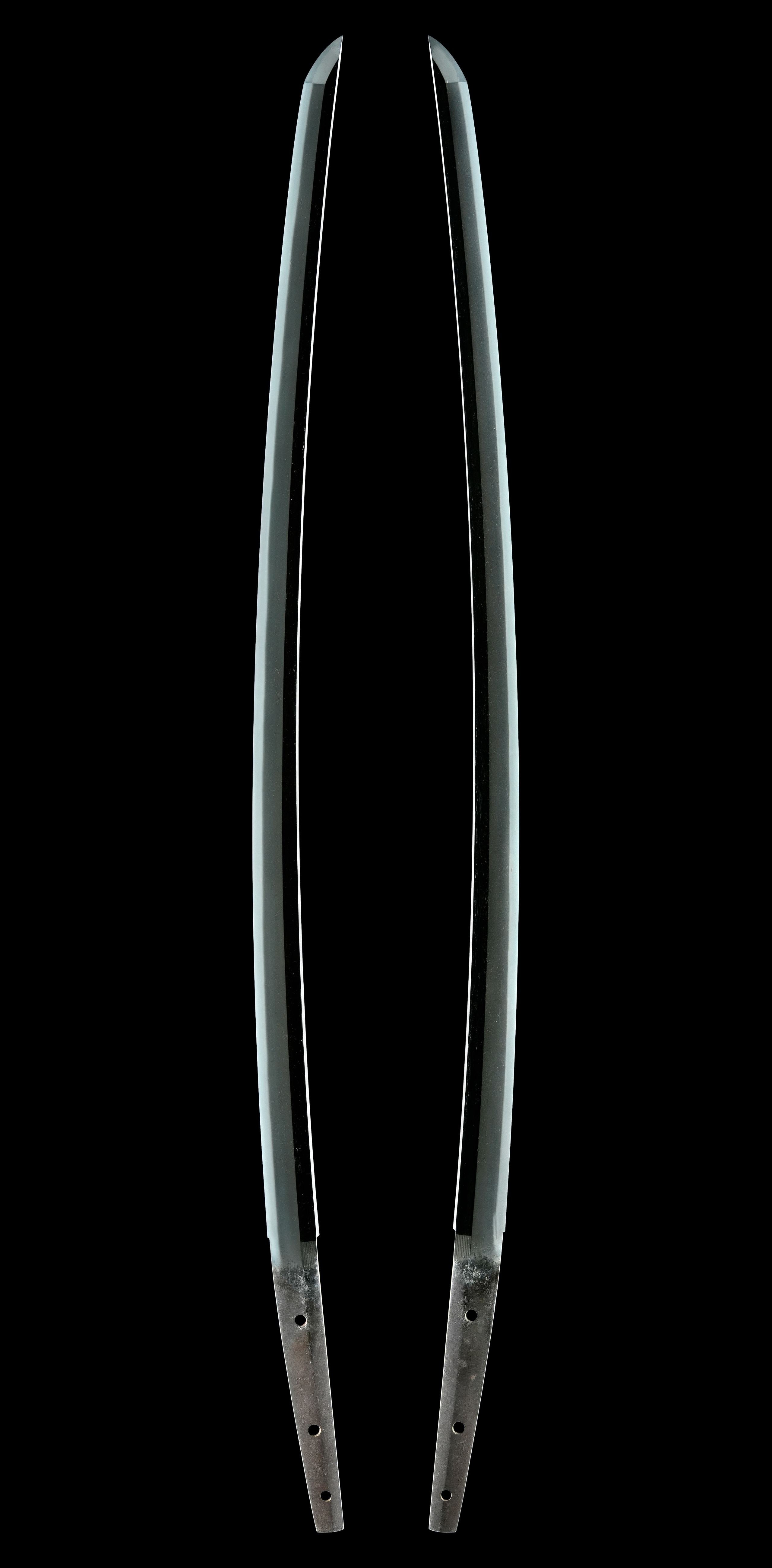
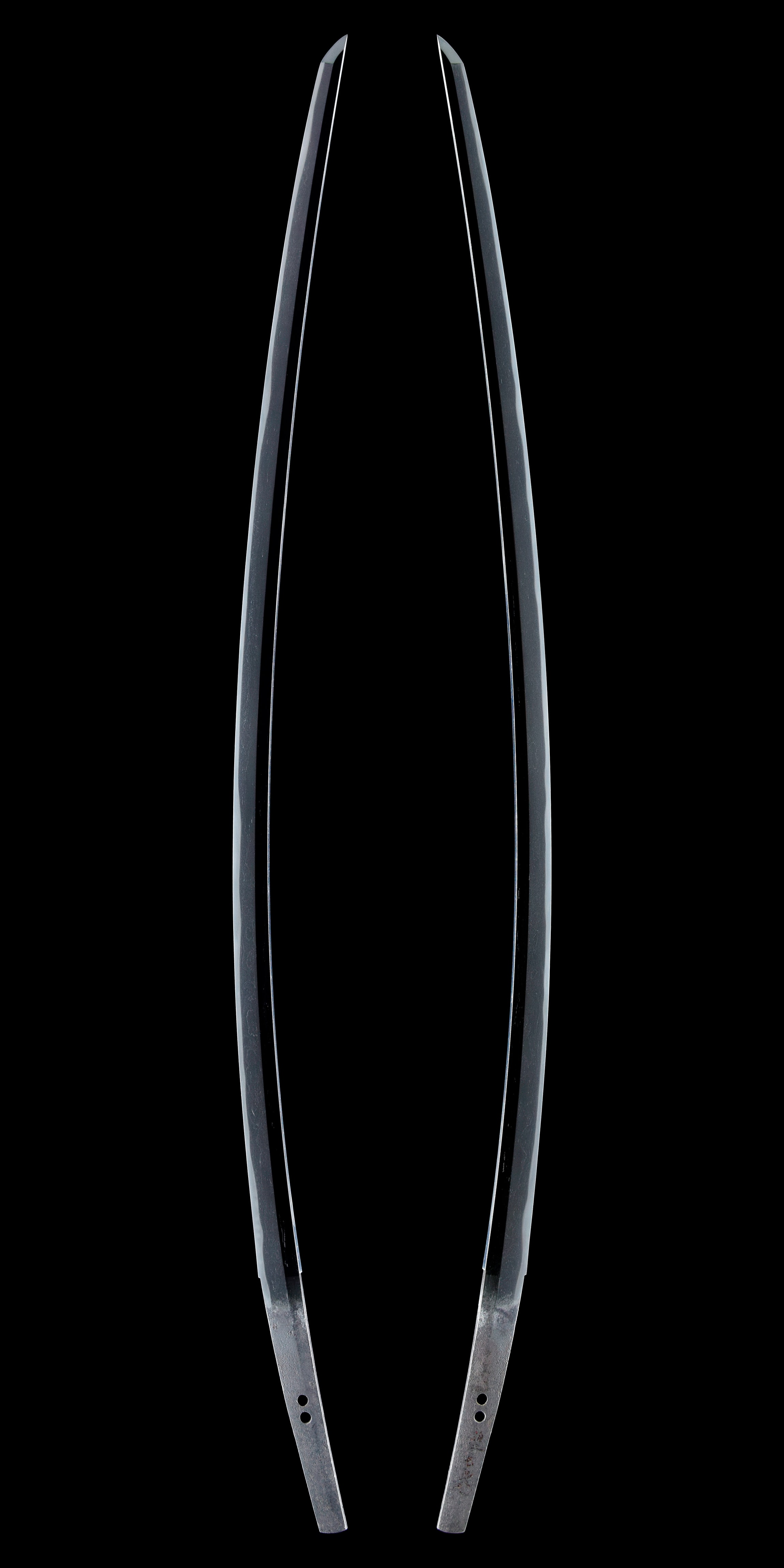
His recognized typical work is the slender , with and a , where it survives whole, the large two-character 助光 cut above the in a thick, angular chisel. The tell of his hand is the temper: not the free clove-flower of the school whose name he shares, but a bright into which , and small are worked, entering well, a hardened toward the base, running in the lower half with , the clear and bright with well adhered. The published commentary describes the very chiselling as forceful, the 力 element of and the legs of mitsu all angular forms cut with a thick chisel, so that signature and temper read together as one knowable hand.
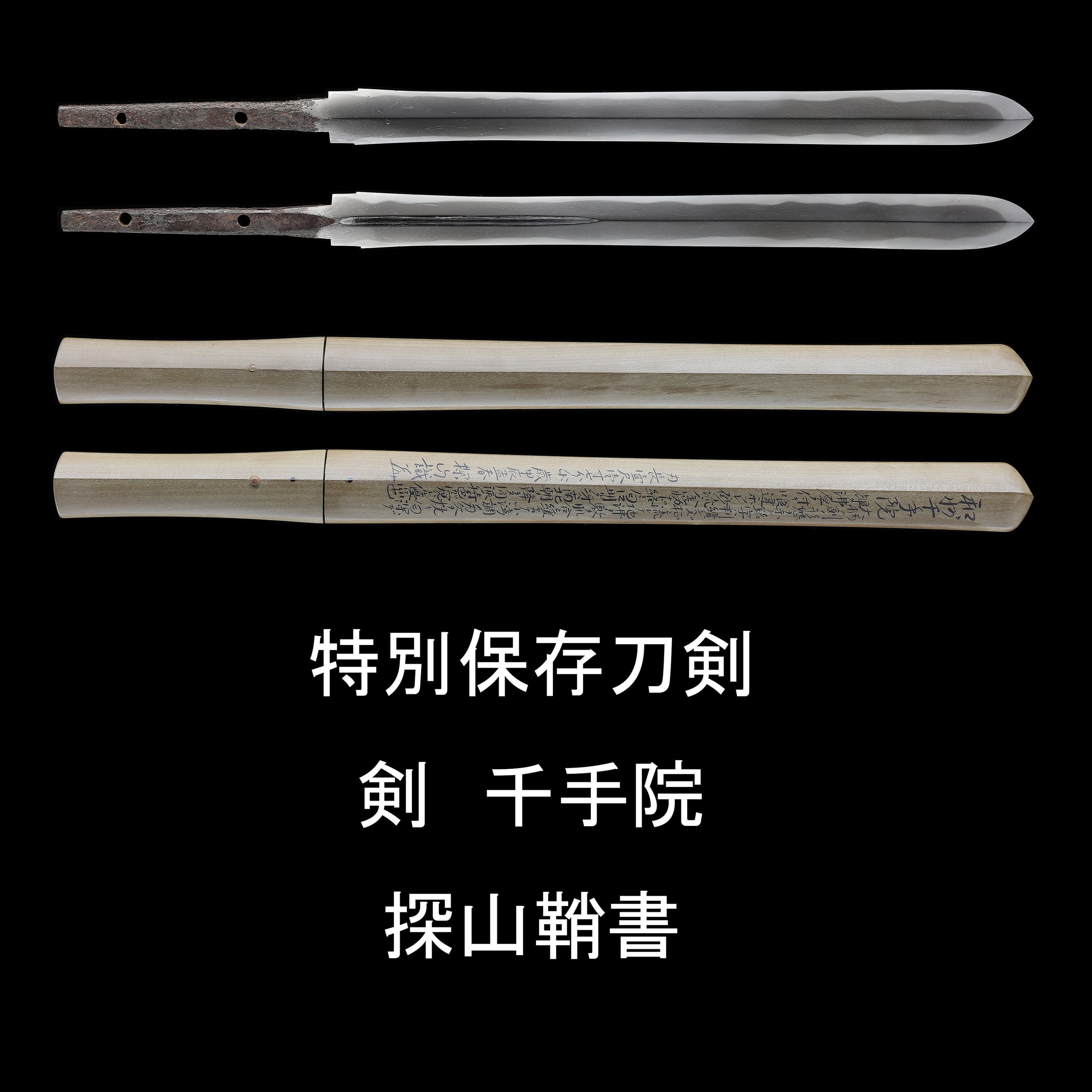
The is the Yamato constant beneath both his manners. Over a compact the grain flows and inclines toward , standing a little, with fine adhering densely and mixed in, fine entering; on the finest signed a distinct stands clear, and where the forging tightens the only grows brighter. The runs straight, or with a slight , and turns back in , shallow and a little moist on the piece; a is carried through on both faces. On the shortened, unsigned attributions the hand stands more openly, the flowing into along the edge, the fraying with the running to and turning pointed, the Yamato character shown plainly.
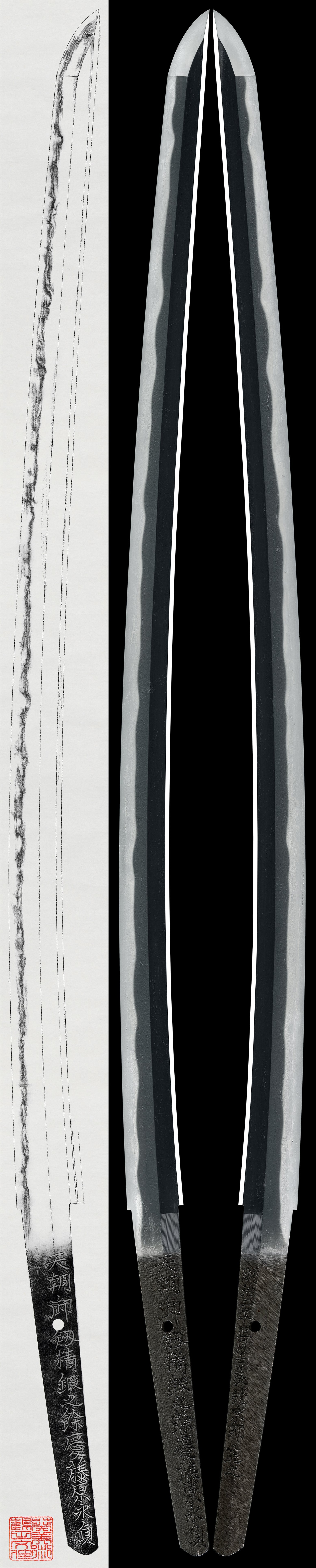
The central scholarly question around him is his own two-sidedness. Examining the signed against the Tokyo National Museum dated piece, the published sources find that "that two modes of workmanship are present is made clear by these two swords": the one a flowing with a and small showing the Yamato highlights, the other a closely packed with clear and a mixing and that carries a -like temperament. One opens further into mixed with , slightly , and at first glance reads as a ; yet the laid through both and holds it apart, and the commentary concludes that "considered overall, he should be regarded as a Yamato smith", leaving the relation between Sukemitsu and the smiths for further study.
What sets him apart from his neighbours is exactly what the judges name. From the famous Yoshioka Sukemitsu he is divided by the bold two-character signature and by a temper that stays -based where the hand runs to free ; from the plainer Yamato smiths he is divided by the brightness of his and the and small gathered on his edge, the -leaning admixture that gives his work its individual color. He stands within the Senjuin tradition as a minor but distinct hand, knowable from the construction and the bright alone, his place fixed less by lineage records, which are silent, than by the dated reference and the consistency of the signed group.
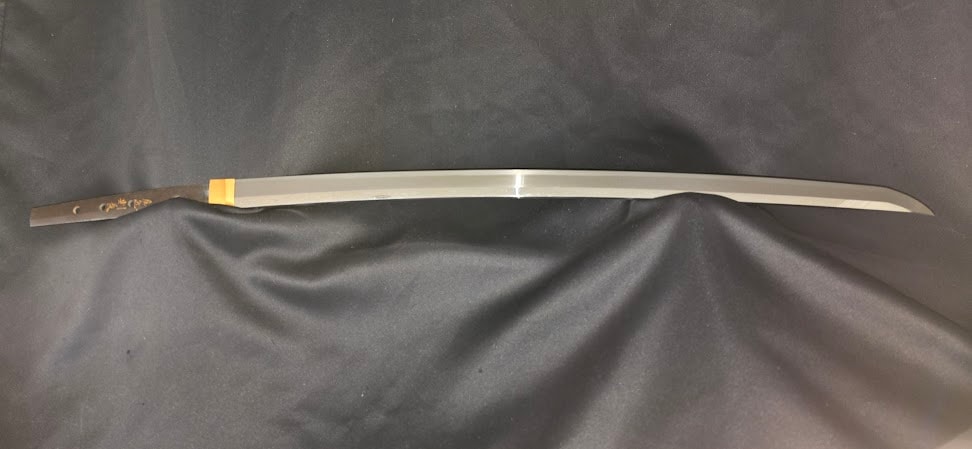
For the collector he is a rare early Yamato name. Fujishiro grades him Jō-jō . He has no National Treasures and no Important Cultural Properties; his record runs instead through one and a small number of , with a further attributed , the four blades of the and tiers being nearly the whole of his designated record. The published sources state plainly that "extant signed works by the Yamato smith Sukemitsu are extremely few" and call one of the "an extremely rare surviving work". The dated reference is preserved in the Tokyo National Museum, and his blades otherwise rest in long-held private collections of recorded whereabouts. A signed Yamato Sukemitsu comes to light only seldom, so a privately held example is a notable thing for a collector to encounter, a quiet document of a Yamato hand that looked, at moments, toward .