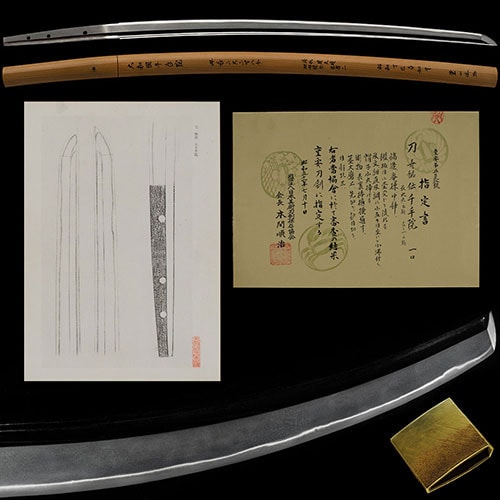
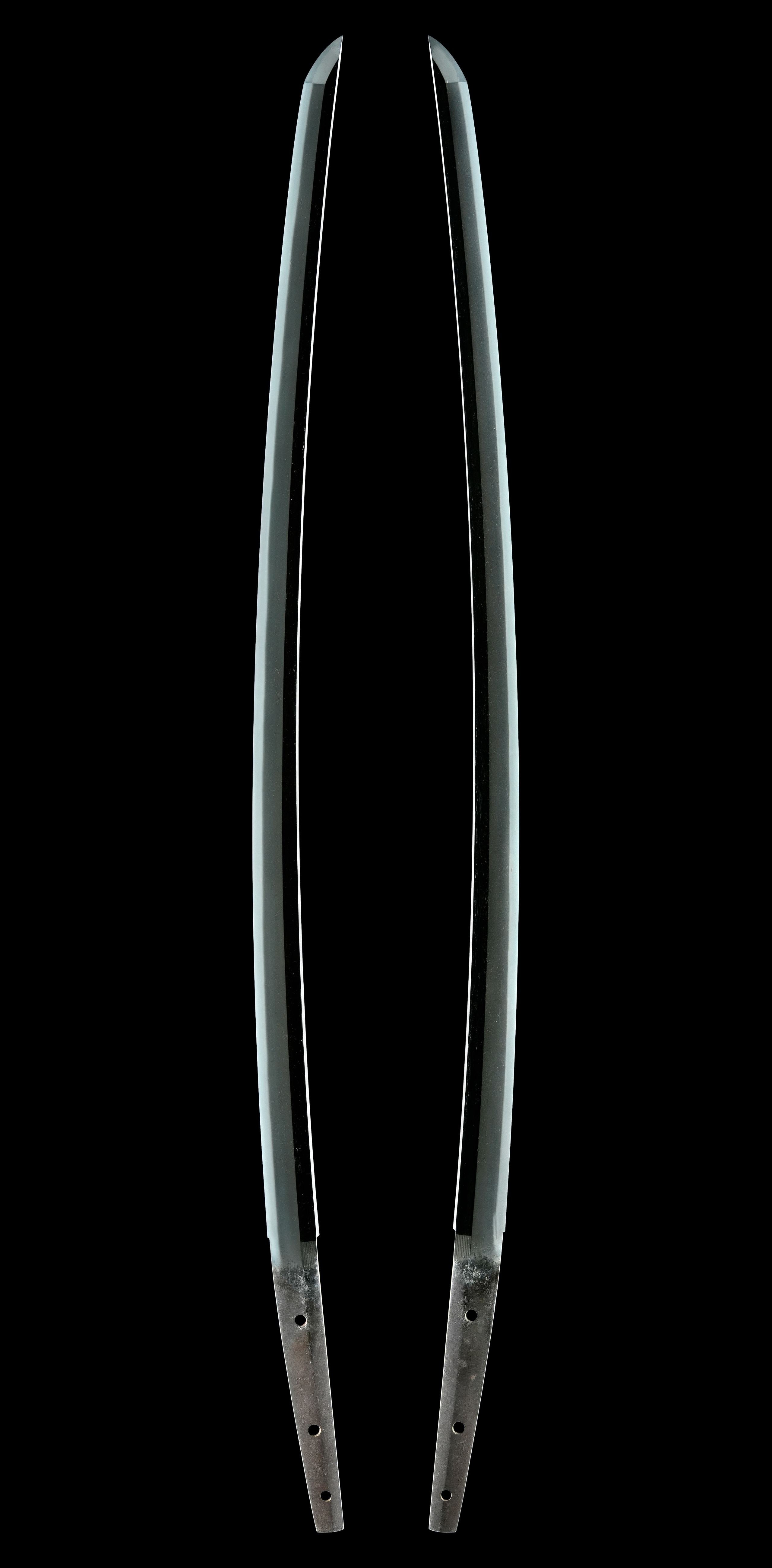
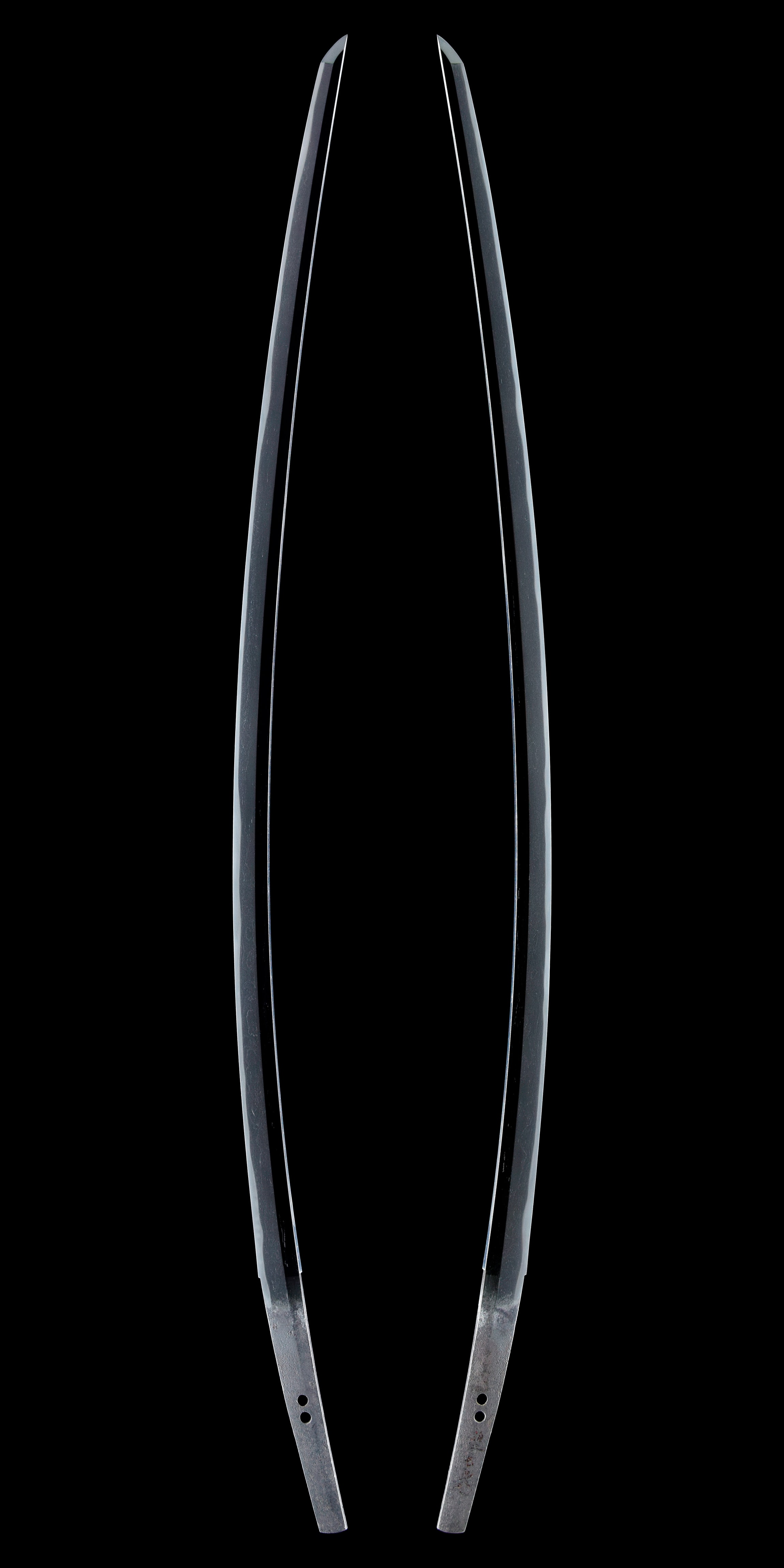
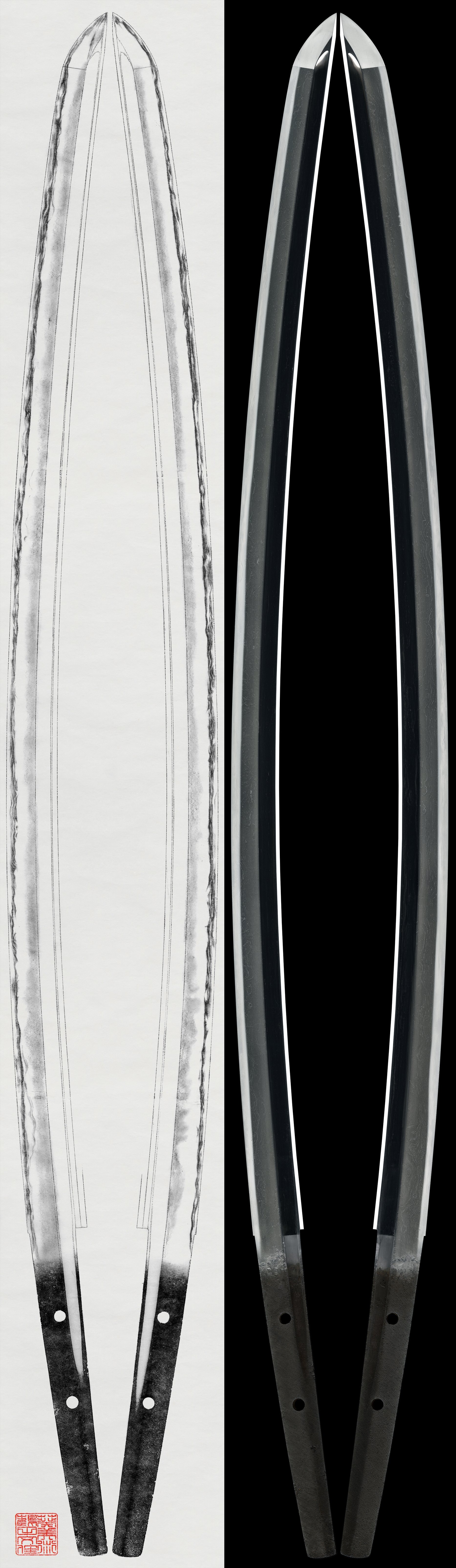
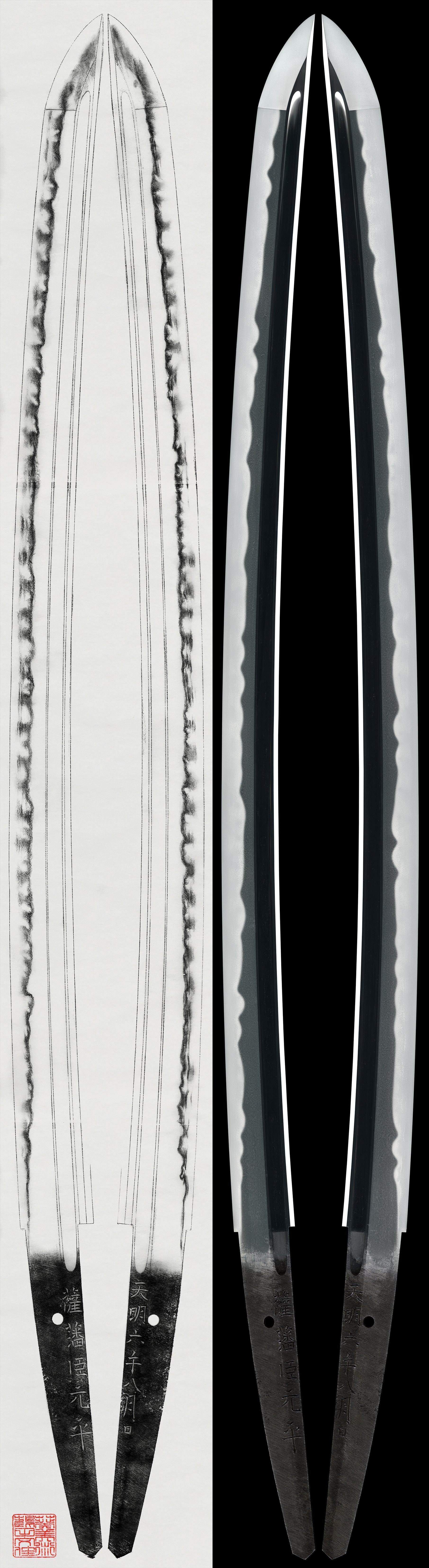
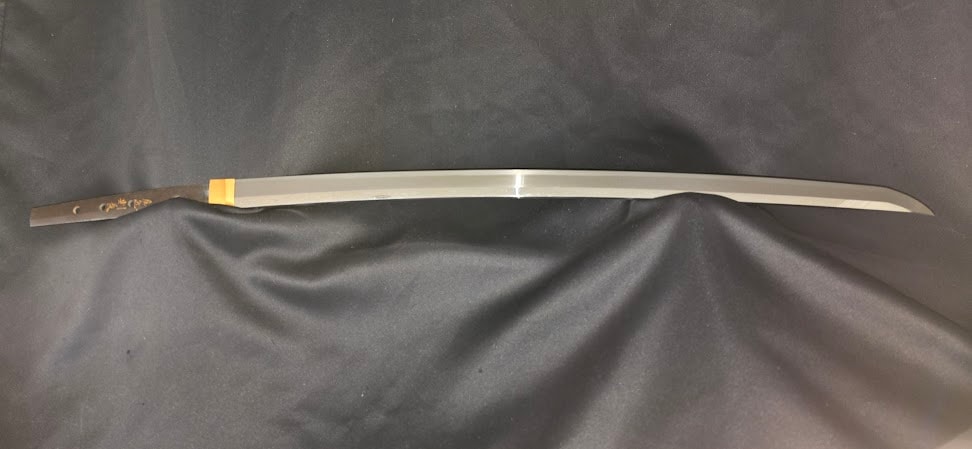
One signed by Yoshihiro survives bearing the date Koei 2 (1343), and a second carries the inscription "Washu Soekami-gun Senjuin Yoshihiro, Bunwa 2, eighth month"; from these few dated pieces the smith is placed in the Bunwa years of the early period and read as a hand of the Senjuin group in Yamato. His name is cut 吉広 or 吉弘 on the rare signed blades, while his works are appraised under the character 義弘, the recording these as one and the smith. The Senjuin school takes its name from the Senjudo at the western foot of Mount Wakakusa in Nara, where Senju Kannon is enshrined, and the smiths said to have resided there formed the group. The published sources call it the earliest in origin of the Five Schools of Yamato, with the late- masters Yukinobu and Shigehiro named in old writings, though no secure example by either survives and signed works of the school remained few thereafter, which is why Yoshihiro's handful of dated blades carries an unusual documentary weight.
What sets Yoshihiro apart within Yamato is the sheer range of his hand. Among Yamato works the singles him out as the smith whose blades show 「南北朝期の大和物中、最も地刃に変化を見せ、働きが豊富であり、更に特に沸の強いものである」, the one whose and vary most, whose is most abundant, and whose is especially strong. He works two distinct manners on the Yamato foundation. The first is a flamboyant large , tempered with strong , running through the , entering frequently, and a that turns in and breaks into . The published sources read these traits as suggesting workmanship, and it is on works of this character that the Yoshihiro is traditionally hung.
Under both manners lies one constant , and it is the surest mark of his work. He forges a flowing that runs toward , gathering especially toward the edge, the steel thickly covered in with entering frequently and, on his most refined pieces, very fine settling densely as -. The temper divides cleanly. In his calm register the is a tone with a shallow , the breaking into , and uchi-noke with small , the old Yamato motifs carried in with and through the steel and a bright . In his flamboyant register the is deep and the thick, the activity richer and the wider. The answers each manner in kind, and on the bold blades, turning in a small or running straight to a point on the quiet ones, the swept tip recurring across both.
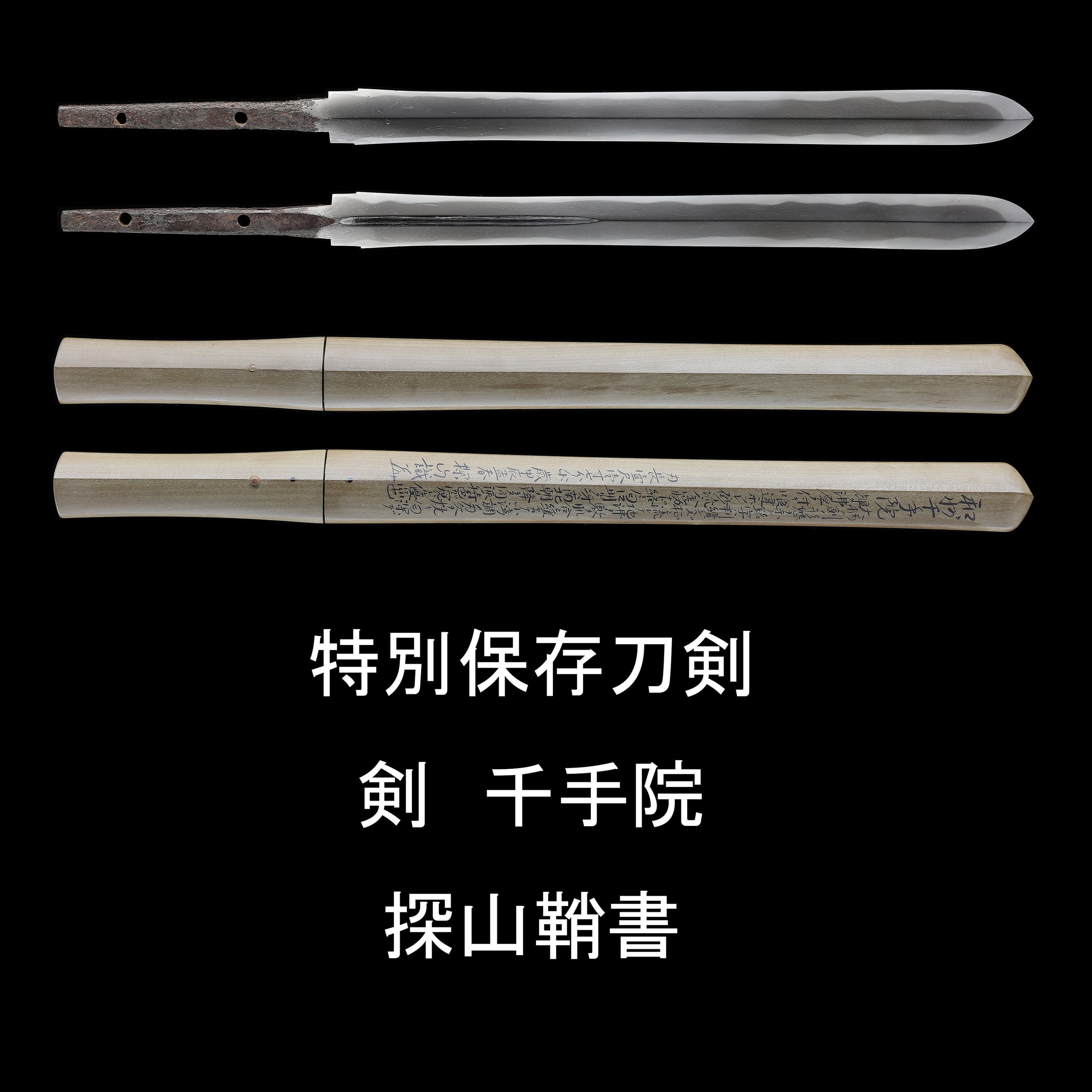
The scholarship around him turns on this division and on the rarity of his signed work. The published sources note that 「古来、千手院派の中で相州伝が色濃く混在しているものに義弘の極めをあてる傾向がある」, that within Senjuin attributions the Yoshihiro has long been applied to works in which the - element is strongly intermixed, and they name the dated Bunwa , with its flamboyant , strong and , as the touchstone against which pieces are measured. Yet the quieter manner is equally his. An with a relaxed, gentle in with shallow , deep and thick through the and , is recognized as one settled manner of the smith. His signed pieces span the forms: the only surviving signed , likely the only one of that shape; a signed in narrow with and abundant and ; and the dated known from old records. The directories also preserve a reference to a Yoshihiro blade dated Ryakuo 4 (1341) whose tang is reproduced in the Kotoku , the actual sword unseen in modern times.
Against his Yamato contemporaries Yoshihiro is distinguished less by any single feature than by amplitude. The other Yamato schools, , , Shikkake and Hosho, hold to a narrower discipline and a more insistent ; Yoshihiro keeps the school's flowing -tending steel and its and , but his swells into a and his and run with a freedom the published sources call the most varied of the period's Yamato hands. The very breadth that makes him recognizable also complicates attribution, since a flamboyant -laden blade with coloring may pass under his name when its true author is uncertain; it is precisely for that reason that his signed and dated blades, anchoring the manner to a real hand and a real date, are valued as documentary material rather than for prestige alone, the published commentary describing the signed as a piece of antique fragrance overflowing with dignity.
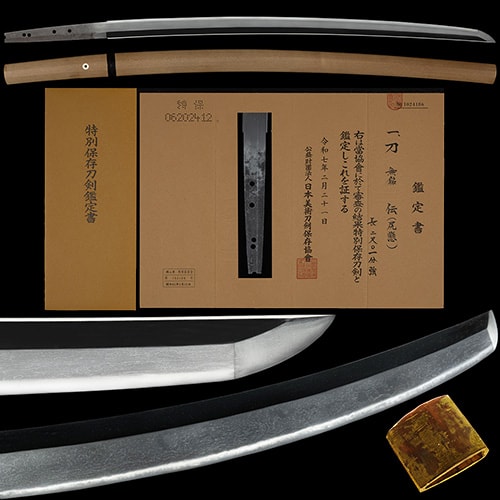
Five of his blades are recorded at the level, two signed and three , and none has been raised to the higher tiers of designation, nor does any documented provenance attach to his work in the present record. His blades are held quietly, in private hands and in the care of regional owners, rather than in the great public collections, and none of his pieces carries the kind of celebrated that follows a . For the collector this is a smith encountered rarely and by patience: a Senjuin Yoshihiro of either manner, the bold -tinged or the calm Yamato , comes to light only from time to time, and a signed example, of which barely a handful exist across and , is among the rarer things a student of Yamato work could hope to see. Where most Yamato attributions retreat into anonymity, Yoshihiro's dated signatures give him a face, and the blades that carry them are prized as the fixed points from which the rest of his varied output is read.