Summary
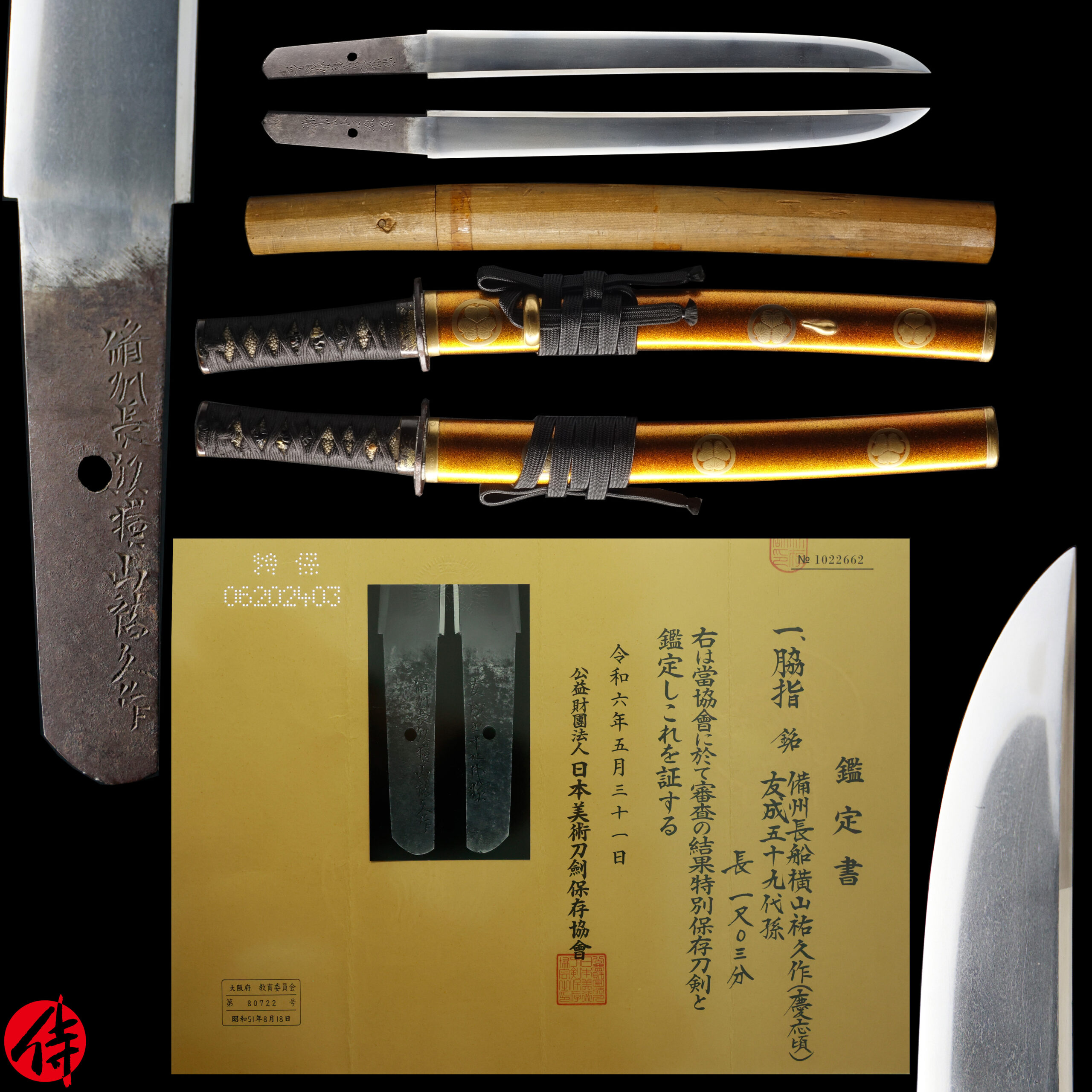
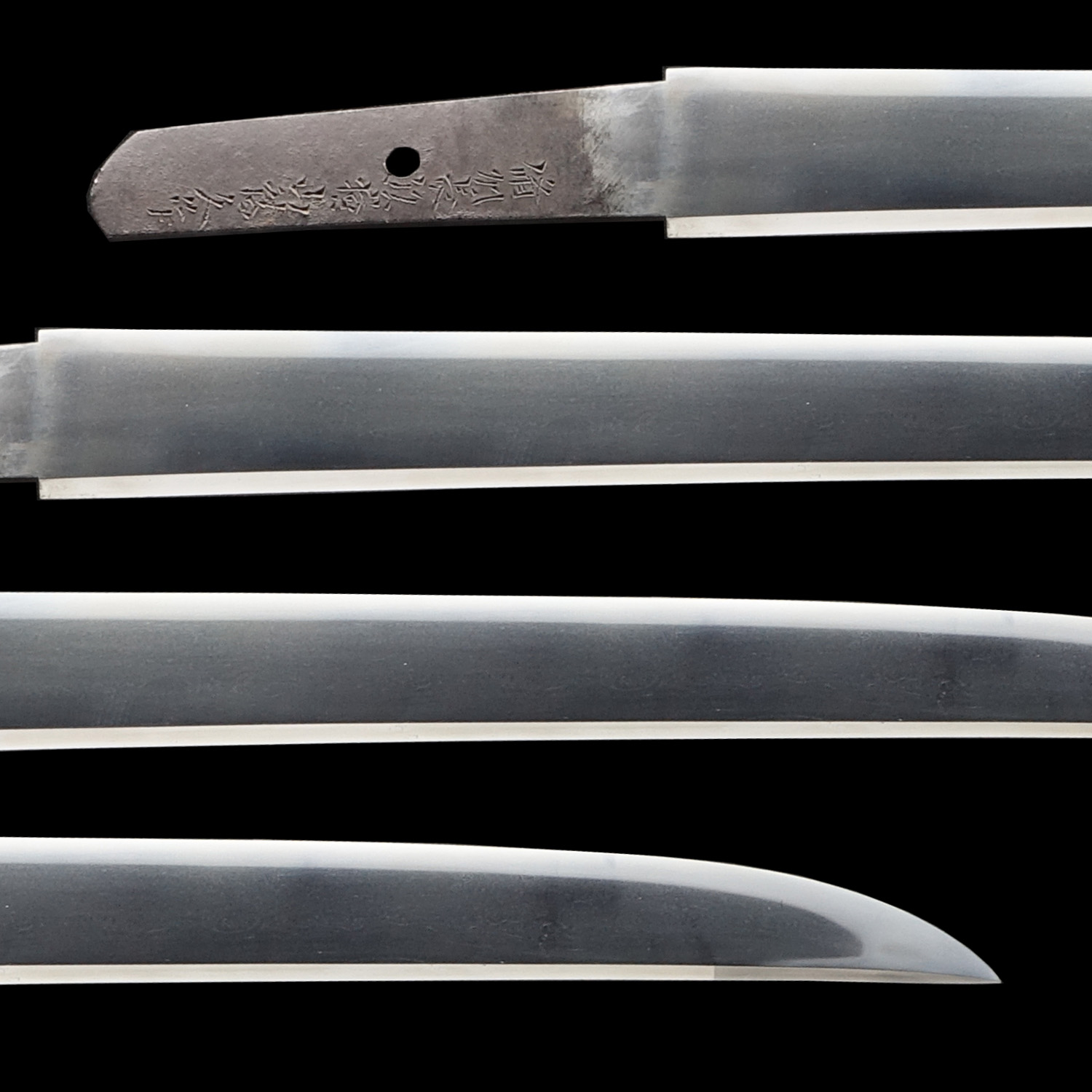
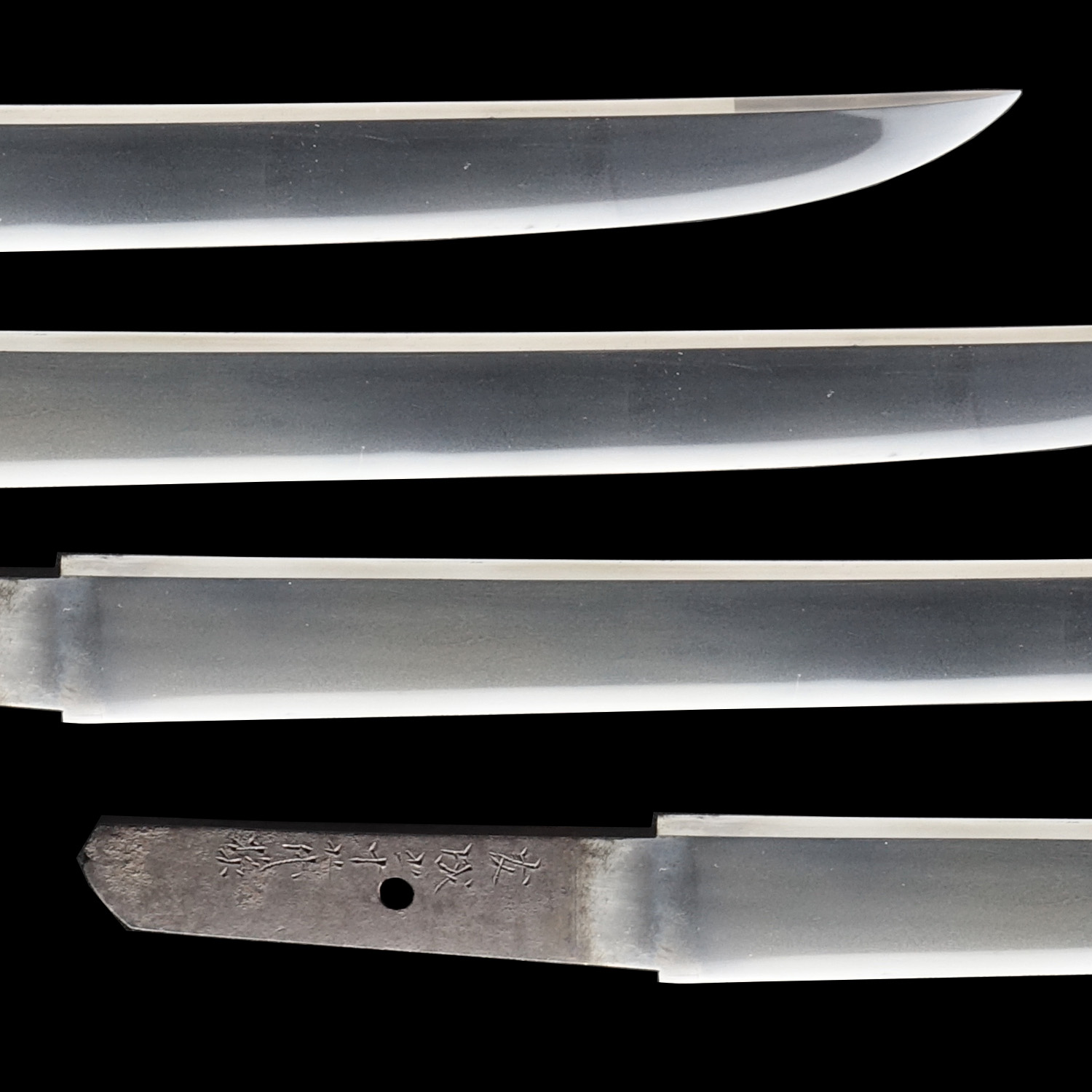
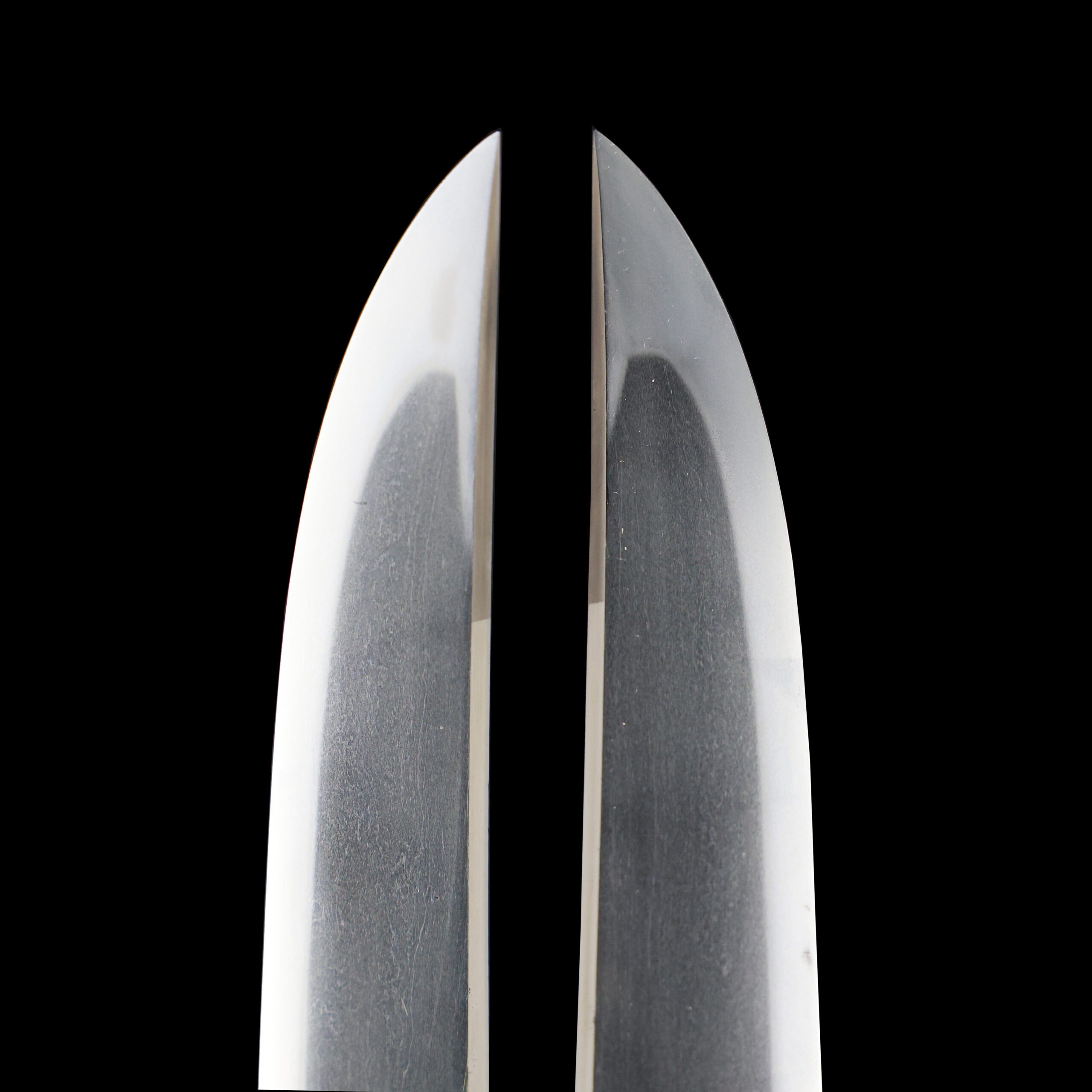
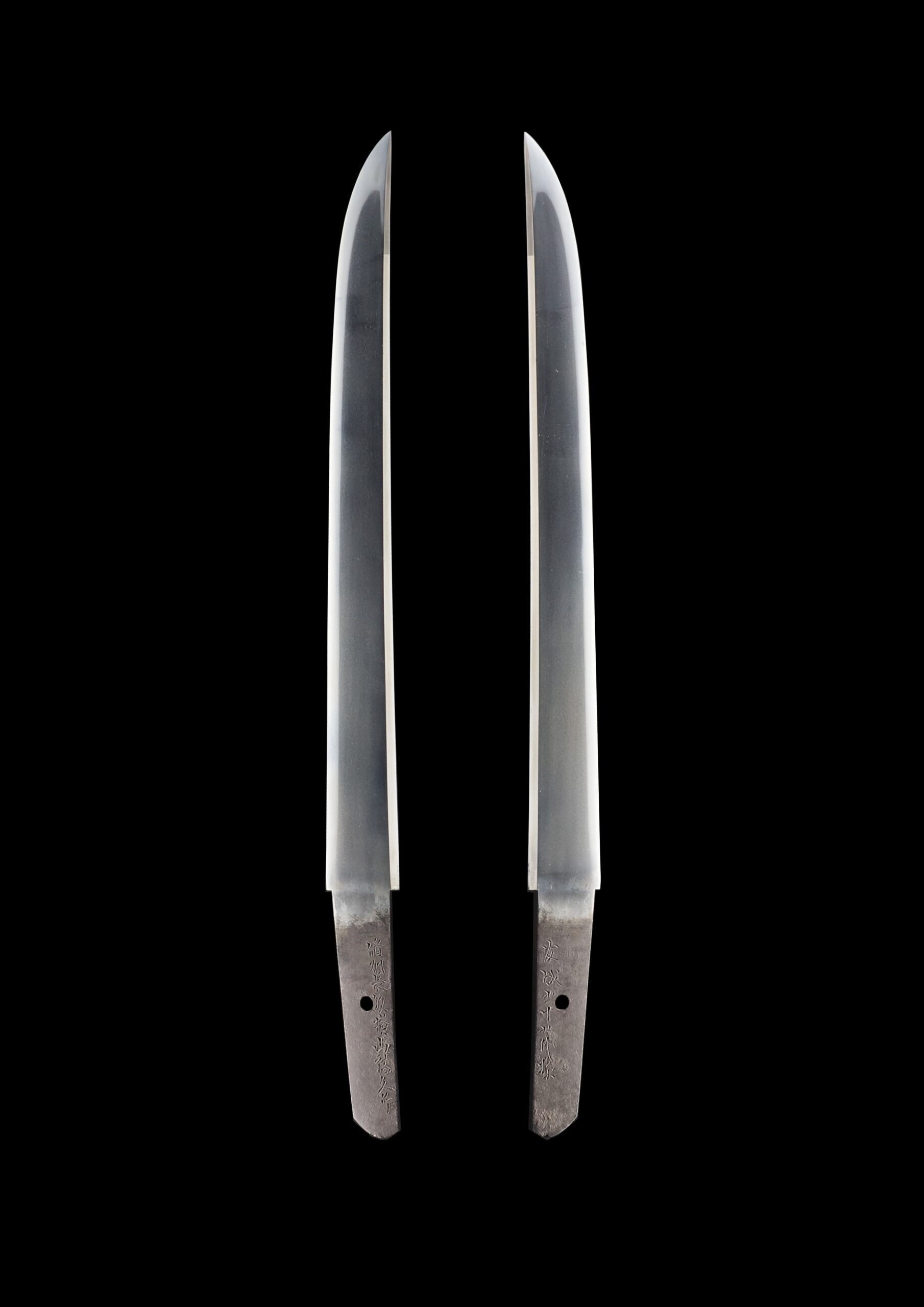
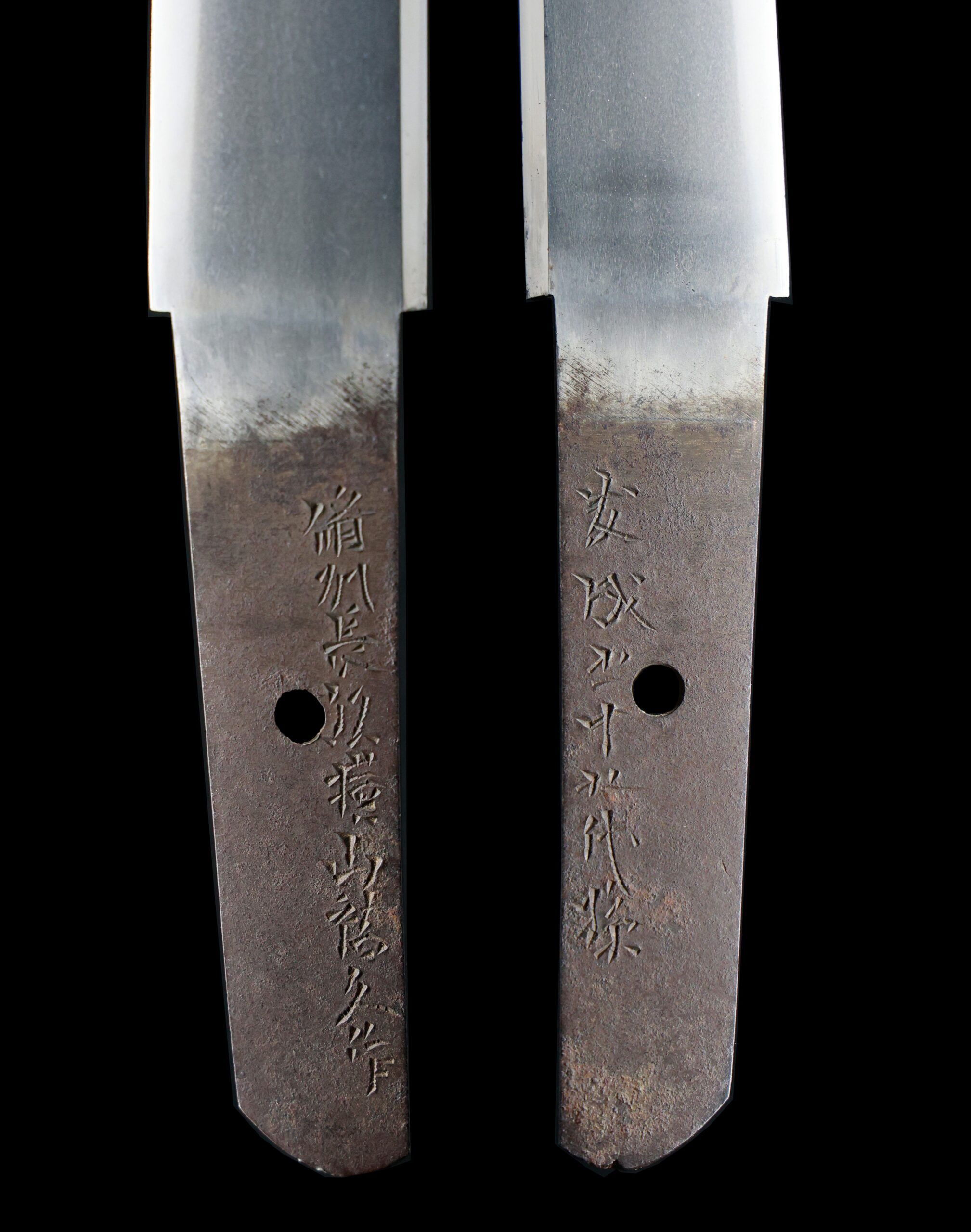
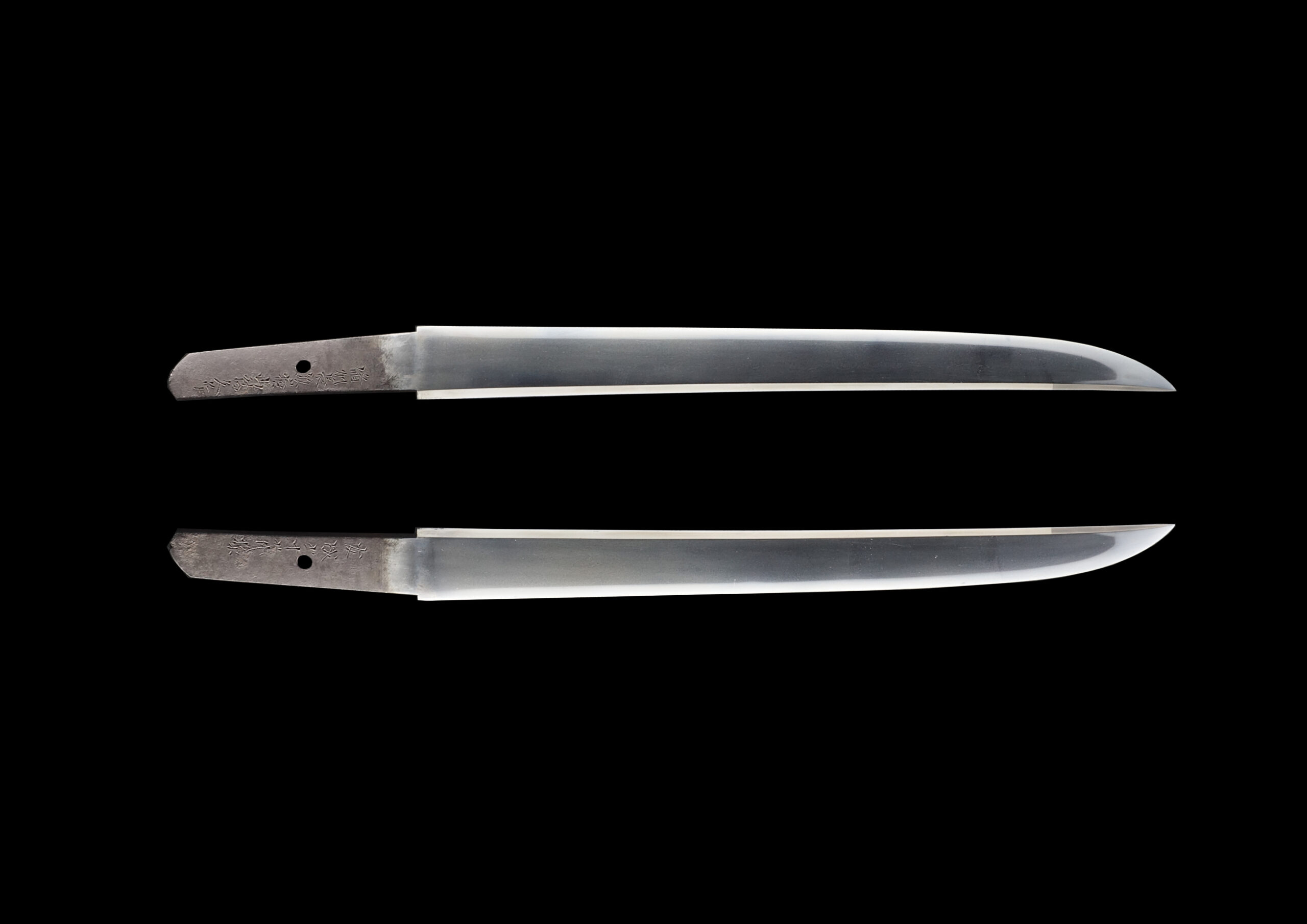
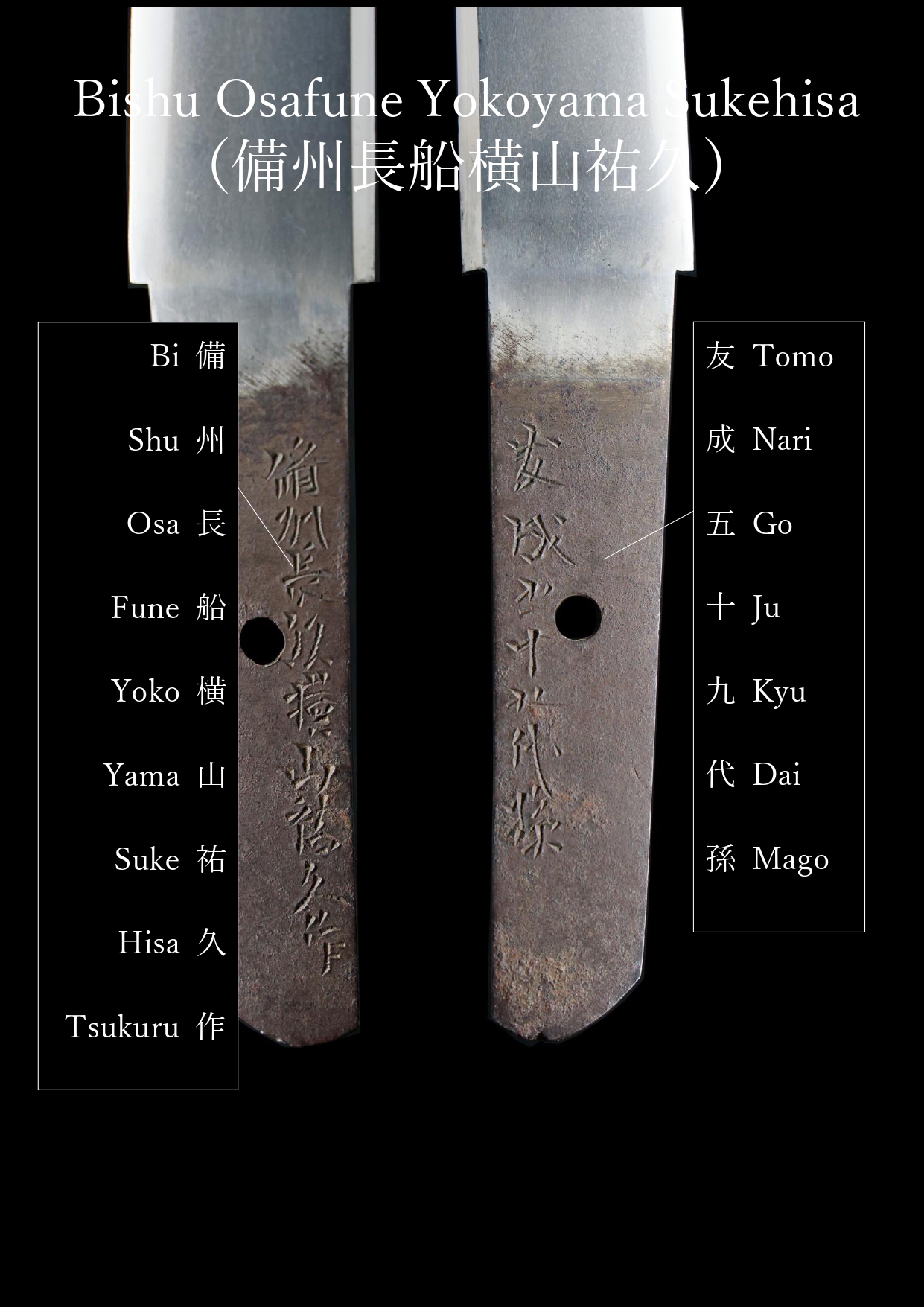
This blade was signed by Bishu Osafune Yokoyama Sukehisa (備州長船横山祐久) during the Keio era (1865-1868: the End of the Edo period), according to NBTHK appraisal. He belonged to Bizen Osafune school, located in today’s Okayama prefecture. He was especially active during the Ansei-Keio era (1855-1868). He was an apprentice of Yokoyama Sukenaga.
About Sukenaga (His master)
Bizen Osafune Jyu Sukenaga (備前長船住祐永) is one of the most famous swordsmiths in Bizen province at the end of the Edo period (Bakumatsu). Born as the second son of Yokoyama Sukehira, he belonged to the Yokoyama school in Bizen province (today’s Okayama prefecture). He eventually became the head of this school. He called himself the 56th-gen of Tomonari, a renowned swordsmith in the mid-late Heian period in Bizen province. He was allowed to inscribe a chrysanthemum emblem, which is the symbol of the Japanese emperor. His sword forging technique was so great that the emperor allowed him to use this emblem, which was quite honorable for any swordsmith. He trained many apprentices. Sukehisa was one of his students. And we believe Sukehisa was a very skilled swordsmith while there aren’t many remaining works today.
This History of Bizen Osafune School
It is said that Osafune school was founded by Mitsutada (光忠), who was active during the mid-Kamakura period. Bizen Osafune school was the biggest one of all other schools in Bizen province, and they received many orders from feudal lords or renowned Samurai. They were called Osafunemono and were beloved by Samurai warriors.
Among the swordsmiths who belonged to this school, Nagamitsu, Sanenaga, and Kagemitsu are known as Osafune Sansaku, the three renowned Osafune swordsmiths. There are also four other prominent swordsmiths who were from Bizen Osafune school. They are called Osafune Shiten-no, the four masters of Osafune school. Their names are Nagamitsu, Kanemitsu, Nagayoshi, and Motoshige.
BIZEN is located near the Chugoku Mountains, where iron sands, one of the essential materials for making Japanese swords, were abundant. Furthermore, BIZEN swordsmiths had close access to the Yoshi River, where they could find water and charcoal. This geological location contributed to the swordsmiths forging high-quality refined blades. We presume BIZEN was quite active in sword-forging from ancient times. It is said that BIZEN DEN was created by groups of swordsmiths there during the late Heian era (Late 12th century). These ancient swordsmiths in Bizen province are called Ko-Bizen (Old Bizen) swordsmiths. By inheriting the sword forging techniques from Ko-Bizen swordsmiths, the Bizen Osafune school flourished from the mid-Kamakura period.
Sunnobi Tanto (寸延び短刀)
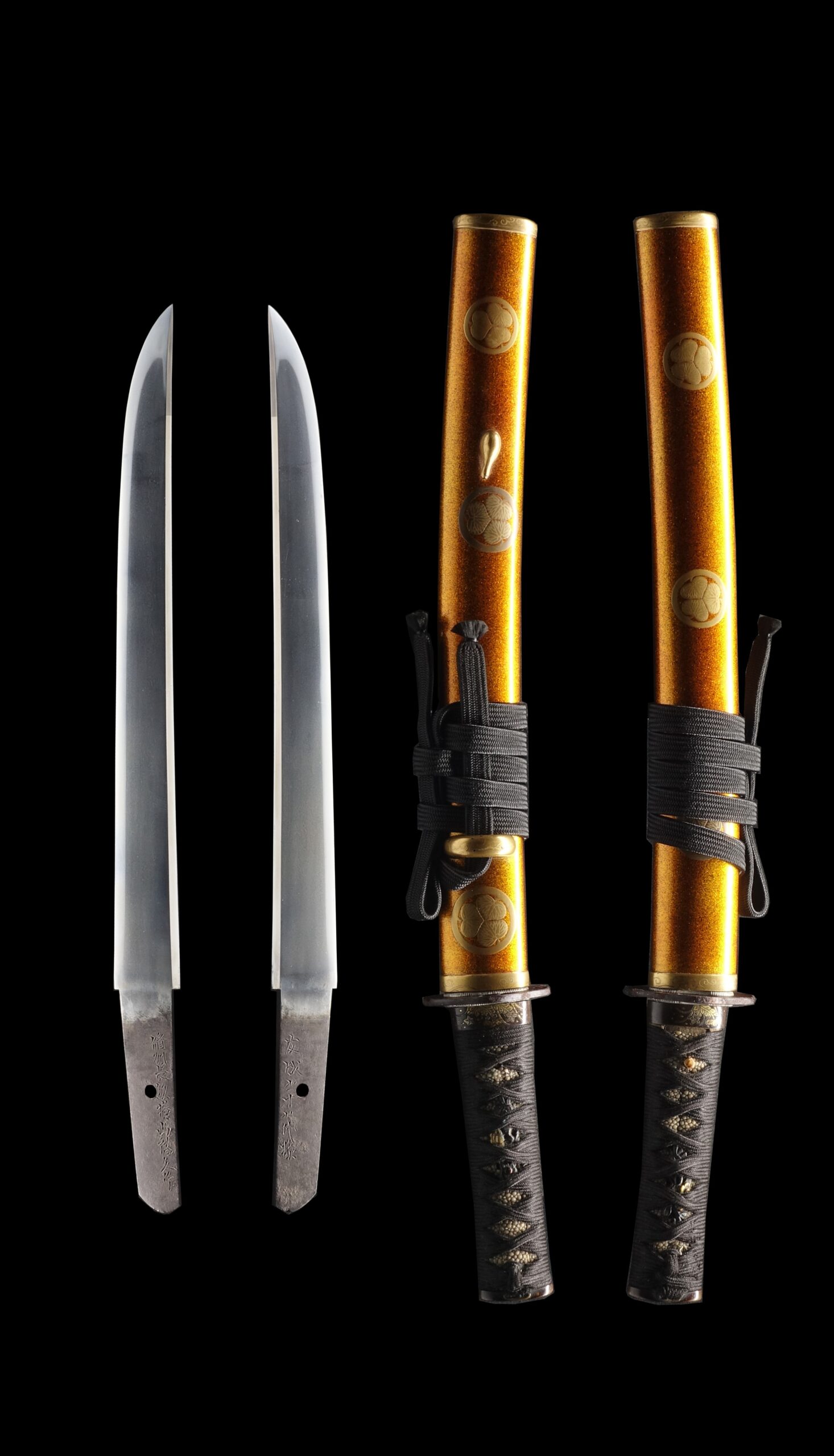
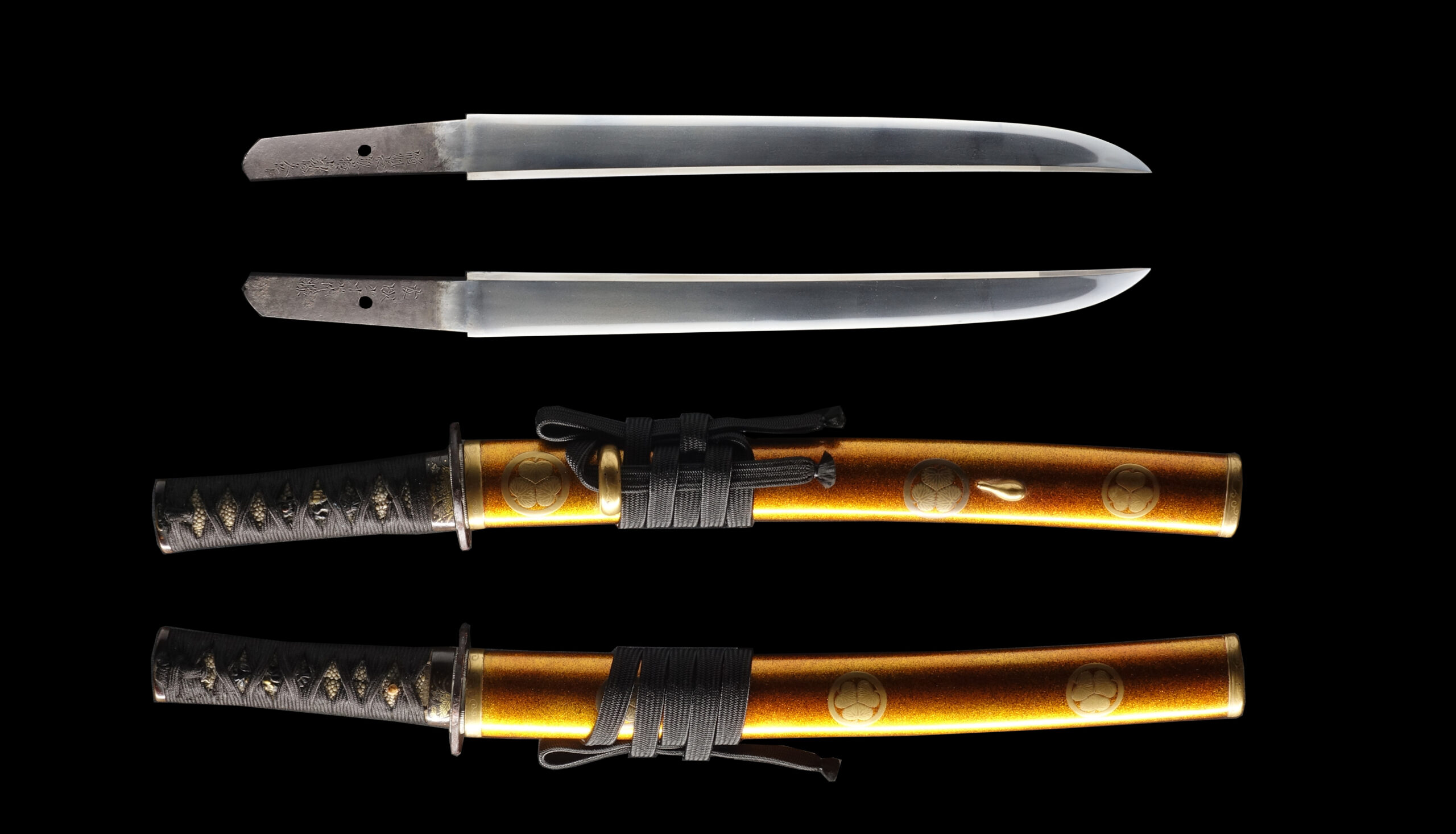
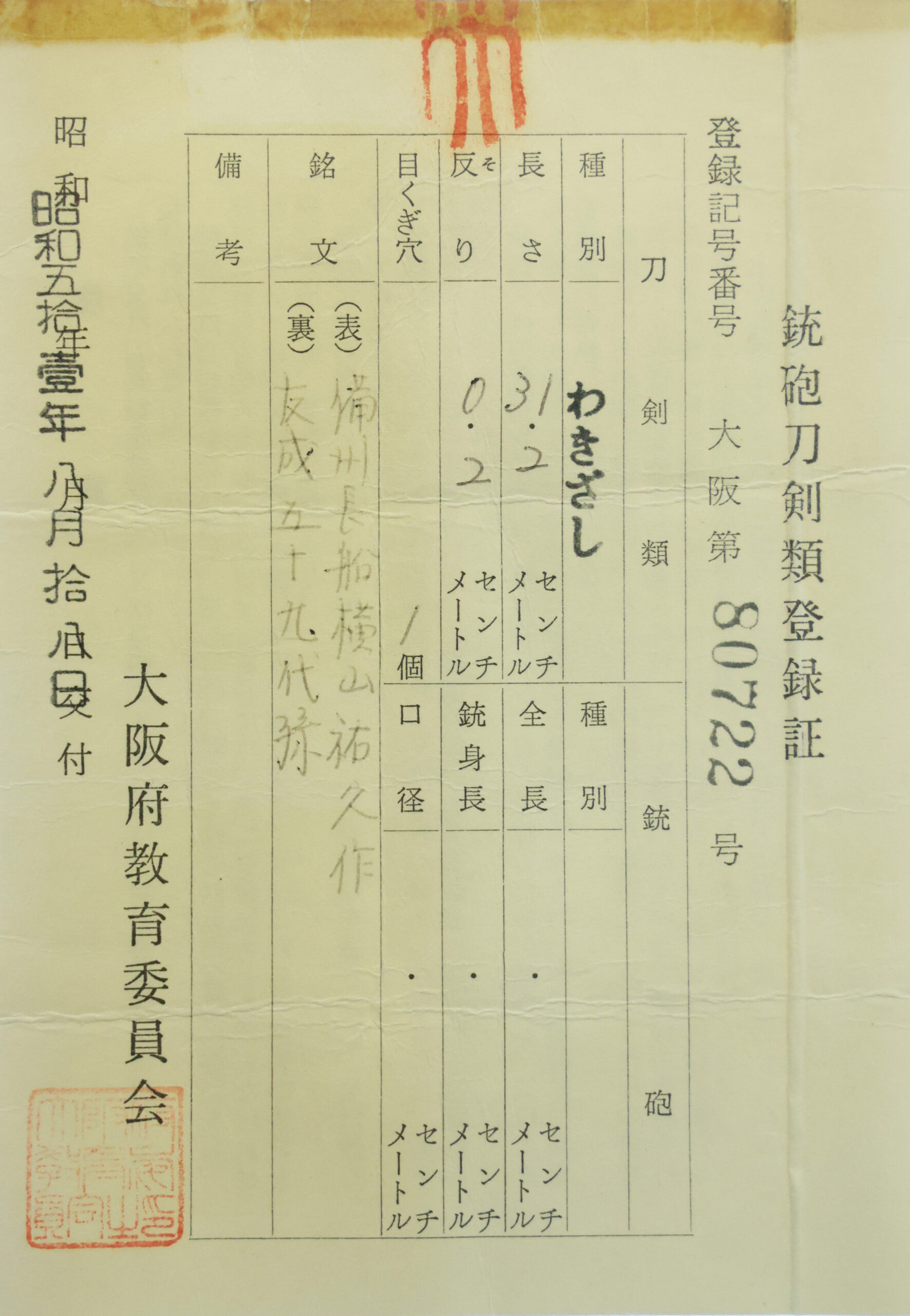
In Japanese sword terminology, this blade is categorized as a Wakizashi because its cutting edge length is more than 30.3 cm long. However, it is much shorter than the average Wakizashi sword. And it is very close to the Tanto sword. This Tanto is widely called Sunnobi Tanto, a Wakizashi sword whose cutting edge is very close to the category of Tanto (Cutting edge less than 30 cm). And it must have been used as a Tanto back in the day.
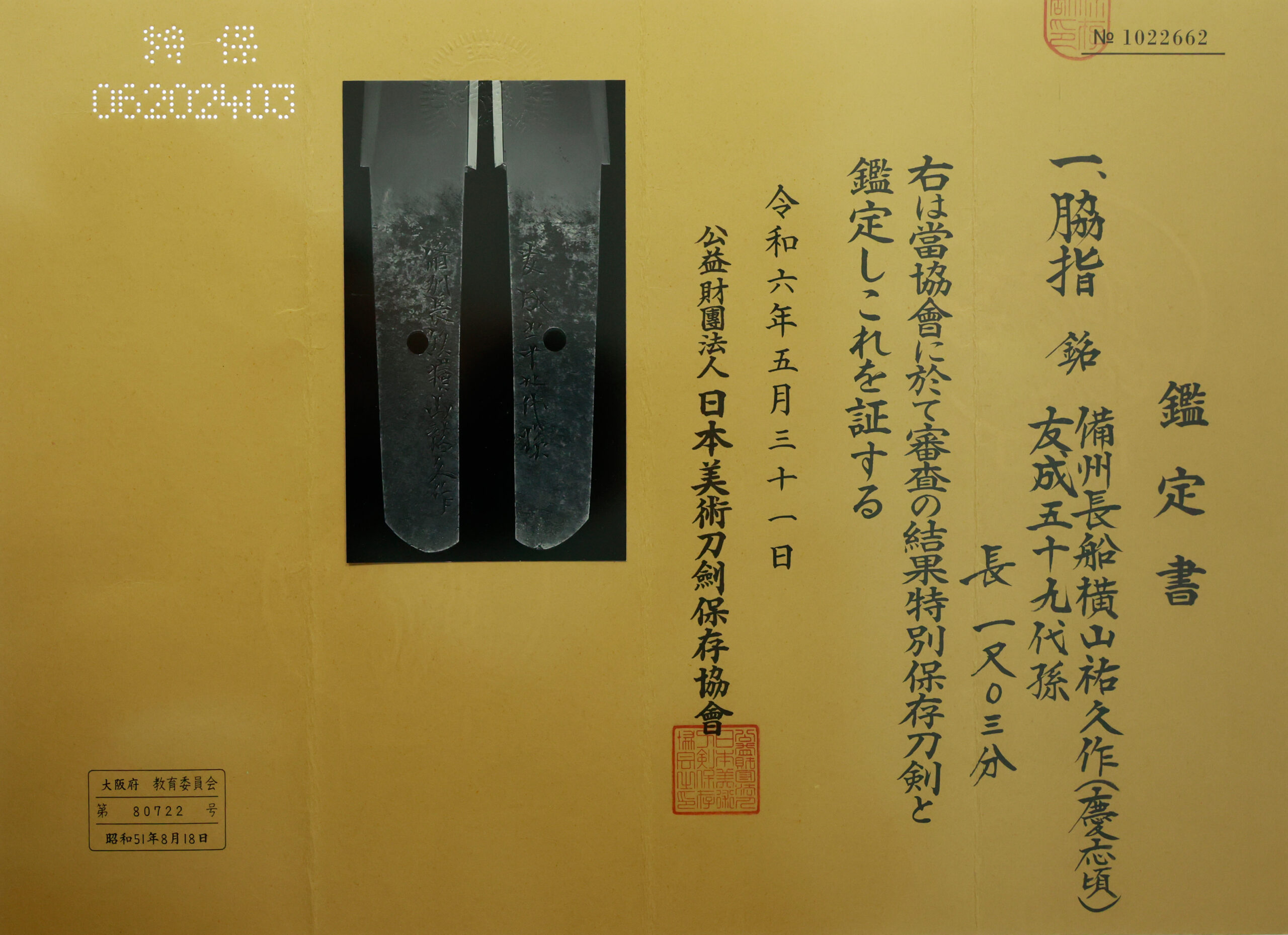
This blade is appraised as a Tokubetsu Hozon Token (特別保存刀剣) issued by NBTHK (Nihon Bijutsu Touken Hozon Kyokai:日本美術刀剣保存協会).
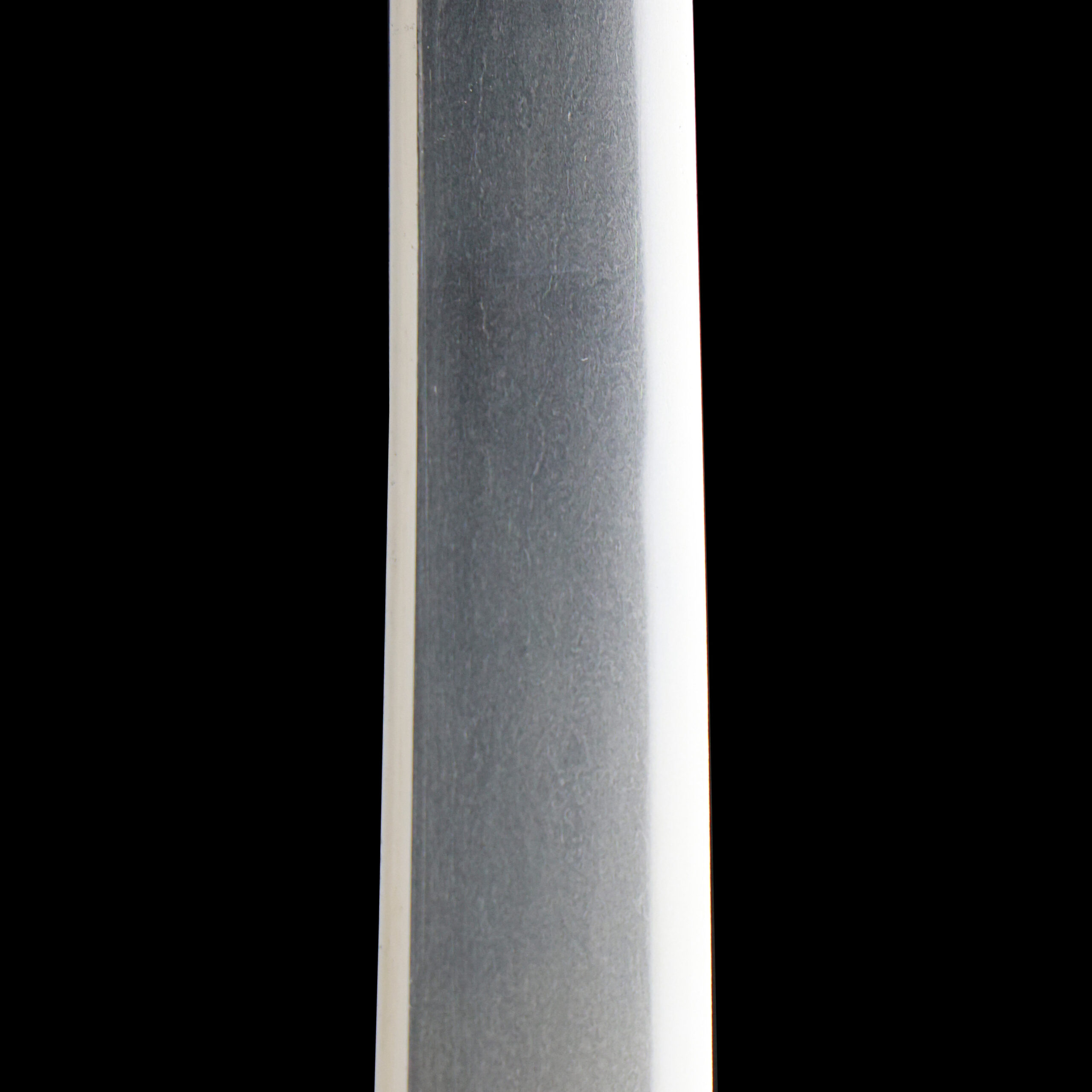
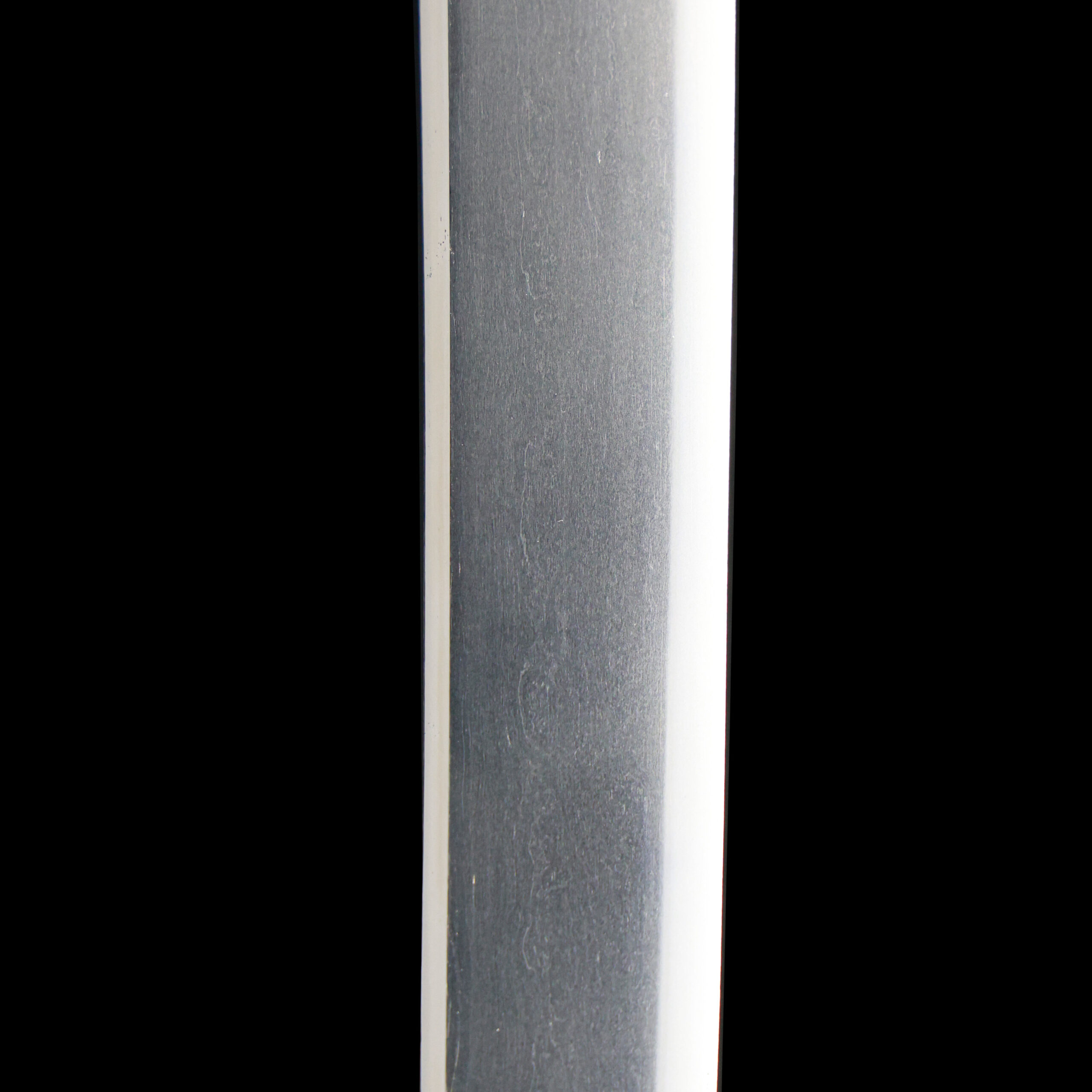
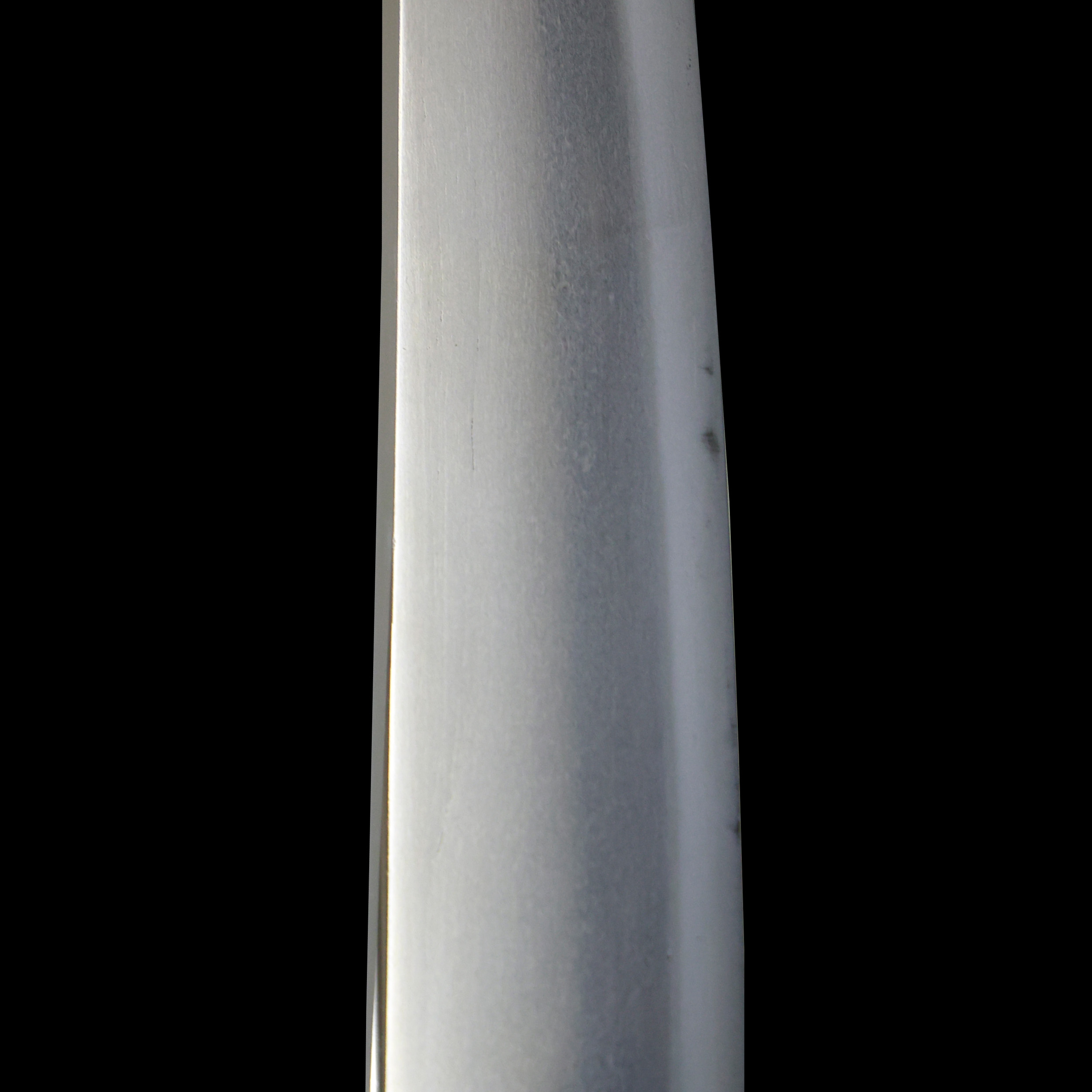
*Please keep in mind that there is a small black rust on the blade.
Fuchi-Kashira
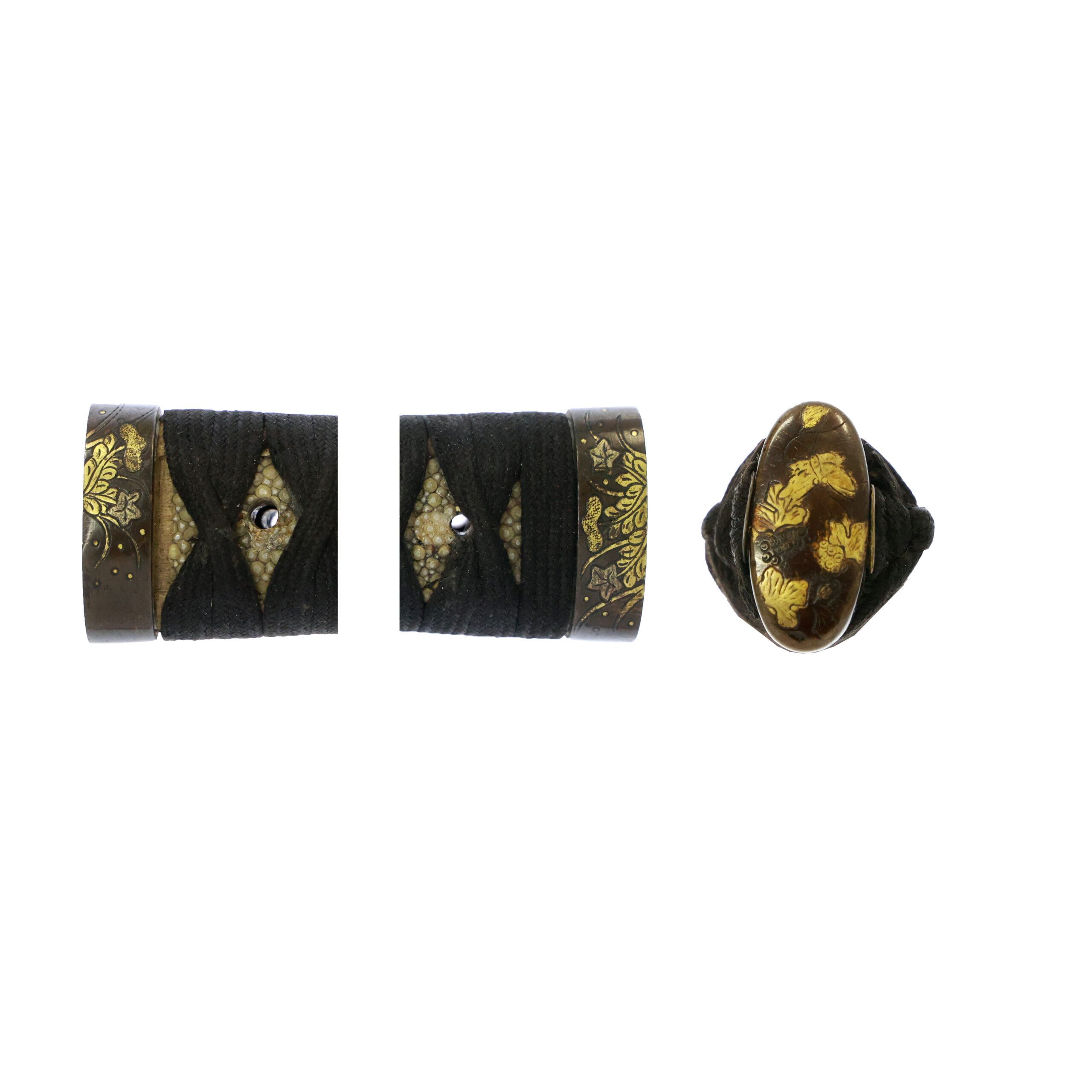
While Japanese bellflowers (桔梗, Kikyou) are depicted on the Fuchi, grapes (葡萄,Budou) with a butterfly (蝶, Chou) are depicted on the Kashira.
Kikyou is a small star-shaped flower. It is said its root has medicinal efficacy. The Kikyou pattern has often been used as a motif of Tanka (短歌, a kind of traditional Japanese poem) and pictures since the Heian period (794-1185). Its name was initially “Kichikou,” and it changed to “Kikyou” with time. It is said this flower was used for fortune-telling in the old days. This action is called Kikkyou-wo Uranau (吉凶を占う) in Japanese. The word Kikkyou (吉凶, good or bad omen) was associated with this flower’s name. “Kichikou” was compared to the word “Kichi Kou (吉更),” which means further good fortune. That is why this flower pattern is treated as a good omen design.
As for grapes, a theory says the grape pattern represents fertility, good health, and longevity. People treat this motif as an auspicious design. In Japanese, there is the word Budou (武道) which means martial arts. As Budou (葡萄, grape) has the same pronunciation of this word, it is considered that grape pattern shares some underlying ideas with Bushido (武士道, Japanese chivalry). That is why many Samurai appreciated the grape motif. Especially the combination of grape and squirrel patterns was widespread, as you see in the second Tsuba in this category. The squirrel is a familiar animal to people since ancient times. According to a theory, this motif was brought to Japan in the Muromachi period (1336-1573). The Budou Risu (葡萄栗鼠, combination of squirrel and grape) pattern became famous and started to be applied to porcelains or sculptures. Since squirrels resemble mice that is a fertile animal, people regarded squirrels as the symbol of the prosperity of descendants.
Regarding a butterfly, a larva becomes a chrysalis, and it grows up to a butterfly. As this insect changes its looks, it symbolizes reborn; therefore, Samurai loved the butterfly pattern. Also, as butterflies make a couple on good terms, this motif represents happy marriage.
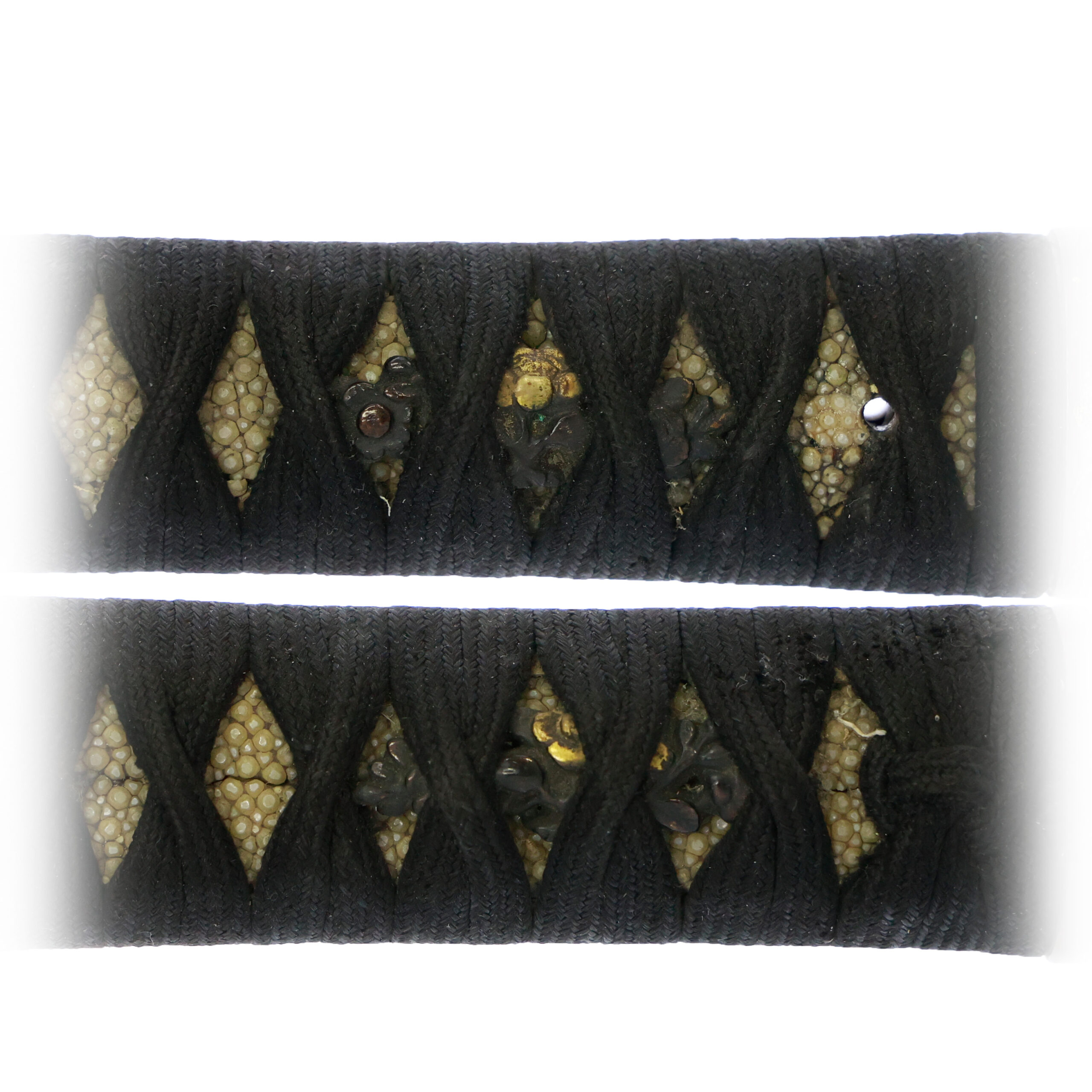
Tsuka and Menuki
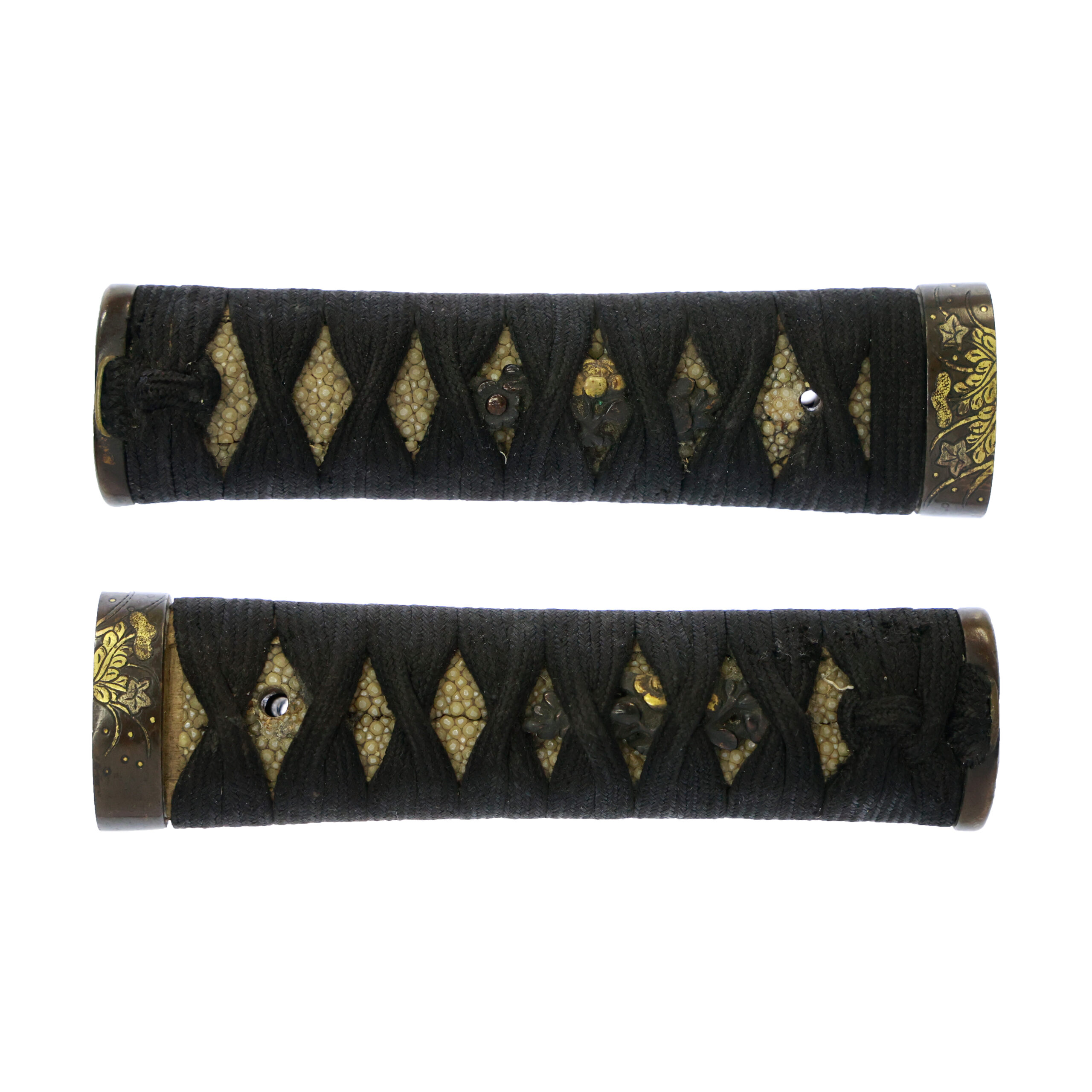
We assume the motif of this Menuki might be Ume (梅, Japanese apricot blossom) or Tsubaki (椿, camellia). Japanese apricot blossoms begin to bloom in winter that snow still covers its tree so that people thought this flower tells the arrival of spring. Same as cherry blossom, it has been appreciated for a long time in Japan. People enjoy its adorable petal shape and scent, gracefully branched tree, and compose many poems. As it comes out in the cold season, it symbolizes the power of perseverance and vitality.
As for Tsubaki, it has been treated as an auspicious motif since this plant is an evergreen tree that keeps its green color throughout the year. The Tsubaki was also said to be the most auspicious tree before Japanese apricot blossoms were introduced from the continent. In the Heian period (794-1185), it was cherished as a noble flower among aristocrats.
According to a theory, the way flowers fell off was unfavorably received among Samurai families because it was seen just like a head had fallen off. However, on the other hand, Tsubaki has been appreciated as a plant that produces various byproducts. Tsubaki has been used for various things such as oil, cosmetics, and medicine, and it can be seen that this flower has been very familiar to Japanese people’s lives since ancient times. Also, some people believed that the Tsubaki would protect people from epidemics or evil spirits. As mentioned above, the Japanese name of camellia is written as 椿. And this letter is composed of 木 (tree) and 春 (spring). So, this flower was considered a plant that waits for the arrival of spring. We could imagine how people named this flower in an attempt to give it a good meaning.
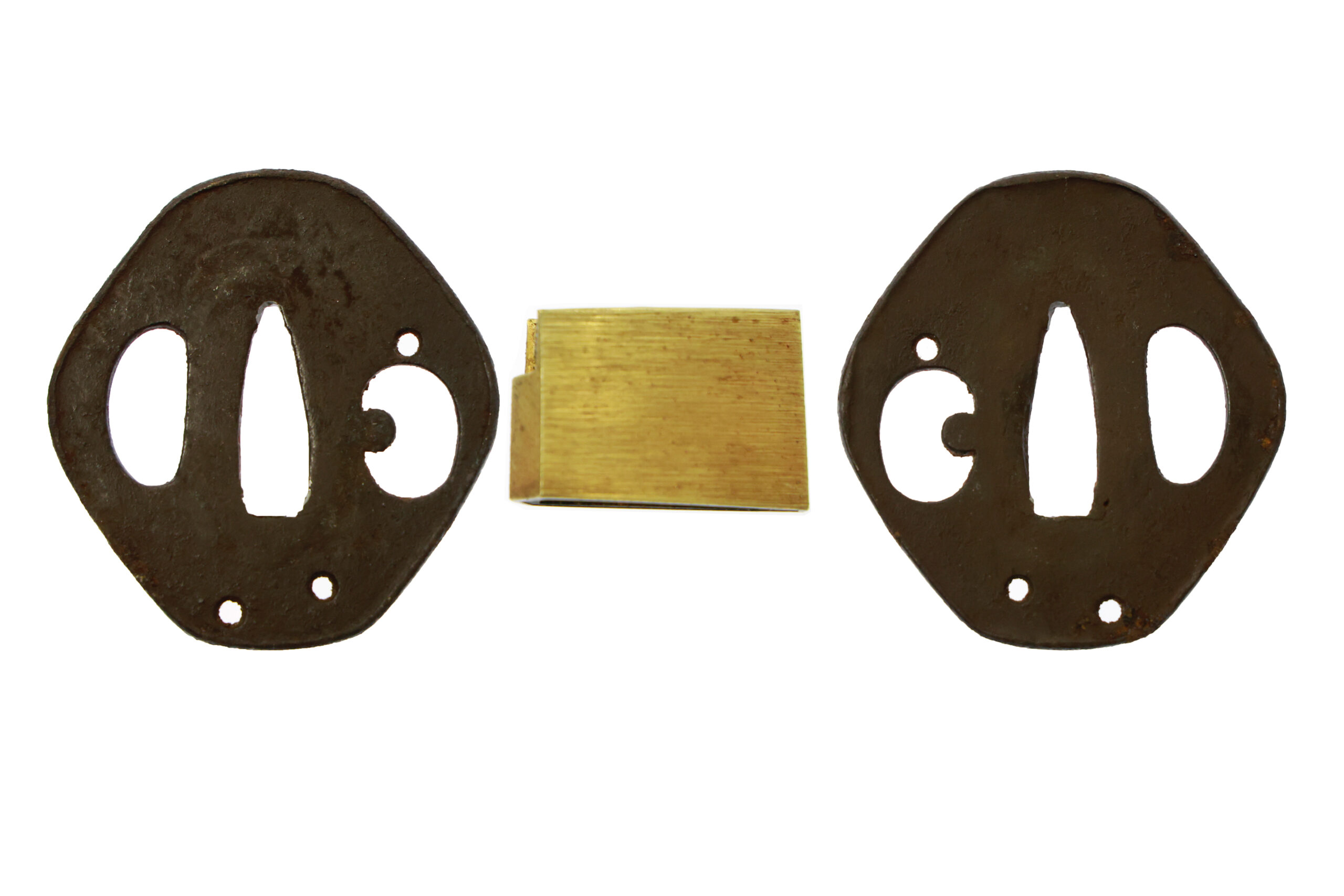
Tsuba and Habaki
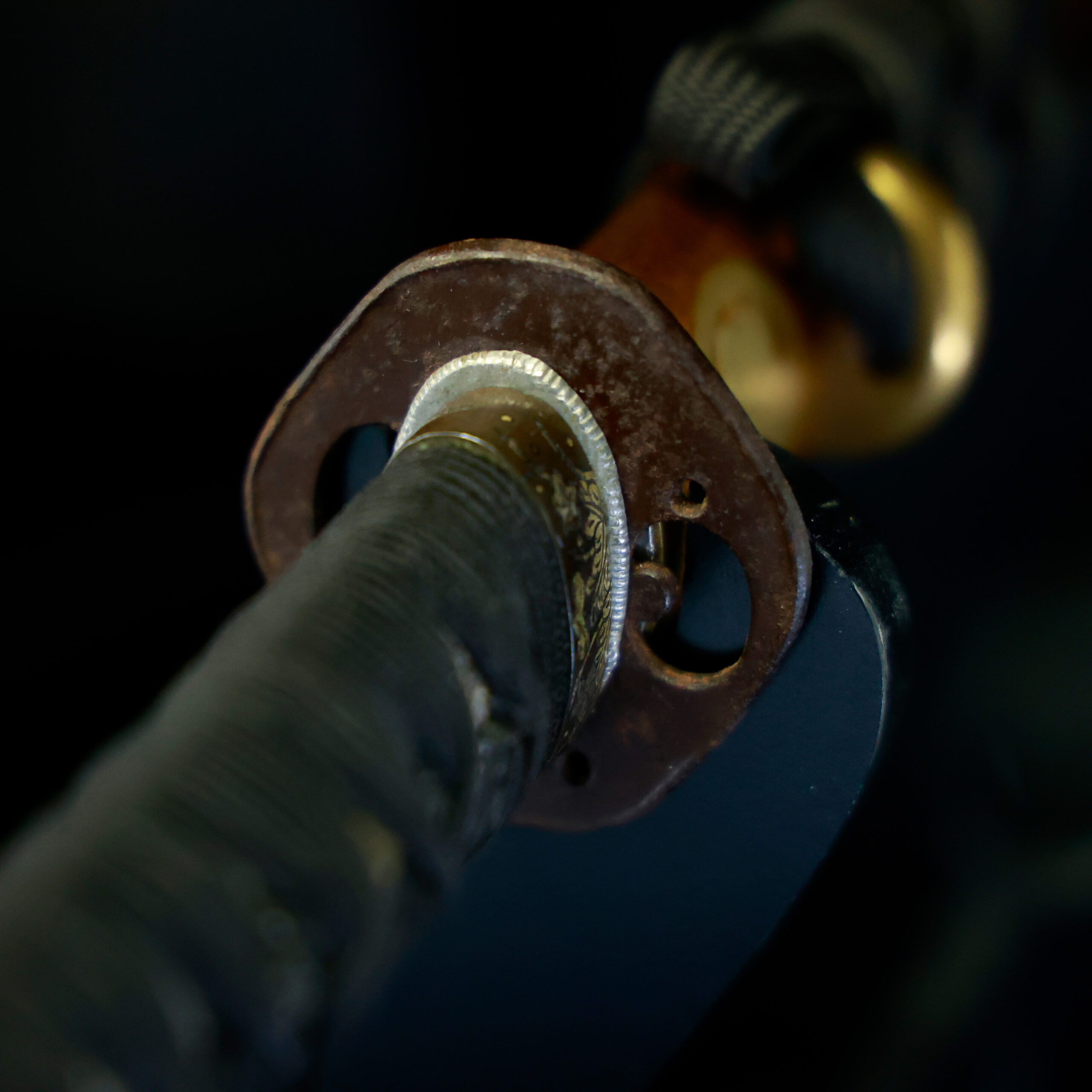
This Tsuba has a hexagon shape and some small holes engraved with openwork.
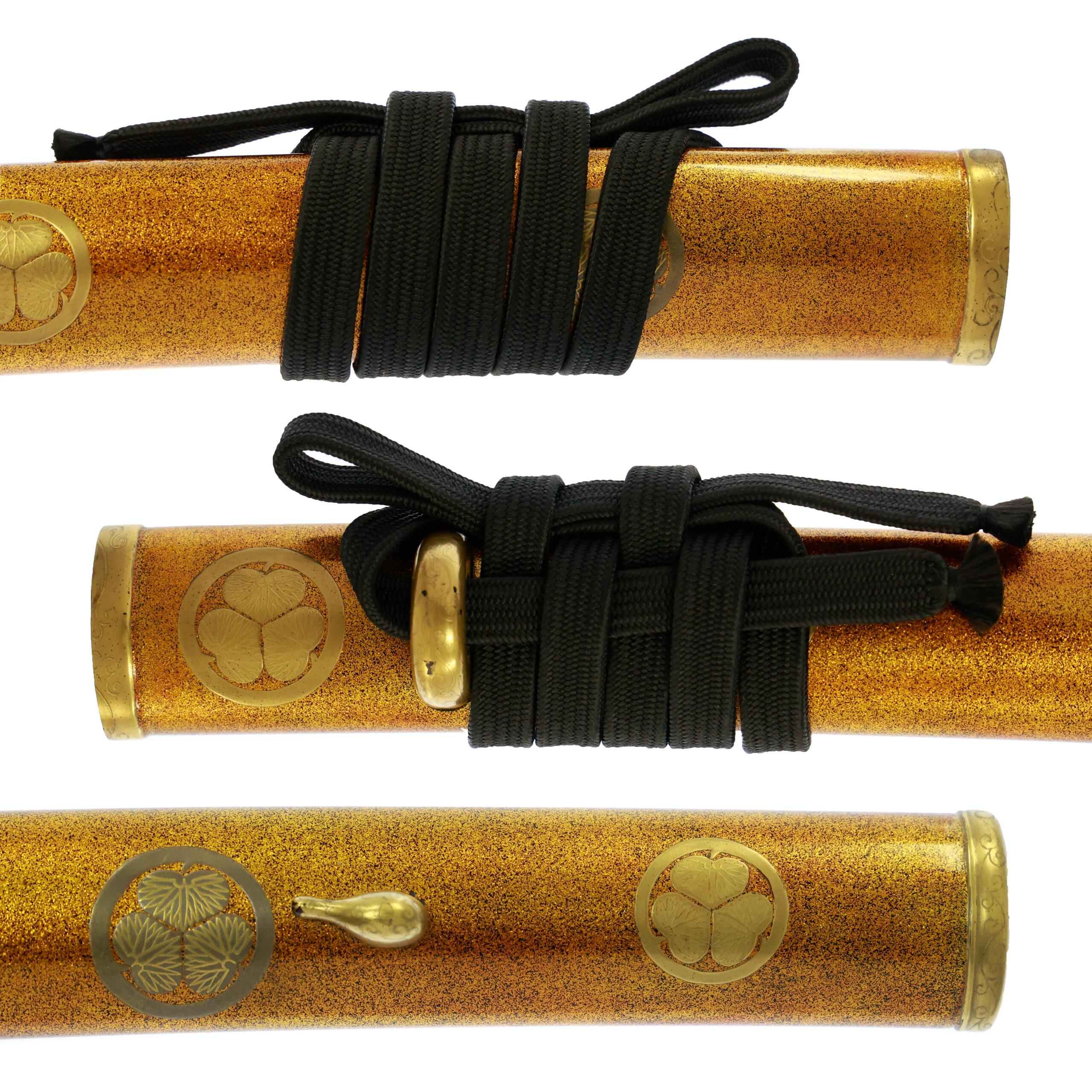
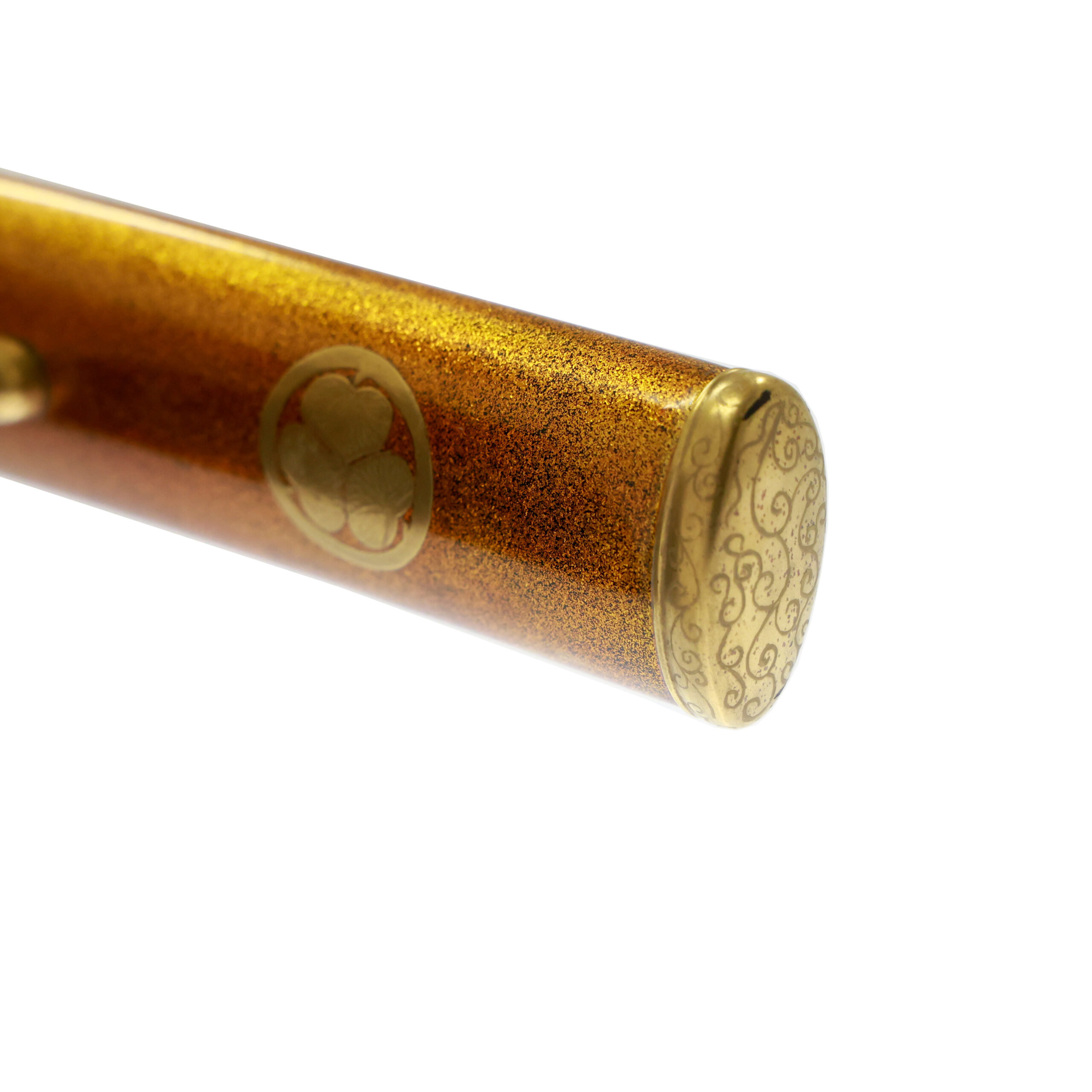
Saya
The surface of this Saya is decorated with the Nashiji Nuri (梨子地塗/梨地塗) technique, which is a kind of Makie (蒔絵) method. This surface treatment method creates a rough texture by creating fine unevenness on the surface of the metal. They also come in varying degrees of gloss, including glossy, semi-gloss, and matte. According to a theory, it was invented in the Kamakura (鎌倉) period (1185-1333), and in the Edo period, various techniques were devised to color the products.
Also, a family crest called the Aoi-Domoe / Mitsuba-Aoi-no Mon (葵巴/三つ葉葵の紋) is depicted. It is known as the family crest of Tokugawa Shogunate family led by Tokugawa Ieyasu, a famous military commander of the Warring States period. Aoi (葵, Asarum caulescens) is a plant pattern in which each stem branches and has characteristic heart-shaped leaves. This plant pattern has also been used for the crest of the Kamo shrine in Kyoto prefecture. As mentioned above, the famous Shogunate family, the Tokugawa family, had their family crest with three leaves of Aoi due to the relationship with the Kamo shrine. As its leaves have a habit of always facing the sun, and the word “Aoi” is taken as “Aogu (仰ぐ, looking up)” for the sun, people thought the Aoi pattern would bring good fortune.
In addition, Karakusa (唐草, arabesque) pattern is depicted on the gold edge of this Saya. It is a pattern in which stems and leaves of vines are twined and make curves. Since ivy has a strong vitality and grows up without interruption, people regarded this design as a symbol of prosperity and longevity. Vine is called Tsuru (蔓) in Japanese, and it has another pronunciation; “Man.” There is a word 万 (it is also read Man), which means ten thousand. In the Karakusa pattern, leaves and vines are connected like Obi (帯, belt). The word “帯” can also be read “Tai.” Due to its pronunciation, the term “代 (Tai)” is associated. From this word-association game, an idiom 万代 is associated, and it means a thousand generations. In other words, we could imagine that people used this design wishing prosperity and longevity for their clans for a long time.
Authentication Paper
They authenticated the blade on May 31st in the 6th year of Reiwa (2024). They appraised it as Tokubetsu Hozon Touken, the blade especially worth preserving for Japanese society.


 NihontoWatch