War at home and trade abroad made Muromachi Bizen the busiest forge region in Japan: a century of Sengoku demand after the Ōnin War, and export missions to Ming China carrying blades by the tens of thousands.
 NihontoWatchNihontoWatch
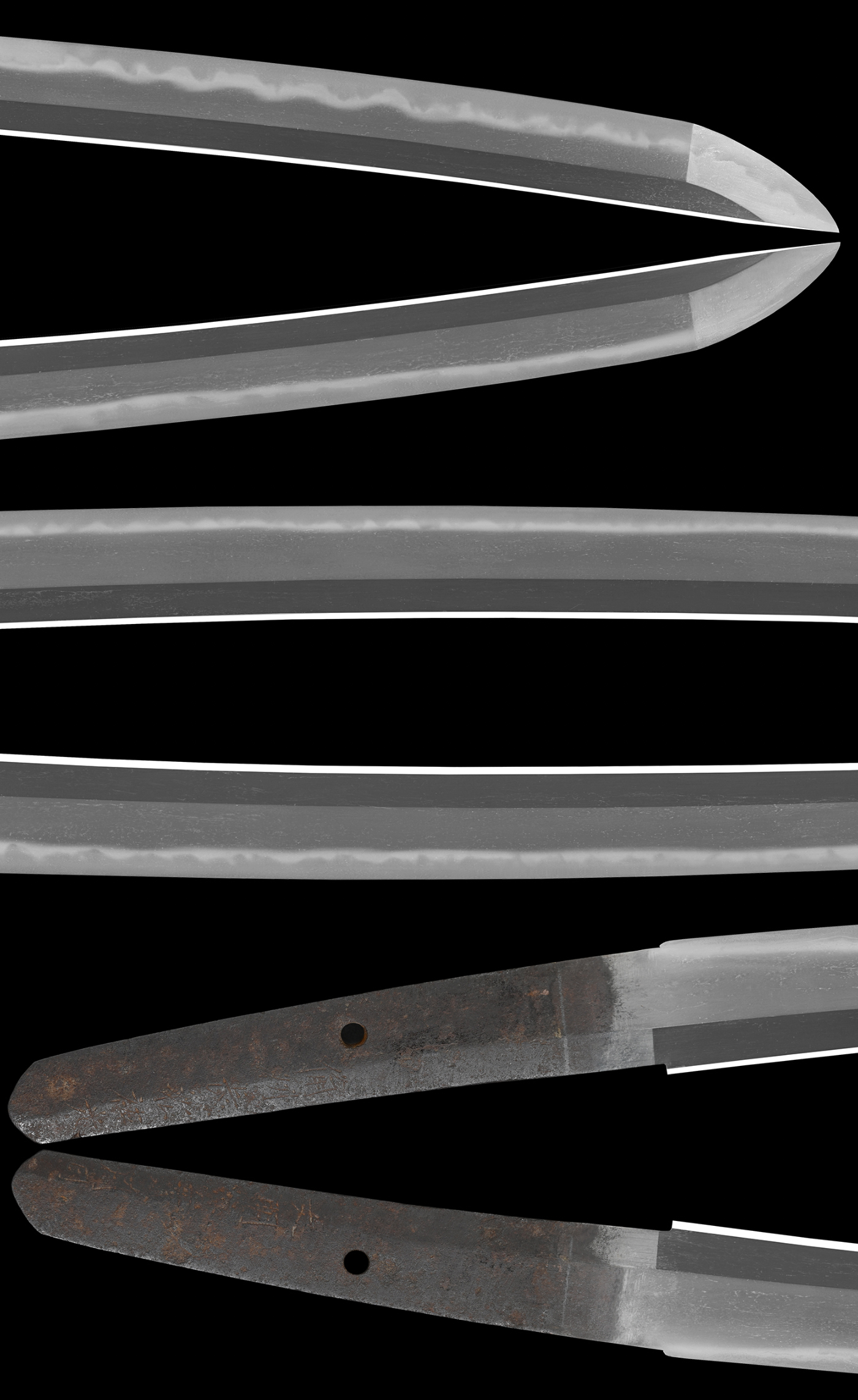
Characteristics: Bishu Osafune Sukemitsu (Rokurozaemon-no-jo Sukemitsu) was the father of Ukyonosuke Katsumitsu and Sakyoshin Munemitsu, and as a swordsmith of the Eikyo era, which falls between Oei Bizen and Sue Bizen, he is known to the world as "Eikyo Bizen."
Certificate reading — 銘 備州長船祐光 文明□年八月日
NihontoWatchOffered by Samurai Shokai

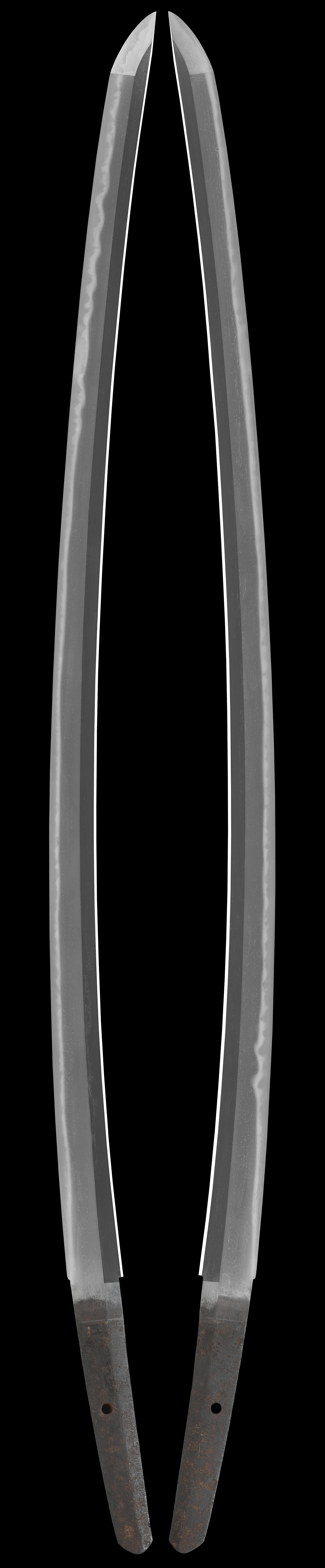
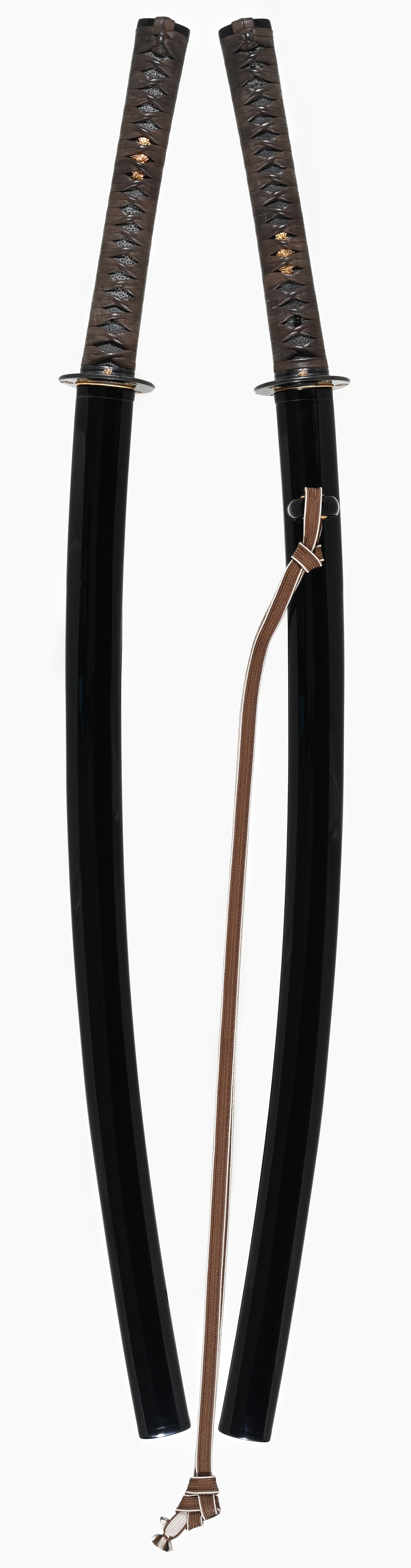
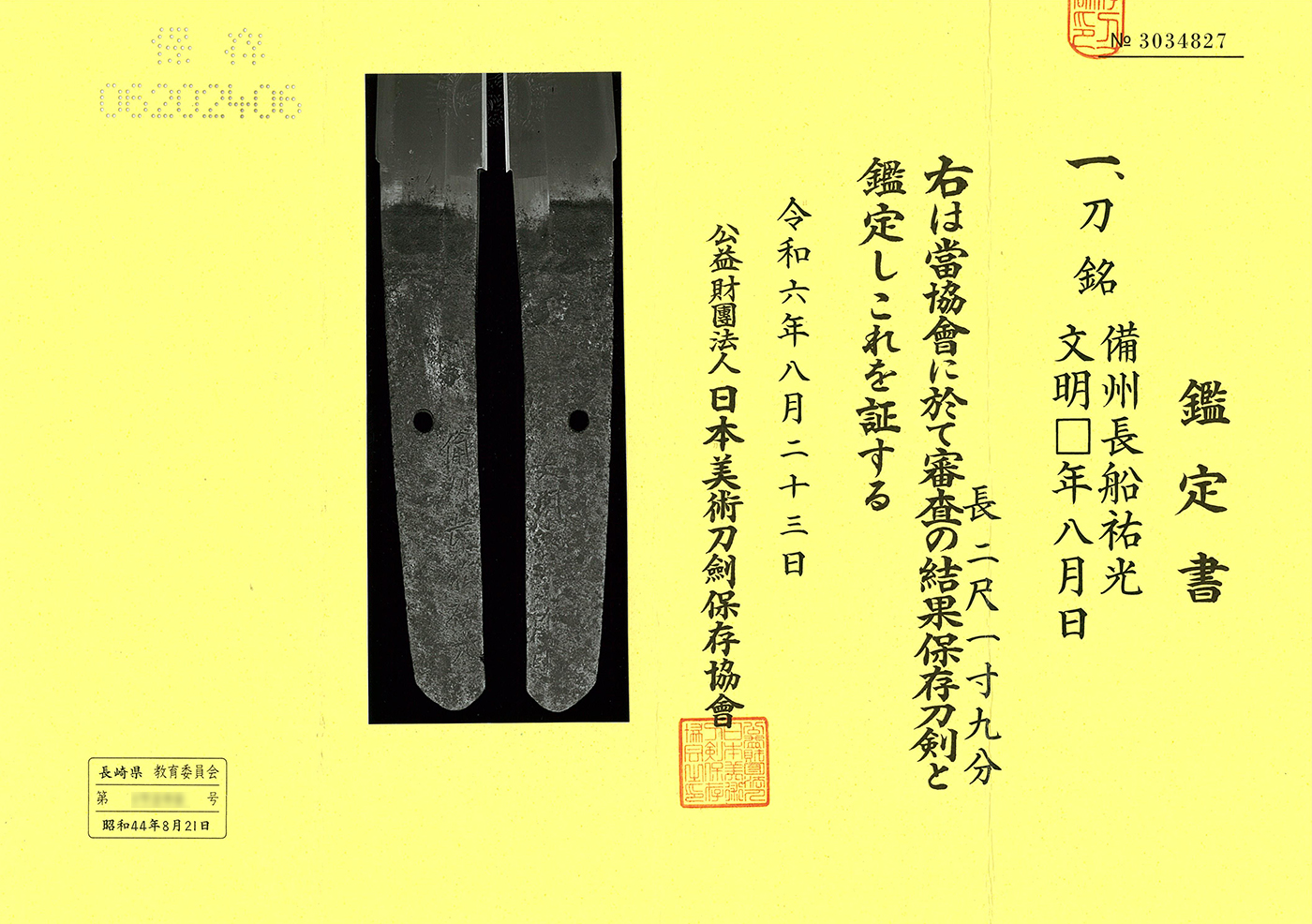
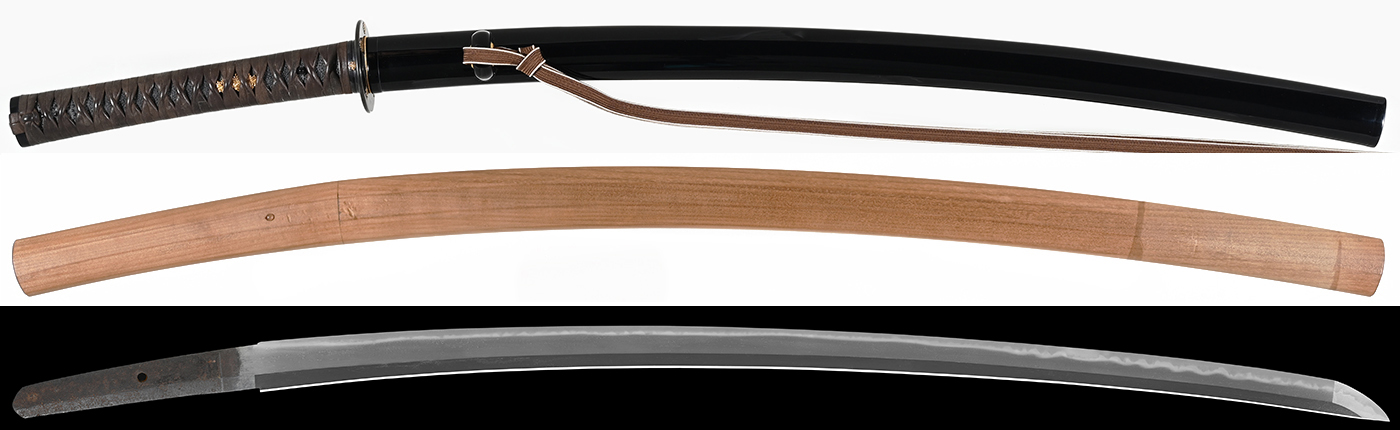
Machine translation from the shop's Japanese · may contain errors ·
Bizen Osafune (Sue-Bizen) · Bizen · around 1429-1462
Tōken Taikan top 21%
1 piece on the market now
A tachi signed Bishū Osafune Sukemitsu and dated the eighth month of Eikyō 9 (1437) is the earliest dated work of this Osafune smith, and the published sources call it an ubu, signed tachi in the manner known as Oei-Bizen, "an imposing work"[[c:1]]. His dated blades continue through Kakitsu, Bun'an, Hōtoku, Kōshō and Kanshō, and a wakizashi of Bunmei 5 (1473) carries the name further. The Meikan lists seven smiths signing Sukemitsu, and the NBTHK takes this one, judging from his dates, as the first among them. On several blades he adds the common-name title Rokurōzaemon no Jō, and those pieces identify him as the father of the brothers Ukyō no Suke Katsumitsu and Sakyō no Jō Munemitsu. The proof is a Munemitsu tanto dated Bunmei 9 signed "Osafune Sukemitsu's second son, Sakyō no Jō Munemitsu"[[c:2]], a blade the published sources say shows well the transition from Oei-Bizen into Sue-Bizen.
His characteristic temper is a gunome that opens wide at the waist, the koshi no hiraita gunome, mixed with a little chōji, nioi-dominant with ko-nie, with fine kinsuji and sunagashi running within and a bright nioiguchi. On the Eikyō tachi it is mixed with pointed elements; on a Bun'an 5 tachi it carries pointed and angular teeth and in places recalls shima-ba. The published sources describe that Bun'an tachi as full in its contours and healthy, a fine piece that "fully displays the height of his skill"[[c:3]]. It carries on the ura a gold-inlaid cutting-test inscription of Manji 1 by the tester Yamano Kaemon no Jō Nagahisa.
The jigane is an itame mixed with mokume, at times flowing or standing, with ji-nie and well-entered chikei, and over it a bō-utsuri stands, faint on some blades and clear on others. The bōshi runs in a midare-komi to a ko-maru, or runs straight and points as it turns. A Bun'an 6 tanto with slight uchizori shows the whole manner on a small scale: a standing itame with mokume, thick ji-nie, chikei and bō-utsuri, under a waist-open gunome and gunome-notare with abundant ashi and a little yubashiri. The published sources call it a superb piece "showing Sukemitsu's typical manner, its merits displayed throughout"[[c:4]]. It is incised with the deity name Ichinomiya Daimyōjin.
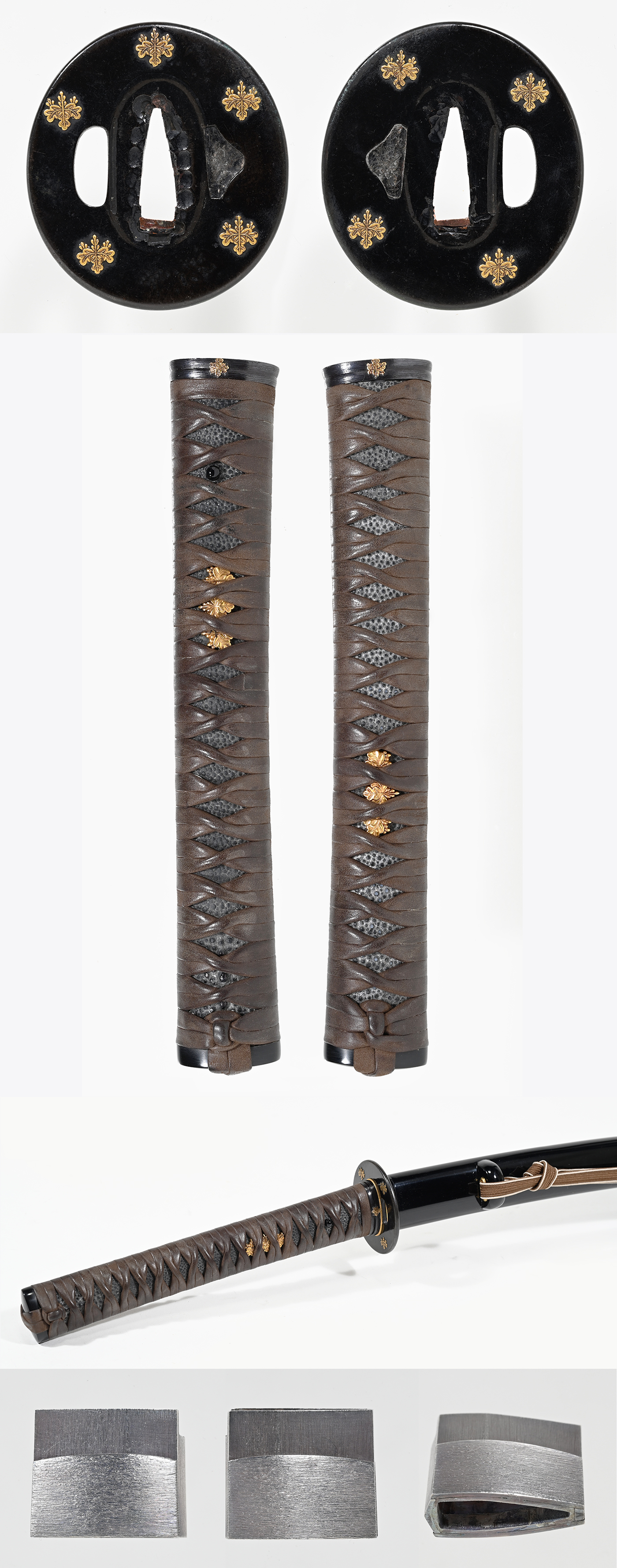
The published sources read his dated work as a single hand crossing from Oei-Bizen into Sue-Bizen. Of a Kakitsu 3 wakizashi they write that the construction and the ji and ha still show an Oei-Bizen flavour, but that "the smaller amplitude of the midare and the inconspicuous chōji show that the date has descended"[[c:5]]. A Kōshō 3 tachi keeps the high koshizori of a tachi with a waist-open gunome mixed with chōji, while a Kanshō 3 katana, signed in full with the Rokurōzaemon title and fitted with a brocade-wrapped handachi mounting, has a suguha-toned temper with gunome ashi and a tightening nioiguchi above. Of it the published sources write that "works with this signature are very few, its carving fine, and it is well made as Sue-Bizen"[[c:6]]. His carving is notable throughout: kurikara, bonji and sutra text, twin grooves, and sacred names.
He also tempered a chū-suguha. A wakizashi of Hōtoku 3 is inscribed on the ura as made at Takehara in Settsu, a record of the period when Bizen smiths moved to work in other provinces, as Katsumitsu did in Bitchū, Kojima, Kyoto and Ōmi. The published sources call it "not only good material for the study of the Sue-Bizen smiths but a fine work in chū-suguha"[[c:7]]. The Bunmei 5 wakizashi, recorded in Honma's inventory of the Imperial collection, is of the same quiet kind: an itame flowing slightly and standing, with a whitish bō-utsuri, under a chū-suguha with a slight notare and ko-nie, carved with bonji and a sankoken over twin grooves and inscribed with the deity name Tenshō Daijingū. Honma gives the Meikan's scheme of five generations of the name but adds that "whether this division is correct must await further study"[[c:8]]. He finds the smiths of the name "skilled in both suguha and midare"[[c:9]], and calls the Tenshō Daijingū inscription "worth noting together with the Ise faith"[[c:10]].
For the collector, Sukemitsu's record is seven blades designated Jūyō, every one signed and dated on an ubu tang, with no blade in the higher tiers. No provenance is recorded for them. The published sources stress how few works carry his full Rokurōzaemon signature, and a dated, carved blade from the head of the family that led Osafune into the late Muromachi appears only from time to time; it is valued as a document of the passage from Oei-Bizen to Sue-Bizen.
Where Sukemitsu stands among comparable artisans: across all of nihontō, and within tradition, era, and period. The tiers (Foremost · Leading · Major · Notable) weigh official designations from the NBTHK and Japan's Agency for Cultural Affairs, together with historical honors of lasting repute such as the Sansaku and Meibutsu-chō.
Select a lens to see how it's measured.
Years he was demonstrably active, proven by signed-and-dated blades
Bizen-den · Bizen
188 pieces on the market now
No single workshop in the history of Japanese swordmaking grew larger or lasted longer than Osafune, the riverside village in Bizen Province whose name became, across three centuries, a byword for the province's mainline. Its de facto founder was Mitsutada (光忠), working at Osafune in the middle Kamakura period; tradition makes him the son of Chikatada, and the genealogies derive his line from the Ko-Bizen Masatsune group already settled in the village. His blades, bold and imposing with a jigane so refined the sources say it can at a glance suggest Kyoto work, were treasured from old as the swords of commanders, and from his hand the school spread immediately: his sons Nagamitsu (長光) and Sanenaga (眞長), his grandson Kagemitsu (景光), and outward through pupils and collaterals until, by the late Kamakura years, Osafune was less a family than an industry. The line is conventionally read as a three-generation spine, Mitsutada founding it, Nagamitsu setting its classical standard, Kagemitsu bringing both temper and forging to their finished form before handing the manner to his pupil Chikakage (近景), whose echo of the master is so close that signed Kagemitsu blades are sometimes read as Chikakage daimei. What binds the membership is a shared steel before any shared temper. The forging is itame mixed with mokume, tightening on the finest blades into a dense ko-itame; fine ji-nie adheres, chikei enter, and over all of it stands the midare-utsuri that anchors even the most Kyoto-like jigane back to Bizen. On that floor the founding generation tempers a flamboyant choji-midare mixed with gunome: Mitsutada's tadpole-headed kawazuko-choji, Nagamitsu's round-topped plump choji, the deep nioi with ko-nie, the bright nioiguchi. From here the school divides by hand and by era. Sanenaga draws the calm pole, a gentle chu-suguha of tightened nioiguchi; Kagemitsu completes the slanting, square-shouldered kataochi-gunome over a suguha base, the family's last great Kamakura invention, carried on by his close kinsman Kagemasa (景政). The Nanbokucho generation then turns toward Soshu-den: Kanemitsu (兼光), fourth master of the mainline, pioneers a broad notare and is read, with Chogi (長義), as the head of Soden-Bizen, the Bizen wing that worked Soshu nie into a jigane that still throws a Bizen utsuri.
Chogi is called the most un-Bizen of Bizen smiths, his ear-shaped mimigata his tell; around him Nagashige (長重), Yoshikage (義景), Tomomitsu (倫光) and Kanenaga (兼長) press the Soshu side by degrees, while Motoshige (元重), of a separate Hatakeda descent, carries an Aoe-tinged squared, slanting ha. Two generations later the Oei revival returns to Kamakura: Yasumitsu (康光) and Morimitsu (盛光), the twin pillars of Oei-Bizen, revive the tachi shape and the choji temper over a wide-waisted koshibiraki-gunome, both finishing in the pointed rosoku-no-shin (candle-wick) boshi that gives the late date away. For the collector the school is a school of discriminations, and to kantei it is to read those fine partitions. The constant midare-utsuri over a bright ko-itame fixes the province; the boshi then sorts the maker, Mitsutada's pointed midare-komi against Nagamitsu's composed ko-maru Sansaku turn, Kagemitsu's contained return, the candle-wick tongue of Oei. Within a single phase the calls turn on a half-step: Nagamitsu's plump crests against Sanenaga's cooler nioiguchi, Kagemasa's freer play against Kagemitsu's tighter order, Nagashige read out of Chogi by a nie that surpasses his brother's. The standing of the best is matched by their patrimony. Mitsutada, Nagamitsu and Kagemitsu each hold National Treasures and stand at the head of Fujishiro's Sai-jo saku; their named blades, the Daihannya Nagamitsu, the Kogaryu Kagemitsu, the O-Kanemitsu, passed through Nobunaga, Ieyasu, Uesugi Kenshin and the great daimyo houses. Because Nagamitsu and the Nanbokucho masters signed and survived in number, Osafune offers what most peerage names cannot, a deep field of Tokubetsu Juyo and Juyo work that a patient collector may still realistically hold. Through every register the same hand declares itself: the bright steel, the vivid reflection, and a temper that runs, across three centuries, as the spine of Bizen. Learn more →
| Smith | Era | Designated |
|---|---|---|
| Mitsutada光忠 | 1238-1239 | 60 |
| Nagamitsu長光 | 1274-1304 | 254 |
| Kagemitsu景光 | 1303-1336 | 142 |
| Sanenaga眞長 | 1299-1309 | 68 |
| Kanemitsu兼光 | 1323-1370 | 235 |
Bizen in the Muromachi period
War at home and trade abroad made Muromachi Bizen the busiest forge region in Japan: a century of Sengoku demand after the Ōnin War, and export missions to Ming China carrying blades by the tens of thousands.
Certifies a genuine blade worth preserving: a signature confirmed correct, or, if unsigned, an era, province, and school that the NBTHK can reliably identify.
The NBTHK (Nihon Bijutsu Tōken Hozon Kyōkai, the Society for the Preservation of Japanese Art Swords) is a public-interest incorporated foundation founded in 1948 and supervised by Japan’s Agency for Cultural Affairs (Bunkachō); it is based at the Japanese Sword Museum in Tokyo. Its expert panels physically examine each submitted work (shinsa) and issue a certificate (kanteishō) ranking it by artistic and historical merit. NBTHK papers are the most widely recognized standard of authentication for Japanese swords and fittings.
NBTHK official siteReturns are possible within 3 days of the item's arrival; however, cooling-off may not apply if any of the notes below applies. Notes: - The item's condition differs from the time of sale - 3 or more days have passed since the item's arrival - A trade-in item was part of the purchase - Items delivered overseas cannot be returned - The item was purchased in our shop - Return shipping and the bank transfer fee for the refund are at the customer's expense Please also note that bank transfer fees, credit card fees and cash-on-delivery fees cannot be refunded. (Refunds for credit card, cash-on-delivery and similar payments are made after the payment has reached us.)
Price on request