NihontoWatch MonNihontoWatchBETA
MarketEncyclopedia
NihontoWatch Mon

NihontoWatchBETA

Market
Encyclopedia
Overview·Kantei·Designations·Provenance·Blade Forms·Signatures·Lineage·School
OverviewKanteiDesignationsProvenanceBlade FormsSignaturesLineageSchool
  1. Schools
  2. Osafune
  3. Ōei-Bizen
  4. Sukemitsu

Osafune Sukemitsu

祐光

Jūyō
Vol. 17, No. 170 · Katana

Osafune Sukemitsu

祐光

8 ranked works

ProvinceBizenEraEikyo (1429–1441)PeriodMuromachiSchoolOsafuneTraditionBizen-denGeneration1stTeacherSukemitsuToko Taikan600(top 21%)TypeSwordsmithCodeSUK719
1Gyobutsu
7Jūyō Tōken

Overview

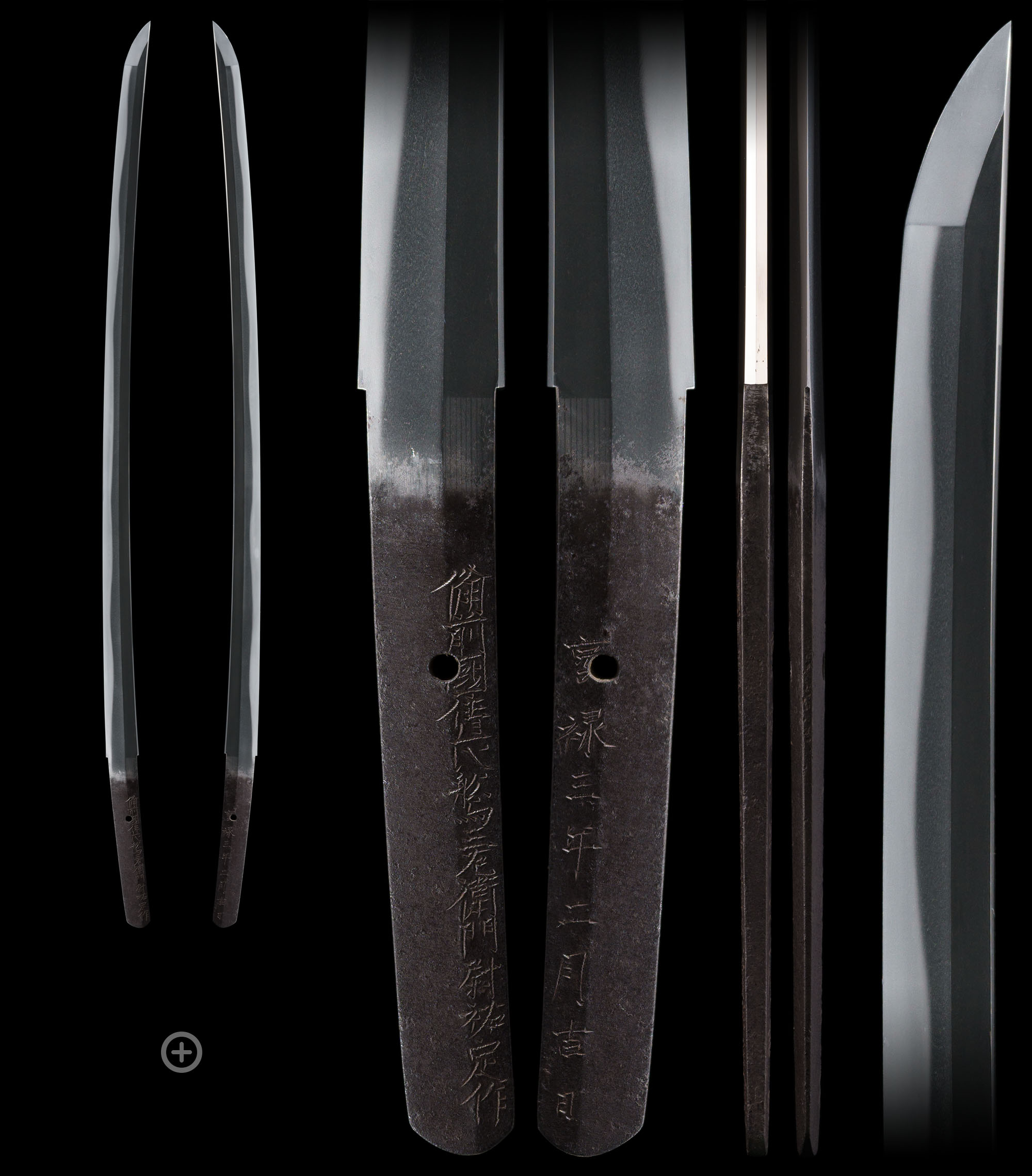
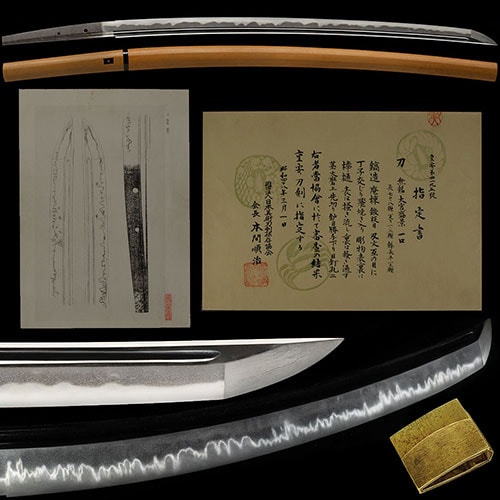
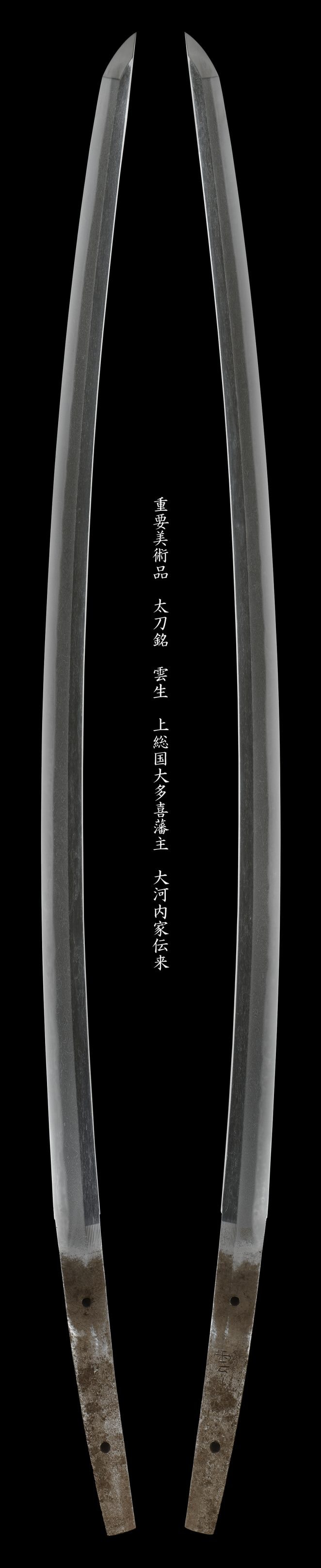
The earliest dated work that survives under Sukemitsu of is a of Eikyo 9 (1437), an , signed blade that displays the manner the published sources call Oei-, and which they pronounce an imposing, dignified piece (堂々としたものである). The latest is a of Kansho 3 (1462) that carries within its signature the common name and title Rokurozaemon no Jo. Between those two dates lies a span of twenty-five years and a stylistic crossing, for Sukemitsu worked the moment the published record names the move from Oei- into . The lists seven smiths who signed this name, and the , judging from the year inscriptions, reads the dated works gathered here as the among them, the head of the family who fathered the brothers Ukyo no Katsumitsu and Sakyo no Jo Munemitsu. His blades stand at the hinge of that descent, the Oei- manner of the early fifteenth century already turning toward the workmanship his sons would lead.

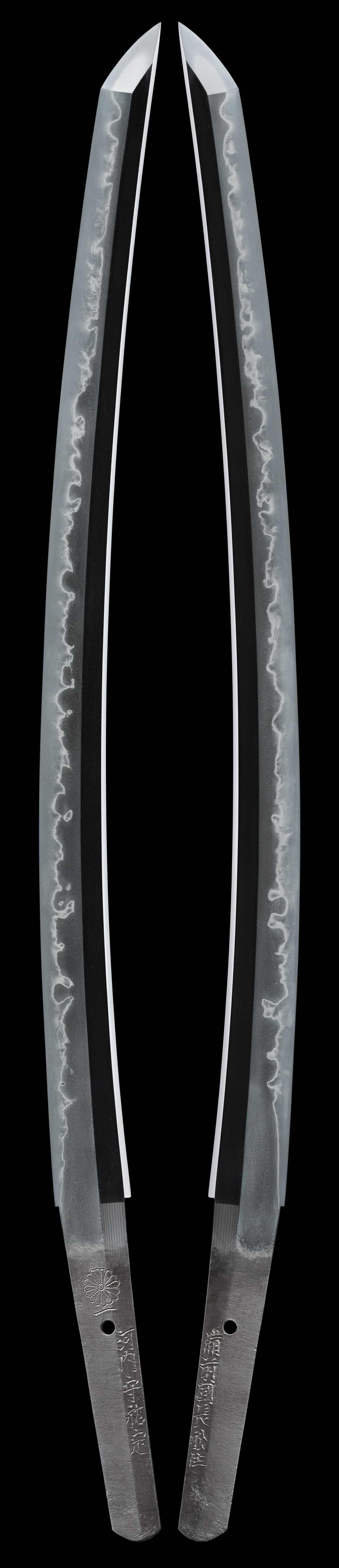
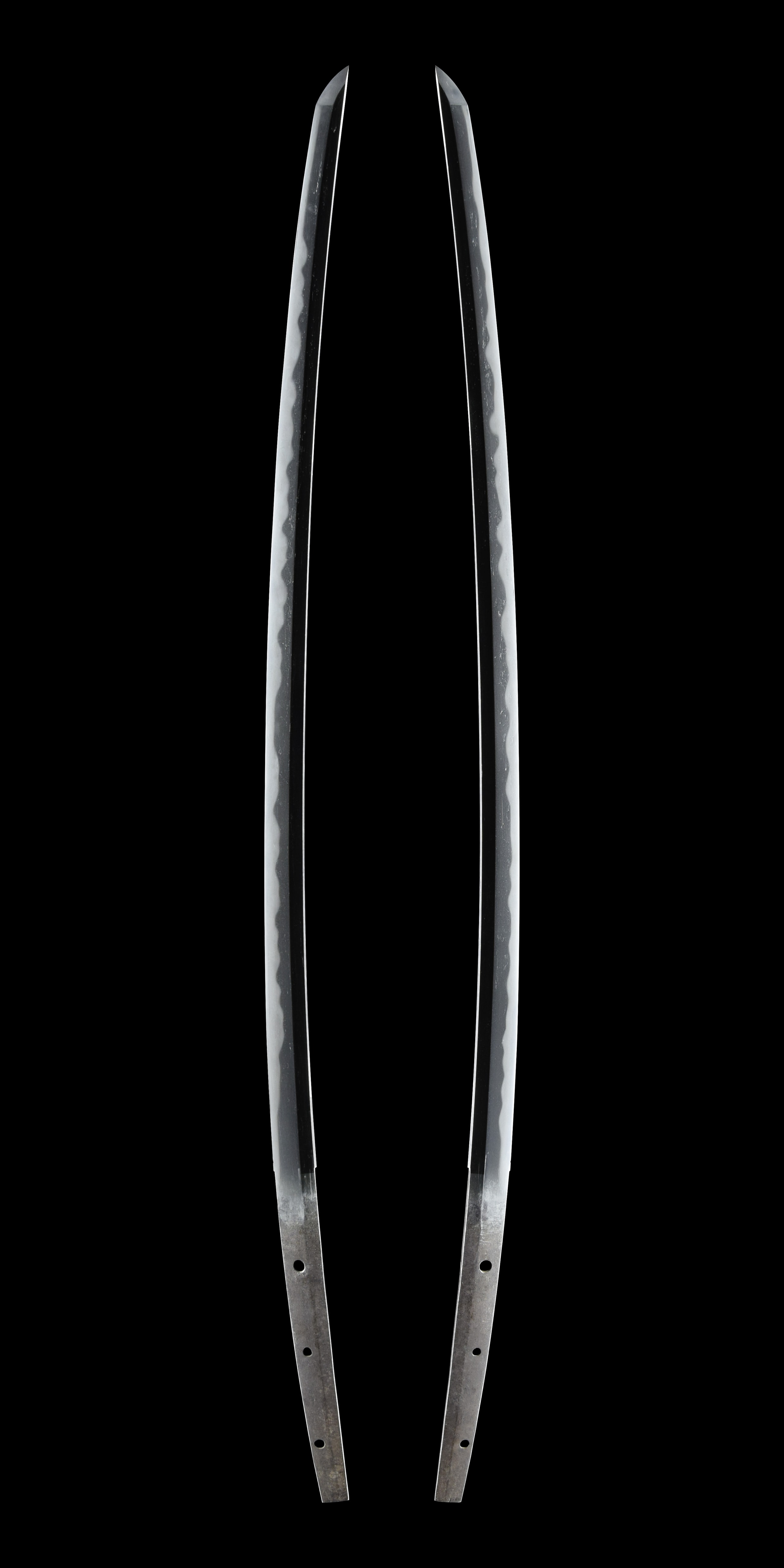
The matter that distinguishes his work is a , a whose valleys open wide at the waist, mixed with a little and built into a varied . It is -dominant with attaching, fine and running within, the at its best bright. On the early Eikyo the temper opens at the waist with pointed elements mixed in, slight and laid over it, and the runs straight with to a pointed tip. On the mature dated pieces the waist-open takes in -ba and angular teeth, in places reminiscent of , the whole still -dominant with and bright in the . The descent of his date is read off the temper itself: of the Kakitsu 3 (1443) the published sources note that the amplitude of the is small and the inconspicuous (乱れの振幅が小さく丁子が目立たない), and in that quieting of the once-flamboyant Oei- clove pattern they read the period coming down. The waist-open temper is his constant, and its narrowing waves are his clock.

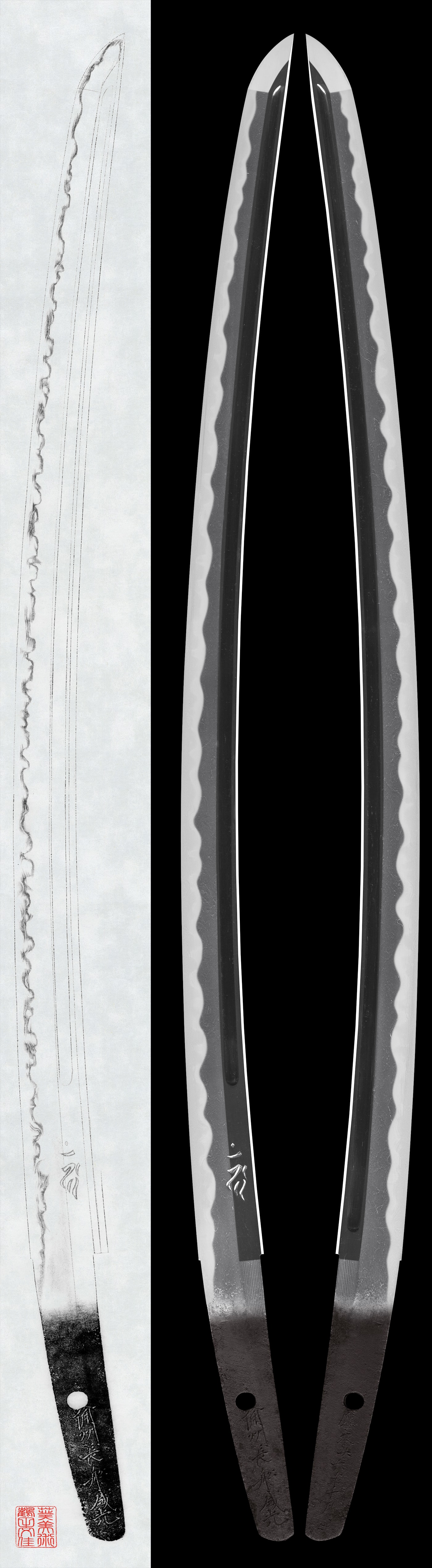
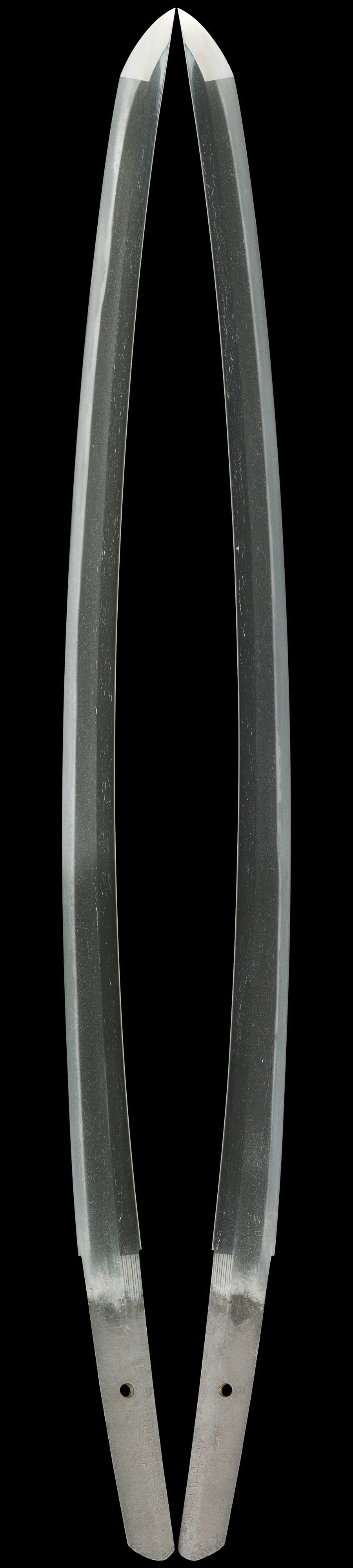
Beneath the lies an mixed with , the grain standing in places, over which a clear rises, the bar-shaped reflection of the steel. The attaches somewhat thickly and enter well; on the broader the grows fine and dustlike, a faint drifting above it. The answers the temper, turning in to a on the agitated blades, running straight to a small round turnback or pointing and returning on the quieter ones. The moves with his dates and forms: the early slender with deep and a in the Oei- stance, the mature of standard width with a noticeable taper and a thick , the and broad pieces, elongated and thick. The carvings are a recurring pleasure of his work, a grass-script and and a sutra text on one blade, twin grooves on another, and on a Bun'an 6 (1449) the incised deity name Ichinomiya Daimyojin. The published sources call that a piece in which Sukemitsu's working range is clearly shown (祐光の作域がよく示されている).

The generations are the open question of his name, and the published sources resolve it by date. They observe that several generations of Sukemitsu have been pointed out and that the lists seven of the name, an earlier small-curvature Sukemitsu of around the Eiwa era among them; the dated blades, on the evidence of their year inscriptions, they assign to the first generation. His fatherhood of Katsumitsu and Munemitsu is fixed by a document blade outside the corpus, a Bunmei 9 of Munemitsu inscribed as the work of Sukemitsu's second son, Sakyo no Jo Munemitsu, which the judges say clearly demonstrates the transitional workmanship as moved from Oei- into (応永備前から末備前へ移る過渡期の作風). His own dated pieces show that hand mid-transition, the Eikyo imposing and Oei- in flavor, the later and calmer in their , the construction and the -and- still carrying an Oei- character while the recedes and the waves narrow. The blades signed with the full Rokurozaemon no Jo title, of which the published sources say extant examples are extremely few (現存するものは頗る少), are the ones they treat as the touchstone of the .

Within the school he belongs to the main line at its mid- turn, the generation between the Oei- of Morimitsu and Yasumitsu and the dense workshop his sons would run. His distinction is read not by borrowing a comparison but by his own grounded traits, the waist-open with its subdued , the over a standing , the bright and the pointed and angular teeth that mark the direction of his hand rather than the round clove of the older . The published sources value his blades as material as much as as swords: a signed as made at Takehara in Settsu records the documented movement of smiths to other provinces in this period and is called valuable source material for the study of the late- smiths (末備前鍛冶研究の好資料). Through Katsumitsu and Munemitsu his line became the principal workshop of the late , the names that would lead the school into the mass production of the Eisho and Tenmon eras.

Fujishiro's rating is not recorded for him, and his designation record is modest in scale: seven works on record, all at the level, with a further blade preserved in the Imperial collection, and none of the higher tiers among them. That Imperial blade descends in the Imperial Family and is held today in the Hayashibara Museum of Art, the one clear provenance to survive in his data. The blades are a body of mid- , and held in private and long-recorded hands, and one of recorded whereabouts appears from time to time rather than rarely, a more findable thing than a though not on that account common. The value of his work is partly documentary, for the dated, signed, pieces let the Oei- to crossing be worked out blade by blade. A Bun'an 5 (1448) bears on the a gold-inlaid cutting-test inscription by the celebrated tester Yamano Kaemon-no-jo Nagahisa, evidence that his swords were proven as cutters generations after they left his forge. For a collector the Rokurozaemon no Jo Sukemitsu is the dated, knowable end of the name at its transition, a sword on which the period arc and the family question can be read in the hand, and on the best of which the working range of the smith is fully shown.

Kantei

the NBTHK's own developmental frame, stated across the corpus: the dated works run from Eikyo through Kansho and the published sources read them as a single hand crossing the Oei-Bizen to Sue-Bizen transition, the earlier tachi carrying the dignified Oei-Bizen manner and the later, broader pieces a calmer Sue-Bizen in which the choji recedes and the temper's amplitude narrows; orthogonal to this period arc runs the constant register of long, dated, ubu signatures with the Rokurozaemon no Jo title that mark the shodai

Sukemitsu of , who signed the long Rokurozaemon no Jo signature and dated his blades from Eikyo 9 (1437) through Kansho 3 (1462), spanning the transition the published sources call the move from Oei- into . The lists seven smiths of this name, and the reads the dated works as the , the father of the brothers Ukyo no Katsumitsu and Sakyo no Jo Munemitsu and so the head of the family that carried the school into the late . His characteristic hand is a , a opening wide at the waist mixed with a little , -dominant with , fine and running within, the bright. Over an mixed with he forges a clear ; the runs and turns in or points and returns. The published sources call the dated an imposing, dignified Oei- work, and the late pieces a calm, mature with the subdued and the waves of the temper smaller, his typical workmanship fully expressed.

Diagnostic discriminators

71% of his works

57% of his works

100% of his works

29% of his works

Observation by phase

The Oei-Bizen tachi manner (early, Eikyo to Kakitsu)

The earliest dated works, which the published sources read as Oei-. The Eikyo 9 is slender with deep curvature and a , a dense on which a faint appears; over it a opens, mixed with pointed elements, adhering, with slight and , and the runs straight with and tends to point. The calls this an , signed that shows the manner known as Oei-, and an imposing, dignified work. The Kosho 3 keeps the high and of a shape, its well-forged with , the temper a mixed with , and entering. This stance and the -tinged waist-open temper are the inheritance the published sources describe as the Oei- ground out of which the family moved.

Sugata 姿
Jigane 地鉄
Hamon 刃文
Bōshi 帽子

The Sue-Bizen prime, his typical hand (Bun'an to Kansho, the bulk of the dated works)

the broad hira-zukuri wakizashi and tanto and the standard-width tachi of his maturity; the published sources read the slighter amplitude of the waist-open temper and the subdued choji as the marker of the later date, while bo-utsuri and a bright nioiguchi remain constant

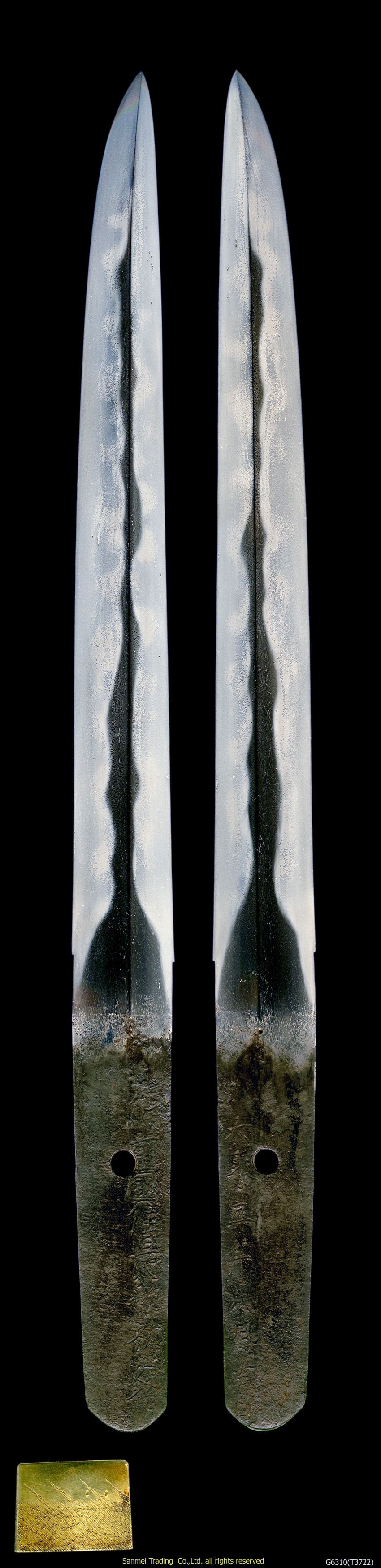
The full and typical manner of the dated maturity, which the names his characteristic workmanship. Over an mixed with , the grain standing in places, adhering somewhat thickly with entering well, a clear stands; on the a fine, dustlike and appear with a faint . The temper is a mixed with -ba, angular elements and varied , in places reminiscent of , -dominant with , fine and running throughout and the bright. The turns in to , or runs and points. On the late and the is subdued and the waves of the temper smaller, which the published sources read as the descent of the date; the is calm and his merits, they say, are broadly manifested. The are notable: and , a sutra text, twin grooves, and on the the incised deity name Ichinomiya Daimyojin.

Sugata 姿
Jigane 地鉄
Hamon 刃文
Bōshi 帽子
Scholarship

The Meikan lists seven smiths signing Sukemitsu, and the published sources read the dated works, judging from their year inscriptions, as the shodai among them; an earlier small-curvature Sukemitsu of around the Eiwa era is also noted, so the name is a multi-generation problem the NBTHK resolves by date.

His fatherhood of Katsumitsu and Munemitsu is fixed by a dated document blade: a Bunmei 9 tanto of Munemitsu inscribed 'Osafune Sukemitsu's second son, Sakyo no Jo Munemitsu,' which the published sources say clearly demonstrates the transitional workmanship as Bizen moved from Oei-Bizen into Sue-Bizen.

On the later dated blades the published sources read the smaller amplitude of the midare and the subdued choji as evidence of the descending date, while the construction and the ji-and-ha still show an Oei-Bizen flavor, the hand caught mid-transition.

Designations

Kokuhō—
Jūyō Bunkazai—
Jūyō Bijutsuhin—
Gyobutsu1
Tokubetsu Jūyō—
Jūyō Tōken7

Elite Standing

0.05 across 8 designated works

Top 22% among smiths

Provenance

1 documented provenance across certified works by Sukemitsu

Provenance Standing

1 works held in elite collections across 1 documented provenances

Top 100% among smiths

Raw score: 1.77 / 10

Blade Forms

Distribution across 8 ranked works

Signatures

Signature types across 8 ranked works

Currently Available

Lineage

TeacherSukemitsu
Sukemitsu
Students (3)
  1. 1.Sukemitsu祐光1 for sale8designated
  2. 2.Norimitsu則光1 for sale3designated
  3. 3.Norimitsu法光6designated

Osafune School

Other artisans of the Osafune school

  1. 1.Mitsutada光忠61designated
  2. 2.Nagamitsu長光2 for sale253designated
  3. 3.Kagemitsu景光1 for sale146designated
  4. 4.Kanemitsu兼光4 for sale237designated
  5. 5.Sanenaga眞長64designated
  6. 6.Chikakage近景4 for sale86designated
  7. 7.Tomomitsu倫光1 for sale64designated
  8. 8.Kagemasa景政2 for sale22designated
  9. 9.Masamitsu政光4 for sale84designated
  10. 10.Motomitsu基光3 for sale41designated
  11. 11.Kagehide景秀23designated
  12. 12.Yoshimitsu義光35designated