NihontoWatch MonNihontoWatch
マーケット
事典
鑑定
NihontoWatch MonNihontoWatch
マーケット
事典
鑑定

説明

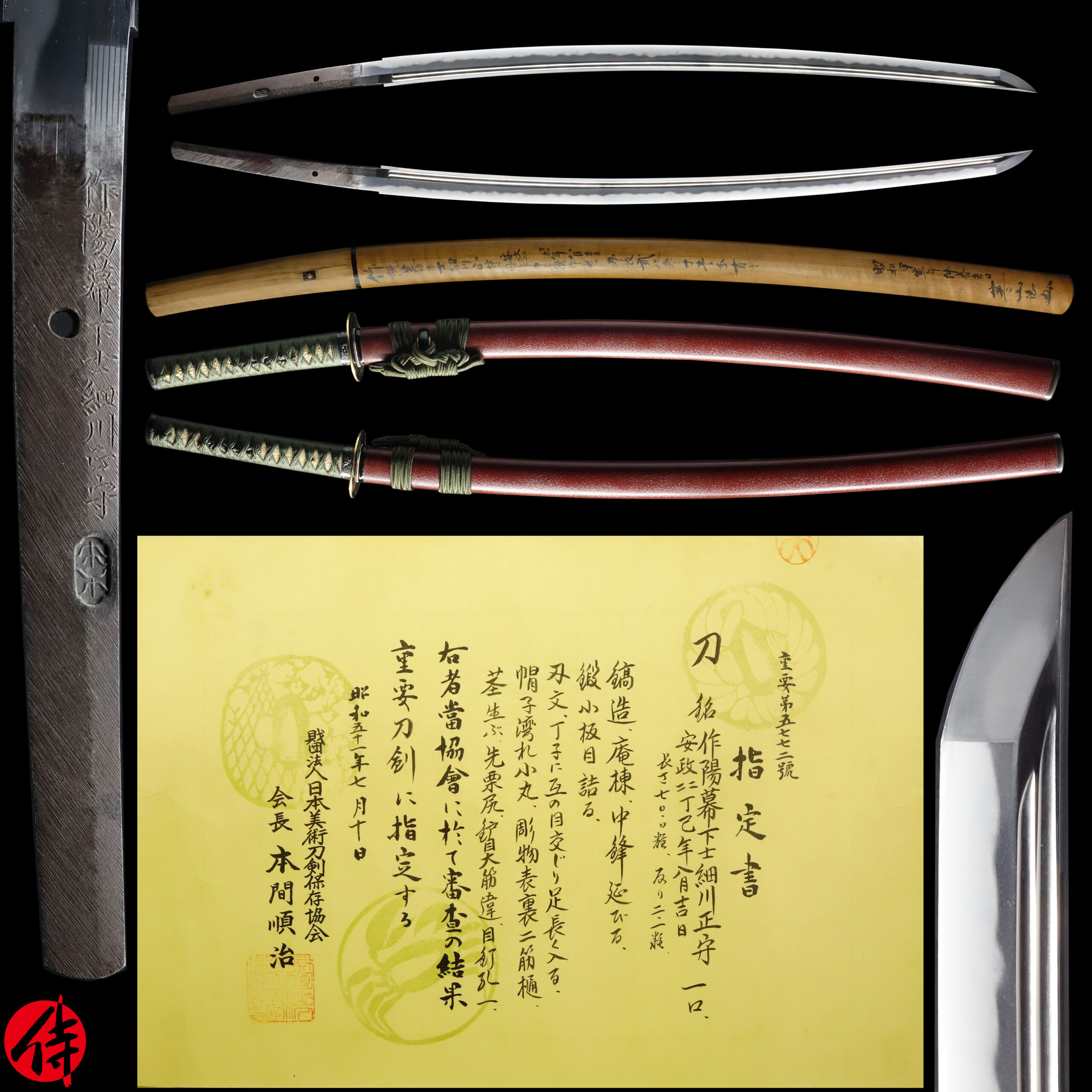
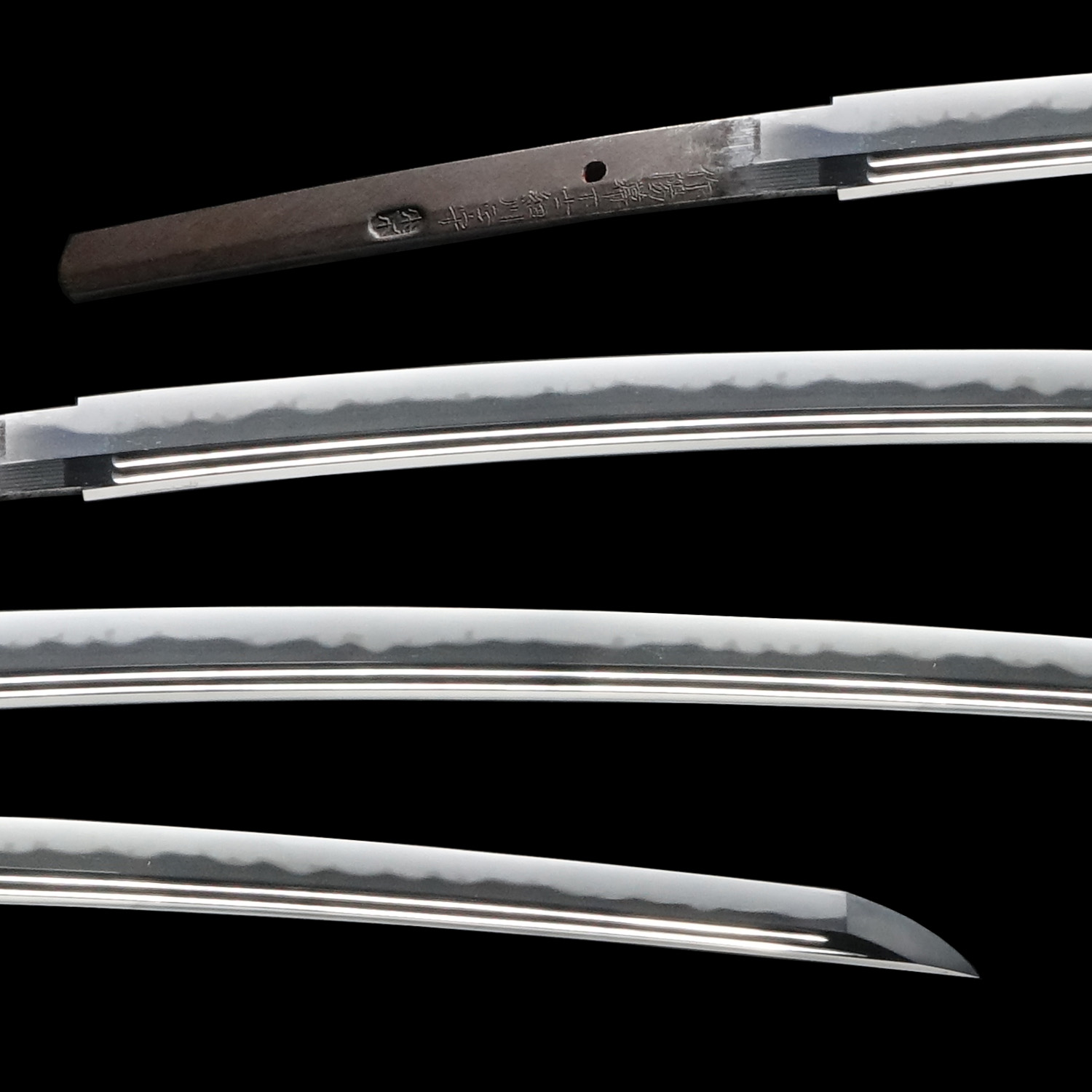
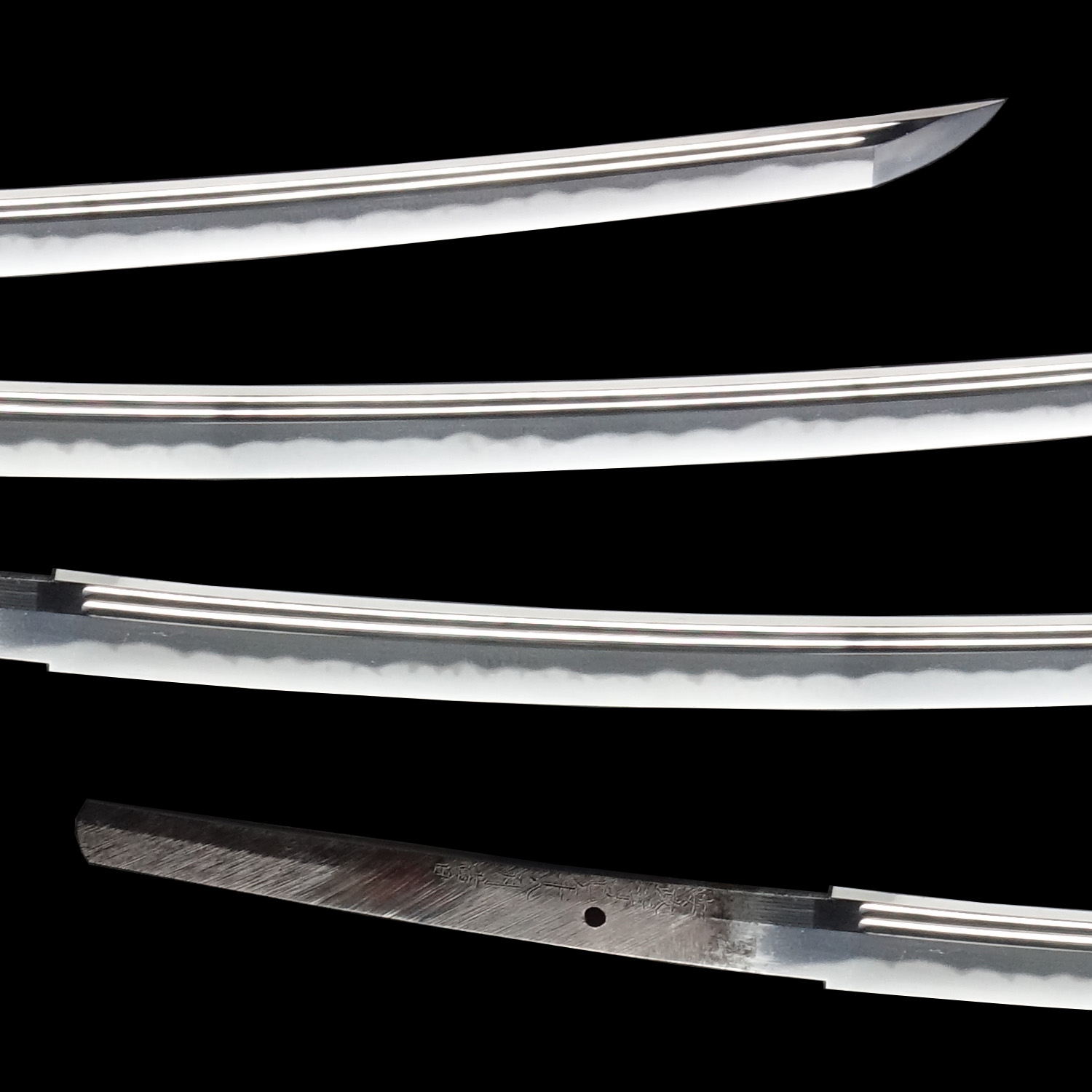
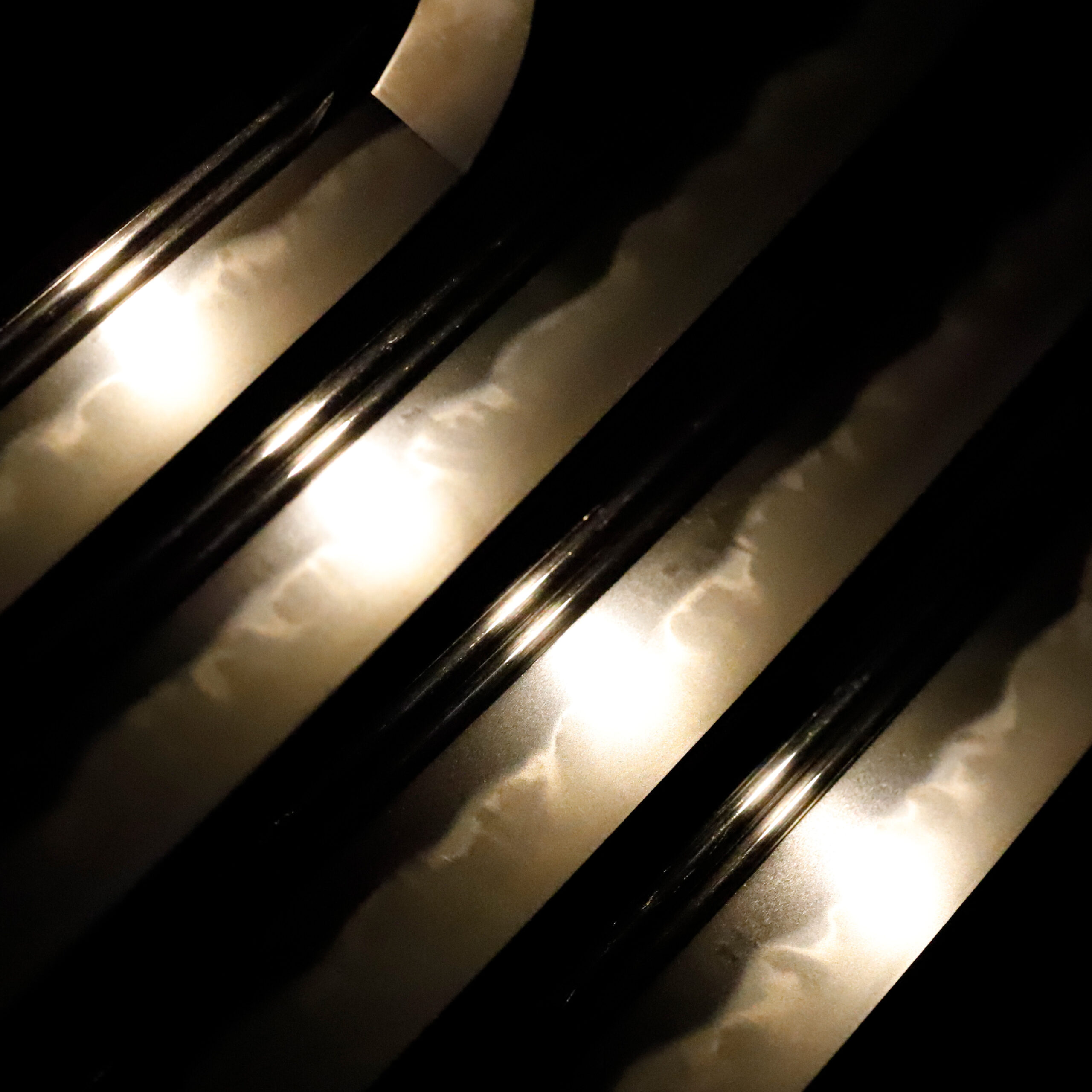
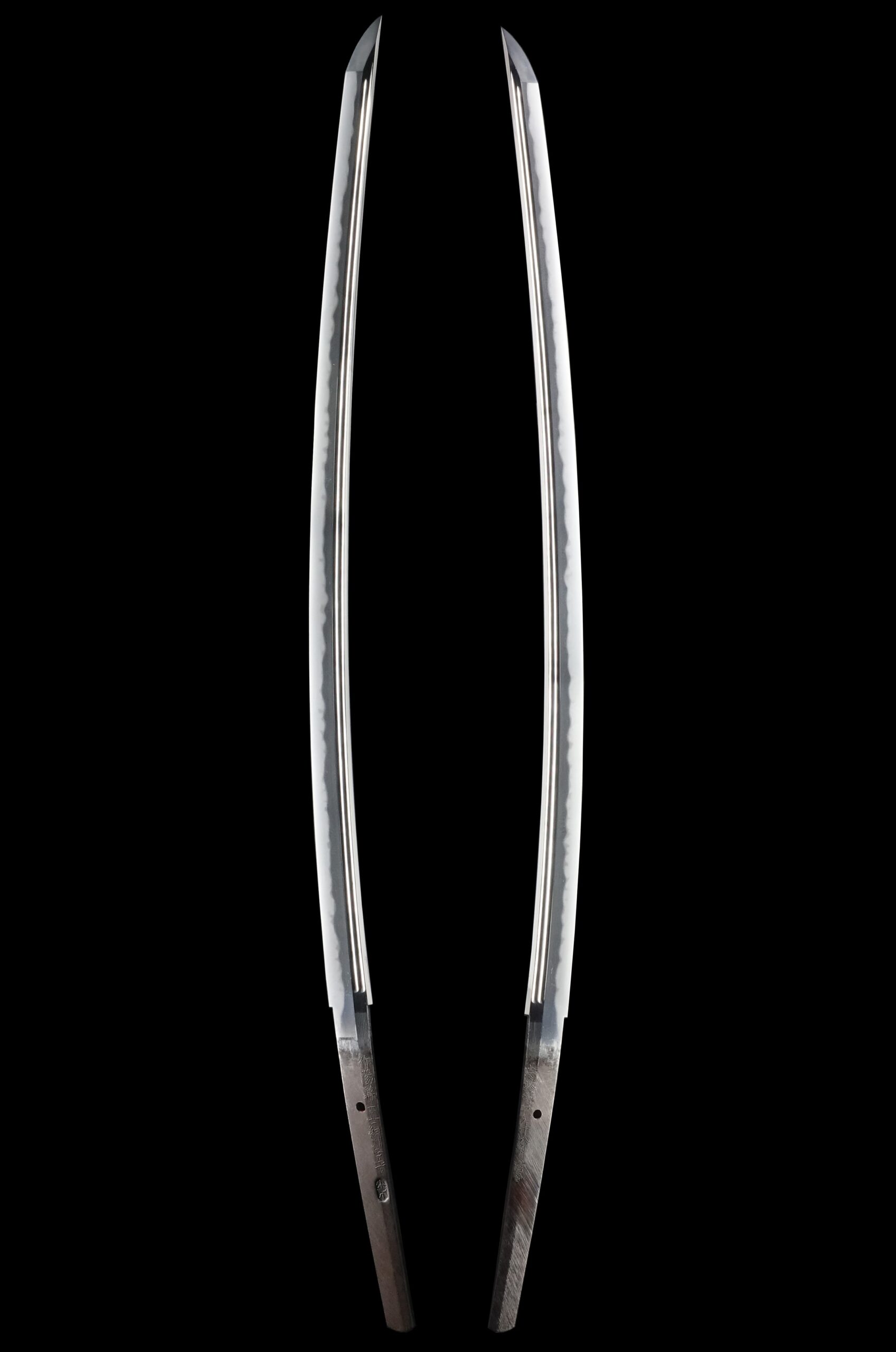
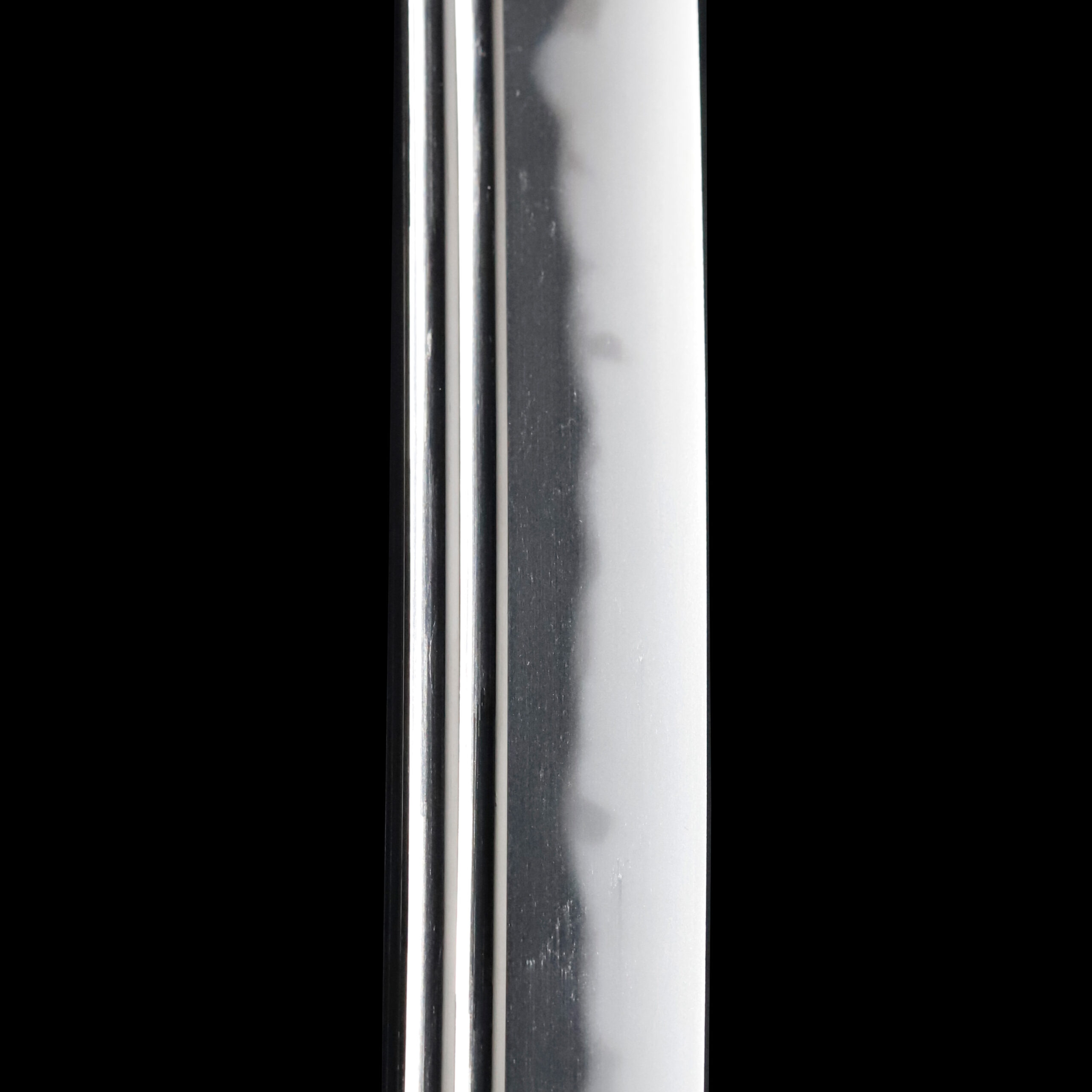
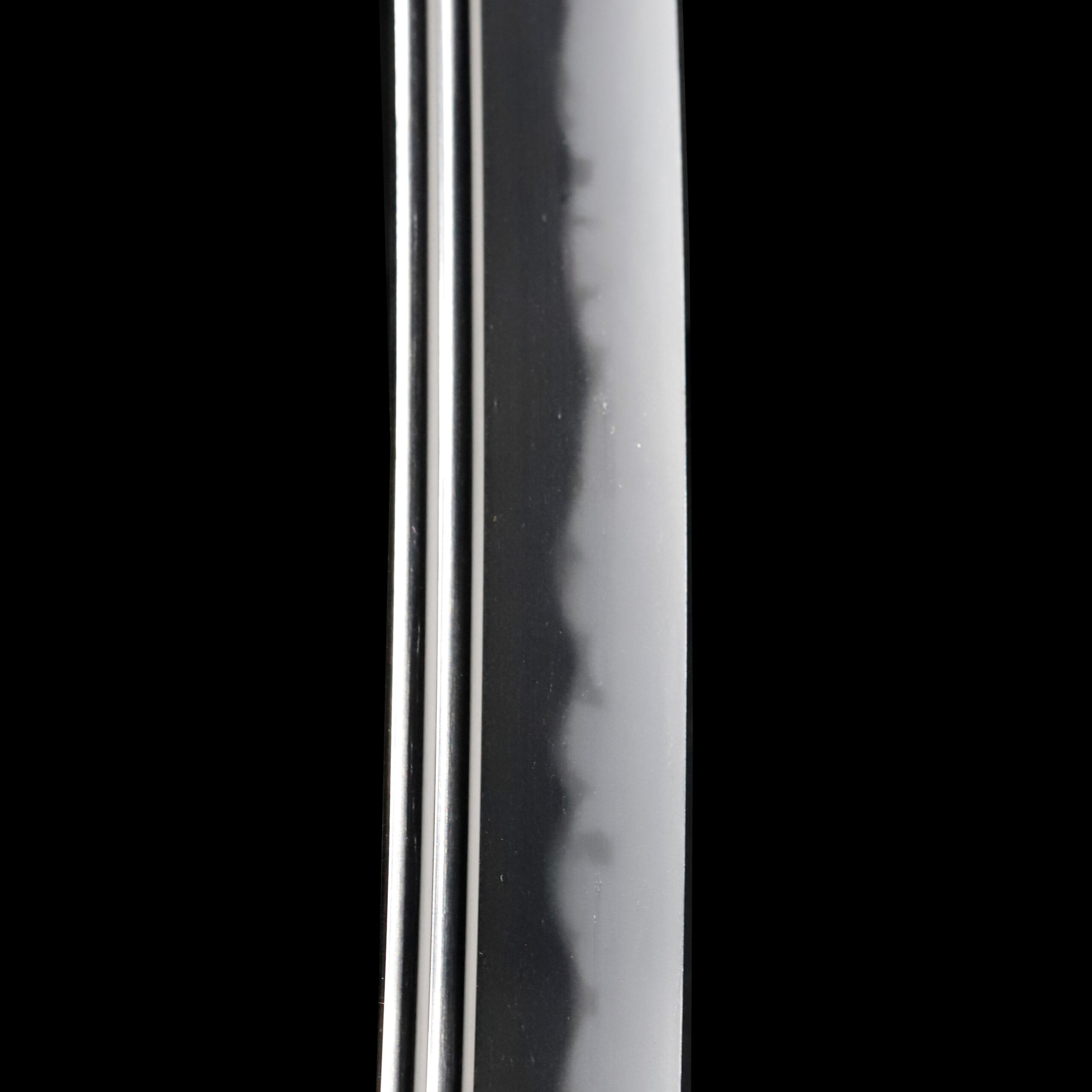
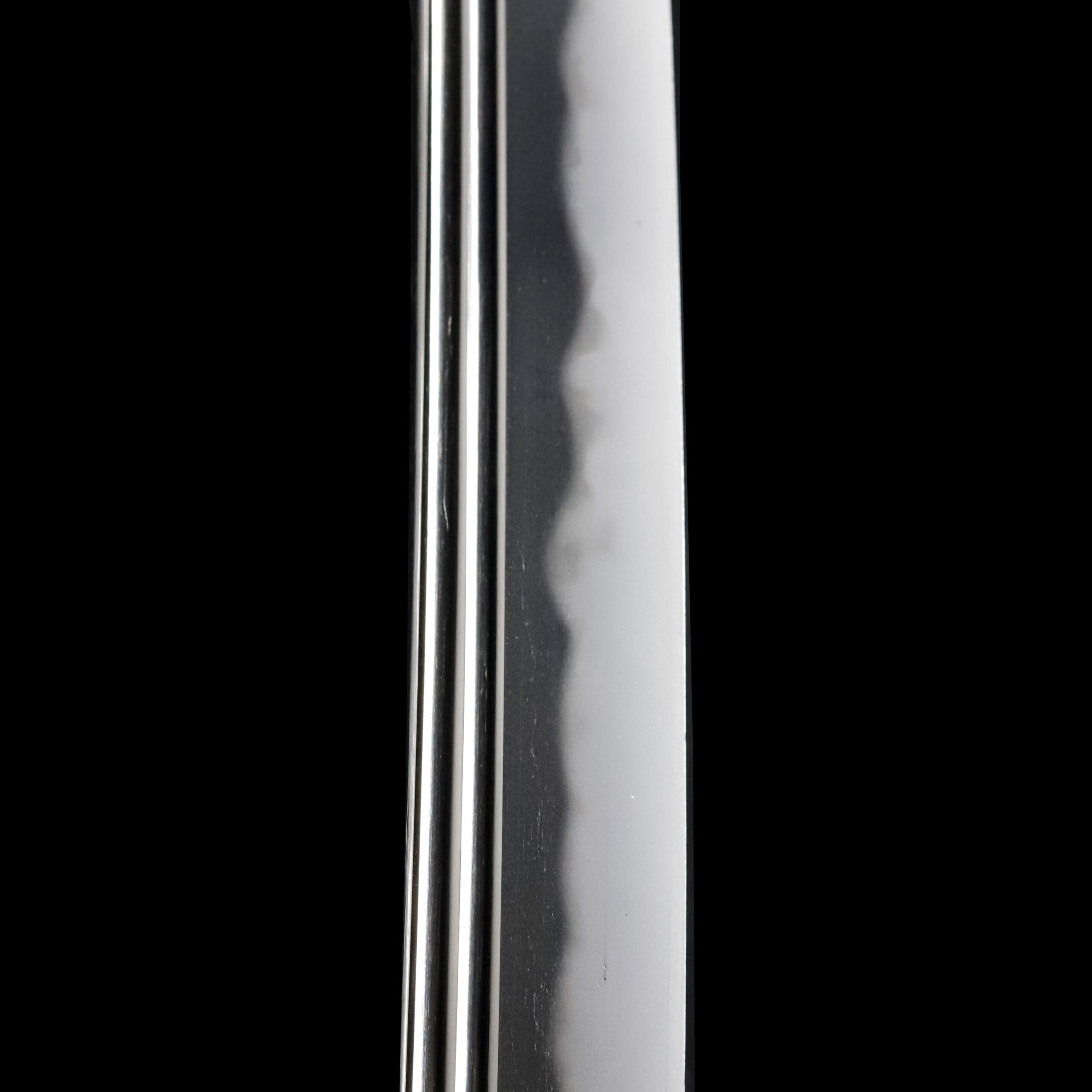
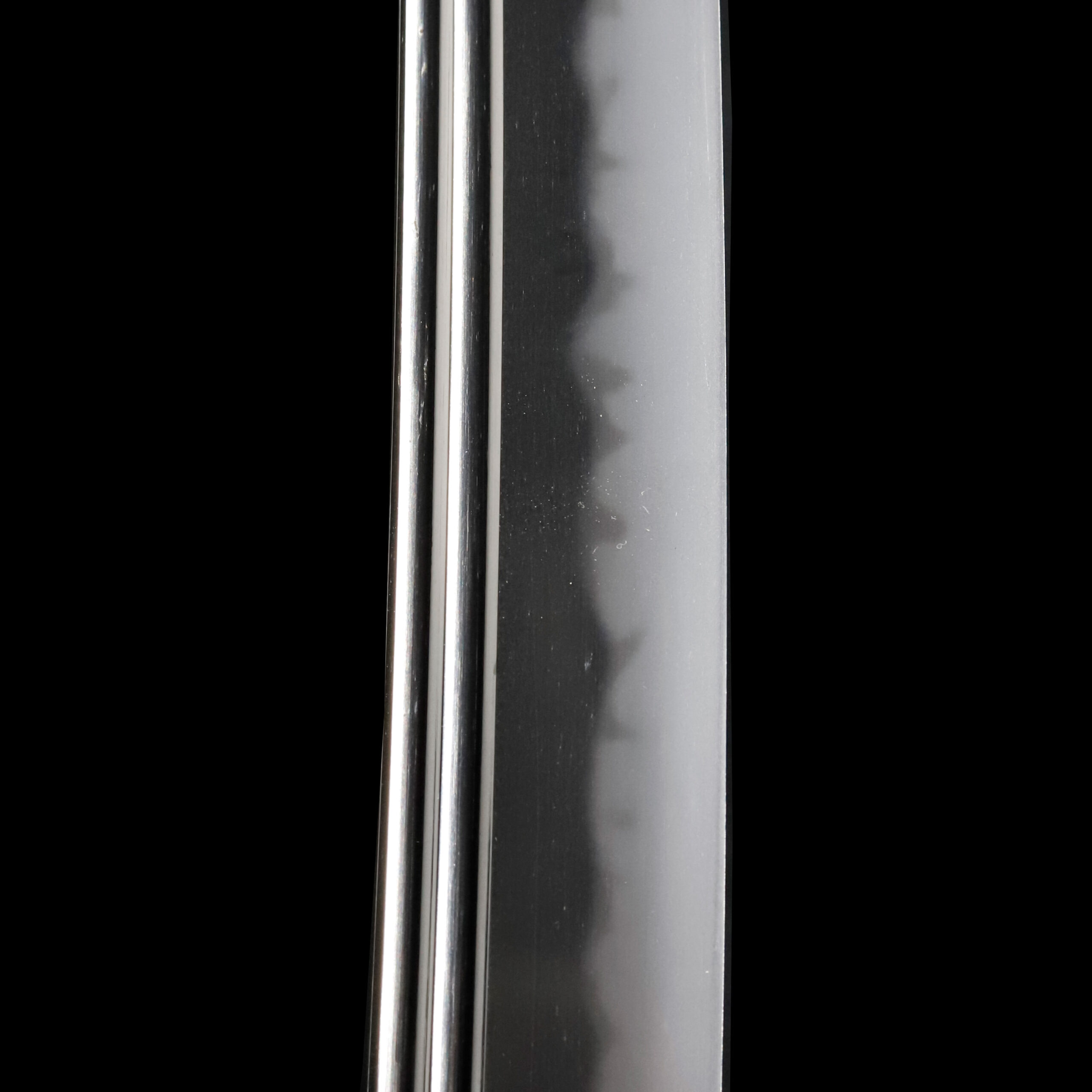
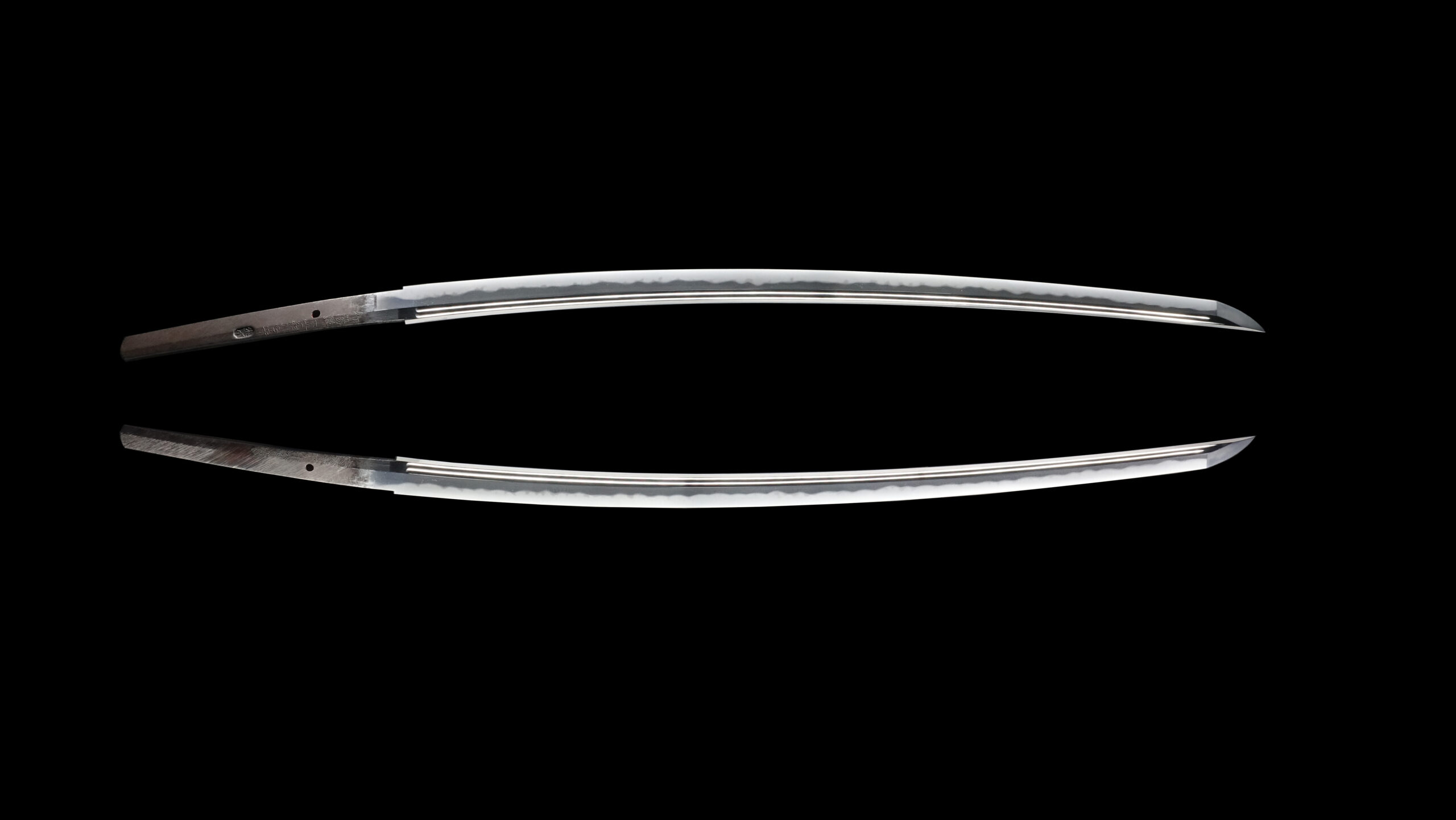
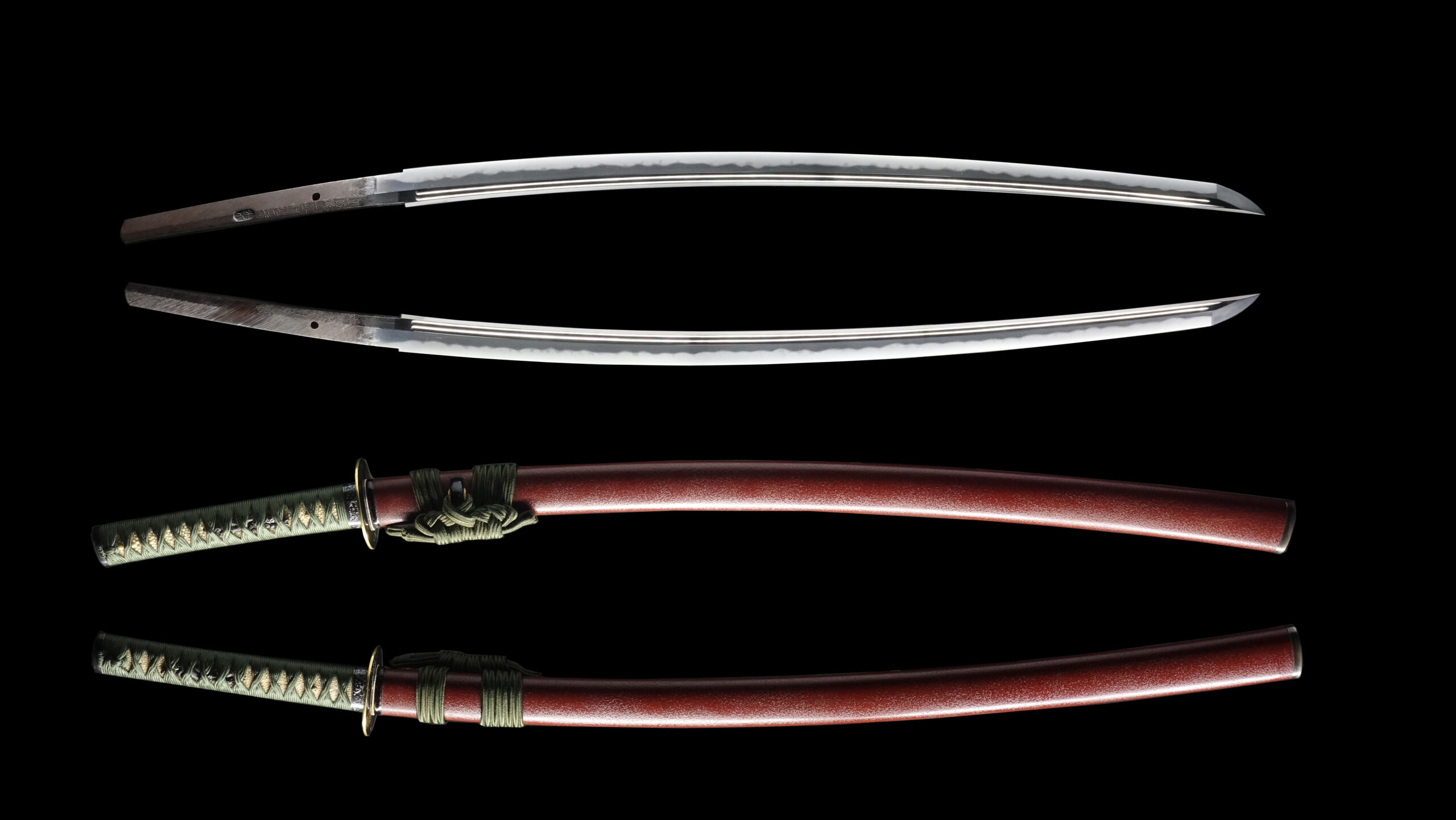
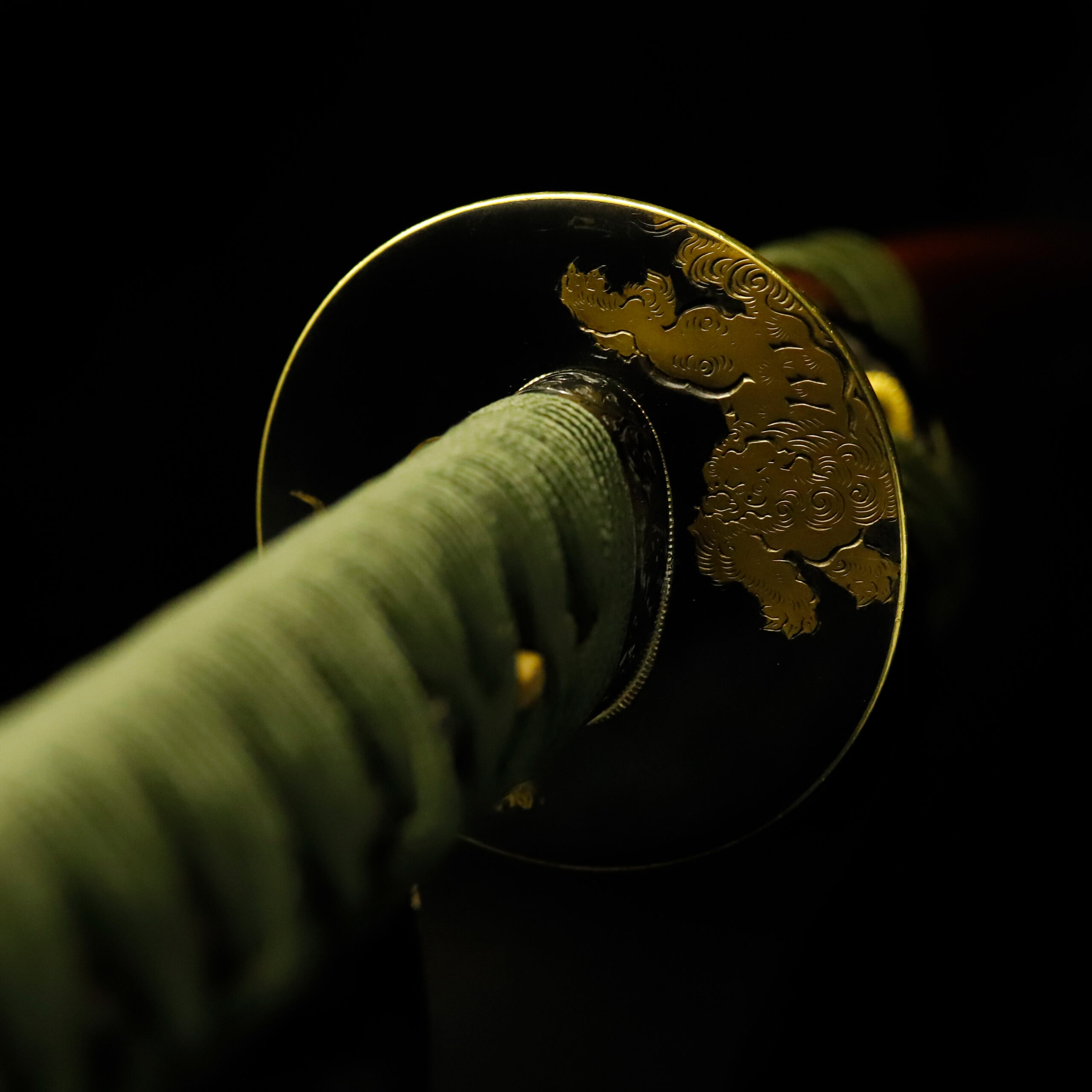
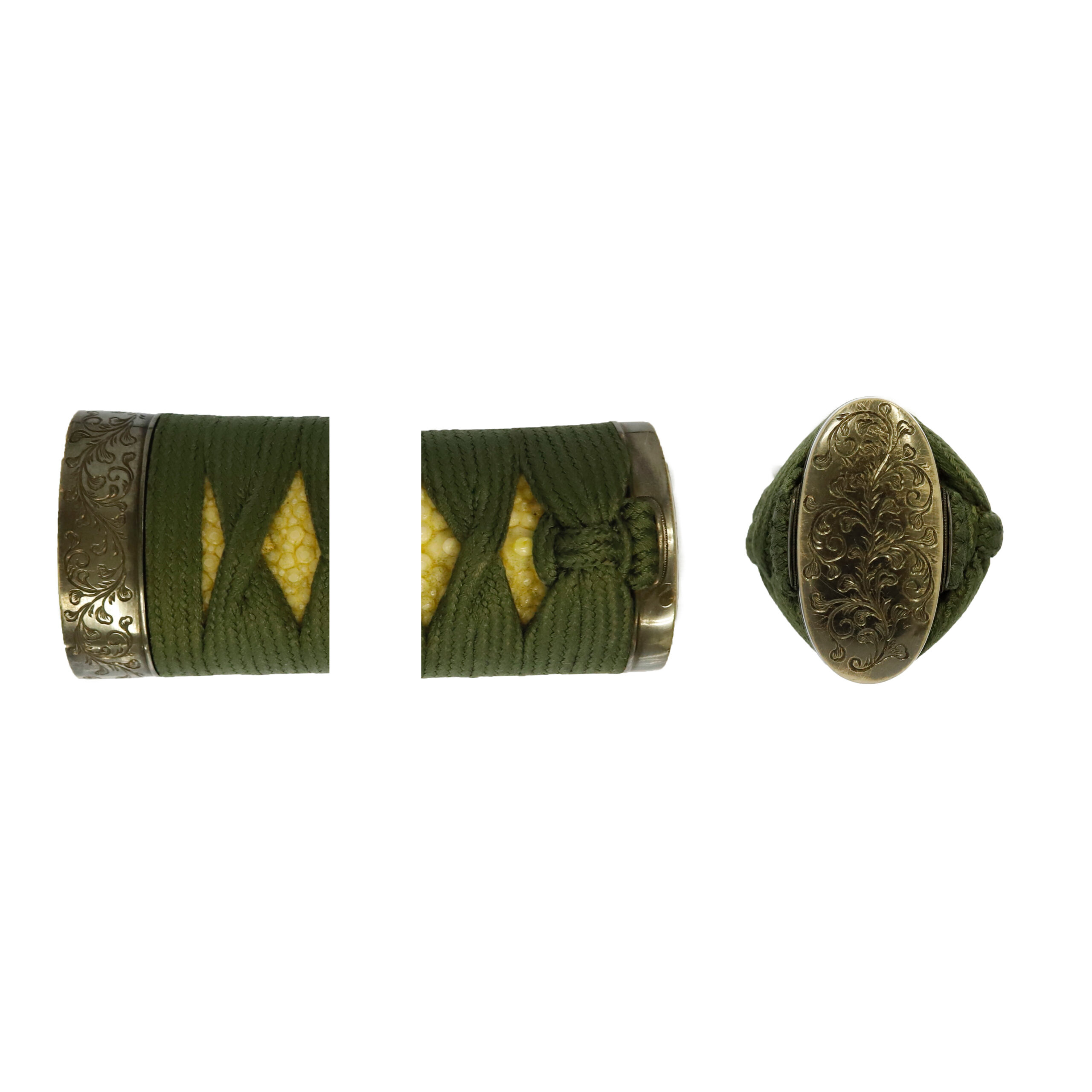
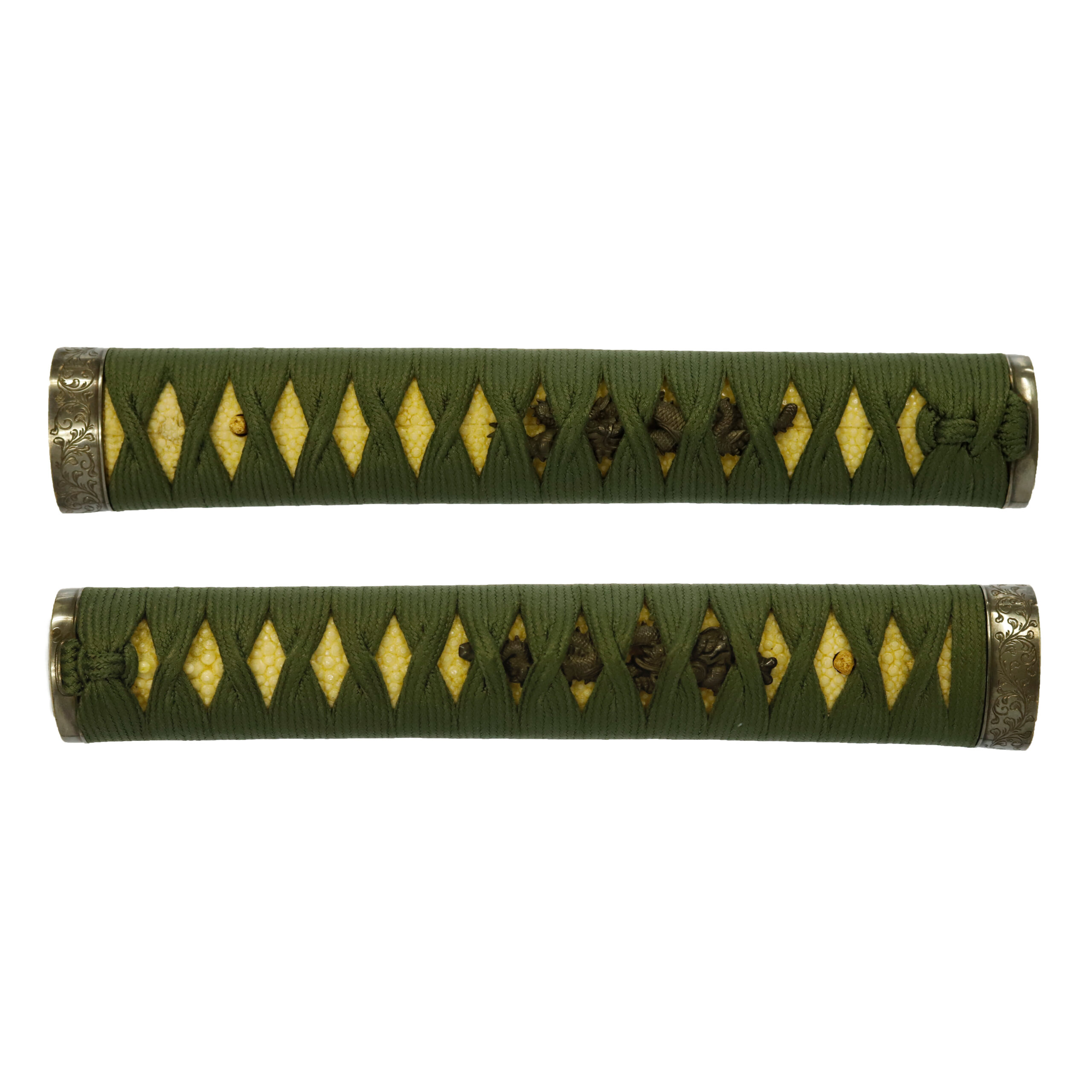
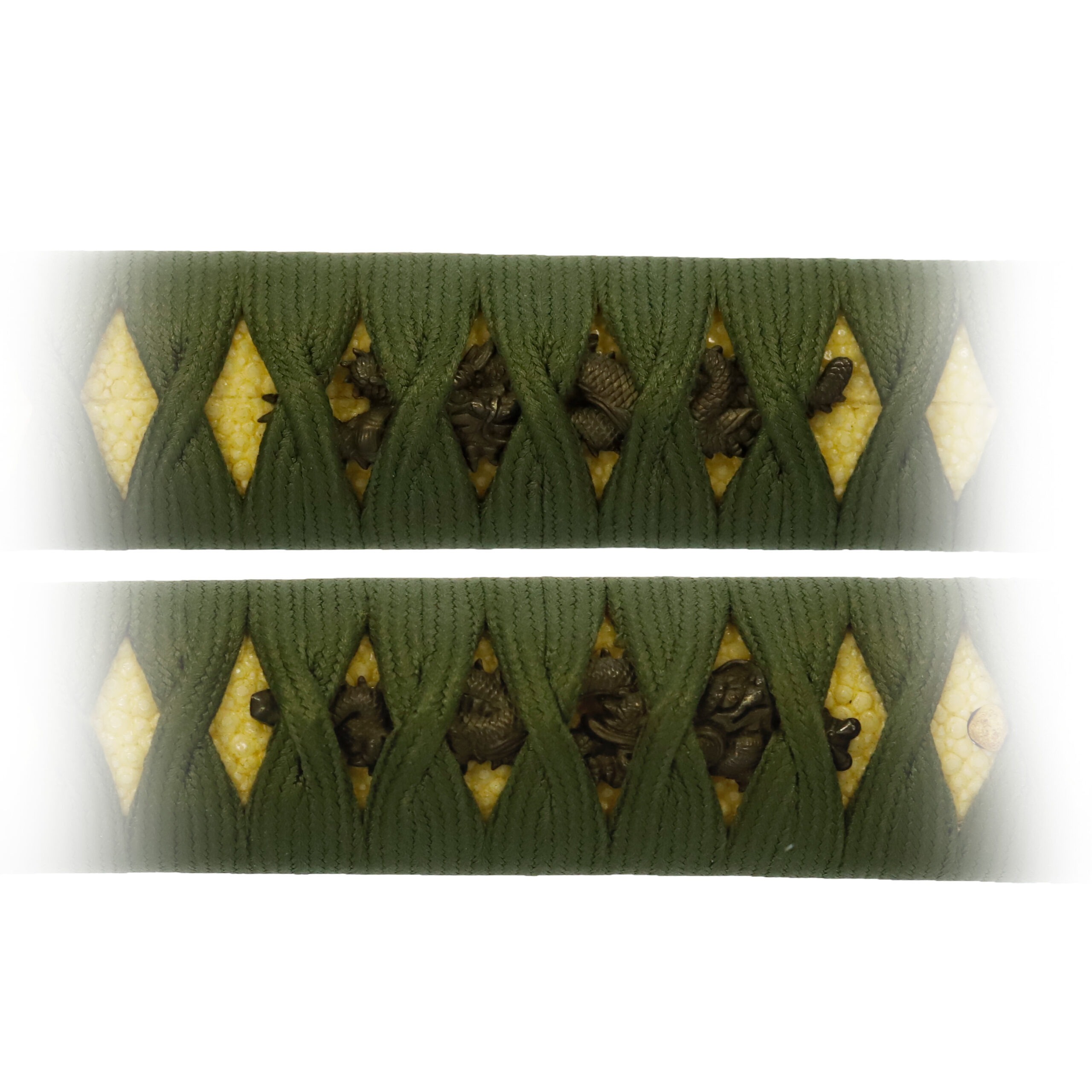
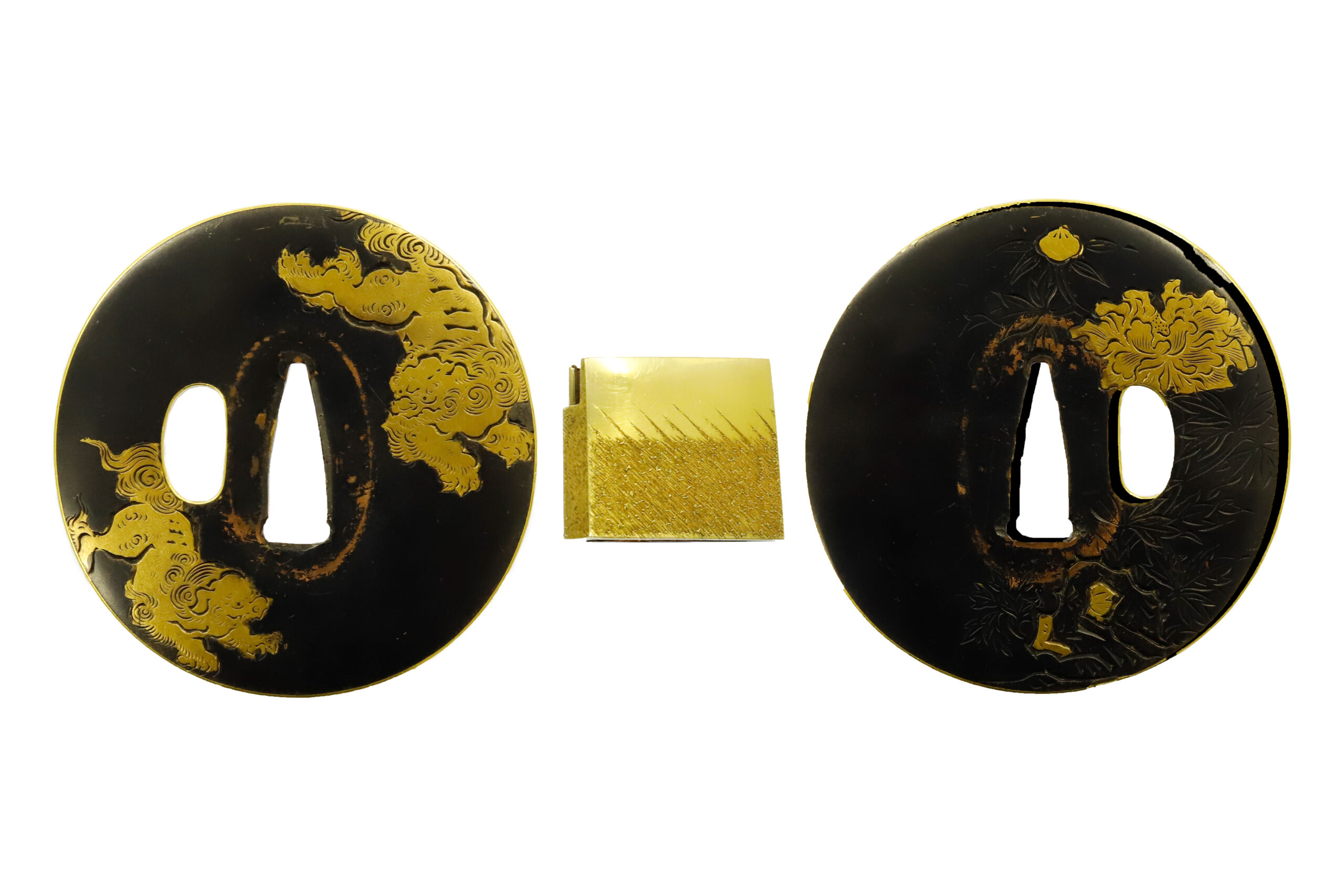
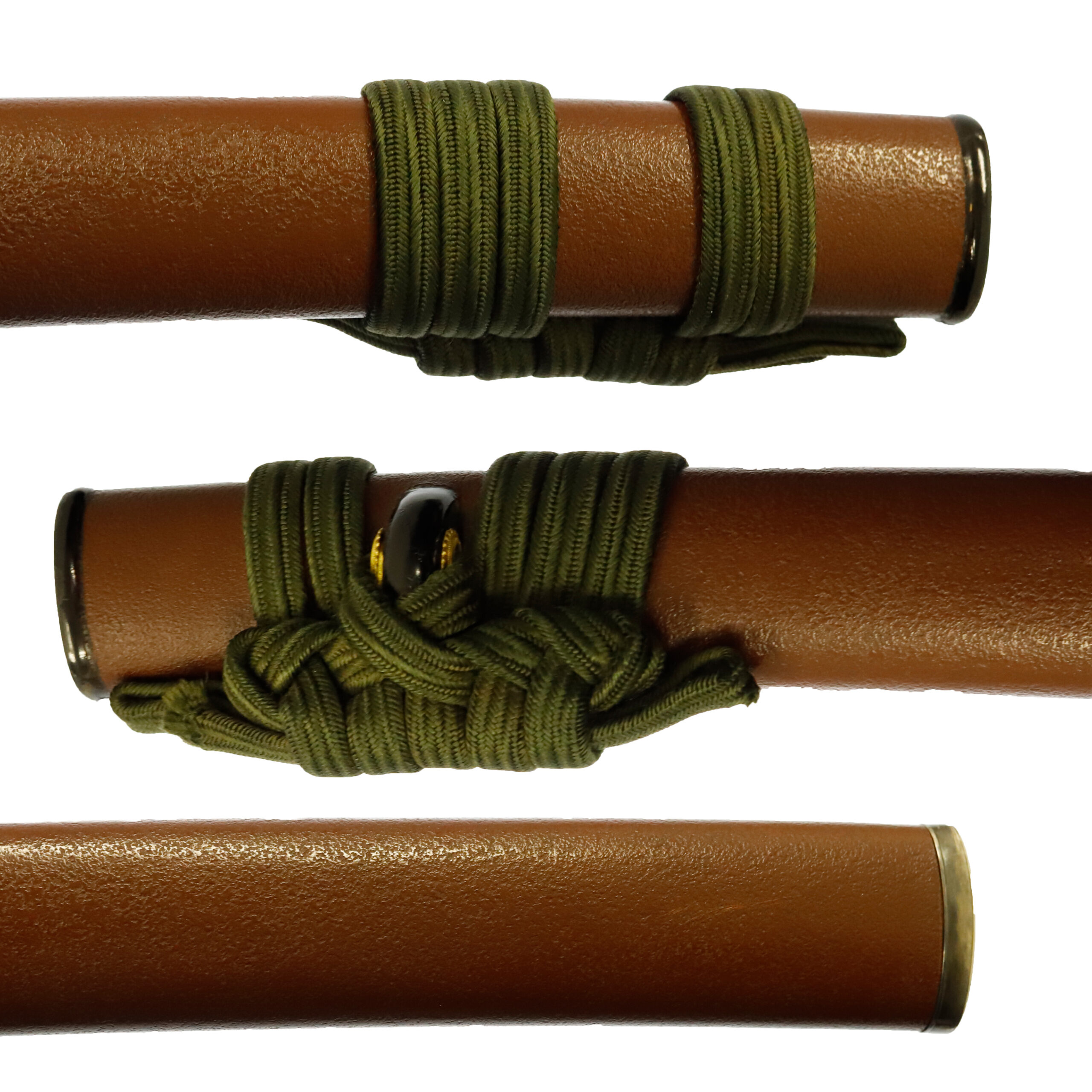
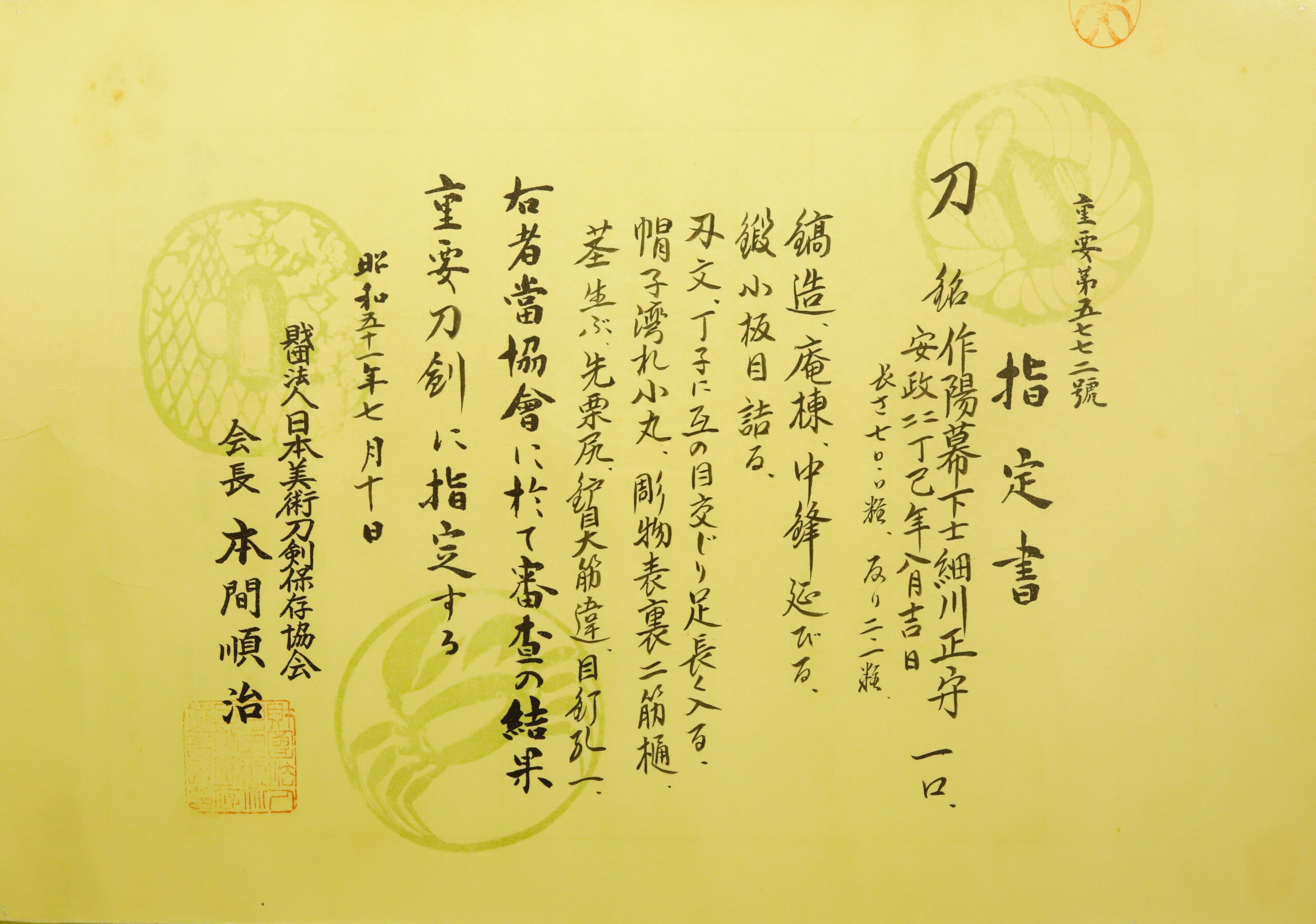
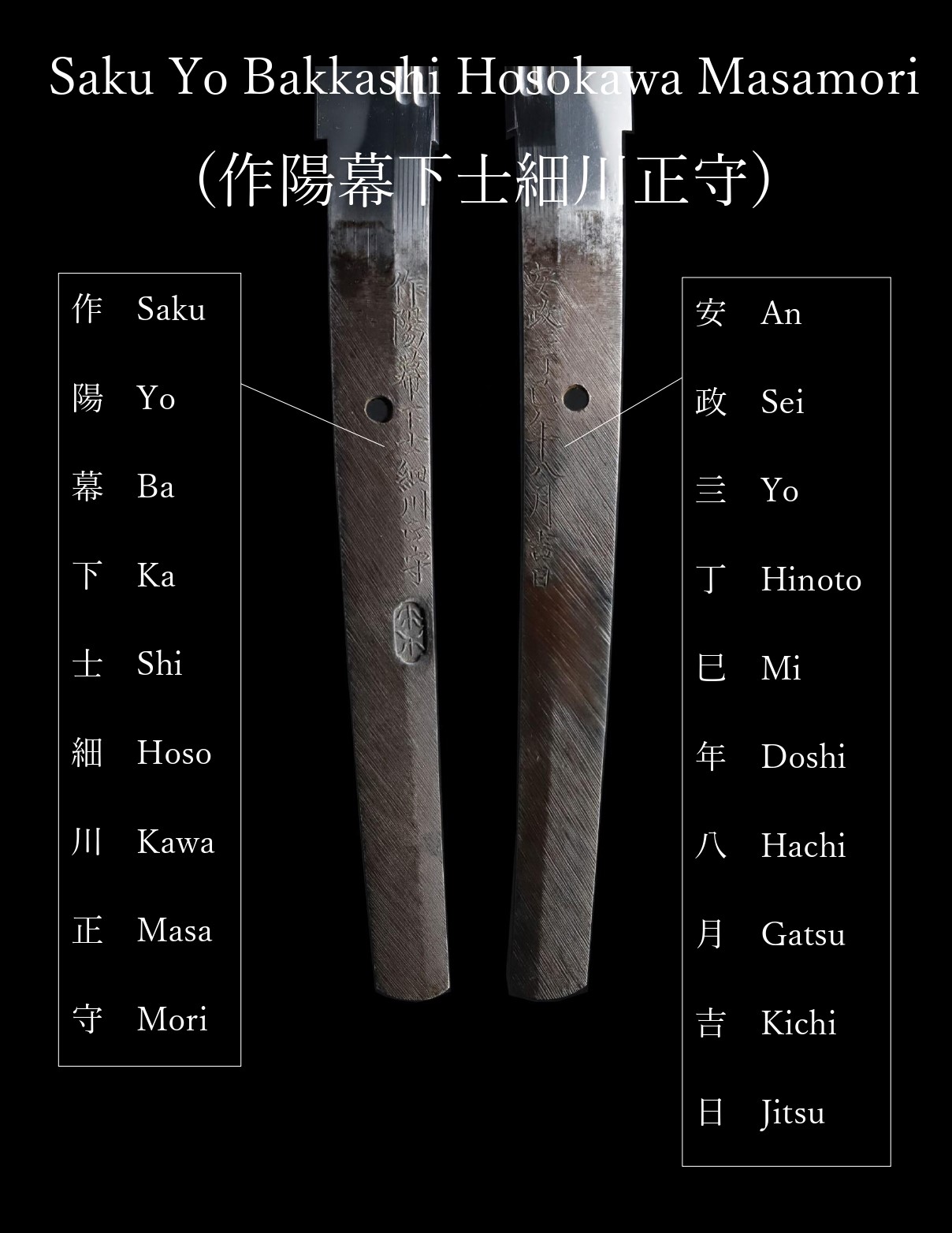
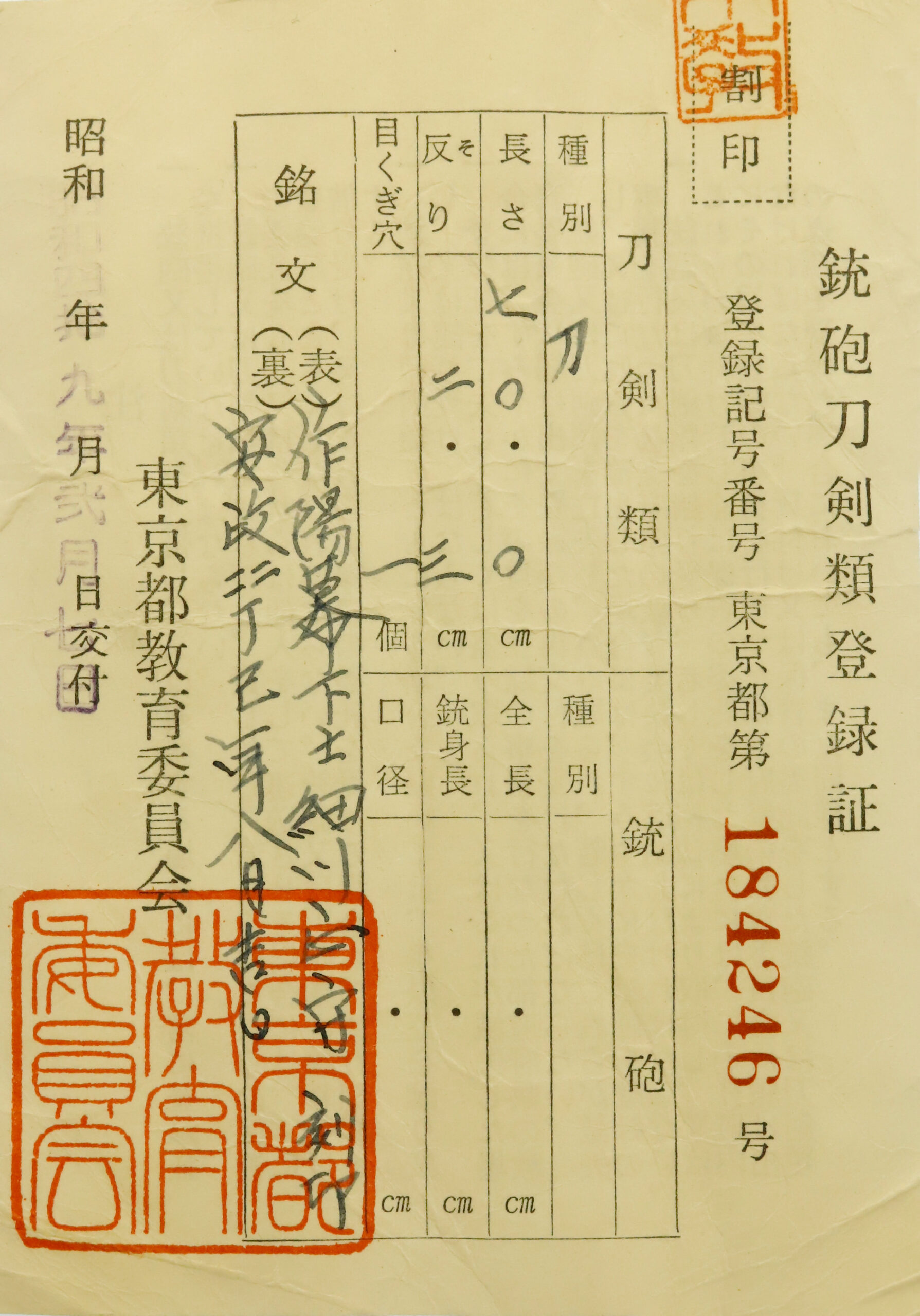
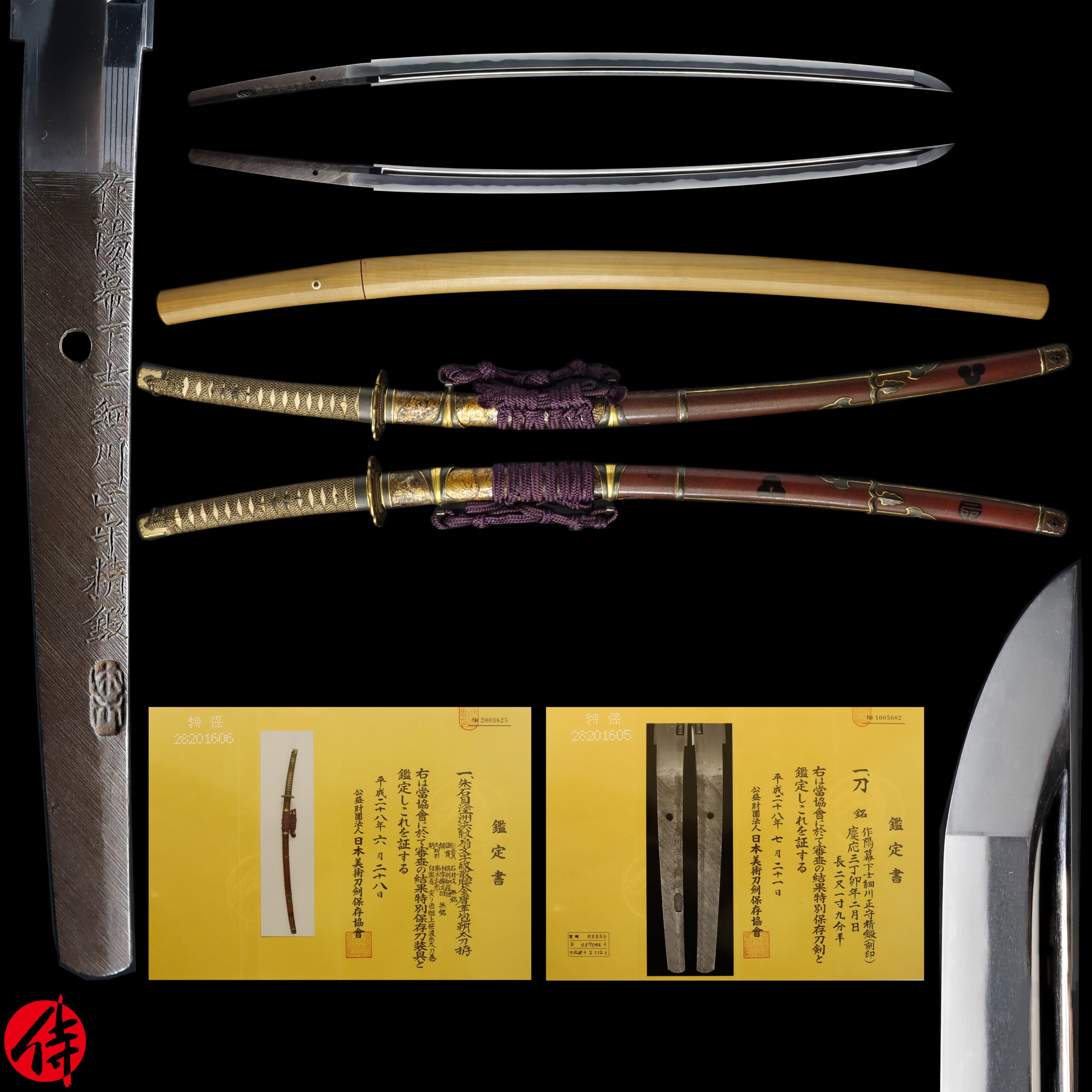
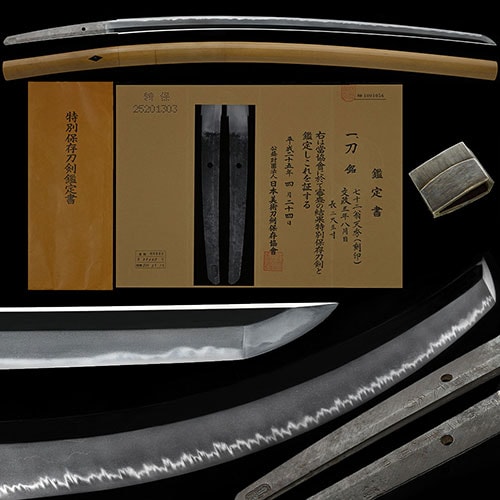
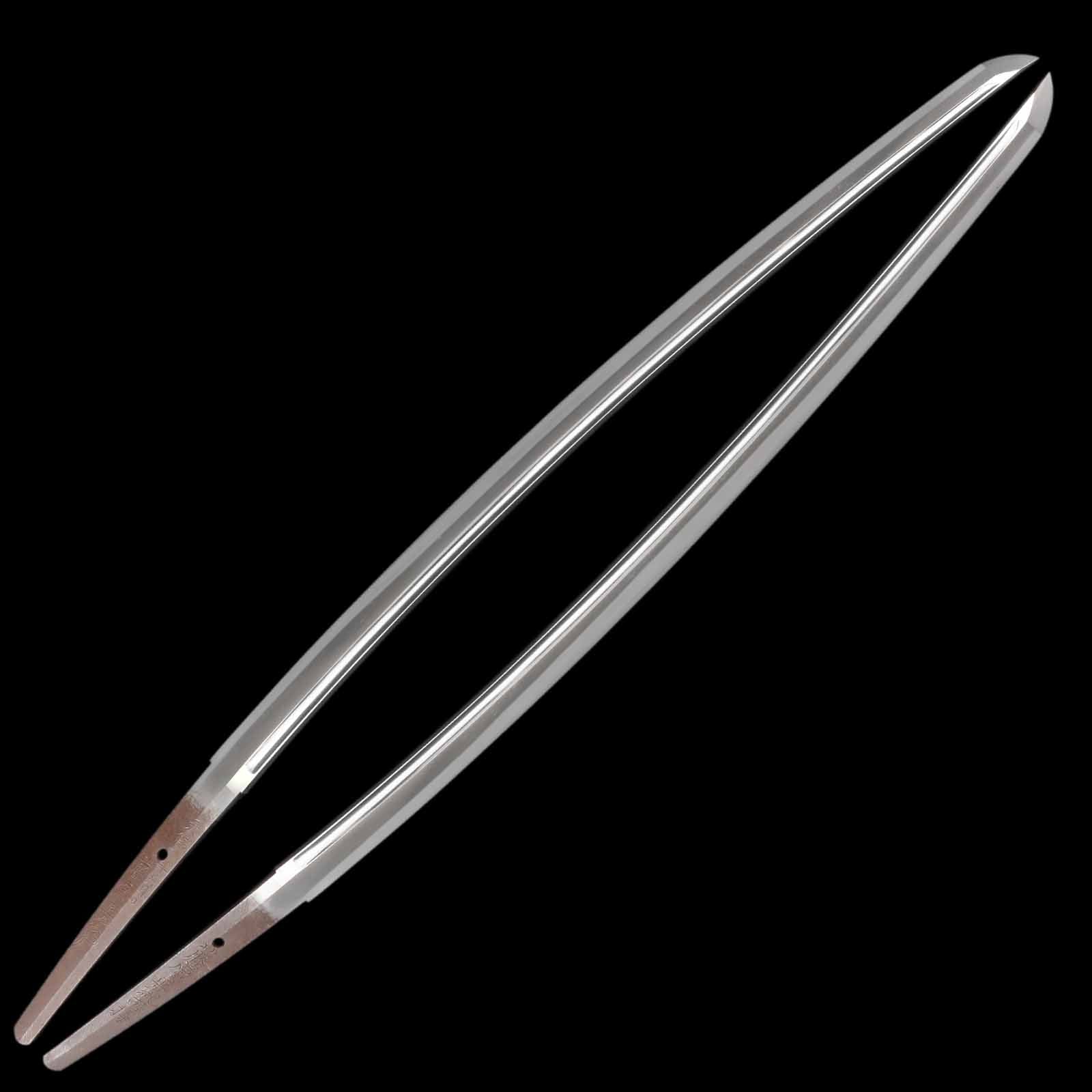
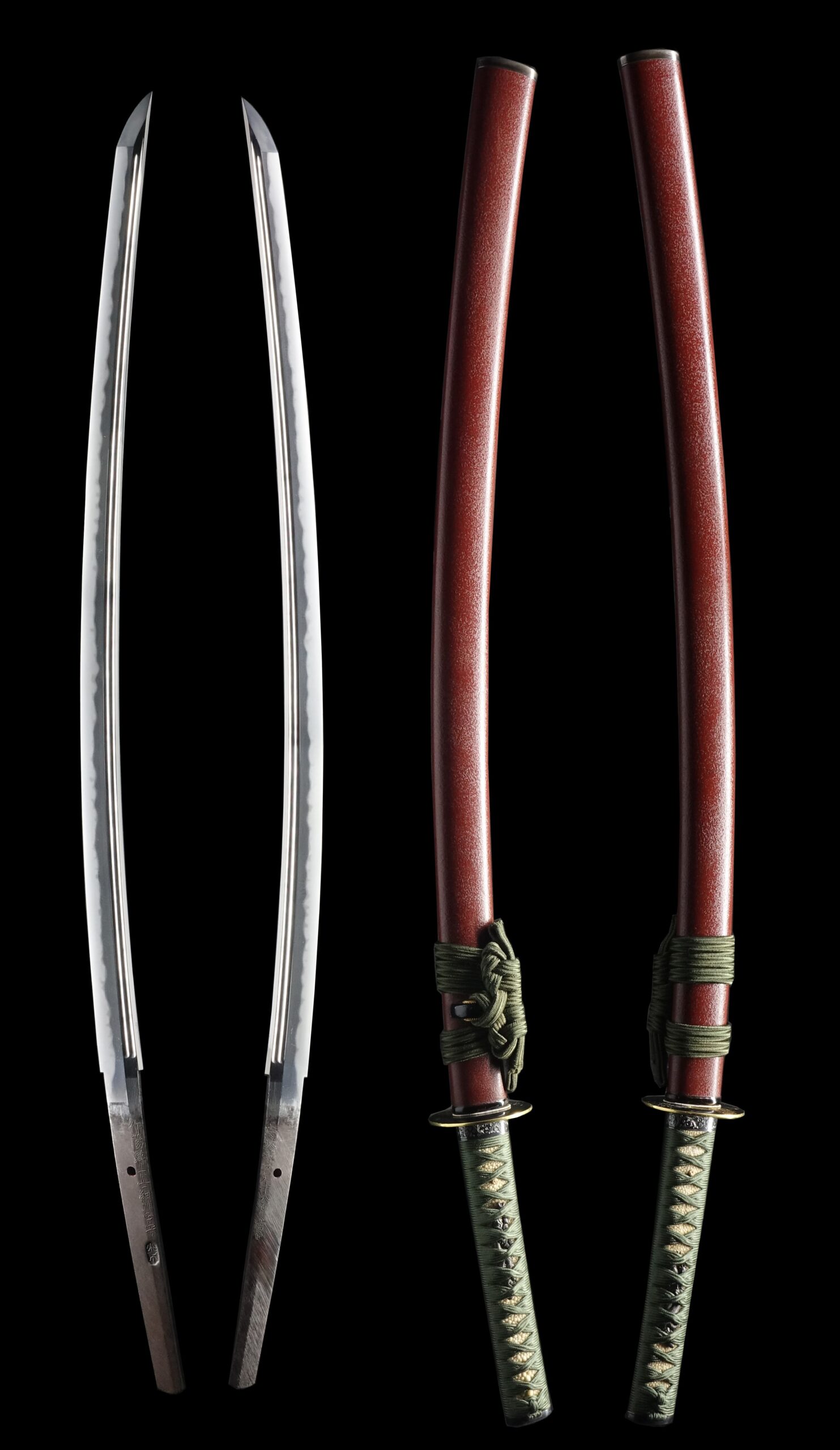
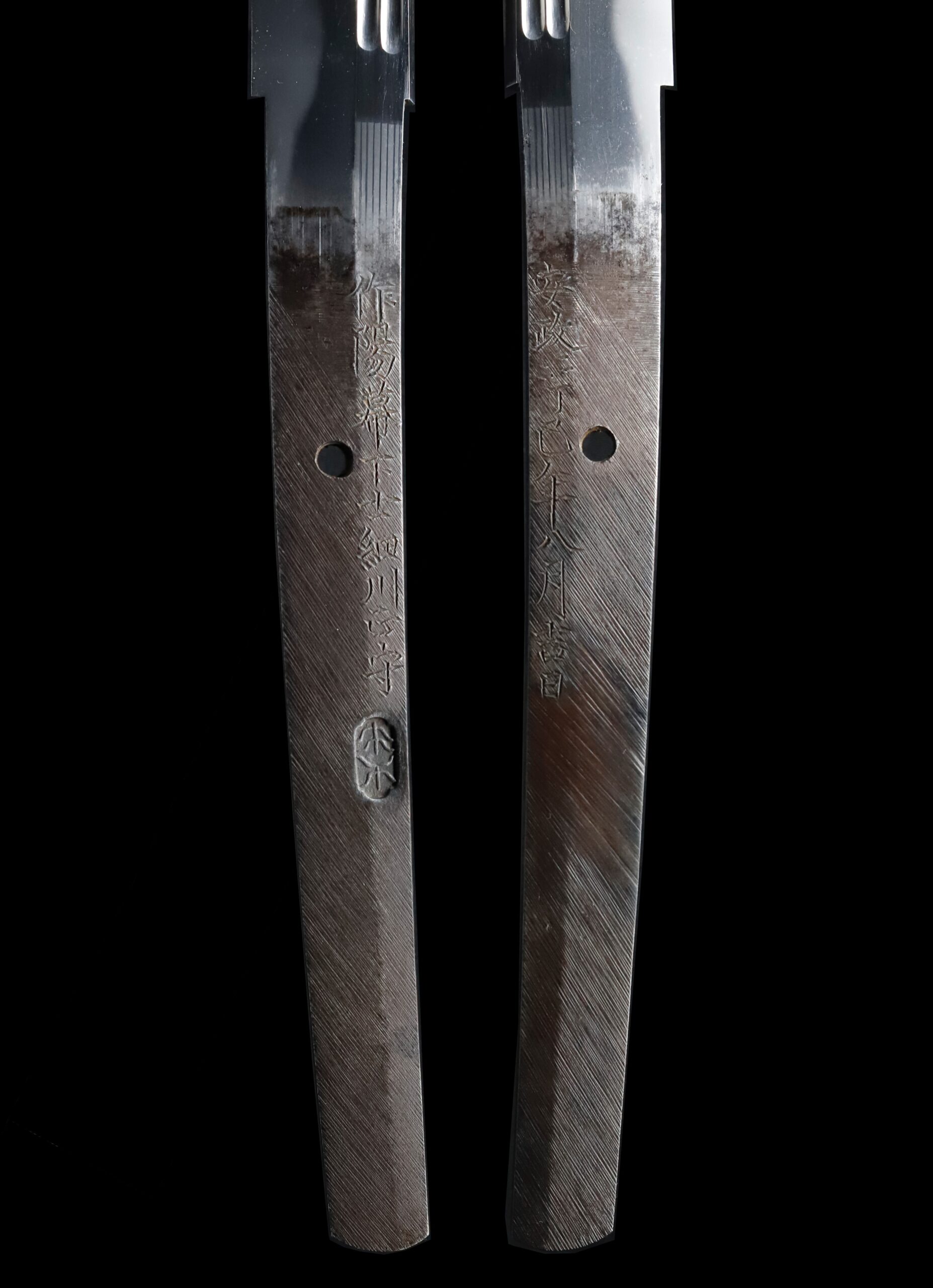
Antique Japanese Sword Katana Signed by Hosokawa Masamori with NBTHK JUYO TOKEN Certificate 【Description】 Summary This blade was signed by Saku Yo Bakkashi Hosokawa Masamori (作陽幕下士細川正守) in the 4th year of the Ansei era (1857: The end of the Edo period). Saku Yo Bakkashi signifies that he was also a Samurai, and we assume he engraved these letters to show his dignity for being a Samurai. Hosokawa Masamori was active during the Koka-early Meiji era (1844-early 1870s). He was the son of Hosokawa Masayoshi, one of the most renowned swordsmiths during the late Edo period. Hosokawa Masanori&Masayoshi His father, Hosokawa Masayoshi, had learned sword-forging techniques under the master, Suishinshi Masahide(水心子正秀), one of the most famous swordsmiths in Samurai history. Masamori learned sword-forging techniques in Edo city under master Taikei Naotane, an apprentice of Suishinshi Masahide. Masayoshi was an extremely skilled swordsmith, and he was excellent at forging blades with Choji Midare Hamon, which is the characteristic of the Bizen sword-forging style (BIZEN DEN). Masamori also mastered this excellent sword-forging technique from his father. Choji Midare Hamon is an Irregular wavy tempering line. Most of Masamori’s work reflects on Bizen Den (One of the Five Japanese sword-forging traditions). Hosokawa Masamori was famous for having a gorgeous groove (Hi: 樋) on his creations. Mamori and his father served the Matsudaira clan in the Sakushu Tsuyama domain(today’s Okayama prefecture). They served the clan as a Hanko(藩工), who exclusively forged swords for a specific clan. This blade is appraised as a JUYO TOKEN (重要刀剣) issued by NBTHK (Nihon Bijutsu Touken Hozon Kyokai:日本美術刀剣保存協会). This authentication paper was only given to authentic Japanese swords, exceptionally well preserved and of high quality with artistic value. JUYO is one rank higher than Tokubetsu Hozon. To be eligible for a Juyo Token, it needs to be appraised as a Tokubetsu Hozon Token first. It is extremely rare for an antique Japanese sword to be appraised as JUYO TOKEN, and it is highly desirable among Japanese sword collectors. 【 Blade】 Cutting Edge Length(Nagasa) : 70.0 cm (27.5 inches) Curvature(Sori) : 2.3 cm (0.90 inches) Hamon : The crystalline structure which forms along the cutting edge of a blade as a result of the hardening process Jimon(Jihada) : visible steel surface pattern created by folding and hammering during forging process Nakago : Nakago is the tang of the Japanese sword. Japanese swordsmiths left the black rust on the tang because it prevents red rust while the tang is in its handle. And the discoloration of the tang was created over time, and it is a great indicator for a Japanese sword specialist to estimate when the sword was forged. According to the certificate, this blade was heavily shortened in the past (Osuriage: 大磨り上げ). Koshirae: Koshirae is the mounting of the Japanese sword. There are several parts that consist of Koshirae such as Saya(Scabbard), Tsuka( Handle), Tsuba(Handguard). Fuchi-Kashira : A pair of matching sword fittings that cover the upper and bottom parts of its sword hilt. This Fuchi Kashira is made of silvery metal. The Karakusa (唐草, arabesque) pattern is engraved elegantly on the entire surface. Each vein of every leaf is elaborately carved; it shows the proficiency of its maker. The Karakusa pattern is a design in which stems and leaves of vines are twined and make curves. Since ivy has a strong vitality and grows up without interruption, people regarded this design as a symbol of prosperity and longevity. Vine is called Tsuru (蔓) in Japanese and has another pronunciation; Man. There is a word 万 (it is also read Man), which means ten thousand. In the Karakusa pattern, leaves and vines are connected like Obi (帯, belt). The word 帯 can also be read “Tai.” Due to its pronunciation, the term 代 (Tai) is associated. From this word-association game, an idiom 万代 is associated, and it means a thousand generations. In other words, we

NihontoWatch MonNihontoWatch
マーケット
事典
鑑定
刀剣›水心子正秀›正守›Antique Japanese Sword Katana Signed by Hosokawa Masamori NBTHK JUYO TOKEN Certificate
刀重要
正守

Antique Japanese Sword Katana Signed by Hosokawa Masamori NBTHK JUYO TOKEN Certificate

在銘 · 安政〜慶応 · 長さ 70cm · 反り 2.3cm
売却済
正守 · 安政〜慶応販売中 2点 →
刀重要
刀身だけで刀工を見抜けますか? 本日の鑑定 →
正守 — 1 of 25
正守 — 2 of 25
正守 — 3 of 25
正守 — 4 of 25
正守 — 5 of 25
正守 — 6 of 25
正守 — 7 of 25
正守 — 8 of 25
正守 — 9 of 25
正守 — 10 of 25
正守 — 11 of 25
正守 — 12 of 25
正守 — 13 of 25
正守 — 14 of 25
正守 — 15 of 25
正守 — 16 of 25
正守 — 17 of 25
正守 — 18 of 25
正守 — 19 of 25
正守 — 20 of 25
正守 — 21 of 25
正守 — 22 of 25
正守 — 23 of 25
正守 — 24 of 25
正守 — 25 of 25
1 / 25
1 / 25
正守 — 1 of 25正守 — 2 of 25正守 — 3 of 25正守 — 4 of 25正守 — 5 of 25正守 — 6 of 25正守 — 7 of 25正守 — 8 of 25正守 — 9 of 25正守 — 10 of 25正守 — 11 of 25正守 — 12 of 25正守 — 13 of 25正守 — 14 of 25正守 — 15 of 25正守 — 16 of 25正守 — 17 of 25正守 — 18 of 25正守 — 19 of 25正守 — 20 of 25正守 — 21 of 25正守 — 22 of 25正守 — 23 of 25正守 — 24 of 25正守 — 25 of 25
正守 · 安政〜慶応販売中 2点 →
刀重要
刀身だけで刀工を見抜けますか? 本日の鑑定 →
法量・詳細
刀工
正守
種別
刀
流派
水心子正秀
活動期
1854–1867年頃(安政〜慶応)
国
武蔵
銘
在銘(在銘率 100%)
法量
長さ 70cm反り 2.3cm
説明

Antique Japanese Sword Katana Signed by Hosokawa Masamori with NBTHK JUYO TOKEN Certificate 【Description】 Summary This blade was signed by Saku Yo Bakkashi Hosokawa Masamori (作陽幕下士細川正守) in the 4th year of the Ansei era (1857: The end of the Edo period). Saku Yo Bakkashi signifies that he was also a Samurai, and we assume he engraved these letters to show his dignity for being a Samurai. Hosokawa Masamori was active during the Koka-early Meiji era (1844-early 1870s). He was the son of Hosokawa Masayoshi, one of the most renowned swordsmiths during the late Edo period. Hosokawa Masanori&Masayoshi His father, Hosokawa Masayoshi, had learned sword-forging techniques under the master, Suishinshi Masahide(水心子正秀), one of the most famous swordsmiths in Samurai history. Masamori learned sword-forging techniques in Edo city under master Taikei Naotane, an apprentice of Suishinshi Masahide. Masayoshi was an extremely skilled swordsmith, and he was excellent at forging blades with Choji Midare Hamon, which is the characteristic of the Bizen sword-forging style (BIZEN DEN). Masamori also mastered this excellent sword-forging technique from his father. Choji Midare Hamon is an Irregular wavy tempering line. Most of Masamori’s work reflects on Bizen Den (One of the Five Japanese sword-forging traditions). Hosokawa Masamori was famous for having a gorgeous groove (Hi: 樋) on his creations. Mamori and his father served the Matsudaira clan in the Sakushu Tsuyama domain(today’s Okayama prefecture). They served the clan as a Hanko(藩工), who exclusively forged swords for a specific clan. This blade is appraised as a JUYO TOKEN (重要刀剣) issued by NBTHK (Nihon Bijutsu Touken Hozon Kyokai:日本美術刀剣保存協会). This authentication paper was only given to authentic Japanese swords, exceptionally well preserved and of high quality with artistic value. JUYO is one rank higher than Tokubetsu Hozon. To be eligible for a Juyo Token, it needs to be appraised as a Tokubetsu Hozon Token first. It is extremely rare for an antique Japanese sword to be appraised as JUYO TOKEN, and it is highly desirable among Japanese sword collectors. 【 Blade】 Cutting Edge Length(Nagasa) : 70.0 cm (27.5 inches) Curvature(Sori) : 2.3 cm (0.90 inches) Hamon : The crystalline structure which forms along the cutting edge of a blade as a result of the hardening process Jimon(Jihada) : visible steel surface pattern created by folding and hammering during forging process Nakago : Nakago is the tang of the Japanese sword. Japanese swordsmiths left the black rust on the tang because it prevents red rust while the tang is in its handle. And the discoloration of the tang was created over time, and it is a great indicator for a Japanese sword specialist to estimate when the sword was forged. According to the certificate, this blade was heavily shortened in the past (Osuriage: 大磨り上げ). Koshirae: Koshirae is the mounting of the Japanese sword. There are several parts that consist of Koshirae such as Saya(Scabbard), Tsuka( Handle), Tsuba(Handguard). Fuchi-Kashira : A pair of matching sword fittings that cover the upper and bottom parts of its sword hilt. This Fuchi Kashira is made of silvery metal. The Karakusa (唐草, arabesque) pattern is engraved elegantly on the entire surface. Each vein of every leaf is elaborately carved; it shows the proficiency of its maker. The Karakusa pattern is a design in which stems and leaves of vines are twined and make curves. Since ivy has a strong vitality and grows up without interruption, people regarded this design as a symbol of prosperity and longevity. Vine is called Tsuru (蔓) in Japanese and has another pronunciation; Man. There is a word 万 (it is also read Man), which means ten thousand. In the Karakusa pattern, leaves and vines are connected like Obi (帯, belt). The word 帯 can also be read “Tai.” Due to its pronunciation, the term 代 (Tai) is associated. From this word-association game, an idiom 万代 is associated, and it means a thousand generations. In other words, we

NBTHK図譜解説

Juyo #24

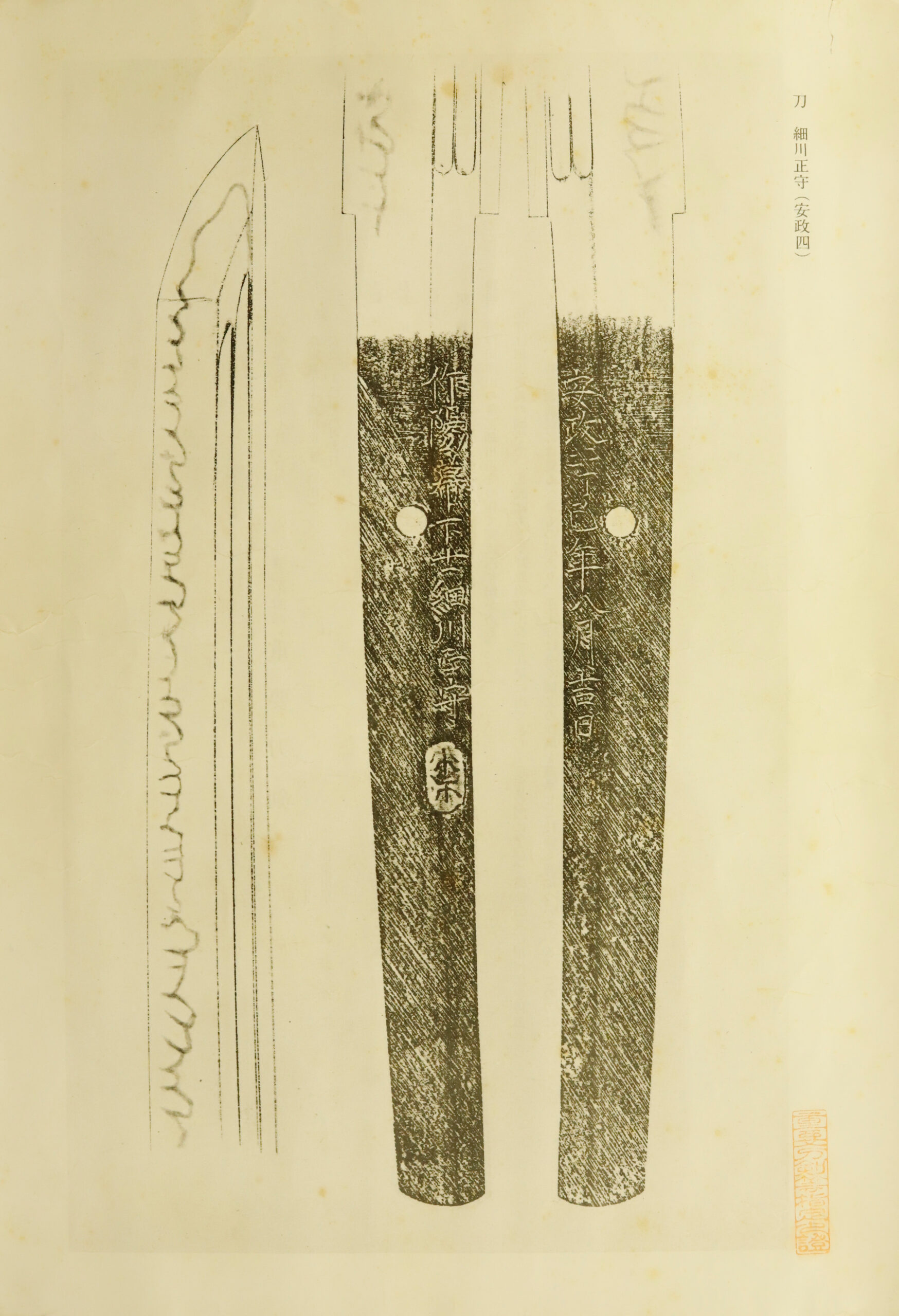
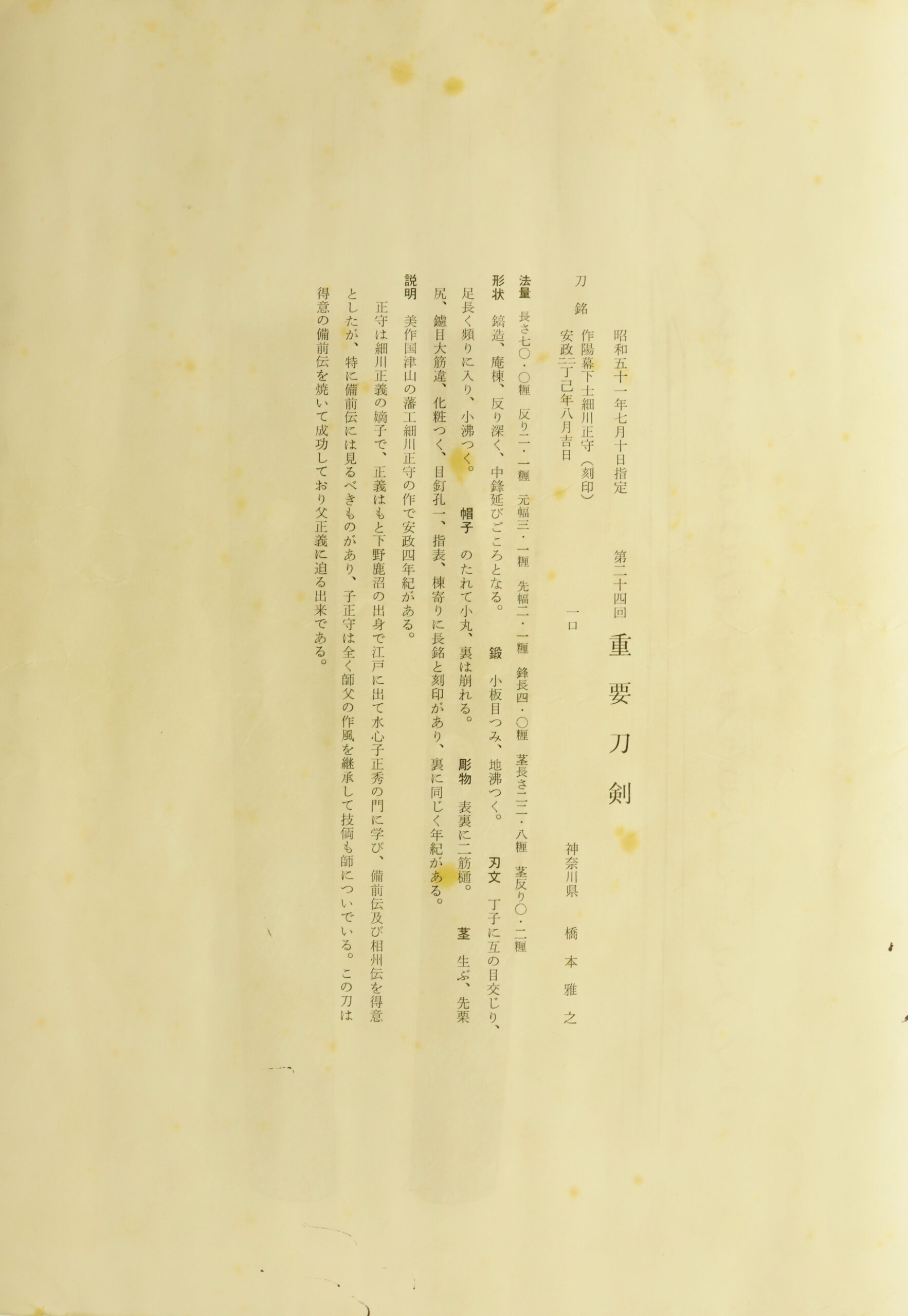
美作国津山の藩工細川正守の作で安政四年紀がある。 正守は細川正義の嫡子で、正義はもと下野鹿沼の出身で江戸に出て水心子正秀の門に学び、備前伝及び相州伝を得意 としたが、特に備前伝には見るべきものがあり、子正守は全く師父の作風を継承して技術も師についでいる。この刀は 得意の備前伝を焼いて成功しており父正義に迫る出来である。

作者について

正守

新々刀 · 美作 · 1854-1867頃

藤代 Chu-jo saku · 刀剣大鑑 上位76%

現在2点販売中

›

正守は美作国津山の藩工であり、細川正義の嫡子である。正義はもと下野国鹿沼の出身であるが、江戸に出て水心子正秀の門に学び、備前伝及び相州伝を得意とし、特に備前伝には見るべきものがあった。正守は全く師父の作風を継承し、技術も正義に次ぐものと評され、正義門下では師に次ぐ技量を誇る刀工である。作品には「作陽幕下士細川正守」[[c:1]]と長銘を切り、安政・元治・慶応と続く年紀を遺している。

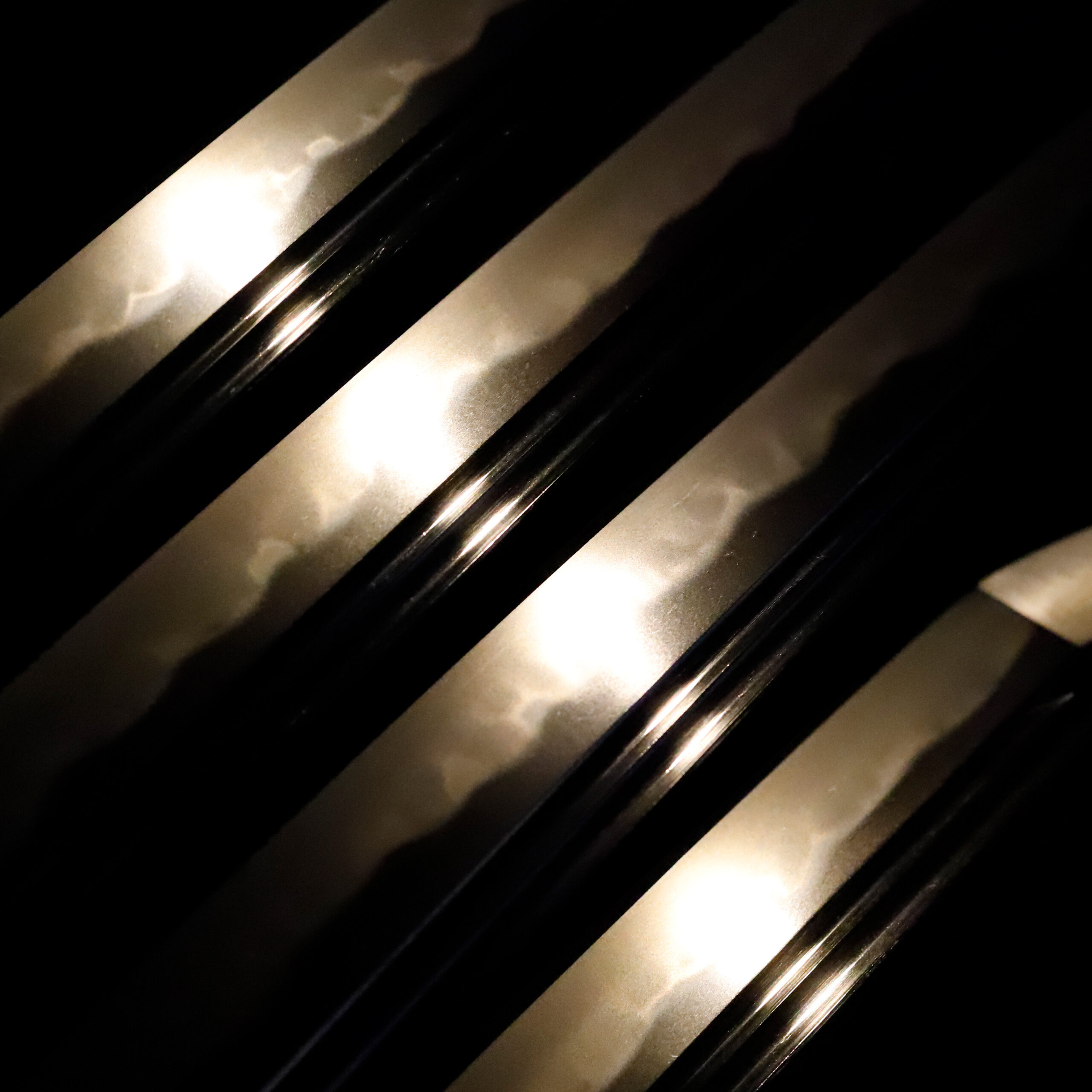
作風は得意の備前伝を主とし、形状は鎬造、庵棟で、身幅広く重ね厚く、反りつき、中鋒延びごころから大鋒に至るものが見られる。鍛えは小板目肌よくつみ、地沸厚くつき、地景の入るものがある。刃文は丁子に互の目丁子・尖り刃等を交え、足総体に長く頻りに入り、小沸よくつき、部分的に一際光の強い荒めの沸が現われ、金筋・砂流し細かにかかり、匂口明るい。帽子は乱れ込んで先尖りごころに掃きかけ、あるいは小丸に返るものがある。茎は生ぶ、先栗尻、鑢目大筋違に化粧つくを常とする。

得意の備前伝を焼いて成功した作は、いずれも父正義に迫る出来栄えを示し、同作中の白眉と称される。中には同工の常以上に丁子の房が大振りで、焼きに高低を見せて一際華やかに乱れ、手持ちの重い豪壮な体配と相俟って父正義の傑作に劣らぬ出来口に仕上がるものがあり、正守屈指の名品と称すべきものである。

歴史的重要度

正守の位置づけを、日本刀全体および伝統・時代・時期ごとに示します。各位(随一・屈指・有数・著名)は、NBTHK および文化庁による指定に加え、三作や名物帳などの歴史的栄誉を加味したものです。

随一
随一
屈指
屈指
有数
有数
著名
著名

各項目を選ぶと評価方法が表示されます。

指定の実績
指定3口
重要刀剣
3
正守の作 2点が現在販売中→
正守 — 詳細新々刀派

この作者について学ぶ →

流派について

水心子正秀

新々刀 · 武蔵

現在78点販売中

›

水心子正秀派は、十八世紀末から十九世紀初頭の江戸に興り、刀はすべて鎌倉の昔に復すべしとする復古刀運動を中核に据えた新々刀の一門である。開祖水心子正秀は、寛延三年に出羽国赤湯に川部儀八郎として生まれ[[c:1]]、武州下原の鍛冶吉英に学んだのち山形秋元家に仕え、のちに江戸浜町に移って約五十年に及ぶ作刀生活を送り、文政八年に七十六歳で歿した。彼は新々刀の祖と称され、古作の伝法を意図して甦らせることを唱えてその理論を世に広めたが、説明書は正秀自身の才のありかをむしろ壮年までの大坂写しに見いだす。この一門の物語で最も重きをなすのは、彼が江戸に糾合し育てた門人たちであろう。復古刀論を実地に示した第一の門人大慶直胤、二代正義細川守秀がその直下に立ち、さらに直胤の門から養子となった次郎太郎直勝、直胤の女婿と伝える水心子正次、正義の嫡子正守、米沢上杉家に仕えた長運斎綱俊、水戸藩工直江助政が連なって、出羽・江戸を中心に各藩へと広がった。 この一門を貫く共通の語法は、古刀各伝の意図的な復興にある。よく約んだ無地風に近い小板目に地沸を厚くつけ、その地の上に相州伝ののたれ・互の目、あるいは備前伝の丁子・互の目を焼くのが基調で、技術論的かつ教導的な性格がこれを支える。正秀の典型は津田助広に私淑した大坂写しの濤瀾乱れと井上真改風の広直刃にあり、地へこぼれる黒味がちの荒い沸が終始の手癖をなした。これに対して門人たちは古備前への遡りをいっそう深め、新々刀には本来失われた映りを意図して甦らせた。直胤はよくつんだ小板目に乱れ映りを鮮明に立て、後期長船の逆がかりを示す丁子乱れを焼いてこれを得意とし、説明書はその丁子乱れの巧みさを新々刀第一と評する。直勝は兼光に範をとった片落ち互の目を主体に、直胤よりも豪壮な姿と低く静かな焼きで古調を醸し、正次と正守はともに直胤・正義の二伝を忠実に承けて相州伝と備前伝を均しく再現し、綱俊は丁子に互の目を交えた備前伝を主調とした。一方で正秀みずからの備前伝・相州伝は終始焼刃が浅く荒い沸を交え、説明書はその技が門人直胤に及ばないと明記する。差異は資料の支持する範囲で明瞭で、直胤の備前・相州の両伝、直勝の長船写しに見る逆がかりと大杢目、助政の真改風直刃に偏した作域がそれぞれを分かつ。 鑑定の勘所は、まずこの意図的な映りと逆がかりに置かれる。明るい乱れ映りと角互の目を伴う逆がかりの丁子は、映りも逆がかりも持たぬ一般の新々刀から備前伝を分かち、相州伝は独特の渦巻肌と叢づき縞がかる沸の働きによって示される。位列としては正秀を上々作、直胤を最上作の在銘の大名跡とし、正義に次ぐ正守、綱俊、助政らがこれに続く。この一門は在銘・有年紀の作を数多く遺したため、その鑑定の問題は極めの難ではなくむしろ系統内の位置にあり、年ごとに変化する銘がその発展を正確に辿らせる。伝来は真田家伝来の大小や皇室に伝わった御太刀の副作、各藩工としての藩命作にうかがわれ、正秀が向き直らせた江戸の作刀は直胤を介して直勝・正次らへ受け継がれ、兼光・景光をねらった長船復古として幕末の十九世紀作刀に広く及んだ。 詳しく見る →

14名の刀工指定105口
主要刀工
刀工時代指定
直胤1801-183740
正秀1777-181728
助政1804-18258
直勝1805-18586
正義1791-18605
水心子正秀流派を見る →

歴史的背景

新々刀 復古の運動

›

1800年前後、水心子正秀は著述をもって、鍛刀は古作の法に立ち返るべしと説いた。復古刀の運動である。最大の後継者直胤は、数百年絶えていた備前伝と相州伝を確信をもって再現した。

新々刀 復古の運動 →

NBTHK鑑定書
重要刀剣Jūyō Tōken
›

特別保存刀剣の中から、特に出来が優れ、国認定の重要美術品に準ずると判断された名品です。年に一度の重要刀剣審査で選ばれます。

極めて選別的で、日本に登録された約250万口の刀剣のうち、重要刀剣に達したものは12,307口(約203口に1口)にすぎません。

NBTHKについて›

日本美術刀剣保存協会(NBTHK)は、1948年に設立され、文化庁の監督を受ける公益財団法人で、東京・刀剣博物館に本部を置きます。専門の審査員が出品作を直接審査し、美術的・歴史的価値に応じた鑑定書を発行します。NBTHKの鑑定書は、日本刀および刀装具の真正性を示す最も広く認知された基準です。

NBTHK公式サイト→
販売店
サ
サムライミュージアム
🇯🇵日本から発送
›
✓認証販売店samuraimuseum.jp
✓海外発送可✓英語対応PayPalクレジットカード
返品ポリシー

Returns/exchanges limited to defects caused by shipping (except willful misconduct or gross negligence by the company); customers must contact within 72 hours of receiving the product.

サムライミュージアムの出品一覧を見る→販売店サイトでこの商品を見る→

正守の他の作

すべて見る →
刀剣はたや
保存
Katana - Hozon - 作 正守 - 刀 於大城下細川正守(刻印)慶応三年八月日Katana - Hozon - 作 正守 - 刀 於大城下細川正守(刻印)慶応三年八月日

刀

作正守
68.4cm·安政〜慶応
¥1,100,000
銀座長州屋
Katana - 作 正守 - 銘 作陽幕下士細川正守[刻印]元治二歳孟春日造之Katana - 作 正守 - 銘 作陽幕下士細川正守[刻印]元治二歳孟春日造之

刀

作正守
安政〜慶応
¥2,500,000

正守の売約済み

すべて見る →
銀座誠友堂
特別保存
Tanto - Tokuho - 作 正守 - Sunnobi Tanto [Hosokawa Masamori] [N.B.T.H.K] Tokubetsu Hozon TokenTanto - Tokuho - 作 正守 - Sunnobi Tanto [Hosokawa Masamori] [N.B.T.H.K] Tokubetsu Hozon Token
売切れ

短刀

作正守
31.6cm·安政〜慶応
売却済
葵美術
Katana - 作 正守 - 刀:作陽幕下士細川正守(元治元年)(日本美術刀剣保存協会 特別保存刀剣)Katana - 作 正守 - 刀:作陽幕下士細川正守(元治元年)(日本美術刀剣保存協会 特別保存刀剣)
売切れ

刀

作正守
71.4cm·新々刀
売却済
十拳
保存
Katana - Hozon - 作 正守 - 刀/無銘 細川正守Katana - Hozon - 作 正守 - 刀/無銘 細川正守
売切れ

刀

作正守
71.2cm·安政〜慶応
売却済
十拳
保存
Katana - Hozon - 作 正守 - 刀/作陽幕下士細川正守Katana - Hozon - 作 正守 - 刀/作陽幕下士細川正守
売切れ

刀

作正守
76.3cm·安政〜慶応
売却済
サムライミュージアム
特別保存
Katana - Tokuho - 作 正守 - 日本刀 刀 銘 細川正守 NBTHK特別保存刀剣 刀装具付Katana - Tokuho - 作 正守 - 日本刀 刀 銘 細川正守 NBTHK特別保存刀剣 刀装具付
売切れ

刀

作正守
66.6cm·安政〜慶応
売却済

水心子正秀派の作

すべて見る →
刀剣徳川
特別保存
Katana - Tokuho - 作 信高 - 刀 銘 伯耆守十代孫藤原信高 明治二二年二月日 黒石目地塗鞘打刀拵付Katana - Tokuho - 作 信高 - 刀 銘 伯耆守十代孫藤原信高 明治二二年二月日 黒石目地塗鞘打刀拵付

刀

作信高
70.5cm·天保
¥1,500,000
刀剣小町
重要
Katana - Jūyō - 作 直胤 - 刀 大慶直胤Katana - Jūyō - 作 直胤 - 刀 大慶直胤

刀

作直胤
83.5cm·享和
¥8,000,000
丸英刀剣
特別保存
Daisho - Tokuho - 作 直胤 - 大小 大慶直胤 (附)蛇皮包鞘大小拵Daisho - Tokuho - 作 直胤 - 大小 大慶直胤 (附)蛇皮包鞘大小拵

大小

作直胤
71.2cm·享和
お問い合わせ
永楽堂
特別保存
Katana - Tokuho - 作 正秀 - 水心子正秀 刀 特別保存刀剣Katana - Tokuho - 作 正秀 - 水心子正秀 刀 特別保存刀剣

刀

作正秀
69.8cm·天明
¥2,000,000
Tozando
特別保存
Katana - Tokuho - 作 正次 - 日本刀分譲 新々刀 刀 銘 正次(NBTHK 特別保存刀剣・特別貴重刀剣認定書付)|東山堂Katana - Tokuho - 作 正次 - 日本刀分譲 新々刀 刀 銘 正次(NBTHK 特別保存刀剣・特別貴重刀剣認定書付)|東山堂

刀

作正次
61.2cm·弘化
¥1,500,000
永楽堂
特別保存
Katana - Tokuho - 作 直胤 - 直胤 刀 特別保存刀剣Katana - Tokuho - 作 直胤 - 直胤 刀 特別保存刀剣

刀

作直胤
74.4cm·享和
¥4,000,000
丸英刀剣
重要
Katana - Jūyō - 作 直胤 - 刀 大慶直胤 重要刀剣 刀剣博物館企画展 江戸三作〈正秀・直胤・清麿〉展示Katana - Jūyō - 作 直胤 - 刀 大慶直胤 重要刀剣 刀剣博物館企画展 江戸三作〈正秀・直胤・清麿〉展示

刀

作直胤
71.4cm·享和
お問い合わせ
永楽堂
特別保存
Wakizashi - Tokuho - 作 正秀 - 正秀 脇差 特別保存刀剣Wakizashi - Tokuho - 作 正秀 - 正秀 脇差 特別保存刀剣

脇差

作正秀
55.3cm·天明
¥2,500,000

刀剣

  • 刀
  • 脇差
  • 短刀
  • 太刀
  • 薙刀
  • 槍
  • 日本刀の販売
  • サムライソード

刀装具

  • 鍔
  • 縁頭
  • 小柄
  • 目貫
  • 鍔(ソードガード)

甲冑武具

  • 兜
  • 甲冑
  • 甲冑・武具一覧

鑑定別

  • 特重
  • 重要
  • 特別保存
  • 保存

リソース

  • 刀剣商一覧
  • 刀工一覧
  • 誌上鑑定
  • すべて見る
Nihontowatch© 2026
利用規約プライバシーCookie運営者情報
売切れ

説明

Antique Japanese Sword Katana Signed by Hosokawa Masamori with NBTHK JUYO TOKEN Certificate 【Description】 Summary This blade was signed by Saku Yo Bakkashi Hosokawa Masamori (作陽幕下士細川正守) in the 4th year of the Ansei era (1857: The end of the Edo period). Saku Yo Bakkashi signifies that he was also a Samurai, and we assume he engraved these letters to show his dignity for being a Samurai. Hosokawa Masamori was active during the Koka-early Meiji era (1844-early 1870s). He was the son of Hosokawa Masayoshi, one of the most renowned swordsmiths during the late Edo period. Hosokawa Masanori&Masayoshi His father, Hosokawa Masayoshi, had learned sword-forging techniques under the master, Suishinshi Masahide(水心子正秀), one of the most famous swordsmiths in Samurai history. Masamori learned sword-forging techniques in Edo city under master Taikei Naotane, an apprentice of Suishinshi Masahide. Masayoshi was an extremely skilled swordsmith, and he was excellent at forging blades with Choji Midare Hamon, which is the characteristic of the Bizen sword-forging style (BIZEN DEN). Masamori also mastered this excellent sword-forging technique from his father. Choji Midare Hamon is an Irregular wavy tempering line. Most of Masamori’s work reflects on Bizen Den (One of the Five Japanese sword-forging traditions). Hosokawa Masamori was famous for having a gorgeous groove (Hi: 樋) on his creations. Mamori and his father served the Matsudaira clan in the Sakushu Tsuyama domain(today’s Okayama prefecture). They served the clan as a Hanko(藩工), who exclusively forged swords for a specific clan. This blade is appraised as a JUYO TOKEN (重要刀剣) issued by NBTHK (Nihon Bijutsu Touken Hozon Kyokai:日本美術刀剣保存協会). This authentication paper was only given to authentic Japanese swords, exceptionally well preserved and of high quality with artistic value. JUYO is one rank higher than Tokubetsu Hozon. To be eligible for a Juyo Token, it needs to be appraised as a Tokubetsu Hozon Token first. It is extremely rare for an antique Japanese sword to be appraised as JUYO TOKEN, and it is highly desirable among Japanese sword collectors. 【 Blade】 Cutting Edge Length(Nagasa) : 70.0 cm (27.5 inches) Curvature(Sori) : 2.3 cm (0.90 inches) Hamon : The crystalline structure which forms along the cutting edge of a blade as a result of the hardening process Jimon(Jihada) : visible steel surface pattern created by folding and hammering during forging process Nakago : Nakago is the tang of the Japanese sword. Japanese swordsmiths left the black rust on the tang because it prevents red rust while the tang is in its handle. And the discoloration of the tang was created over time, and it is a great indicator for a Japanese sword specialist to estimate when the sword was forged. According to the certificate, this blade was heavily shortened in the past (Osuriage: 大磨り上げ). Koshirae: Koshirae is the mounting of the Japanese sword. There are several parts that consist of Koshirae such as Saya(Scabbard), Tsuka( Handle), Tsuba(Handguard). Fuchi-Kashira : A pair of matching sword fittings that cover the upper and bottom parts of its sword hilt. This Fuchi Kashira is made of silvery metal. The Karakusa (唐草, arabesque) pattern is engraved elegantly on the entire surface. Each vein of every leaf is elaborately carved; it shows the proficiency of its maker. The Karakusa pattern is a design in which stems and leaves of vines are twined and make curves. Since ivy has a strong vitality and grows up without interruption, people regarded this design as a symbol of prosperity and longevity. Vine is called Tsuru (蔓) in Japanese and has another pronunciation; Man. There is a word 万 (it is also read Man), which means ten thousand. In the Karakusa pattern, leaves and vines are connected like Obi (帯, belt). The word 帯 can also be read “Tai.” Due to its pronunciation, the term 代 (Tai) is associated. From this word-association game, an idiom 万代 is associated, and it means a thousand generations. In other words, we

NihontoWatch MonNihontoWatch
マーケット
事典
鑑定
刀剣›水心子正秀›正守›Antique Japanese Sword Katana Signed by Hosokawa Masamori NBTHK JUYO TOKEN Certificate
刀重要
正守

Antique Japanese Sword Katana Signed by Hosokawa Masamori NBTHK JUYO TOKEN Certificate

在銘 · 安政〜慶応 · 長さ 70cm · 反り 2.3cm
売却済
正守 · 安政〜慶応販売中 2点 →
刀重要
刀身だけで刀工を見抜けますか? 本日の鑑定 →
正守 — 1 of 25
正守 — 2 of 25
正守 — 3 of 25
正守 — 4 of 25
正守 — 5 of 25
正守 — 6 of 25
正守 — 7 of 25
正守 — 8 of 25
正守 — 9 of 25
正守 — 10 of 25
正守 — 11 of 25
正守 — 12 of 25
正守 — 13 of 25
正守 — 14 of 25
正守 — 15 of 25
正守 — 16 of 25
正守 — 17 of 25
正守 — 18 of 25
正守 — 19 of 25
正守 — 20 of 25
正守 — 21 of 25
正守 — 22 of 25
正守 — 23 of 25
正守 — 24 of 25
正守 — 25 of 25
1 / 25
1 / 25
正守 — 1 of 25正守 — 2 of 25正守 — 3 of 25正守 — 4 of 25正守 — 5 of 25正守 — 6 of 25正守 — 7 of 25正守 — 8 of 25正守 — 9 of 25正守 — 10 of 25正守 — 11 of 25正守 — 12 of 25正守 — 13 of 25正守 — 14 of 25正守 — 15 of 25正守 — 16 of 25正守 — 17 of 25正守 — 18 of 25正守 — 19 of 25正守 — 20 of 25正守 — 21 of 25正守 — 22 of 25正守 — 23 of 25正守 — 24 of 25正守 — 25 of 25
正守 · 安政〜慶応販売中 2点 →
刀重要
刀身だけで刀工を見抜けますか? 本日の鑑定 →
法量・詳細
刀工
正守
種別
刀
流派
水心子正秀
活動期
1854–1867年頃(安政〜慶応)
国
武蔵
銘
在銘(在銘率 100%)
法量
長さ 70cm反り 2.3cm
説明

Antique Japanese Sword Katana Signed by Hosokawa Masamori with NBTHK JUYO TOKEN Certificate 【Description】 Summary This blade was signed by Saku Yo Bakkashi Hosokawa Masamori (作陽幕下士細川正守) in the 4th year of the Ansei era (1857: The end of the Edo period). Saku Yo Bakkashi signifies that he was also a Samurai, and we assume he engraved these letters to show his dignity for being a Samurai. Hosokawa Masamori was active during the Koka-early Meiji era (1844-early 1870s). He was the son of Hosokawa Masayoshi, one of the most renowned swordsmiths during the late Edo period. Hosokawa Masanori&Masayoshi His father, Hosokawa Masayoshi, had learned sword-forging techniques under the master, Suishinshi Masahide(水心子正秀), one of the most famous swordsmiths in Samurai history. Masamori learned sword-forging techniques in Edo city under master Taikei Naotane, an apprentice of Suishinshi Masahide. Masayoshi was an extremely skilled swordsmith, and he was excellent at forging blades with Choji Midare Hamon, which is the characteristic of the Bizen sword-forging style (BIZEN DEN). Masamori also mastered this excellent sword-forging technique from his father. Choji Midare Hamon is an Irregular wavy tempering line. Most of Masamori’s work reflects on Bizen Den (One of the Five Japanese sword-forging traditions). Hosokawa Masamori was famous for having a gorgeous groove (Hi: 樋) on his creations. Mamori and his father served the Matsudaira clan in the Sakushu Tsuyama domain(today’s Okayama prefecture). They served the clan as a Hanko(藩工), who exclusively forged swords for a specific clan. This blade is appraised as a JUYO TOKEN (重要刀剣) issued by NBTHK (Nihon Bijutsu Touken Hozon Kyokai:日本美術刀剣保存協会). This authentication paper was only given to authentic Japanese swords, exceptionally well preserved and of high quality with artistic value. JUYO is one rank higher than Tokubetsu Hozon. To be eligible for a Juyo Token, it needs to be appraised as a Tokubetsu Hozon Token first. It is extremely rare for an antique Japanese sword to be appraised as JUYO TOKEN, and it is highly desirable among Japanese sword collectors. 【 Blade】 Cutting Edge Length(Nagasa) : 70.0 cm (27.5 inches) Curvature(Sori) : 2.3 cm (0.90 inches) Hamon : The crystalline structure which forms along the cutting edge of a blade as a result of the hardening process Jimon(Jihada) : visible steel surface pattern created by folding and hammering during forging process Nakago : Nakago is the tang of the Japanese sword. Japanese swordsmiths left the black rust on the tang because it prevents red rust while the tang is in its handle. And the discoloration of the tang was created over time, and it is a great indicator for a Japanese sword specialist to estimate when the sword was forged. According to the certificate, this blade was heavily shortened in the past (Osuriage: 大磨り上げ). Koshirae: Koshirae is the mounting of the Japanese sword. There are several parts that consist of Koshirae such as Saya(Scabbard), Tsuka( Handle), Tsuba(Handguard). Fuchi-Kashira : A pair of matching sword fittings that cover the upper and bottom parts of its sword hilt. This Fuchi Kashira is made of silvery metal. The Karakusa (唐草, arabesque) pattern is engraved elegantly on the entire surface. Each vein of every leaf is elaborately carved; it shows the proficiency of its maker. The Karakusa pattern is a design in which stems and leaves of vines are twined and make curves. Since ivy has a strong vitality and grows up without interruption, people regarded this design as a symbol of prosperity and longevity. Vine is called Tsuru (蔓) in Japanese and has another pronunciation; Man. There is a word 万 (it is also read Man), which means ten thousand. In the Karakusa pattern, leaves and vines are connected like Obi (帯, belt). The word 帯 can also be read “Tai.” Due to its pronunciation, the term 代 (Tai) is associated. From this word-association game, an idiom 万代 is associated, and it means a thousand generations. In other words, we

NBTHK図譜解説

Juyo #24

美作国津山の藩工細川正守の作で安政四年紀がある。 正守は細川正義の嫡子で、正義はもと下野鹿沼の出身で江戸に出て水心子正秀の門に学び、備前伝及び相州伝を得意 としたが、特に備前伝には見るべきものがあり、子正守は全く師父の作風を継承して技術も師についでいる。この刀は 得意の備前伝を焼いて成功しており父正義に迫る出来である。

作者について

正守

新々刀 · 美作 · 1854-1867頃

藤代 Chu-jo saku · 刀剣大鑑 上位76%

現在2点販売中

›

正守は美作国津山の藩工であり、細川正義の嫡子である。正義はもと下野国鹿沼の出身であるが、江戸に出て水心子正秀の門に学び、備前伝及び相州伝を得意とし、特に備前伝には見るべきものがあった。正守は全く師父の作風を継承し、技術も正義に次ぐものと評され、正義門下では師に次ぐ技量を誇る刀工である。作品には「作陽幕下士細川正守」[[c:1]]と長銘を切り、安政・元治・慶応と続く年紀を遺している。

作風は得意の備前伝を主とし、形状は鎬造、庵棟で、身幅広く重ね厚く、反りつき、中鋒延びごころから大鋒に至るものが見られる。鍛えは小板目肌よくつみ、地沸厚くつき、地景の入るものがある。刃文は丁子に互の目丁子・尖り刃等を交え、足総体に長く頻りに入り、小沸よくつき、部分的に一際光の強い荒めの沸が現われ、金筋・砂流し細かにかかり、匂口明るい。帽子は乱れ込んで先尖りごころに掃きかけ、あるいは小丸に返るものがある。茎は生ぶ、先栗尻、鑢目大筋違に化粧つくを常とする。

得意の備前伝を焼いて成功した作は、いずれも父正義に迫る出来栄えを示し、同作中の白眉と称される。中には同工の常以上に丁子の房が大振りで、焼きに高低を見せて一際華やかに乱れ、手持ちの重い豪壮な体配と相俟って父正義の傑作に劣らぬ出来口に仕上がるものがあり、正守屈指の名品と称すべきものである。

歴史的重要度

正守の位置づけを、日本刀全体および伝統・時代・時期ごとに示します。各位(随一・屈指・有数・著名)は、NBTHK および文化庁による指定に加え、三作や名物帳などの歴史的栄誉を加味したものです。

随一
随一
屈指
屈指
有数
有数
著名
著名

各項目を選ぶと評価方法が表示されます。

指定の実績
指定3口
重要刀剣
3
正守の作 2点が現在販売中→
正守 — 詳細新々刀派

この作者について学ぶ →

流派について

水心子正秀

新々刀 · 武蔵

現在78点販売中

›

水心子正秀派は、十八世紀末から十九世紀初頭の江戸に興り、刀はすべて鎌倉の昔に復すべしとする復古刀運動を中核に据えた新々刀の一門である。開祖水心子正秀は、寛延三年に出羽国赤湯に川部儀八郎として生まれ[[c:1]]、武州下原の鍛冶吉英に学んだのち山形秋元家に仕え、のちに江戸浜町に移って約五十年に及ぶ作刀生活を送り、文政八年に七十六歳で歿した。彼は新々刀の祖と称され、古作の伝法を意図して甦らせることを唱えてその理論を世に広めたが、説明書は正秀自身の才のありかをむしろ壮年までの大坂写しに見いだす。この一門の物語で最も重きをなすのは、彼が江戸に糾合し育てた門人たちであろう。復古刀論を実地に示した第一の門人大慶直胤、二代正義細川守秀がその直下に立ち、さらに直胤の門から養子となった次郎太郎直勝、直胤の女婿と伝える水心子正次、正義の嫡子正守、米沢上杉家に仕えた長運斎綱俊、水戸藩工直江助政が連なって、出羽・江戸を中心に各藩へと広がった。 この一門を貫く共通の語法は、古刀各伝の意図的な復興にある。よく約んだ無地風に近い小板目に地沸を厚くつけ、その地の上に相州伝ののたれ・互の目、あるいは備前伝の丁子・互の目を焼くのが基調で、技術論的かつ教導的な性格がこれを支える。正秀の典型は津田助広に私淑した大坂写しの濤瀾乱れと井上真改風の広直刃にあり、地へこぼれる黒味がちの荒い沸が終始の手癖をなした。これに対して門人たちは古備前への遡りをいっそう深め、新々刀には本来失われた映りを意図して甦らせた。直胤はよくつんだ小板目に乱れ映りを鮮明に立て、後期長船の逆がかりを示す丁子乱れを焼いてこれを得意とし、説明書はその丁子乱れの巧みさを新々刀第一と評する。直勝は兼光に範をとった片落ち互の目を主体に、直胤よりも豪壮な姿と低く静かな焼きで古調を醸し、正次と正守はともに直胤・正義の二伝を忠実に承けて相州伝と備前伝を均しく再現し、綱俊は丁子に互の目を交えた備前伝を主調とした。一方で正秀みずからの備前伝・相州伝は終始焼刃が浅く荒い沸を交え、説明書はその技が門人直胤に及ばないと明記する。差異は資料の支持する範囲で明瞭で、直胤の備前・相州の両伝、直勝の長船写しに見る逆がかりと大杢目、助政の真改風直刃に偏した作域がそれぞれを分かつ。 鑑定の勘所は、まずこの意図的な映りと逆がかりに置かれる。明るい乱れ映りと角互の目を伴う逆がかりの丁子は、映りも逆がかりも持たぬ一般の新々刀から備前伝を分かち、相州伝は独特の渦巻肌と叢づき縞がかる沸の働きによって示される。位列としては正秀を上々作、直胤を最上作の在銘の大名跡とし、正義に次ぐ正守、綱俊、助政らがこれに続く。この一門は在銘・有年紀の作を数多く遺したため、その鑑定の問題は極めの難ではなくむしろ系統内の位置にあり、年ごとに変化する銘がその発展を正確に辿らせる。伝来は真田家伝来の大小や皇室に伝わった御太刀の副作、各藩工としての藩命作にうかがわれ、正秀が向き直らせた江戸の作刀は直胤を介して直勝・正次らへ受け継がれ、兼光・景光をねらった長船復古として幕末の十九世紀作刀に広く及んだ。 詳しく見る →

14名の刀工指定105口
主要刀工
刀工時代指定
直胤1801-183740
正秀1777-181728
助政1804-18258
直勝1805-18586
正義1791-18605
水心子正秀流派を見る →

歴史的背景

新々刀 復古の運動

›

1800年前後、水心子正秀は著述をもって、鍛刀は古作の法に立ち返るべしと説いた。復古刀の運動である。最大の後継者直胤は、数百年絶えていた備前伝と相州伝を確信をもって再現した。

新々刀 復古の運動 →

NBTHK鑑定書
重要刀剣Jūyō Tōken
›

特別保存刀剣の中から、特に出来が優れ、国認定の重要美術品に準ずると判断された名品です。年に一度の重要刀剣審査で選ばれます。

極めて選別的で、日本に登録された約250万口の刀剣のうち、重要刀剣に達したものは12,307口(約203口に1口)にすぎません。

NBTHKについて›

日本美術刀剣保存協会(NBTHK)は、1948年に設立され、文化庁の監督を受ける公益財団法人で、東京・刀剣博物館に本部を置きます。専門の審査員が出品作を直接審査し、美術的・歴史的価値に応じた鑑定書を発行します。NBTHKの鑑定書は、日本刀および刀装具の真正性を示す最も広く認知された基準です。

NBTHK公式サイト→
販売店
サ
サムライミュージアム
🇯🇵日本から発送
›
✓認証販売店samuraimuseum.jp
✓海外発送可✓英語対応PayPalクレジットカード
返品ポリシー

Returns/exchanges limited to defects caused by shipping (except willful misconduct or gross negligence by the company); customers must contact within 72 hours of receiving the product.

サムライミュージアムの出品一覧を見る→販売店サイトでこの商品を見る→

正守の他の作

すべて見る →
刀剣はたや
保存
Katana - Hozon - 作 正守 - 刀 於大城下細川正守(刻印)慶応三年八月日Katana - Hozon - 作 正守 - 刀 於大城下細川正守(刻印)慶応三年八月日

刀

作正守
68.4cm·安政〜慶応
¥1,100,000
銀座長州屋
Katana - 作 正守 - 銘 作陽幕下士細川正守[刻印]元治二歳孟春日造之Katana - 作 正守 - 銘 作陽幕下士細川正守[刻印]元治二歳孟春日造之

刀

作正守
安政〜慶応
¥2,500,000

正守の売約済み

すべて見る →
銀座誠友堂
特別保存
Tanto - Tokuho - 作 正守 - Sunnobi Tanto [Hosokawa Masamori] [N.B.T.H.K] Tokubetsu Hozon TokenTanto - Tokuho - 作 正守 - Sunnobi Tanto [Hosokawa Masamori] [N.B.T.H.K] Tokubetsu Hozon Token
売切れ

短刀

作正守
31.6cm·安政〜慶応
売却済
葵美術
Katana - 作 正守 - 刀:作陽幕下士細川正守(元治元年)(日本美術刀剣保存協会 特別保存刀剣)Katana - 作 正守 - 刀:作陽幕下士細川正守(元治元年)(日本美術刀剣保存協会 特別保存刀剣)
売切れ

刀

作正守
71.4cm·新々刀
売却済
十拳
保存
Katana - Hozon - 作 正守 - 刀/無銘 細川正守Katana - Hozon - 作 正守 - 刀/無銘 細川正守
売切れ

刀

作正守
71.2cm·安政〜慶応
売却済
十拳
保存
Katana - Hozon - 作 正守 - 刀/作陽幕下士細川正守Katana - Hozon - 作 正守 - 刀/作陽幕下士細川正守
売切れ

刀

作正守
76.3cm·安政〜慶応
売却済
サムライミュージアム
特別保存
Katana - Tokuho - 作 正守 - 日本刀 刀 銘 細川正守 NBTHK特別保存刀剣 刀装具付Katana - Tokuho - 作 正守 - 日本刀 刀 銘 細川正守 NBTHK特別保存刀剣 刀装具付
売切れ

刀

作正守
66.6cm·安政〜慶応
売却済

水心子正秀派の作

すべて見る →
刀剣徳川
特別保存
Katana - Tokuho - 作 信高 - 刀 銘 伯耆守十代孫藤原信高 明治二二年二月日 黒石目地塗鞘打刀拵付Katana - Tokuho - 作 信高 - 刀 銘 伯耆守十代孫藤原信高 明治二二年二月日 黒石目地塗鞘打刀拵付

刀

作信高
70.5cm·天保
¥1,500,000
刀剣小町
重要
Katana - Jūyō - 作 直胤 - 刀 大慶直胤Katana - Jūyō - 作 直胤 - 刀 大慶直胤

刀

作直胤
83.5cm·享和
¥8,000,000
丸英刀剣
特別保存
Daisho - Tokuho - 作 直胤 - 大小 大慶直胤 (附)蛇皮包鞘大小拵Daisho - Tokuho - 作 直胤 - 大小 大慶直胤 (附)蛇皮包鞘大小拵

大小

作直胤
71.2cm·享和
お問い合わせ
永楽堂
特別保存
Katana - Tokuho - 作 正秀 - 水心子正秀 刀 特別保存刀剣Katana - Tokuho - 作 正秀 - 水心子正秀 刀 特別保存刀剣

刀

作正秀
69.8cm·天明
¥2,000,000
Tozando
特別保存
Katana - Tokuho - 作 正次 - 日本刀分譲 新々刀 刀 銘 正次(NBTHK 特別保存刀剣・特別貴重刀剣認定書付)|東山堂Katana - Tokuho - 作 正次 - 日本刀分譲 新々刀 刀 銘 正次(NBTHK 特別保存刀剣・特別貴重刀剣認定書付)|東山堂

刀

作正次
61.2cm·弘化
¥1,500,000
永楽堂
特別保存
Katana - Tokuho - 作 直胤 - 直胤 刀 特別保存刀剣Katana - Tokuho - 作 直胤 - 直胤 刀 特別保存刀剣

刀

作直胤
74.4cm·享和
¥4,000,000
丸英刀剣
重要
Katana - Jūyō - 作 直胤 - 刀 大慶直胤 重要刀剣 刀剣博物館企画展 江戸三作〈正秀・直胤・清麿〉展示Katana - Jūyō - 作 直胤 - 刀 大慶直胤 重要刀剣 刀剣博物館企画展 江戸三作〈正秀・直胤・清麿〉展示

刀

作直胤
71.4cm·享和
お問い合わせ
永楽堂
特別保存
Wakizashi - Tokuho - 作 正秀 - 正秀 脇差 特別保存刀剣Wakizashi - Tokuho - 作 正秀 - 正秀 脇差 特別保存刀剣

脇差

作正秀
55.3cm·天明
¥2,500,000

刀剣

  • 刀
  • 脇差
  • 短刀
  • 太刀
  • 薙刀
  • 槍
  • 日本刀の販売
  • サムライソード

刀装具

  • 鍔
  • 縁頭
  • 小柄
  • 目貫
  • 鍔(ソードガード)

甲冑武具

  • 兜
  • 甲冑
  • 甲冑・武具一覧

鑑定別

  • 特重
  • 重要
  • 特別保存
  • 保存

リソース

  • 刀剣商一覧
  • 刀工一覧
  • 誌上鑑定
  • すべて見る
Nihontowatch© 2026
利用規約プライバシーCookie運営者情報
売切れ

図譜解説

美作国津山の藩工細川正守の作で安政四年紀がある。 正守は細川正義の嫡子で、正義はもと下野鹿沼の出身で江戸に出て水心子正秀の門に学び、備前伝及び相州伝を得意 としたが、特に備前伝には見るべきものがあり、子正守は全く師父の作風を継承して技術も師についでいる。この刀は 得意の備前伝を焼いて成功しており父正義に迫る出来である。

図譜解説

美作国津山の藩工細川正守の作で安政四年紀がある。 正守は細川正義の嫡子で、正義はもと下野鹿沼の出身で江戸に出て水心子正秀の門に学び、備前伝及び相州伝を得意 としたが、特に備前伝には見るべきものがあり、子正守は全く師父の作風を継承して技術も師についでいる。この刀は 得意の備前伝を焼いて成功しており父正義に迫る出来である。