NihontoWatch MonNihontoWatchBETA
MarketEncyclopedia
NihontoWatch Mon

NihontoWatchBETA

Market
Encyclopedia
Overview·Kantei·Designations·Blade Forms·Signatures·School
OverviewKanteiDesignationsBlade FormsSignaturesSchool
  1. Schools
  2. Suishinshi Masahide
  3. Masayoshi

Suishinshi Masayoshi

正義

Jūyō
Vol. 43, No. 137 · Katana

Suishinshi Masayoshi

正義

5 ranked works

ProvinceMimasakaEraKyowa (1801–1804)PeriodEdoSchoolSuishinshi MasahideTraditionShinshintoTypeSwordsmithCodeMAS1401
5Jūyō Tōken

Overview

Hosokawa Masayoshi is the second smith to bear the name, the son of Hosokawa Yoshisuke of Shimotsuke who signed Masayoshi before him, and he is the hand the published sources mean when they speak of Masayoshi of the Suishinshi Masahide school. He entered the forge of Suishinshi Masahide, the reviver of the old traditions, signed first Masakata and then Morihide, and only afterward took the Masayoshi name; he became a retained smith of the Matsudaira house of the Tsuyama domain in Mimasaka, signing himself a lower vassal of Sakuyo, and worked for most of his life in . He died on the sixth day of the sixth month of Ansei 5, at the age of seventy-three. The published record places him high in the bakumatsu hierarchy of the Masahide school: it calls him the effective successor within that school, names him a twin pillar with Naotane, and says without hedging that he surpassed his own father.

His work divides into a - and a -, and the published sources are unusually direct about the difference between them. The - is far the superior, holding his masterpieces, while his -, a -laden , leaves nothing that truly commands admiration. The - is the manner by which he is known, and it is the spine of his designated record. Over a that forges tightly he tempers a , the long entering vigorously and mingling through it, the deep with well adhering, the running in with and ending in . He tempers this skillfully rather than mechanically, and on his finest blades the crowds and gathers into , and until the temper heads press together, a showy massing the published sources record in the words of the Shuroku, that his heaps up like double-cherry blossoms on the branch.

The is the controlled, refined steel over which that flamboyant temper is set. The published sources describe a forging tightly, with , and on his best blades fine gathering thickly with ko- entering well, the surface at times becoming almost . It is a deliberately quiet, well-knit steel, far from the standing of old , and the restraint of the throws the activity of the into relief. The published sources are careful to qualify the temper itself: his - is not a complete in the old manner but, like the - of other smiths, carries . The reflection of old is not part of his record; his is a revival worked in and together rather than a copy of the original. Across the edge run long and fine , and on his broadest blades the temper widens further, the opening left and right within the in a way the judges read as the hand-habit of this smith.

The richest of his recorded blades are the late, broad and long pieces with large . A of Kaei 4 carries an added inscription naming it the Choju-, the sword of long life; a second, of Ansei 2, bears his age of seventy-two carved on the tang together with the name of the man who ordered it. On both the temper is at its most crowded, the massing until the heads abut, with long , , deep and , the with . The published sources call these his representative - work, robust and handsome despite their great length, and they note that even at such size the and betray no break. Against this stands the half of his output the judges set explicitly below it, the - ; the record names it without illustrating a masterpiece in it, and the contrast is itself part of how he is read. His finest blades are -like in shape, the and alike accomplished, and they are the ones the published sources call his work of full satisfaction.

What sets him apart within the Masahide school is the particular character of that -. His teacher's program was the revival of every old tradition; Masayoshi made the his own and carried it further than most of his contemporaries, while his nearest peer in standing, Naotane, ranged more widely across the manners. The published sources keep the comparison to Naotane at the level of rank, twin pillars of the school, rather than of style, and they reserve their stylistic praise for his . The angular heads, the way the temper heads press together, and the opening are named as his own tells, not borrowed from any single old model, and it is on these that a Hosokawa Masayoshi is recognized rather than on the broad outline of - that he shares with the whole revival.

Five of his blades carry the designation, four of them signed with the long signature and the carved seal he habitually used, the body of his known record. He has no National Treasures and no Important Cultural Properties, as befits a bakumatsu smith whose work is recent; his standing rests on the quality of the - rather than on age or provenance, and no or temple descent is recorded for these blades. They are held, for the most part, in private hands, with one tang preserving the name of an -period patron and another the Choju- title. For a collector this places him among the more attainable of the front-rank names: his designated blades survive in small numbers and come to the market only from time to time, a substantial being a landmark when one appears, but not beyond the reach of a serious collection in the way a masterpiece is. What he offers is the late- - at close to its height, a deep- that the published sources judged the equal of his task and a manner they were content to set beside the best of his school.


Kantei

one prime hand read across his two traditions: a far-superior Bizen-den (choji-midare with juka-choji and ko-choji on a tight ko-itame, deep nioi, midare-komi ko-maru boshi) holding his masterpieces, against a secondary Soshu-den (nie-laden o-midare) the sources rate plainly inferior; the late, broad and long blades carry the most crowded, showy juka-choji

Hosokawa Masayoshi, the second to bear the name and the smith the published sources mean by it, was a leading hand of the Suishinshi Masahide school in the closing decades of the Edo period. He was the son of Hosokawa Yoshisuke of Shimotsuke, the first-generation Masayoshi; he entered the forge of Suishinshi Masahide, signed first Masakata and then Morihide, and finally took the name Masayoshi, becoming a retained smith of the Matsudaira house of the Tsuyama domain in Mimasaka and working mostly in Edo. The published sources call him the effective successor within the school and a twin pillar with Taikei Naotane, and they say plainly that he surpassed his own father. His record divides into a Bizen-den and a Soshu-den, and on this the sources are emphatic: the Bizen-den is far the superior, holding his masterpieces, while his Soshu-den, a nie-laden o-midare, leaves nothing that commands real admiration. The Bizen-den is a choji-midare on a tightly forged ko-itame, the temper running into juka-choji, ko-choji and gunome with long vigorous ashi and yo, deep in nioi with ko-nie, the boshi a midare-komi to ko-maru. His most flamboyant late blades, broad and long with large kissaki, gather juka-choji until the heads crowd together, a manner the Shinto Mei Shuroku likens to double-cherry blossoms massing on the branch.

Diagnostic discriminators

unique vs his plainer Bizen-den blades (choji-midare without massed juka-choji)

unique vs his Soshu-den (nie o-midare, no choji)

100% of his works · 5.0× vs old Bizen-Osafune ground (a more standing itame-mokume)

Observation by phase

His Bizen-den (the prime manner, his masterpieces)

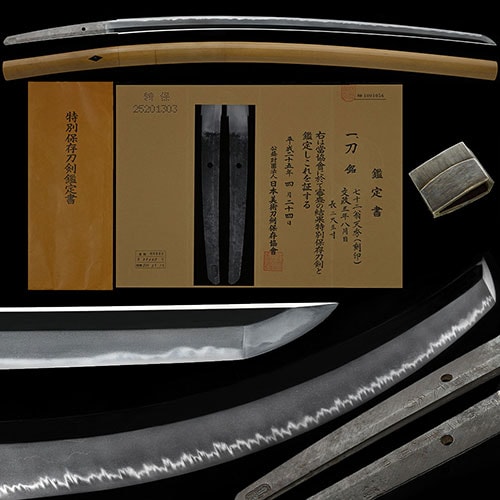
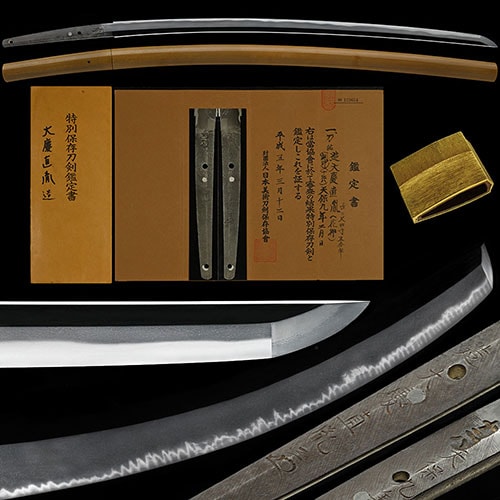
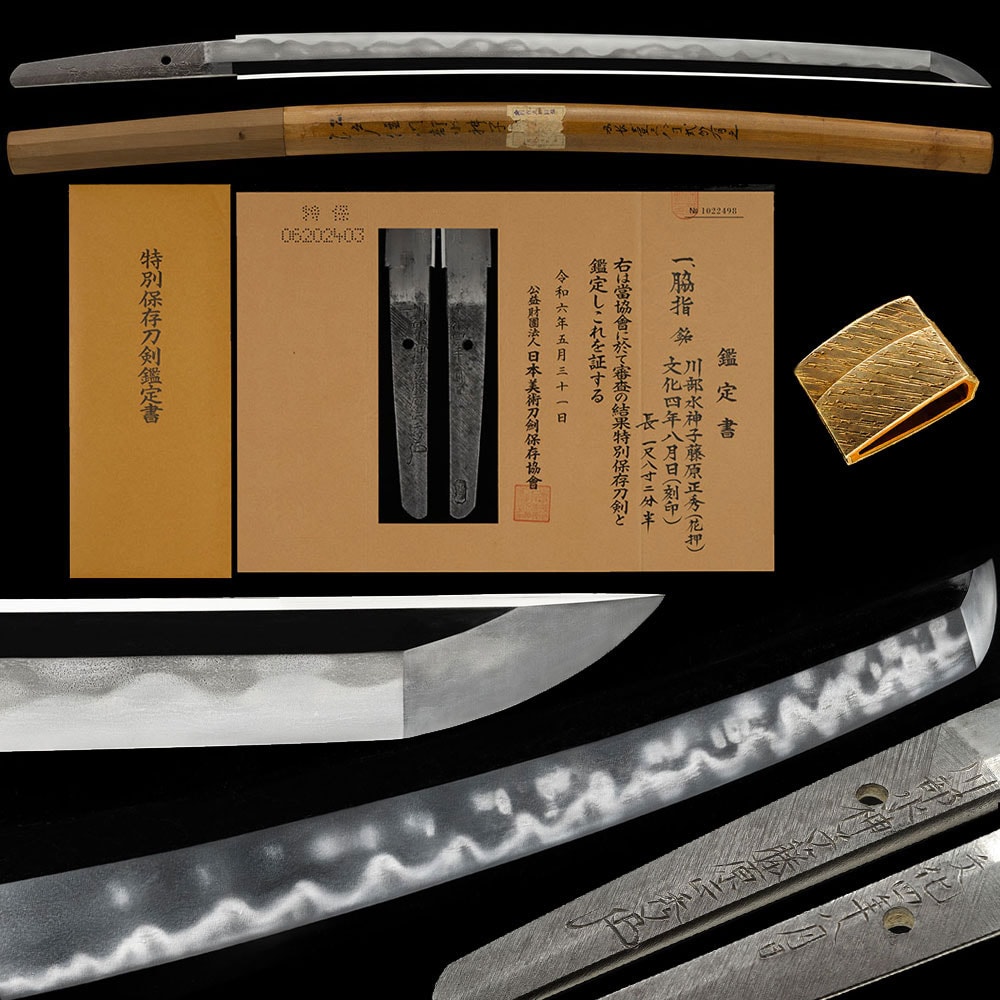
The body of his recognized record is the Bizen-den, which the published sources call far the superior of his two manners and the home of his masterpieces. Over a ko-itame that forges tightly, with ji-nie and at his best fine ji-nie gathering thickly and ko-chikei entering, he sets a choji-midare mixed with gunome, the long ashi entering vigorously and yo mingling, the nioiguchi deep with ko-nie well adhering. The boshi runs in with midare and ends in ko-maru. The sources read these as his representative work, the tachi-like shape handsome and ji and ha alike accomplished, the choji-midare skillfully tempered. On his broadest and longest late blades the temper widens and the choji crowds into juka-choji, ko-choji and gunome until the heads press together, with long kinsuji and fine sunagashi crossing the edge; the published sources note that even at great length the ji and ha betray no break, and they call such a blade the head of his Bizen-den.

Sugata 姿
Jigane 地鉄
Hamon 刃文
Bōshi 帽子

His Soshu-den (the secondary manner, rated inferior)

less firmly established

Alongside the Bizen-den the published sources record a Soshu-den, a nie-laden o-midare, and they are unusually frank about it: it leaves nothing that commands real admiration, and his superior blades are the Bizen-den works. They add that even his Bizen-den is not a complete nioi-deki in the old manner but, like the Bizen-den of other Shinshinto smiths, carries ko-nie. This phase is asserted by the sources rather than illustrated in his masterpiece record, and is therefore marked at medium confidence; it matters as the half of his output the judges set explicitly below the choji-midare for which he is known.

Hamon 刃文
Scholarship

The published sources divide his work into a Bizen-den and a Soshu-den and judge the Bizen-den far the superior, holding his masterpieces, while the Soshu-den, a nie-laden o-midare, leaves nothing that truly commands admiration; they add that his Bizen-den is not a complete nioi-deki but, like other Shinshinto Bizen-den, carries ko-nie.

The published sources record his massed juka-choji in the words of the Shinto Mei Shuroku, that his choji-midare heaps up like double-cherry blossoms, and read in the angular choji heads, the way the temper heads press together and the choji ashi open left and right within the edge, the hand-habits of this smith.

Designations

Kokuhō—
Jūyō Bunkazai—
Jūyō Bijutsuhin—
Gyobutsu—
Tokubetsu Jūyō—
Jūyō Tōken5

Elite Standing

0.03 across 5 designated works

Top 25% among smiths

Blade Forms

Distribution across 5 ranked works

Signatures

Signature types across 5 ranked works

Currently Available

Suishinshi Masahide School

Other artisans of the Suishinshi Masahide school

  1. 1.Naotane直胤14 for sale40designated
  2. 2.Masahide正秀10 for sale28designated
  3. 3.Sukemasa助政1 for sale8designated
  4. 4.Jirotaro Naokatsu直勝1 for sale6designated
  5. 5.Masatsugu正次4designated
  6. 6.Tsunatoshi綱俊5 for sale3designated
  7. 7.Masamori正守1 for sale3designated
  8. 8.Masanao昌直2designated
  9. 9.Masaaki正明3 for sale1designated
  10. 10.Munetsugu宗次1designated
  11. 11.Naokatsu直勝1designated
  12. 12.Masayoshi正義4 for sale2designated