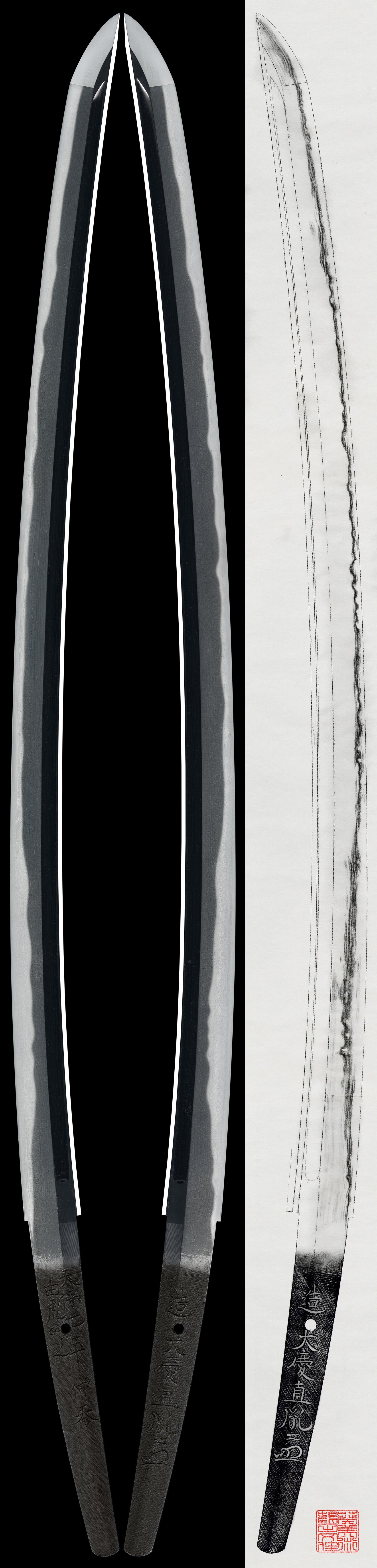
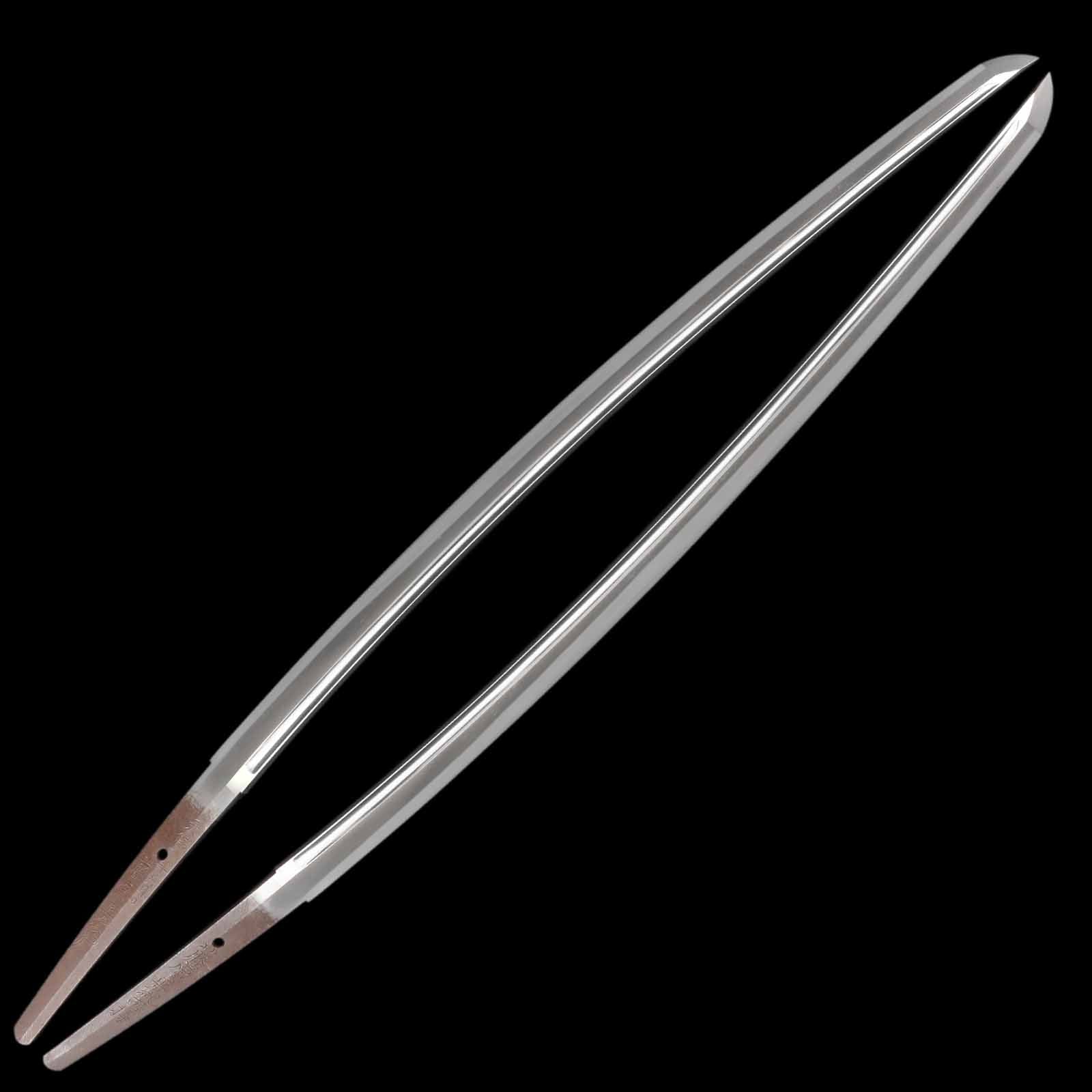
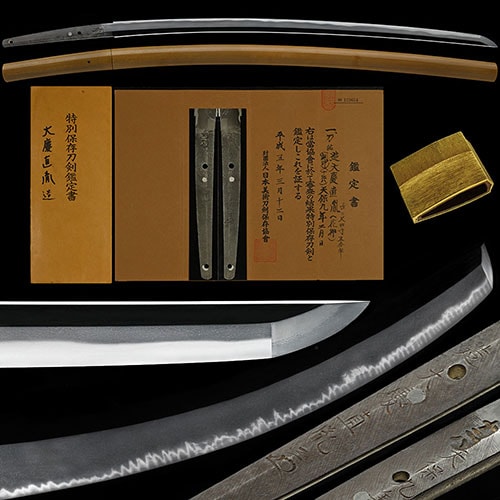
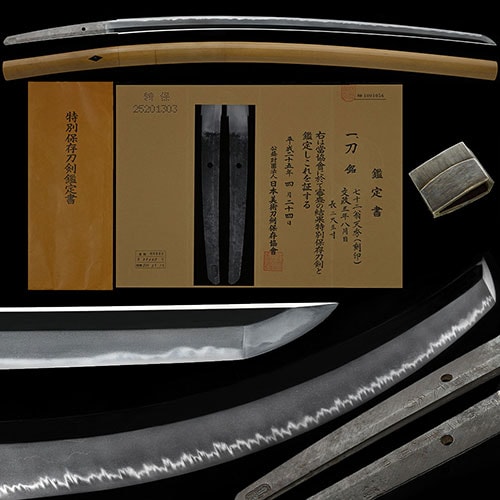
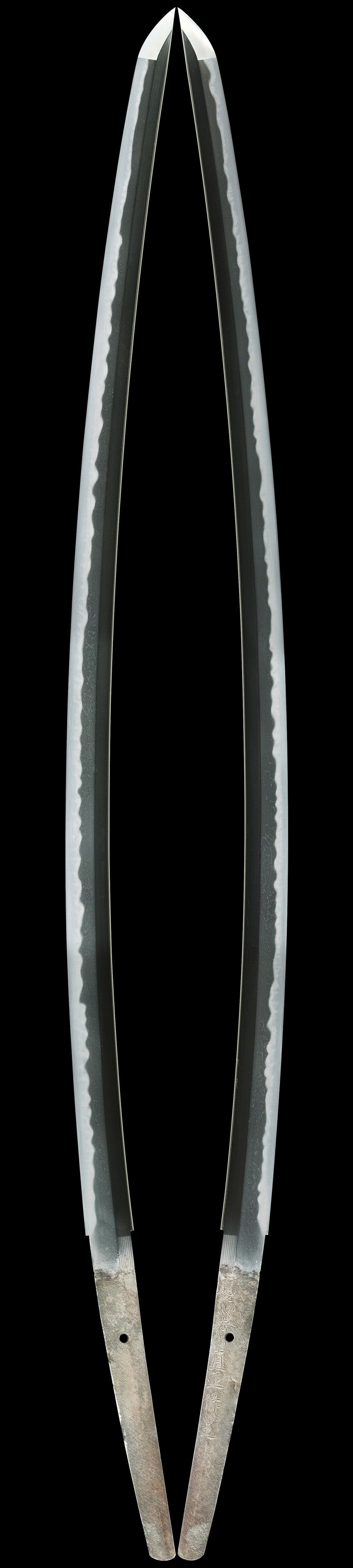
Jirōtarō Naokatsu signed Jirōtarō Naokatsu in a large six-character and dated his blades across the late- decades from Tenpō into Ansei, the earliest of the surviving designated works carrying a Tenpō 2 (1831) date and the latest an Ansei 2 (1855) one. He was a pupil of Naotane and later became Naotane's adopted son, serving the Akimoto house of Tatebayashi in Jōshū and living at Shitaya in ; he first used the name Kazusa Tarō and afterward changed it to Jirōtarō, though the published sources note that no work bearing the Kazusa Tarō signature has been observed. Through Naotane he stands in the Suishinshi line of Masahide, the central school of the revival, whose aim was the fukkō-tō recovery of the old traditions. The published sources rank him within that line as the next most capable hand after Naotane and Masayoshi, calling him plainly the smith who follows Naotane in ability and a noted master in his own right. He died in Ansei 5 (1858), the year after Naotane, at the age of fifty-four.
His most characteristic hand is a - revival modeled on the old masters, and the feature that carries it is a taken from Kanemitsu, the saw-tooth temper the published sources name when they call one 's work primarily a . Into that base he sets angular and pointed and ordinary , and the whole runs with a pervasive slant, the long entering well with intermingled. The that carries this manner is robust: a wide with thick , at the base, and an extended chū- or , so that on the long Tenpō 13 of eighty centimetres the blade has a weighty, martial presence in the hand. The published sources observe that in works of this type his is bolder than Naotane's, the growing larger, and that the slant and the large of the forging are habitual traits he shares with his teacher, what they call the points common to his Kanemitsu copies. The enters and turns with a slightly pointed tendency or a .
Beneath that temper the is the constant of the revival. He forges a that packs well, at times opening into an with areas of large and some , the lying thick and the steel bright. Over it rises the antique reflection that anchors the whole manner: a chōji-utsuri on the earliest Tenpō 14 , a standing clearly on the long Tenpō 13 blade, and on others a fainter -like effect over a tightly packed -toned . This is the old deliberately reached for, set lower and quieter than Naotane's, and it is the surest mark of his -. The is bright throughout, the long and frequent, with , fine and , and occasional small where the temper grows flamboyant. On one Tenpō the carvings turn unusual for him, a and carved down toward the tang, and the published sources read that piece as a copy directed not at Kanemitsu but at classical Nagamitsu, perhaps of a now-lost original.
The published sources divide his work in two, into - and Sōshū-den, and his record carries both faces. The - just described is his hallmark, the manner the judges set explicitly against the old Kanemitsu and beside him Kagemitsu and Nagamitsu. His Sōshū-den is the other register, and it is the one the published sources praise most highly: examining it, they say there are works in which he even surpasses Naotane. In this manner the temper opens into a flamboyant mixed with , the long entering, the attaching thickly and at places strongly so as to suggest , appearing on the back, and running, and the turning to a pointed return; the is bright and clear. One Ka'ei 5 made at Suibara in Echigo is called the blade in which he fully displays his true strengths in this manner. His carries the marks of an professional: an tang filed in with , a large six-character signature set near the , the longer signatures adding the Shōji name and the Fujiwara clan-name, at times an added note of where the blade was forged.
What sets him apart within the school is the antique colour the judges name. His - is held against Naotane's own work of the type, and the published sources call his best blade the standout among his works of that approach, judged to stand alongside Naotane's masterpieces of the manner; the difference they draw is that his is bolder and his larger, the temper set lower to evoke an older atmosphere. His own grounded tells distinguish him from the plainer hands: the taken from Kanemitsu, the that runs through half his work, the - and in the , and the bright over a thick . He carries the Suishinshi program forward from Naotane on both its sides, the revival modeled openly on the old line and the manner the judges hold to surpass his teacher, and in doing so he defines the late- revival as this school practiced it.
For the collector he is a fine late- name held within a single rank. He has no National Treasures and no Important Cultural Properties, and no ; his designated record runs entirely through the , with six blades raised to that rank across sessions from the eighteenth in 1969 to the sixty-eighth in 2022, every one of them a signed and dated . Fujishiro rates him Jō- and the Tōkō Taikan values his work at the upper-middle of the field. The recorded blades stay in private hands, the older designations passing through named private owners rather than through museums or shrines, and none carries an old . Because his whole surviving designated record is six signed , a Naokatsu of this quality comes to market only seldom, a signed and dated blade by the hand the published sources rank next after Naotane, and most welcome when one of his - in the Kanemitsu manner, with its and , is the one that appears.