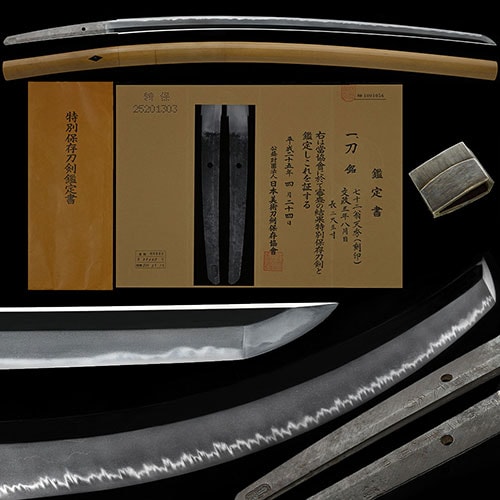
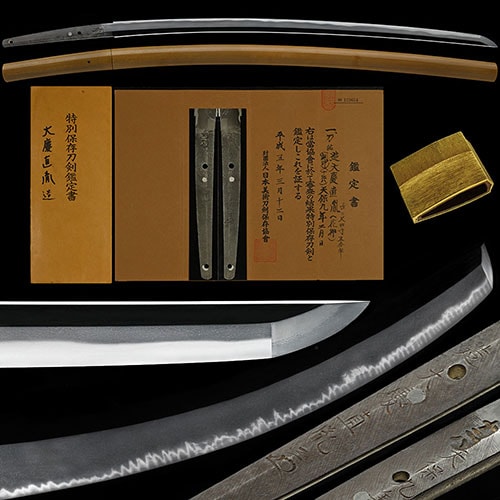
Naoe Sukemasa, whose common names were Shinpachi and Shinzo, was a swordsmith of Mito in Hitachi Province, retained by the Mito domain at the height of the new-new-sword revival. The published sources fix his standing in a sentence they repeat almost word for word across his blades: with Ichige Tokurin he was a representative swordsmith of the new-new-sword of Hitachi province at Mito. His career followed the pattern of that revival. He lived in Daimachi in Mito, went up to Osaka to study under Ozaki Suketaka, and on his return was retained, together with Tokurin, as a smith of the Mito domain in Bunka 6 (1809). He worked through the Bunka and Bunsei years, his dated blades running from Bunka 6 (1809) to Bunsei 8 (1825), and died in Tenpo 5 (1834) at the age of seventy. In Fujishiro's grading he is rated Jo-, an accomplished maker of the era, and his work survives almost entirely in signed carrying the long Mito-style signature on a healthy .
His hand resolves into two inherited manners, and the published sources state them almost verbatim from one blade to the next: his manner continues his teacher's toran-, and beside it stands a -toned temper in the manner of Inoue Shinkai, of which they write that he favored the latter, so that it is the relatively more numerous. The favored register is the one a viewer meets first. Over a tightly forged he tempers a -toned shallow , at times taking in a at the base, the deep, the small thick, the bright and clear, with entering and running through; the runs straight into a . The judges read these pieces as copies aimed straight at Inoue Shinkai of Osaka, and call the manner a success. One of his Bunka is named outright a typical Shinkai copy, and a late piece is praised as a masterwork of Naoe Sukemasa that calls Shinkai to mind. His other manner is the toran- he took from Suketaka, the regular billowing temper of the Osaka tradition descending through his teacher from the line of Tsuda no Kami Sukehiro, who founded that wave. Where a blade is read as the toran register the sources set it against the Shinkai as the named alternative rather than the workmanship he handled the more often; where they read a workmanlike they call it tempered well in a -ba.
The beneath both manners is a that packs fine and clear, with adhering finely. On his fullest pieces, the two latest dated of Bunsei 8, the forging is at its richest: the sits dust-fine and thick, fine enter well, a little moku is mixed in, and on one a water-shadow rises slanting from below the . There he starts the temper straight and runs above it the -toned shallow with long , the deep, the thick, coarse mixed in places to a slight unevenness, fine and running through, along the and a faint - on the upper half. The on these runs straight into a , returns deeply, and brushes at the point in . The deep is the constant of his work, named in every text, and on the latest pieces the judges single out the deep and the well--laden interior of the edge as the point that draws attention.
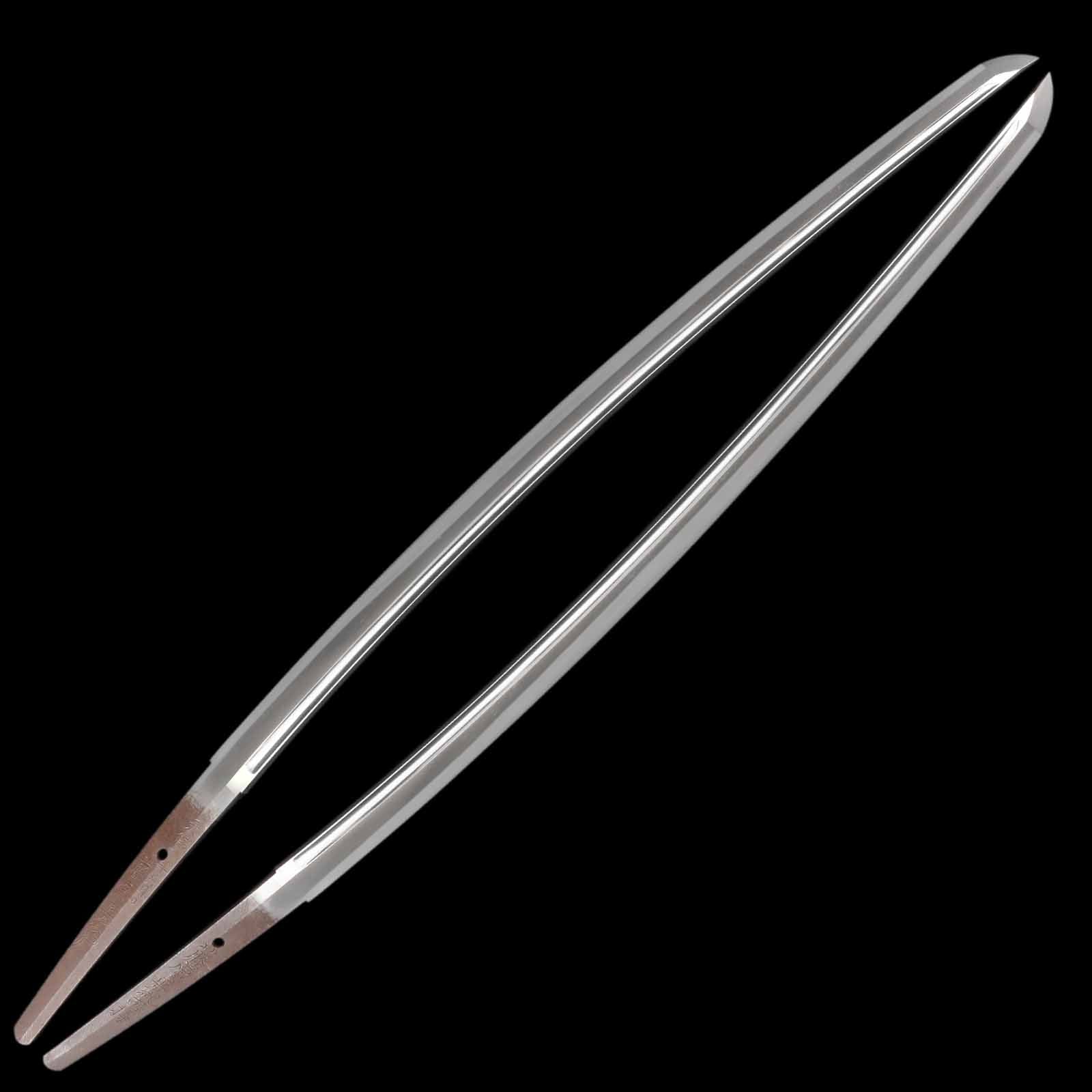
The documentary record of his blades is unusually exact, because all are signed and dated. The eight on record are all carrying a year date, so each can be placed to within a year and traced through his development. His Bunka pieces tend to the and in the Shinkai manner; his Bunsei pieces give the broad and martial late shape. The signatures themselves carry the move home: the Bunka blades sign Mito-ju Naoe Sukemasa, while the two Bunsei 8 sign Joshu Suifu-ju Naoe Sukemasa, naming the Mito castle town directly. The published sources read his late as characteristic of the province, noting that the broad, large-pointed, long and thick- martial bearing is much seen among Mito blades, and that long blades of this construction are encountered often among his own work; his longest on record passes ninety centimeters.
Within the school he is read first through his teacher and his peer. Ozaki Suketaka, named in his blades as Ozaki Gengo-uemon Suketaka and Ozaki Nagato no Kami Suketaka, was the Osaka master who himself worked both the toran- and a Shinkai-styled , and the published sources say repeatedly that Sukemasa resembles his teacher and is skilled in both. He is paired in nearly every text with Ichige Tokurin, the fellow Mito smith who studied with him under Suketaka, returned with him, and was retained beside him in Bunka 6; the two are named together as the representative new-new-sword smiths of Hitachi. His own bright and the deep of his Shinkai-styled set his work apart, the closeness of his copy to Inoue Shinkai being the recurring measure the judges apply, and his standing rests on how well he carries that Osaka manner into a Mito blade.
His blades come almost entirely with the authority of the Mito domain behind them, and several carry that history in their inscriptions. One , dated Bunka 11 (1814), bears an added inscription recording that it was forged at the Korakuen garden by the order of Yoshiatsu, son of the late lord Nariaki of Mito, a careful piece made under direct domain command. Another Bunka 11 was made on commission for Miyamoto -ichiro, who at the time served the domain as instructor of swordsmanship in the Munen-ryu. A Bunsei 8 carries a later cut-in inscription of Tenpo 6 (1835) recording that it was received in grant from the lord of Suifu, the Mito domain, a domain bestowal preserved on the blade itself. In Fujishiro's grading he is a Jo- smith, recognized among the Mito makers of the age. He holds no National Treasure and no Important Cultural Property, his eight recorded blades sitting in the tier; with their date inscriptions and full signatures they form an unusually legible body of work for a domain smith of his time. Provenance otherwise rests with the Mito domain itself and with long-private collections rather than named institutions. A signed and dated Sukemasa is held more often than traded, coming to a private collector from time to time and with patience, a clear and well-documented example of the Mito wing of the new-new-sword revival when it does.