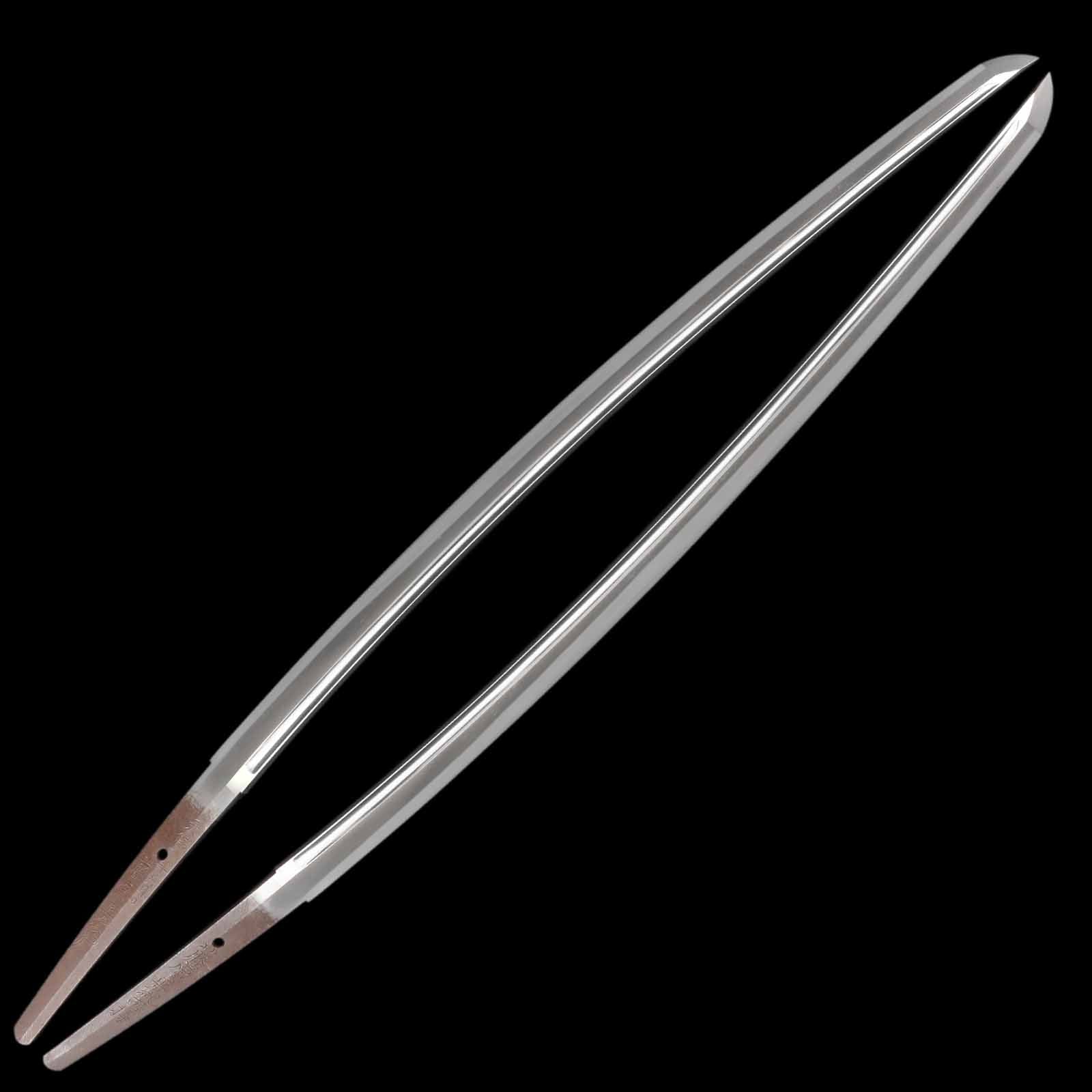
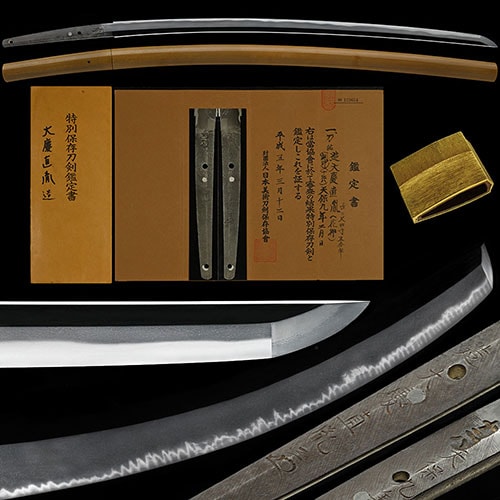
Suishinshi Masahide was born Kawabe Gihachirō in 'en 3 (1750) at Akayu in Dewa, signed first as Suzuki Takahide and then Eikoku, studied under the Shitahara smith Yoshihide of , took the name Masahide in An'ei 3, served the Akimoto house of , and later moved to Hamachō in , where he died in Bunsei 8 at the age of seventy-six after a working career of nearly fifty years. He is the founding father of the and the theorist of the revival-sword (fukko-tō) movement, the doctrine that all swords ought to return to the models. The figure who matters most in that story is the one he taught: among his many disciples stood Naotane, who gave the revival theory its actual form, and the future second Masayoshi, Hosokawa Morihide. The published sources are unusually candid about where Masahide's own gift lay, and it was not in the theory he is remembered for proclaiming.
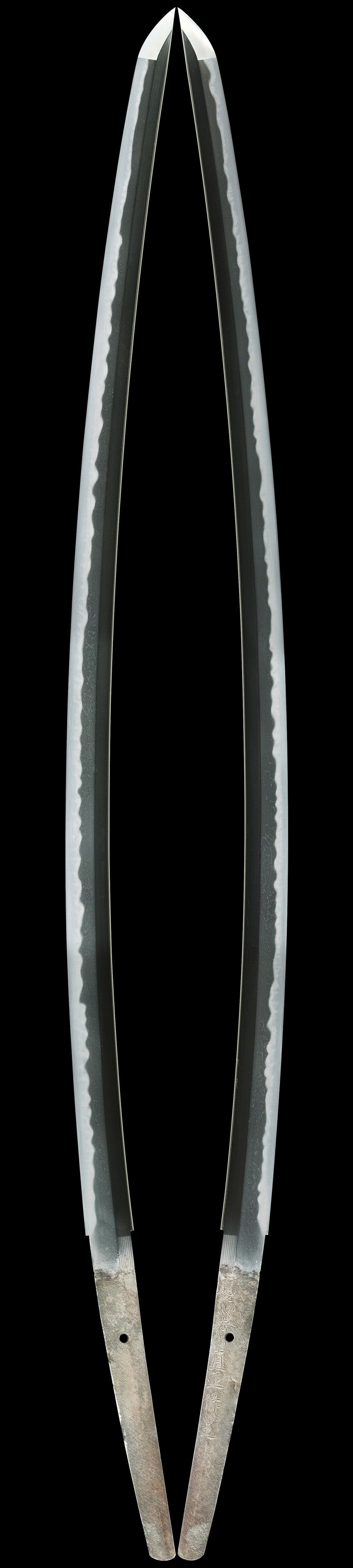
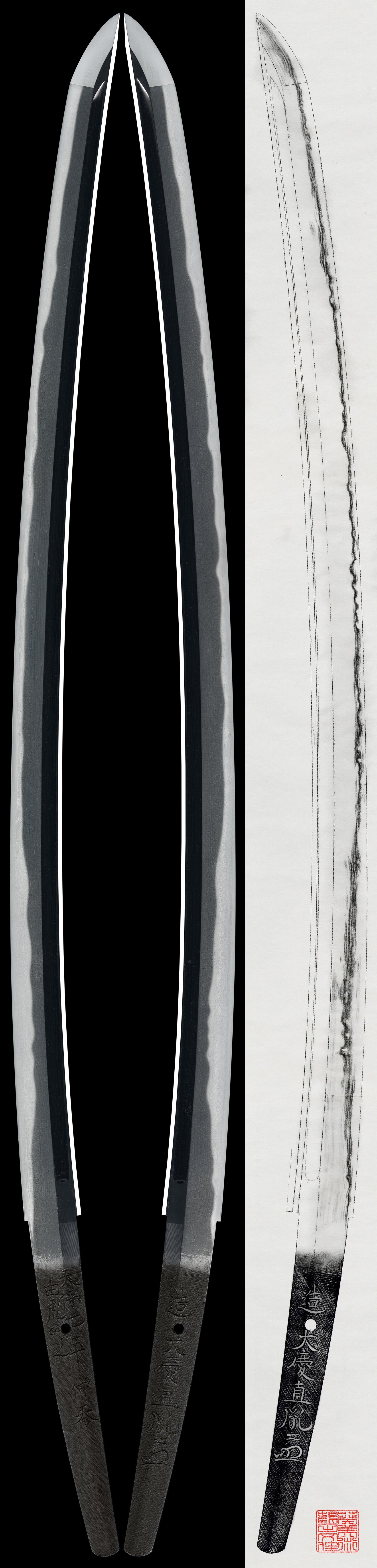
His characteristic hand is the Ōsaka-, the work he made up through his prime in private emulation of the Ōsaka masters, and the published sources call these his finest pieces. Over a tightly packed that often tightens toward a plain, near-grainless surface, with thick , he sets the surging tōran-midare of Tsuda Sukehiro, a large billowing like waves and usually opening from a long straight , entering, the deep and the bright. The other Ōsaka idiom he commands is a and broad after Inoue Shinkai and Naokai, deep in with well-adhering , and on rare occasion a manner recalling Ikkanshi Tadatsuna. The tell that betrays his hand even on his best copies is constant: a blackish, coarse-grained that spills from within the down into the . The names it on one Shinkai-target blade as a typical example of his manner in this approach, 「彼の手癖が見られる」 ("his habitual hand is revealed"), and on a Sukehiro tōran as 「これにもその手癖が示された典型的な一口」 ("a typical piece in which this habitual hand of his is shown").
The is the steady foundation of all this. It is a , finely and closely forged, frequently approaching a -like plainness, with that adheres well and, in places, somewhat clustered. The published sources praise the steel as beautiful and clear, then immediately qualify it: of his Shinkai copy they write that, fine as the is, 「黒ずんだ荒汸がつき」 ("a darkened, coarse attaches"), running 「めくらがねに近く」 ("close to mekura-gane"), the blind steel in which the does not readily appear. Over that the temper carries deep and well-adhering , often coarse, and the runs straight to a , sometimes deeply tempered and rounded, occasionally with a single -. A genuine reflection is not part of his repertoire: a is named on only one early piece, not the reliable revived his pupil would later set on the .
His record divides cleanly into two phases, and the sources let the division speak. The earlier, the Ōsaka copies, they call his strongest; the later, the fukko-tō revival of his theory years, they treat more soberly. His - is consistently shallow-tempered, a mixed with and the occasional pointed element, on one blade taking a boxed, -like with -like elements and slight . His Sōshū-den, signalled by the homage in which he styled himself "Gorō Masahide" after Gorō Masamune, runs a with over a flowing, slightly standing , entering. The honest period mark runs through all of it, for the line is never the pure of the old but carries coarse throughout. Of one Sukehiro copy a judge writes that, between the early Ōsaka work and the later revival, 「出来はむしろ前者に佳作を見る」 ("in quality the finer pieces are rather to be found among the former"). His signed and dated blades, cut in both block and cursive script and varying considerably from year to year, make him among the most exactly knowable of the masters.
What sets him apart is therefore not a problem but a candid place in the line. He is the teacher at the head of the revival, and the published sources do not flatter that role: of his and work they write plainly that 「その技は弟子の大慶直胤に及ばない」 ("his technical skill did not reach that of his disciple Naotane"). His distinction lies elsewhere, in the bright, surging tōran and the broad Shinkai of his prime, and in the coarse spilling by which a connoisseur reads his hand behind even a close Ōsaka copy. His finest copies come so near the originals that the records them as 「殆んど本科に迫るものがある」 ("all but reaching the original models"), one Tenmei piece called 「いわゆる大坂写しの僑出の一口」 ("an outstanding example of the so-called Ōsaka copy"). It is the precision of these copies, more than the theory, that the published record honours.
For the collector Masahide is a signed and dated open book rather than an attribution puzzle. Fujishiro grades him Jō-jō . He has no National Treasures and no Important Cultural Properties; his record runs instead through the rank and the prewar Jūyō Bijutsuhin, with twenty-four blades in the tier among some twenty-five designated works on the published record, all of them signed and dated across the An'ei to Bunka years. Provenance is recorded for only a few: one Jūyō Bijutsuhin of Kyōwa 3 passed through the Imperial Family and the Imperial Household before the Shiga Mutual Aid Association, and his domain service ties him to the Akimoto family of . The published commentary singles out his masterpieces by name, an early Tenmei it calls 「いわゆる大坂写しの僑出の一口」 and a rare with gold-inlaid dragon poems it ranks 「同作中の優品」 ("a superior piece among his works"); his uncommon collaborations with disciples, jointly signed with the tenth-generation Sendai Kunikane and with Hosokawa Morihide, it prizes as study material. Because he was prolific and entirely signed, a Masahide is not beyond reach as the great names are. A signed, dated example of his Ōsaka manner appears at the higher tiers from time to time, and to acquire one is to hold a document of the moment swordmaking turned back toward the old models, in the hand of the man who turned it.