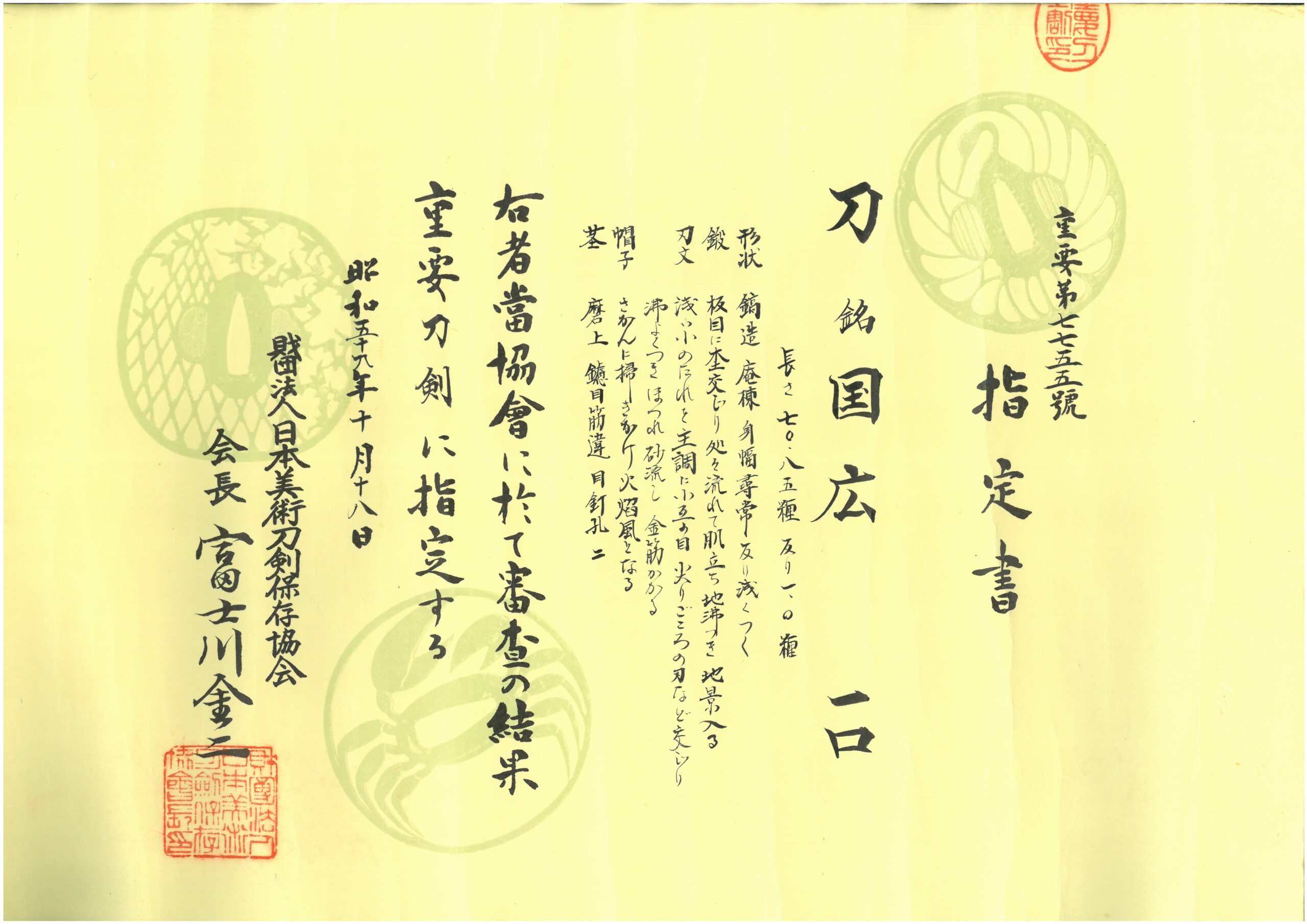
Echigo no Kami Fujiwara Kunitomo was born at Obi in and came up to the capital in the train of Kunihiro, settling at Ichijō in Kyoto, where he worked through the Keichō and 'ei years. The published record knows him as Kunihiro's pupil, by one tradition his nephew, and as the youngest of that circle, yet it is from his pupils rather than from documents that his standing is reconstructed. No work of his bears a date, and the sword books pass on little beyond his birthplace and residence. What the judges do affirm is his place in the descent of the school: because the early manner and signatures of Izumi no Kami Kunisada and Kawachi no Kami Kunisuke so closely resemble his own, the published sources conclude that "their direct instruction was clearly carried out by Kunitomo". He is thus the hinge of the line, the man who taught the two smiths from whom the great Osaka tradition would descend.
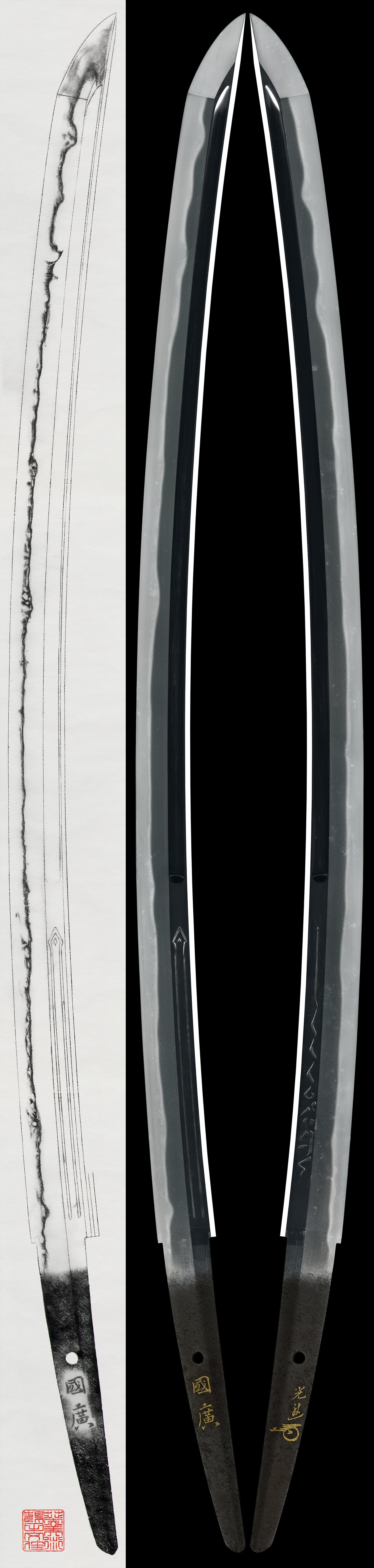
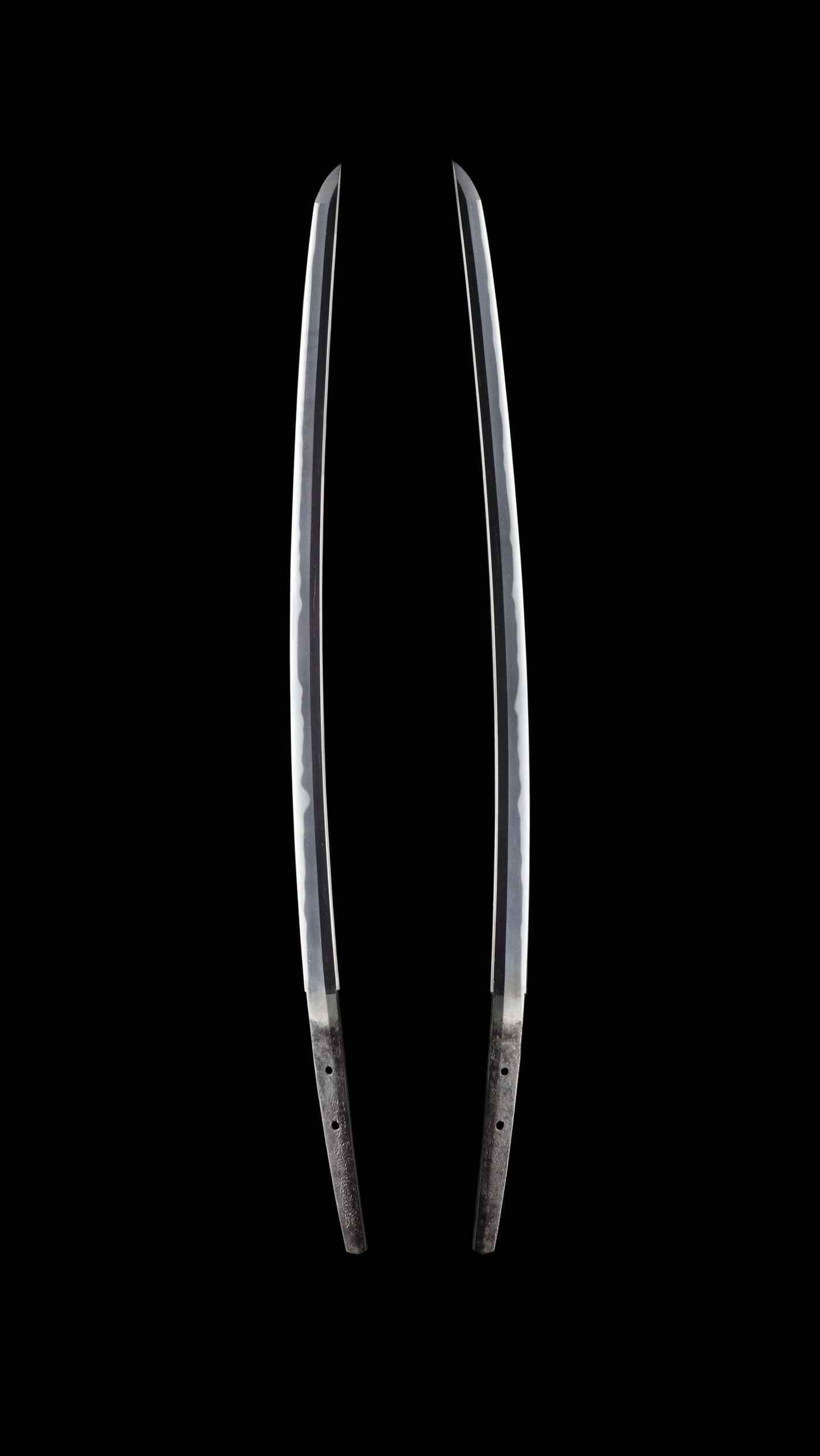
His characteristic hand is the exception within his own school. Where most work takes the superior masters and Sadamune for its model, Kunitomo turns instead toward late . Over a notare base he sets round-headed , pointed and , and the tightens and sinks rather than opening bright, with that gathers at times coarse, running through, and long entering. The published sources name this their point of recognition for him: it is, they write, "the hallmark of Kunitomo to show, at a glance, workmanship reminiscent of late Seki, and of Kanenoshita above all". The follows the quiet logic, a shallow turning with and a deep return.
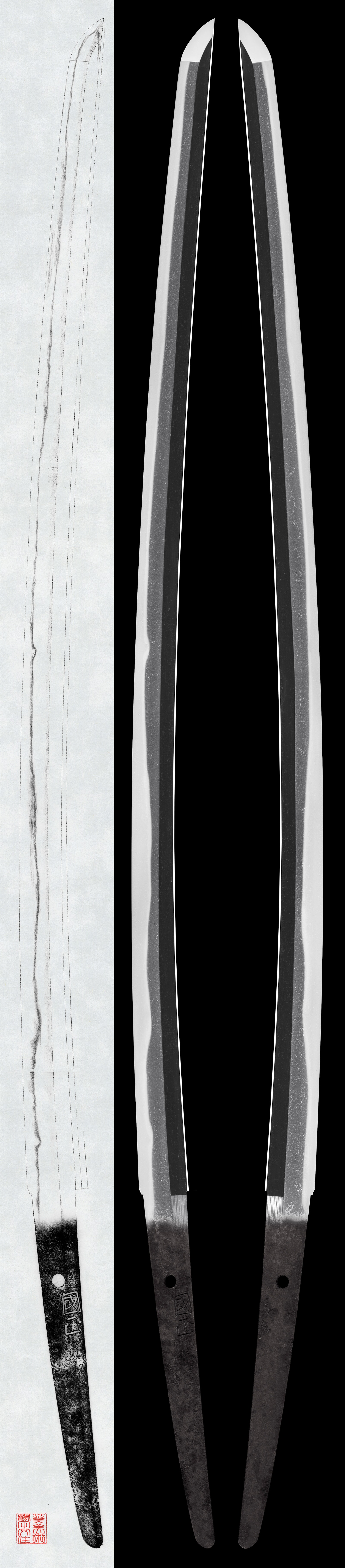
The comes in two modes, and the judges are careful to distinguish them. One is the standing, dry the whole school shares, mixed with and flowing grain, coarse in the manner, with and ; the other is a tightly consolidated , clean and beautiful even by standards. The sinking is the constant across both, so much so that when one departs from it the change is worth remark, the published commentary singling out a blade in which, against the subdued temper usual to his work, "the brightness of the is especially noteworthy". His carry the coloration more strongly still, often in or shapes with su- and carved into the base.
Within this one hand the published sources read two registers. The prime is the late-Seki manner just described, and it reaches its clearest statement in a that copies, down to its compact one-handed tang and , the shape of the late , from which the judges venture that "it may well be imagined that Kunitomo's ideal lay in Kaneshiba". Beside it stands a calmer register in a wide over the tighter , gentle and dignified, that approaches his teacher; one of this kind the commentary calls a masterpiece among his works, sound in both and . His signature is itself a point. He invariably cuts the seven characters and, as the sources note, "signs them without fail in seven characters, and no dated work is seen", the chisel slightly distorted and growing larger as it descends.
What sets Kunitomo apart from his fellow smiths is therefore not refinement of the copy but the strain he carried alone, and the precision of his chisel. Among the whole group, the published sources observe, "his is the finest chisel", and where his fellow for Kunihiro, Ōsumi no Kami Masahiro, often cut a long tang, Kunitomo by contrast left works in which "the tang length is somewhat compact". The contrast is a working connoisseur's tell. His calm wide- pieces are held apart from the school by the cleanliness of the ; his sinking, -tinged ones, by the round-headed and tight that no copy would show.
For the collector Kunitomo is a substantial but rarely traded name. Fujishiro grades him Jō-jō . He has no National Treasures and no Important Cultural Properties; his record runs instead through the modern designation tiers, three at and some twenty-three at , together with a prewar Jūyō Bijutsuhin once owned by Kishimoto Kannosuke of Kyoto. His blades are held in long-private hands, among them the Ikeda house, from whom one descends. Signed works by him are not plentiful, and a designated example reaches the market only seldom, the more so because his finest pieces are held rather than traded. When one does appear it is a document of the school at its hinge, the work of the quiet teacher who stood between Kunihiro and the founders of Osaka .