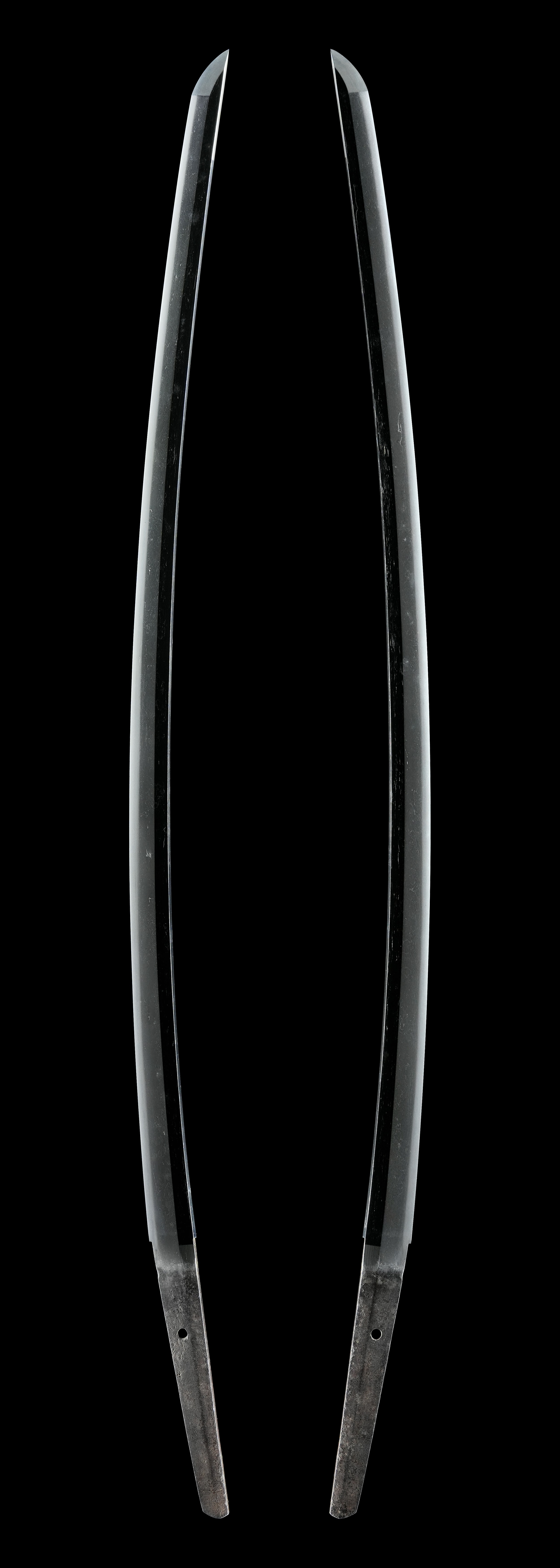
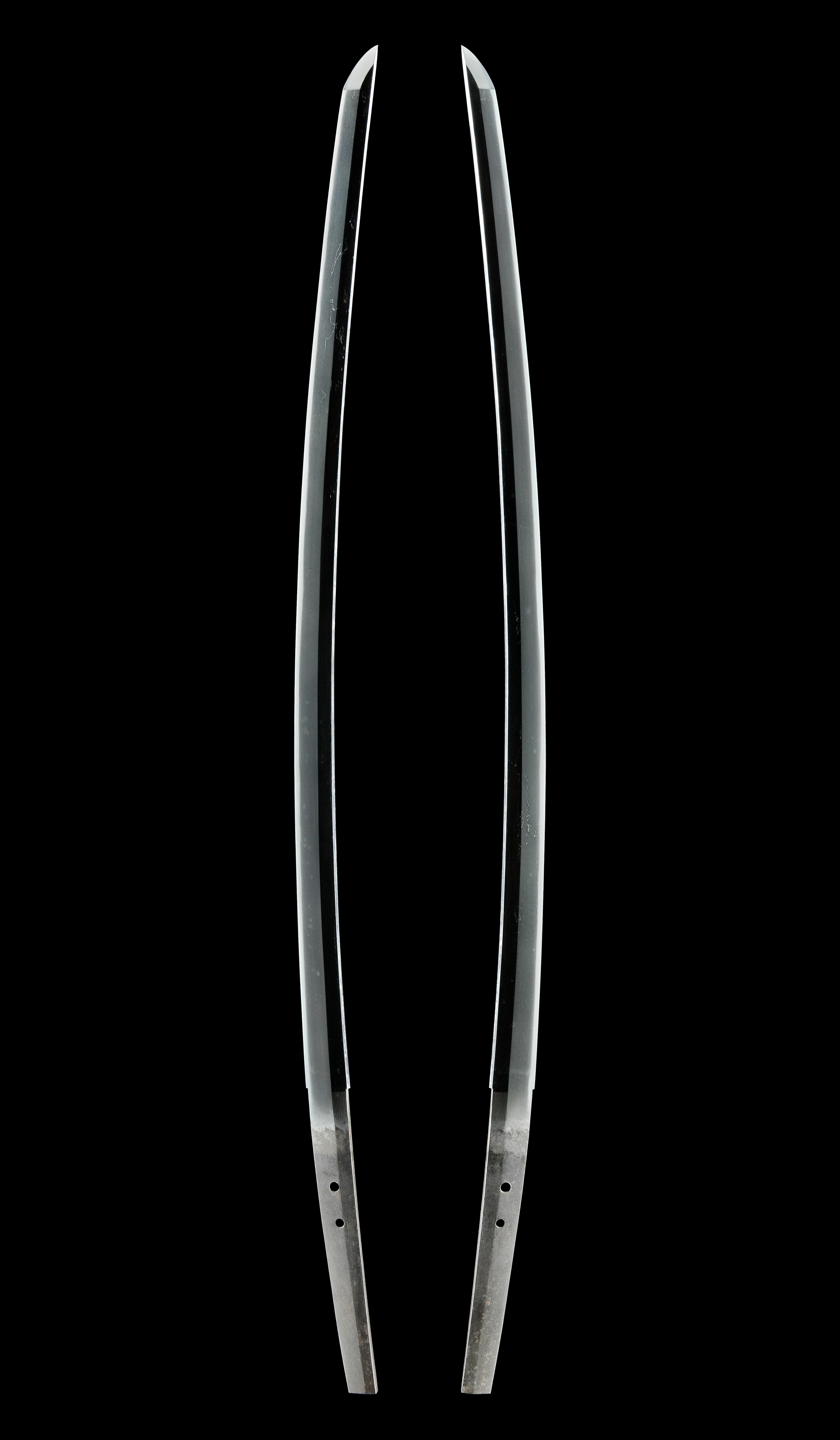
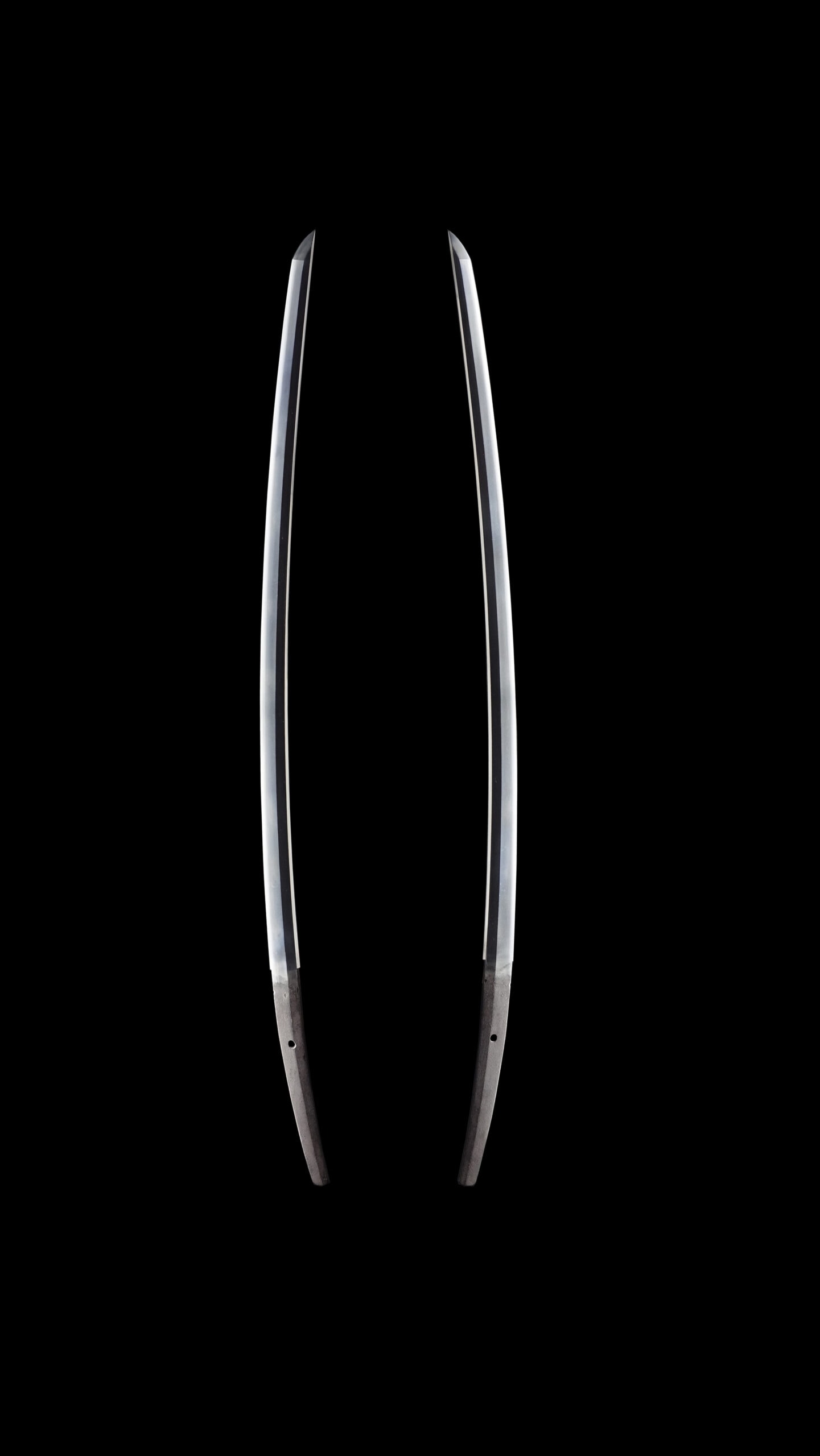
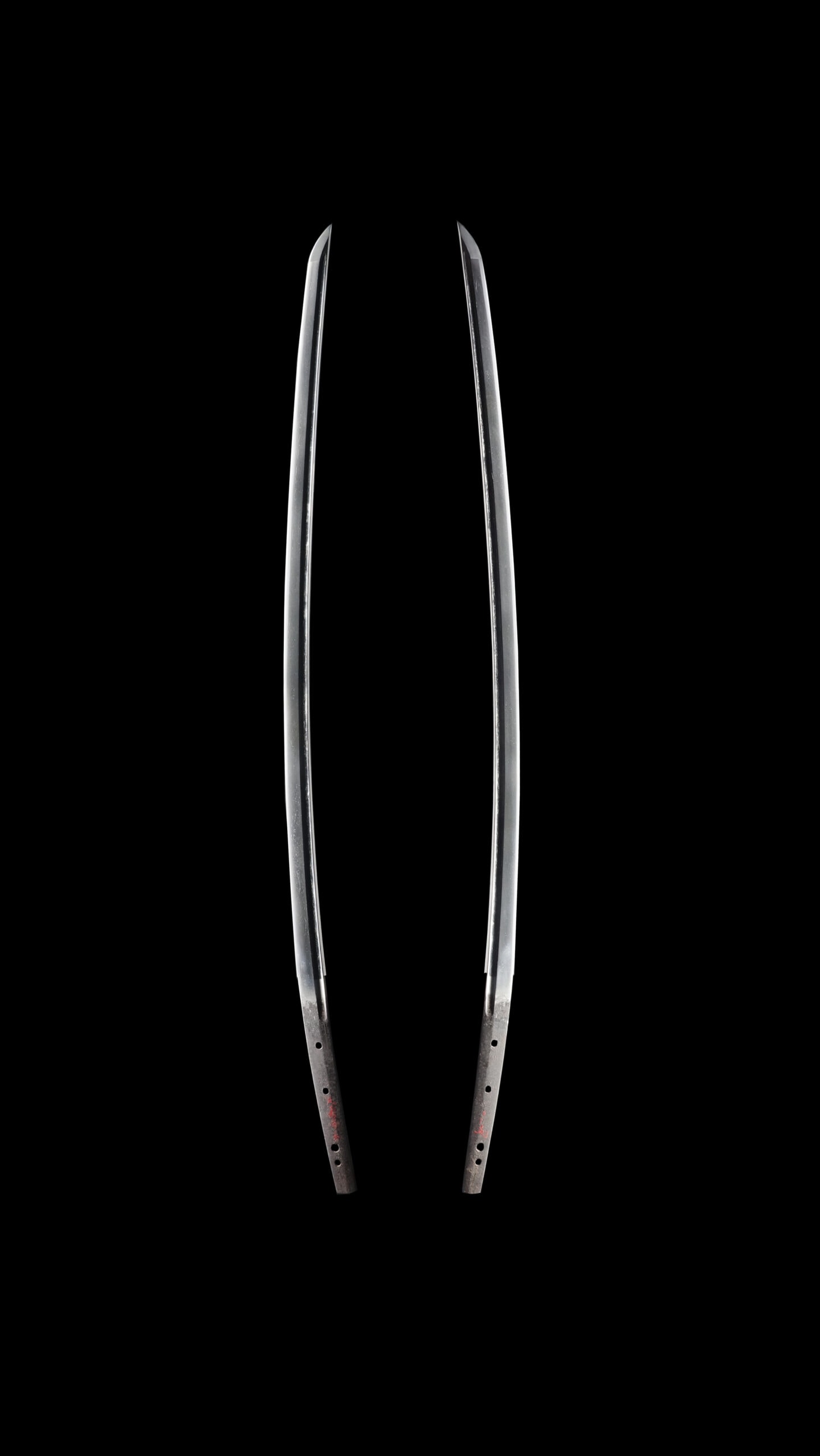
The divided-courts war impoverished the court society that had sustained Kyōto’s most refined work. With the last Rai masters the classic line effectively closed, while Hasebe and Nobukuni carried the new Sōshū manner into the capital.
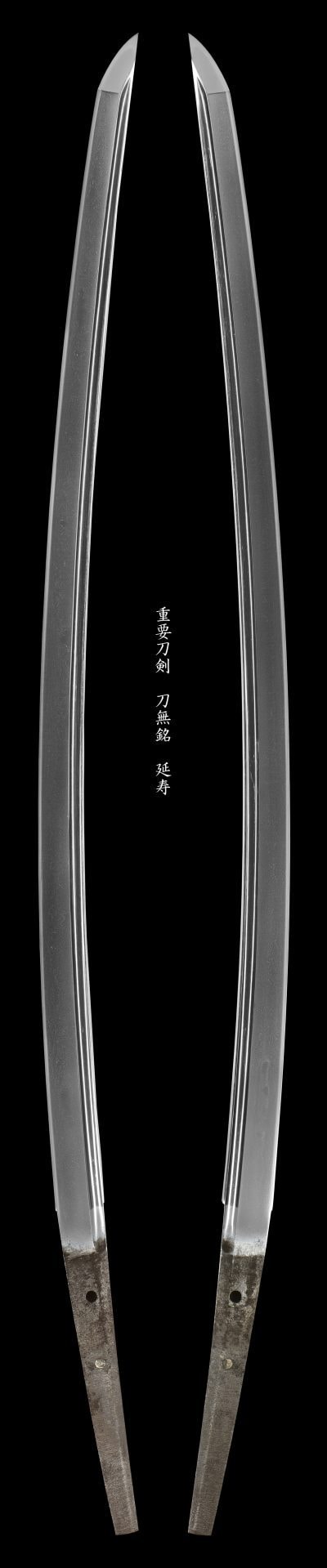
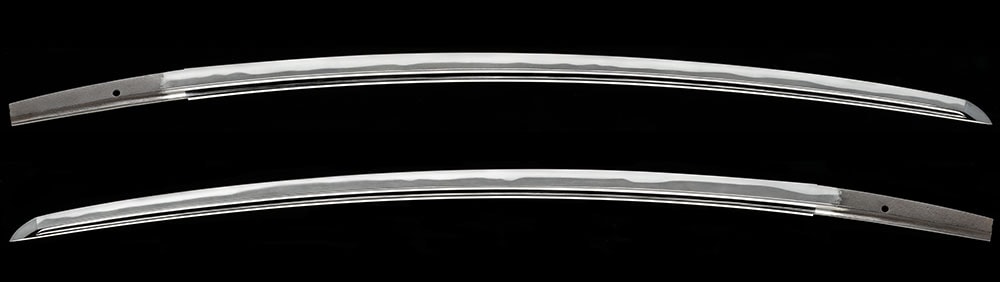
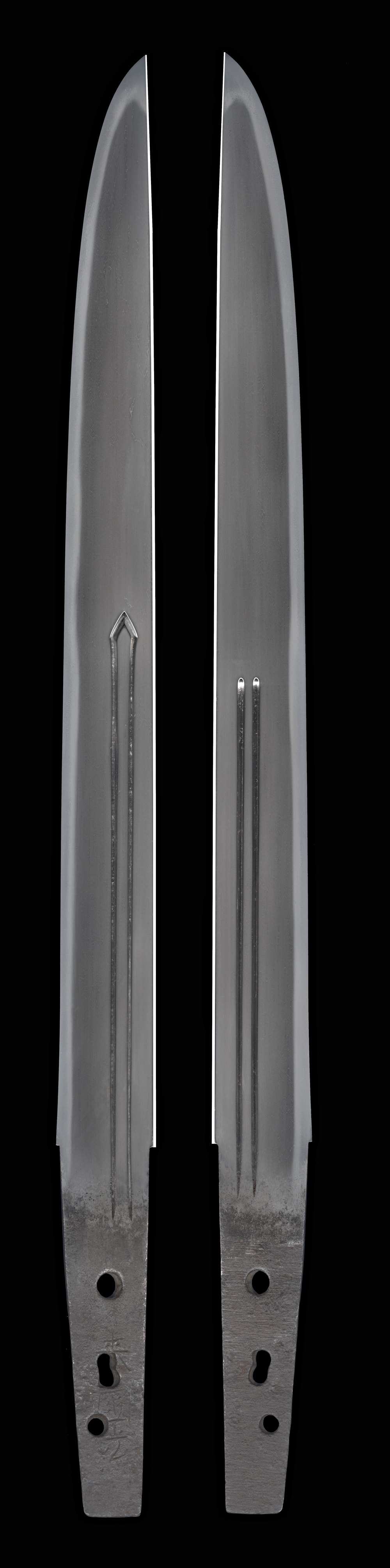
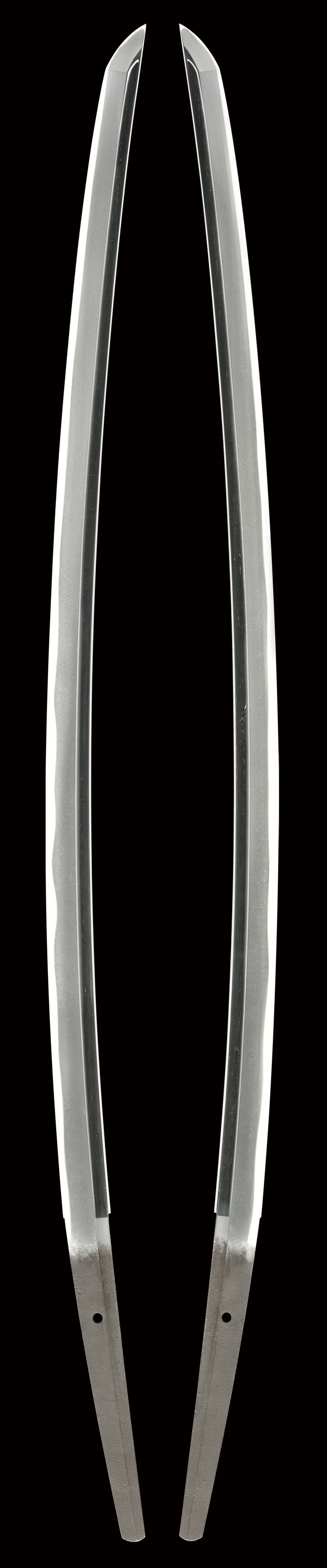
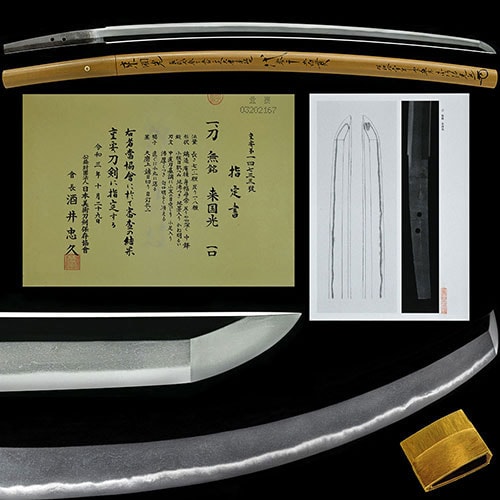
This listing features a katana by Kunitoki, bearing a gold powder inscription (kinzogan-mei) by Hon'ami Koson. The blade is from the Nanbokucho period, specifically around the Kenmu era, and originates from Higo Province. It is described as an O-wazamono, indicating its exceptional cutting ability.
 NihontoWatch
kinzogan-mei · Kokoku (1340-1346)
Yamashiro-den · Higo · around 1340-1346
Fujishiro Jo saku · Tōken Taikan top 10%
2 pieces on the market now
Yamashiro-den · Higo
22 pieces on the market now
Among the provincial lines that carried the Kyoto manner beyond Yamashiro, the Enju (延寿) school of Higo province grew up at Kumafu in the Kikuchi District, working from the close of the Kamakura period through the Nanbokuchō era. Its founder, Tarō Kunimura, is transmitted in the prevailing account as the son of Hiromura of the Yamato Senjuin line, who married a daughter of Rai Kuniyuki of Yamashiro; by that marriage Kunimura is held to be Kuniyuki's grandson in the female line and a pupil of the Rai workshop (one early text instead places him in the gate of Rai Kunitoshi). The school name reads on the same characters as the Rai line itself, and from that double descent, Yamashiro through the Rai marriage and Yamato through the Senjuin side, the family took its character. Around the founder a cluster of named smiths arose almost at once, Kuniyoshi, Kunitoki, Kuniyasu, Kunitomo, Kunisuke, Kuninobu and Kunitsuna among them, the Enju line attached to the Kikuchi clan and loyal to the Southern Court, so that the dated blades carry that history in their Southern-Court eras. The published sources describe Enju work as one that broadly resembles the Rai school[[c:1]], refined in suguha yet cooler and whiter than its Kyoto parent, and they name the provincial accents by which the two are separated. The forging is an itame or closely packed ko-itame that flows toward the edge into masame, the grain standing a little, with fine ji-nie laid on and delicate chikei entering; over it rises a whitish shirake-utsuri, the surest single Enju tell, the cool reflection of a Kyushu steel that is not quite the bright Rai jigane. The temper is a chū-suguha or narrower hoso-suguha, the nioiguchi carried somewhat shizumi (sunken and quiet), often breaking into nijūba, the doubled line that recurs across the line; ko-ashi, yō, ko-nie, fine sunagashi and kinsuji play within it, the activity gentler than the brighter Rai suguha. The bōshi turns back on a larger radius than Rai's tight ko-maru, a shallow ō-maru with a short kaeri.
The signature is a tool of attribution: across the line the right half within the kuni (国) enclosure is cut in an ear-shaped form, a calligraphic habit the sources say cannot be confused with another school. Against true Rai, the school is read by its masame-lean, its whitish utsuri, its sinking nioiguchi and its quieter internal work, the ji and ha running a degree softer than the Yamashiro line. To kantei an Enju blade is to weigh those provincial accents against the Rai air it carries: a wheel-like wa-zori and Kyoto refinement may recall the parent at a glance, but the nagare in the ji, the shirake-utsuri, the subdued nioiguchi and the ear-shaped kuni settle the attribution, and the level of the work then narrows it to a hand. The founder Kunimura sets the quiet register and signs the slender, sharply tapering tachi the sources call distinctive even within the school; among the later smiths, Kunitoki survives in relative number and runs his suguha the busiest with ko-gunome and kinsuji, Kuniyasu is the most nie-laden and brightest, Kunisuke cuts the boldest chisel and hardens a unique flaming bōshi on his wide pieces, while Kuniyoshi, Kuninobu and the various other Kuni- smiths work the same vocabulary, the best of them refining the steel to a clarity that escapes the school's whitish thinness. The corpus runs mostly to slender signed tachi and to ō-suriage mumei katana attributed on appraisal, with broad sunobi tantō in the Nanbokuchō phase, the work confined to long blades in the founder's case. Provenance is unusually grand for a provincial line: blades pass through Toyotomi Hideyoshi and Tokugawa Ieyasu and rest in the Hosokawa, Date, Uesugi, Owari and Mito Tokugawa houses, with examples held today by the Sano, Tokugawa, Seikadō and other institutions. A signed ubu Enju tachi is among the rarer encounters in Higo work; most survive as the mumei attribution, held as heritage rather than offered. Learn more →
| Smith | Era | Designated |
|---|---|---|
| Kunimura國村 | 1275-1278 | 15 |
| Kunitoki國時 | 1317-1353 | 32 |
| Kuniyasu國泰 | 1329-1331 | 17 |
| Kunisuke國資 | 1346-1370 | 22 |
| Kunitoki國時 | 1275-1278 | 7 |
Yamashiro in the Nanbokuchō period
The divided-courts war impoverished the court society that had sustained Kyōto’s most refined work. With the last Rai masters the classic line effectively closed, while Hasebe and Nobukuni carried the new Sōshū manner into the capital.
We could not find an authenticity certificate on the seller’s listing. Japanese swords and fittings are normally papered by the NBTHK (or the NTHK). Without one, the attribution is the seller’s own assessment and has not been independently verified — treat it with caution and ask the dealer about certification before buying.
If, due to our fault, the item differs significantly from its proper condition, the item may be returned. Cooling-off is within one week of the item's arrival.
¥2,700,000