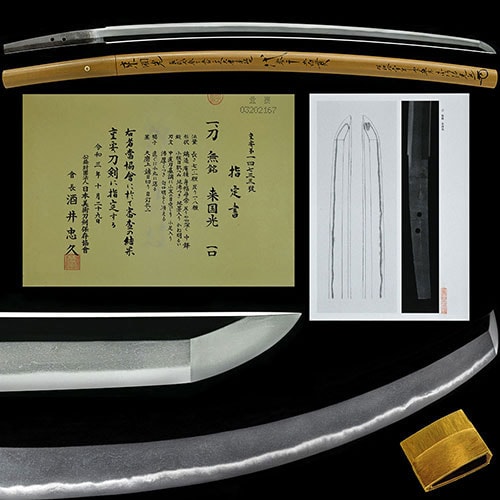
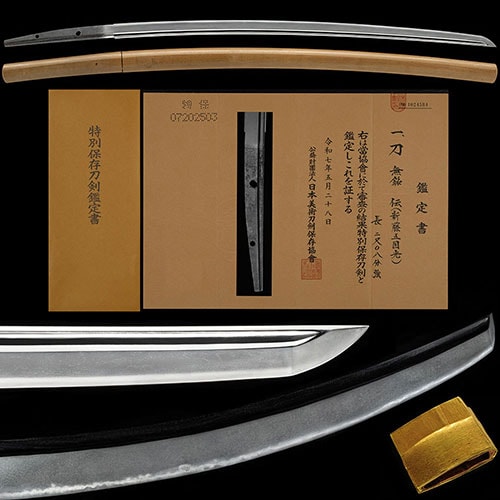
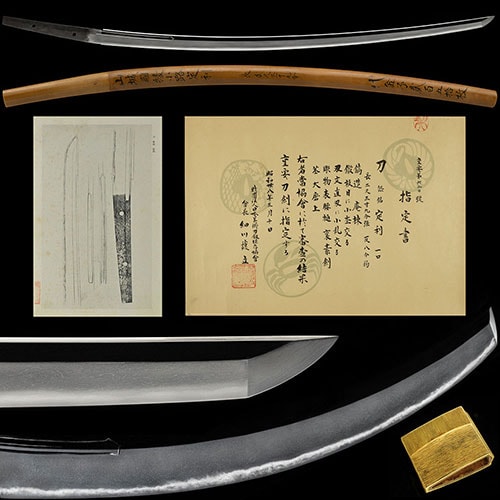
A single dated work anchors the two-character Kunitoshi in time: a inscribed in Koan 1 (1278), designated an Important Cultural Property and preserved in the Tokyo National Museum. Its maker, Kunitoshi of Yamashiro, cut his name in two characters only, without the character , and the published sources accordingly call him Niji Kunitoshi, the two-character Kunitoshi, to part him from the smith who signed Kunitoshi in three. He is traditionally recorded as the son of Kuniyuki, and of the mainline he stands closest to his father, down to details of forging and carving that the designation records trace from one hand to the other. He worked at the school's grand mid- moment, and whether he and the three-character Kunitoshi are one man or two remains the classic question of the school, carried in nearly every published entry as an open verdict.
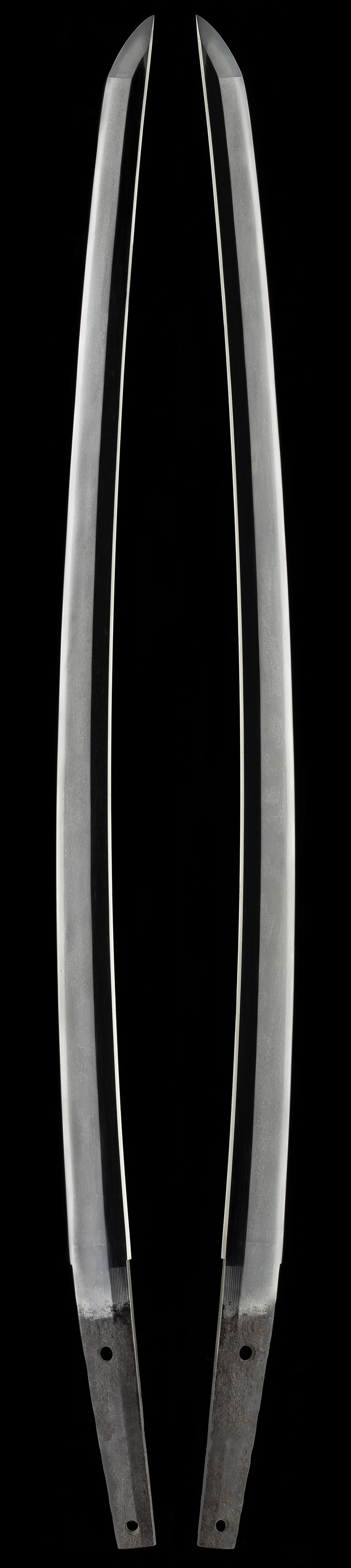
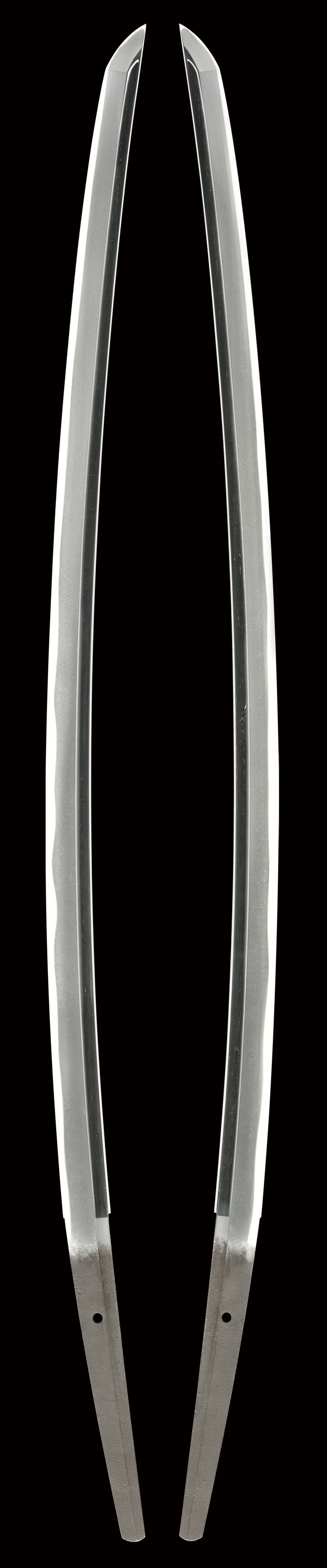
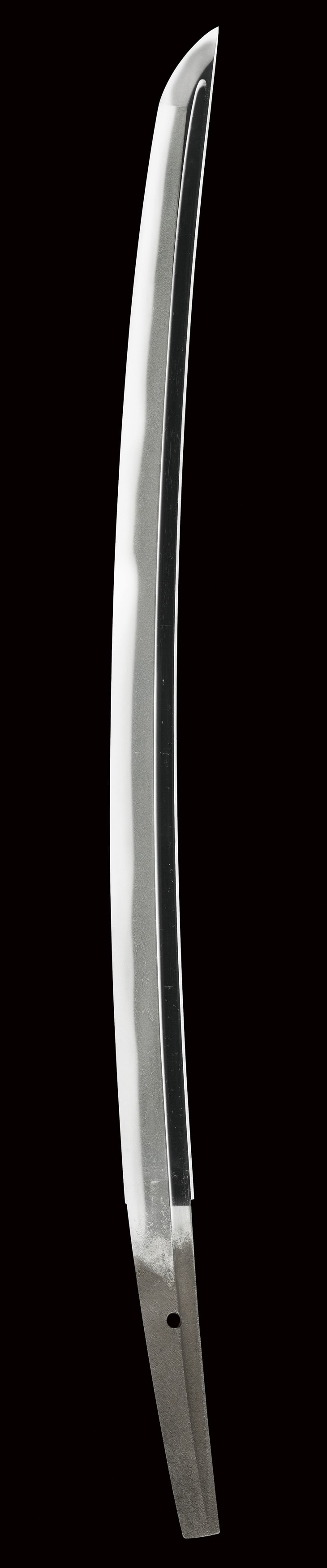
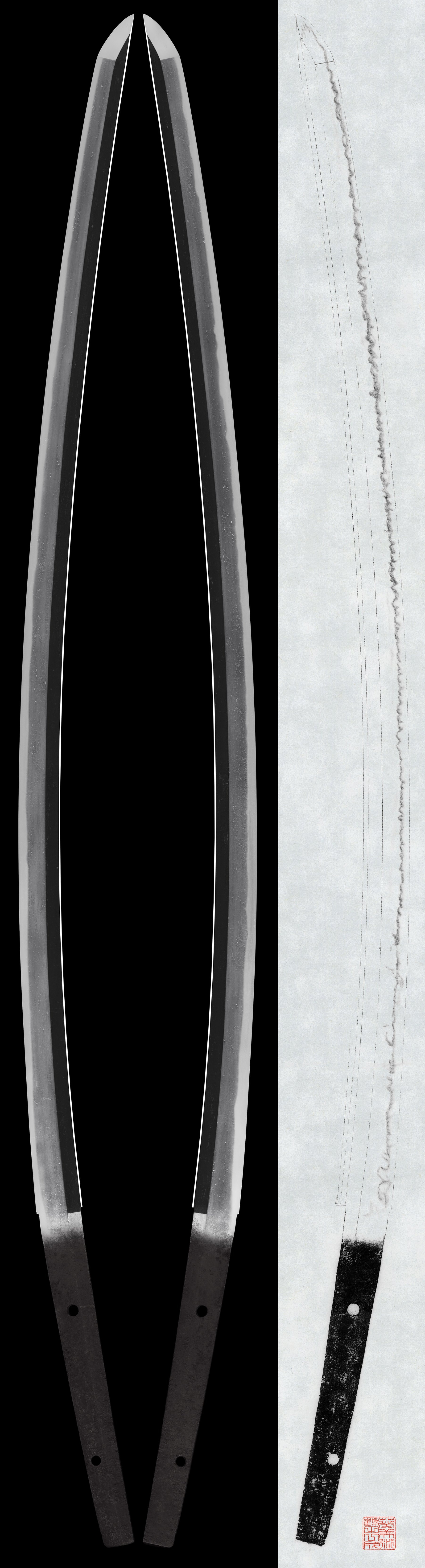
The hand the published sources describe as typical is the most flamboyant in the mainline. His blades run wide in with little taper from base to point, the thick, the curve a deep wa-zori, the point a compact, stout . Over this powerful build he burns a -dominant in , so showy that the records repeat the verdict of the old books that it "resembles the ". and crowd into the , and stream through it, and plays at the heads of the . Patches of lie along the back, a feature one entry names a habit of the hand. The Kyoto marks are stated just as plainly: the within the is markedly strong, the stated point of difference from ; the that rises is, as a rule, a ; and the , chiefly on the wearing side, slant back toward the , opposite to the direction, the so-called kyo- (京逆足).
The is in his father Kuniyuki's manner, an of comparatively large texture with a tendency to stand, under laid thick and fine , the steel bright. Beside the usual a rises on occasion; one entry notes a accompanied by a dark band as a rarity otherwise confirmed on signed works of Kunitoshi and Ryokai, so that even his exceptions stay inside the school. On the flamboyant works the runs in , sweeps in , and often finishes near with considerable force, while the calmer works settle into a quiet . Most blades carry , and on more than one the groove at the holds a in relief, a carving the published sources point out exists in the form on work of Kuniyuki.
Signed works are comparatively few, and nearly all of them are . The published record long repeated that his came to "merely one piece", the Aizen Kunitoshi, an Important Cultural Property, until a second signed was recognized at the 61st session and later raised to , its signature judged on the close likeness of the character for to the dated Koan 1 . It is on the signed blades that a second, quieter register concentrates: a chu- or with and over a tight with dust-fine , the a calm . The sources read a from the Kishu Tokugawa house as showing "a workmanship close to Kuniyuki", judge the of the Owari Tokugawa "hardly different from Kunitoshi", and call a signed in true "precious material" should the one-smith theory be argued. The scholarship turns on exactly this. The dated examples of the two signatures span Koan 1 to Genko 1, about forty years, no impossible working life for a single smith; counted back from the Kunitoshi dated Showa 4 (1315) with an age of seventy-five, the man would have been thirty-eight in Koan 1. Against this the Kaifunki draws the line another way: "the two-character Kunitoshi was Kuniyuki's heir and died young; Kunitoshi was the second son, and from him the cutting of the character began". The most recent designation entries record that re-examination of workmanship and signatures has lately revived the one-smith view, prompting, in their words, a reconsideration of the two-smith position.
Against the , the smiths his work most resembles, he is told by his own marks: the strength of the within the , the rising as a , and the kyo- slanting toward the . One entry states the position from inside the school, placing him in a working range that, within the school, can pass among the showy productions of the and . His place in the lineage is double. Upstream he is the nearest of the smiths to Kuniyuki, sharing the standing , the and the carving in the groove; downstream his calm signed flows directly into the refined manner of the three-character Kunitoshi. Brother, father or the man's earlier self, he is the bridge over which the school's grand mid- style passes into its late- refinement.
Fujishiro grades him Sai-jo , the highest rank. Eighty-four designated works stand on record: twenty-one and forty-eight , sixty-nine blades in those two tiers together, with nine Bijutsuhin and four Important Cultural Properties above them, among the last the Aizen Kunitoshi and the dated Koan 1 of the Tokyo National Museum. The Torikai Kunitoshi, a of one nine nine listed in the Meibutsucho, passed to the Owari Tokugawa after the death of Tokugawa Ieyasu and is held by the Tokugawa Reimeikai Foundation. The provenance roll is substantial: nineteen blades carry recorded histories through the Owari and Kishu Tokugawa, the Maeda, Hosokawa, Uesugi, Date, Asano, Yamauchi, Hachisuka and Matsudaira houses and the Imperial Family, one Owari blade entering the registers as a Suruga Tokugawa distribution piece ranked in the house's highest group (仁壹ノ廿), with of Genroku and Hoei attached to others. His Important Cultural Properties are patrimony, preserved in the Tokyo National Museum and in long-held collections, and of the remainder the recorded whereabouts run heavily to institutions and old families. For the private collector the realistic field is the and tier, some sixty blades that can in principle change hands; in practice they are held far more often than they are traded, and a two-character Kunitoshi coming to market is a rare event, standing at the very top of the field when it does.