NihontoWatch MonNihontoWatchBETA
MarketEncyclopedia
NihontoWatch Mon

NihontoWatchBETA

Market
Encyclopedia
Overview·Kantei·Designations·Provenance·Blade Forms·Signatures·School
OverviewKanteiDesignationsProvenanceBlade FormsSignaturesSchool
  1. Schools
  2. Enju
  3. Kuniyasu

Enju Kuniyasu

國泰

Tokujū
Vol. 24, No. 65 · Tantō

Enju Kuniyasu

國泰

17 ranked works

ProvinceHigoEraGentoku (1329–1331)PeriodKamakuraSchoolEnjuTraditionYamashiro-denFujishiroJo-jo sakuToko Taikan750(top 15%)TypeSwordsmithCodeKUN1719
1Jūyō Bunkazai
1Jūyō Bijutsuhin
2Gyobutsu
2Tokubetsu Jūyō11Jūyō Tōken

Overview

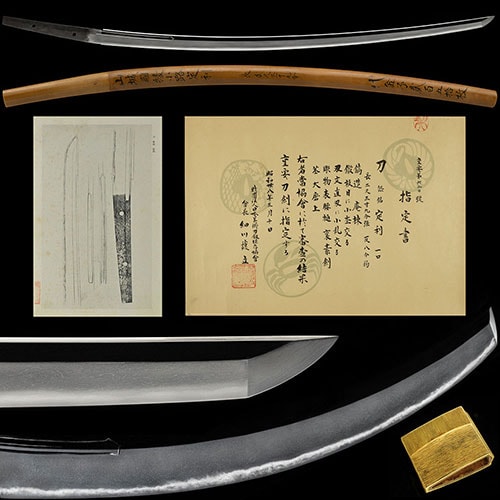
Kuniyasu of , whose two-character signature 国泰 is also read Kunitai, is by the published record traditionally held to be the son of the school's founder Tarō Kunimura, who is himself transmitted as a grandson of Kuniyuki of Yamashiro. His extant dated works carry the eras Enkyō, Gentoku, Shōkei and Kenmu, placing him at the close of and into the earliest ; a dated Gentoku 2 (1330) is among the firm anchors of his hand. The group, the published sources explain, settled at Kumafu in Kikuchi District and prospered there from the late period through the , and its work resembles the Yamashiro school so closely that the school is said to show little pronounced individuality from one smith to the next. Within that uniformity Kuniyasu is the smith the sources single out: he is named one of the leading hands of the line, and his individuality, they write, shows in a style that within the school is the most strongly -laden.

That strong is the heart of his hand, and the published commentary returns to it again and again. The school as a whole runs subdued, its somewhat and the activity within the calm; Kuniyasu's blades do the opposite. His temper is a admitting , and shallow , with and entering and gathering thickly; in the upper half the edge frays into and takes on a -like aspect, while fine and run densely through it. Where the rest of the line holds a plainer line, his is the least plain, and the turns bright and clear rather than sinking. The published sources put the matter as a near-formula across his designations: within the group "a slight individuality can be perceived in that his work shows the most strongly -laden appearance." It is this, not any borrowed resemblance, that fixes him within the school.

The forging beneath that temper is an or , generally well packed yet flowing in places toward , so that the grain stands a little; very fine is laid on thickly and delicate enter densely, at times with a mottled - cast. Over this the school's whitish stands in the , the very reflection the published sources name as one of the points that separate from its bright parent. On Kuniyasu the is present but his brighter, more -laden steel tends to crowd it; on his finest , the commentary records, the tightly knit "is well refined with a bright steel color, the bright and thick, recalling at a glance the work of Kunimitsu of the home province." The closes to a , the tip frequently brushed with ; on his broad late it turns back in the school's larger with a shallow , the rounded, shallow-return being itself one of the cited points.

His work is read in two registers. The signed survivals are or lightly shortened , slender and deeply curved, and that by the very end of grow broad and a touch , thick in and nearly ; the is a large two-character signature cut near the tang-tip. One dated is signed in a somewhat thick six-character chisel "Namu-Tenjin Kuniyasu" (南無天神国泰) with a Gentoku 2 date, another adds a Kikuchi-jū residence inscription. The second register is the shortened : blades attributed to Kuniyasu, and others carrying a later inlay attribution. Several keep a ring-shaped wa-zori and a Kyoto air that recall at first glance, but the in the , the and the settle the appraisal as , the level of the work and the strong then narrowing it to Kuniyasu. The published sources caution that the 国泰 name continued: a two-character Kunitai inscribed Kikuchi-jū is judged not the first generation but a -name successor of the mid-to-late , recorded in the , yet keeping the founder's strong edge- and bright and .

What distinguishes him is best drawn from his own blades rather than from the school around him. The judges call one of his "a comparatively uncommon -leaning work for the working range of this school," the forging singled out as distinctly superior, and they note that compared to the school's usual blades the strong adherence of in both and shows his individuality, the steel "of excellent quality and distinctly superior." One earlier appraisal goes further, finding that with his strong his work "corresponds rather to Yamato pieces than to the group," a reading that places his force a step away from the Kyoto manner the school otherwise keeps. The signature itself is a school tell: the right half of the enclosure in the character 国 is cut into an ear-like shape, the published sources note, a manner shared across the line and "not to be confused with other smiths." His is therefore the bright, -strong reading of an otherwise quiet school, and a plain can in turn be mistaken for at a glance.

In Fujishiro's grading Kuniyasu is Jō-jō . The designated record on which his name rests is one Important Cultural Property, two and a substantial run of blades, thirteen in the and tiers together, across both signed and and shortened attributed ; signed survivals, the published sources observe, are comparatively few. His provenance carries some weight of history: a shortened bears a Genna 3 (1617) gold-inlay attribution recording that it was shortened by one Murayama Gensuke and was formerly held by Hori Hidemasa, its blade-school sobriquet "Sokonuke-hishaku," a bottomless ladle, a witticism that "even water will not pool" boasting of the cutting edge. Other recorded holders include the Asō family and a piece with an Imperial connection, and a blade is held today in the Nagoya City Museum. For a collector, an Kuniyasu is not wholly beyond reach: his attributed and the occasional signed stand among the tradeable designated tiers and come to market from time to time, with patience, while the Important Cultural Property and the long-held pieces remain patrimony rather than stock. He is the brightest, most -laden hand the school produced, and the most readily known of an otherwise quiet line.

Kantei

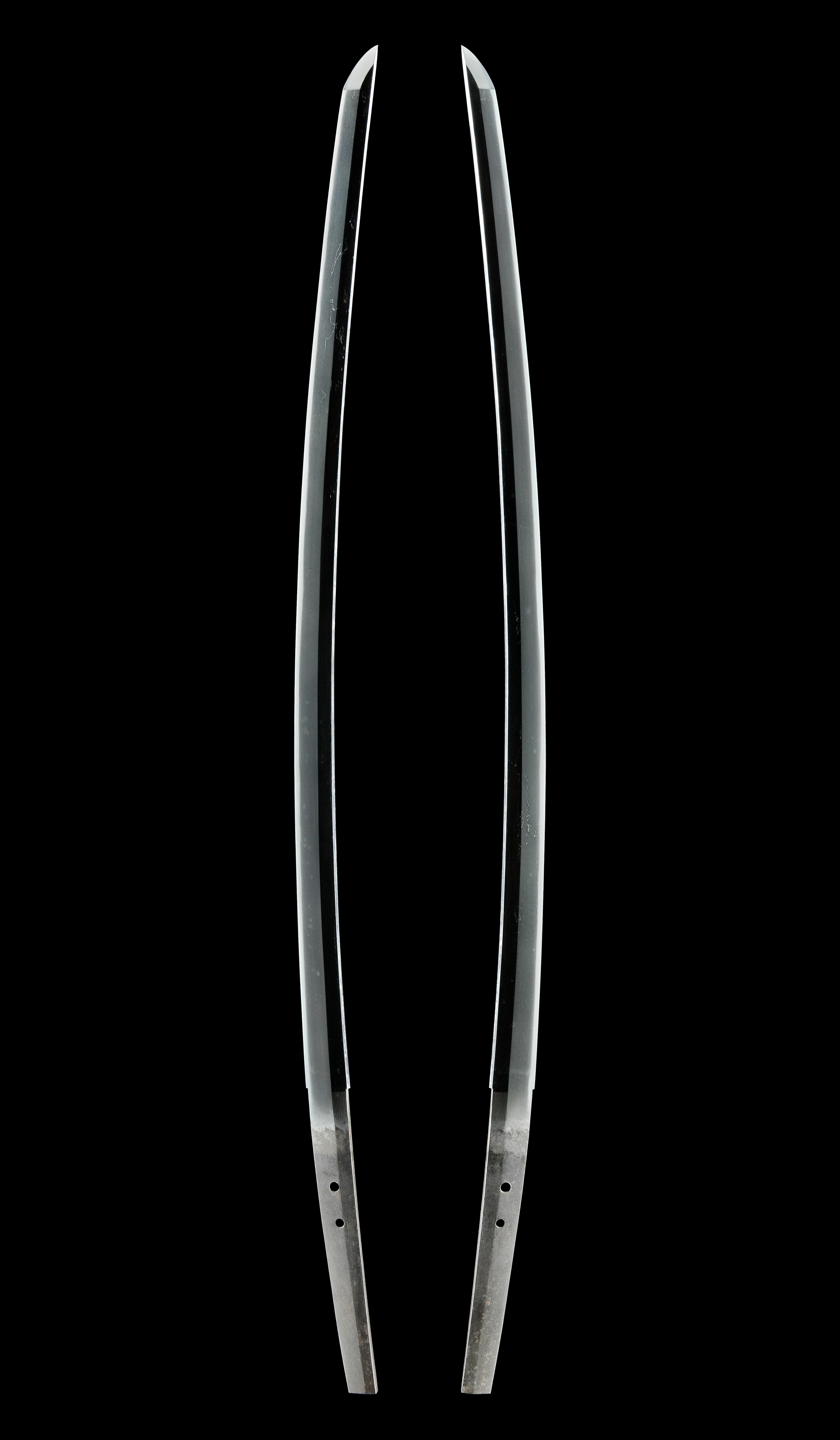
One coherent Enju manner in Kuniyasu's own cast (a chu-suguha laid over the school's shirake-bearing nagare jigane, but worked the most strongly nie-laden hand in the line and, at times, into a rare midareba), read in two registers: signed ubu tachi and hira-zukuri tanto carrying his two-character 国泰 mei, and mumei or kinzogan/ginzogan osuriage katana attributed to Enju Kuniyasu on the jigane and fixed by appraisal inscription. The 国泰 name continued to a second generation in the mid-to-late Nanbokucho, and the NBTHK lumps that line under one code while dating individual blades; this corpus is overwhelmingly the Late-Kamakura hand the judges call the shodai, with one signed Kikuchi-ju piece explicitly read as the nidai.

Kuniyasu (the kanji 国泰 also read Kunitai) is a leading hand of the school of , by tradition the son of the founder Tarō Kunimura, who is himself transmitted as a grandson of Kuniyuki of Yamashiro. His dated works span the close of into early . He keeps the whole manner, the -Yamashiro look carried south: a packed or flowing toward , dust-fine laid on thickly with fine , and the school's whitish , hardened in a that admits and shallow , the closing to a or a larger with . What sets him apart within an otherwise uniform school the published sources state plainly and repeatedly: of all the smiths his work is the most strongly -laden, the and turning bright and clear where the school usually runs subdued. On his best blades the upper edge frays into a and the turns bright, recalling at a glance Kunimitsu of the home province.

Diagnostic discriminators

the published sources state it in nearly every Explanation (12 of 17): within an otherwise uniform school whose nioiguchi runs somewhat sunk and whose activity is calm, Kuniyasu's work is the most strongly nie-laden of the line, the ji and ha bright and clear; this, not a borrowed Rai comparison, is the tell that fixes him within the school

the prime Enju tell separating the school from its Rai parent: a whitish shirake-utsuri stands in the ji where Rai has essentially none (Rai Kunimitsu 0%, Rai Kunitoshi 1%). Kuniyasu carries it, though a little less insistently than the founder Kunimura (69%) and Kunitoki (65%), his brighter, more nie-laden ji tending to crowd it

where the founder keeps a near-pure suguha (Kunimura suguha 100%, ko-gunome 13%), Kuniyasu's suguha is the least plain of the group (suguha 53% vs Kunimura 100% / Kunitoki 92%), breaking three times as often into ko-gunome (41% vs 13%); the judges call one of his tachi a comparatively uncommon midare-leaning blade for the school

Kuniyasu closes sugu to a ko-maru most often (59%), the tip frequently brushed with hakikake (35%), and on his broad late tanto turns back in the school's larger o-maru with a shallow kaeri (12%); the round, shallow-kaeri boshi is one of the points the published sources name for the whole school

Observation by phase

Kuniyasu's Enju manner: the school's shirake jigane, the suguha worked the strongest in nie of the line

Over a packed or , generally flowing and gathering a -lean, the carries dust-fine , fine and the school's whitish , at times with a mottled - cast. On this ground Kuniyasu tempers a mixed with , and shallow , and entering, gathering thickly. Where the rest of the line keeps the plain and the somewhat sunk, his blades run the most strongly -laden in the school, the and bright and clear; fine and play through, the upper edge frays into a , and at the begins to drift. The closes to a , frequently brushed with , and sometimes turns back round and shallow as a larger in the school habit. The judges call a -leaning blade of his comparatively uncommon for the school, and twice note that the level of forging stands out as distinctly superior.

Jigane 地鉄
Hamon 刃文
Bōshi 帽子

Signed register: ubu tachi and hira-zukuri tanto with the two-character mei

ubu hira-zukuri tanto and ubu/lightly-suriage tachi carrying a large two-character 国泰 mei near the tang-tip; one tanto is dated Gentoku 2 (1330) and signed Namu-Tenjin Kuniyasu, another adds a Kikuchi-ju residence inscription. Signed survivals are comparatively few, found among both tachi and tanto

His signed survivals are (or lightly ) , slender with a deep curvature, and , by the very end of broad and a touch with a thick and an almost form. The is a large two-character signature cut near the tang-tip, the chisel sometimes broad and strong; one dated carries a six-character Namu-Tenjin Kuniyasu with a Gentoku 2 (1330) date, another a Kikuchi-ju place inscription. On this register the temper most freely admits and shallow , the frays with into a , and the is bright; on these blades the way adheres especially well is named the very point that fixes the attribution within the school.

Sugata 姿
Hamon 刃文

Mumei / inlay-mei osuriage katana register (attributed on jigane, fixed by inlay inscription)

osuriage katana attributed Enju Kuniyasu: a wa-zori and Kyoto air recall Rai at a glance, but the nagare jigane, the shirake-utsuri and the chu-suguha settle it as Enju, narrowed to Kuniyasu by the level of the work and the strong nie; two carry a Honmei ginzogan reading Kuniyasu, one a Genna 3 (1617) Mae-Enju Kuniyasu kinzogan with Hori Hidemasa provenance

A large part of the designated record is , either attributed to Kuniyasu or carrying a later silver- or gold-inlay inscription. Several keep a ring-shaped wa-zori that, with a Kyoto air, recalls at first glance, but the in the , the and the settle it as , the level of work and the strong narrowing it to Kuniyasu. The here mixes and , enter, begins at the , and the upper edge takes a ; the closes to a or . Two of these carry a Honmei silver inlay reading Kuniyasu, judged to record an originally signed shortened down; one bears a Genna 3 (1617) Mae- Kuniyasu gold-inlay attribution with a former Hori Hidemasa provenance.

Sugata 姿
Hamon 刃文
Scholarship

His dated survivals carry the eras Enkyo, Gentoku, Shokei (Shokyo) and Kenmu, placing the shodai at the close of Kamakura into early Nanbokucho; a tanto dated Gentoku 2 (1330) is signed Namu-Tenjin Kuniyasu in a thick six-character chisel.

A two-character Kunitai tanto inscribed Kikuchi-ju is judged not the first generation but a same-name successor of the mid-to-late Nanbokucho, recorded in the Umetada Oshigata, yet keeping the shodai's strong edge-nie and bright ji and ha.

The 国 character of the school's signatures is cut with the right half of its enclosure shaped like an ear, named a tell of the whole Enju line that cannot be confused with another school.

Designations

Kokuhō—
Jūyō Bunkazai1
Jūyō Bijutsuhin1
Gyobutsu2
Tokubetsu Jūyō2
Jūyō Tōken11

Elite Standing

0.39 across 17 designated works

Top 6% among smiths

Provenance

4 documented provenances across certified works by Kuniyasu

Provenance Standing

2 works held in elite collections across 4 documented provenances

Top 68% among smiths

Raw score: 1.92 / 10

Blade Forms

Distribution across 17 ranked works

Signatures

Signature types across 17 ranked works

Currently Available

Enju School

Other artisans of the Enju school

  1. 1.Kunimura國村15designated
  2. 2.Kunitoki國時1 for sale32designated
  3. 3.Kunisuke國資3 for sale22designated
  4. 4.Kunitoki國時7designated
  5. 5.Kuniyoshi國吉1 for sale22designated
  6. 6.Kuninobu國信7designated
  7. 7.Kunishige國重2designated
  8. 8.Koreyoshi是吉1designated
  9. 9.Kunimoto國元1designated
  10. 10.Kuniie國家1designated
  11. 11.Kunimitsu國光1designated
  12. 12.Kunitsuna國綱2designated