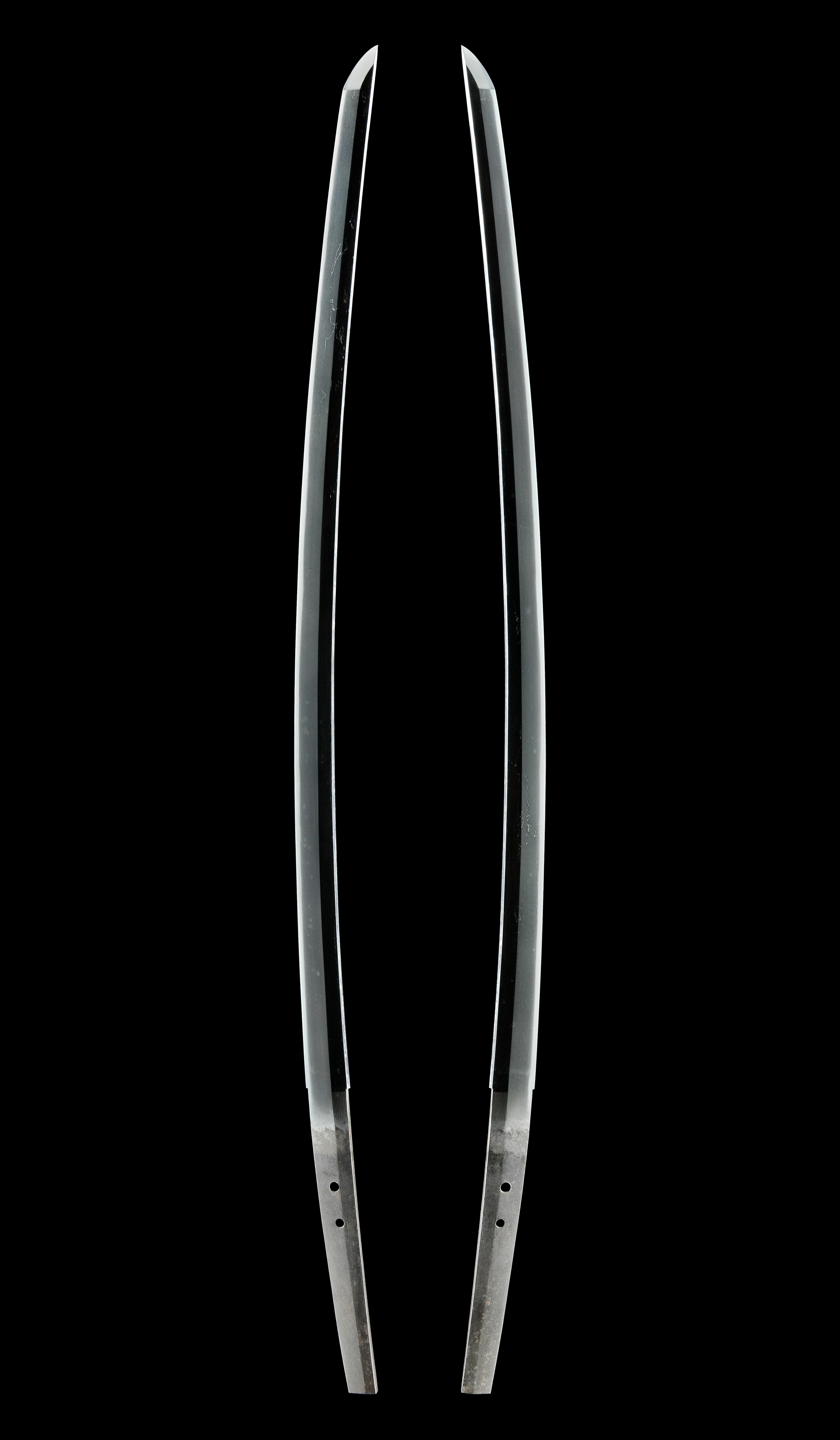
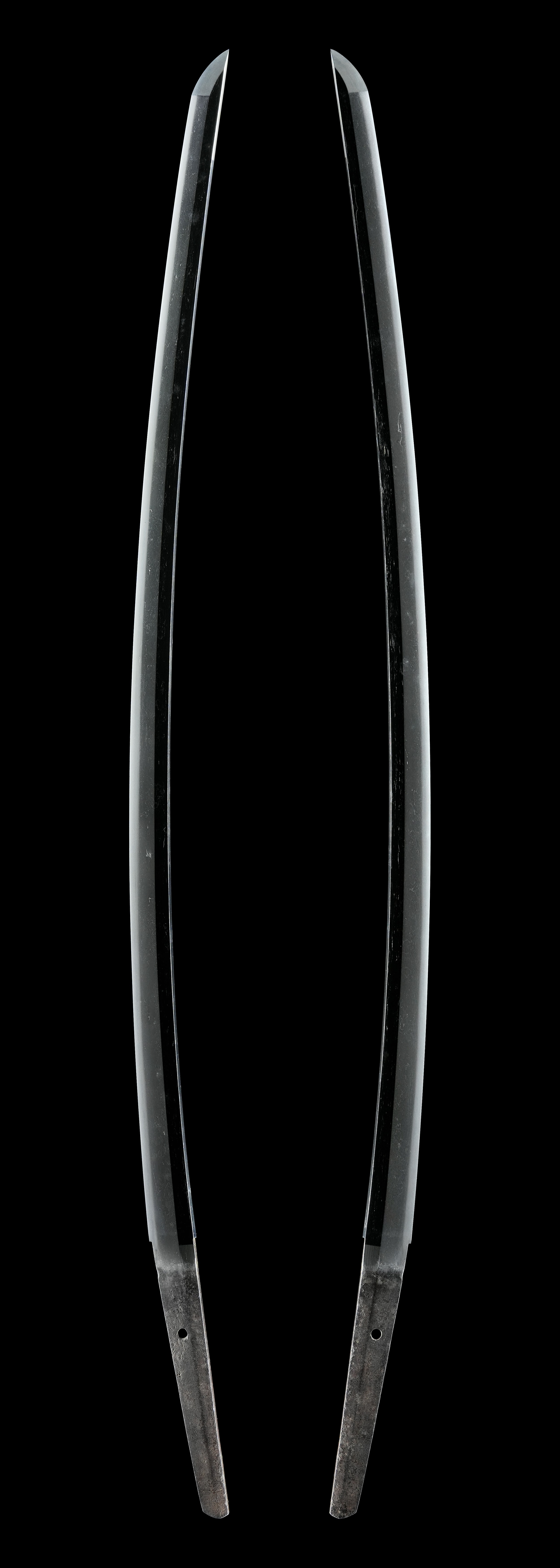
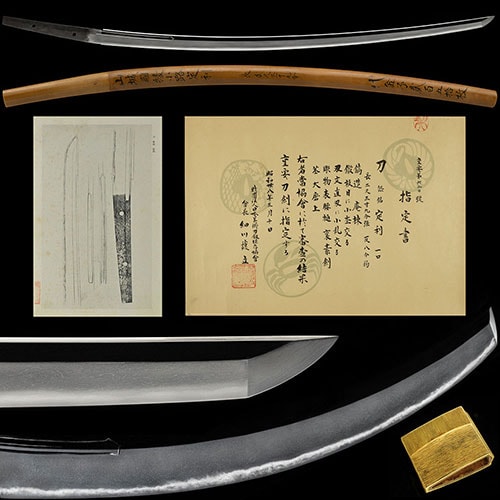
Kunitoki is the representative master of the school of , the line that carried the Yamashiro manner south into Kyushu. The published sources trace the school to Tarō Kunimura, transmitted as an "outside grandson" of Kuniyuki of Yamashiro through a daughter, and they place Kunitoki among the best-known smiths of the group, variously recorded as the son or the pupil of the founder. His working life runs from the close of the period into at Kumafu in the Kikuchi District; dated survivals carry the Southern-Court eras, one signed Shōhei 7 (1352), placing his late hand in the middle of the fourteenth century. The school is judged to show little individual variation and to resemble broadly, so that the manner reads almost as one hand. Within that uniformity Kunitoki stands out for two reasons. The published record judges that "relatively many of his works survive, and the average quality of his workmanship is high", and his hand worked the school's restrained busier than any other of the line.
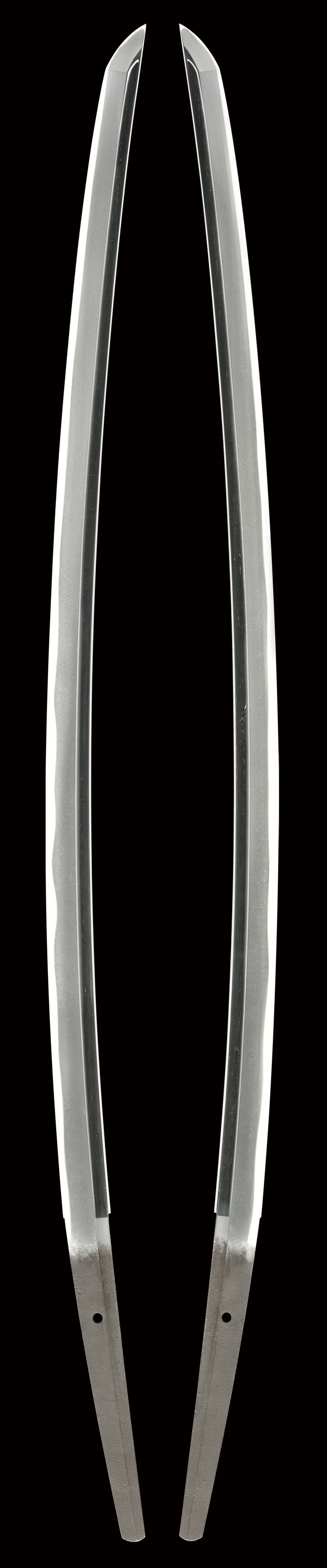
His characteristic manner is a or that refuses to stay plain. Where the published sources record that "many works of the group temper a sparing in internal activity," Kunitoki breaks his straight temper with continuous , occasional and pointed teeth, and entering well, gathering along the edge, with fine and playing through. On his best blades the , which the school carries somewhat (subdued) against the brighter , turns bright and clear. The school's own nature pulls the other way, and it is precisely because of that restraint that a lively blade reads as exceptional: of one the published commentary writes that it shows "a -dominant tempering rare not only for Kunitoki but for works generally", and of a with strong , and a that goes into with vigorous , that it presents "the most active not only of this smith but within the whole school". That a single blade can be called both rare and the most active is the measure of how quiet the line normally runs, and of how far Kunitoki pushes against it.
The forging is the school's whole inheritance read clearly. Over an or tightly forged , generally flowing and gathering a -like tendency toward the edge, fine dust-like adheres well and fine enter, and the school's whitish stands in the . This whitish is the prime point the published sources name in separating from , and it sits on a that keeps the Kyoto refinement of the parent while taking on the flowing Kyushu steel. The most often runs straight and closes in a , frequently brushed with , and sometimes turns back round and shallow as a large in the school habit. The signature, when present, is a large two-character , and the published sources repeatedly single out one calligraphic tell: in the character (国), the right half within the enclosing strokes is cut in an "ear-shaped" manner, a writing habit shared by the whole line that cannot be confused with another school.
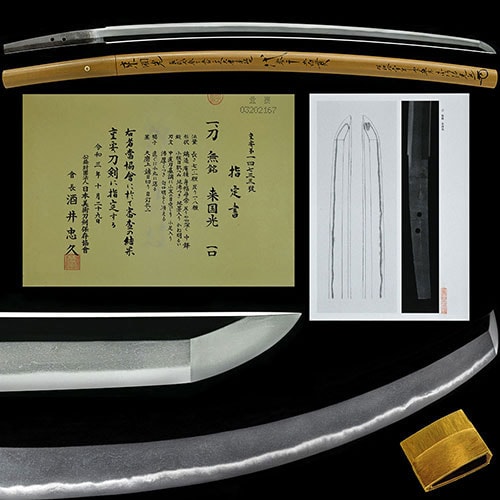
The surviving record falls into two registers. The first is signed and : long with a deep and , and broad , slightly with a thick , carrying the bold two-character near the tang-tip; the chisel on some is noted as broader and stronger than usual. The dated late blades of this register sign the longer Kikuchi-jū Kunitoki with Engen and Shōhei dates, and the published sources assign that long signature to the lower generations of the name. The second register is , attributed to Kunitoki and often fixed by a later appraisal: at first glance a ring-shaped wa-zori and a Kyoto air recall , but the in the , the and the subdued settle the attribution to , and the overall level of the work narrows it to Kunitoki. Several of these carry a Kōsson appraisal inscription in gold, the smith's name set in or kinpun with his .
Kunitoki's place is best read against his two neighbors. Against , the parent, the difference is fixed: the published sources record the -lean, the whitish and the subdued as the points by which parts from the Yamashiro line, and they note that the school is felt to be "somewhat weaker in and than ." Yet the kinship is close enough that one of his finest is judged to show "a level of workmanship comparable to Kunimitsu", the tells visible only on close reading. Against Kunimura, the founder, the difference is Kunitoki's own: his breaks into and far more freely than the founder's plainer straight temper, and his closes to a more often than the founder's larger . Because the line shows so little individual variation, Kunitoki is taken as its representative hand and its most frequently surviving one, and a plain can in turn be mistaken at a glance for . The smiths were attached to the Kikuchi clan, loyal to the Southern Court, and the dated blades carry that history in their Southern-Court eras.
Kunitoki's standing is matched by a substantial designated record: thirty blades stand in the and tiers, six of them , with one further work in the Important Cultural Property rank, and his work earns a high mark in the Tōkō Taikan. He is among the most heavily represented hands on the official record. The provenance recorded against his blades reaches into the high households of late : a held by the Mito Tokugawa family and one by the Kishu Tokugawa family, a now of Minatogawa Shrine, and a known as a relic of Seikan'in-no-Miya, the imperial princess Kazunomiya, the figure of the late-Tokugawa marriage settlement, by way of the 'in-no-Miya house. One blade is locked in the Important Cultural Property tier and will never trade. Of the rest, the school's quiet and the relative abundance of Kunitoki's survival mean that his and blades come to the serious collector from time to time, more readily than the rarest masters but as designated heritage rather than ready stock; a fine signed or a broad signed of his is a landmark when it appears, and most of the recorded record is held, not traded.