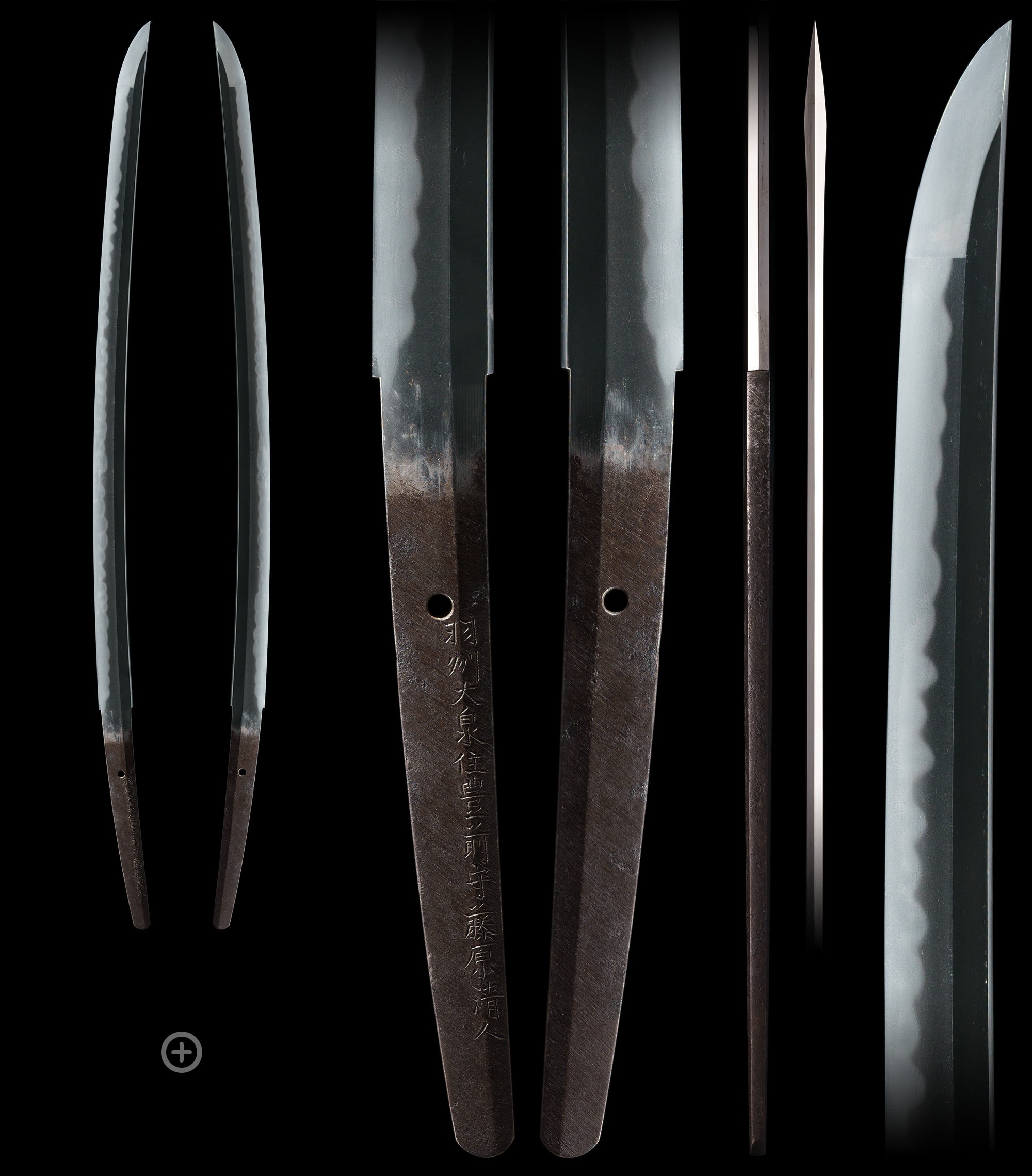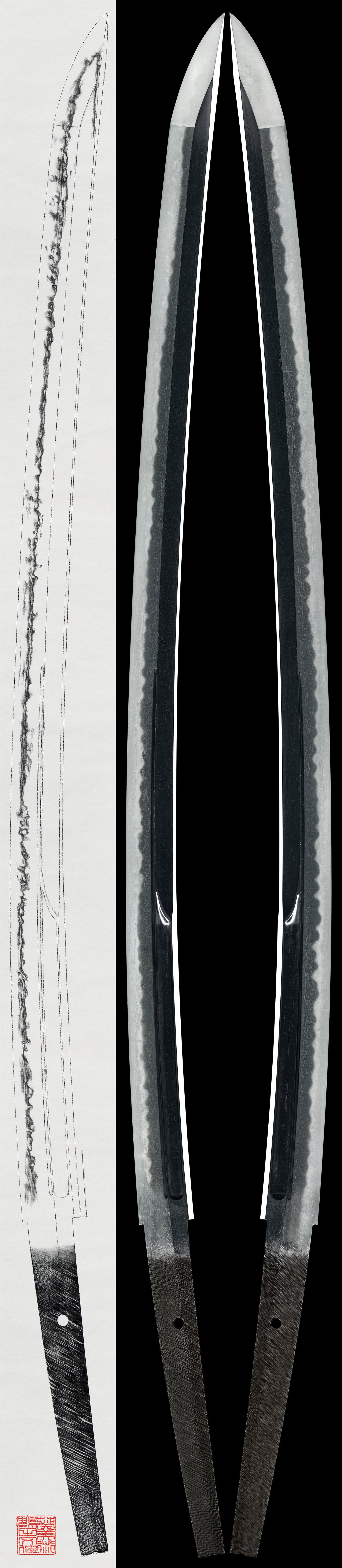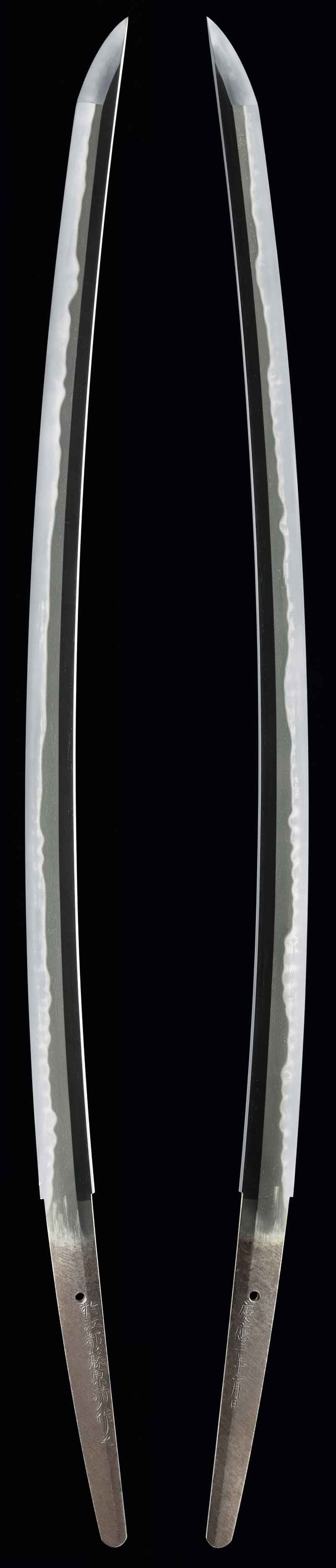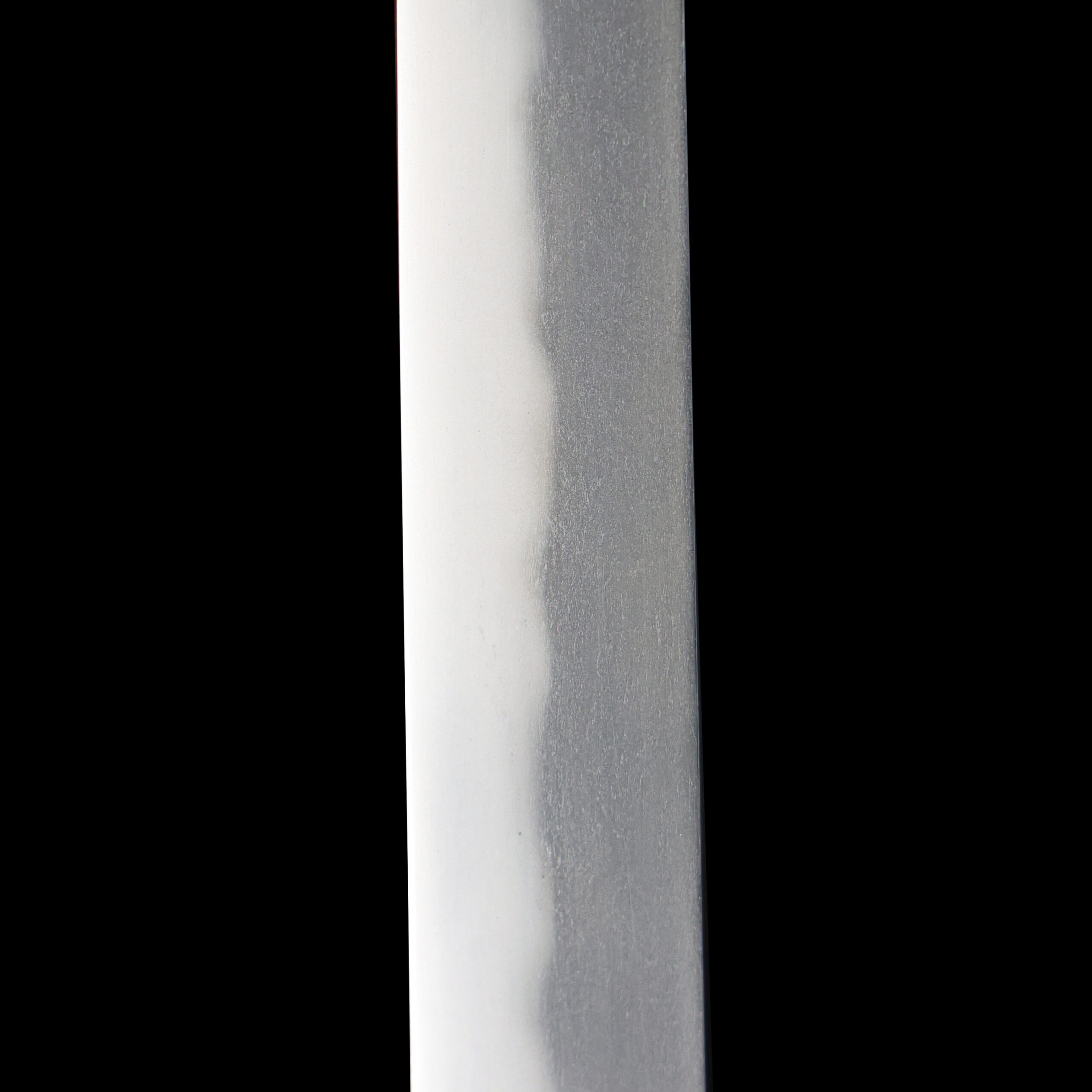
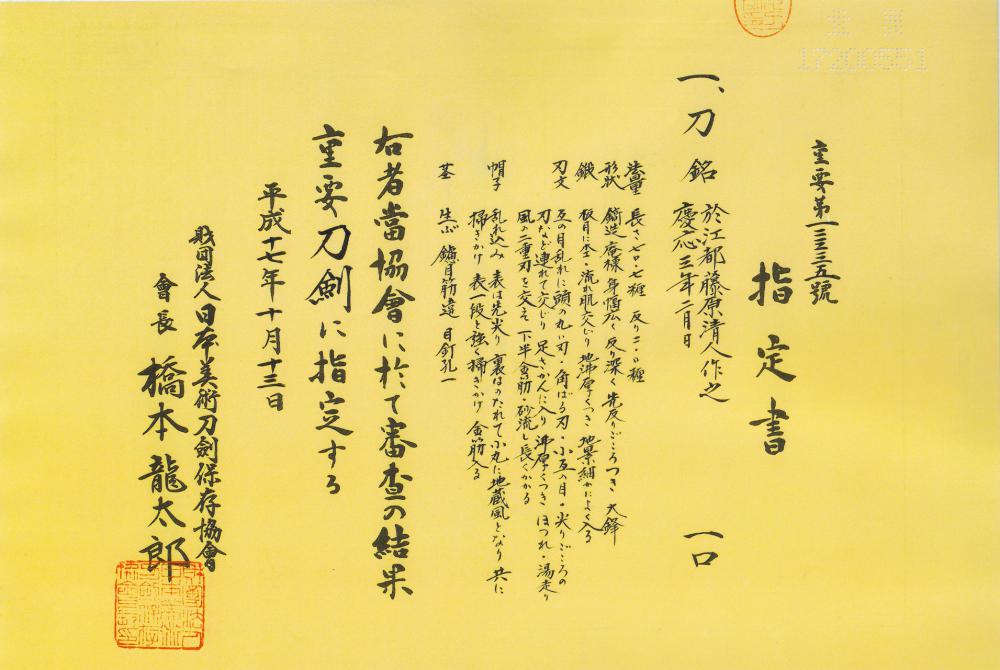
-, 51st Session — Designated October 13, 2005
, : Kiyohito (清人)
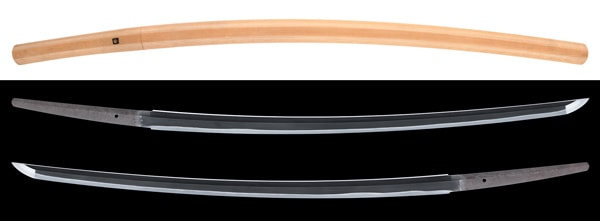
Measurements 70.7 cm, 2.0 cm, 3.35 cm, 5.5 cm, 20.5 cm, extremely slight
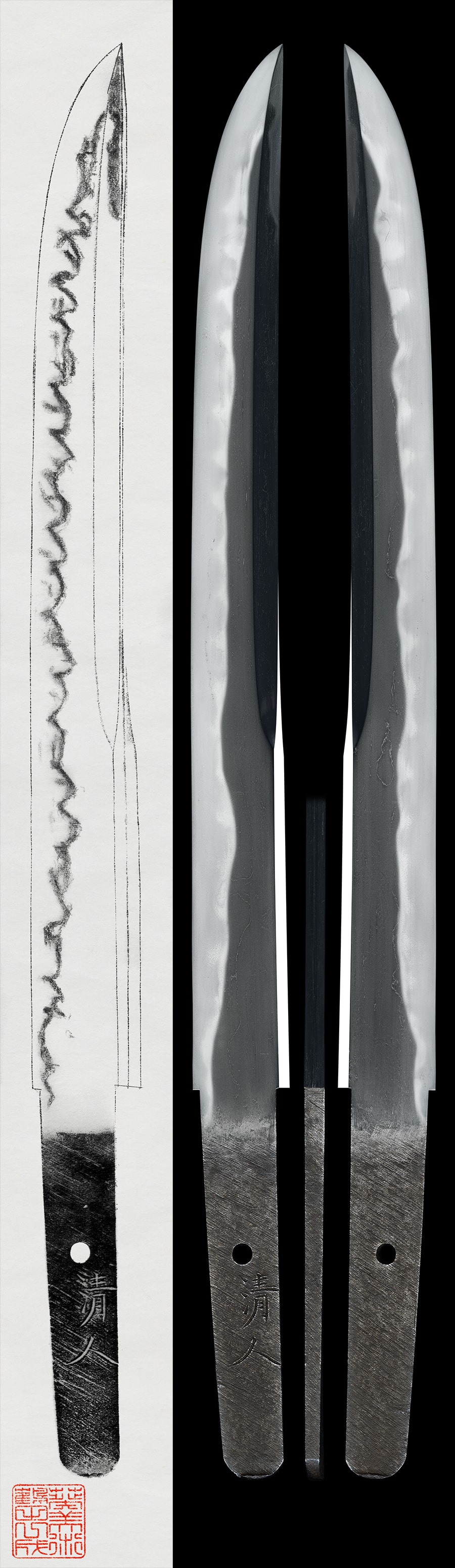
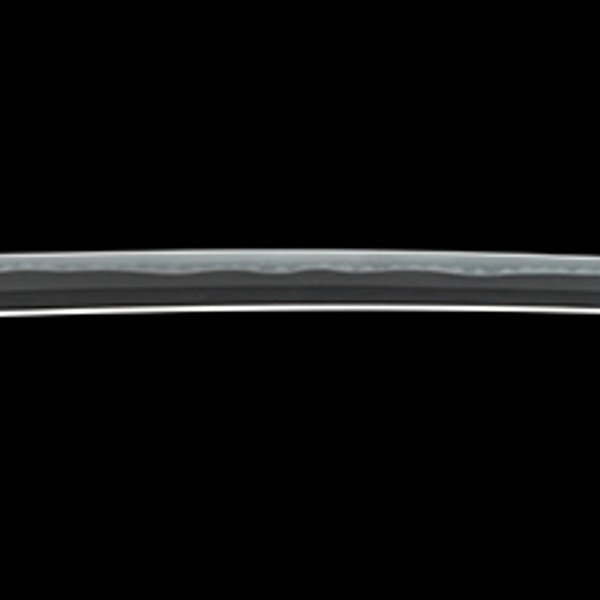
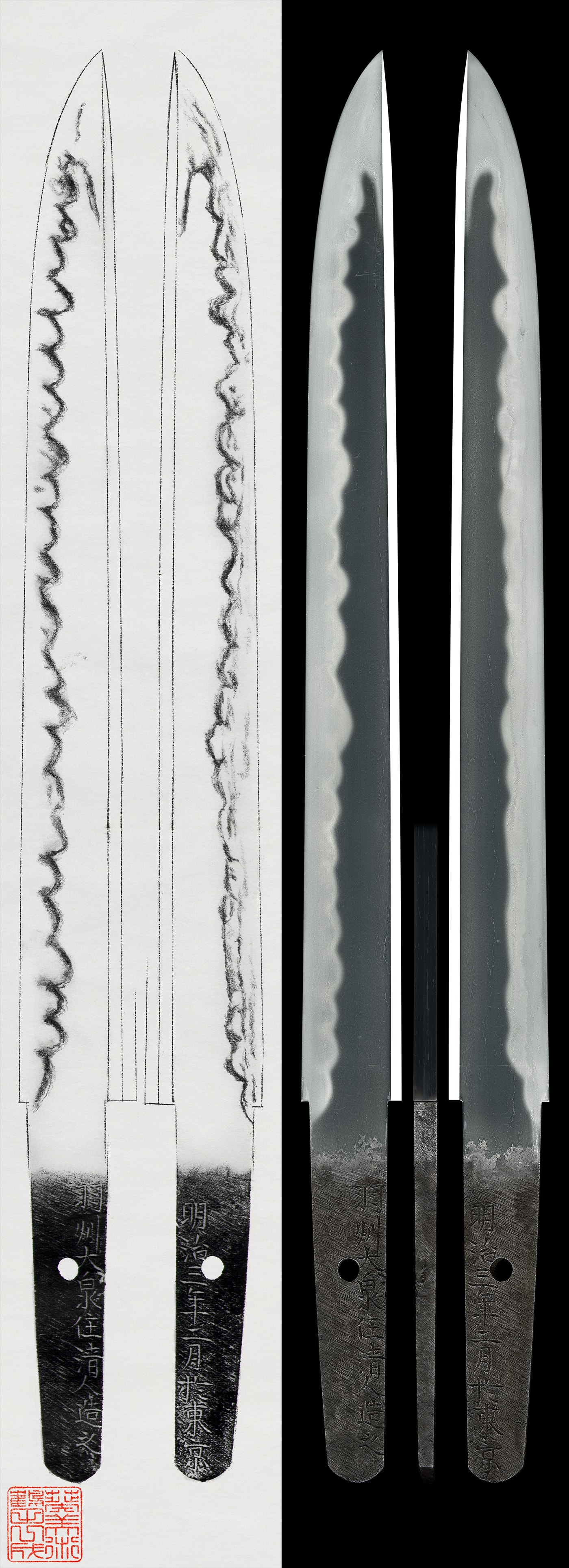
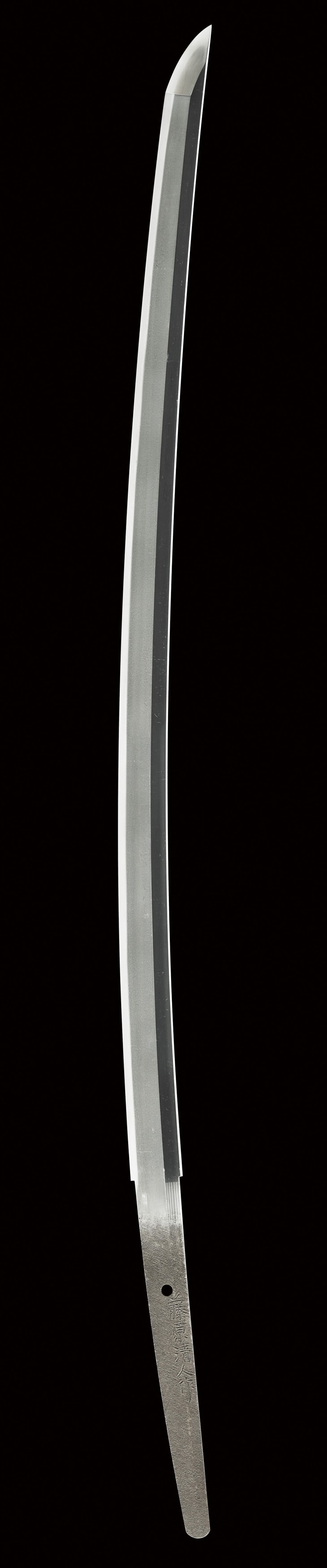
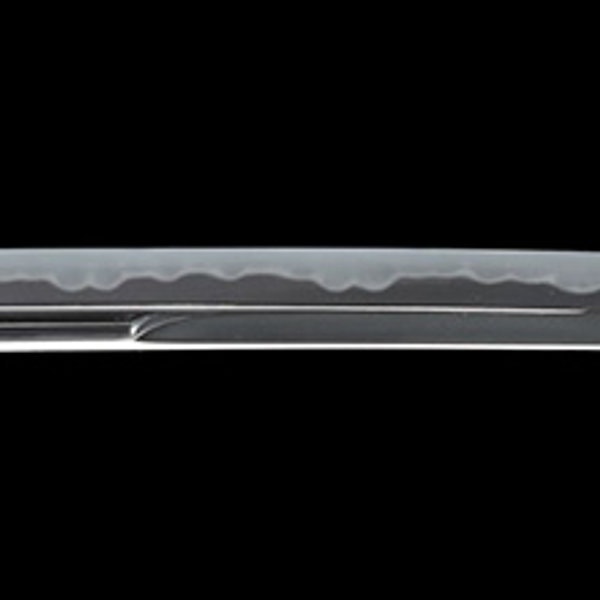
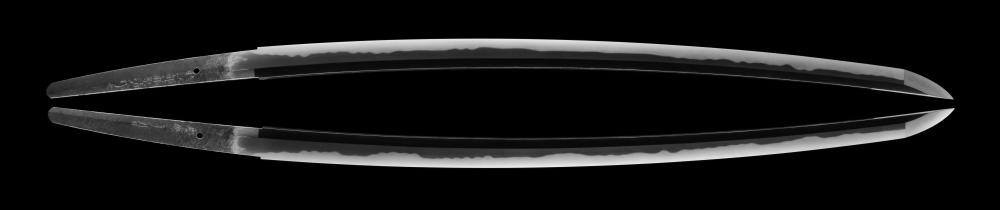
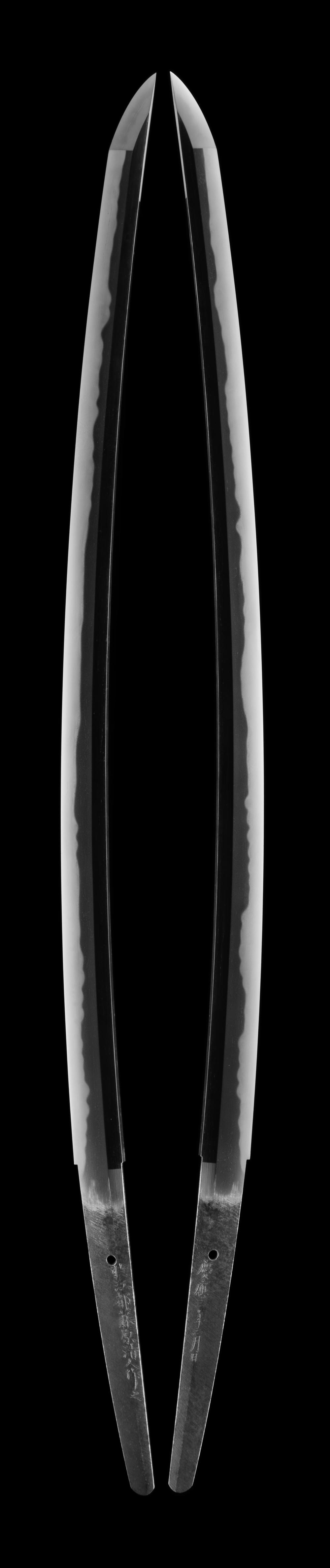
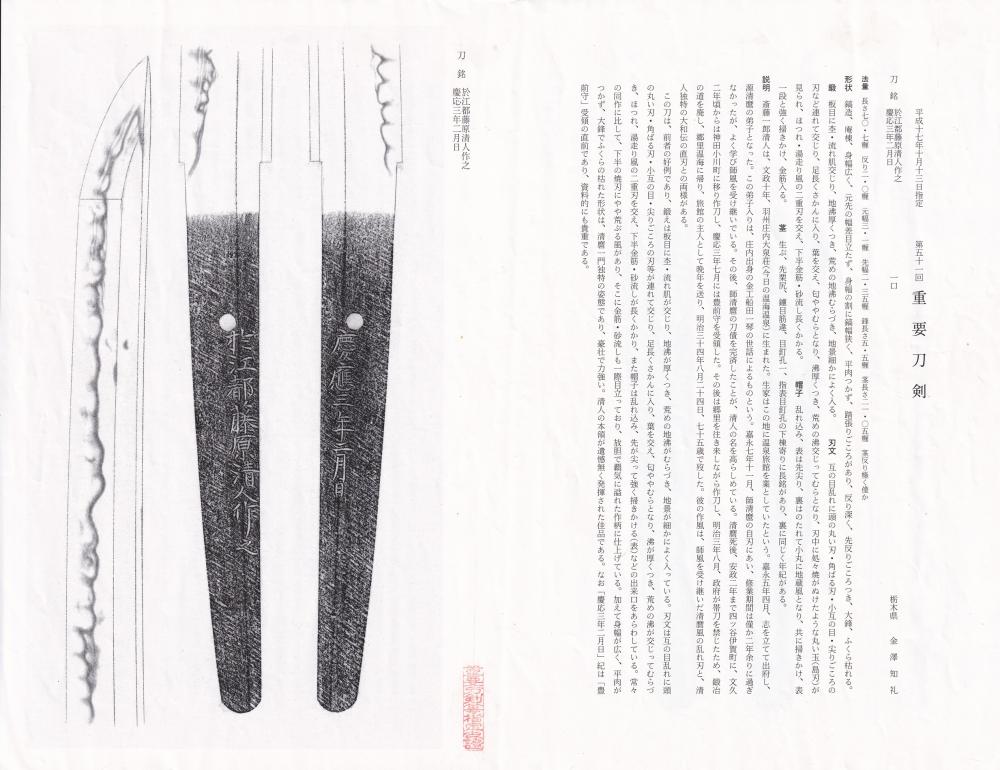
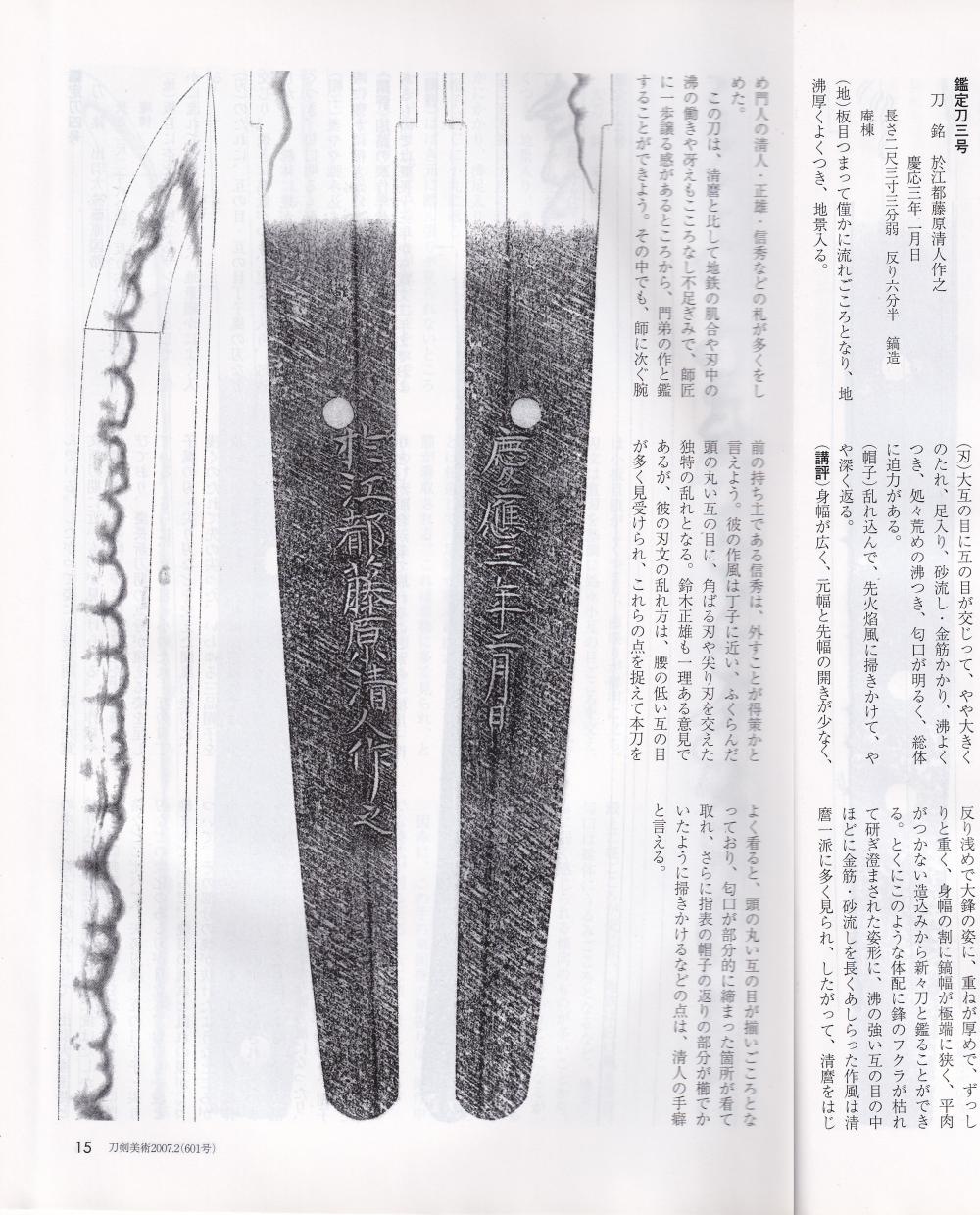
Description Keijō: , ; wide with little difference between and width; comparatively narrow for the overall width; little ; with a sense of ; deep with a tendency toward ; ; the is withered (). : mixed with and ; thick ; somewhat coarse appearing unevenly; fine entering well. : mixing rounded-headed elements, angular elements, small , and slightly pointed elements; long entering vigorously; mixed with ; the is somewhat uneven; thick with somewhat coarse mixed in and uneven; here and there rounded “jewels” () that look like places where the temper has dropped out () are seen; mixed with and -like ; in the lower half, and run long. : ; on the the point is slightly pointed, and on the it becomes and turns back in small with a Jizō-like flavor; both sides show ; the shows particularly strong and contains . : None. : ; ; ; one ; a long signature on the below the toward the side, and a corresponding date inscription on the .
Artisan Fujiwara Kiyohito (藤原清人), i.e., Saitō Ichirō Kiyohito (斎藤一郎清人)
Era Keiō 3 (1867), second month (day unspecified)
Explanation Saitō Ichirō Kiyohito was born in Bunsei 10 (1827) at Ōizumi-shō in Shōnai, Ushū (present-day Atsumi Onsen). It is said that his family operated a hot-springs inn there. In the fourth month of Ka’ei 5 (1852), he resolved to go to and became a disciple of Minamoto Kiyomaro. This apprenticeship is said to have been arranged through the assistance of the Shōnai-born metalworker Funada Ikkin.
In the eleventh month of Ka’ei 7 (1854), his teacher Kiyomaro committed suicide, so Kiyohito’s period of training amounted to little more than two years; nevertheless, he studied well and inherited his teacher’s manner. Thereafter, Kiyohito’s reputation was enhanced by the fact that he fully repaid the outstanding debts left by Kiyomaro. After Kiyomaro’s death, Kiyohito lived and worked at Yotsuya Iga-chō until Ansei 2 (1855), then from around Bunkyū 2 (1862) moved to Kanda Ogawa-chō, continuing to make swords. In the seventh month of Keiō 3 (1867) he received the court title Buzen no Kami.
After that he continued forging while traveling back and forth to his home region. In the eighth month of Meiji 3 (1870), when the government prohibited the wearing of swords, he abandoned the smith’s path, returned to Atsumi in his home province, and spent his later years as proprietor of the inn. He died on August 24, Meiji 34 (1901), aged seventy-five. His workmanship shows two principal manners: a Kiyomaro-inherited style of -ba, and Kiyohito’s own distinctive Yamato-tradition .
This is an excellent example of the former. The forging is mixed with and , with thick ; somewhat coarse appears unevenly, and fine enters well. The is a in which rounded-headed elements, angular elements, small , and slightly pointed elements mingle together; long enter vigorously, with interspersed. The is somewhat uneven; forms thickly, with somewhat coarse mixed in and appearing unevenly. It also shows , and -like ; in the lower half, and run long. The is , and on the it becomes pointed and ends in strong .
Compared to Kiyohito’s usual works, the tempered area in the lower half here is somewhat more assertive and rough in feeling, and accordingly the and stand out all the more, giving the piece a bold, spirited character. Moreover, the wide , lack of , , and withered are distinctive forms particular to the Kiyomaro lineage, producing a grand and powerful impression. This is a fine work in which Kiyohito’s true strengths are fully manifested.
Finally, the date inscription “Keiō 3, second month, [day]” falls immediately before his receipt of the title “Buzen no Kami,” and is therefore also valuable as documentary material.