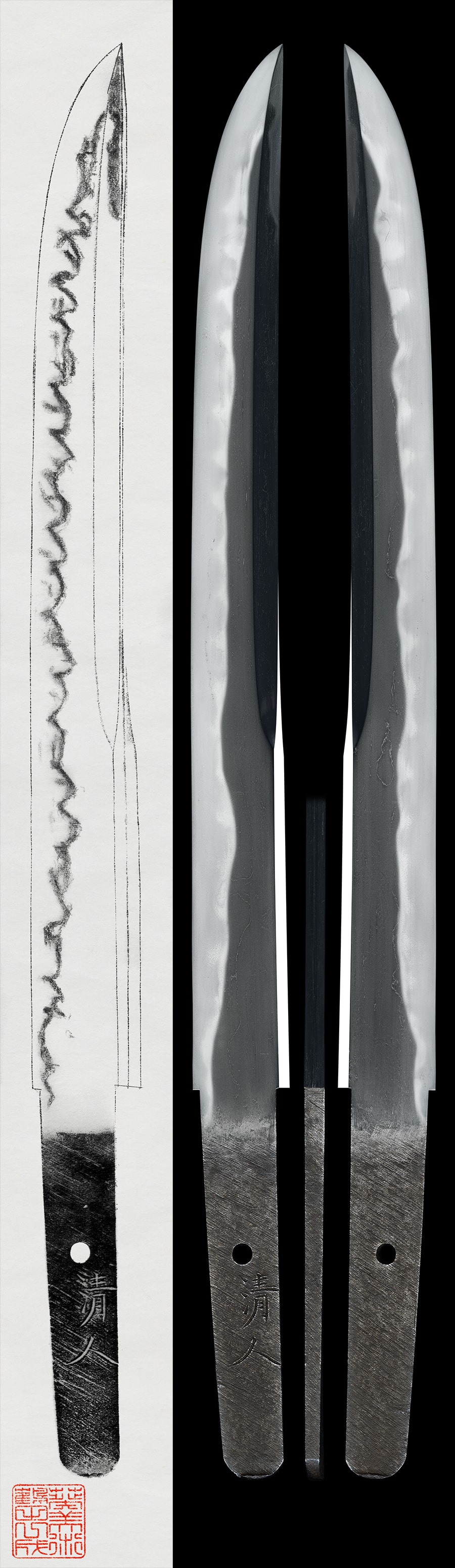
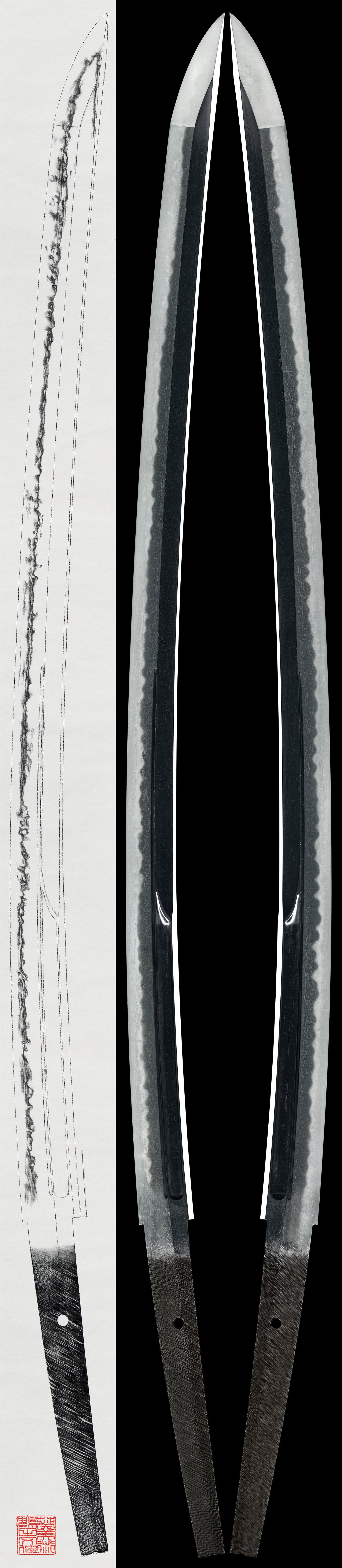
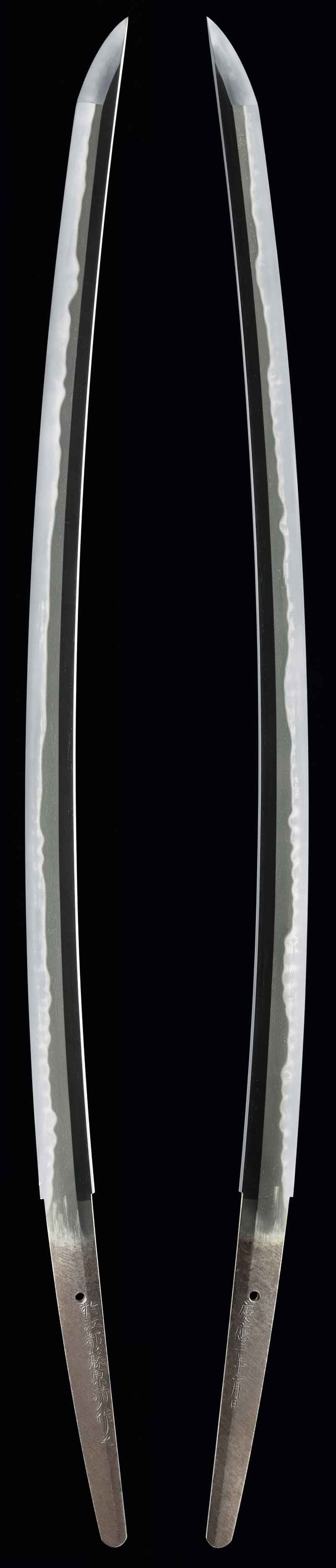
Kurihara Kenji Nobuhide was born at in Echigo and began life as a maker of metal mirrors, turning to the sword only around Kaei 3 when he entered the workshop of Yamaura Kiyomaro at Yotsuya. Of the master's pupils he is the one the published sources place nearest the source: examining a blade made before he took his title, the writes that 'his technique was, among the members of that school, the closest to approaching the level of his master'. He received the honorary title no Kami in the fifth month of Keiō 1, lived three years at Osaka, returned to , and after the Haitōrei went home to Echigo and forged only a little until his death in Meiji 13. He signed Nobuhide, often Taira Nobuhide and, after the title, Kurihara no Kami Taira Nobuhide. With Kiyondo he is one of the two hands who carried the Kaei-era revival of the Yotsuya Masamune into the Bakumatsu and early Meiji.
What he aimed at is his teacher's manner, and within it the vein Kiyomaro favoured most. The published commentary states plainly that his workmanship 'resembles his teacher and excels in the tradition'. The temper is a into which he sets and an angular , a feeling entering and at times mixing in, with and well in. The activity is that of a deep edge: adheres well, streams through, and long enter frequently, the bright and clear. The runs and turns with a pointed tendency, often with , sometimes thrusting up to a small round. On a wide the judges read exactly this hand at full strength, 'a work full of commanding spirit, and operating repeatedly, giving a powerful impression'.
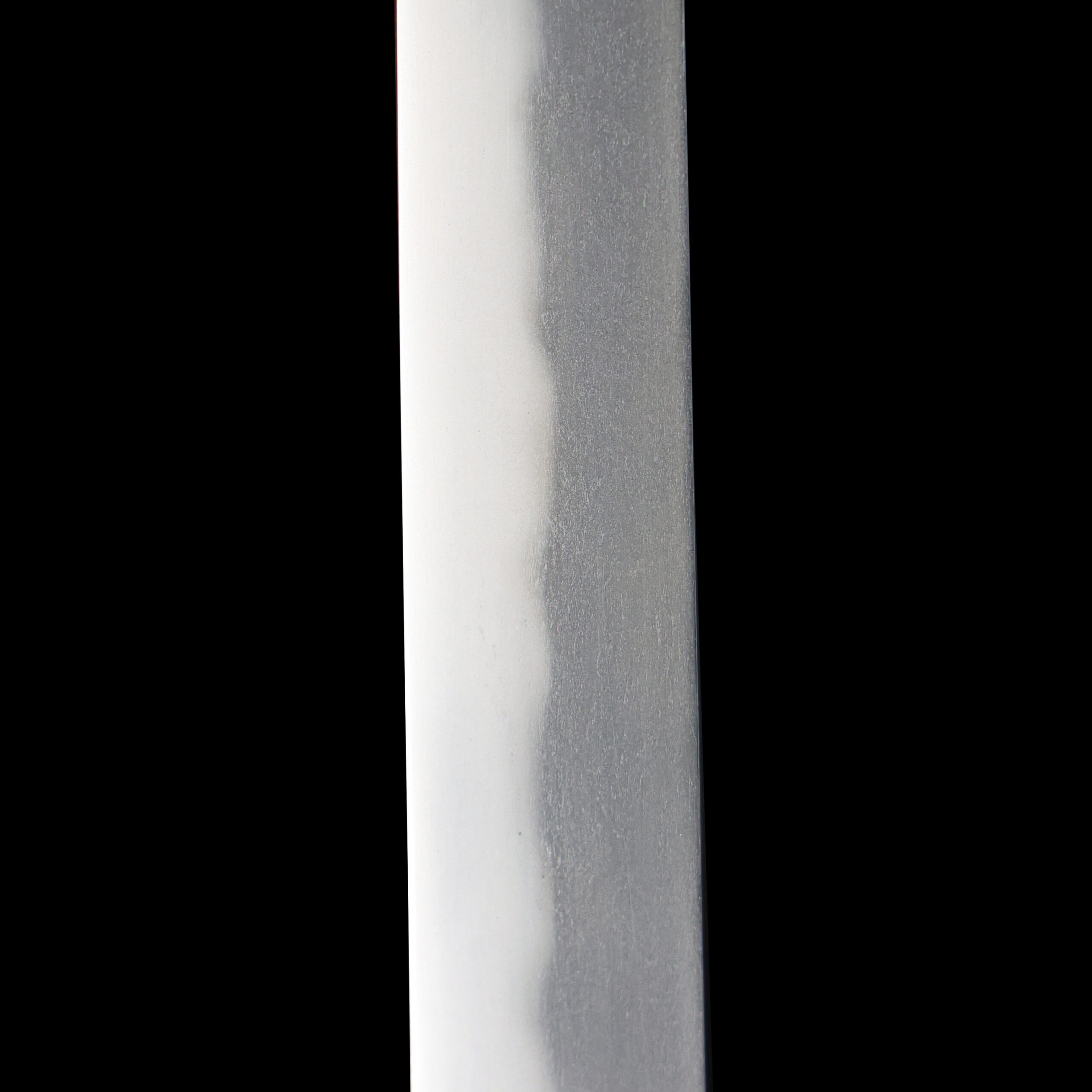
The is where his closeness to Kiyomaro tells most. Over an that flows and stands a little, at times mixed with and , he lays a thick with entering frequently, the steel clear. There is no : this is a hand reaching back to through , not a one, and the brightness lives in the of and rather than in any reflection. His swords are imposing in shape, wide in body, the often thin and the shallow, the extended or run to an , several with a tendency. Set against this strength the published sources are candid about the limit of the inheritance: his spirit and forcefulness, they note more than once, do not reach his master's, even as the deftness of the work is beyond question.
His own tell, the feature that is his alone in the school, is the carving. The mirror-maker's training gave him a hand for metal that the others lacked, and the records that within the Yamaura line 'there are no blades but his that bear carvings'. The motifs are diverse and distinctively his: a grass-style , a jewel-chasing dragon, a dragon-riding Kannon, Ame-no-Uzume-no-Mikoto and mountain cherry at the , and beneath and . From Meiji 1, after study with the metal-artist Kanō Natsuo, his carving changes markedly into a shallow, low-relief manner. The form that accompanies the carving is the , which the published sources note is not uncommonly encountered among his swords, alongside the wide . Carving was so much the point of his work that on one entirely uncarved the judges turn the absence into praise: with no to occupy the eye, they write, the blade is 'all the more such that it could be mistaken for his teacher Kiyomaro'.
What separates him from his teacher is named in the commentary itself, and it is a matter of degree, not of kind. He works the flowing with thick and , the deep in with and , the pointed ; but where Kiyomaro's hand is read as overwhelming in spirit, Nobuhide's is read as the most skillful approach to it, the closest the school came. Among the Kiyomaro pupils his is the carved hand, the Osaka and Echigo wandering hand, the one whose blades can be dated and placed by their signatures and titles. He is therefore the open, knowable face of a school whose founder is the more mythologized for his short and violent life.
For the collector he is an attainable Kiyomaro-school name of real quality. Fujishiro grades him Jō-jō , and the Tōkō Taikan values his work highly among smiths. He has no National Treasures and no Important Cultural Properties; his record runs instead through the rank, where something over thirty of his signed , and are designated. His provenance is grounded and historically resonant rather than broad: one of Keiō 1, the published sources record, 'was presented to Shogun Yoshinobu', and a blade is preserved at the Hachiman shrine of his native in Echigo. Most designated blades are held rather than traded, and only a small share fall in the tradeable tier, so a signed Nobuhide reaches the market only from time to time. When one does, it is among the most rewarding ways a collector can hold the Kiyomaro manner, signed, dated, and often carried by his own carving.