


NihontoWatch Mon

NihontoWatch

MarketAuctions
Encyclopedia
NihontoWatch Mon

NihontoWatch

MarketAuctions
Encyclopedia

Description

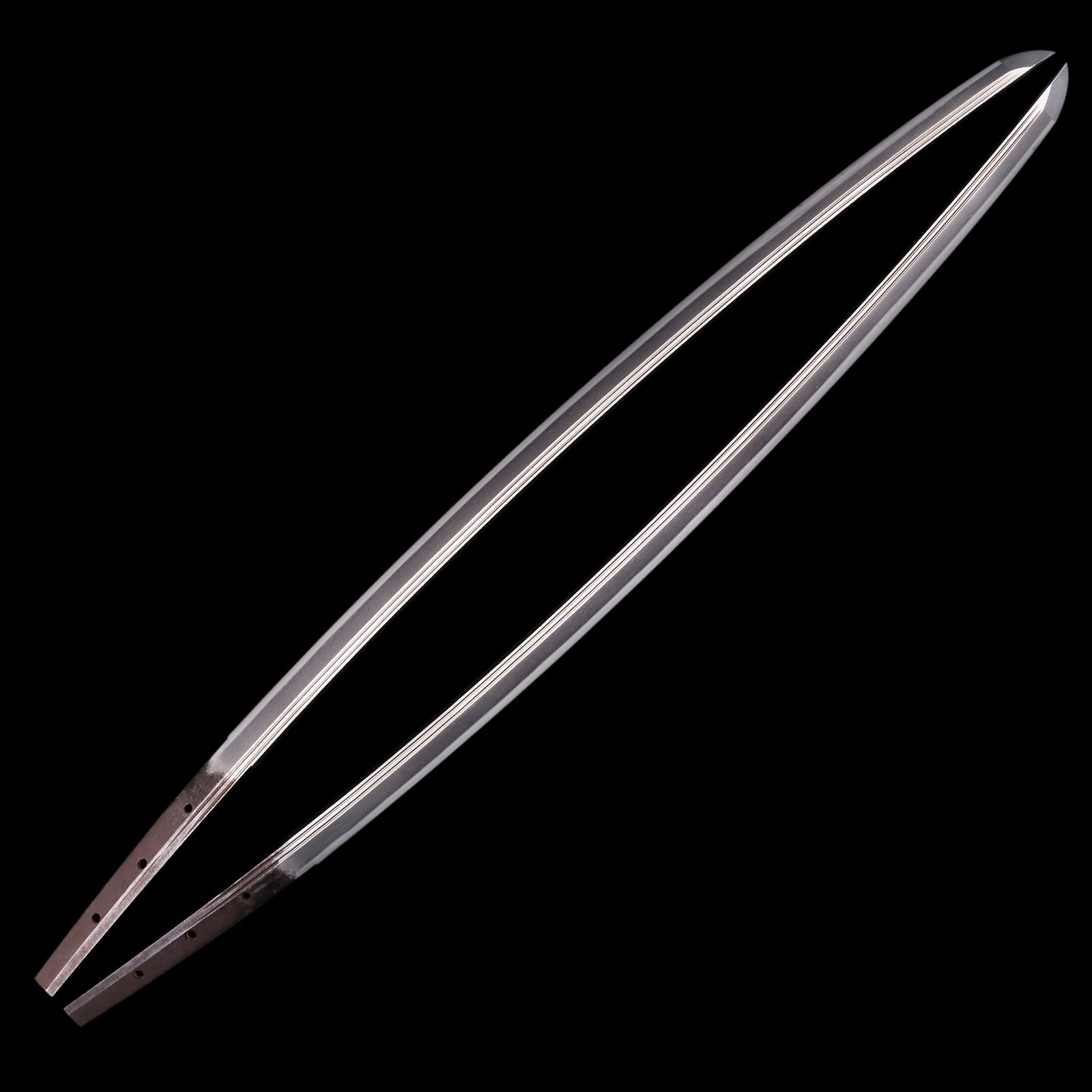
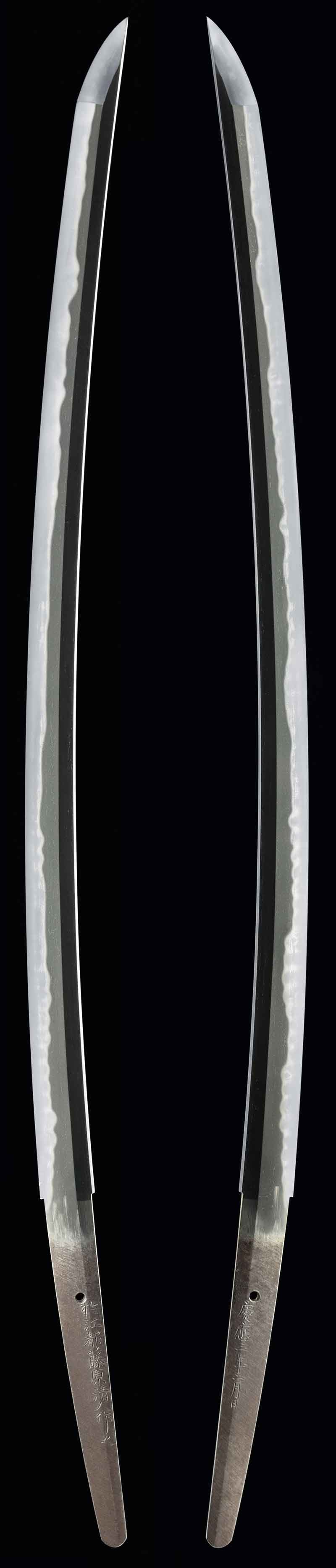
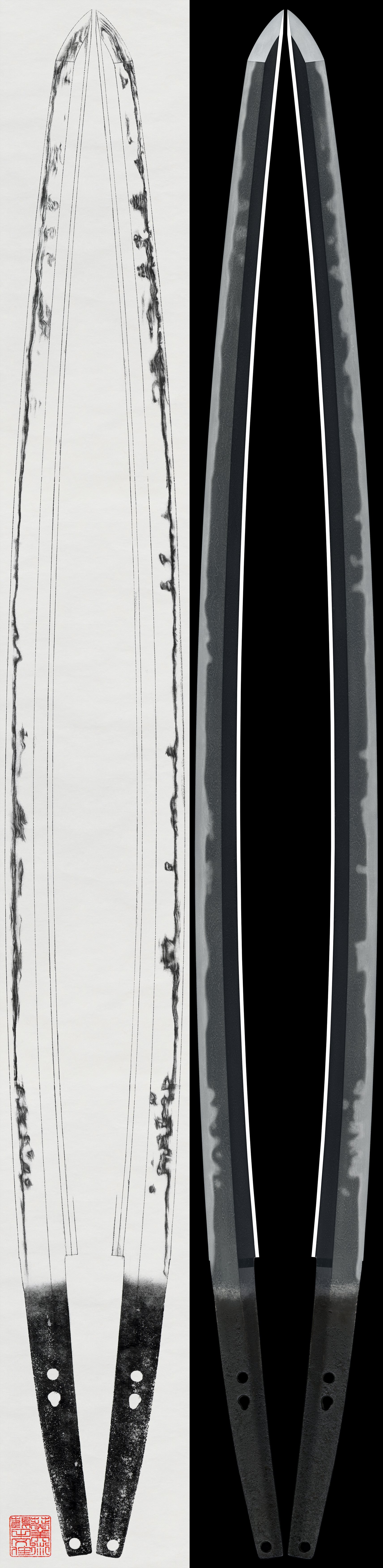
This is a katana made by Saito Kiyohito in the late Edo period (Keio 3, 1867). It has a blade length of 70.7cm and a sori of 2.0cm. The sword is designated as a Juyo Token by the NBTHK.

NBTHK Setsumei

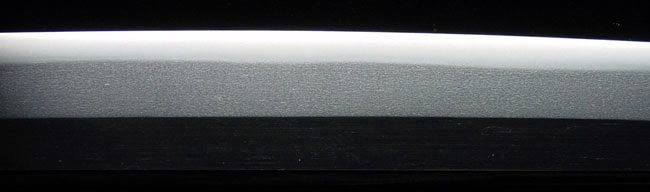
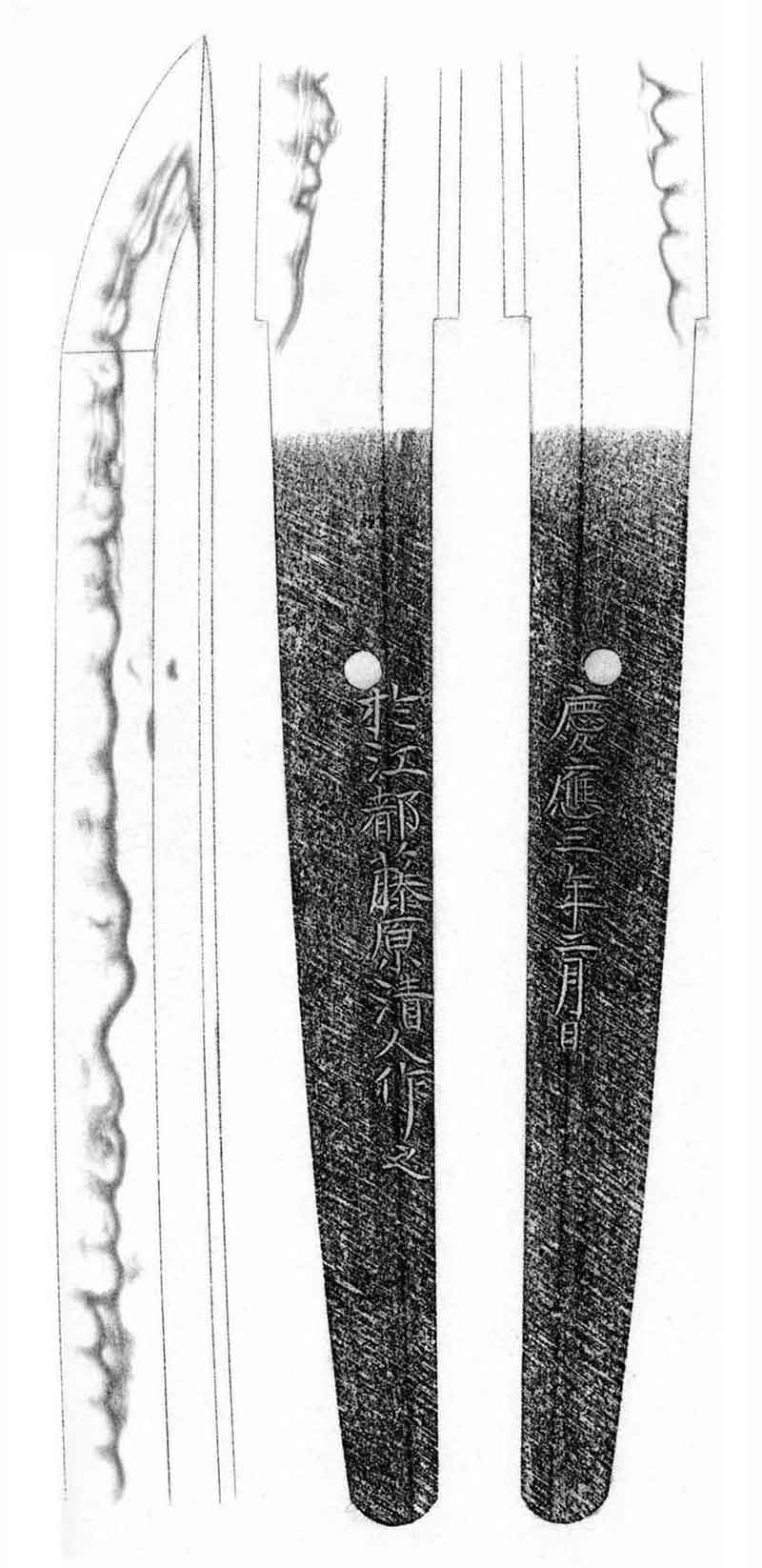
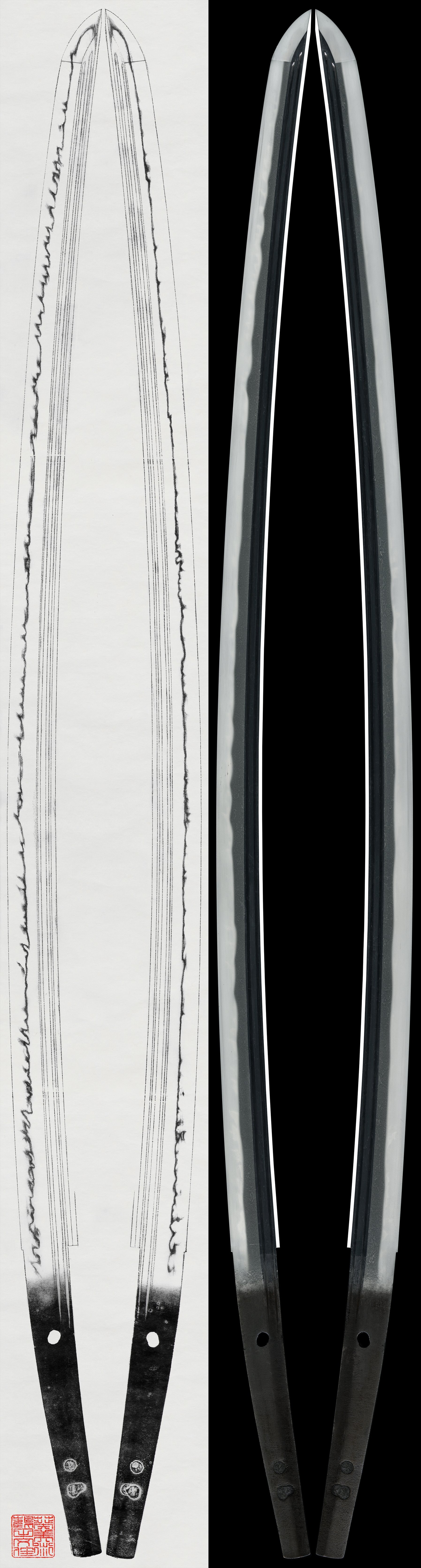
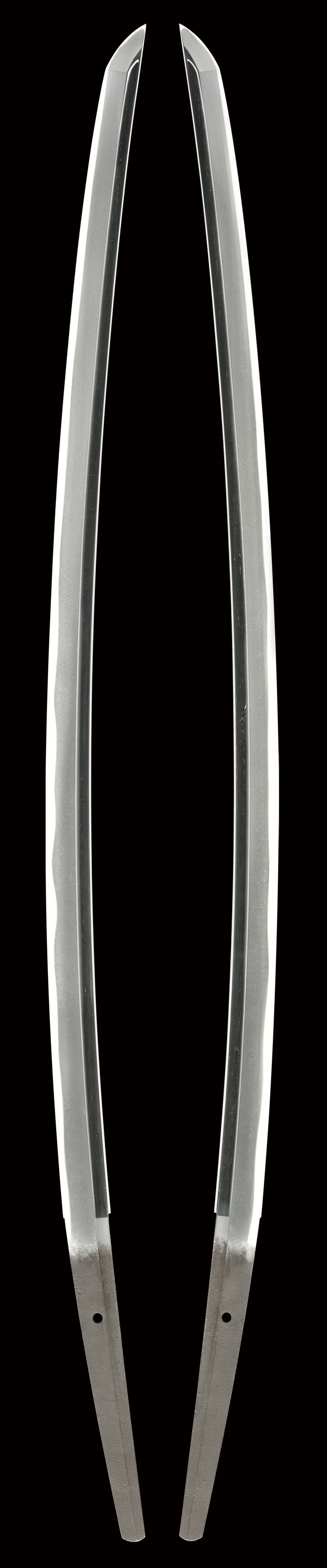
Jūyō-Tōken, 51st Session — Designated October 13, 2005 Katana, mei: Kiyohito (清人) Measurements Nagasa 70.7 cm, sori 2.0 cm, motohaba 3.35 cm, kissaki-nagasa 5.5 cm, nakago-nagasa 20.5 cm, nakago-sori extremely slight Description Keijō: shinogi-zukuri, iori-mune; wide mihaba with little difference between moto and saki width; comparatively narrow shinogi-haba for the overall width; little hiraniku; with a sense of funbari; deep sori with a tendency toward sakizori; ō-kissaki; the fukura is withered (kare). Kitae: itame-hada mixed with mokume and nagare-hada; thick ji-nie; somewhat coarse ji-nie appearing unevenly; fine chikei entering well. Hamon: gunome-midare mixing rounded-headed elements, angular elements, small gunome, and slightly pointed elements; long ashi entering vigorously; mixed with yō; the nioi is somewhat uneven; thick nie with somewhat coarse nie mixed in and uneven; here and there rounded “jewels” (tama) that look like places where the temper has dropped out (shima-ba) are seen; mixed with hotsure and yubashiri-like nijūba; in the lower half, kinsuji and sunagashi run long. Bōshi: midare-komi; on the omote the point is slightly pointed, and on the ura it becomes notare and turns back in small maru with a Jizō-like flavor; both sides show hakikake; the omote shows particularly strong hakikake and contains kinsuji. Horimono: None. Nakago: ubu; kurijiri; sujikai yasurime; one mekugi-ana; a long signature on the omote below the mekugi-ana toward the mune side, and a corresponding date inscription on the ura. Artisan Fujiwara Kiyohito (藤原清人), i.e., Saitō Ichirō Kiyohito (斎藤一郎清人) Era Keiō 3 (1867), second month (day unspecified) Explanation Saitō Ichirō Kiyohito was born in Bunsei 10 (1827) at Ōizumi-shō in Shōnai, Ushū (present-day Atsumi Onsen). It is said that his family operated a hot-springs inn there. In the fourth month of Ka’ei 5 (1852), he resolved to go to Edo and became a disciple of Minamoto Kiyomaro. This apprenticeship is said to have been arranged through the assistance of the Shōnai-born metalworker Funada Ikkin. In the eleventh month of Ka’ei 7 (1854), his teacher Kiyomaro committed suicide, so Kiyohito’s period of training amounted to little more than two years; nevertheless, he studied well and inherited his teacher’s manner. Thereafter, Kiyohito’s reputation was enhanced by the fact that he fully repaid the outstanding debts left by Kiyomaro. After Kiyomaro’s death, Kiyohito lived and worked at Yotsuya Iga-chō until Ansei 2 (1855), then from around Bunkyū 2 (1862) moved to Kanda Ogawa-chō, continuing to make swords. In the seventh month of Keiō 3 (1867) he received the court title Buzen no Kami. After that he continued forging while traveling back and forth to his home region. In the eighth month of Meiji 3 (1870), when the government prohibited the wearing of swords, he abandoned the smith’s path, returned to Atsumi in his home province, and spent his later years as proprietor of the inn. He died on August 24, Meiji 34 (1901), aged seventy-five. His workmanship shows two principal manners: a Kiyomaro-inherited style of midare-ba, and Kiyohito’s own distinctive Yamato-tradition suguha. This katana is an excellent example of the former. The forging is itame mixed with mokume and nagare, with thick ji-nie; somewhat coarse ji-nie appears unevenly, and fine chikei enters well. The hamon is a gunome-midare in which rounded-headed elements, angular elements, small gunome, and slightly pointed elements mingle together; long ashi enter vigorously, with yō interspersed. The nioi is somewhat uneven; nie forms thickly, with somewhat coarse nie mixed in and appearing unevenly. It also shows hotsure, and yubashiri-like nijūba; in the lower half, kinsuji and sunagashi run long. The bōshi is midare-komi, and on the omote it becomes pointed and ends in strong hakikake. Compared to Kiyohito’s usual works, the tempered area in the lower half here is somewhat more assertive and rough in feeling, and accordingly the kinsuji and sunagashi stand out all the more, giving the piece a bold, spirited character. Moreover, the wide mihaba, lack of hiraniku, ō-kissaki, and withered fukura are distinctive forms particular to the Kiyomaro lineage, producing a grand and powerful impression. This is a fine work in which Kiyohito’s true strengths are fully manifested. Finally, the date inscription “Keiō 3, second month, ” falls immediately before his receipt of the title “Buzen no Kami,” and is therefore also valuable as documentary material.

NihontoWatch MonNihontoWatch
MarketAuctionsEncyclopedia
Swords›Musashi›Katana: Saito Kiyohito
katanaJūyō
Kiyomaro Kiyohito

Katana: Saito Kiyohito

mei · Bunkyu (1861-1864) · nagasa 70.7cm · sori 2cm

Price on request
Visit seller website →
Kiyomaro Kiyohito — 1 of 6
Kiyomaro Kiyohito — 2 of 6
Kiyomaro Kiyohito — 3 of 6
Kiyomaro Kiyohito — 4 of 6
Kiyomaro Kiyohito — 5 of 6
Kiyomaro Kiyohito — 6 of 6
1 / 6
1 / 6
Kiyomaro Kiyohito — 1 of 6Kiyomaro Kiyohito — 2 of 6Kiyomaro Kiyohito — 3 of 6Kiyomaro Kiyohito — 4 of 6Kiyomaro Kiyohito — 5 of 6Kiyomaro Kiyohito — 6 of 6
Measurements & details
Smith
Kiyomaro Kiyohito
Type
Katana
Period
Bunkyu (1861-1864)
Province
Musashi
Signature
Signed
Measurements
Nagasa 70.7cmSori 2cmMotohaba 3.1cmSakihaba 2.35cmKasane 0.7cm
Description

This is a katana made by Saito Kiyohito in the late Edo period (Keio 3, 1867). It has a blade length of 70.7cm and a sori of 2.0cm. The sword is designated as a Juyo Token by the NBTHK.

NBTHK Zufu Commentary

Juyo #51

AI translation — may contain errors

-, 51st Session — Designated October 13, 2005

, : Kiyohito (清人)

Measurements 70.7 cm, 2.0 cm, 3.35 cm, 5.5 cm, 20.5 cm, extremely slight

Description Keijō: , ; wide with little difference between and width; comparatively narrow for the overall width; little ; with a sense of ; deep with a tendency toward ; ; the is withered (). : mixed with and ; thick ; somewhat coarse appearing unevenly; fine entering well. : mixing rounded-headed elements, angular elements, small , and slightly pointed elements; long entering vigorously; mixed with ; the is somewhat uneven; thick with somewhat coarse mixed in and uneven; here and there rounded “jewels” () that look like places where the temper has dropped out () are seen; mixed with and -like ; in the lower half, and run long. : ; on the the point is slightly pointed, and on the it becomes and turns back in small with a Jizō-like flavor; both sides show ; the shows particularly strong and contains . : None. : ; ; ; one ; a long signature on the below the toward the side, and a corresponding date inscription on the .

Artisan Fujiwara Kiyohito (藤原清人), i.e., Saitō Ichirō Kiyohito (斎藤一郎清人)

Era Keiō 3 (1867), second month (day unspecified)

Explanation Saitō Ichirō Kiyohito was born in Bunsei 10 (1827) at Ōizumi-shō in Shōnai, Ushū (present-day Atsumi Onsen). It is said that his family operated a hot-springs inn there. In the fourth month of Ka’ei 5 (1852), he resolved to go to and became a disciple of Minamoto Kiyomaro. This apprenticeship is said to have been arranged through the assistance of the Shōnai-born metalworker Funada Ikkin.

In the eleventh month of Ka’ei 7 (1854), his teacher Kiyomaro committed suicide, so Kiyohito’s period of training amounted to little more than two years; nevertheless, he studied well and inherited his teacher’s manner. Thereafter, Kiyohito’s reputation was enhanced by the fact that he fully repaid the outstanding debts left by Kiyomaro. After Kiyomaro’s death, Kiyohito lived and worked at Yotsuya Iga-chō until Ansei 2 (1855), then from around Bunkyū 2 (1862) moved to Kanda Ogawa-chō, continuing to make swords. In the seventh month of Keiō 3 (1867) he received the court title Buzen no Kami.

After that he continued forging while traveling back and forth to his home region. In the eighth month of Meiji 3 (1870), when the government prohibited the wearing of swords, he abandoned the smith’s path, returned to Atsumi in his home province, and spent his later years as proprietor of the inn. He died on August 24, Meiji 34 (1901), aged seventy-five. His workmanship shows two principal manners: a Kiyomaro-inherited style of -ba, and Kiyohito’s own distinctive Yamato-tradition .

This is an excellent example of the former. The forging is mixed with and , with thick ; somewhat coarse appears unevenly, and fine enters well. The is a in which rounded-headed elements, angular elements, small , and slightly pointed elements mingle together; long enter vigorously, with interspersed. The is somewhat uneven; forms thickly, with somewhat coarse mixed in and appearing unevenly. It also shows , and -like ; in the lower half, and run long. The is , and on the it becomes pointed and ends in strong .

Compared to Kiyohito’s usual works, the tempered area in the lower half here is somewhat more assertive and rough in feeling, and accordingly the and stand out all the more, giving the piece a bold, spirited character. Moreover, the wide , lack of , , and withered are distinctive forms particular to the Kiyomaro lineage, producing a grand and powerful impression. This is a fine work in which Kiyohito’s true strengths are fully manifested.

Finally, the date inscription “Keiō 3, second month, [day]” falls immediately before his receipt of the title “Buzen no Kami,” and is therefore also valuable as documentary material.
NBTHK Certificate
Jūyō Tōken重要刀剣
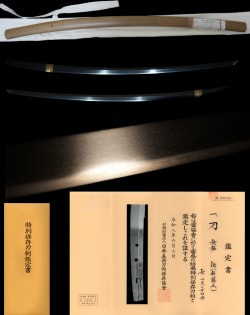
Important Sword
›

A blade of top-grade workmanship and condition, formally judged to rank with a nationally recognized Important Art Object (Jūyō Bijutsuhin). Awarded only at the NBTHK’s competitive annual examination.

Of Japan’s roughly 2.5 million registered swords, only 12,307 (about 1 in 203) have ever attained Jūyō.

About the NBTHK›

The NBTHK (Nihon Bijutsu Tōken Hozon Kyōkai, the Society for the Preservation of Japanese Art Swords) is a public-interest incorporated foundation founded in 1948 and supervised by Japan’s Agency for Cultural Affairs (Bunkachō); it is based at the Japanese Sword Museum in Tokyo. Its expert panels physically examine each submitted work (shinsa) and issue a certificate (kanteishō) ranking it by artistic and historical merit. NBTHK papers are the most widely recognized standard of authentication for Japanese swords and fittings.

NBTHK official site→
Seller
T
Tsuruginoya
🇯🇵Ships from Japan
›
✓Verified dealertsuruginoya.com
✓Ships worldwide✓English supportWire transferPayPalCredit card
Return policy

Returns accepted within 8 days of receipt (cooling-off). Excludes items with alterations, exhibitions, or photography; return shipping is customer's responsibility. No returns/refunds for overseas deliveries.

View all of Tsuruginoya’s listings→View this item on the dealer’s site→

Swords

  • Katana
  • Wakizashi
  • Tantō
  • Tachi
  • Naginata
  • Yari

Fittings

  • Tsuba
  • Fuchi-Kashira
  • Kozuka
  • Menuki

By Certification

  • Tokujū
  • Jūyō
  • Tokuho
  • Hozon

Resources

  • Dealer Directory
  • Artist Directory
  • Glossary
  • Browse All
Nihontowatch© 2026
TermsPrivacyCookiesAbout

Description

This is a katana made by Saito Kiyohito in the late Edo period (Keio 3, 1867). It has a blade length of 70.7cm and a sori of 2.0cm. The sword is designated as a Juyo Token by the NBTHK.

NBTHK Setsumei

Jūyō-Tōken, 51st Session — Designated October 13, 2005 Katana, mei: Kiyohito (清人) Measurements Nagasa 70.7 cm, sori 2.0 cm, motohaba 3.35 cm, kissaki-nagasa 5.5 cm, nakago-nagasa 20.5 cm, nakago-sori extremely slight Description Keijō: shinogi-zukuri, iori-mune; wide mihaba with little difference between moto and saki width; comparatively narrow shinogi-haba for the overall width; little hiraniku; with a sense of funbari; deep sori with a tendency toward sakizori; ō-kissaki; the fukura is withered (kare). Kitae: itame-hada mixed with mokume and nagare-hada; thick ji-nie; somewhat coarse ji-nie appearing unevenly; fine chikei entering well. Hamon: gunome-midare mixing rounded-headed elements, angular elements, small gunome, and slightly pointed elements; long ashi entering vigorously; mixed with yō; the nioi is somewhat uneven; thick nie with somewhat coarse nie mixed in and uneven; here and there rounded “jewels” (tama) that look like places where the temper has dropped out (shima-ba) are seen; mixed with hotsure and yubashiri-like nijūba; in the lower half, kinsuji and sunagashi run long. Bōshi: midare-komi; on the omote the point is slightly pointed, and on the ura it becomes notare and turns back in small maru with a Jizō-like flavor; both sides show hakikake; the omote shows particularly strong hakikake and contains kinsuji. Horimono: None. Nakago: ubu; kurijiri; sujikai yasurime; one mekugi-ana; a long signature on the omote below the mekugi-ana toward the mune side, and a corresponding date inscription on the ura. Artisan Fujiwara Kiyohito (藤原清人), i.e., Saitō Ichirō Kiyohito (斎藤一郎清人) Era Keiō 3 (1867), second month (day unspecified) Explanation Saitō Ichirō Kiyohito was born in Bunsei 10 (1827) at Ōizumi-shō in Shōnai, Ushū (present-day Atsumi Onsen). It is said that his family operated a hot-springs inn there. In the fourth month of Ka’ei 5 (1852), he resolved to go to Edo and became a disciple of Minamoto Kiyomaro. This apprenticeship is said to have been arranged through the assistance of the Shōnai-born metalworker Funada Ikkin. In the eleventh month of Ka’ei 7 (1854), his teacher Kiyomaro committed suicide, so Kiyohito’s period of training amounted to little more than two years; nevertheless, he studied well and inherited his teacher’s manner. Thereafter, Kiyohito’s reputation was enhanced by the fact that he fully repaid the outstanding debts left by Kiyomaro. After Kiyomaro’s death, Kiyohito lived and worked at Yotsuya Iga-chō until Ansei 2 (1855), then from around Bunkyū 2 (1862) moved to Kanda Ogawa-chō, continuing to make swords. In the seventh month of Keiō 3 (1867) he received the court title Buzen no Kami. After that he continued forging while traveling back and forth to his home region. In the eighth month of Meiji 3 (1870), when the government prohibited the wearing of swords, he abandoned the smith’s path, returned to Atsumi in his home province, and spent his later years as proprietor of the inn. He died on August 24, Meiji 34 (1901), aged seventy-five. His workmanship shows two principal manners: a Kiyomaro-inherited style of midare-ba, and Kiyohito’s own distinctive Yamato-tradition suguha. This katana is an excellent example of the former. The forging is itame mixed with mokume and nagare, with thick ji-nie; somewhat coarse ji-nie appears unevenly, and fine chikei enters well. The hamon is a gunome-midare in which rounded-headed elements, angular elements, small gunome, and slightly pointed elements mingle together; long ashi enter vigorously, with yō interspersed. The nioi is somewhat uneven; nie forms thickly, with somewhat coarse nie mixed in and appearing unevenly. It also shows hotsure, and yubashiri-like nijūba; in the lower half, kinsuji and sunagashi run long. The bōshi is midare-komi, and on the omote it becomes pointed and ends in strong hakikake. Compared to Kiyohito’s usual works, the tempered area in the lower half here is somewhat more assertive and rough in feeling, and accordingly the kinsuji and sunagashi stand out all the more, giving the piece a bold, spirited character. Moreover, the wide mihaba, lack of hiraniku, ō-kissaki, and withered fukura are distinctive forms particular to the Kiyomaro lineage, producing a grand and powerful impression. This is a fine work in which Kiyohito’s true strengths are fully manifested. Finally, the date inscription “Keiō 3, second month, ” falls immediately before his receipt of the title “Buzen no Kami,” and is therefore also valuable as documentary material.
NihontoWatch MonNihontoWatch
MarketAuctionsEncyclopedia
Swords›Musashi›Katana: Saito Kiyohito
katanaJūyō
Kiyomaro Kiyohito

Katana: Saito Kiyohito

mei · Bunkyu (1861-1864) · nagasa 70.7cm · sori 2cm

Price on request
Visit seller website →
Kiyomaro Kiyohito — 1 of 6
Kiyomaro Kiyohito — 2 of 6
Kiyomaro Kiyohito — 3 of 6
Kiyomaro Kiyohito — 4 of 6
Kiyomaro Kiyohito — 5 of 6
Kiyomaro Kiyohito — 6 of 6
1 / 6
1 / 6
Kiyomaro Kiyohito — 1 of 6Kiyomaro Kiyohito — 2 of 6Kiyomaro Kiyohito — 3 of 6Kiyomaro Kiyohito — 4 of 6Kiyomaro Kiyohito — 5 of 6Kiyomaro Kiyohito — 6 of 6
Measurements & details
Smith
Kiyomaro Kiyohito
Type
Katana
Period
Bunkyu (1861-1864)
Province
Musashi
Signature
Signed
Measurements
Nagasa 70.7cmSori 2cmMotohaba 3.1cmSakihaba 2.35cmKasane 0.7cm
Description

This is a katana made by Saito Kiyohito in the late Edo period (Keio 3, 1867). It has a blade length of 70.7cm and a sori of 2.0cm. The sword is designated as a Juyo Token by the NBTHK.

NBTHK Zufu Commentary

Juyo #51

AI translation — may contain errors

-, 51st Session — Designated October 13, 2005

, : Kiyohito (清人)

Measurements 70.7 cm, 2.0 cm, 3.35 cm, 5.5 cm, 20.5 cm, extremely slight

Description Keijō: , ; wide with little difference between and width; comparatively narrow for the overall width; little ; with a sense of ; deep with a tendency toward ; ; the is withered (). : mixed with and ; thick ; somewhat coarse appearing unevenly; fine entering well. : mixing rounded-headed elements, angular elements, small , and slightly pointed elements; long entering vigorously; mixed with ; the is somewhat uneven; thick with somewhat coarse mixed in and uneven; here and there rounded “jewels” () that look like places where the temper has dropped out () are seen; mixed with and -like ; in the lower half, and run long. : ; on the the point is slightly pointed, and on the it becomes and turns back in small with a Jizō-like flavor; both sides show ; the shows particularly strong and contains . : None. : ; ; ; one ; a long signature on the below the toward the side, and a corresponding date inscription on the .

Artisan Fujiwara Kiyohito (藤原清人), i.e., Saitō Ichirō Kiyohito (斎藤一郎清人)

Era Keiō 3 (1867), second month (day unspecified)

Explanation Saitō Ichirō Kiyohito was born in Bunsei 10 (1827) at Ōizumi-shō in Shōnai, Ushū (present-day Atsumi Onsen). It is said that his family operated a hot-springs inn there. In the fourth month of Ka’ei 5 (1852), he resolved to go to and became a disciple of Minamoto Kiyomaro. This apprenticeship is said to have been arranged through the assistance of the Shōnai-born metalworker Funada Ikkin.

In the eleventh month of Ka’ei 7 (1854), his teacher Kiyomaro committed suicide, so Kiyohito’s period of training amounted to little more than two years; nevertheless, he studied well and inherited his teacher’s manner. Thereafter, Kiyohito’s reputation was enhanced by the fact that he fully repaid the outstanding debts left by Kiyomaro. After Kiyomaro’s death, Kiyohito lived and worked at Yotsuya Iga-chō until Ansei 2 (1855), then from around Bunkyū 2 (1862) moved to Kanda Ogawa-chō, continuing to make swords. In the seventh month of Keiō 3 (1867) he received the court title Buzen no Kami.

After that he continued forging while traveling back and forth to his home region. In the eighth month of Meiji 3 (1870), when the government prohibited the wearing of swords, he abandoned the smith’s path, returned to Atsumi in his home province, and spent his later years as proprietor of the inn. He died on August 24, Meiji 34 (1901), aged seventy-five. His workmanship shows two principal manners: a Kiyomaro-inherited style of -ba, and Kiyohito’s own distinctive Yamato-tradition .

This is an excellent example of the former. The forging is mixed with and , with thick ; somewhat coarse appears unevenly, and fine enters well. The is a in which rounded-headed elements, angular elements, small , and slightly pointed elements mingle together; long enter vigorously, with interspersed. The is somewhat uneven; forms thickly, with somewhat coarse mixed in and appearing unevenly. It also shows , and -like ; in the lower half, and run long. The is , and on the it becomes pointed and ends in strong .

Compared to Kiyohito’s usual works, the tempered area in the lower half here is somewhat more assertive and rough in feeling, and accordingly the and stand out all the more, giving the piece a bold, spirited character. Moreover, the wide , lack of , , and withered are distinctive forms particular to the Kiyomaro lineage, producing a grand and powerful impression. This is a fine work in which Kiyohito’s true strengths are fully manifested.

Finally, the date inscription “Keiō 3, second month, [day]” falls immediately before his receipt of the title “Buzen no Kami,” and is therefore also valuable as documentary material.
NBTHK Certificate
Jūyō Tōken重要刀剣
Important Sword
›

A blade of top-grade workmanship and condition, formally judged to rank with a nationally recognized Important Art Object (Jūyō Bijutsuhin). Awarded only at the NBTHK’s competitive annual examination.

Of Japan’s roughly 2.5 million registered swords, only 12,307 (about 1 in 203) have ever attained Jūyō.

About the NBTHK›

The NBTHK (Nihon Bijutsu Tōken Hozon Kyōkai, the Society for the Preservation of Japanese Art Swords) is a public-interest incorporated foundation founded in 1948 and supervised by Japan’s Agency for Cultural Affairs (Bunkachō); it is based at the Japanese Sword Museum in Tokyo. Its expert panels physically examine each submitted work (shinsa) and issue a certificate (kanteishō) ranking it by artistic and historical merit. NBTHK papers are the most widely recognized standard of authentication for Japanese swords and fittings.

NBTHK official site→
Seller
T
Tsuruginoya
🇯🇵Ships from Japan
›
✓Verified dealertsuruginoya.com
✓Ships worldwide✓English supportWire transferPayPalCredit card
Return policy

Returns accepted within 8 days of receipt (cooling-off). Excludes items with alterations, exhibitions, or photography; return shipping is customer's responsibility. No returns/refunds for overseas deliveries.

View all of Tsuruginoya’s listings→View this item on the dealer’s site→

Swords

  • Katana
  • Wakizashi
  • Tantō
  • Tachi
  • Naginata
  • Yari

Fittings

  • Tsuba
  • Fuchi-Kashira
  • Kozuka
  • Menuki

By Certification

  • Tokujū
  • Jūyō
  • Tokuho
  • Hozon

Resources

  • Dealer Directory
  • Artist Directory
  • Glossary
  • Browse All
Nihontowatch© 2026
TermsPrivacyCookiesAbout
NihontoWatch Mon

NihontoWatch

MarketAuctions
Encyclopedia
NihontoWatch Mon

NihontoWatch

MarketAuctions
Encyclopedia