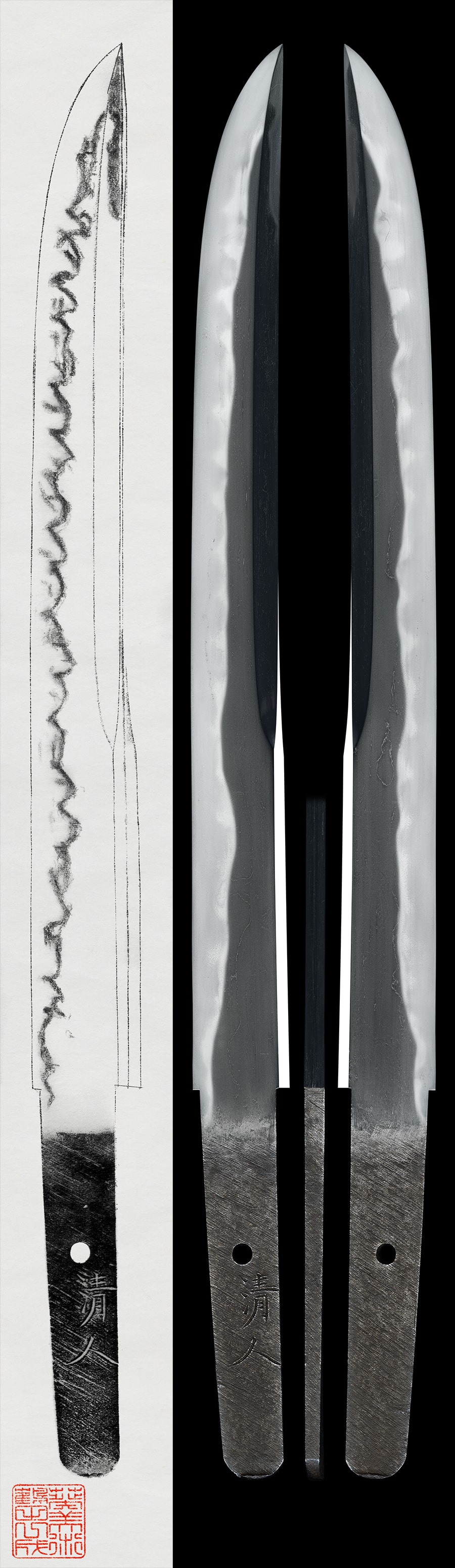
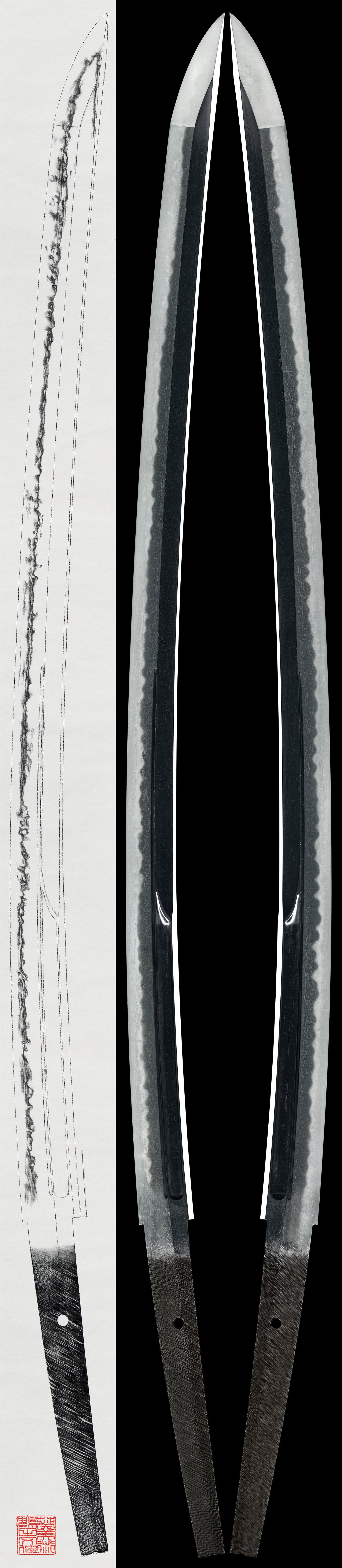
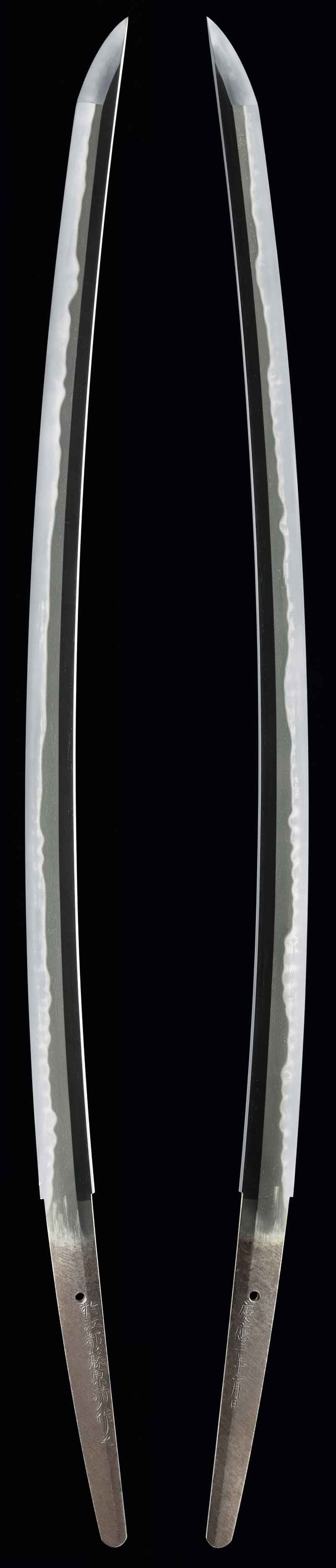
Yamaura Masao (山浦真雄) was born in Bunka 1 (1804) at Akaiwa village in the Komoro district of Shinano, the eldest son of the country gentry-warrior (gōshi) Yamaura Nobukaze (山浦信風), and his younger brother was Minamoto Kiyomaro (清麿), the most celebrated swordsmith of the late revival. His personal name was Noboru (昇). In Bunsei 12 (1829), in his twenties, he entered together with Kiyomaro the school of the Ueda-domain smith Kawamura Toshitaka (河村寿隆), and from that shared apprenticeship the two brothers set out on the path. He signed first as Kanri (完利) and Jushō (寿昌), then took the names Masao (正雄) and Masao (真雄), and in his late years changed his signature again to Toshinaga (寿長); during his Jushō period he used the art-name Tennenshi (天然子), and across the long span of his Masao years the art-names Yūshaken (遊射軒) and others. He lived to an advanced age and died in Meiji 7 (1874) at seventy-one. The published sources fix his development in a single recurring sentence, that his manner, like Kiyomaro's, 「作風は清麿と同じく、寿隆風の丁子に始まって相州伝に転じている」, beginning with in the style of Toshitaka and then turning to Sōshū-den.
It is the Sōshū-den manner of his maturity that the published record calls his favored field, his 得意の相州伝, and it is the work on which his designations rest. Over an he tempers a mixed with and , richly covered in with coarse at times, the and entering, and across it the and run with force; appears in nearly all of his recorded blades and the follow it in the way. The turns back in a with a pointed tendency, at times a , and where the work is at its boldest the point shows vigorous . A residual flavor from the early manner persists into these later blades as a faint admixture, 僅かに丁子風の刃交じり, so that the two phases are never wholly separate but shade one into the other.
The is an that takes thick throughout and draws , at times piling into mokume and and tending to flow into toward the . The published commentary measures him candidly against his brother on exactly this point, observing that 「清麿に較べて地には地景が刃中には砂流し・金筋が少なく出来が及ばない」, that his in the and his and within the hardened area are fewer than Kiyomaro's and the overall quality does not reach his brother's level. Yet on his best blades the activities gather in strength: of one late the sources say 「金筋・砂流しの働きも同工の作としては常以上に豊富であり」, that the and are richer than usual even for this maker, and that 「地景を頻りに交えて地沸の厚くついた強い鍛えがよく」, the frequently interwoven and the thickly gathered into a strong forging.
His two manners answer the development the sources describe, and they answer also to the form of the blade. The early phase is the Toshitaka , a mixed with over an with plentiful , the bright and clear with , the running to ; of one such the sources write 「この刀は真雄の本領が発揮された一口であり、鍛えが非常によい」, that here his true strengths are fully brought forth and the forging is exceptionally good. The mature Sōshū-den is the field of his as much as his , and a characteristic vehicle for it is the with a withered, sharpened (). Of one such blade the published account remarks that 「これは同工によく見られる姿であり」, that this is a form frequently seen in his work, and that 「ふくらの枯れた姿にも同工の特徴がよく表われている」, the characteristic traits of the smith clearly manifest even in that faded silhouette. His signatures track the biography the texts recite, the long inscriptions running from the Masao readings through the formal 山浦昇源正雄 of his commissioned pieces.
Masao's place is settled by his brother and by their shared teacher. He stands at the head of the Yamaura household and at the senior edge of the Kiyomaro circle, the elder who took the instruction and walked the course from Toshitaka's into the revival, and the sources weigh the two brothers as a matter of course, marking where his and fall short of Kiyomaro's while crediting the strong, -laden forging that is his own. His distinction is carried by his own grounded traits rather than by the comparison: the thick and frequent of his , the forceful and of his temper, and the pointed that recurs across his work. Where a blade is wide in the and carries an , the sources call the construction bold and heroic and the whole 「極めて覇気にみちた作である」, a work filled with an exceptionally forceful spirit.
For the collector, Masao is a late name whose record runs through the tier rather than the higher designations; his blades hold no National Treasure or Important Cultural Property standing, and the six on record are -. The provenance that survives is modest and personal, the commissions of the Shinano gentry he served, a of Ka'ei 2 (1849) forged for Aoki Yasuei (青木安栄) among them, the sources noting plainly that 「この刀は青木安栄のために作刀したもの」 and judging its and especially outstanding among his works. As the elder brother of Kiyomaro, whose own blades are rare and closely held, Masao offers a way into the Yamaura workshop and the revival that comes to market from time to time rather than never; a signed or of his appears with patience, and a strong example, well covered in with the and at full strength, is a substantial acquisition for a collector of the bakumatsu masters.