Perry’s arrival in 1853 unraveled the Tokugawa peace and created the first mass demand for working swords in two centuries. Kiyomaro, called the Masamune of Yotsuya, died on its eve; Munetsugu and Yukihide carried the boom to the end.
 NihontoWatchNihontoWatch
Miyakawa Munetsugu was a pupil of Minamoto Kiyomaro's older brother Masao. He received the title of Chikuzen no Kami during the Keio era (Note). He lived through a turbulent era as a retained swordsmith for the Sanada family of the Shinano Matsushiro domain, known for the service of the military scholar and ideologue Sakuma Shozan, but like many other swordsmiths, he was forced to lay down his hammer due to the Haitorei. For that reason, the works left behind are extremely few. This tanto has a small and tight tsukurikomi, likely something that a patriot or activist from the end of the Edo period to the Meiji era would have concealed in their pocket for the purpose of self-protection. The sori is restrained and the kasane is ordinary, a healthy body in kenzen state with no loss from polishing and the ububa remaining. The jitetsu of ko-itame kitae has itame faintly floating in the depths of the steel, yet it is uniform without showing the hahada, fine ji-nie covers the entire surface, and faint yubashiri works in places to glow dimly. The hamon in bright ko-nie deki is a gunome midare-ba mixed with notare starting from a calm yaki-komi below the machi, with faint ashi entering, and the boshi which is shallowly midare-konda is in the Yamaura style, slightly falling and returning in saki-komaru. Sujikai yasuri are present, and a fluent sosho mei similar to Masao is carved. The koshirae attached has a rugged impression with a flared sayajiri, yet it is a refined nomikuchi style with the intervals of the carvings varied from small to large. It is equipped with menuki of futatsu-tomoe mon and a kozuka of delicate design utilizing gold, silver, and suaka hira-zogan on a shakudo ground of Kaga kinko; the fuchi-kashira, koiguchi, otoshi, uragawara, and kojiri are all made of horn in migaki-ji mumon with accurate carving edges, showing a workmanship where skillful technique can be observed. Note... There is a dated work "Oite Raku Gojo-hen Matsushiro Shin Munetsugu tsukuru kore Keio 2 nen 8 gatsu hi". "Ginza Joho" Issue 280.
NihontoWatchOffered by Choshuya


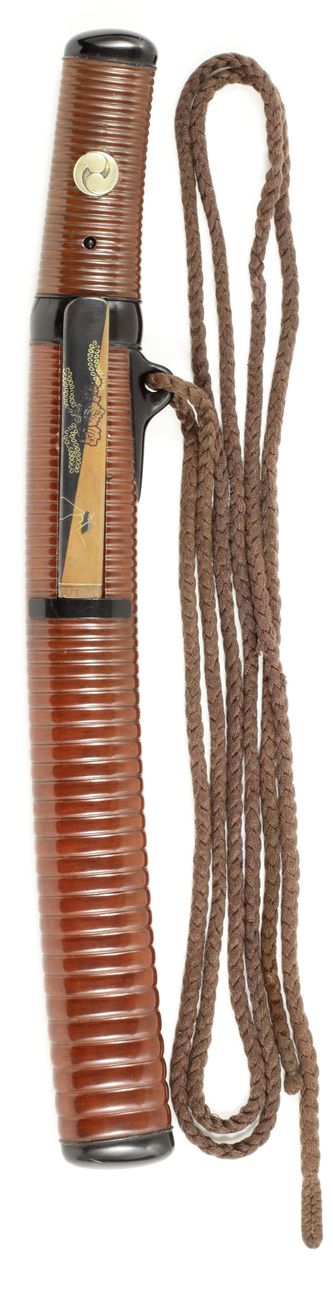
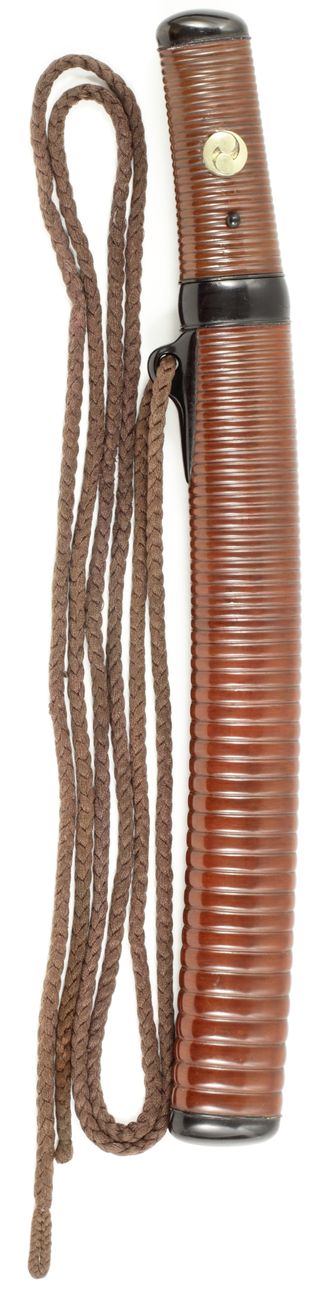



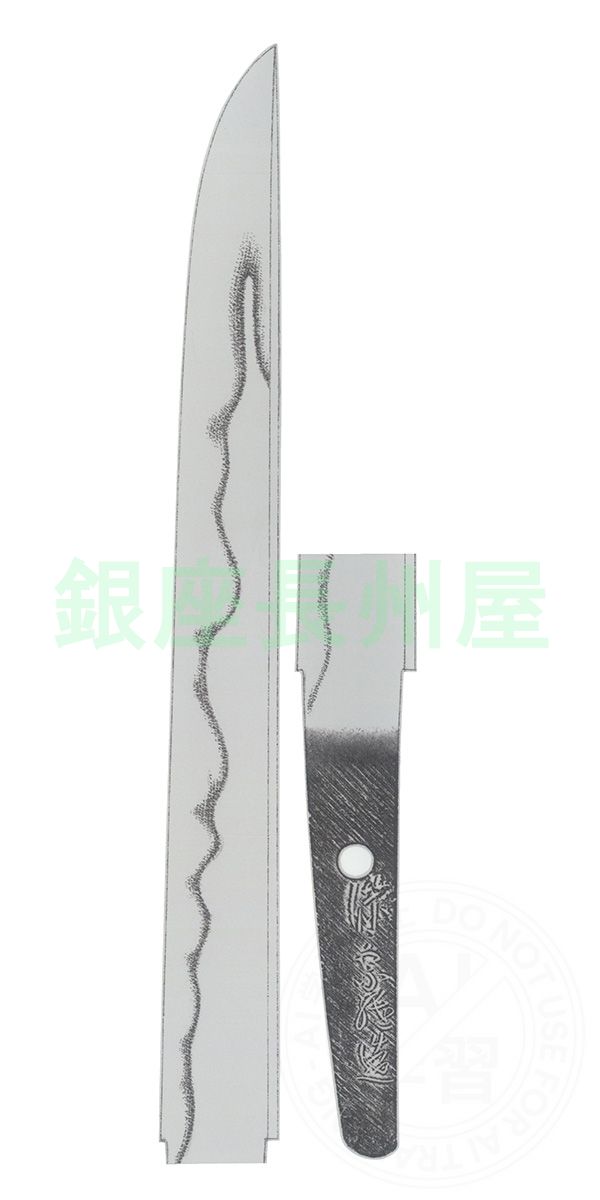
Machine translation from the shop's Japanese · may contain errors ·
Shinshinto · Shinano
Bakumatsu: the last war market
Perry’s arrival in 1853 unraveled the Tokugawa peace and created the first mass demand for working swords in two centuries. Kiyomaro, called the Masamune of Yotsuya, died on its eve; Munetsugu and Yukihide carried the boom to the end.
Certifies a genuine blade worth preserving: a signature confirmed correct, or, if unsigned, an era, province, and school that the NBTHK can reliably identify.
The NBTHK (Nihon Bijutsu Tōken Hozon Kyōkai, the Society for the Preservation of Japanese Art Swords) is a public-interest incorporated foundation founded in 1948 and supervised by Japan’s Agency for Cultural Affairs (Bunkachō); it is based at the Japanese Sword Museum in Tokyo. Its expert panels physically examine each submitted work (shinsa) and issue a certificate (kanteishō) ranking it by artistic and historical merit. NBTHK papers are the most widely recognized standard of authentication for Japanese swords and fittings.
NBTHK official siteIf, due to our fault, the item differs significantly from its proper condition, the item may be returned. Cooling-off is within one week of the item's arrival.
¥1,000,000