 NihontoWatchNihontoWatch
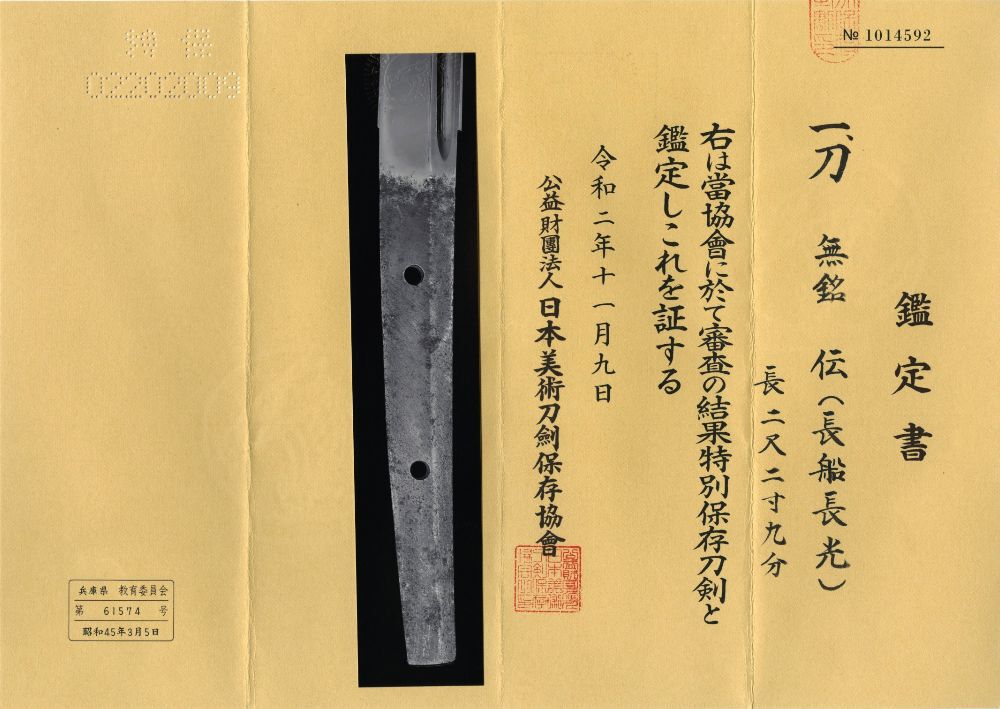
特別保存刀剣 『 伝(長船長光) 』 刀剣種別 『刀・katana』 銘 『無銘(伝)長船長光』 『Osafune NAGAMITSU』 日本刀 鑑定書『日本美術刀剣保存協会 特別保存 刀剣』 NBTHK 『Tokubetsu Hozon Paper』 時代『弘安(鎌倉中期)』 Production age 『1278-1288』 刀剣 位列『古刀最上作』 長光は、長船派の祖である光忠の子で、長船二代目であり、現存する有銘の作品は鎌倉時代の刀工の中で最も多いが、何も出来にむらがなく、技倆の充実していたことが知られる。その作風は大別して、父光忠風を継承した感のある豪壮な造り込みに、華やかな丁字主調の乱れを焼いたものと、身幅が尋常か細身の姿に、直刃調丁字足の入った比較的穏和な出来口の二様が見られる。 この刀は小板目肌が詰んだ鍛えに、地沸がよくついて乱れ映りが鮮明に立ち、刃文は丁字に互の目・小乱れ刃などを交じり、足・葉入りて匂勝ちに小沸つき、帽子は乱れ込んで先丸風に返るなど、地刃共に長光の特色が顕現されており、極めは正しく首肯される。加えて肉置きが良く、柔らかな味を帯びた塩相の深い匂口も特筆される、長光極めの佳品である。 『形状』鎬造、庵棟、身幅・反り尋常で健全、中峰。 『鍛』小板目肌よく練れて見事に詰み、地沸よくつき、地景細かに入り、肌潤い、乱れ映り鮮明に立つ。 『刃文』丁字に互の目・小乱れ刃などを交じり、足・葉入りて、匂勝ち小沸つき、匂口明るく冴える。 『帽子』乱れ込んで先丸風に返る。 『茎』大磨上、先切り、鑢目勝手下がり、目釘穴二、無銘。 『彫』表裏に腰樋を掻き流す。 『附』白鞘 『寸法(Size)』 長さ(Blade length)69.4cm、反り(Sori)1.5cm、 元幅(Width of moto)3.0cm、先幅(Width of saki)2.1cm、 元重(Thickness of moto)0.74cm 先重(Thickness of saki)0.5cm
NihontoWatchOffered by Taiseido
This piece has sold
189 on the market
Get an email when new Osafune School work hits the market.







Bizen-den · Bizen
189 pieces on the market now
No single workshop in the history of Japanese swordmaking grew larger or lasted longer than Osafune, the riverside village in Bizen Province whose name became, across three centuries, a byword for the province's mainline. Its de facto founder was Mitsutada (光忠), working at Osafune in the middle Kamakura period; tradition makes him the son of Chikatada, and the genealogies derive his line from the Ko-Bizen Masatsune group already settled in the village. His blades, bold and imposing with a jigane so refined the sources say it can at a glance suggest Kyoto work, were treasured from old as the swords of commanders, and from his hand the school spread immediately: his sons Nagamitsu (長光) and Sanenaga (眞長), his grandson Kagemitsu (景光), and outward through pupils and collaterals until, by the late Kamakura years, Osafune was less a family than an industry. The line is conventionally read as a three-generation spine, Mitsutada founding it, Nagamitsu setting its classical standard, Kagemitsu bringing both temper and forging to their finished form before handing the manner to his pupil Chikakage (近景), whose echo of the master is so close that signed Kagemitsu blades are sometimes read as Chikakage daimei. What binds the membership is a shared steel before any shared temper. The forging is itame mixed with mokume, tightening on the finest blades into a dense ko-itame; fine ji-nie adheres, chikei enter, and over all of it stands the midare-utsuri that anchors even the most Kyoto-like jigane back to Bizen. On that floor the founding generation tempers a flamboyant choji-midare mixed with gunome: Mitsutada's tadpole-headed kawazuko-choji, Nagamitsu's round-topped plump choji, the deep nioi with ko-nie, the bright nioiguchi. From here the school divides by hand and by era. Sanenaga draws the calm pole, a gentle chu-suguha of tightened nioiguchi; Kagemitsu completes the slanting, square-shouldered kataochi-gunome over a suguha base, the family's last great Kamakura invention, carried on by his close kinsman Kagemasa (景政). The Nanbokucho generation then turns toward Soshu-den: Kanemitsu (兼光), fourth master of the mainline, pioneers a broad notare and is read, with Chogi (長義), as the head of Soden-Bizen, the Bizen wing that worked Soshu nie into a jigane that still throws a Bizen utsuri.
Chogi is called the most un-Bizen of Bizen smiths, his ear-shaped mimigata his tell; around him Nagashige (長重), Yoshikage (義景), Tomomitsu (倫光) and Kanenaga (兼長) press the Soshu side by degrees, while Motoshige (元重), of a separate Hatakeda descent, carries an Aoe-tinged squared, slanting ha. Two generations later the Oei revival returns to Kamakura: Yasumitsu (康光) and Morimitsu (盛光), the twin pillars of Oei-Bizen, revive the tachi shape and the choji temper over a wide-waisted koshibiraki-gunome, both finishing in the pointed rosoku-no-shin (candle-wick) boshi that gives the late date away. For the collector the school is a school of discriminations, and to kantei it is to read those fine partitions. The constant midare-utsuri over a bright ko-itame fixes the province; the boshi then sorts the maker, Mitsutada's pointed midare-komi against Nagamitsu's composed ko-maru Sansaku turn, Kagemitsu's contained return, the candle-wick tongue of Oei. Within a single phase the calls turn on a half-step: Nagamitsu's plump crests against Sanenaga's cooler nioiguchi, Kagemasa's freer play against Kagemitsu's tighter order, Nagashige read out of Chogi by a nie that surpasses his brother's. The standing of the best is matched by their patrimony. Mitsutada, Nagamitsu and Kagemitsu each hold National Treasures and stand at the head of Fujishiro's Sai-jo saku; their named blades, the Daihannya Nagamitsu, the Kogaryu Kagemitsu, the O-Kanemitsu, passed through Nobunaga, Ieyasu, Uesugi Kenshin and the great daimyo houses. Because Nagamitsu and the Nanbokucho masters signed and survived in number, Osafune offers what most peerage names cannot, a deep field of Tokubetsu Juyo and Juyo work that a patient collector may still realistically hold. Through every register the same hand declares itself: the bright steel, the vivid reflection, and a temper that runs, across three centuries, as the spine of Bizen. Learn more →
| Smith | Era | Designated |
|---|---|---|
| Mitsutada光忠 | 1238-1239 | 60 |
| Nagamitsu長光 | 1274-1304 | 254 |
| Kagemitsu景光 | 1303-1336 | 142 |
| Sanenaga眞長 | 1299-1309 | 68 |
| Kanemitsu兼光 | 1323-1370 | 235 |
A Hozon-certified blade judged to show notably superior workmanship and a better state of preservation. The bar is higher: re-tempered blades and most unsigned Muromachi/Edo works are excluded.
The NBTHK (Nihon Bijutsu Tōken Hozon Kyōkai, the Society for the Preservation of Japanese Art Swords) is a public-interest incorporated foundation founded in 1948 and supervised by Japan’s Agency for Cultural Affairs (Bunkachō); it is based at the Japanese Sword Museum in Tokyo. Its expert panels physically examine each submitted work (shinsa) and issue a certificate (kanteishō) ranking it by artistic and historical merit. NBTHK papers are the most widely recognized standard of authentication for Japanese swords and fittings.
NBTHK official siteWhen the item reaches you, please check immediately for damage and that it matches your order. We bear the shipping cost for a return; please send it freight-collect. Costs other than the item price cannot be refunded.