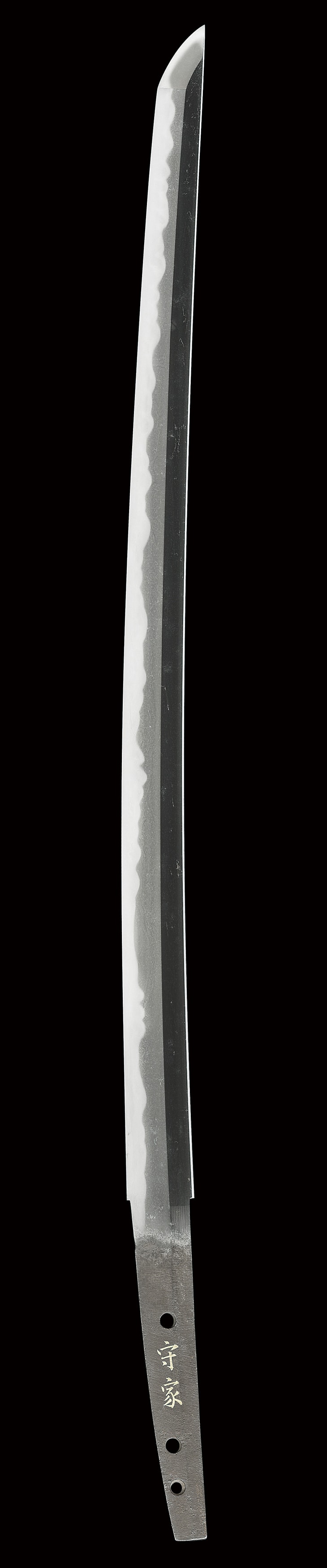
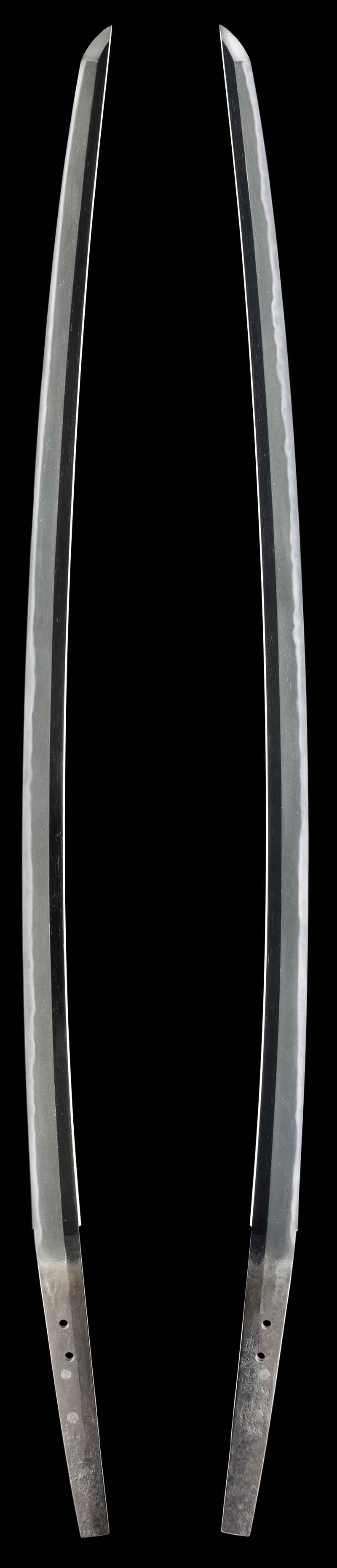
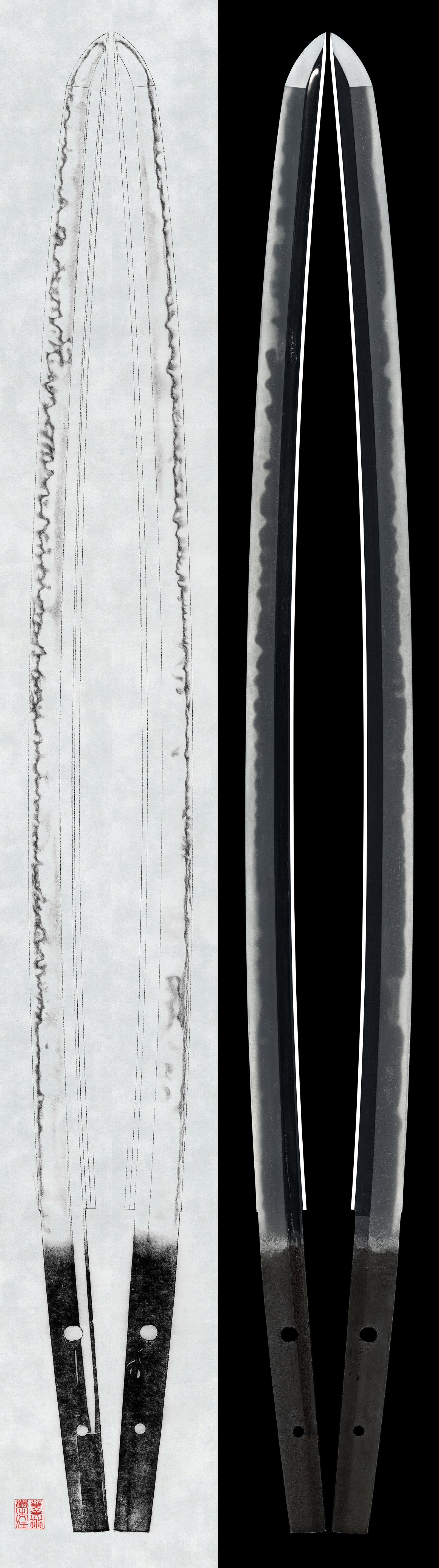
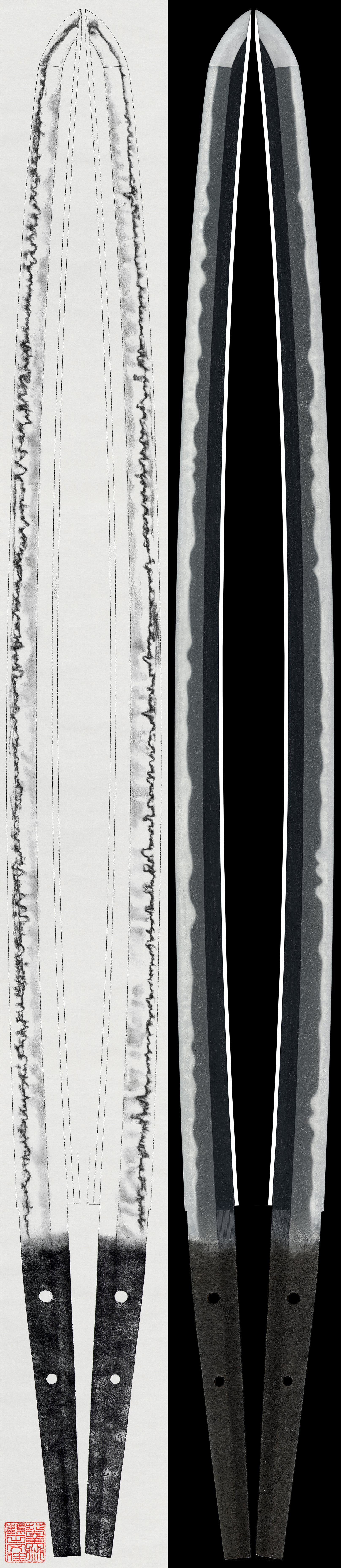
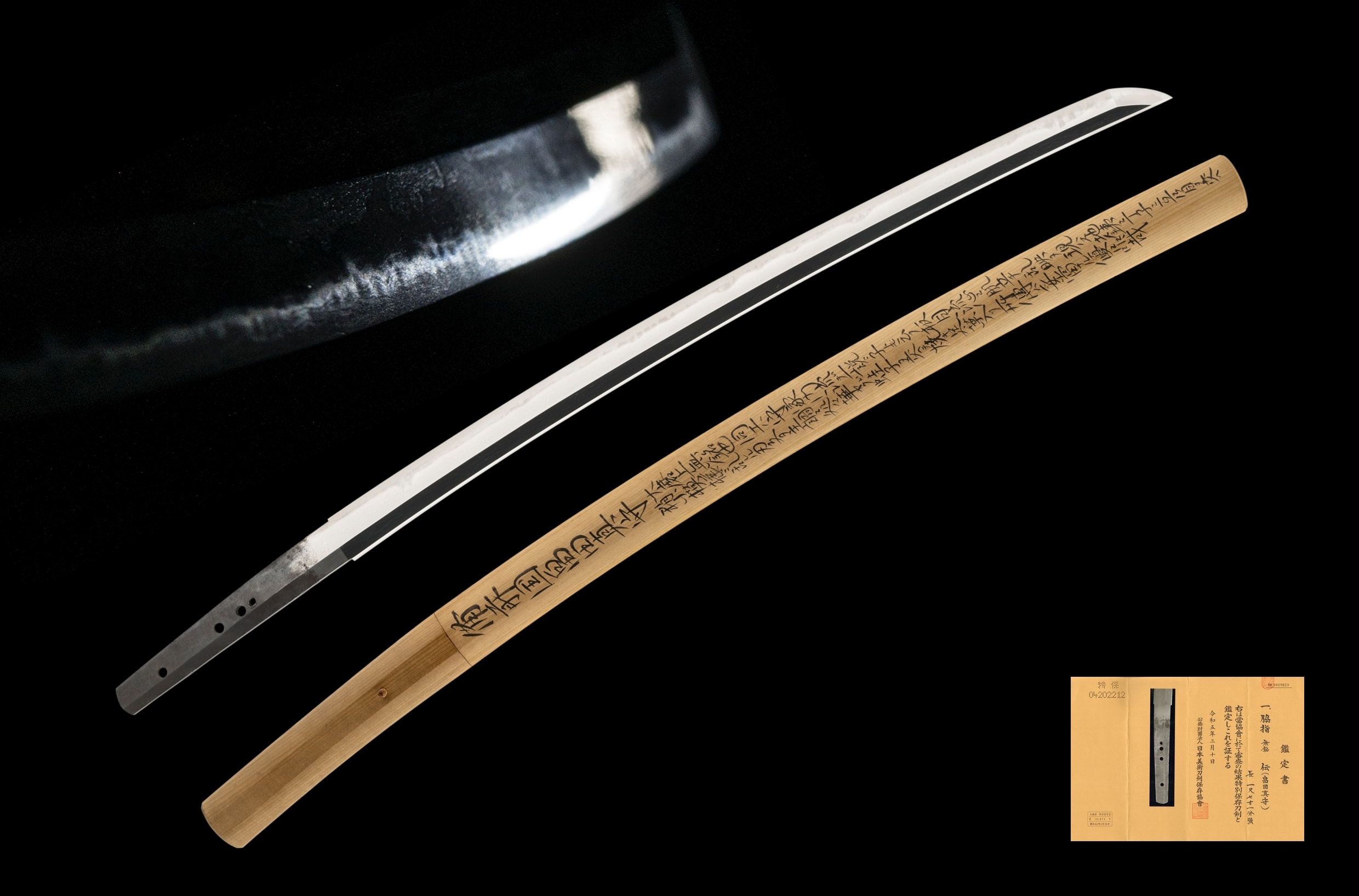
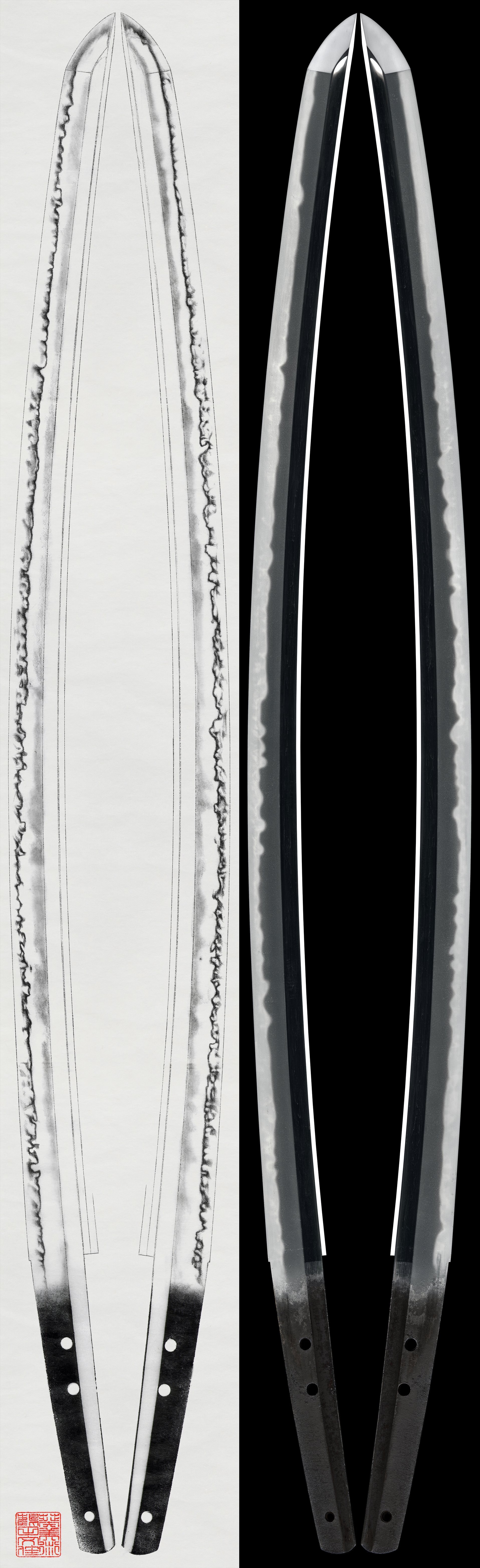
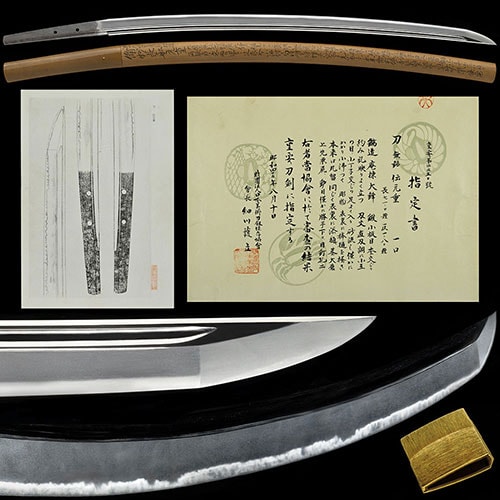
特別保存刀剣 『備前家守(長船家守)』 刀剣種別 『刀』 Katana 無銘 『備前家守(長船家守)』 bizen osafune IEMORI 日本刀 鑑定書『日本美術刀剣保存協会 特別保存 刀剣』 NBTHK 『Tokubetsu Hozon Paper』 時代『南北朝中期 文和頃』 Production age 『AD1352』 備前家守・長船家守は、同名数代おり、名鑑によれば初代を鎌倉末期の畠田派としている。同名を継承しているが、南北朝初期(元徳)からのものを初代、南北朝中期(延文〜永和)のものを二代、南北朝末期(康暦)から室町期(応永末年)のものを三代とされている。初代は畠田派とされ、福岡一文字系と伝う。二代以降は小反り派に分類される。一般的に家守といえば室町期の三代小反りのものが多く、小反り備前派中もっとも名高く大業物にランクされるが、初代・二代の作は比較的稀である。小反りとは、南北朝後期から室町初期において、兼光・元重・長義・大宮などの一派に属さない刀工を一握りにした呼称であり、総体に小模様であることが多い。 この刀は備前家守(長船家守)の無銘作である。本間順治博士により時代は南北朝中期の(文和)とされており、二代を(延文)からとするのであれば、初代家守であり、畠田派という事になる。鍛えは板目によく詰んで肌潤い、地沸が微塵によくつき、地斑を交え地景がよく入り、乱れ映りが鮮明に立ち、刃文は焼高く大互の目に腰開きの互の目丁字・飛び焼き等が交じり、足・葉入り、金筋・砂流し頻りにかかり、小沸がよくつくなどの出来口を示している。大模様で華やかに乱れ乱れ映りがたつ様は、一見福岡一文字を彷彿とさせ、初代とした本間順治博士の極めは首肯される。同工極めの中でも焼に高低がが目立ち覇気がある。出来が優れており、白眉の一振りである。 『形状』鎬造、庵棟、身幅広く・重ね反り共に尋常、中鋒。 『鍛』板目総じてよく詰み、地沸つき、地景入り、乱れ映り鮮明に立つ。 『刃文』焼高く大互の目に腰開きの互の目丁字・飛び焼き等が交じり、大模様に華やかに乱れ、足・葉繁く入り、金筋・砂流し頻りにかかり、匂口明るい。 『帽子』焼き高く乱れ込み、先小丸に浅く返る。 『茎』大磨上、先浅い栗尻、鑢目切り、目釘孔三。 『彫』表裏に棒樋掻き流す。 『附』白鞘 『寸法(Size)』 長さ(Blade length)69.2cm、反り(Sori)1.6cm、 元幅(Width of moto)3cm、先幅(Width of saki)2.2cm、 元重(Thickness of moto)0.7cm 先重(Thickness of saki)0.5cm
 NihontoWatch
mumei · Osafune · Nanbokucho · nagasa 69.2cm · sori 1.6cm
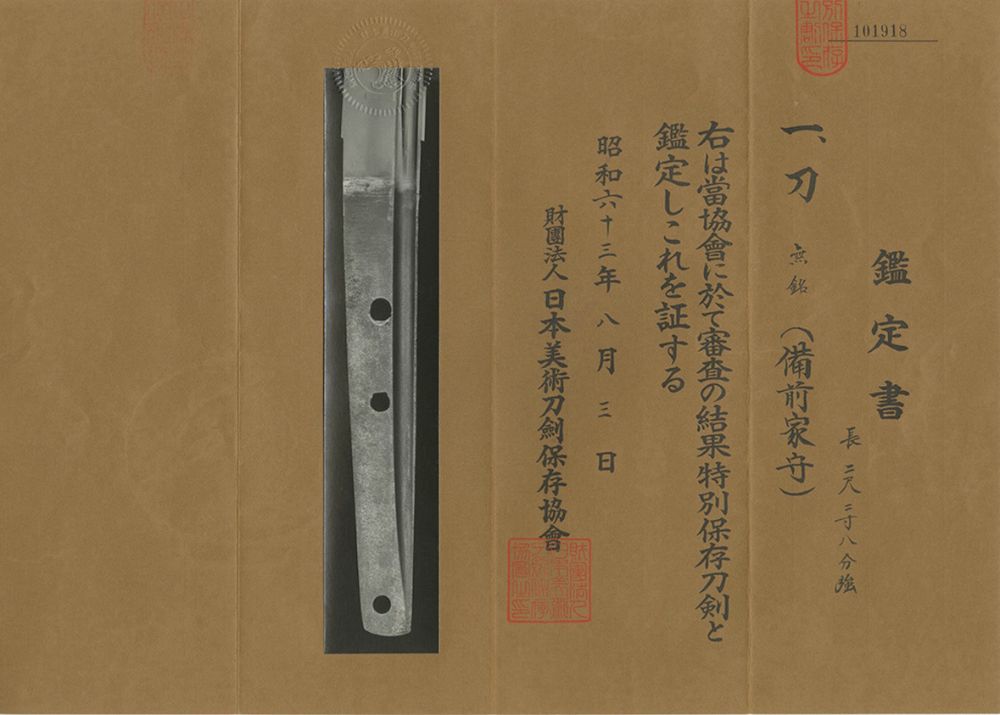
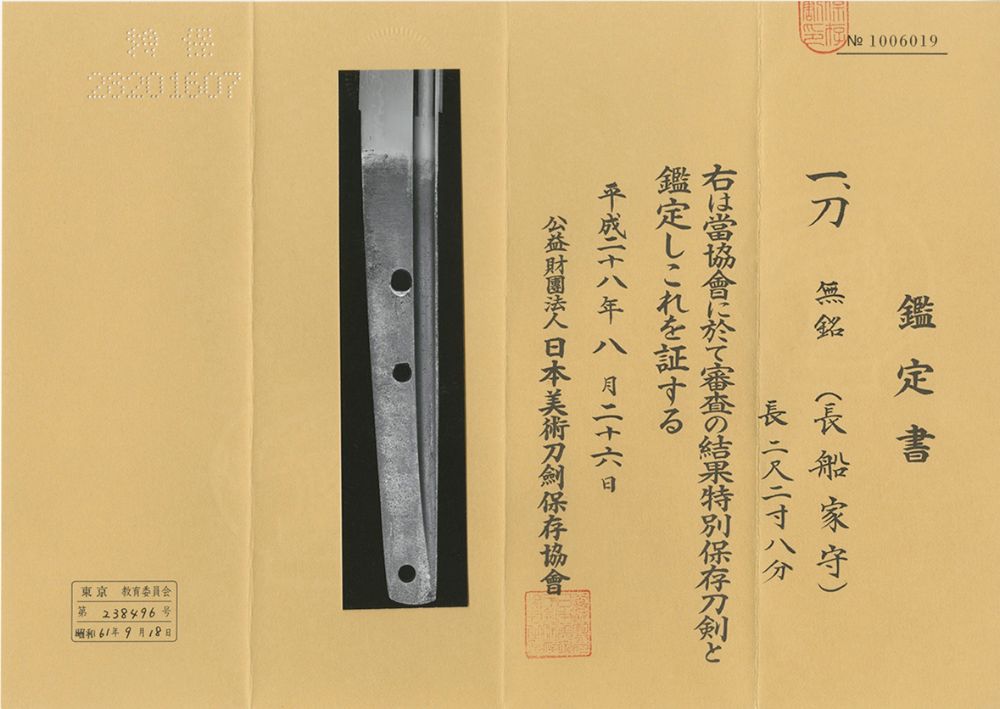






Osafune Iemori
Nanbokuchō
Bizen
Unsigned
Tokuho (NBTHK)
Bizen-den · Bizen
6 pieces on the market now
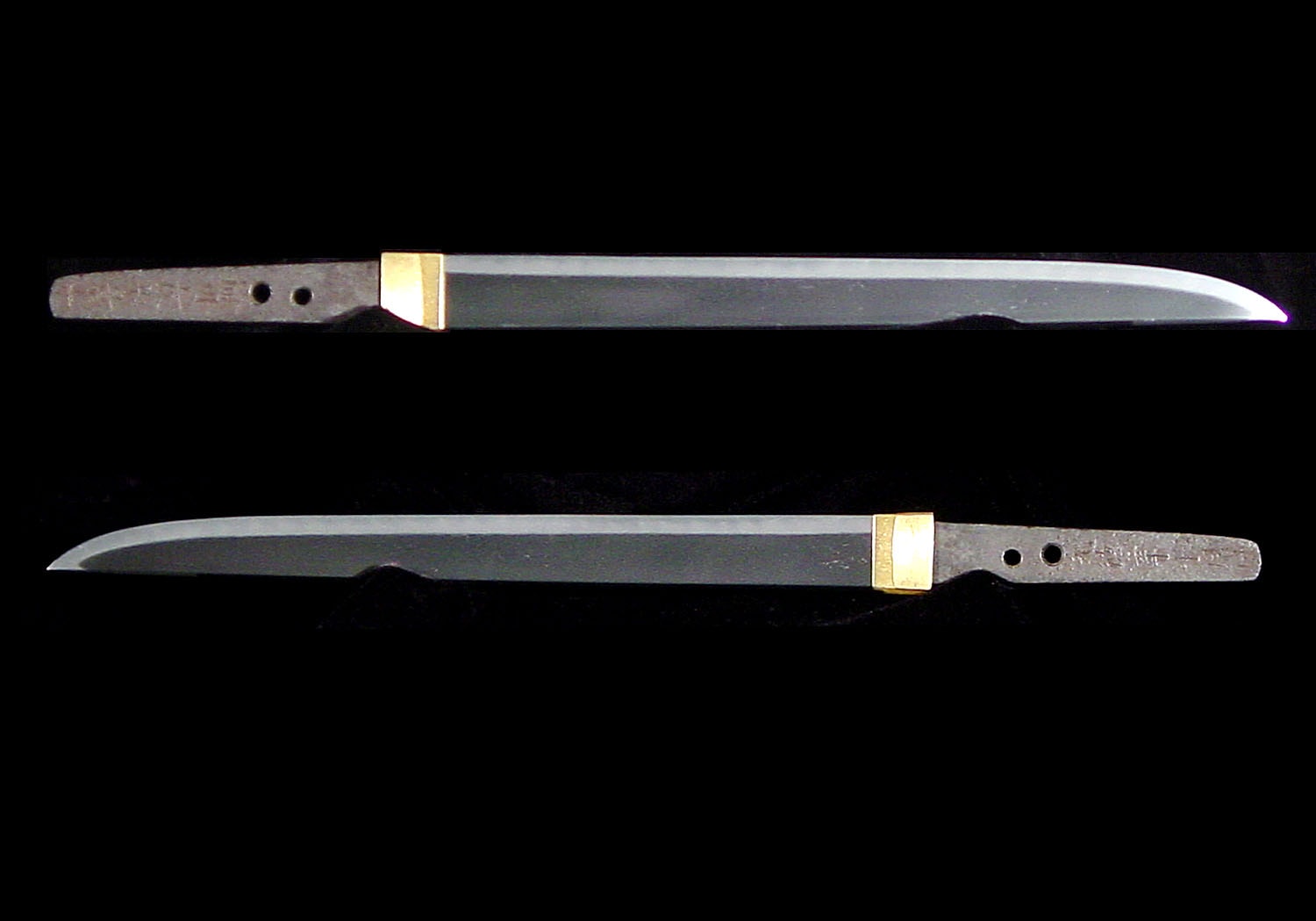
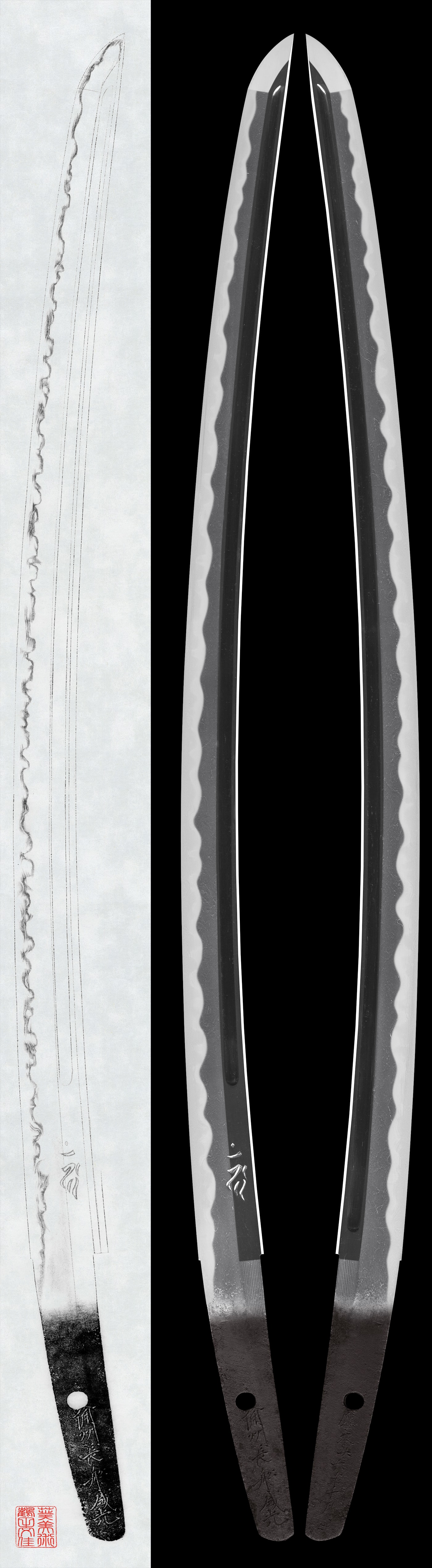
The Hatakeda school (畠田) takes its name from a hamlet in Bizen lying hard against Osafune village, and from that address its founder, Moriie, is called Hatakeda Moriie. The published sources place his line across the great middle decades of Kamakura, the earliest dated work a tachi of Bun'ei 9 (1272), with the name running on through the Nanbokucho years. The standard reading sets two generations under Moriie, the first contemporary with Osafune Mitsutada and the second with Nagamitsu, though the same designations are candid that a clean division of generations on the carved characters alone is difficult and remains a subject for future study, and that some advocate a single-smith theory. Neither Moriie nor his fellow Sanemori ever signed Hatakeda-ju (畠田住); their residence always reads Osafune, as in inscriptions such as Bizen no Kuni Osafune-ju Moriie[[c:1]], and from this the record concludes that Hatakeda was a small place-name within Osafune village itself. The meikan set the line under Moritsune of the Fukuoka Ichimonji school, and the school worked the same bright Bizen steel as the smiths around whom the Osafune tradition first took its classic form. Across decades of NBTHK commentary the Hatakeda manner is fixed in nearly the same sentence: the workmanship broadly resembles that of the contemporary Osafune smiths, yet the jigane tends to stand and the kawazuko-choji (蛙子丁子), the waist-pinched, tadpole-headed clove, is conspicuous in the tempered edge. The forging is itame run with mokume, tending to hada-dachi and to stand in the grain where the Osafune masters close into a tight ko-itame, carrying thick fine ji-nie, fine chikei, and a vivid midare-utsuri that rises on nearly every blade. Over that standing, utsuri-lit ji the school forges at full power a flamboyant choji-midare mixing fukuro-choji, juka-choji, ko-choji and gunome with the tadpole clove, ashi and yo entering vigorously, ko-nie attaching, tobiyaki and yubashiri about the monouchi, fine kinsuji and sunagashi running, and a bright nioiguchi; the boshi runs midare-komi to a ko-maru, often turning pointed and sweeping out in hakikake. Moriie carries this flamboyance at its boldest, his ha-nie the stronger and his clove the more insistent, with a quieter second register of kataochi-gunome and tight suguha-cho on his later pieces.
His pupil or son Sanemori reads one degree calmer, the midare tending toward a somewhat smaller pattern and the rise and fall less pronounced, his finest work at a glance recalling a superior Nagamitsu. Among the juniors, Mitsumori widens a nioi-based clove led by the tadpole heads, while the late Morinaga turns wholly toward a nie-laden, notare-based Soden-Bizen hand, and Morishige drifts toward the Osafune mainline as the school assimilated into it. To kantei a Hatakeda blade is to read the standing, utsuri-lit Bizen ji against the round-headed clove. Where the choji of Mitsutada and Nagamitsu swells round and full, the Hatakeda clove pinches at the waist, and on unsigned blades the deciding point is the kawazuko breaking into great clusters midway along the edge, the place where, the published record states, lies the point of attribution to Moriie. Against Fukuoka Ichimonji the Hatakeda ji stands more and the utsuri reads as the old Bizen reflection rather than the Ichimonji exuberance of pure clove; against the Osafune mainline the standing grain and the pinched clove give the line away, the kissaki tending to extend where Mitsutada and the Osafune smiths keep theirs compact. Moriie stands at the head of the school, graded Sai-jo saku by Fujishiro and ranked beside the Osafune founders, his blades carrying the histories of the great houses, the Tokugawa, Mitsui, Hosokawa, Uesugi and Okudaira among them, and held in such collections as the Tokyo and Kyoto National Museums, the Tokugawa Art Museum and the Eisei Bunko. Sanemori, Jo-jo saku, is the more approachable name, most of his circulating work osuriage mumei resting on the smaller-patterned tadpole clove, his signed and dated tachi rare events when they appear. For the Bizen collector a standing, kawazuko-laden ji-ha reads as Hatakeda almost on that count, a blade from the circle in which the Osafune tradition first took its classic shape. Learn more →
| Smith | Era | Designated |
|---|---|---|
| Moriie守家 | 1259-1260 | 33 |
| Moriie守家 | 1232-1233 | 27 |
| Sanemori眞守 | 1277-1293 | 57 |
| Mitsumori光守 | 1278-1288 | 13 |
| Moriie守家 | 1280-1299 | 14 |
A Hozon-certified blade judged to show notably superior workmanship and a better state of preservation. The bar is higher: re-tempered blades and most unsigned Muromachi/Edo works are excluded.
The NBTHK (Nihon Bijutsu Tōken Hozon Kyōkai, the Society for the Preservation of Japanese Art Swords) is a public-interest incorporated foundation founded in 1948 and supervised by Japan’s Agency for Cultural Affairs (Bunkachō); it is based at the Japanese Sword Museum in Tokyo. Its expert panels physically examine each submitted work (shinsa) and issue a certificate (kanteishō) ranking it by artistic and historical merit. NBTHK papers are the most widely recognized standard of authentication for Japanese swords and fittings.
NBTHK official siteWhen the item reaches you, please check immediately for damage and that it matches your order. We bear the shipping cost for a return; please send it freight-collect. Costs other than the item price cannot be refunded.

特別保存刀剣 『備前家守(長船家守)』 刀剣種別 『刀』 Katana 無銘 『備前家守(長船家守)』 bizen osafune IEMORI 日本刀 鑑定書『日本美術刀剣保存協会 特別保存 刀剣』 NBTHK 『Tokubetsu Hozon Paper』 時代『南北朝中期 文和頃』 Production age 『AD1352』 備前家守・長船家守は、同名数代おり、名鑑によれば初代を鎌倉末期の畠田派としている。同名を継承しているが、南北朝初期(元徳)からのものを初代、南北朝中期(延文〜永和)のものを二代、南北朝末期(康暦)から室町期(応永末年)のものを三代とされている。初代は畠田派とされ、福岡一文字系と伝う。二代以降は小反り派に分類される。一般的に家守といえば室町期の三代小反りのものが多く、小反り備前派中もっとも名高く大業物にランクされるが、初代・二代の作は比較的稀である。小反りとは、南北朝後期から室町初期において、兼光・元重・長義・大宮などの一派に属さない刀工を一握りにした呼称であり、総体に小模様であることが多い。 この刀は備前家守(長船家守)の無銘作である。本間順治博士により時代は南北朝中期の(文和)とされており、二代を(延文)からとするのであれば、初代家守であり、畠田派という事になる。鍛えは板目によく詰んで肌潤い、地沸が微塵によくつき、地斑を交え地景がよく入り、乱れ映りが鮮明に立ち、刃文は焼高く大互の目に腰開きの互の目丁字・飛び焼き等が交じり、足・葉入り、金筋・砂流し頻りにかかり、小沸がよくつくなどの出来口を示している。大模様で華やかに乱れ乱れ映りがたつ様は、一見福岡一文字を彷彿とさせ、初代とした本間順治博士の極めは首肯される。同工極めの中でも焼に高低がが目立ち覇気がある。出来が優れており、白眉の一振りである。 『形状』鎬造、庵棟、身幅広く・重ね反り共に尋常、中鋒。 『鍛』板目総じてよく詰み、地沸つき、地景入り、乱れ映り鮮明に立つ。 『刃文』焼高く大互の目に腰開きの互の目丁字・飛び焼き等が交じり、大模様に華やかに乱れ、足・葉繁く入り、金筋・砂流し頻りにかかり、匂口明るい。 『帽子』焼き高く乱れ込み、先小丸に浅く返る。 『茎』大磨上、先浅い栗尻、鑢目切り、目釘孔三。 『彫』表裏に棒樋掻き流す。 『附』白鞘 『寸法(Size)』 長さ(Blade length)69.2cm、反り(Sori)1.6cm、 元幅(Width of moto)3cm、先幅(Width of saki)2.2cm、 元重(Thickness of moto)0.7cm 先重(Thickness of saki)0.5cm
NihontoWatchmumei · Osafune · Nanbokucho · nagasa 69.2cm · sori 1.6cm
Osafune Iemori
Nanbokuchō
Bizen
Unsigned
Tokuho (NBTHK)
Bizen-den · Bizen
6 pieces on the market now
The Hatakeda school (畠田) takes its name from a hamlet in Bizen lying hard against Osafune village, and from that address its founder, Moriie, is called Hatakeda Moriie. The published sources place his line across the great middle decades of Kamakura, the earliest dated work a tachi of Bun'ei 9 (1272), with the name running on through the Nanbokucho years. The standard reading sets two generations under Moriie, the first contemporary with Osafune Mitsutada and the second with Nagamitsu, though the same designations are candid that a clean division of generations on the carved characters alone is difficult and remains a subject for future study, and that some advocate a single-smith theory. Neither Moriie nor his fellow Sanemori ever signed Hatakeda-ju (畠田住); their residence always reads Osafune, as in inscriptions such as Bizen no Kuni Osafune-ju Moriie[[c:1]], and from this the record concludes that Hatakeda was a small place-name within Osafune village itself. The meikan set the line under Moritsune of the Fukuoka Ichimonji school, and the school worked the same bright Bizen steel as the smiths around whom the Osafune tradition first took its classic form. Across decades of NBTHK commentary the Hatakeda manner is fixed in nearly the same sentence: the workmanship broadly resembles that of the contemporary Osafune smiths, yet the jigane tends to stand and the kawazuko-choji (蛙子丁子), the waist-pinched, tadpole-headed clove, is conspicuous in the tempered edge. The forging is itame run with mokume, tending to hada-dachi and to stand in the grain where the Osafune masters close into a tight ko-itame, carrying thick fine ji-nie, fine chikei, and a vivid midare-utsuri that rises on nearly every blade. Over that standing, utsuri-lit ji the school forges at full power a flamboyant choji-midare mixing fukuro-choji, juka-choji, ko-choji and gunome with the tadpole clove, ashi and yo entering vigorously, ko-nie attaching, tobiyaki and yubashiri about the monouchi, fine kinsuji and sunagashi running, and a bright nioiguchi; the boshi runs midare-komi to a ko-maru, often turning pointed and sweeping out in hakikake. Moriie carries this flamboyance at its boldest, his ha-nie the stronger and his clove the more insistent, with a quieter second register of kataochi-gunome and tight suguha-cho on his later pieces.
His pupil or son Sanemori reads one degree calmer, the midare tending toward a somewhat smaller pattern and the rise and fall less pronounced, his finest work at a glance recalling a superior Nagamitsu. Among the juniors, Mitsumori widens a nioi-based clove led by the tadpole heads, while the late Morinaga turns wholly toward a nie-laden, notare-based Soden-Bizen hand, and Morishige drifts toward the Osafune mainline as the school assimilated into it. To kantei a Hatakeda blade is to read the standing, utsuri-lit Bizen ji against the round-headed clove. Where the choji of Mitsutada and Nagamitsu swells round and full, the Hatakeda clove pinches at the waist, and on unsigned blades the deciding point is the kawazuko breaking into great clusters midway along the edge, the place where, the published record states, lies the point of attribution to Moriie. Against Fukuoka Ichimonji the Hatakeda ji stands more and the utsuri reads as the old Bizen reflection rather than the Ichimonji exuberance of pure clove; against the Osafune mainline the standing grain and the pinched clove give the line away, the kissaki tending to extend where Mitsutada and the Osafune smiths keep theirs compact. Moriie stands at the head of the school, graded Sai-jo saku by Fujishiro and ranked beside the Osafune founders, his blades carrying the histories of the great houses, the Tokugawa, Mitsui, Hosokawa, Uesugi and Okudaira among them, and held in such collections as the Tokyo and Kyoto National Museums, the Tokugawa Art Museum and the Eisei Bunko. Sanemori, Jo-jo saku, is the more approachable name, most of his circulating work osuriage mumei resting on the smaller-patterned tadpole clove, his signed and dated tachi rare events when they appear. For the Bizen collector a standing, kawazuko-laden ji-ha reads as Hatakeda almost on that count, a blade from the circle in which the Osafune tradition first took its classic shape. Learn more →
| Smith | Era | Designated |
|---|---|---|
| Moriie守家 | 1259-1260 | 33 |
| Moriie守家 | 1232-1233 | 27 |
| Sanemori眞守 | 1277-1293 | 57 |
| Mitsumori光守 | 1278-1288 | 13 |
| Moriie守家 | 1280-1299 | 14 |
A Hozon-certified blade judged to show notably superior workmanship and a better state of preservation. The bar is higher: re-tempered blades and most unsigned Muromachi/Edo works are excluded.
The NBTHK (Nihon Bijutsu Tōken Hozon Kyōkai, the Society for the Preservation of Japanese Art Swords) is a public-interest incorporated foundation founded in 1948 and supervised by Japan’s Agency for Cultural Affairs (Bunkachō); it is based at the Japanese Sword Museum in Tokyo. Its expert panels physically examine each submitted work (shinsa) and issue a certificate (kanteishō) ranking it by artistic and historical merit. NBTHK papers are the most widely recognized standard of authentication for Japanese swords and fittings.
NBTHK official siteWhen the item reaches you, please check immediately for damage and that it matches your order. We bear the shipping cost for a return; please send it freight-collect. Costs other than the item price cannot be refunded.