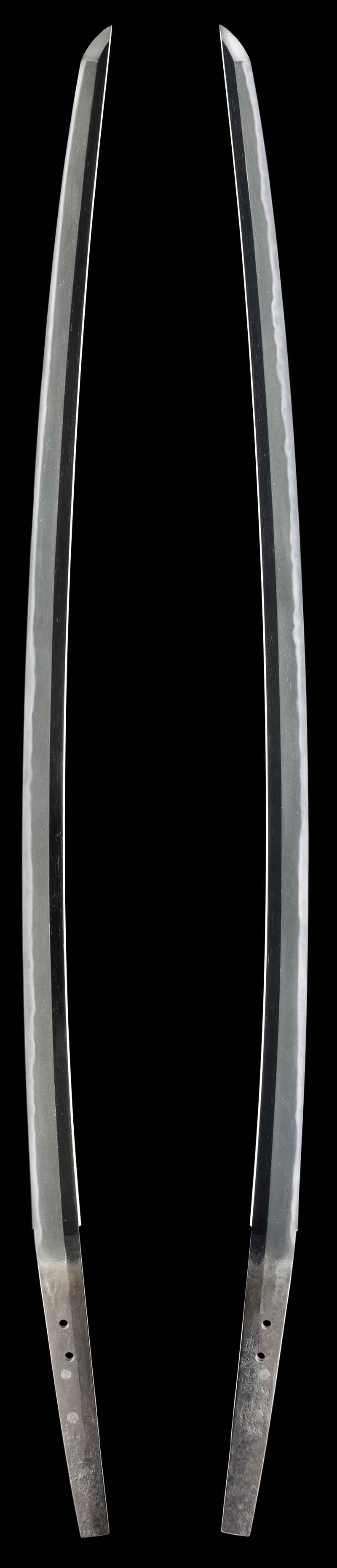
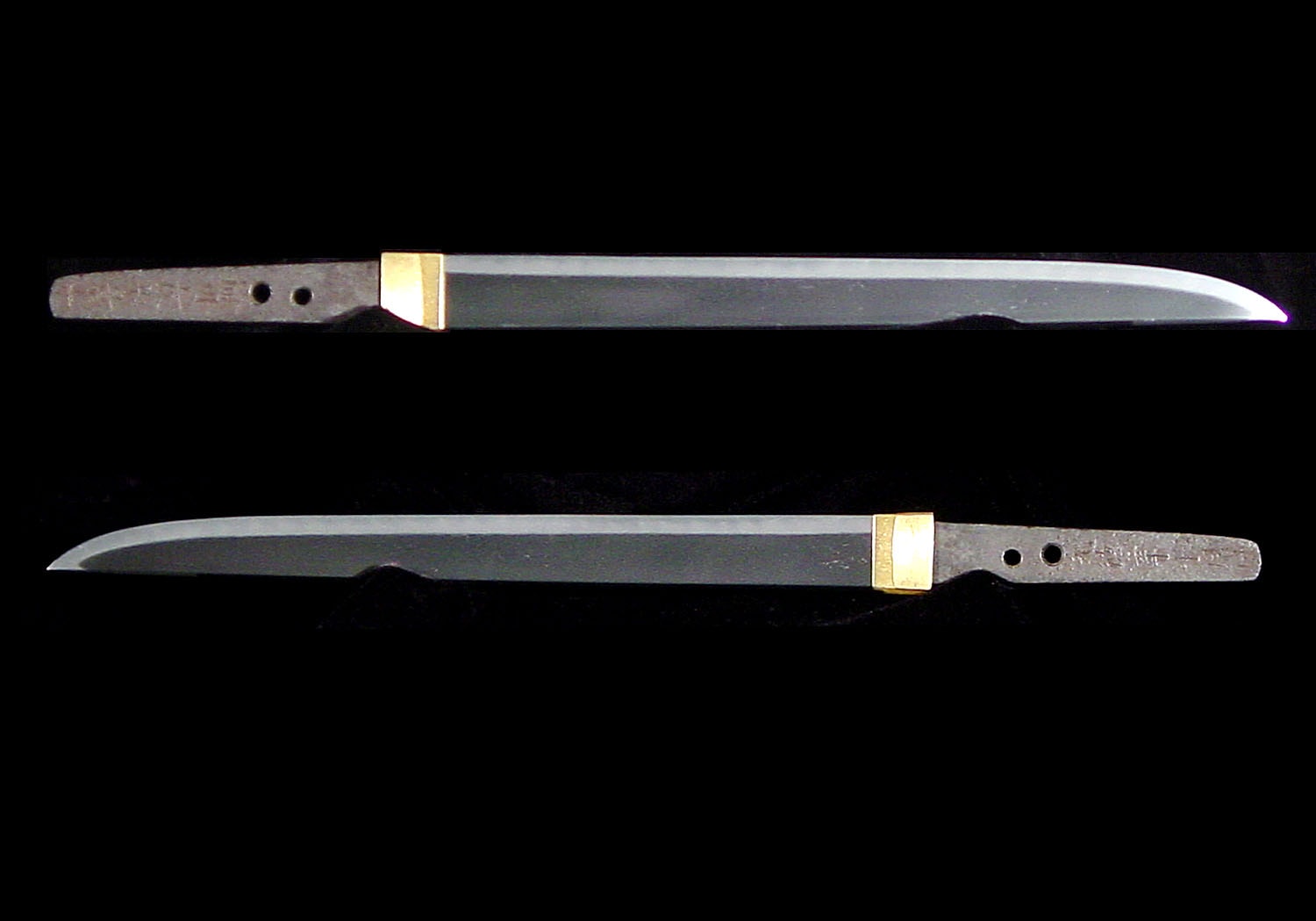
Moriie worked at , a hamlet directly adjacent to village in , and from that address the published sources call him Moriie. They rank him beside the founders, naming him as a smith "famed on a level with Mitsutada," and they place his line across the great middle decades of : the first generation in the era of Mitsutada, the second in that of Nagamitsu, beginning with a smith who left a work dated Bun'ei 9 (1272). Among his pieces are long signatures such as " no ju Moriie," and the name continues, through dates, into several hands. He is one of the close circle around which the school took its classic form, working the bright steel, yet recognized by two features that hold him apart from his neighbors.
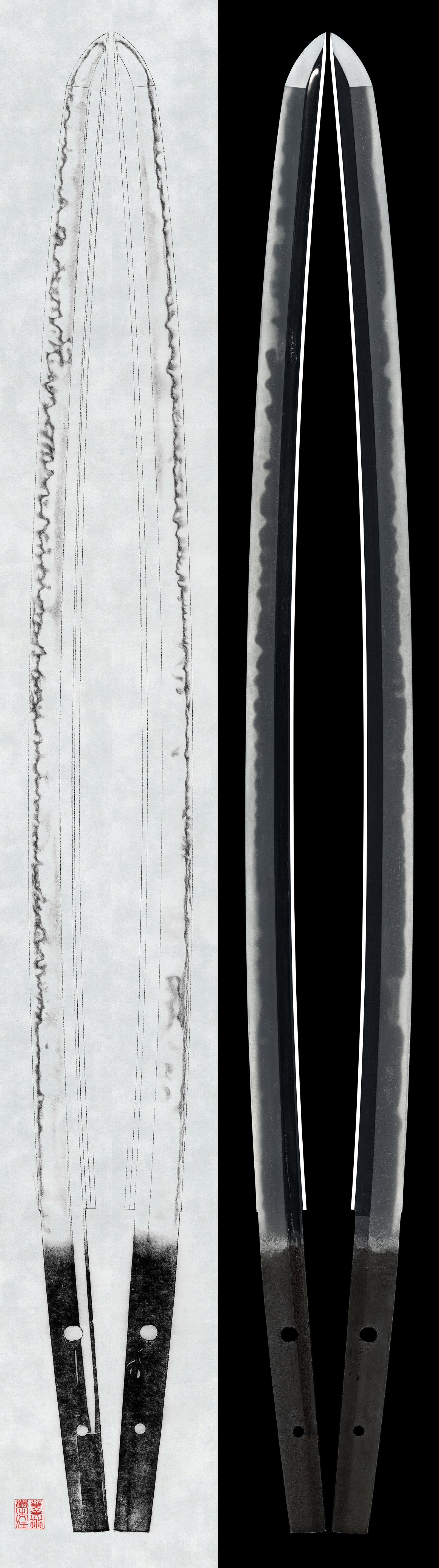
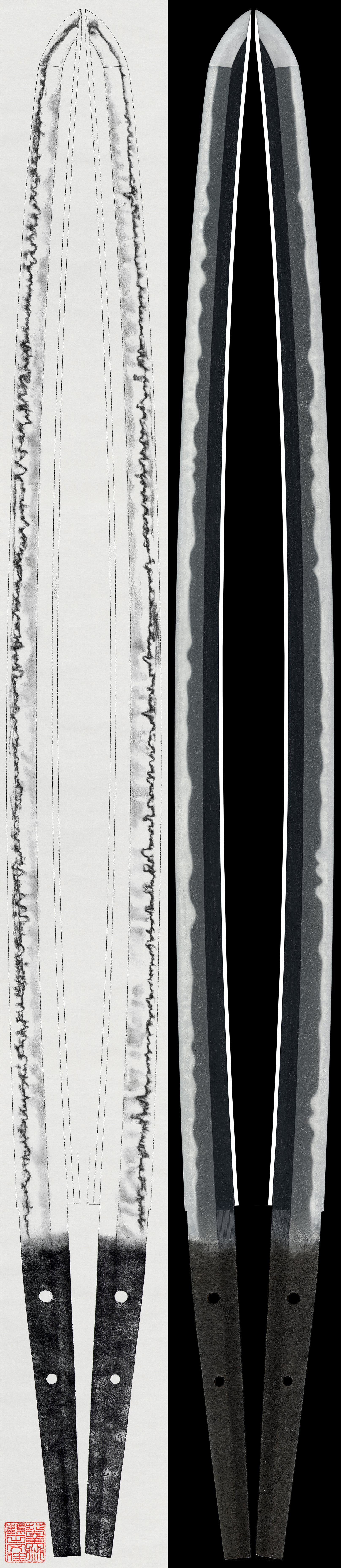
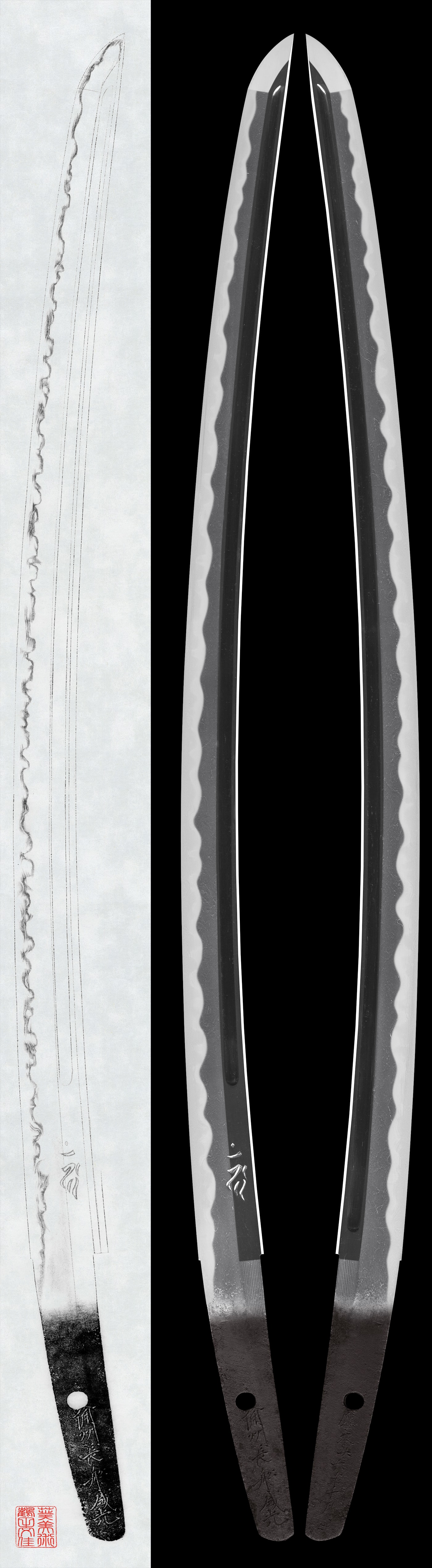
The first of those features is the temper. Over and over the published commentary returns to the tell: that in his "- stands out". This is the waist-pinched, round-headed clove, the frog's-mouth , and the 44th-session is read precisely by it, the commentary noting how the temper "changes here and there into the waist-pinched - that is the hallmark of the group". On his finest signed it sits within a flamboyant , mixed with , small , pointed-feeling and , and entering well, fine at intervals, adhering and the bright and clear. and run through it. Where the of Mitsutada and Nagamitsu swells round and full, Moriie's pinches at the waist, and that pinch is the single most reliable thing a blade carries.
His is the second constant. It is an , often run with and tightening toward , with thick fine , fine entering, and a vivid that stands on nearly every blade, the bright old- reflection he shares with the school. What he does not share is its quietness: his tends to , to stand and show its grain. The published sources are explicit on the comparison, observing on the 21st-session that, set against Mitsutada, "his stands out more", and on the 39th-session blade that his is the stronger, "its even more so". The answers the temper, running to a or pointed turnback with , at times a , -like sweep.
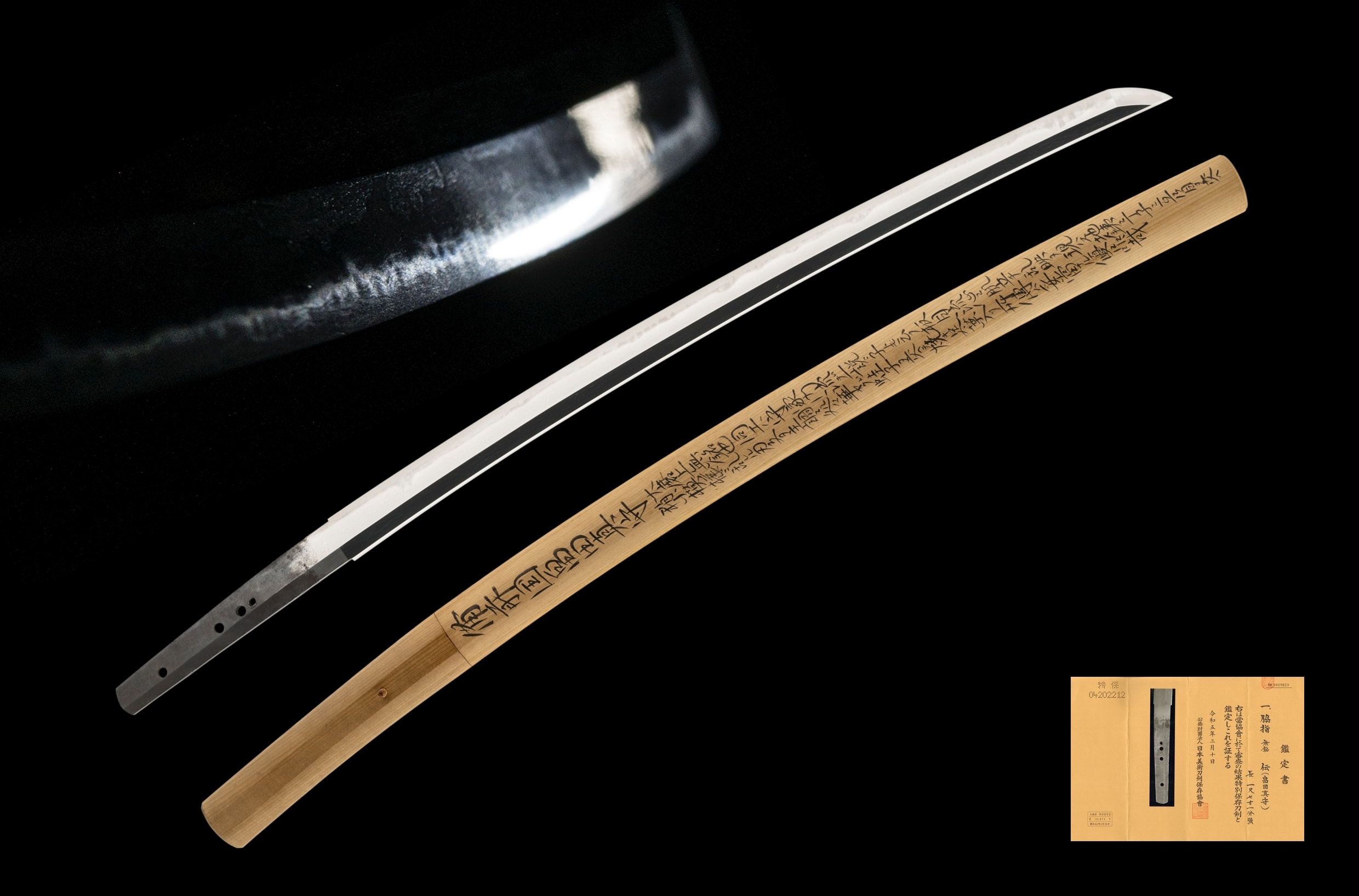
His record divides into two registers. The signed are his recognized prime, slender to standard in width with high and marked , several preserved , signed in two characters Moriie or three Moriie-zo. Against these stand the attributions, and , sometimes wide with an -leaning , judged Moriie by that standing and round-headed clove. The 47th-session the commentary calls "truly a quintessential piece judged as Moriie"; on the 58th-session , even where the temper grows lively, a faint - settles the attribution. Behind both registers stands the school's open scholarly question, which the published sources frame in nearly the words on entry after entry: there were two generations, perhaps three, the first beside Mitsutada and the second beside Nagamitsu, yet "a clear demarcation between the first and second generations" remains "a subject for future research", and "there are also those who advocate a single-smith theory".
What sets him apart from his own neighbors is therefore exactly what the judges name: not a difference of school but a difference of hand within it. His stands where Mitsutada's lies tight; his gathers stronger; his pinches at the waist where the masters' runs round. The 56th-session is praised as forged "better than is usual for this smith," and the 58th, with its , as showing "a tightly forged, meticulous even among works attributed to this smith". He is the manner read one degree more austere in the steel and one degree more particular in the clove, the voice within the Ko- chorus.
For the collector Moriie is a thin but real presence. The Toko Taikan grades his work at the upper-middle of the field. He has no National Treasures and no Important Cultural Properties; his record on the books runs entirely through the tier, fourteen blades across the sessions, eleven of them signed and the rest attributed, one carrying a 1745 Koyu that valued it at fifty gold . Provenance is barely recorded, a single privately held piece of known whereabouts and no institution named in his own data, so the honest account is that little of him is ever in view at once. A signed, Moriie comes to light only seldom, and from time to time a attribution; a privately held example, with the standing and the waist-pinched clove on the edge, is a quiet and notable thing for a collector to encounter, a blade from the circle in which the tradition first took shape.