
NihontoWatch MonNihontoWatch
Market
Encyclopedia
Kantei
NihontoWatch MonNihontoWatch
Market
Encyclopedia
Kantei

Description

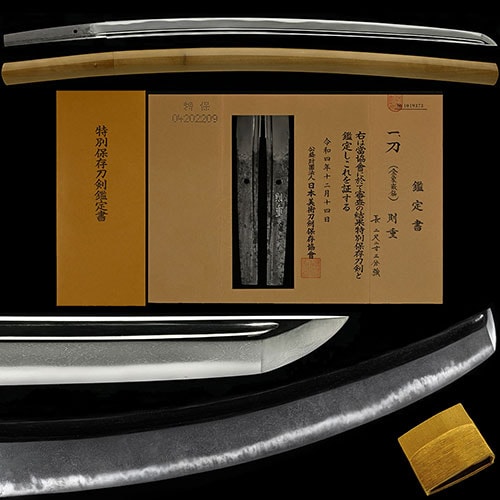
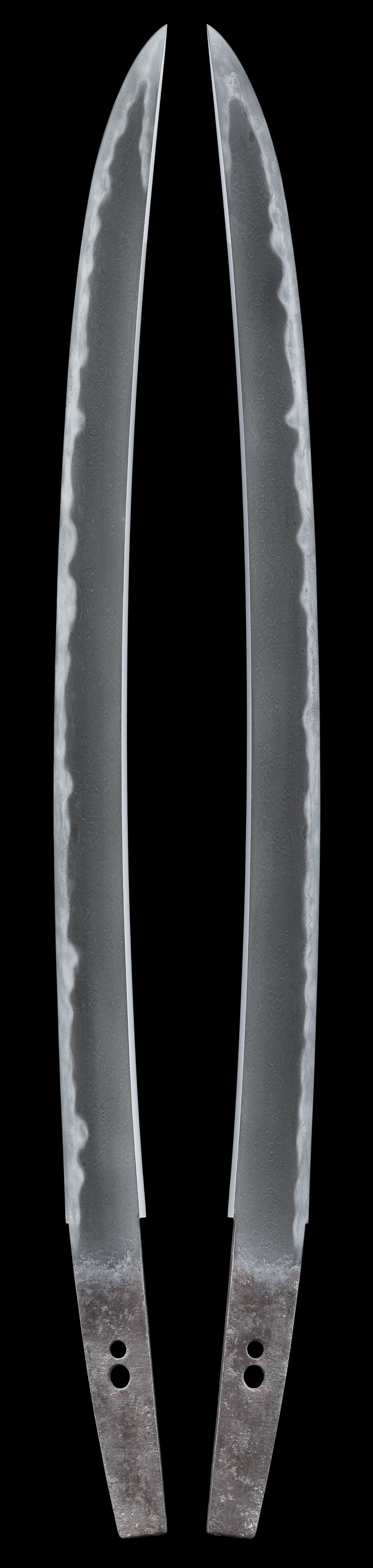
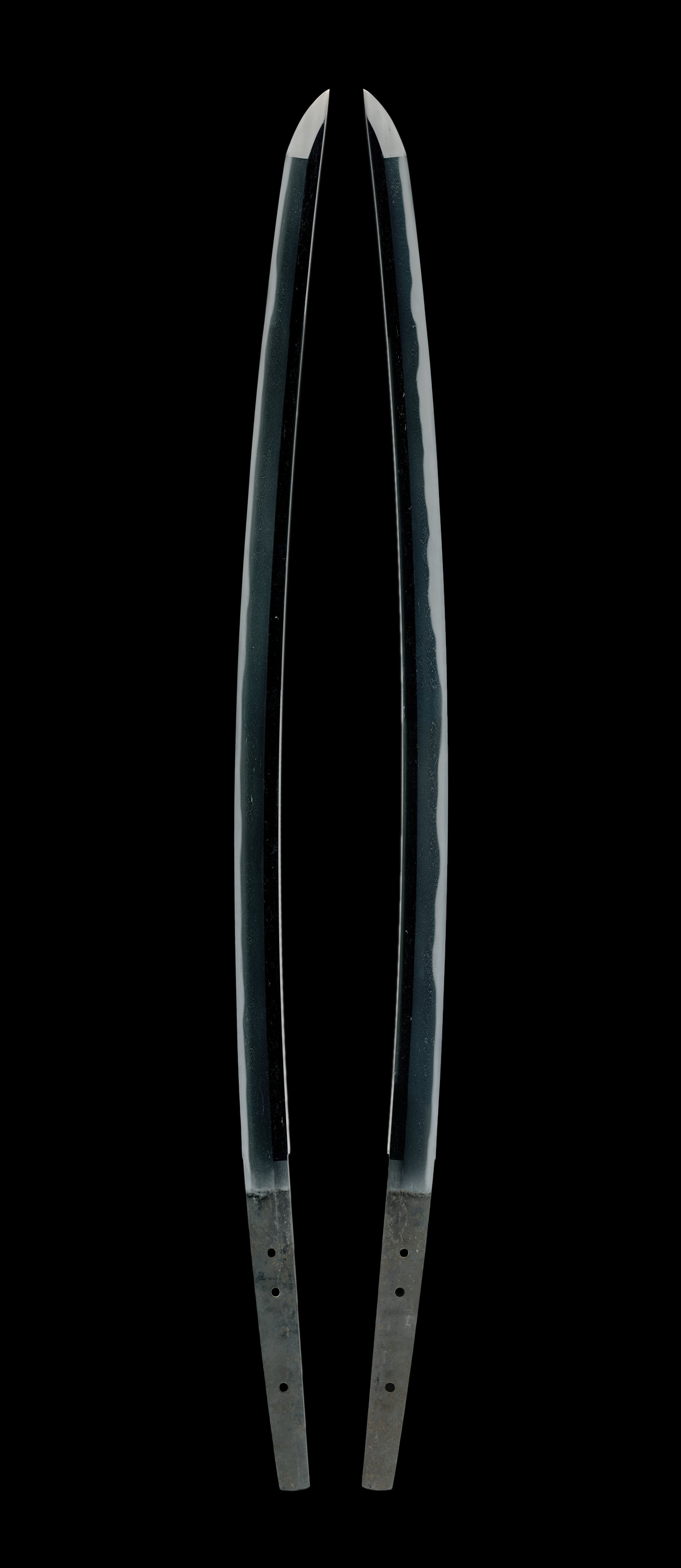
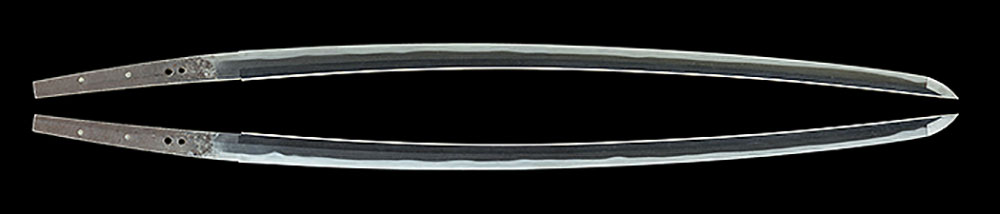
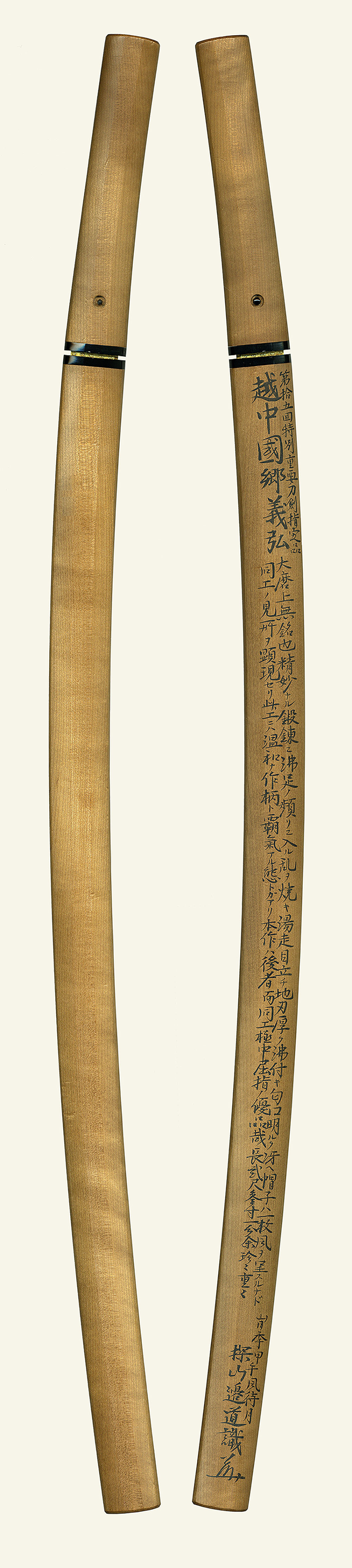
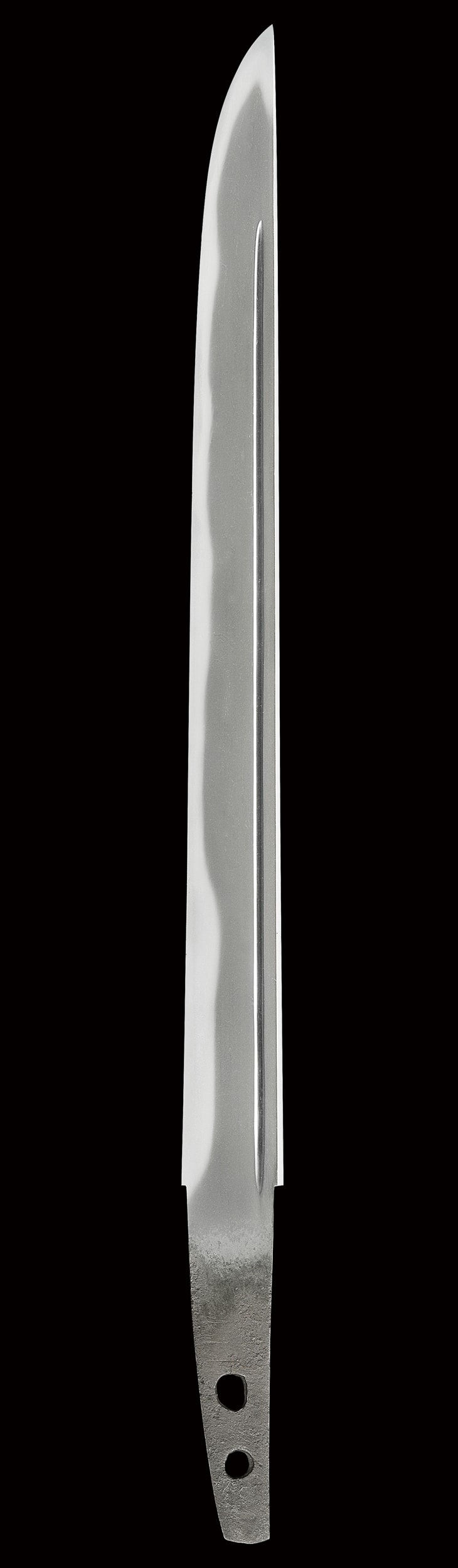
This is a Tokubetsu Juyo Token designated katana attributed to Gou Yoshihiro, a legendary swordsmith from the late Kamakura period known as one of Masamune's ten disciples. The blade is o-suriage mumei, exhibiting a vibrant jihada with ko-itame mixed with mokume and flowing grain, and a bright, active hamon with strong nie and various activities. It is considered an outstanding example of Gou Yoshihiro's work.

NBTHK Setsumei

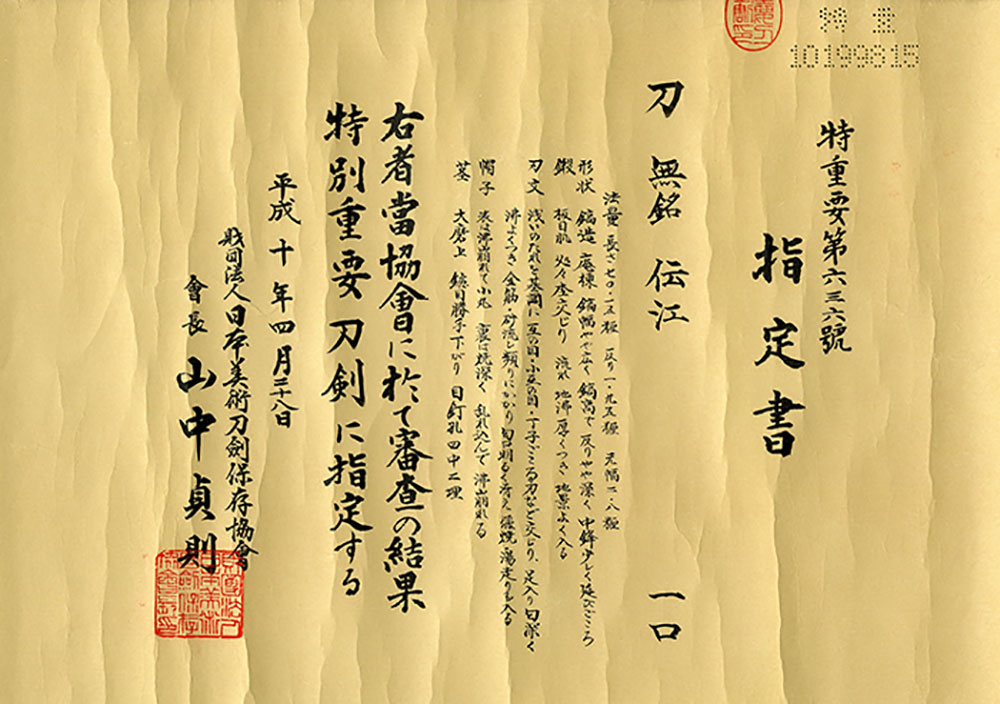
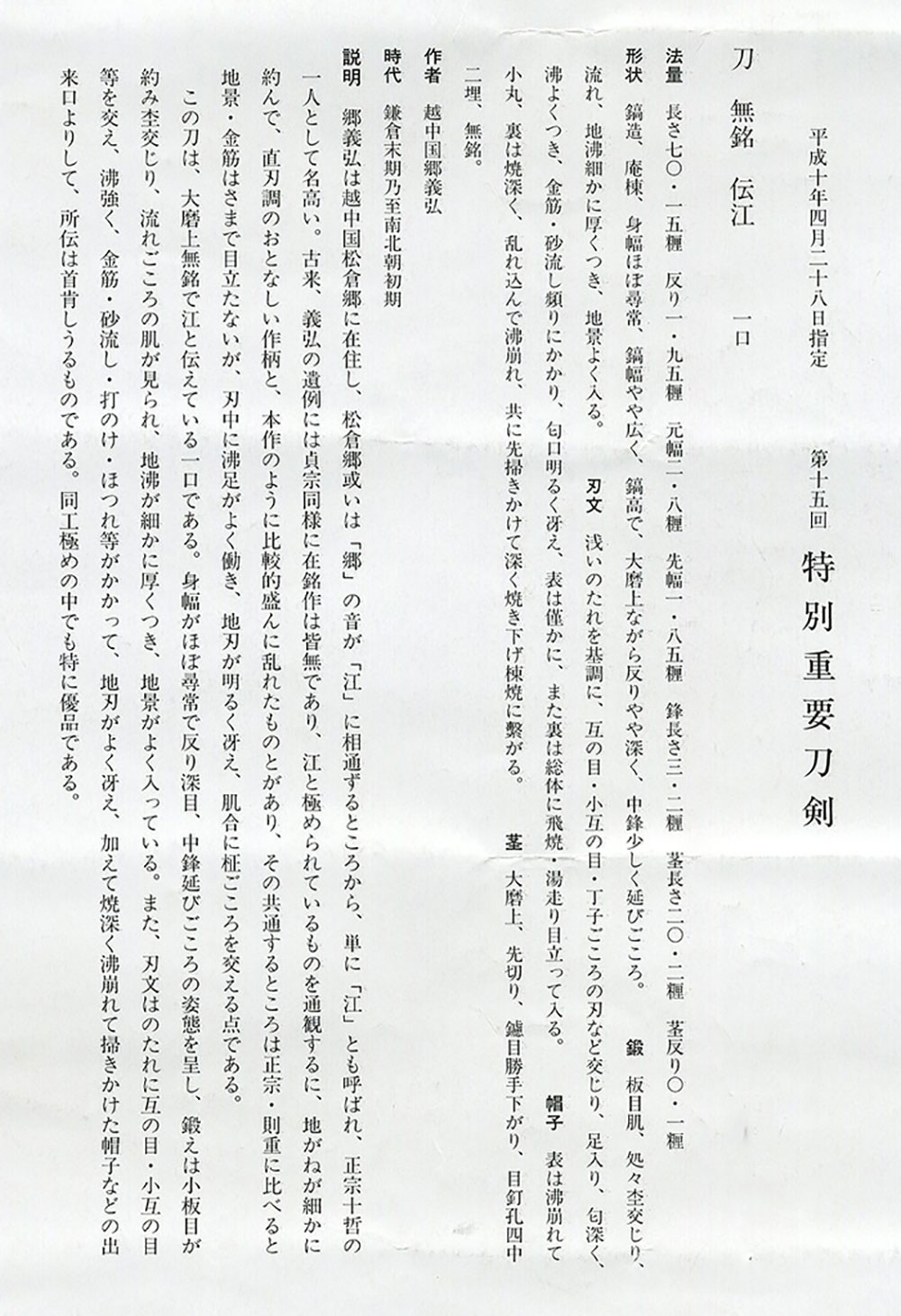
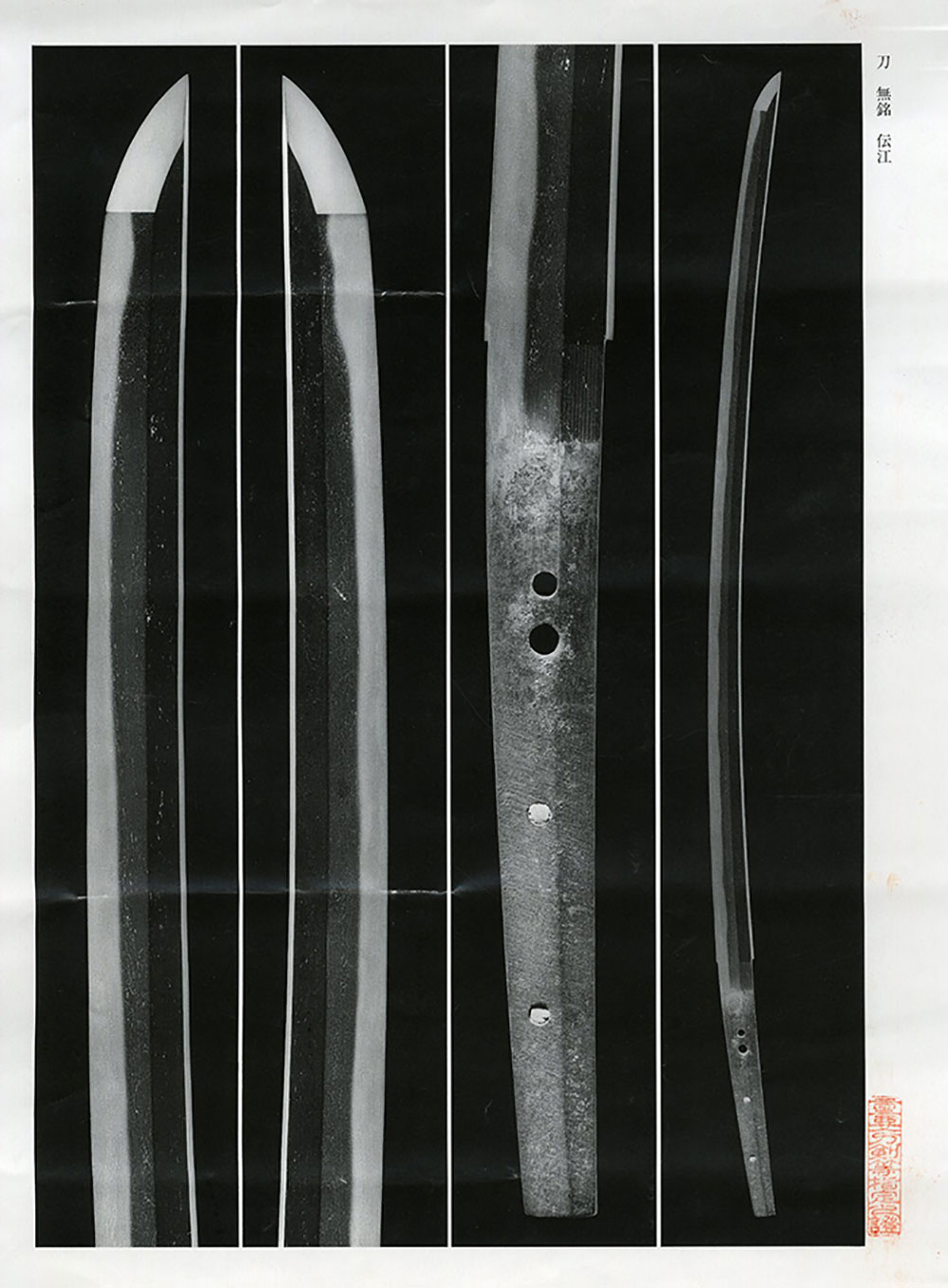
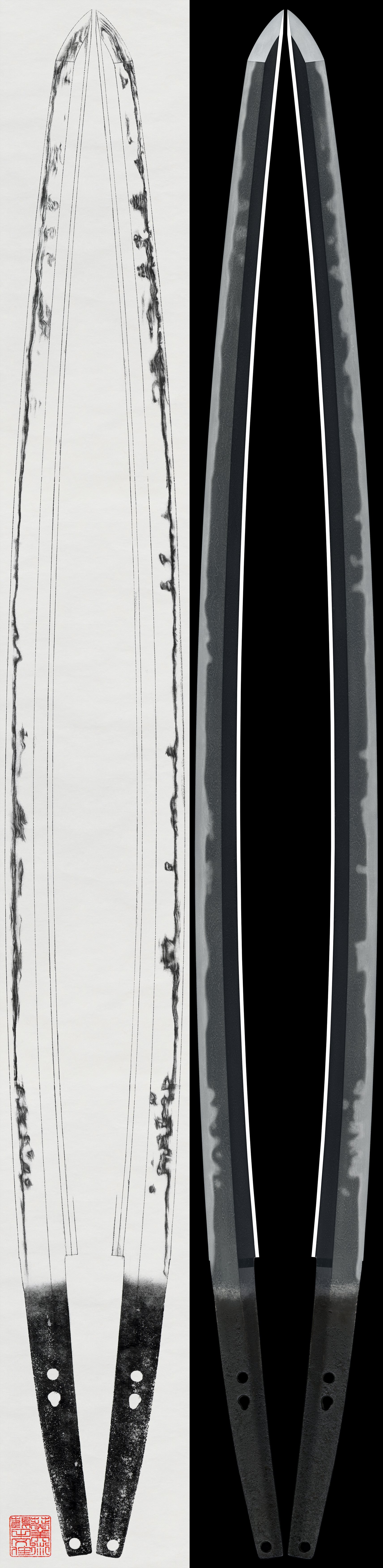
Tokubetsu-Jūyō-Tōken, 15th Session — Designated April 28, 1998 Katana, mumei: den Gō Yoshihiro (郷義弘) Measurements Nagasa 70.15 cm, sori 1.95 cm, motohaba 2.8 cm, sakihaba 1.85 cm, kissaki-nagasa 3.2 cm, nakago-nagasa 20.2 cm, nakago-sori 0.1 cm Description Keijō: shinogi-zukuri, iori-mune. The mihaba is approximately standard; the shinogi-ji is somewhat wide and the shinogi is high. Although greatly shortened (ō-suriage), the curvature is rather deep, and the chū-kissaki shows a slight tendency to extend. Kitae: itame-hada, with mokume intermingling in places. A flowing tendency is seen; fine ji-nie adheres thickly, and chikei enter well. Hamon: Based on a shallow notare, mixed with gunome, ko-gunome, and a chōji-like flavor; ashi enter, and the nioi is deep. Nie adheres strongly; kinsuji, sunagashi, uchi-noke, and hotsure appear. The nioiguchi is bright and clear. On the omote these activities are slight, while on the ura conspicuous tobiyaki and yubashiri appear overall. Bōshi: On the omote it becomes nie-kuzure; nie adheres well and kinsuji and sunagashi run frequently. It forms ko-maru. On the ura the temper is deeper, enters in midare-komi, and becomes nie-kuzure. Both sides show hakikake at the tip and are deeply yakisage, connecting to muneyaki. Horimono: None. Nakago: Greatly shortened (ō-suriage), tip cut off (saki-kiri); yasurime katte-sagari. Four mekugi-ana, two plugged. Unsigned. Artisan Gō Yoshihiro (郷義弘), Etchū Province. Era Late Kamakura period to early Nanbokuchō period. Explanation Gō Yoshihiro resided at Matsukura-gō in Etchū Province. Because Matsukura-gō—or the sound of “gō” (郷)—corresponds phonetically with “gō/ei” (江), he was also called simply “Gō” (江). He is famed as one of the “Ten Great Disciples of Masamune” (Masamune Jittetsu). From old times, as with Sadamune, there are said to be no extant signed works (zaimei) by Yoshihiro. Surveying those blades that have been appraised as “Gō,” one finds examples in a quiet manner close to suguha with a refined feel, as well as works—such as the present sword—in which the midare is comparatively vigorous. What they share is that, in comparison with Masamune and Norishige, the chikei and kinsuji are not so conspicuous; however, the nie-ashi within the ha functions well, the ji and ha are bright and clear, and the texture of the hada includes a masame-like tendency. This katana is a greatly shortened, unsigned blade transmitted as “Gō.” Its sugata shows approximately standard mihaba, rather deep curvature, and a chū-kissaki with a slightly extended feel. The forging is a tightly packed ko-itame with mokume mixed in; a flowing tendency can be seen, fine ji-nie adheres thickly, and chikei enter well. The hamon mixes gunome and ko-gunome into notare; the nie is strong, and kinsuji, sunagashi, uchi-noke, hotsure, and other activities appear, making the ji and ha vividly clear. In addition, the deeply tempered bōshi with nie-kuzure and hakikake—together with the overall workmanship—supports the traditional attribution. Among swords appraised to this smith, it is an especially superior example.

NihontoWatch MonNihontoWatch
MarketEncyclopediaKantei
Swords›Sōshū-den›Soshu›Go Yoshihiro›Koto Katana: Mumei (Gou Yoshihiro)
katanaTokubetsu Jūyō
Gō Yoshihiro

Koto Katana: Mumei (Gou Yoshihiro)

mumei · Kamakura · nagasa 70.1cm · sori 1.9cm

SOLD
Gō Yoshihiro (義弘) · Kamakura1 work for sale →
KatanaTokubetsu Jūyō
Could you name the smith from the blade alone? Today’s kantei →
Gō Yoshihiro — 1 of 6
Gō Yoshihiro — 2 of 6
Gō Yoshihiro — 3 of 6
Gō Yoshihiro — 4 of 6
Gō Yoshihiro — 5 of 6
Gō Yoshihiro — 6 of 6
1 / 6
1 / 6
Gō Yoshihiro — 1 of 6Gō Yoshihiro — 2 of 6Gō Yoshihiro — 3 of 6Gō Yoshihiro — 4 of 6Gō Yoshihiro — 5 of 6Gō Yoshihiro — 6 of 6
Gō Yoshihiro (義弘) · Kamakura1 work for sale →
KatanaTokubetsu Jūyō
Could you name the smith from the blade alone? Today’s kantei →
Measurements & details
Smith
Gō Yoshihiro
Type
Katana
School
Soshu
Period
Around 1299–1302(Shoan)
Province
Etchu
Signature
Unsigned(2% of this smith's designated works are signed)
Measurements
Nagasa 70.1cmSori 1.9cmMotohaba 2.8cmSakihaba 1.8cmKasane 0.6cm
Description

This is a Tokubetsu Juyo Token designated katana attributed to Gou Yoshihiro, a legendary swordsmith from the late Kamakura period known as one of Masamune's ten disciples. The blade is o-suriage mumei, exhibiting a vibrant jihada with ko-itame mixed with mokume and flowing grain, and a bright, active hamon with strong nie and various activities. It is considered an outstanding example of Gou Yoshihiro's work.

NBTHK Zufu Commentary

Tokuju #15

AI translation — may contain errors

-, 15th Session — Designated April 28, 1998

, : Gō Yoshihiro (郷義弘)

Measurements 70.15 cm, 1.95 cm, 2.8 cm, 1.85 cm, 3.2 cm, 20.2 cm, 0.1 cm

Description Keijō: , . The is approximately standard; the is somewhat wide and the is high. Although greatly shortened (), the curvature is rather deep, and the shows a slight tendency to extend. : , with intermingling in places. A flowing tendency is seen; fine adheres thickly, and enter well. : Based on a shallow , mixed with , , and a -like flavor; enter, and the is deep. adheres strongly; , , uchi-noke, and appear. The is bright and clear. On the these activities are slight, while on the conspicuous and appear overall. : On the it becomes ; adheres well and and run frequently. It forms . On the the temper is deeper, enters in , and becomes . Both sides show at the tip and are deeply , connecting to . : None. : Greatly shortened (), tip cut off (); . Four , two plugged. Unsigned.

Artisan Gō Yoshihiro (郷義弘), Province.

Era Late period to early period.

Explanation Gō Yoshihiro resided at Matsukura-gō in Province. Because Matsukura-gō—or the sound of “gō” (郷)—corresponds phonetically with “gō/ei” (江), he was also called simply “Gō” (江). He is famed as one of the “Ten Great Disciples of Masamune” (Masamune Jittetsu).

From old times, as with Sadamune, there are said to be no extant signed works () by Yoshihiro. Surveying those blades that have been appraised as “Gō,” one finds examples in a quiet manner close to with a refined feel, as well as works—such as the present sword—in which the is comparatively vigorous. What they share is that, in comparison with Masamune and Norishige, the and are not so conspicuous; however, the within the functions well, the and are bright and clear, and the texture of the includes a -like tendency.

This is a greatly shortened, unsigned blade transmitted as “Gō.” Its shows approximately standard , rather deep curvature, and a with a slightly extended feel. The forging is a tightly packed with mixed in; a flowing tendency can be seen, fine adheres thickly, and enter well. The mixes and into ; the is strong, and , , uchi-noke, , and other activities appear, making the and vividly clear. In addition, the deeply tempered with and —together with the overall workmanship—supports the traditional attribution. Among swords appraised to this smith, it is an especially superior example.
About the maker

Go Yoshihiro

義弘

Soshu / Etchu (Matsukura Go) · Etchu · around 1299-1302

Fujishiro Sai-jo saku · Tōken Taikan top 5%

1 piece on the market now

›

Go is the name by which Yoshihiro of Matsukura-gō in Etchū is known, and the published sources place him among the ten disciples of Masamune[[c:1]], one of the supreme names in the whole study of the sword. Like Sadamune he left no genuine signed work; every blade that carries his name is ō-suriage and mumei, an attribution resting on the judgment of the Hon'ami and the later appraisers, so the smith survives only through his manner and through the great houses that kept him. He stands at the very end of the Kamakura period and the opening of the Nanbokuchō, when the Sōshū tradition that Masamune had brought to completion was carried west into Etchū.

The jigane is the first thing the published sources reach for. It is an itame, often mixed with mokume and with a flowing nagare-hada that stands up a little, and in places it inclines strongly to masame; over it the ji-nie lies microscopically fine and thick, and chikei enter frequently, so the steel reads bright and clear. The appraisers make a point of the masame-gokoro worked into the hada (柾ごころ), one of the tells they list for his hand, and they single out that the ji and ha together come up a degree brighter and clearer than his fellows[[c:2]].

The hamon is built on a notare, broad and gentle, with ko-notare and gunome mixed in and the temper height tending to broaden from the base toward the monouchi. Ashi and yō enter, the nioiguchi is deep, and the nie lies thick and even, breaking in places into nie-kuzure with standing nie-suji; through the ha run abundant kinsuji and sunagashi, with occasional yubashiri spilling into the ji. Set beside Masamune and Norishige, the published sources call his chikei and kinsuji the calmer (穏やか), yet they note the nie-ashi working busily within the ha and the whole coming up brighter, which is exactly where they locate him.

The bōshi is where Go is most distinctly himself, and it is the feature the published record names outright as a major characteristic of his hand: the point is tempered deep, sweeping with hakikake (掃きかけ) and breaking into a nie-kuzure so that it becomes an ichimai-style bōshi, the whole tip hardened nearly solid. A representative Tokubetsu-Jūyō katana records it precisely, the bōshi burned deep into a single sheet, collapsing in nie and brushing out in hakikake[[c:4]]. Where it does turn back it settles into a quiet ko-maru, the return sometimes running long; but the deep, swept, single-sheet point is the signature, and a profile that gives him only a calm ko-maru has misread the smith.

For the collector the recognition runs in this order: a clear itame with thick fine ji-nie and frequent chikei, masame creeping into the hada, a deep-nie notare carrying kinsuji and sunagashi, and the deep ichimai-swept bōshi above it[[c:3]], the entire ji and ha lit a degree brighter than the surrounding masters. That brightness and clarity is the discriminator the appraisers use to part him from Masamune himself and from Norishige, whose hada stands up more and whose matsukawa is the heavier. Fujishiro places him at Sai-jō saku, the highest rank, and among all Sōshū hands his is reckoned at the summit.

Because nothing of his is signed and so little survives, Go is among the least attainable of all names. Of the work on record a few sit as National Treasures and Important Cultural Properties that can never trade, and the named meibutsu carry the histories of the great daimyō: the Ōkubo Gō (大久保江), which bears a Hon'ami gold-inlay attribution and descended to the Ōkubo of Odawara, and the Kabutokiri Gō (兜切り江), once of the Mizuno family. Others pass through the Uwajima Date family, one of them bestowed by Tokugawa Hidetada on the first lord of Uwajima and kept thereafter as a house treasure, while further blades descended through the Maeda. To meet a Gō at all is to meet a blade the appraisers judged worthy of the very first names, held for centuries by the houses that could command it.

Historical importance

Where Go Yoshihiro stands among comparable artisans: across all of nihontō, and within tradition, era, and period. The tiers (Foremost · Leading · Major · Notable) weigh official designations from the NBTHK and Japan's Agency for Cultural Affairs, together with historical honors of lasting repute such as the Sansaku and Meibutsu-chō.

随一
Foremost
屈指
Leading
有数
Major
著名
Notable

Select a lens to see how it's measured.

Designation record
54 designated works
Kokuhō (National Treasure)
2
Jūyō Bunkazai
6
Jūyō Bijutsuhin
5
Tokubetsu Jūyō
14
Jūyō
27
1 work by Go Yoshihiro on the market→
Go Yoshihiro — full profileSoshu / Etchu (Matsukura Go) school

Study this maker →

About the school

Soshu

相州

Soshu-den · Sagami

Phase: Sōshū相州· 1288–1385

45 pieces on the market now

›

Steel "bright and clear," with thick ji-nie and chikei entering frequently, is the constant the NBTHK returns to in nearly every blade of this phase, and it marks the moment the Soshu tradition reached its summit in Sagami. " The sampled blades cluster around the masters who carried this manner forward: Go Yoshihiro of Matsukura-go in Etchu, counted among the Masamune Juttetsu and represented here by numerous ō-suriage katana, and the Sagami smiths Hiromitsu and Akihiro, who stand "next after Sadamune" and extend the phase with dated works running from Enbun 2 (1357) to Shitoku 4 (1387). The window spans late Kamakura proportions through the broad Enbun-Joji forms of the fourteenth century. The phase reads as itame-hada mixed with mokume, often tending toward standing or flowing grain, carrying very fine ji-nie laid thickly with chikei threaded densely throughout; over this the hamon is founded on notare mixed with gunome, ko-gunome, and a chōji flavor, with deep nioi, thick nie, and kinsuji and sunagashi running well, the nioiguchi bright and clear. This is precisely the distance the school traveled from its Awataguchi roots: where that foundation held a tight, restrained suguha, the Go katana break into wide yakihaba, nie-kuzure, and yubashiri (one setsumei records nie that "gathers, thickens, and congeals"), with a bōshi tempered so deeply it becomes ichimai and sweeps in hakikake. Go himself sits one step calmer than Masamune and Norishige, his chikei and kinsuji more reserved but his ji and ha a step brighter, the hada often masame-inclined; one wide-suguha example with ko-midare shows how close the quiet end of his range stays to the Kunimitsu manner.

" Here the classic phase divides from the later Sue-Soshu continuation, whose Muromachi smiths inherited the vocabulary without the depth of nie and clarity of steel recorded in these blades. A collector separates this phase because it holds the recognized masters at full strength. Go achieved the highest designation through the unmistakable brightness of his ji-ha alone, despite no surviving signed works, and the sample carries the weight of that reputation: the meibutsu Nakagawa-Go owned by a retainer of Oda Nobunaga and later the Tokugawa house, the "Kabuto-giri" Go inlaid by Hon'ami appraisal, the Okubo-Go transmitted in the Odawara Okubo family, and blades held by the Uwajima Date and Chikuzen Kuroda houses, with names recorded in the Kyoho Meibutsu-cho. The kantei points are concrete and repeated: Go's active nie-ashi, masame tendency, and ichimai bōshi; Akihiro's dated five-character "Soshu Akihiro" signatures, whose shift from full to abbreviated dating after Eiwa lets a viewer place a blade in time; and the near-indistinguishability of Hiromitsu and Akihiro, parsed only by scale and the prominence of dango-chōji. These are the works that define the Soshu apex, against which both the Awataguchi foundation and the Sue-Soshu aftermath are measured. Learn more →

34 recorded smiths841 designated works
Leading smiths
SmithEraDesignated
Masamune正宗1288-129384
Sadamune貞宗1329-133186
Go Yoshihiro義弘1299-130254
Akihiro秋廣1346-137027
Kunimitsu國光1293-132269
Explore the Soshu school →

Historical context

Sōshū in the Kamakura period

›

Sōshū was born in a boomtown: Kamakura, seat of the warrior government, dense with elite patrons. Tradition holds that master smiths were summoned east to serve it, and from their students came Shintōgo Kunimitsu and then Masamune.

Sōshū in the Kamakura period →

NBTHK Certificate
Tokubetsu Jūyō Tōken特別重要刀剣
Especially Important Sword
›

The NBTHK’s highest grade, reserved for the rare Jūyō blades of exceptional artistry, condition, and historical value, judged on par with a nationally designated Important Cultural Property (Jūyō Bunkazai).

Only 1,211 swords have ever reached Tokubetsu Jūyō, about 1 in 2,064 registered blades.

About the NBTHK›

The NBTHK (Nihon Bijutsu Tōken Hozon Kyōkai, the Society for the Preservation of Japanese Art Swords) is a public-interest incorporated foundation founded in 1948 and supervised by Japan’s Agency for Cultural Affairs (Bunkachō); it is based at the Japanese Sword Museum in Tokyo. Its expert panels physically examine each submitted work (shinsa) and issue a certificate (kanteishō) ranking it by artistic and historical merit. NBTHK papers are the most widely recognized standard of authentication for Japanese swords and fittings.

NBTHK official site→
Seller
I
Iida Koendo
Established 1880 · 146 yrs on the market
🇯🇵Ships from Japan
›
✓Verified dealeriidakoendo.com
✓Ships worldwide✓English supportWire transfer
Return policy

Customer-initiated returns accepted within two days of arrival; return shipping paid by customer and fees non-refundable. Returns/refunds unavailable for overseas deliveries.

View all of Iida Koendo’s listings→View this item on the dealer’s site→

More works by Gō Yoshihiro

View all →
Aoi Art
Tokuho
Katana - Tokuho - by Gō Yoshihiro - Mumei (Unsigned) Den Go YoshihiroKatana - Tokuho - by Gō Yoshihiro - Mumei (Unsigned) Den Go Yoshihiro

Katana

ByGō Yoshihiro
¥35,000,000

More from the Soshu school

View all →
Tsuruginoya
Tokujū
Katana - Tokuju - by Soshu Yukimitsu - Soshu YukimitsuKatana - Tokuju - by Soshu Yukimitsu - Soshu Yukimitsu

Katana

BySoshu Yukimitsu
Ask
Samurai Nippon
Jūyō
Tanto - Jūyō - by Soshu Yukimitsu - Soshu Yukimitsu (Ubu Mumei)Tanto - Jūyō - by Soshu Yukimitsu - Soshu Yukimitsu (Ubu Mumei)

Tantō

BySoshu Yukimitsu
¥6,700,000
Mandarin Mansion
Jūyō
Tachi - Jūyō - by Soshu Yukimitsu - Juyo Soshu Yukimitsu TachiTachi - Jūyō - by Soshu Yukimitsu - Juyo Soshu Yukimitsu Tachi

Tachi

BySoshu Yukimitsu
Ask
Choshuya
Jūyō
Tanto - Jūyō - by Soshu Norishige - Unsigned (Ubu-nakago) NorishigeTanto - Jūyō - by Soshu Norishige - Unsigned (Ubu-nakago) Norishige

Tantō

BySoshu Norishige
¥6,500,000
Eirakudo
Tokuho
Katana - Tokuho - by Shintogo Kunimitsu - Shintogo Kunimitsu - Tokubetsu Hozon TokenKatana - Tokuho - by Shintogo Kunimitsu - Shintogo Kunimitsu - Tokubetsu Hozon Token

Katana

ByShintogo Kunimitsu
¥7,500,000
Eirakudo
Tokuho
Katana - Tokuho - by Soshu Norishige - Norishige - Tokubetsu Hozon TokenKatana - Tokuho - by Soshu Norishige - Norishige - Tokubetsu Hozon Token

Katana

BySoshu Norishige
¥6,500,000
Eirakudo
Jūyō
Tanto - Jūyō - by Soshu Yukimitsu - Sosyu Yukimitsu Tanto Juyo TokenTanto - Jūyō - by Soshu Yukimitsu - Sosyu Yukimitsu Tanto Juyo Token

Tantō

BySoshu Yukimitsu
Ask
World Seiyudo
Tokuho
Wakizashi - Tokuho - by Sue-Soshu Masahiro - Mumei Soshu Masahiro with NBTHK Tokubetsu Hozon Token and Tosogu CertificatesWakizashi - Tokuho - by Sue-Soshu Masahiro - Mumei Soshu Masahiro with NBTHK Tokubetsu Hozon Token and Tosogu Certificates

Wakizashi

BySue-Soshu Masahiro
¥2,500,000

More from the Sōshū tradition

View all →
Katanahanbai
Tokuho
Tanto - Tokuho - by Shimada Yoshisuke - Shimada GisukeTanto - Tokuho - by Shimada Yoshisuke - Shimada Gisuke

Tantō

ByShimada Yoshisuke
¥750,000
Hyozaemon
Hozon
Katana - Hozon - by Wakasa Fuyuhiro - Fuyuhiro KatanaKatana - Hozon - by Wakasa Fuyuhiro - Fuyuhiro Katana

Katana

ByWakasa Fuyuhiro
¥680,000
Token Hasegawa
Hozon
Tanto - Hozon - by Wakasa Fuyuhiro - Koto Tanto: Mumei Fuyuhiro - NBTHK Hozon Token, with Koshirae (20.2cm)Tanto - Hozon - by Wakasa Fuyuhiro - Koto Tanto: Mumei Fuyuhiro - NBTHK Hozon Token, with Koshirae (20.2cm)

Tantō

ByWakasa Fuyuhiro
¥253,000
Choshuya
Tokuho
Katana - Tokuho - by Sue-Soshu Tsunahiro - Soshu ju Tsunahiro (The founder)Katana - Tokuho - by Sue-Soshu Tsunahiro - Soshu ju Tsunahiro (The founder)

Katana

BySue-Soshu Tsunahiro
Ask
Toukentakarado
Tokuho
Katana - Tokuho - by Soshu Tametsugu - Mumei Attributed to TametsuguKatana - Tokuho - by Soshu Tametsugu - Mumei Attributed to Tametsugu

Katana

BySoshu Tametsugu
¥1,200,000
Choshuya
Tokuho
Katana - Tokuho - by Soshu Norishige - Unsigned (O-suriage) NorishigeKatana - Tokuho - by Soshu Norishige - Unsigned (O-suriage) Norishige

Katana

BySoshu Norishige
Ask
Onihonto
Tokuho
Tanto - Tokuho - by Sa Yasuyoshi - YasuyoshiTanto - Tokuho - by Sa Yasuyoshi - Yasuyoshi

Tantō

BySa Yasuyoshi
¥16,000
Ayakashi
Hozon
Tanto - Hozon - by Muramasa - Tanto by MuramasaTanto - Hozon - by Muramasa - Tanto by Muramasa

Tantō

ByMuramasa
¥7,500,000

Swords

  • Katana
  • Wakizashi
  • Tantō
  • Tachi
  • Naginata
  • Yari
  • Japanese Swords
  • Samurai Swords

Fittings

  • Tsuba
  • Fuchi-Kashira
  • Kozuka
  • Menuki
  • Sword Guards (Tsuba)

Armor

  • Kabuto
  • Samurai Armor
  • All Samurai Armor

By Certification

  • Tokujū
  • Jūyō
  • Tokuho
  • Hozon

Resources

  • Dealer Directory
  • Artist Directory
  • The Daily Kantei
  • Glossary
  • Browse All
Nihontowatch© 2026
TermsPrivacyCookiesAbout
Sold

Description

This is a Tokubetsu Juyo Token designated katana attributed to Gou Yoshihiro, a legendary swordsmith from the late Kamakura period known as one of Masamune's ten disciples. The blade is o-suriage mumei, exhibiting a vibrant jihada with ko-itame mixed with mokume and flowing grain, and a bright, active hamon with strong nie and various activities. It is considered an outstanding example of Gou Yoshihiro's work.

NBTHK Setsumei

Tokubetsu-Jūyō-Tōken, 15th Session — Designated April 28, 1998 Katana, mumei: den Gō Yoshihiro (郷義弘) Measurements Nagasa 70.15 cm, sori 1.95 cm, motohaba 2.8 cm, sakihaba 1.85 cm, kissaki-nagasa 3.2 cm, nakago-nagasa 20.2 cm, nakago-sori 0.1 cm Description Keijō: shinogi-zukuri, iori-mune. The mihaba is approximately standard; the shinogi-ji is somewhat wide and the shinogi is high. Although greatly shortened (ō-suriage), the curvature is rather deep, and the chū-kissaki shows a slight tendency to extend. Kitae: itame-hada, with mokume intermingling in places. A flowing tendency is seen; fine ji-nie adheres thickly, and chikei enter well. Hamon: Based on a shallow notare, mixed with gunome, ko-gunome, and a chōji-like flavor; ashi enter, and the nioi is deep. Nie adheres strongly; kinsuji, sunagashi, uchi-noke, and hotsure appear. The nioiguchi is bright and clear. On the omote these activities are slight, while on the ura conspicuous tobiyaki and yubashiri appear overall. Bōshi: On the omote it becomes nie-kuzure; nie adheres well and kinsuji and sunagashi run frequently. It forms ko-maru. On the ura the temper is deeper, enters in midare-komi, and becomes nie-kuzure. Both sides show hakikake at the tip and are deeply yakisage, connecting to muneyaki. Horimono: None. Nakago: Greatly shortened (ō-suriage), tip cut off (saki-kiri); yasurime katte-sagari. Four mekugi-ana, two plugged. Unsigned. Artisan Gō Yoshihiro (郷義弘), Etchū Province. Era Late Kamakura period to early Nanbokuchō period. Explanation Gō Yoshihiro resided at Matsukura-gō in Etchū Province. Because Matsukura-gō—or the sound of “gō” (郷)—corresponds phonetically with “gō/ei” (江), he was also called simply “Gō” (江). He is famed as one of the “Ten Great Disciples of Masamune” (Masamune Jittetsu). From old times, as with Sadamune, there are said to be no extant signed works (zaimei) by Yoshihiro. Surveying those blades that have been appraised as “Gō,” one finds examples in a quiet manner close to suguha with a refined feel, as well as works—such as the present sword—in which the midare is comparatively vigorous. What they share is that, in comparison with Masamune and Norishige, the chikei and kinsuji are not so conspicuous; however, the nie-ashi within the ha functions well, the ji and ha are bright and clear, and the texture of the hada includes a masame-like tendency. This katana is a greatly shortened, unsigned blade transmitted as “Gō.” Its sugata shows approximately standard mihaba, rather deep curvature, and a chū-kissaki with a slightly extended feel. The forging is a tightly packed ko-itame with mokume mixed in; a flowing tendency can be seen, fine ji-nie adheres thickly, and chikei enter well. The hamon mixes gunome and ko-gunome into notare; the nie is strong, and kinsuji, sunagashi, uchi-noke, hotsure, and other activities appear, making the ji and ha vividly clear. In addition, the deeply tempered bōshi with nie-kuzure and hakikake—together with the overall workmanship—supports the traditional attribution. Among swords appraised to this smith, it is an especially superior example.

NihontoWatch MonNihontoWatch
MarketEncyclopediaKantei
Swords›Sōshū-den›Soshu›Go Yoshihiro›Koto Katana: Mumei (Gou Yoshihiro)
katanaTokubetsu Jūyō
Gō Yoshihiro

Koto Katana: Mumei (Gou Yoshihiro)

mumei · Kamakura · nagasa 70.1cm · sori 1.9cm

SOLD
Gō Yoshihiro (義弘) · Kamakura1 work for sale →
KatanaTokubetsu Jūyō
Could you name the smith from the blade alone? Today’s kantei →
Gō Yoshihiro — 1 of 6
Gō Yoshihiro — 2 of 6
Gō Yoshihiro — 3 of 6
Gō Yoshihiro — 4 of 6
Gō Yoshihiro — 5 of 6
Gō Yoshihiro — 6 of 6
1 / 6
1 / 6
Gō Yoshihiro — 1 of 6Gō Yoshihiro — 2 of 6Gō Yoshihiro — 3 of 6Gō Yoshihiro — 4 of 6Gō Yoshihiro — 5 of 6Gō Yoshihiro — 6 of 6
Gō Yoshihiro (義弘) · Kamakura1 work for sale →
KatanaTokubetsu Jūyō
Could you name the smith from the blade alone? Today’s kantei →
Measurements & details
Smith
Gō Yoshihiro
Type
Katana
School
Soshu
Period
Around 1299–1302(Shoan)
Province
Etchu
Signature
Unsigned(2% of this smith's designated works are signed)
Measurements
Nagasa 70.1cmSori 1.9cmMotohaba 2.8cmSakihaba 1.8cmKasane 0.6cm
Description

This is a Tokubetsu Juyo Token designated katana attributed to Gou Yoshihiro, a legendary swordsmith from the late Kamakura period known as one of Masamune's ten disciples. The blade is o-suriage mumei, exhibiting a vibrant jihada with ko-itame mixed with mokume and flowing grain, and a bright, active hamon with strong nie and various activities. It is considered an outstanding example of Gou Yoshihiro's work.

NBTHK Zufu Commentary

Tokuju #15

AI translation — may contain errors

-, 15th Session — Designated April 28, 1998

, : Gō Yoshihiro (郷義弘)

Measurements 70.15 cm, 1.95 cm, 2.8 cm, 1.85 cm, 3.2 cm, 20.2 cm, 0.1 cm

Description Keijō: , . The is approximately standard; the is somewhat wide and the is high. Although greatly shortened (), the curvature is rather deep, and the shows a slight tendency to extend. : , with intermingling in places. A flowing tendency is seen; fine adheres thickly, and enter well. : Based on a shallow , mixed with , , and a -like flavor; enter, and the is deep. adheres strongly; , , uchi-noke, and appear. The is bright and clear. On the these activities are slight, while on the conspicuous and appear overall. : On the it becomes ; adheres well and and run frequently. It forms . On the the temper is deeper, enters in , and becomes . Both sides show at the tip and are deeply , connecting to . : None. : Greatly shortened (), tip cut off (); . Four , two plugged. Unsigned.

Artisan Gō Yoshihiro (郷義弘), Province.

Era Late period to early period.

Explanation Gō Yoshihiro resided at Matsukura-gō in Province. Because Matsukura-gō—or the sound of “gō” (郷)—corresponds phonetically with “gō/ei” (江), he was also called simply “Gō” (江). He is famed as one of the “Ten Great Disciples of Masamune” (Masamune Jittetsu).

From old times, as with Sadamune, there are said to be no extant signed works () by Yoshihiro. Surveying those blades that have been appraised as “Gō,” one finds examples in a quiet manner close to with a refined feel, as well as works—such as the present sword—in which the is comparatively vigorous. What they share is that, in comparison with Masamune and Norishige, the and are not so conspicuous; however, the within the functions well, the and are bright and clear, and the texture of the includes a -like tendency.

This is a greatly shortened, unsigned blade transmitted as “Gō.” Its shows approximately standard , rather deep curvature, and a with a slightly extended feel. The forging is a tightly packed with mixed in; a flowing tendency can be seen, fine adheres thickly, and enter well. The mixes and into ; the is strong, and , , uchi-noke, , and other activities appear, making the and vividly clear. In addition, the deeply tempered with and —together with the overall workmanship—supports the traditional attribution. Among swords appraised to this smith, it is an especially superior example.

About the maker

Go Yoshihiro

義弘

Soshu / Etchu (Matsukura Go) · Etchu · around 1299-1302

Fujishiro Sai-jo saku · Tōken Taikan top 5%

1 piece on the market now

›

Go is the name by which Yoshihiro of Matsukura-gō in Etchū is known, and the published sources place him among the ten disciples of Masamune[[c:1]], one of the supreme names in the whole study of the sword. Like Sadamune he left no genuine signed work; every blade that carries his name is ō-suriage and mumei, an attribution resting on the judgment of the Hon'ami and the later appraisers, so the smith survives only through his manner and through the great houses that kept him. He stands at the very end of the Kamakura period and the opening of the Nanbokuchō, when the Sōshū tradition that Masamune had brought to completion was carried west into Etchū.

The jigane is the first thing the published sources reach for. It is an itame, often mixed with mokume and with a flowing nagare-hada that stands up a little, and in places it inclines strongly to masame; over it the ji-nie lies microscopically fine and thick, and chikei enter frequently, so the steel reads bright and clear. The appraisers make a point of the masame-gokoro worked into the hada (柾ごころ), one of the tells they list for his hand, and they single out that the ji and ha together come up a degree brighter and clearer than his fellows[[c:2]].

The hamon is built on a notare, broad and gentle, with ko-notare and gunome mixed in and the temper height tending to broaden from the base toward the monouchi. Ashi and yō enter, the nioiguchi is deep, and the nie lies thick and even, breaking in places into nie-kuzure with standing nie-suji; through the ha run abundant kinsuji and sunagashi, with occasional yubashiri spilling into the ji. Set beside Masamune and Norishige, the published sources call his chikei and kinsuji the calmer (穏やか), yet they note the nie-ashi working busily within the ha and the whole coming up brighter, which is exactly where they locate him.

The bōshi is where Go is most distinctly himself, and it is the feature the published record names outright as a major characteristic of his hand: the point is tempered deep, sweeping with hakikake (掃きかけ) and breaking into a nie-kuzure so that it becomes an ichimai-style bōshi, the whole tip hardened nearly solid. A representative Tokubetsu-Jūyō katana records it precisely, the bōshi burned deep into a single sheet, collapsing in nie and brushing out in hakikake[[c:4]]. Where it does turn back it settles into a quiet ko-maru, the return sometimes running long; but the deep, swept, single-sheet point is the signature, and a profile that gives him only a calm ko-maru has misread the smith.

For the collector the recognition runs in this order: a clear itame with thick fine ji-nie and frequent chikei, masame creeping into the hada, a deep-nie notare carrying kinsuji and sunagashi, and the deep ichimai-swept bōshi above it[[c:3]], the entire ji and ha lit a degree brighter than the surrounding masters. That brightness and clarity is the discriminator the appraisers use to part him from Masamune himself and from Norishige, whose hada stands up more and whose matsukawa is the heavier. Fujishiro places him at Sai-jō saku, the highest rank, and among all Sōshū hands his is reckoned at the summit.

Because nothing of his is signed and so little survives, Go is among the least attainable of all names. Of the work on record a few sit as National Treasures and Important Cultural Properties that can never trade, and the named meibutsu carry the histories of the great daimyō: the Ōkubo Gō (大久保江), which bears a Hon'ami gold-inlay attribution and descended to the Ōkubo of Odawara, and the Kabutokiri Gō (兜切り江), once of the Mizuno family. Others pass through the Uwajima Date family, one of them bestowed by Tokugawa Hidetada on the first lord of Uwajima and kept thereafter as a house treasure, while further blades descended through the Maeda. To meet a Gō at all is to meet a blade the appraisers judged worthy of the very first names, held for centuries by the houses that could command it.

Historical importance

Where Go Yoshihiro stands among comparable artisans: across all of nihontō, and within tradition, era, and period. The tiers (Foremost · Leading · Major · Notable) weigh official designations from the NBTHK and Japan's Agency for Cultural Affairs, together with historical honors of lasting repute such as the Sansaku and Meibutsu-chō.

随一
Foremost
屈指
Leading
有数
Major
著名
Notable

Select a lens to see how it's measured.

Designation record
54 designated works
Kokuhō (National Treasure)
2
Jūyō Bunkazai
6
Jūyō Bijutsuhin
5
Tokubetsu Jūyō
14
Jūyō
27
1 work by Go Yoshihiro on the market→
Go Yoshihiro — full profileSoshu / Etchu (Matsukura Go) school

Study this maker →

About the school

Soshu

相州

Soshu-den · Sagami

Phase: Sōshū相州· 1288–1385

45 pieces on the market now

›

Steel "bright and clear," with thick ji-nie and chikei entering frequently, is the constant the NBTHK returns to in nearly every blade of this phase, and it marks the moment the Soshu tradition reached its summit in Sagami. " The sampled blades cluster around the masters who carried this manner forward: Go Yoshihiro of Matsukura-go in Etchu, counted among the Masamune Juttetsu and represented here by numerous ō-suriage katana, and the Sagami smiths Hiromitsu and Akihiro, who stand "next after Sadamune" and extend the phase with dated works running from Enbun 2 (1357) to Shitoku 4 (1387). The window spans late Kamakura proportions through the broad Enbun-Joji forms of the fourteenth century. The phase reads as itame-hada mixed with mokume, often tending toward standing or flowing grain, carrying very fine ji-nie laid thickly with chikei threaded densely throughout; over this the hamon is founded on notare mixed with gunome, ko-gunome, and a chōji flavor, with deep nioi, thick nie, and kinsuji and sunagashi running well, the nioiguchi bright and clear. This is precisely the distance the school traveled from its Awataguchi roots: where that foundation held a tight, restrained suguha, the Go katana break into wide yakihaba, nie-kuzure, and yubashiri (one setsumei records nie that "gathers, thickens, and congeals"), with a bōshi tempered so deeply it becomes ichimai and sweeps in hakikake. Go himself sits one step calmer than Masamune and Norishige, his chikei and kinsuji more reserved but his ji and ha a step brighter, the hada often masame-inclined; one wide-suguha example with ko-midare shows how close the quiet end of his range stays to the Kunimitsu manner.

" Here the classic phase divides from the later Sue-Soshu continuation, whose Muromachi smiths inherited the vocabulary without the depth of nie and clarity of steel recorded in these blades. A collector separates this phase because it holds the recognized masters at full strength. Go achieved the highest designation through the unmistakable brightness of his ji-ha alone, despite no surviving signed works, and the sample carries the weight of that reputation: the meibutsu Nakagawa-Go owned by a retainer of Oda Nobunaga and later the Tokugawa house, the "Kabuto-giri" Go inlaid by Hon'ami appraisal, the Okubo-Go transmitted in the Odawara Okubo family, and blades held by the Uwajima Date and Chikuzen Kuroda houses, with names recorded in the Kyoho Meibutsu-cho. The kantei points are concrete and repeated: Go's active nie-ashi, masame tendency, and ichimai bōshi; Akihiro's dated five-character "Soshu Akihiro" signatures, whose shift from full to abbreviated dating after Eiwa lets a viewer place a blade in time; and the near-indistinguishability of Hiromitsu and Akihiro, parsed only by scale and the prominence of dango-chōji. These are the works that define the Soshu apex, against which both the Awataguchi foundation and the Sue-Soshu aftermath are measured. Learn more →

34 recorded smiths841 designated works
Leading smiths
SmithEraDesignated
Masamune正宗1288-129384
Sadamune貞宗1329-133186
Go Yoshihiro義弘1299-130254
Akihiro秋廣1346-137027
Kunimitsu國光1293-132269
Explore the Soshu school →

Historical context

Sōshū in the Kamakura period

›

Sōshū was born in a boomtown: Kamakura, seat of the warrior government, dense with elite patrons. Tradition holds that master smiths were summoned east to serve it, and from their students came Shintōgo Kunimitsu and then Masamune.

Sōshū in the Kamakura period →

NBTHK Certificate
Tokubetsu Jūyō Tōken特別重要刀剣
Especially Important Sword
›

The NBTHK’s highest grade, reserved for the rare Jūyō blades of exceptional artistry, condition, and historical value, judged on par with a nationally designated Important Cultural Property (Jūyō Bunkazai).

Only 1,211 swords have ever reached Tokubetsu Jūyō, about 1 in 2,064 registered blades.

About the NBTHK›

The NBTHK (Nihon Bijutsu Tōken Hozon Kyōkai, the Society for the Preservation of Japanese Art Swords) is a public-interest incorporated foundation founded in 1948 and supervised by Japan’s Agency for Cultural Affairs (Bunkachō); it is based at the Japanese Sword Museum in Tokyo. Its expert panels physically examine each submitted work (shinsa) and issue a certificate (kanteishō) ranking it by artistic and historical merit. NBTHK papers are the most widely recognized standard of authentication for Japanese swords and fittings.

NBTHK official site→
Seller
I
Iida Koendo
Established 1880 · 146 yrs on the market
🇯🇵Ships from Japan
›
✓Verified dealeriidakoendo.com
✓Ships worldwide✓English supportWire transfer
Return policy

Customer-initiated returns accepted within two days of arrival; return shipping paid by customer and fees non-refundable. Returns/refunds unavailable for overseas deliveries.

View all of Iida Koendo’s listings→View this item on the dealer’s site→

More works by Gō Yoshihiro

View all →
Aoi Art
Tokuho
Katana - Tokuho - by Gō Yoshihiro - Mumei (Unsigned) Den Go YoshihiroKatana - Tokuho - by Gō Yoshihiro - Mumei (Unsigned) Den Go Yoshihiro

Katana

ByGō Yoshihiro
¥35,000,000

More from the Soshu school

View all →
Tsuruginoya
Tokujū
Katana - Tokuju - by Soshu Yukimitsu - Soshu YukimitsuKatana - Tokuju - by Soshu Yukimitsu - Soshu Yukimitsu

Katana

BySoshu Yukimitsu
Ask
Samurai Nippon
Jūyō
Tanto - Jūyō - by Soshu Yukimitsu - Soshu Yukimitsu (Ubu Mumei)Tanto - Jūyō - by Soshu Yukimitsu - Soshu Yukimitsu (Ubu Mumei)

Tantō

BySoshu Yukimitsu
¥6,700,000
Mandarin Mansion
Jūyō
Tachi - Jūyō - by Soshu Yukimitsu - Juyo Soshu Yukimitsu TachiTachi - Jūyō - by Soshu Yukimitsu - Juyo Soshu Yukimitsu Tachi

Tachi

BySoshu Yukimitsu
Ask
Choshuya
Jūyō
Tanto - Jūyō - by Soshu Norishige - Unsigned (Ubu-nakago) NorishigeTanto - Jūyō - by Soshu Norishige - Unsigned (Ubu-nakago) Norishige

Tantō

BySoshu Norishige
¥6,500,000
Eirakudo
Tokuho
Katana - Tokuho - by Shintogo Kunimitsu - Shintogo Kunimitsu - Tokubetsu Hozon TokenKatana - Tokuho - by Shintogo Kunimitsu - Shintogo Kunimitsu - Tokubetsu Hozon Token

Katana

ByShintogo Kunimitsu
¥7,500,000
Eirakudo
Tokuho
Katana - Tokuho - by Soshu Norishige - Norishige - Tokubetsu Hozon TokenKatana - Tokuho - by Soshu Norishige - Norishige - Tokubetsu Hozon Token

Katana

BySoshu Norishige
¥6,500,000
Eirakudo
Jūyō
Tanto - Jūyō - by Soshu Yukimitsu - Sosyu Yukimitsu Tanto Juyo TokenTanto - Jūyō - by Soshu Yukimitsu - Sosyu Yukimitsu Tanto Juyo Token

Tantō

BySoshu Yukimitsu
Ask
World Seiyudo
Tokuho
Wakizashi - Tokuho - by Sue-Soshu Masahiro - Mumei Soshu Masahiro with NBTHK Tokubetsu Hozon Token and Tosogu CertificatesWakizashi - Tokuho - by Sue-Soshu Masahiro - Mumei Soshu Masahiro with NBTHK Tokubetsu Hozon Token and Tosogu Certificates

Wakizashi

BySue-Soshu Masahiro
¥2,500,000

More from the Sōshū tradition

View all →
Katanahanbai
Tokuho
Tanto - Tokuho - by Shimada Yoshisuke - Shimada GisukeTanto - Tokuho - by Shimada Yoshisuke - Shimada Gisuke

Tantō

ByShimada Yoshisuke
¥750,000
Hyozaemon
Hozon
Katana - Hozon - by Wakasa Fuyuhiro - Fuyuhiro KatanaKatana - Hozon - by Wakasa Fuyuhiro - Fuyuhiro Katana

Katana

ByWakasa Fuyuhiro
¥680,000
Token Hasegawa
Hozon
Tanto - Hozon - by Wakasa Fuyuhiro - Koto Tanto: Mumei Fuyuhiro - NBTHK Hozon Token, with Koshirae (20.2cm)Tanto - Hozon - by Wakasa Fuyuhiro - Koto Tanto: Mumei Fuyuhiro - NBTHK Hozon Token, with Koshirae (20.2cm)

Tantō

ByWakasa Fuyuhiro
¥253,000
Choshuya
Tokuho
Katana - Tokuho - by Sue-Soshu Tsunahiro - Soshu ju Tsunahiro (The founder)Katana - Tokuho - by Sue-Soshu Tsunahiro - Soshu ju Tsunahiro (The founder)

Katana

BySue-Soshu Tsunahiro
Ask
Toukentakarado
Tokuho
Katana - Tokuho - by Soshu Tametsugu - Mumei Attributed to TametsuguKatana - Tokuho - by Soshu Tametsugu - Mumei Attributed to Tametsugu

Katana

BySoshu Tametsugu
¥1,200,000
Choshuya
Tokuho
Katana - Tokuho - by Soshu Norishige - Unsigned (O-suriage) NorishigeKatana - Tokuho - by Soshu Norishige - Unsigned (O-suriage) Norishige

Katana

BySoshu Norishige
Ask
Onihonto
Tokuho
Tanto - Tokuho - by Sa Yasuyoshi - YasuyoshiTanto - Tokuho - by Sa Yasuyoshi - Yasuyoshi

Tantō

BySa Yasuyoshi
¥16,000
Ayakashi
Hozon
Tanto - Hozon - by Muramasa - Tanto by MuramasaTanto - Hozon - by Muramasa - Tanto by Muramasa

Tantō

ByMuramasa
¥7,500,000

Swords

  • Katana
  • Wakizashi
  • Tantō
  • Tachi
  • Naginata
  • Yari
  • Japanese Swords
  • Samurai Swords

Fittings

  • Tsuba
  • Fuchi-Kashira
  • Kozuka
  • Menuki
  • Sword Guards (Tsuba)

Armor

  • Kabuto
  • Samurai Armor
  • All Samurai Armor

By Certification

  • Tokujū
  • Jūyō
  • Tokuho
  • Hozon

Resources

  • Dealer Directory
  • Artist Directory
  • The Daily Kantei
  • Glossary
  • Browse All
Nihontowatch© 2026
TermsPrivacyCookiesAbout
Sold
NihontoWatch MonNihontoWatch
Market
Encyclopedia
Kantei
NihontoWatch MonNihontoWatch
Market
Encyclopedia
Kantei