NihontoWatch Mon

NihontoWatch

Market
Encyclopedia
Kantei
NihontoWatch Mon

NihontoWatch

Market
Encyclopedia
Kantei

Description

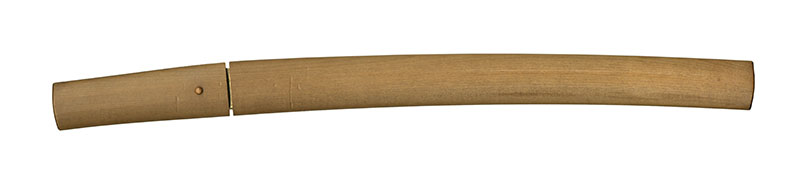
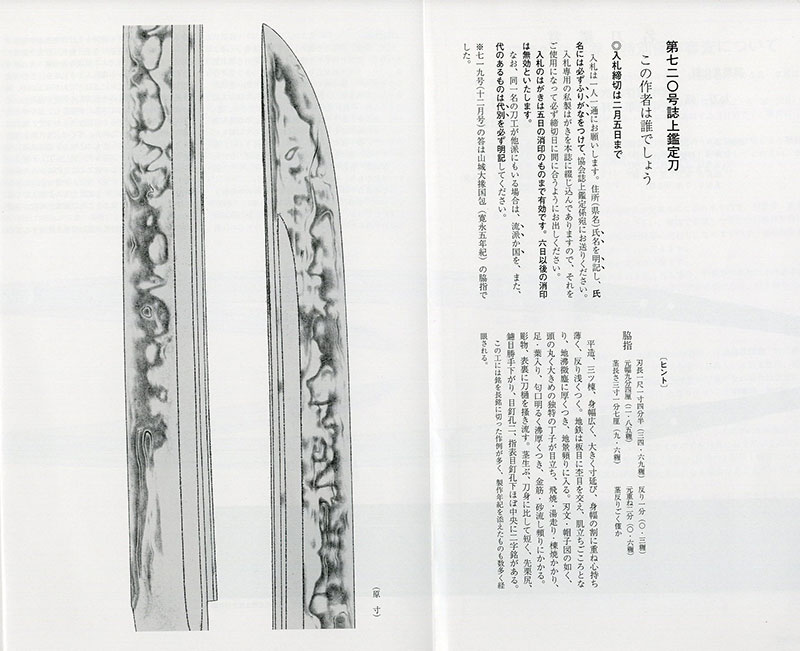
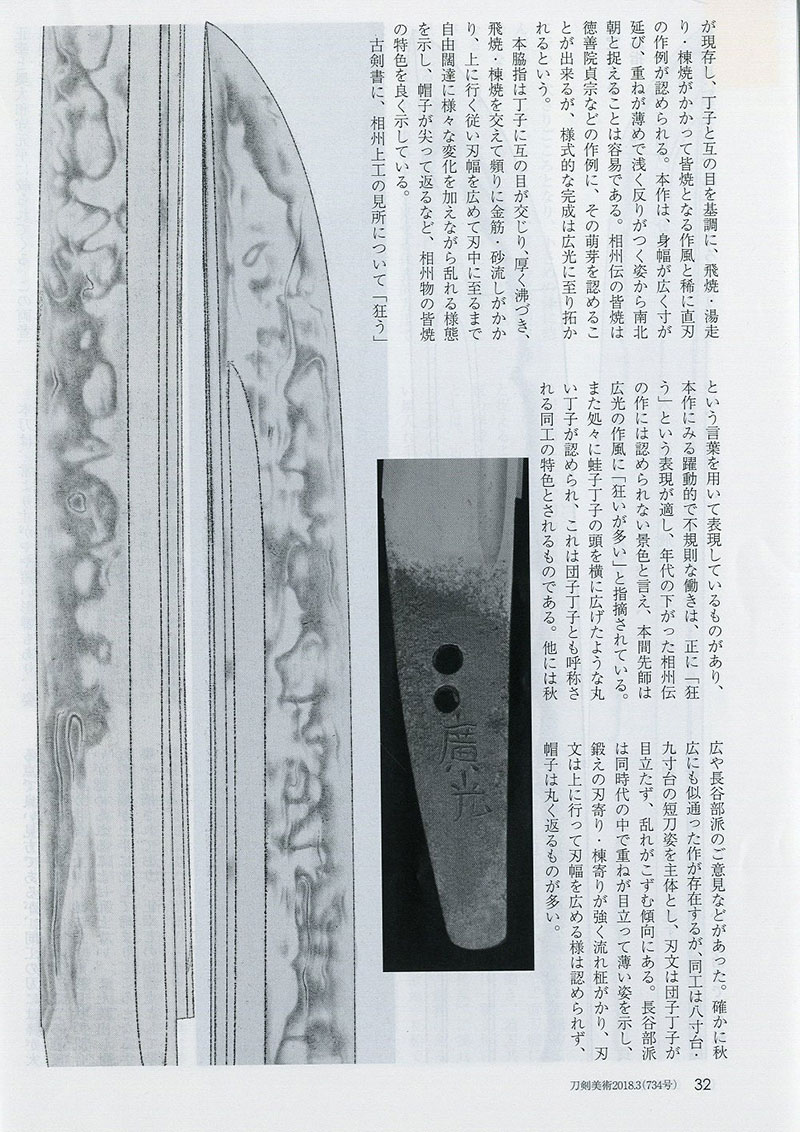
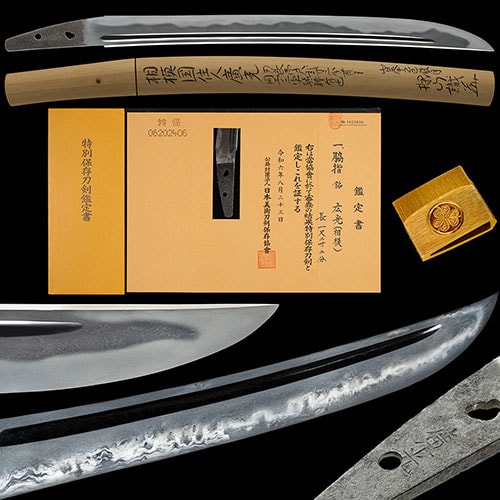
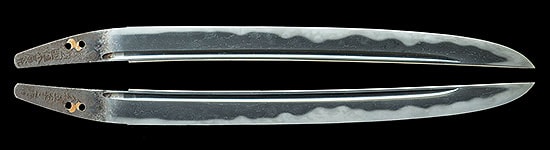
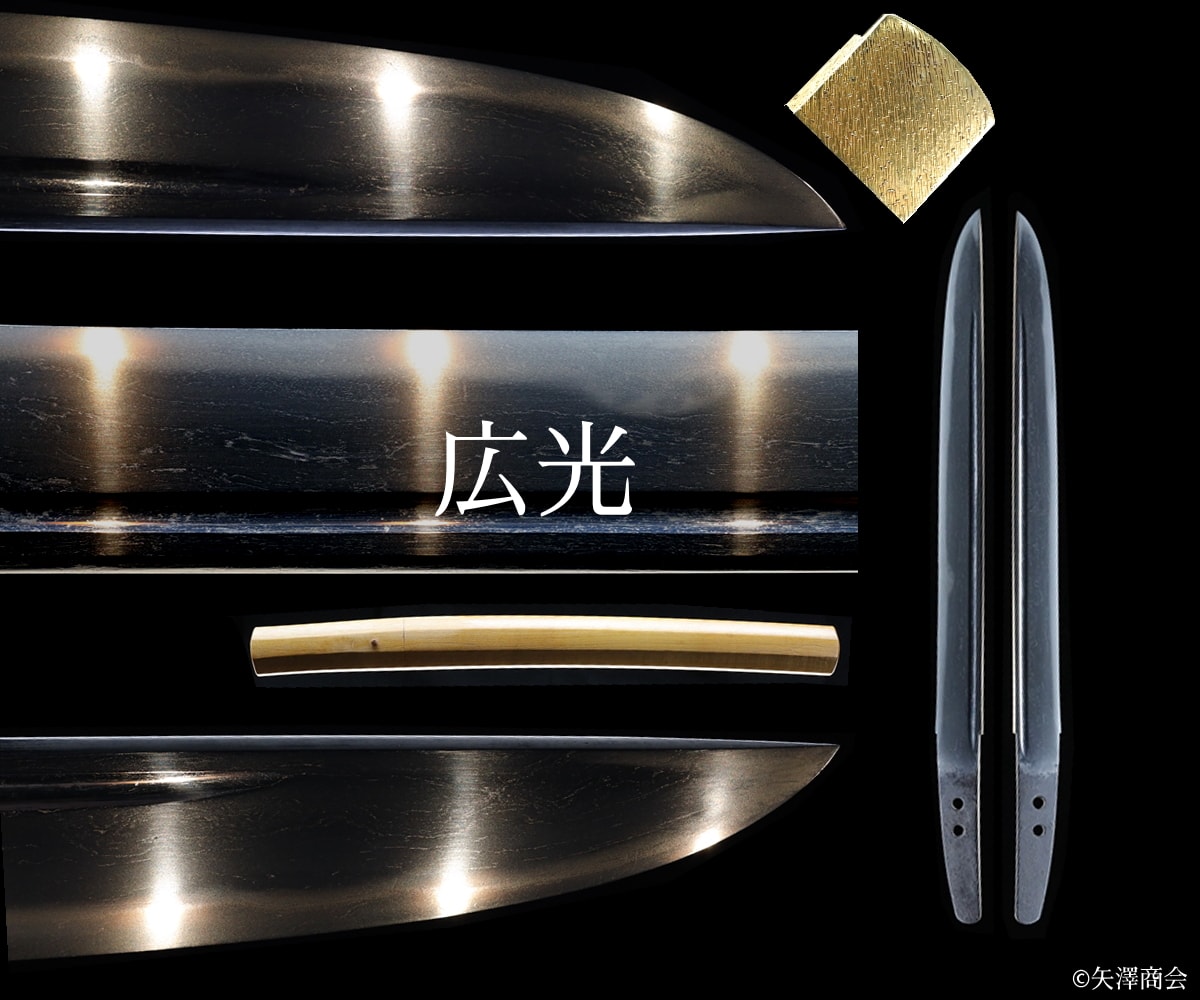
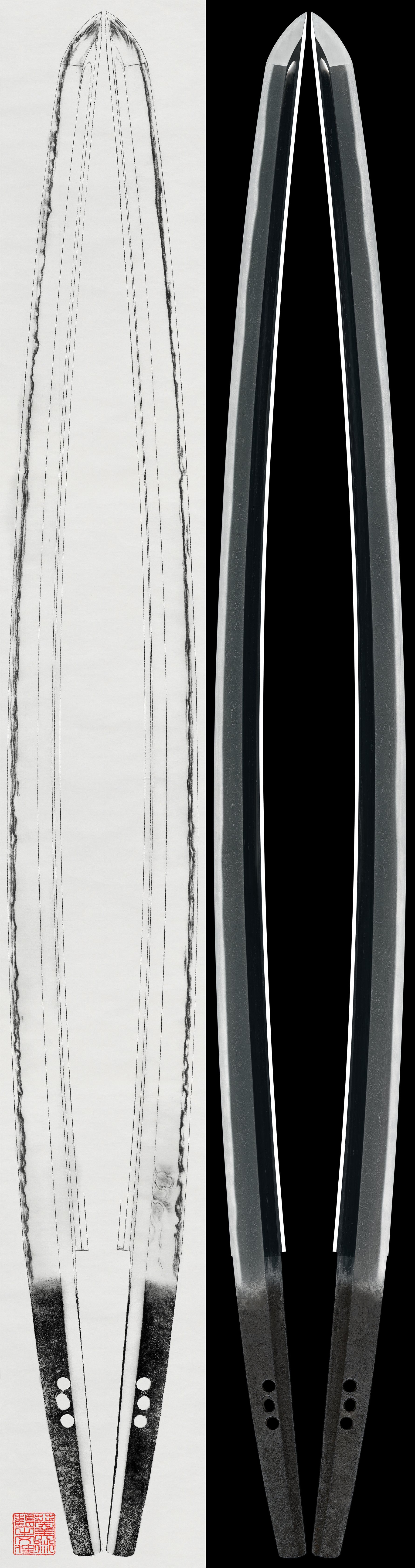
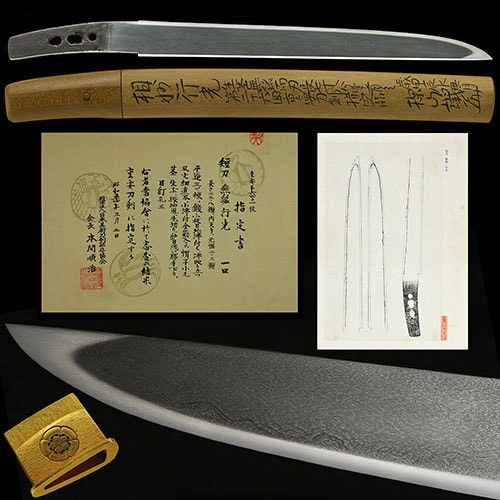
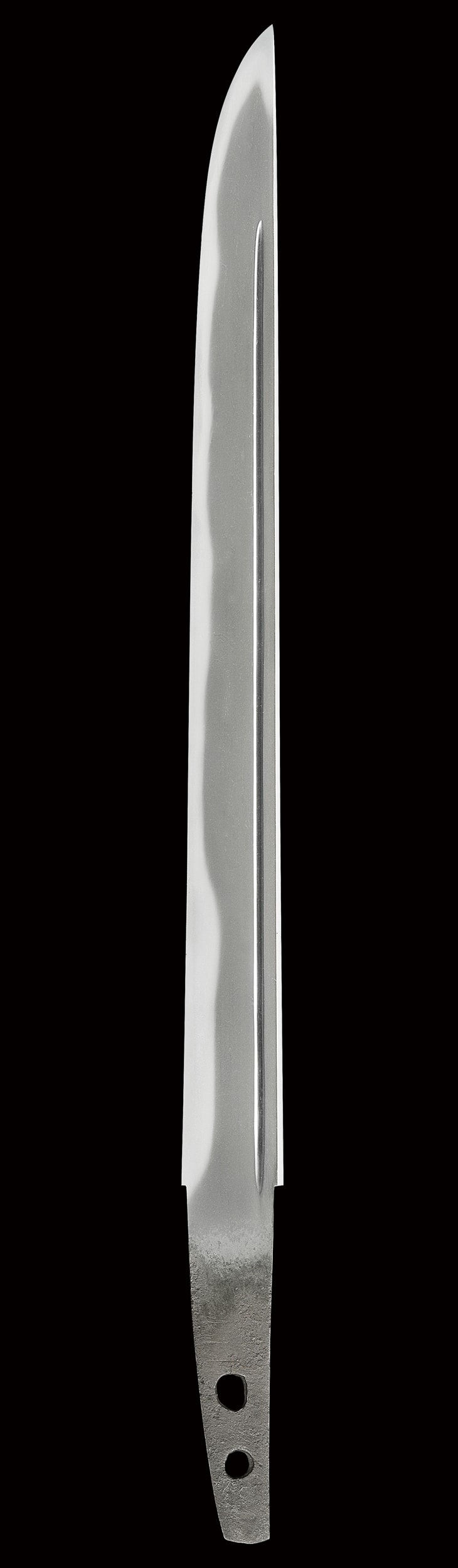
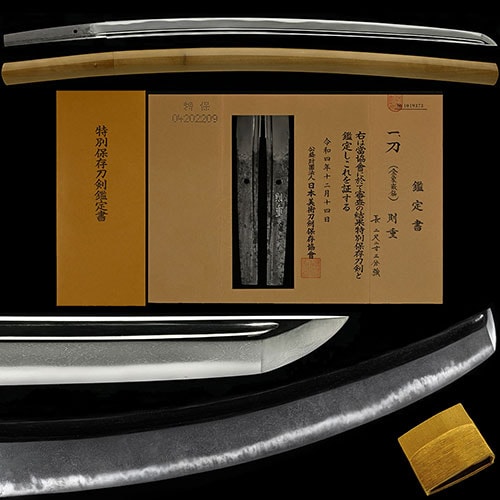
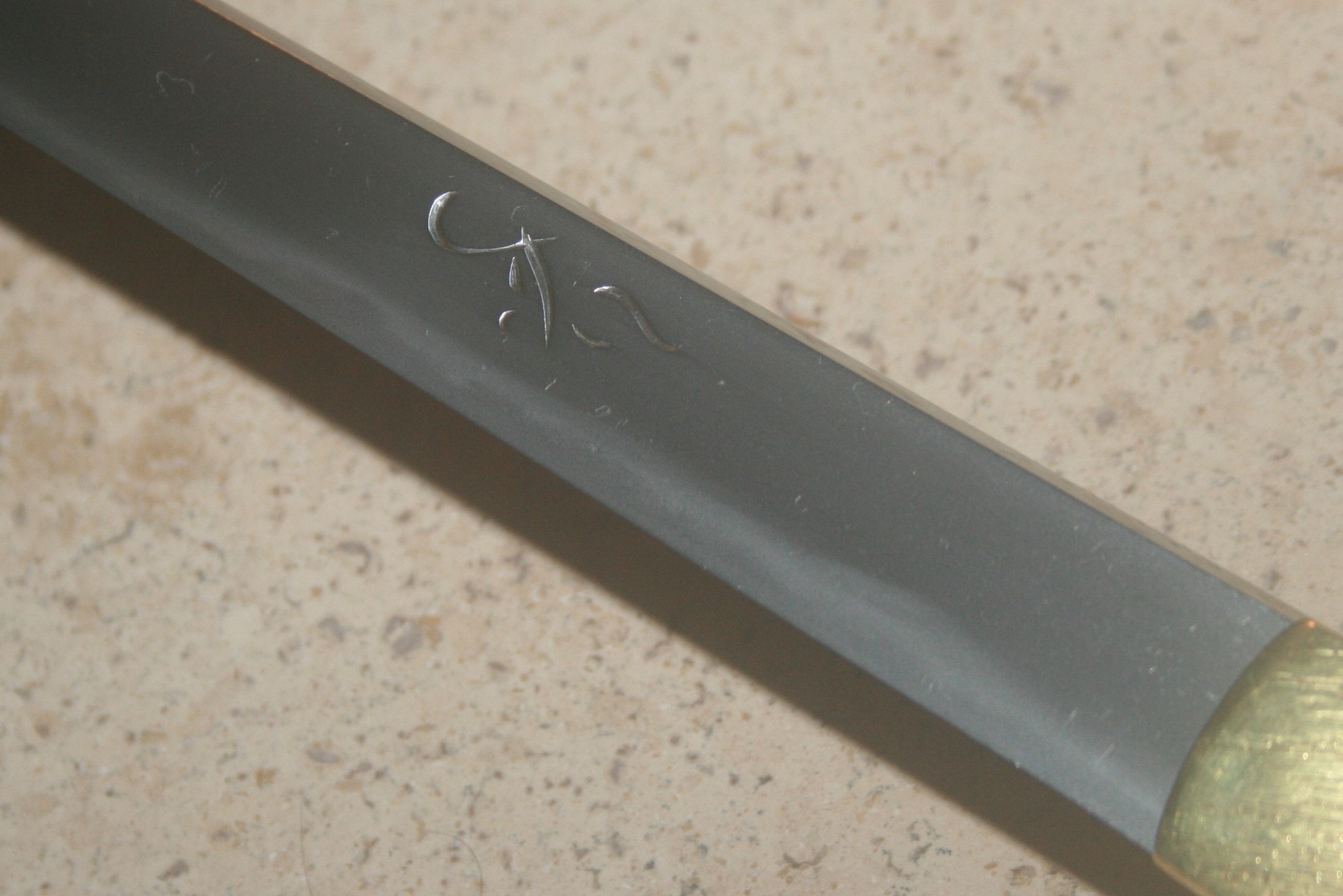
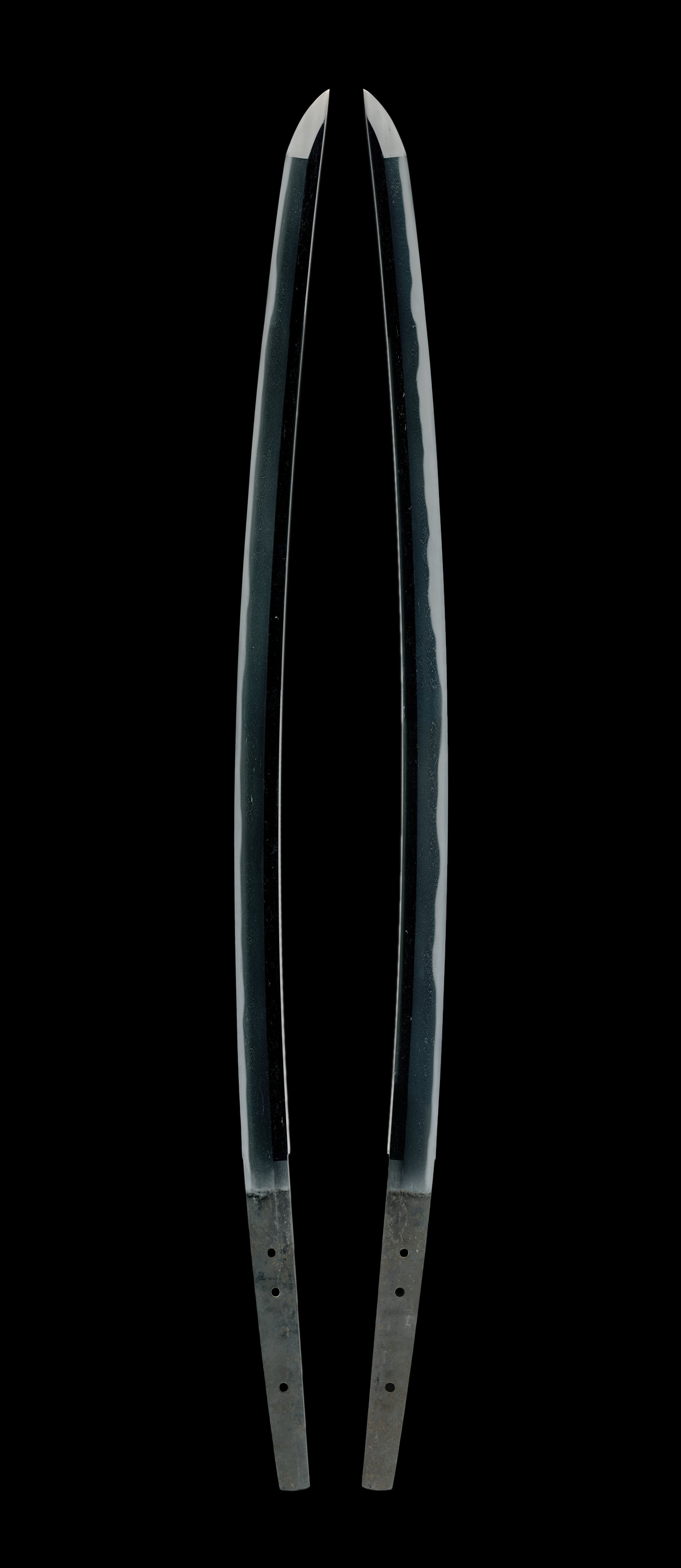
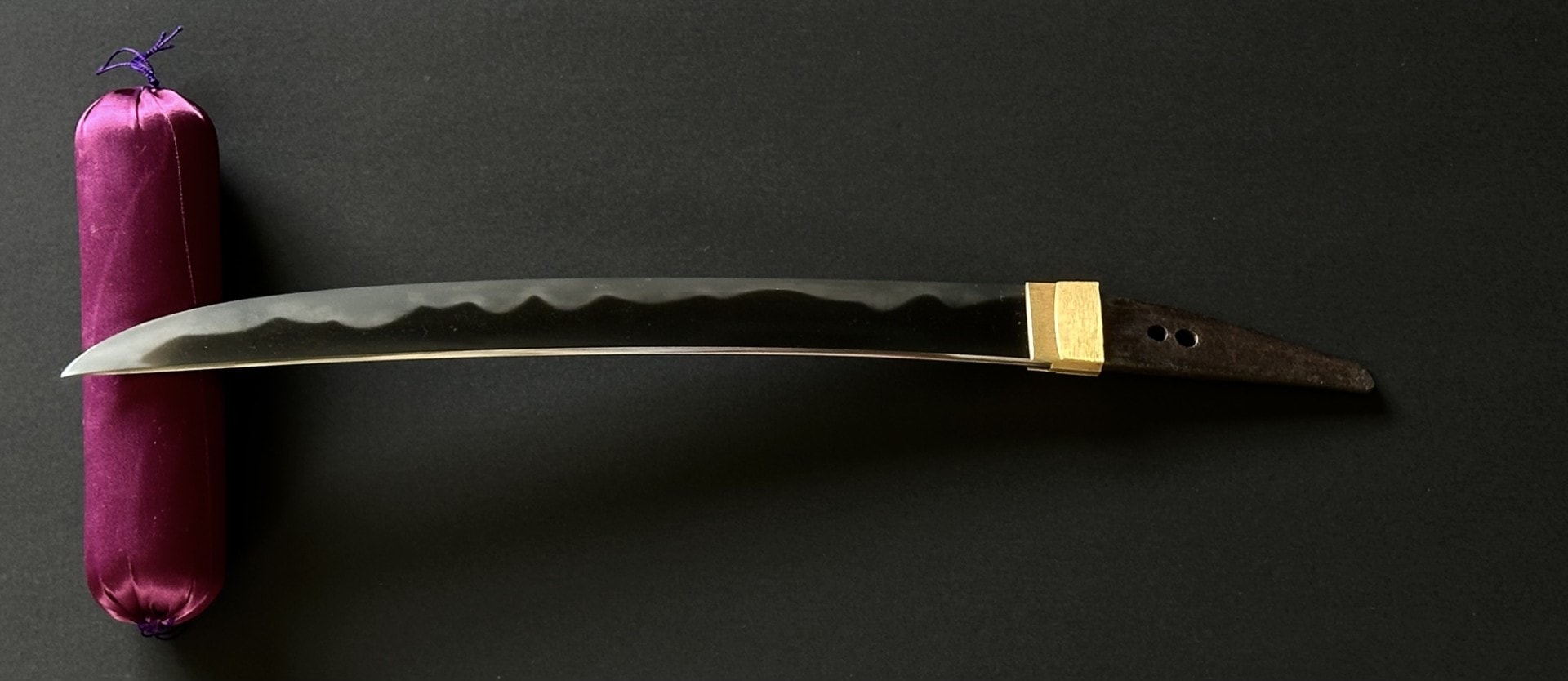
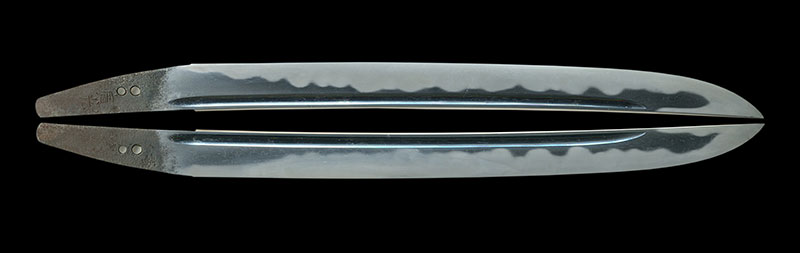
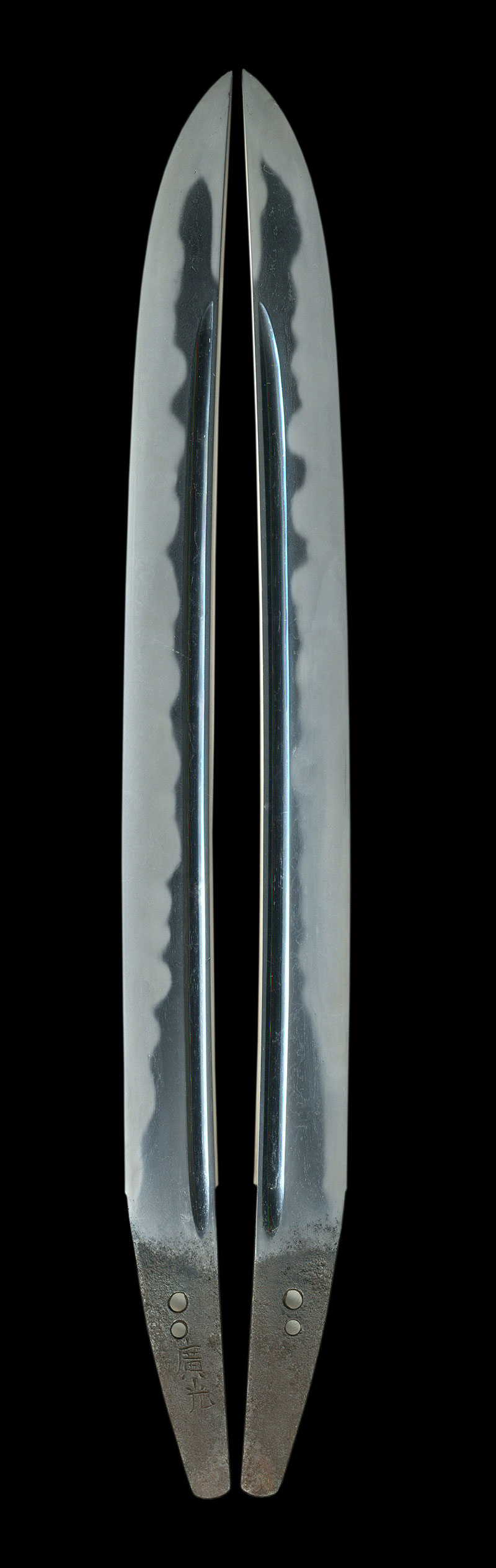
This is a Juyo Token designated wakizashi by Hiromitsu, a master smith representing the Soshu school during the Nanbokucho period. It features a wide body, extended length, and thin kasane, typical of the era. The jihada shows a beautiful itame mixed with mokume, with thick nie and frequent chikei, while the hamon is a flamboyant gunome with prominent, round choji, intense kinsuji and sunagashi, and a bright, thick nioiguchi. This is a rare example of Hiromitsu's work with a two-character mei, as he often signed with a longer inscription.

NBTHK Setsumei

Jūyō-Tōken, 63rd Session — Designated November 17, 2017 Wakizashi, mei: Hiromitsu (広光) Measurements Nagasa 34.7 cm, sori 0.3 cm, motohaba 2.85 cm, nakago-nagasa 9.7 cm, nakago-sori none Description Keijō: hira-zukuri, mitsu-mune; somewhat wide mihaba, rather thin kasane, with shallow sori. Kitae: itame-hada mixed with mokume and nagare-hada; ji-nie adheres thickly in fine particles, with abundant chikei. Hamon: chōji-midare as the dominant theme, mixed with ko-chōji and ko-gunome; here and there appear dumpling-like (dango-jō) large clustered fusa-chōji; with ashi and yō; ko-nie adheres well; kinsuji and sunagashi appear; tobiyaki enters well across the entire ji, becoming hitatsura; the nioiguchi is bright. Bōshi: midare-komi; on the omote it forms maru, and on the ura it rises (tsukiage) to a pointed form; both return deeply, and toward the tip it frequently becomes hakikake. Horimono: On both sides, bō-hi carved kaki-nagashi. Nakago: ubu; tip kurijiri; yasurime katte-sagari; two mekugi-ana; on the omote, a two-character signature is present, centered below the second mekugi-ana. Artisan Hiromitsu (広光) Era Nanbokuchō period, Enbun–Jōji era style (mid-14th century) Explanation Following Sadamune, the two smiths Hiromitsu and Akihiro are regarded as those who represent Sōshū smithing in the Nanbokuchō period. For Hiromitsu, reliably signed tachi are extremely rare; of the signed works that survive today, the great majority are large tantō and small wakizashi of bold proportions that display the period’s distinctive taste. He is particularly associated with the innovative hitatsura tempering style, something not seen in earlier Sōshū works. Among Hiromitsu’s dated works, the earliest bear the era name Kōō, followed thereafter by Bunwa, Enbun, Kōan, and Jōji. This work, though broad, is elongated in proportion and bears a shallow sori, presenting the typical construction of a hira-zukuri small wakizashi from the Enbun–Jōji period. The forging shows itame mixed with mokume and nagare-hada, with thickly adhering minute ji-nie and plentiful chikei. The hamon is fundamentally chōji-midare, mixed with ko-chōji and ko-gunome, and includes, in places, large clustered fusa-chōji of dumpling-like form; together with tobiyaki spread across the surface, it displays a fully developed hitatsura domain. In sugata, jigane, and hamon, the characteristic features of this smith are clearly expressed, making it an exemplary and unmistakably typical work. It is also notably flamboyant in effect, and its state of preservation is good.

NihontoWatch MonNihontoWatch
MarketEncyclopediaKantei
Swords›Sōshū-den›Soshu›Hiromitsu›Koto Wakizashi: Hiromitsu - NBTHK Juyo Token No.63
wakizashiJūyō
Soshu Hiromitsu

Koto Wakizashi: Hiromitsu - NBTHK Juyo Token No.63

mei · Soshu · Nanbokucho · nagasa 34.6cm · sori 0.3cm

SOLD
Soshu Hiromitsu — 1 of 8
Soshu Hiromitsu — 2 of 8
Soshu Hiromitsu — 3 of 8
Soshu Hiromitsu — 4 of 8
Soshu Hiromitsu — 5 of 8
Soshu Hiromitsu — 6 of 8
Soshu Hiromitsu — 7 of 8
Soshu Hiromitsu — 8 of 8
1 / 8
1 / 8
Soshu Hiromitsu — 1 of 8Soshu Hiromitsu — 2 of 8Soshu Hiromitsu — 3 of 8Soshu Hiromitsu — 4 of 8Soshu Hiromitsu — 5 of 8Soshu Hiromitsu — 6 of 8Soshu Hiromitsu — 7 of 8Soshu Hiromitsu — 8 of 8
Measurements & details
Smith
Soshu Hiromitsu
Type
Wakizashi
School
Soshu
Period
Around 1352–1364(Bunna ND)
Province
Sagami
Signature
Signed(70% of this smith's designated works are signed)
Measurements
Nagasa 34.6cmSori 0.3cmMotohaba 2.8cmKasane 0.6cm
Description

This is a Juyo Token designated wakizashi by Hiromitsu, a master smith representing the Soshu school during the Nanbokucho period. It features a wide body, extended length, and thin kasane, typical of the era. The jihada shows a beautiful itame mixed with mokume, with thick nie and frequent chikei, while the hamon is a flamboyant gunome with prominent, round choji, intense kinsuji and sunagashi, and a bright, thick nioiguchi. This is a rare example of Hiromitsu's work with a two-character mei, as he often signed with a longer inscription.

NBTHK Zufu Commentary

Juyo #63

AI translation — may contain errors

-, 63rd Session — Designated November 17, 2017

, : Hiromitsu (広光)

Measurements 34.7 cm, 0.3 cm, 2.85 cm, 9.7 cm, none

Description Keijō: , ; somewhat wide , rather thin , with shallow . : mixed with and ; adheres thickly in fine particles, with abundant . : as the dominant theme, mixed with and ; here and there appear dumpling-like (dango-jō) large clustered fusa-; with and ; adheres well; and appear; enters well across the entire , becoming ; the is bright. : ; on the it forms , and on the it rises () to a pointed form; both return deeply, and toward the tip it frequently becomes . : On both sides, carved kaki-nagashi. : ; tip ; ; two ; on the , a two-character signature is present, centered below the second .

Artisan Hiromitsu (広光)

Era period, Enbun–Jōji era style (mid-14th century)

Explanation Following Sadamune, the two smiths Hiromitsu and Akihiro are regarded as those who represent smithing in the period. For Hiromitsu, reliably signed are extremely rare; of the signed works that survive today, the great majority are large and small of bold proportions that display the period’s distinctive taste. He is particularly associated with the innovative tempering style, something not seen in earlier works. Among Hiromitsu’s dated works, the earliest bear the era name Kōō, followed thereafter by Bunwa, Enbun, Kōan, and Jōji.

This work, though broad, is elongated in proportion and bears a shallow , presenting the typical construction of a small from the Enbun–Jōji period. The forging shows mixed with and , with thickly adhering minute and plentiful . The is fundamentally , mixed with and , and includes, in places, large clustered fusa- of dumpling-like form; together with spread across the surface, it displays a fully developed domain.

In , , and , the characteristic features of this smith are clearly expressed, making it an exemplary and unmistakably typical work. It is also notably flamboyant in effect, and its state of preservation is good.

About the maker

Hiromitsu

廣光

Soshu (Sagami) · Sagami · around 1352-1364

Fujishiro Sai-jo saku · Tōken Taikan top 5%

1 piece on the market now

›

Following Sadamune, the two smiths who emerged in Soshu in the Nanbokucho period were Hiromitsu and Akihiro; nearly every NBTHK commentary on his blades opens with that sentence. A disposition toward hitatsura can already be found, though rarely, in Sadamune, where it amounts to no more than an artless prominence of yubashiri; with Hiromitsu and Akihiro the sources see "the completion of the full-fledged hitatsura hamon"[[c:1]], an invention that influenced the later Sagami smiths and swordsmiths of other provinces alike. The two "developed an innovative and lively style"[[c:2]]. Hiromitsu stands in the Soshu mainline descending from Shintogo Kunimitsu, after Masamune and Sadamune; the Muromachi genealogies divide between the two schools, and the prevailing reading assigns a first generation to Masamune's circle and a second, the master of the Bunna through Joji years, to Sadamune's.

Nearly everything that survives under his name is the hira-zukuri ko-wakizashi and sunnobi tanto of the Enbun and Joji type, wide in mihaba, thin in kasane and shallow in sori; reliably signed tachi are exceedingly rare. He tempers a midare fronted by choji and mixed with gunome; within it appears his round-headed clove, the dango-choji (団子丁子), the form the published sources single out as his individuality. Tobiyaki, yubashiri and muneyaki spill across the ji until the whole blade is fired as hitatsura. Nie lies thick, kinsuji and sunagashi run through the ha, and the nioiguchi is bright and clear. The boshi enters as midare-komi, rising to a point or breaking into a flame-like form, and returns deeply, often burning down the mune. An Enbun 5 (1360) wakizashi of the Bizen Ikeda line is called "typical and outstanding"[[c:3]], its individuality read in the dango-choji.

The jigane beneath this temper is itame, tending overall to stand, with thick ji-nie and frequent chikei, at times mixed with jifu. Of a Bunna 5 (1356) wakizashi the sources write that the activity within the ha and the character of the nioiguchi carry "an atmosphere recalling Masamune in a single thread"[[c:4]]. In places an exceptionally bright nie breaks down into the ji, and the yakiba often widens toward the upper half until the temper fills the whole surface.

His dated work opens with Kanno (1350) and runs through Bunna, Enbun, Koan and Joji. Akihiro's dates begin only at Enbun and continue past him into Oan, Eiwa, Koryaku, Shitoku and Meitoku, eras never seen on Hiromitsu, so his seniority is held certain. He cuts the long mei Sagami no kuni junin Hiromitsu[[c:5]] with the date written out in full, and the published record is categorical that he never signs Soshu ju (相州住), Akihiro's form. A rare two-character mei stands beside it, undated and more angular in its chiselling; the Seikado Bunko, the Nezu Museum and the Kurokawa Institute each preserve one, with suguha pieces of quality among them, and Honma left the generational question open, asking whether "the two-character signature might be the first generation and the long signature the second"[[c:6]]. A quieter register also runs beside the flamboyant standard. The Bunna 2 (1353) tachi of the Echizen Matsudaira line, the sole surviving example of his title mei Saemon-no-jo, shows a midare wholly small in pattern with few yubashiri and tobiyaki and inconspicuous muneyaki; the sources describe "a calm hitatsura"[[c:7]] imparting "a somewhat archaic feeling"[[c:8]], and a nie-utsuri stands out in its ji.

The discriminators against Akihiro are concrete. The signature rule is one; the build is another, for Akihiro's taihai more often runs smaller, read as the chronological transition of shapes, while a Joji 3 (1364) wakizashi of the Kishu Tokugawa line is described as "larger even than usual, with real presence"[[c:9]]. The dango-choji is the third. Against the contemporaneous hitatsura of the Kyoto smiths the line is structural: his favored temper "differs from the Kyoto Hasebe school in that choji forms its main body"[[c:10]], where Hasebe Kunishige and Kuninobu work theirs over a base of small notare. In Bizen terms, the sources note, he is an exact contemporary of the so-called Enbun Kanemitsu.

Fujishiro grades him Sai-jo saku. Forty-five designated works are on record: two Important Cultural Properties, nine Tokubetsu Juyo, twenty-three Juyo and twelve Important Art Object certifications, the tiers in part overlapping, for the Saemon-no-jo tachi and an Enbun 3 wakizashi, its stolen inscriptions restored as shumei, both later advanced to Tokubetsu Juyo. Signed pieces dominate, thirty-three against ten unsigned, nearly all dated, anchoring his chronology era by era. Three named blades stand in the record: the meibutsu Okurikara Hiromitsu[[c:11]] of the Date family; the Kikkawa family blade styled "Furiwakegami Masamune"[[c:12]] since the Edo period, re-judged to Hiromitsu at its certification; and the Uesugi house tanto styled Kashagiri (火車切). His provenance runs through the daimyo houses, the Kishu Tokugawa, the Echizen Matsudaira of Fukui, the Bizen Ikeda, the Satake, the Nanbu, the Date and the Uesugi, with the Mitsui among the modern collectors. The two Important Cultural Properties are patrimony, and several of the finest remaining pieces rest in the Nezu Museum, the Seikado Bunko, the Sano Art Museum and the Kurokawa Institute. What a private collector may realistically encounter is the Tokuju and Juyo tier, thirty-two blades of partially recorded whereabouts, most of them held rather than traded; a signed and dated Hiromitsu ko-wakizashi comes to market only rarely, and when one does it is among the few chances the field offers at the perfected hitatsura of Soshu.

Historical importance

Where Hiromitsu stands among comparable artisans: across all of nihontō, and within tradition, era, and period. The tiers (Foremost · Leading · Major · Notable) weigh official designations from the NBTHK and Japan's Agency for Cultural Affairs, together with historical honors of lasting repute such as the Sansaku and Meibutsu-chō.

随一
Foremost
屈指
Leading
有数
Major
著名
Notable

Select a lens to see how it's measured.

Designation record
44 designated works
Jūyō Bunkazai
2
Jūyō Bijutsuhin
10
Tokubetsu Jūyō
9
Jūyō
23
1 work by Hiromitsu on the market→
Hiromitsu — full profileSoshu (Sagami) school

Dated Works

Years he was demonstrably active, proven by signed-and-dated blades

Active period
1353–1364Editorial estimate: 1352–1364
16 of 30 designated works carry a date
1350
1360
1370
About the school

Soshu

相州

Soshu-den · Sagami

44 pieces on the market now

›

The Soshu school took root in Kamakura, the seat of the Hojo regents in Sagami province, where the demand of the warrior government drew the country's leading smiths to a single town. The published sources count Awataguchi Kunitsuna of Yamashiro and the Bizen masters Kunimune and Sukezane among the immigrant pioneers of Kamakura sword-making, but the first native smith of Sagami, the man who cut his Kamakura residence and his dates into the nakago, was Shintogo Kunimitsu, reckoned the de facto founder of the Soshu-den. Working from the close of the thirteenth century into the 1330s, Kunimitsu built his refined manner on Awataguchi foundations: his tanto read at a glance like Yamashiro work until the conspicuous chikei and kinsuji in ji and ha betray the new tradition. From his forge came the three masters Yukimitsu, Masamune and Norishige, with Daishinbo Yukei as carving specialist and Kunihiro among the smith's own sons; through them the nie-laden suguha of the founder opened into the mature nie-deki that would define the school. A shared vocabulary runs through the whole register. The forging is itame mixed with mokume, the grain standing in places, covered in thick ji-nie with chikei entering abundantly, so the steel reads bright and clear in the manner the texts call particular to the upper rank of Soshu-den work. Over it the temper runs as a notare mixed with gunome, the nioiguchi deep, the nie thick, kinsuji and sunagashi working busily through the ha, with yubashiri drifting into the ji and a swept hakikake boshi above. From this common ground the internal arc unfolds.

Kunimitsu and Yukimitsu hold the restrained early hand, a calm suguha tending to shallow notare; Norishige carries the bold standing grain laced with thick chikei until the surface reads like pine bark (matsukawa-hada), his nioiguchi subdued and sunken. Masamune raises the nie to its highest refinement, a notare-based midareba alive with leaping kinsuji and chikei that the sources liken to splashed-ink (haboku) landscape painting; Sadamune, succeeding him in the mainline, works a calmer, more relaxed notare and excels as the carving master of the school. With Hiromitsu and Akihiro the temper escapes the edge entirely into the full-fledged hitatsura of Nanbokucho, tobiyaki and muneyaki firing the whole blade, Hiromitsu marked by his round dango-choji and Akihiro by a rougher, more openly active steel. A collector seeks Soshu for the nie itself, the most refined expression of hardened-steel artistry the tradition produced, and Masamune stands at its summit, his name carrying the heaviest weight of designation in the field and a place among Fujishiro's Sai-jo saku. To kantei the school is to read the recognition core the appraisers return to again and again: a chikei-rich standing itame, a deep and bright nioiguchi, busy kinsuji and sunagashi, and the swept boshi. The discriminations are fine and qualitative, Norishige's sunken nioiguchi and heavier grain set against Masamune's tighter quieter ji; Go Yoshihiro, who carried the manner west into Etchu, lit a degree brighter still with masame creeping into the hada and a deep ichimai-swept point; Yukimitsu kept the smaller, quieter pattern; Takagi Sadamune, who took the tradition into Omi, stood a touch more and ran shizumi in the nioiguchi where he fell short of the master. Because the great names left almost nothing signed, most of what survives is o-suriage mumei resting on Hon'ami attribution, and the signed meibutsu (the Kinoshita Masamune, the Mutsu Shintogo, the Okurikara Hiromitsu) carry provenance through the men who held the country: Oda Nobunaga, Toyotomi Hideyoshi, Tokugawa Ieyasu, and the Maeda, Date, Hosokawa and Uesugi houses, with the highest blades resting in the great museums and shrines. The school's influence radiated outward, Norishige's pine-bark forging passing through Tametsugu to the later Etchu smiths and the perfected hitatsura reaching swordsmiths of other provinces, so that the Soshu-den became one of the five great traditions by which the whole field is read. Learn more →

34 recorded smiths840 designated works
Leading smiths
SmithEraDesignated
Masamune正宗1288-129384
Sadamune貞宗1329-133186
Go Yoshihiro義弘1299-130254
Akihiro秋廣1346-137027
Kunimitsu國光1293-132269
Explore the Soshu school →

Historical context

Kamakura fell in 1333, but the school’s greatest era followed: Sadamune working at his teacher’s standard, Hiromitsu and Akihiro spilling hitatsura over the whole blade, and the Sōshū manner spreading with the armies until it became, for a time, a national style.

Sōshū in the Nanbokuchō period →

NBTHK Certificate
Jūyō Tōken重要刀剣
Important Sword
›

A blade of top-grade workmanship and condition, formally judged to rank with a nationally recognized Important Art Object (Jūyō Bijutsuhin). Awarded only at the NBTHK’s competitive annual examination.

Of Japan’s roughly 2.5 million registered swords, only 12,307 (about 1 in 203) have ever attained Jūyō.

About the NBTHK›

The NBTHK (Nihon Bijutsu Tōken Hozon Kyōkai, the Society for the Preservation of Japanese Art Swords) is a public-interest incorporated foundation founded in 1948 and supervised by Japan’s Agency for Cultural Affairs (Bunkachō); it is based at the Japanese Sword Museum in Tokyo. Its expert panels physically examine each submitted work (shinsa) and issue a certificate (kanteishō) ranking it by artistic and historical merit. NBTHK papers are the most widely recognized standard of authentication for Japanese swords and fittings.

NBTHK official site→
Seller
I
Iida Koendo
Established 1880 · 146 yrs on the market
🇯🇵Ships from Japan
›
✓Verified dealeriidakoendo.com
✓Ships worldwide✓English supportWire transfer
Return policy

Customer-initiated returns accepted within two days of arrival; return shipping paid by customer and fees non-refundable. Returns/refunds unavailable for overseas deliveries.

View all of Iida Koendo’s listings→View this item on the dealer’s site→

More works by Soshu Hiromitsu

View all →
Eirakudo
Tokuho
Wakizashi - Tokuho - by Soshu Hiromitsu - Hiromitsu Wakizashi - Tokubetsu Hozon TokenWakizashi - Tokuho - by Soshu Hiromitsu - Hiromitsu Wakizashi - Tokubetsu Hozon Token

Wakizashi

BySoshu Hiromitsu
¥7,500,000

Previously sold by Soshu Hiromitsu

Choshuya
Wakizashi - by Soshu Hiromitsu - HiromitsuWakizashi - by Soshu Hiromitsu - Hiromitsu
Sold

Wakizashi

BySoshu Hiromitsu
SOLD
Yazawa Shokai
Tanto - by Soshu Hiromitsu - Tanto by Soshu Hiromitsu (New Registration Appraisal Pending) - Mitsumune (Shin no Mune) Hirazukuri 2407027Tanto - by Soshu Hiromitsu - Tanto by Soshu Hiromitsu (New Registration Appraisal Pending) - Mitsumune (Shin no Mune) Hirazukuri 2407027
Sold

Tantō

BySoshu Hiromitsu
SOLD
Yazawa Shokai
Hozon
Tanto - Hozon - by Soshu Hiromitsu - Old Registration (Soshu ju Hiromitsu) → New Registration (Mumei) - Hozon Guarantee Possible, Mitsu-mune (Shin no Mune) Hira-zukuriTanto - Hozon - by Soshu Hiromitsu - Old Registration (Soshu ju Hiromitsu) → New Registration (Mumei) - Hozon Guarantee Possible, Mitsu-mune (Shin no Mune) Hira-zukuri
Sold

Tantō

BySoshu Hiromitsu
SOLD
Iida Koendo
Jūyō
Wakizashi - Jūyō - by Soshu Hiromitsu - KotoWakizashi - Jūyō - by Soshu Hiromitsu - Koto
Sold

Wakizashi

BySoshu Hiromitsu
SOLD

More from the Soshu school

View all →
World Seiyudo
Tokuho
Wakizashi - Tokuho - by Sue-Soshu Masahiro - Mumei Soshu Masahiro - NBTHK Tokubetsu Hozon Token & TosoguWakizashi - Tokuho - by Sue-Soshu Masahiro - Mumei Soshu Masahiro - NBTHK Tokubetsu Hozon Token & Tosogu

Wakizashi

BySue-Soshu Masahiro
¥2,500,000
Tsuruginoya
Tokujū
Katana - Tokuju - by Soshu Yukimitsu - Soshu YukimitsuKatana - Tokuju - by Soshu Yukimitsu - Soshu Yukimitsu

Katana

BySoshu Yukimitsu
Ask
Eirakudo
Jūyō
Tanto - Jūyō - by Soshu Yukimitsu - Soshu Yukimitsu - Juyo TokenTanto - Jūyō - by Soshu Yukimitsu - Soshu Yukimitsu - Juyo Token

Tantō

BySoshu Yukimitsu
Ask
Samurai Nippon
Jūyō
Katana - Jūyō - by Soshu Norishige - Mumei (Attributed to Norishige)Katana - Jūyō - by Soshu Norishige - Mumei (Attributed to Norishige)

Katana

BySoshu Norishige
Ask
Choshuya
Jūyō
Tanto - Jūyō - by Soshu Norishige - Ubu-nakago Mumei NorishigeTanto - Jūyō - by Soshu Norishige - Ubu-nakago Mumei Norishige

Tantō

BySoshu Norishige
¥6,500,000
Aoi Art
Tokuho
Katana - Tokuho - by Gō Yoshihiro - Mumei (Unsigned) Den Go YoshihiroKatana - Tokuho - by Gō Yoshihiro - Mumei (Unsigned) Den Go Yoshihiro

Katana

ByGō Yoshihiro
¥35,000,000
Samurai Nippon
Jūyō
Tanto - Jūyō - by Soshu Yukimitsu - Soshu Yukimitsu (Mumei)Tanto - Jūyō - by Soshu Yukimitsu - Soshu Yukimitsu (Mumei)

Tantō

BySoshu Yukimitsu
¥6,700,000
Mandarin Mansion
Jūyō
Tachi - Jūyō - by Soshu Yukimitsu - Juyo Soshu Yukimitsu TachiTachi - Jūyō - by Soshu Yukimitsu - Juyo Soshu Yukimitsu Tachi

Tachi

BySoshu Yukimitsu
Ask

More from the Sōshū tradition

View all →
Toukentakarado
Tokuho
Katana - Tokuho - by Soshu Tametsugu - Mumei Attributed to TametsuguKatana - Tokuho - by Soshu Tametsugu - Mumei Attributed to Tametsugu

Katana

BySoshu Tametsugu
¥1,500,000
Eirakudo
Tokuho
Katana - Tokuho - by Soshu Norishige - Norishige - Tokubetsu Hozon TokenKatana - Tokuho - by Soshu Norishige - Norishige - Tokubetsu Hozon Token

Katana

BySoshu Norishige
¥6,500,000
Katanahanbai
Tokuho
Tanto - Tokuho - by Shimada Yoshisuke - Shimada GisukeTanto - Tokuho - by Shimada Yoshisuke - Shimada Gisuke

Tantō

ByShimada Yoshisuke
¥750,000
Eirakudo
Tokuho
Katana - Tokuho - by Shintogo Kunimitsu - Shintogo Kunimitsu Katana - Tokubetsu Hozon TokenKatana - Tokuho - by Shintogo Kunimitsu - Shintogo Kunimitsu Katana - Tokubetsu Hozon Token

Katana

ByShintogo Kunimitsu
¥7,500,000
Mandarin Mansion
Jūyō
Wakizashi - Jūyō - by Hasebe School - Juyo Den Hasebe Sunnobi TantoWakizashi - Jūyō - by Hasebe School - Juyo Den Hasebe Sunnobi Tanto

Wakizashi

ByHasebe School
¥30,000
Shoubudou
Tokuho
Tachi - Tokuho - by Sue-Soshu Hirotsugu - Hirotsugu sakuTachi - Tokuho - by Sue-Soshu Hirotsugu - Hirotsugu saku

Tachi

BySue-Soshu Hirotsugu
¥2,400,000
Choshuya
Tokuho
Katana - Tokuho - by Soshu Norishige - Unsigned (O-suriage) NorishigeKatana - Tokuho - by Soshu Norishige - Unsigned (O-suriage) Norishige

Katana

BySoshu Norishige
Ask
Token-Net
Jūyō
Tachi - Jūyō - by Naotsuna - Sekishu Dewan Naotsuna Saku (Iwami)Tachi - Jūyō - by Naotsuna - Sekishu Dewan Naotsuna Saku (Iwami)

Tachi

ByNaotsuna
¥5,800,000

Swords

  • Katana
  • Wakizashi
  • Tantō
  • Tachi
  • Naginata
  • Yari

Fittings

  • Tsuba
  • Fuchi-Kashira
  • Kozuka
  • Menuki

Armor

  • Kabuto
  • Samurai Armor

By Certification

  • Tokujū
  • Jūyō
  • Tokuho
  • Hozon

Resources

  • Dealer Directory
  • Artist Directory
  • The Daily Kantei
  • Glossary
  • Browse All
Nihontowatch© 2026
TermsPrivacyCookiesAbout

Description

This is a Juyo Token designated wakizashi by Hiromitsu, a master smith representing the Soshu school during the Nanbokucho period. It features a wide body, extended length, and thin kasane, typical of the era. The jihada shows a beautiful itame mixed with mokume, with thick nie and frequent chikei, while the hamon is a flamboyant gunome with prominent, round choji, intense kinsuji and sunagashi, and a bright, thick nioiguchi. This is a rare example of Hiromitsu's work with a two-character mei, as he often signed with a longer inscription.

NBTHK Setsumei

Jūyō-Tōken, 63rd Session — Designated November 17, 2017 Wakizashi, mei: Hiromitsu (広光) Measurements Nagasa 34.7 cm, sori 0.3 cm, motohaba 2.85 cm, nakago-nagasa 9.7 cm, nakago-sori none Description Keijō: hira-zukuri, mitsu-mune; somewhat wide mihaba, rather thin kasane, with shallow sori. Kitae: itame-hada mixed with mokume and nagare-hada; ji-nie adheres thickly in fine particles, with abundant chikei. Hamon: chōji-midare as the dominant theme, mixed with ko-chōji and ko-gunome; here and there appear dumpling-like (dango-jō) large clustered fusa-chōji; with ashi and yō; ko-nie adheres well; kinsuji and sunagashi appear; tobiyaki enters well across the entire ji, becoming hitatsura; the nioiguchi is bright. Bōshi: midare-komi; on the omote it forms maru, and on the ura it rises (tsukiage) to a pointed form; both return deeply, and toward the tip it frequently becomes hakikake. Horimono: On both sides, bō-hi carved kaki-nagashi. Nakago: ubu; tip kurijiri; yasurime katte-sagari; two mekugi-ana; on the omote, a two-character signature is present, centered below the second mekugi-ana. Artisan Hiromitsu (広光) Era Nanbokuchō period, Enbun–Jōji era style (mid-14th century) Explanation Following Sadamune, the two smiths Hiromitsu and Akihiro are regarded as those who represent Sōshū smithing in the Nanbokuchō period. For Hiromitsu, reliably signed tachi are extremely rare; of the signed works that survive today, the great majority are large tantō and small wakizashi of bold proportions that display the period’s distinctive taste. He is particularly associated with the innovative hitatsura tempering style, something not seen in earlier Sōshū works. Among Hiromitsu’s dated works, the earliest bear the era name Kōō, followed thereafter by Bunwa, Enbun, Kōan, and Jōji. This work, though broad, is elongated in proportion and bears a shallow sori, presenting the typical construction of a hira-zukuri small wakizashi from the Enbun–Jōji period. The forging shows itame mixed with mokume and nagare-hada, with thickly adhering minute ji-nie and plentiful chikei. The hamon is fundamentally chōji-midare, mixed with ko-chōji and ko-gunome, and includes, in places, large clustered fusa-chōji of dumpling-like form; together with tobiyaki spread across the surface, it displays a fully developed hitatsura domain. In sugata, jigane, and hamon, the characteristic features of this smith are clearly expressed, making it an exemplary and unmistakably typical work. It is also notably flamboyant in effect, and its state of preservation is good.

NihontoWatch MonNihontoWatch
MarketEncyclopediaKantei
Swords›Sōshū-den›Soshu›Hiromitsu›Koto Wakizashi: Hiromitsu - NBTHK Juyo Token No.63
wakizashiJūyō
Soshu Hiromitsu

Koto Wakizashi: Hiromitsu - NBTHK Juyo Token No.63

mei · Soshu · Nanbokucho · nagasa 34.6cm · sori 0.3cm

SOLD
Soshu Hiromitsu — 1 of 8
Soshu Hiromitsu — 2 of 8
Soshu Hiromitsu — 3 of 8
Soshu Hiromitsu — 4 of 8
Soshu Hiromitsu — 5 of 8
Soshu Hiromitsu — 6 of 8
Soshu Hiromitsu — 7 of 8
Soshu Hiromitsu — 8 of 8
1 / 8
1 / 8
Soshu Hiromitsu — 1 of 8Soshu Hiromitsu — 2 of 8Soshu Hiromitsu — 3 of 8Soshu Hiromitsu — 4 of 8Soshu Hiromitsu — 5 of 8Soshu Hiromitsu — 6 of 8Soshu Hiromitsu — 7 of 8Soshu Hiromitsu — 8 of 8
Measurements & details
Smith
Soshu Hiromitsu
Type
Wakizashi
School
Soshu
Period
Around 1352–1364(Bunna ND)
Province
Sagami
Signature
Signed(70% of this smith's designated works are signed)
Measurements
Nagasa 34.6cmSori 0.3cmMotohaba 2.8cmKasane 0.6cm
Description

This is a Juyo Token designated wakizashi by Hiromitsu, a master smith representing the Soshu school during the Nanbokucho period. It features a wide body, extended length, and thin kasane, typical of the era. The jihada shows a beautiful itame mixed with mokume, with thick nie and frequent chikei, while the hamon is a flamboyant gunome with prominent, round choji, intense kinsuji and sunagashi, and a bright, thick nioiguchi. This is a rare example of Hiromitsu's work with a two-character mei, as he often signed with a longer inscription.

NBTHK Zufu Commentary

Juyo #63

AI translation — may contain errors

-, 63rd Session — Designated November 17, 2017

, : Hiromitsu (広光)

Measurements 34.7 cm, 0.3 cm, 2.85 cm, 9.7 cm, none

Description Keijō: , ; somewhat wide , rather thin , with shallow . : mixed with and ; adheres thickly in fine particles, with abundant . : as the dominant theme, mixed with and ; here and there appear dumpling-like (dango-jō) large clustered fusa-; with and ; adheres well; and appear; enters well across the entire , becoming ; the is bright. : ; on the it forms , and on the it rises () to a pointed form; both return deeply, and toward the tip it frequently becomes . : On both sides, carved kaki-nagashi. : ; tip ; ; two ; on the , a two-character signature is present, centered below the second .

Artisan Hiromitsu (広光)

Era period, Enbun–Jōji era style (mid-14th century)

Explanation Following Sadamune, the two smiths Hiromitsu and Akihiro are regarded as those who represent smithing in the period. For Hiromitsu, reliably signed are extremely rare; of the signed works that survive today, the great majority are large and small of bold proportions that display the period’s distinctive taste. He is particularly associated with the innovative tempering style, something not seen in earlier works. Among Hiromitsu’s dated works, the earliest bear the era name Kōō, followed thereafter by Bunwa, Enbun, Kōan, and Jōji.

This work, though broad, is elongated in proportion and bears a shallow , presenting the typical construction of a small from the Enbun–Jōji period. The forging shows mixed with and , with thickly adhering minute and plentiful . The is fundamentally , mixed with and , and includes, in places, large clustered fusa- of dumpling-like form; together with spread across the surface, it displays a fully developed domain.

In , , and , the characteristic features of this smith are clearly expressed, making it an exemplary and unmistakably typical work. It is also notably flamboyant in effect, and its state of preservation is good.

About the maker

Hiromitsu

廣光

Soshu (Sagami) · Sagami · around 1352-1364

Fujishiro Sai-jo saku · Tōken Taikan top 5%

1 piece on the market now

›

Following Sadamune, the two smiths who emerged in Soshu in the Nanbokucho period were Hiromitsu and Akihiro; nearly every NBTHK commentary on his blades opens with that sentence. A disposition toward hitatsura can already be found, though rarely, in Sadamune, where it amounts to no more than an artless prominence of yubashiri; with Hiromitsu and Akihiro the sources see "the completion of the full-fledged hitatsura hamon"[[c:1]], an invention that influenced the later Sagami smiths and swordsmiths of other provinces alike. The two "developed an innovative and lively style"[[c:2]]. Hiromitsu stands in the Soshu mainline descending from Shintogo Kunimitsu, after Masamune and Sadamune; the Muromachi genealogies divide between the two schools, and the prevailing reading assigns a first generation to Masamune's circle and a second, the master of the Bunna through Joji years, to Sadamune's.

Nearly everything that survives under his name is the hira-zukuri ko-wakizashi and sunnobi tanto of the Enbun and Joji type, wide in mihaba, thin in kasane and shallow in sori; reliably signed tachi are exceedingly rare. He tempers a midare fronted by choji and mixed with gunome; within it appears his round-headed clove, the dango-choji (団子丁子), the form the published sources single out as his individuality. Tobiyaki, yubashiri and muneyaki spill across the ji until the whole blade is fired as hitatsura. Nie lies thick, kinsuji and sunagashi run through the ha, and the nioiguchi is bright and clear. The boshi enters as midare-komi, rising to a point or breaking into a flame-like form, and returns deeply, often burning down the mune. An Enbun 5 (1360) wakizashi of the Bizen Ikeda line is called "typical and outstanding"[[c:3]], its individuality read in the dango-choji.

The jigane beneath this temper is itame, tending overall to stand, with thick ji-nie and frequent chikei, at times mixed with jifu. Of a Bunna 5 (1356) wakizashi the sources write that the activity within the ha and the character of the nioiguchi carry "an atmosphere recalling Masamune in a single thread"[[c:4]]. In places an exceptionally bright nie breaks down into the ji, and the yakiba often widens toward the upper half until the temper fills the whole surface.

His dated work opens with Kanno (1350) and runs through Bunna, Enbun, Koan and Joji. Akihiro's dates begin only at Enbun and continue past him into Oan, Eiwa, Koryaku, Shitoku and Meitoku, eras never seen on Hiromitsu, so his seniority is held certain. He cuts the long mei Sagami no kuni junin Hiromitsu[[c:5]] with the date written out in full, and the published record is categorical that he never signs Soshu ju (相州住), Akihiro's form. A rare two-character mei stands beside it, undated and more angular in its chiselling; the Seikado Bunko, the Nezu Museum and the Kurokawa Institute each preserve one, with suguha pieces of quality among them, and Honma left the generational question open, asking whether "the two-character signature might be the first generation and the long signature the second"[[c:6]]. A quieter register also runs beside the flamboyant standard. The Bunna 2 (1353) tachi of the Echizen Matsudaira line, the sole surviving example of his title mei Saemon-no-jo, shows a midare wholly small in pattern with few yubashiri and tobiyaki and inconspicuous muneyaki; the sources describe "a calm hitatsura"[[c:7]] imparting "a somewhat archaic feeling"[[c:8]], and a nie-utsuri stands out in its ji.

The discriminators against Akihiro are concrete. The signature rule is one; the build is another, for Akihiro's taihai more often runs smaller, read as the chronological transition of shapes, while a Joji 3 (1364) wakizashi of the Kishu Tokugawa line is described as "larger even than usual, with real presence"[[c:9]]. The dango-choji is the third. Against the contemporaneous hitatsura of the Kyoto smiths the line is structural: his favored temper "differs from the Kyoto Hasebe school in that choji forms its main body"[[c:10]], where Hasebe Kunishige and Kuninobu work theirs over a base of small notare. In Bizen terms, the sources note, he is an exact contemporary of the so-called Enbun Kanemitsu.

Fujishiro grades him Sai-jo saku. Forty-five designated works are on record: two Important Cultural Properties, nine Tokubetsu Juyo, twenty-three Juyo and twelve Important Art Object certifications, the tiers in part overlapping, for the Saemon-no-jo tachi and an Enbun 3 wakizashi, its stolen inscriptions restored as shumei, both later advanced to Tokubetsu Juyo. Signed pieces dominate, thirty-three against ten unsigned, nearly all dated, anchoring his chronology era by era. Three named blades stand in the record: the meibutsu Okurikara Hiromitsu[[c:11]] of the Date family; the Kikkawa family blade styled "Furiwakegami Masamune"[[c:12]] since the Edo period, re-judged to Hiromitsu at its certification; and the Uesugi house tanto styled Kashagiri (火車切). His provenance runs through the daimyo houses, the Kishu Tokugawa, the Echizen Matsudaira of Fukui, the Bizen Ikeda, the Satake, the Nanbu, the Date and the Uesugi, with the Mitsui among the modern collectors. The two Important Cultural Properties are patrimony, and several of the finest remaining pieces rest in the Nezu Museum, the Seikado Bunko, the Sano Art Museum and the Kurokawa Institute. What a private collector may realistically encounter is the Tokuju and Juyo tier, thirty-two blades of partially recorded whereabouts, most of them held rather than traded; a signed and dated Hiromitsu ko-wakizashi comes to market only rarely, and when one does it is among the few chances the field offers at the perfected hitatsura of Soshu.
Historical importance

Where Hiromitsu stands among comparable artisans: across all of nihontō, and within tradition, era, and period. The tiers (Foremost · Leading · Major · Notable) weigh official designations from the NBTHK and Japan's Agency for Cultural Affairs, together with historical honors of lasting repute such as the Sansaku and Meibutsu-chō.

随一
Foremost
屈指
Leading
有数
Major
著名
Notable

Select a lens to see how it's measured.

Designation record
44 designated works
Jūyō Bunkazai
2
Jūyō Bijutsuhin
10
Tokubetsu Jūyō
9
Jūyō
23
1 work by Hiromitsu on the market→
Hiromitsu — full profileSoshu (Sagami) school

Dated Works

Years he was demonstrably active, proven by signed-and-dated blades

Active period
1353–1364Editorial estimate: 1352–1364
16 of 30 designated works carry a date
1350
1360
1370
About the school

Soshu

相州

Soshu-den · Sagami

44 pieces on the market now

›

The Soshu school took root in Kamakura, the seat of the Hojo regents in Sagami province, where the demand of the warrior government drew the country's leading smiths to a single town. The published sources count Awataguchi Kunitsuna of Yamashiro and the Bizen masters Kunimune and Sukezane among the immigrant pioneers of Kamakura sword-making, but the first native smith of Sagami, the man who cut his Kamakura residence and his dates into the nakago, was Shintogo Kunimitsu, reckoned the de facto founder of the Soshu-den. Working from the close of the thirteenth century into the 1330s, Kunimitsu built his refined manner on Awataguchi foundations: his tanto read at a glance like Yamashiro work until the conspicuous chikei and kinsuji in ji and ha betray the new tradition. From his forge came the three masters Yukimitsu, Masamune and Norishige, with Daishinbo Yukei as carving specialist and Kunihiro among the smith's own sons; through them the nie-laden suguha of the founder opened into the mature nie-deki that would define the school. A shared vocabulary runs through the whole register. The forging is itame mixed with mokume, the grain standing in places, covered in thick ji-nie with chikei entering abundantly, so the steel reads bright and clear in the manner the texts call particular to the upper rank of Soshu-den work. Over it the temper runs as a notare mixed with gunome, the nioiguchi deep, the nie thick, kinsuji and sunagashi working busily through the ha, with yubashiri drifting into the ji and a swept hakikake boshi above. From this common ground the internal arc unfolds.

Kunimitsu and Yukimitsu hold the restrained early hand, a calm suguha tending to shallow notare; Norishige carries the bold standing grain laced with thick chikei until the surface reads like pine bark (matsukawa-hada), his nioiguchi subdued and sunken. Masamune raises the nie to its highest refinement, a notare-based midareba alive with leaping kinsuji and chikei that the sources liken to splashed-ink (haboku) landscape painting; Sadamune, succeeding him in the mainline, works a calmer, more relaxed notare and excels as the carving master of the school. With Hiromitsu and Akihiro the temper escapes the edge entirely into the full-fledged hitatsura of Nanbokucho, tobiyaki and muneyaki firing the whole blade, Hiromitsu marked by his round dango-choji and Akihiro by a rougher, more openly active steel. A collector seeks Soshu for the nie itself, the most refined expression of hardened-steel artistry the tradition produced, and Masamune stands at its summit, his name carrying the heaviest weight of designation in the field and a place among Fujishiro's Sai-jo saku. To kantei the school is to read the recognition core the appraisers return to again and again: a chikei-rich standing itame, a deep and bright nioiguchi, busy kinsuji and sunagashi, and the swept boshi. The discriminations are fine and qualitative, Norishige's sunken nioiguchi and heavier grain set against Masamune's tighter quieter ji; Go Yoshihiro, who carried the manner west into Etchu, lit a degree brighter still with masame creeping into the hada and a deep ichimai-swept point; Yukimitsu kept the smaller, quieter pattern; Takagi Sadamune, who took the tradition into Omi, stood a touch more and ran shizumi in the nioiguchi where he fell short of the master. Because the great names left almost nothing signed, most of what survives is o-suriage mumei resting on Hon'ami attribution, and the signed meibutsu (the Kinoshita Masamune, the Mutsu Shintogo, the Okurikara Hiromitsu) carry provenance through the men who held the country: Oda Nobunaga, Toyotomi Hideyoshi, Tokugawa Ieyasu, and the Maeda, Date, Hosokawa and Uesugi houses, with the highest blades resting in the great museums and shrines. The school's influence radiated outward, Norishige's pine-bark forging passing through Tametsugu to the later Etchu smiths and the perfected hitatsura reaching swordsmiths of other provinces, so that the Soshu-den became one of the five great traditions by which the whole field is read. Learn more →

34 recorded smiths840 designated works
Leading smiths
SmithEraDesignated
Masamune正宗1288-129384
Sadamune貞宗1329-133186
Go Yoshihiro義弘1299-130254
Akihiro秋廣1346-137027
Kunimitsu國光1293-132269
Explore the Soshu school →

Historical context

Kamakura fell in 1333, but the school’s greatest era followed: Sadamune working at his teacher’s standard, Hiromitsu and Akihiro spilling hitatsura over the whole blade, and the Sōshū manner spreading with the armies until it became, for a time, a national style.

Sōshū in the Nanbokuchō period →

NBTHK Certificate
Jūyō Tōken重要刀剣
Important Sword
›

A blade of top-grade workmanship and condition, formally judged to rank with a nationally recognized Important Art Object (Jūyō Bijutsuhin). Awarded only at the NBTHK’s competitive annual examination.

Of Japan’s roughly 2.5 million registered swords, only 12,307 (about 1 in 203) have ever attained Jūyō.

About the NBTHK›

The NBTHK (Nihon Bijutsu Tōken Hozon Kyōkai, the Society for the Preservation of Japanese Art Swords) is a public-interest incorporated foundation founded in 1948 and supervised by Japan’s Agency for Cultural Affairs (Bunkachō); it is based at the Japanese Sword Museum in Tokyo. Its expert panels physically examine each submitted work (shinsa) and issue a certificate (kanteishō) ranking it by artistic and historical merit. NBTHK papers are the most widely recognized standard of authentication for Japanese swords and fittings.

NBTHK official site→
Seller
I
Iida Koendo
Established 1880 · 146 yrs on the market
🇯🇵Ships from Japan
›
✓Verified dealeriidakoendo.com
✓Ships worldwide✓English supportWire transfer
Return policy

Customer-initiated returns accepted within two days of arrival; return shipping paid by customer and fees non-refundable. Returns/refunds unavailable for overseas deliveries.

View all of Iida Koendo’s listings→View this item on the dealer’s site→

More works by Soshu Hiromitsu

View all →
Eirakudo
Tokuho
Wakizashi - Tokuho - by Soshu Hiromitsu - Hiromitsu Wakizashi - Tokubetsu Hozon TokenWakizashi - Tokuho - by Soshu Hiromitsu - Hiromitsu Wakizashi - Tokubetsu Hozon Token

Wakizashi

BySoshu Hiromitsu
¥7,500,000

Previously sold by Soshu Hiromitsu

Choshuya
Wakizashi - by Soshu Hiromitsu - HiromitsuWakizashi - by Soshu Hiromitsu - Hiromitsu
Sold

Wakizashi

BySoshu Hiromitsu
SOLD
Yazawa Shokai
Tanto - by Soshu Hiromitsu - Tanto by Soshu Hiromitsu (New Registration Appraisal Pending) - Mitsumune (Shin no Mune) Hirazukuri 2407027Tanto - by Soshu Hiromitsu - Tanto by Soshu Hiromitsu (New Registration Appraisal Pending) - Mitsumune (Shin no Mune) Hirazukuri 2407027
Sold

Tantō

BySoshu Hiromitsu
SOLD
Yazawa Shokai
Hozon
Tanto - Hozon - by Soshu Hiromitsu - Old Registration (Soshu ju Hiromitsu) → New Registration (Mumei) - Hozon Guarantee Possible, Mitsu-mune (Shin no Mune) Hira-zukuriTanto - Hozon - by Soshu Hiromitsu - Old Registration (Soshu ju Hiromitsu) → New Registration (Mumei) - Hozon Guarantee Possible, Mitsu-mune (Shin no Mune) Hira-zukuri
Sold

Tantō

BySoshu Hiromitsu
SOLD
Iida Koendo
Jūyō
Wakizashi - Jūyō - by Soshu Hiromitsu - KotoWakizashi - Jūyō - by Soshu Hiromitsu - Koto
Sold

Wakizashi

BySoshu Hiromitsu
SOLD

More from the Soshu school

View all →
World Seiyudo
Tokuho
Wakizashi - Tokuho - by Sue-Soshu Masahiro - Mumei Soshu Masahiro - NBTHK Tokubetsu Hozon Token & TosoguWakizashi - Tokuho - by Sue-Soshu Masahiro - Mumei Soshu Masahiro - NBTHK Tokubetsu Hozon Token & Tosogu

Wakizashi

BySue-Soshu Masahiro
¥2,500,000
Tsuruginoya
Tokujū
Katana - Tokuju - by Soshu Yukimitsu - Soshu YukimitsuKatana - Tokuju - by Soshu Yukimitsu - Soshu Yukimitsu

Katana

BySoshu Yukimitsu
Ask
Eirakudo
Jūyō
Tanto - Jūyō - by Soshu Yukimitsu - Soshu Yukimitsu - Juyo TokenTanto - Jūyō - by Soshu Yukimitsu - Soshu Yukimitsu - Juyo Token

Tantō

BySoshu Yukimitsu
Ask
Samurai Nippon
Jūyō
Katana - Jūyō - by Soshu Norishige - Mumei (Attributed to Norishige)Katana - Jūyō - by Soshu Norishige - Mumei (Attributed to Norishige)

Katana

BySoshu Norishige
Ask
Choshuya
Jūyō
Tanto - Jūyō - by Soshu Norishige - Ubu-nakago Mumei NorishigeTanto - Jūyō - by Soshu Norishige - Ubu-nakago Mumei Norishige

Tantō

BySoshu Norishige
¥6,500,000
Aoi Art
Tokuho
Katana - Tokuho - by Gō Yoshihiro - Mumei (Unsigned) Den Go YoshihiroKatana - Tokuho - by Gō Yoshihiro - Mumei (Unsigned) Den Go Yoshihiro

Katana

ByGō Yoshihiro
¥35,000,000
Samurai Nippon
Jūyō
Tanto - Jūyō - by Soshu Yukimitsu - Soshu Yukimitsu (Mumei)Tanto - Jūyō - by Soshu Yukimitsu - Soshu Yukimitsu (Mumei)

Tantō

BySoshu Yukimitsu
¥6,700,000
Mandarin Mansion
Jūyō
Tachi - Jūyō - by Soshu Yukimitsu - Juyo Soshu Yukimitsu TachiTachi - Jūyō - by Soshu Yukimitsu - Juyo Soshu Yukimitsu Tachi

Tachi

BySoshu Yukimitsu
Ask

More from the Sōshū tradition

View all →
Toukentakarado
Tokuho
Katana - Tokuho - by Soshu Tametsugu - Mumei Attributed to TametsuguKatana - Tokuho - by Soshu Tametsugu - Mumei Attributed to Tametsugu

Katana

BySoshu Tametsugu
¥1,500,000
Eirakudo
Tokuho
Katana - Tokuho - by Soshu Norishige - Norishige - Tokubetsu Hozon TokenKatana - Tokuho - by Soshu Norishige - Norishige - Tokubetsu Hozon Token

Katana

BySoshu Norishige
¥6,500,000
Katanahanbai
Tokuho
Tanto - Tokuho - by Shimada Yoshisuke - Shimada GisukeTanto - Tokuho - by Shimada Yoshisuke - Shimada Gisuke

Tantō

ByShimada Yoshisuke
¥750,000
Eirakudo
Tokuho
Katana - Tokuho - by Shintogo Kunimitsu - Shintogo Kunimitsu Katana - Tokubetsu Hozon TokenKatana - Tokuho - by Shintogo Kunimitsu - Shintogo Kunimitsu Katana - Tokubetsu Hozon Token

Katana

ByShintogo Kunimitsu
¥7,500,000
Mandarin Mansion
Jūyō
Wakizashi - Jūyō - by Hasebe School - Juyo Den Hasebe Sunnobi TantoWakizashi - Jūyō - by Hasebe School - Juyo Den Hasebe Sunnobi Tanto

Wakizashi

ByHasebe School
¥30,000
Shoubudou
Tokuho
Tachi - Tokuho - by Sue-Soshu Hirotsugu - Hirotsugu sakuTachi - Tokuho - by Sue-Soshu Hirotsugu - Hirotsugu saku

Tachi

BySue-Soshu Hirotsugu
¥2,400,000
Choshuya
Tokuho
Katana - Tokuho - by Soshu Norishige - Unsigned (O-suriage) NorishigeKatana - Tokuho - by Soshu Norishige - Unsigned (O-suriage) Norishige

Katana

BySoshu Norishige
Ask
Token-Net
Jūyō
Tachi - Jūyō - by Naotsuna - Sekishu Dewan Naotsuna Saku (Iwami)Tachi - Jūyō - by Naotsuna - Sekishu Dewan Naotsuna Saku (Iwami)

Tachi

ByNaotsuna
¥5,800,000

Swords

  • Katana
  • Wakizashi
  • Tantō
  • Tachi
  • Naginata
  • Yari

Fittings

  • Tsuba
  • Fuchi-Kashira
  • Kozuka
  • Menuki

Armor

  • Kabuto
  • Samurai Armor

By Certification

  • Tokujū
  • Jūyō
  • Tokuho
  • Hozon

Resources

  • Dealer Directory
  • Artist Directory
  • The Daily Kantei
  • Glossary
  • Browse All
Nihontowatch© 2026
TermsPrivacyCookiesAbout
NihontoWatch Mon

NihontoWatch

Market
Encyclopedia
Kantei
NihontoWatch Mon

NihontoWatch

Market
Encyclopedia
Kantei