NihontoWatch Mon

NihontoWatch

MarketAuctions
Encyclopedia
NihontoWatch Mon

NihontoWatch

MarketAuctions
Encyclopedia

Description

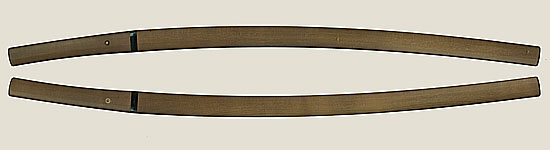
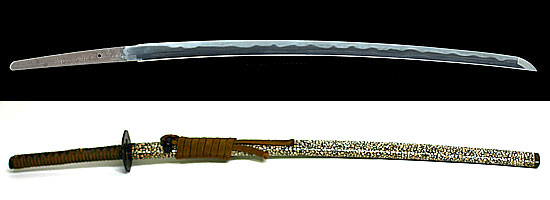
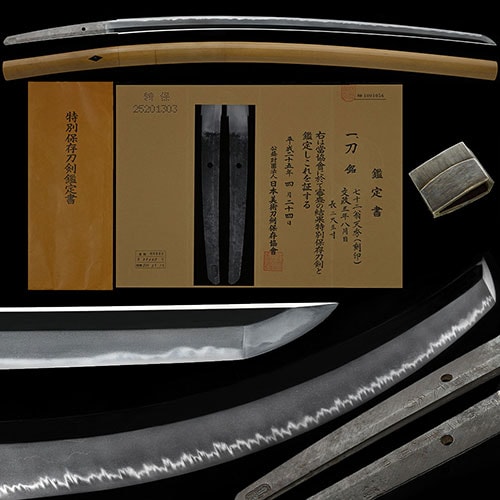
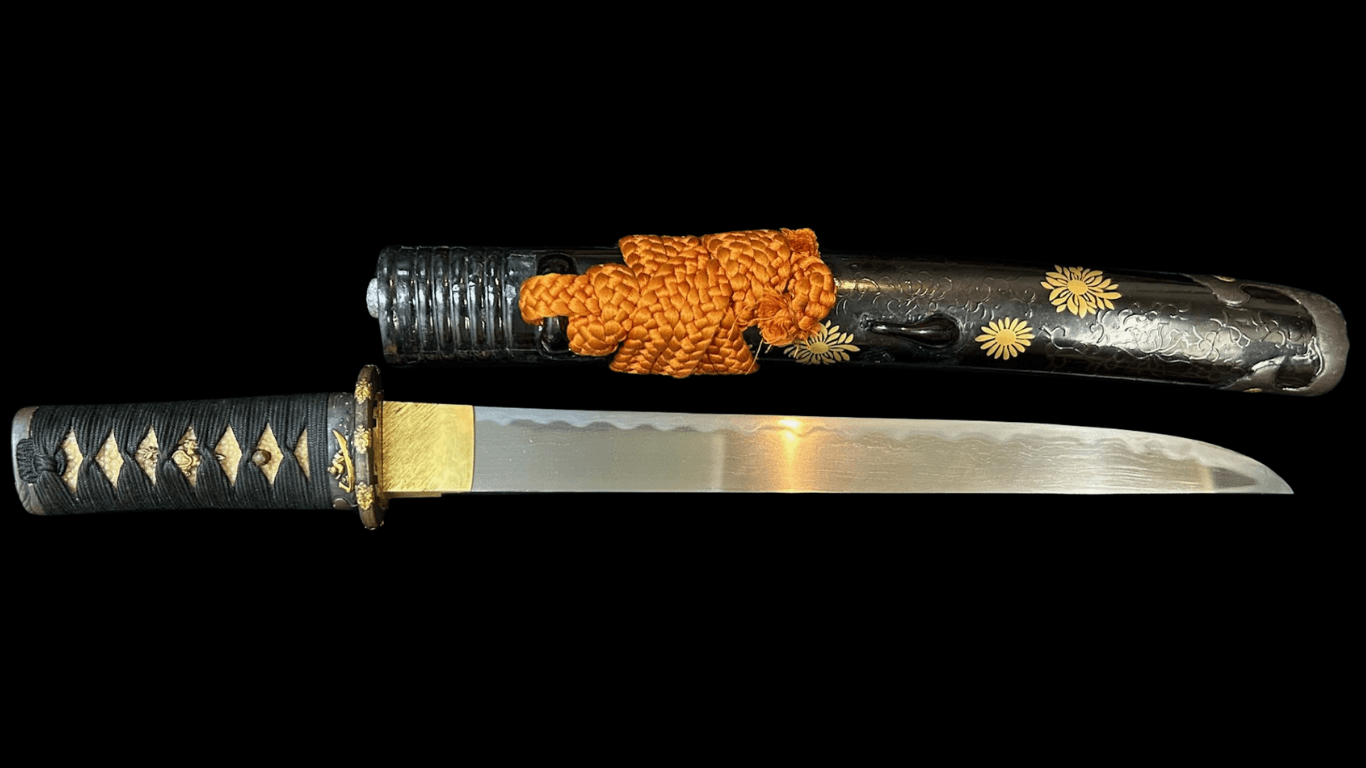
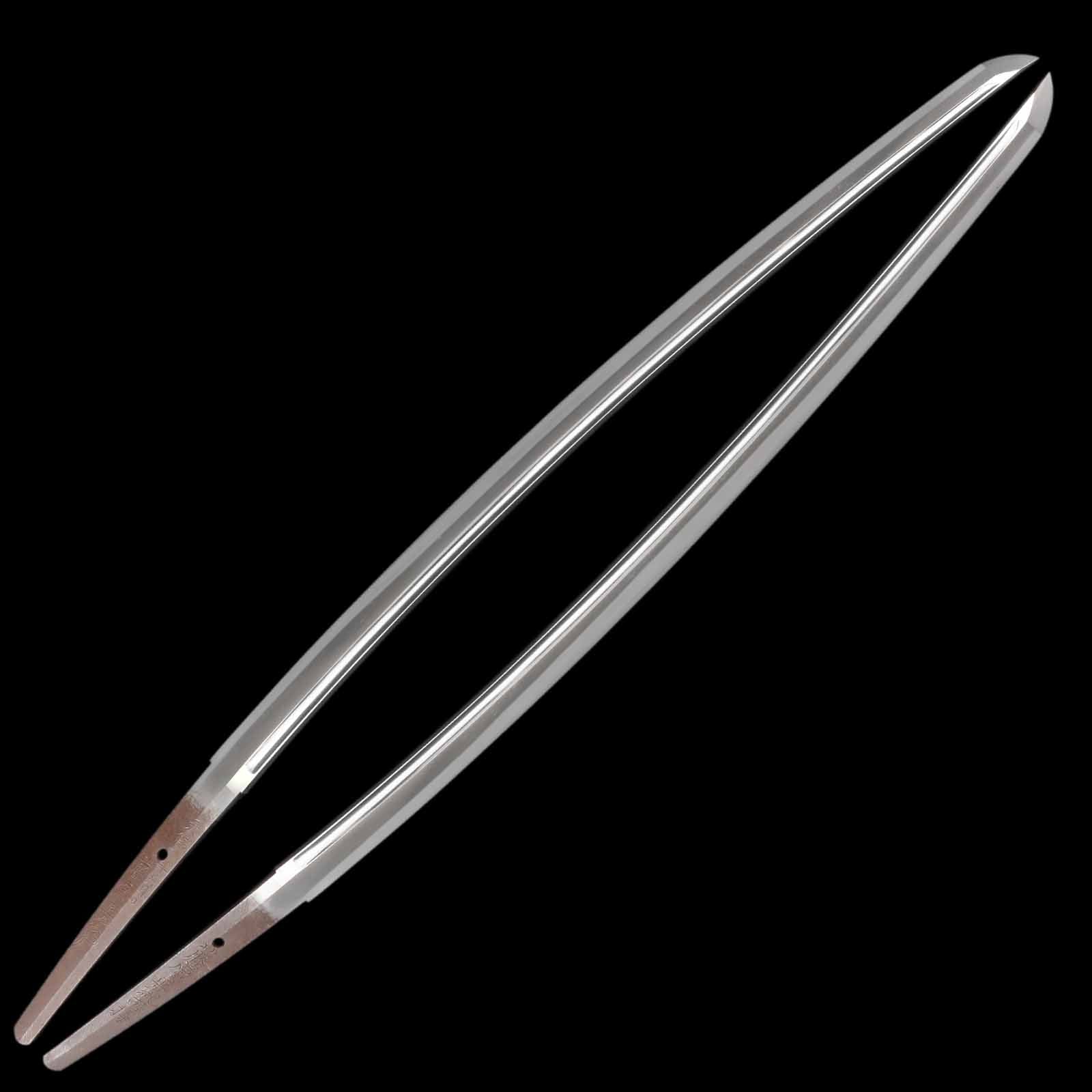
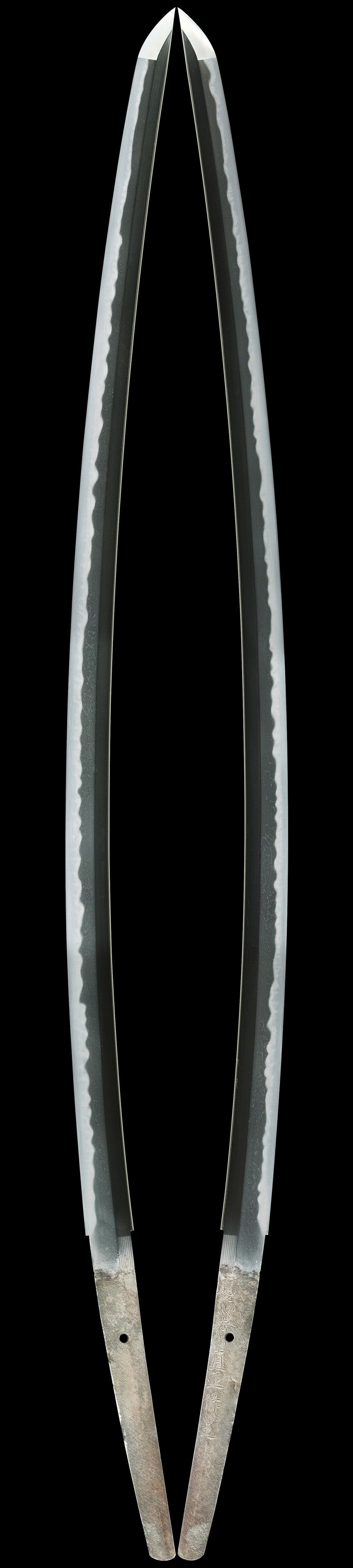
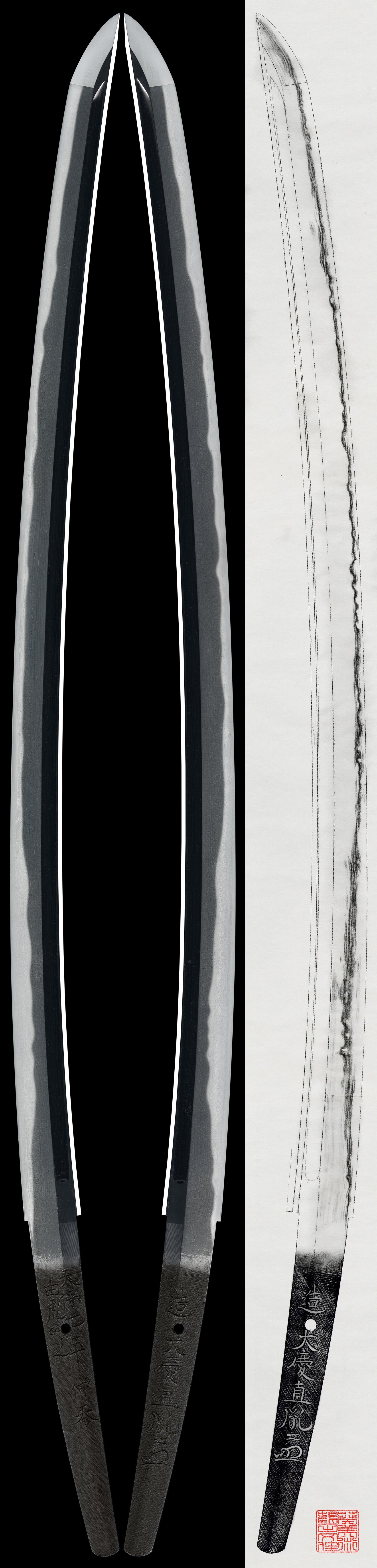
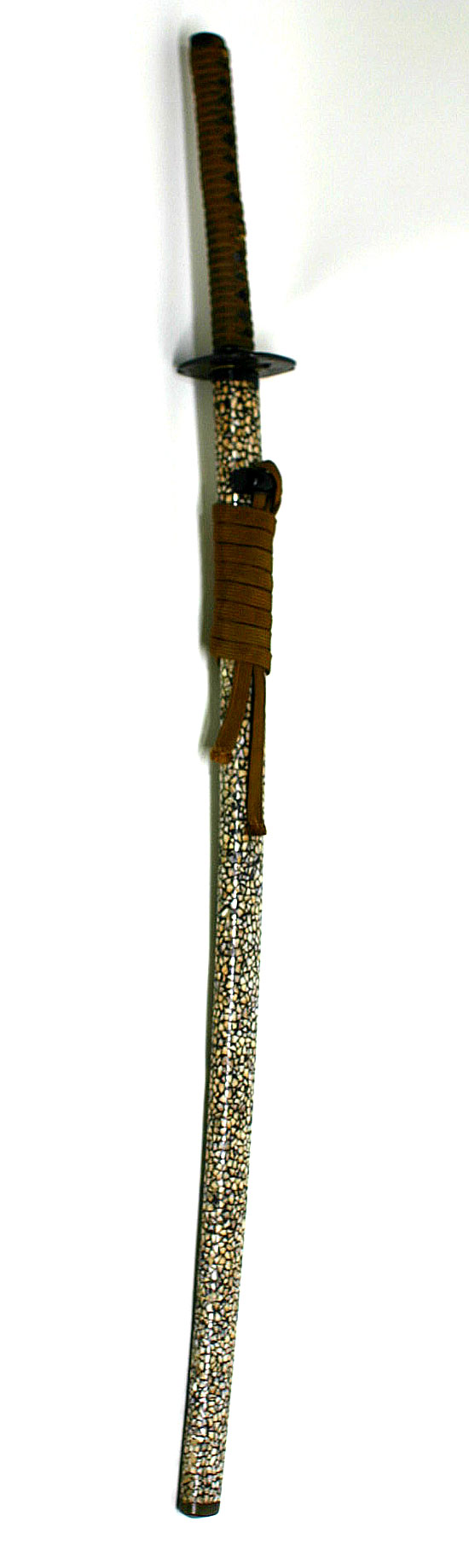
This is a katana by Suishinshi Masahide, a master of the Shin-Shinto period, dated to 1808 when he was 60 years old. It features a robust body with a strong toran-style hamon, characteristic of his work aiming for Osaka Shinto smiths like Sukehiro. The blade comes with an elaborate koshirae, decorated with crushed shell inlay on the saya and intricate metal fittings depicting gourds and rain dragons.

NBTHK Setsumei

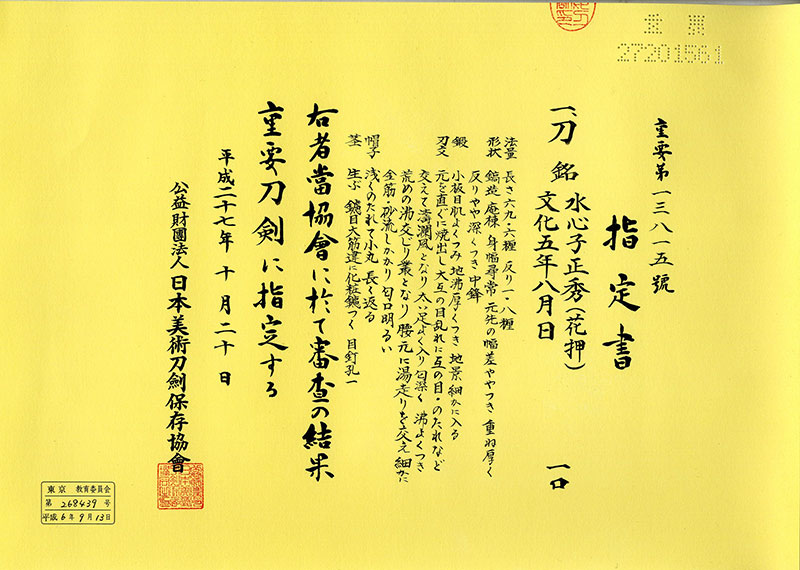
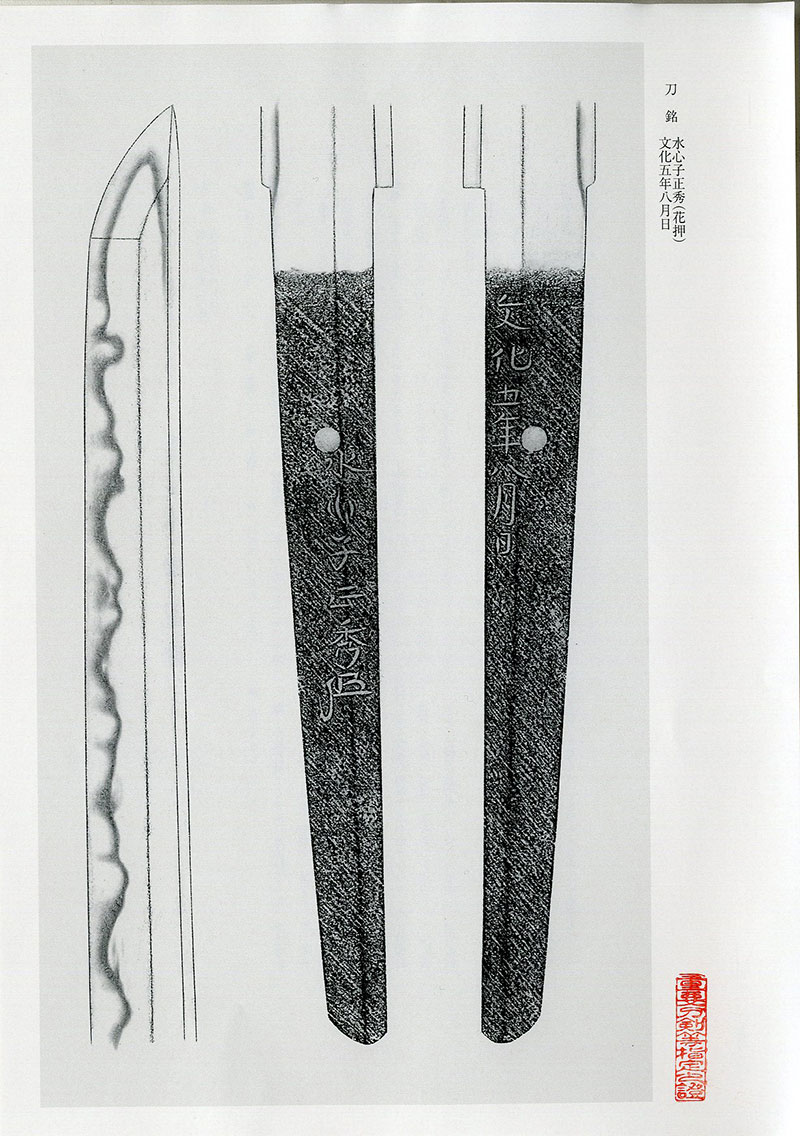
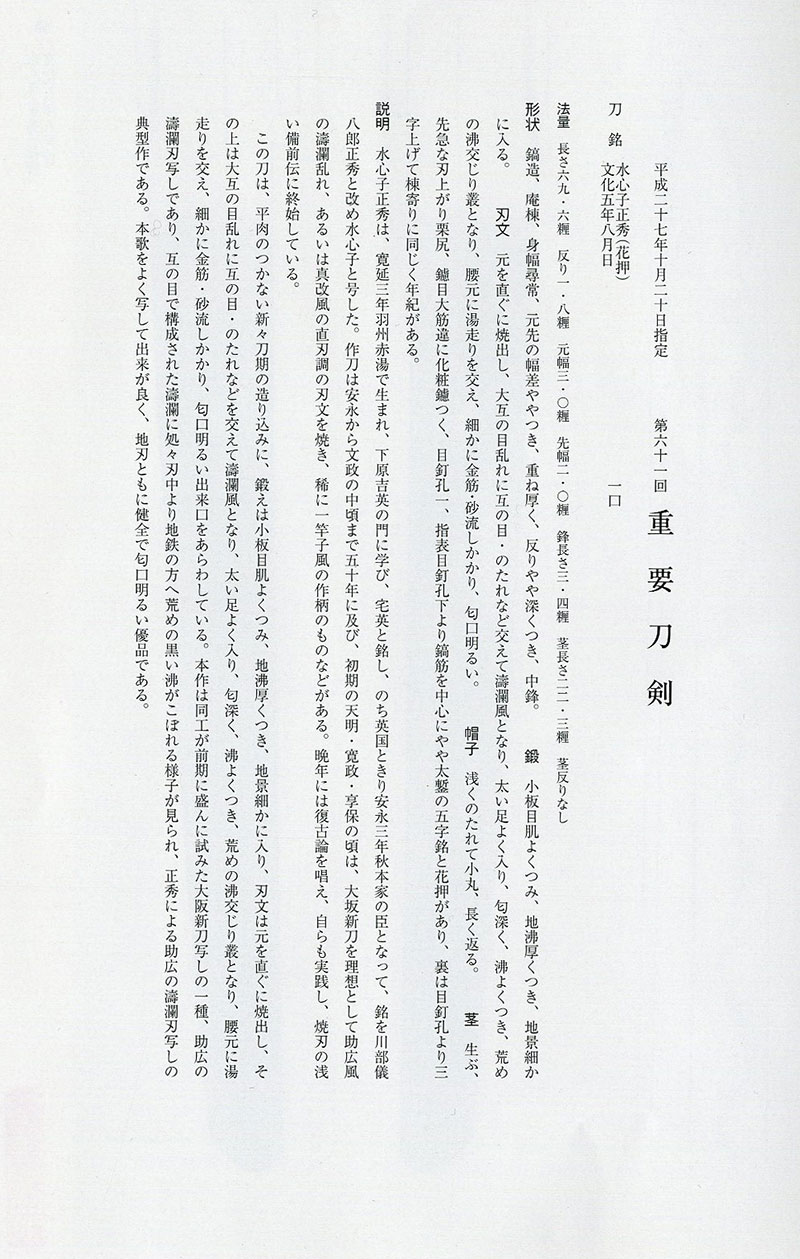
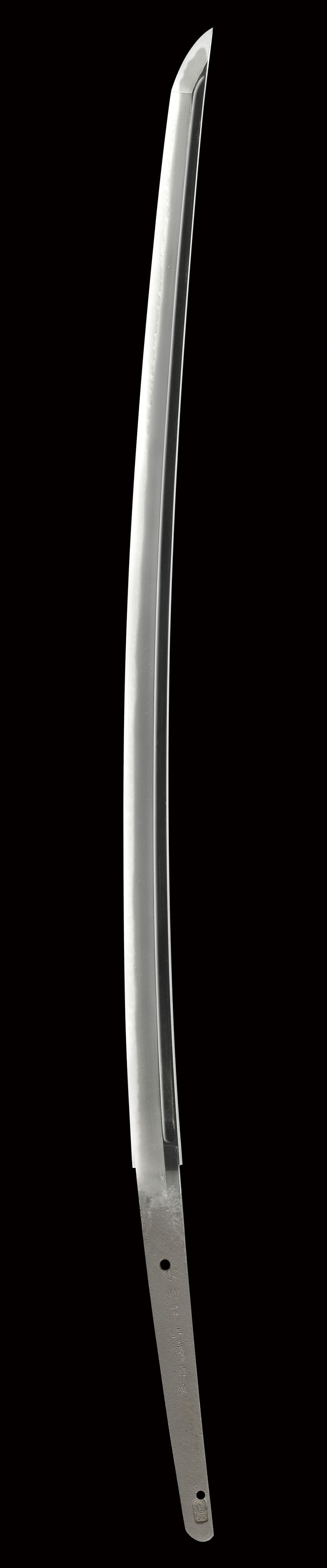
Jūyō-Tōken, 61st Session — Designated October 20, 2015 Katana, mei: Suishinshi Masahide (水心子正秀) Measurements Nagasa 69.6 cm, sori 1.8 cm, motohaba 3.0 cm, sakihaba 2.0 cm, kissaki-nagasa 3.4 cm, nakago-nagasa 22.3 cm, nakago-sori none Description Keijō: shinogi-zukuri with iori-mune; standard mihaba with a somewhat noticeable difference between base and tip widths; thick kasane; rather deep sori; chū-kissaki. Kitae: Well-forged ko-itame-hada; thickly applied ji-nie with fine chikei. Hamon: Begins with yakidashi in suguha at the base, then becomes a large gunome-midare mixed with gunome and notare, forming a tōran-style; thick ashi enter well; the nioi is deep; nie adheres well with some coarser nie mingled, forming clusters; yubashiri appear around the koshi; fine kinsuji and sunagashi occur, and the nioiguchi is bright. Bōshi: Shallow notare tending to ko-maru, with a long kaeri. Horimono: None. Nakago: Ubu; ha-agari-kurijiri with a steeply tapering tip; file marks are large sujikai with kesho-yasurime; one mekugi-ana; on the omote, below the mekugi-ana and centered on the shinogi-suji, there is a five-character signature cut with somewhat thick chisel strokes together with a kaō; on the ura, the date inscription is likewise present, placed three characters above the mekugi-ana toward the mune. Artisan Suishinshi Masahide (水心子正秀) Era Bunka 5 (1808), eighth month (day unspecified) Explanation Suishinshi Masahide was born in Kan’en 3 (1750) at Akayu in Ushū. He studied under Shimohara Yoshihide and initially signed “Takuhide,” later “Hidetaka.” In the autumn of An’ei 3 (1774) he entered the service of the Akimoto main line and changed his name to Kawabe Gihachirō Masahide, adopting the gō “Suishinshi.” His swordmaking activity extended for fifty years, from An’ei through the middle of Bunsei. In his early period—around the Tenmei and Kansei eras—taking the Ōsaka shintō masters as ideals, he produced tōran-midare in the manner of Sukehiro, or alternatively suguha-based tempering reminiscent of Shinkai; on rare occasions he also made works in the style of Ikkanshi. In his later years he advocated a revivalist return to older models and practiced it himself, consistently favoring a Bizen tradition with a shallow yakiba. This katana exemplifies the construction typical of the shinshintō period, in which hiraniku is not emphasized. The forging shows a tightly formed ko-itame-hada, with thick ji-nie and finely entering chikei. The temper begins with yakidashi in suguha, then develops into a large gunome-midare mixed with gunome and notare, producing a wave-like (tōran-style) effect. Thick ashi are prominent; the nioi is deep; nie adheres well, and coarse nie mingles to form clustered patches. Around the koshi one sees yubashiri, and fine kinsuji and sunagashi appear; the nioiguchi is bright. This work is one type of the Ōsaka shintō recreations that Masahide frequently attempted in his earlier years—specifically, a copy of Sukehiro’s tōranba. Within the billowing pattern built from gunome, one can observe, here and there, coarse black nie spilling from the interior of the temper into the jigane. It is a typical example of Masahide’s emulation of Sukehiro’s tōranba: a faithful copy of the original, of fine workmanship, and an excellent piece, with both ji and ha in kenzen (sound and well-preserved) condition and a bright nioiguchi.

NihontoWatch MonNihontoWatch
MarketAuctionsEncyclopedia
Swords›Suishinshi Masahide›Masahide›Suishinshi Masahide, Bunka 5th year, 8th month
katanaJūyō
Suishinshi Masahide

Suishinshi Masahide, Bunka 5th year, 8th month

mei · Tenmei (1781-1789) · nagasa 69.6cm · sori 1.8cm

¥11,000,000
Visit seller website →
Suishinshi Masahide — 1 of 7
Suishinshi Masahide — 2 of 7
Suishinshi Masahide — 3 of 7
Suishinshi Masahide — 4 of 7
Suishinshi Masahide — 5 of 7
Suishinshi Masahide — 6 of 7
Suishinshi Masahide — 7 of 7
1 / 7
1 / 7
Suishinshi Masahide — 1 of 7Suishinshi Masahide — 2 of 7Suishinshi Masahide — 3 of 7Suishinshi Masahide — 4 of 7Suishinshi Masahide — 5 of 7Suishinshi Masahide — 6 of 7Suishinshi Masahide — 7 of 7
Measurements & details
Smith
Suishinshi Masahide
Type
Katana
School
Suishinshi Masahide
Period
Around 1777–1817(Tenmei)
Province
Musashi
Signature
Signed(100% of this smith's designated works are signed)
Measurements
Nagasa 69.6cmSori 1.8cmMotohaba 3cmSakihaba 2cmKasane 0.8cm
Description

This is a katana by Suishinshi Masahide, a master of the Shin-Shinto period, dated to 1808 when he was 60 years old. It features a robust body with a strong toran-style hamon, characteristic of his work aiming for Osaka Shinto smiths like Sukehiro. The blade comes with an elaborate koshirae, decorated with crushed shell inlay on the saya and intricate metal fittings depicting gourds and rain dragons.

NBTHK Zufu Commentary

Juyo #61

AI translation — may contain errors

-, 61st Session — Designated October 20, 2015

, : Suishinshi Masahide (水心子正秀)

Measurements 69.6 cm, 1.8 cm, 3.0 cm, 2.0 cm, 3.4 cm, 22.3 cm, none

Description Keijō: with ; standard with a somewhat noticeable difference between base and tip widths; thick ; rather deep ; . : Well-forged ; thickly applied with fine . : Begins with in at the base, then becomes a large mixed with and , forming a tōran-style; thick enter well; the is deep; adheres well with some coarser mingled, forming clusters; appear around the ; fine and occur, and the is bright. : Shallow tending to , with a long . : None. : ; with a steeply tapering tip; file marks are large with ; one ; on the , below the and centered on the , there is a five-character signature cut with somewhat thick chisel strokes together with a ; on the , the date inscription is likewise present, placed three characters above the toward the .

Artisan Suishinshi Masahide (水心子正秀)

Era Bunka 5 (1808), eighth month (day unspecified)

Explanation Suishinshi Masahide was born in ’en 3 (1750) at Akayu in Ushū. He studied under Shimohara Yoshihide and initially signed “Takuhide,” later “Hidetaka.” In the autumn of An’ei 3 (1774) he entered the service of the Akimoto main line and changed his name to Kawabe Gihachirō Masahide, adopting the gō “Suishinshi.” His swordmaking activity extended for fifty years, from An’ei through the middle of Bunsei. In his early period—around the Tenmei and Kansei eras—taking the Ōsaka masters as ideals, he produced tōran-midare in the manner of Sukehiro, or alternatively -based tempering reminiscent of Shinkai; on rare occasions he also made works in the style of Ikkanshi. In his later years he advocated a revivalist return to older models and practiced it himself, consistently favoring a tradition with a shallow .

This exemplifies the construction typical of the period, in which is not emphasized. The forging shows a tightly formed , with thick and finely entering . The temper begins with in , then develops into a large mixed with and , producing a wave-like (tōran-style) effect. Thick are prominent; the is deep; adheres well, and coarse mingles to form clustered patches. Around the one sees , and fine and appear; the is bright.

This work is one type of the Ōsaka recreations that Masahide frequently attempted in his earlier years—specifically, a copy of Sukehiro’s tōranba. Within the billowing pattern built from , one can observe, here and there, coarse black spilling from the interior of the temper into the . It is a typical example of Masahide’s emulation of Sukehiro’s tōranba: a faithful copy of the original, of fine workmanship, and an excellent piece, with both and in (sound and well-preserved) condition and a bright .

[ 13]

About the maker

Masahide

正秀

Suishinshi Masahide (shinshinto founder of the revival-sword movement, Yamagata / Edo) · Musashi · around 1777-1817

Fujishiro Sai-jo saku · Tōken Taikan top 11%

9 pieces on the market now

›

Suishinshi Masahide was born Kawabe Gihachirō in Kan'en 3 (1750) at Akayu in Dewa, signed first as Suzuki Takahide and then Eikoku, studied under the Shitahara smith Yoshihide of Musashi, took the name Masahide in An'ei 3, served the Akimoto house of Yamagata, and later moved to Hamachō in Edo, where he died in Bunsei 8 at the age of seventy-six after a working career of nearly fifty years. He is the founding father of the shinshintō and the theorist of the revival-sword (fukko-tō) movement, the doctrine that all swords ought to return to the Kamakura models. The figure who matters most in that story is the one he taught: among his many disciples stood Taikei Naotane, who gave the revival theory its actual form, and the future second Masayoshi, Hosokawa Morihide. The published sources are unusually candid about where Masahide's own gift lay, and it was not in the theory he is remembered for proclaiming.

His characteristic hand is the Ōsaka-utsushi, the work he made up through his prime in private emulation of the Ōsaka shintō masters, and the published sources call these his finest pieces. Over a tightly packed ko-itame that often tightens toward a plain, near-grainless surface, with thick ji-nie, he sets the surging tōran-midare of Tsuda Sukehiro, a large gunome billowing like waves and usually opening from a long straight yakidashi, ashi entering, the nioi deep and the nioiguchi bright. The other Ōsaka idiom he commands is a suguha and broad suguha-chō after Inoue Shinkai and Naokai, deep in nioi with well-adhering nie, and on rare occasion a manner recalling Ikkanshi Tadatsuna. The tell that betrays his hand even on his best copies is constant: a blackish, coarse-grained nie that spills from within the ha down into the ji. The NBTHK names it on one Shinkai-target blade as a typical example of his manner in this approach, 「彼の手癖が見られる」 ("his habitual hand is revealed")[[c:1]], and on a Sukehiro tōran as 「これにもその手癖が示された典型的な一口」 ("a typical piece in which this habitual hand of his is shown")[[c:2]].

The jigane is the steady foundation of all this. It is a ko-itame, finely and closely forged, frequently approaching a muji-like plainness, with ji-nie that adheres well and, in places, somewhat clustered. The published sources praise the steel as beautiful and clear, then immediately qualify it: of his Shinkai copy they write that, fine as the jigane is, 「黒ずんだ荒汸がつき」 ("a darkened, coarse nie attaches")[[c:3]], running 「めくらがねに近く」 ("close to mekura-gane")[[c:4]], the blind steel in which the hada does not readily appear. Over that jigane the temper carries deep nioi and well-adhering nie, often coarse, and the bōshi runs straight to a ko-maru, sometimes deeply tempered and rounded, occasionally with a single tama-yaki. A genuine koto reflection is not part of his repertoire: a midare-utsuri is named on only one early piece, not the reliable revived utsuri his pupil would later set on the jigane.

His record divides cleanly into two phases, and the sources let the division speak. The earlier, the Ōsaka copies, they call his strongest; the later, the fukko-tō revival of his theory years, they treat more soberly. His Bizen-den is consistently shallow-tempered, a notare mixed with gunome and the occasional pointed element, on one blade taking a boxed, hako-like notare with yahazu-like elements and slight tobiyaki. His Sōshū-den, signalled by the homage in which he styled himself "Gorō Masahide" after Gorō Masamune, runs a notare with gunome over a flowing, slightly standing itame, sunagashi entering. The honest period mark runs through all of it, for the line is never the pure nioi-deki of the old Bizen but carries coarse nie throughout. Of one Sukehiro copy a judge writes that, between the early Ōsaka work and the later revival, 「出来はむしろ前者に佳作を見る」 ("in quality the finer pieces are rather to be found among the former")[[c:5]]. His signed and dated blades, cut in both block and cursive script and varying considerably from year to year, make him among the most exactly knowable of the shinshintō masters.

What sets him apart is therefore not a kantei problem but a candid place in the line. He is the teacher at the head of the revival, and the published sources do not flatter that role: of his Bizen and Sōshū work they write plainly that 「その技は弟子の大慶直胤に及ばない」 ("his technical skill did not reach that of his disciple Taikei Naotane")[[c:6]]. His distinction lies elsewhere, in the bright, surging tōran and the broad Shinkai suguha of his prime, and in the coarse spilling nie by which a connoisseur reads his hand behind even a close Ōsaka copy. His finest copies come so near the originals that the NBTHK records them as 「殆んど本科に迫るものがある」 ("all but reaching the original models")[[c:7]], one Tenmei piece called 「いわゆる大坂写しの僑出の一口」 ("an outstanding example of the so-called Ōsaka copy")[[c:8]]. It is the precision of these copies, more than the theory, that the published record honours.

For the collector Masahide is a signed and dated open book rather than an attribution puzzle. Fujishiro grades him Jō-jō saku. He has no National Treasures and no Important Cultural Properties; his record runs instead through the Jūyō rank and the prewar Jūyō Bijutsuhin, with twenty-four blades in the Jūyō tier among some twenty-five designated works on the published record, all of them signed and dated across the An'ei to Bunka years. Provenance is recorded for only a few: one Jūyō Bijutsuhin katana of Kyōwa 3 passed through the Imperial Family and the Imperial Household before the Shiga Mutual Aid Association, and his domain service ties him to the Akimoto family of Yamagata. The published commentary singles out his masterpieces by name, an early Tenmei katana it calls 「いわゆる大坂写しの僑出の一口」 and a rare daishō with gold-inlaid dragon poems it ranks 「同作中の優品」 ("a superior piece among his works"); his uncommon collaborations with disciples, jointly signed with the tenth-generation Sendai Kunikane and with Hosokawa Morihide, it prizes as study material. Because he was prolific and entirely signed, a Masahide is not beyond reach as the great Kamakura names are. A signed, dated example of his Ōsaka manner appears at the higher tiers from time to time, and to acquire one is to hold a document of the moment Edo swordmaking turned back toward the old models, in the hand of the man who turned it.


Historical importance

Where Masahide stands among comparable artisans: across all of nihontō, and within tradition, era, and period. The tiers (Foremost · Leading · Major · Notable) weigh official designations from the NBTHK and Japan's Agency for Cultural Affairs, together with historical honors of lasting repute such as the Sansaku and Meibutsu-chō.

随一
Foremost
屈指
Leading
有数
Major
著名
Notable

Select a lens to see how it's measured.

Designation record
28 designated works
Jūyō Bijutsuhin
1
Gyobutsu (Imperial)
3
Jūyō
24
9 works by Masahide on the market→
Masahide — full profileSuishinshi Masahide (shinshinto founder of the revival-sword movement, Yamagata / Edo) school

Dated Works

Years he was demonstrably active, proven by signed-and-dated blades

Active period
1777–1817
18 of 24 designated works carry a date
1770
1780
1790
1800
1810
1820
About the school

Suishinshi Masahide

水心子正秀

Shinshinto · Musashi

75 pieces on the market now

›

At Hamachō in Edo, in the closing decades of the eighteenth century and the opening ones of the nineteenth, Suishinshi Masahide[[c:1]] gathered the school that would turn Japanese swordmaking back toward its medieval models. Born Kawabe Gihachirō at Akayu in Dewa in 1750, signing first as Suzuki Takahide and then Eikoku, he studied under the Shitahara smith Yoshihide of Musashi, took the name Masahide in An'ei 3, and served the Akimoto house of Yamagata before settling in Edo, where he worked for nearly fifty years. Learn more →

14 recorded smiths105 designated works
Leading smiths
SmithEraDesignated
Naotane直胤1801-183740
Masahide正秀1777-181728
Sukemasa助政1804-18258
Jirotaro Naokatsu直勝1805-18586
Masayoshi正義1791-18605
Explore the Suishinshi Masahide school →
NBTHK Certificate
Jūyō Tōken重要刀剣
Important Sword
›

A blade of top-grade workmanship and condition, formally judged to rank with a nationally recognized Important Art Object (Jūyō Bijutsuhin). Awarded only at the NBTHK’s competitive annual examination.

Of Japan’s roughly 2.5 million registered swords, only 12,307 (about 1 in 203) have ever attained Jūyō.

About the NBTHK›

The NBTHK (Nihon Bijutsu Tōken Hozon Kyōkai, the Society for the Preservation of Japanese Art Swords) is a public-interest incorporated foundation founded in 1948 and supervised by Japan’s Agency for Cultural Affairs (Bunkachō); it is based at the Japanese Sword Museum in Tokyo. Its expert panels physically examine each submitted work (shinsa) and issue a certificate (kanteishō) ranking it by artistic and historical merit. NBTHK papers are the most widely recognized standard of authentication for Japanese swords and fittings.

NBTHK official site→
Seller
I
Iida Koendo
Established 1880 · 146 yrs on the market
🇯🇵Ships from Japan
›
✓Verified dealeriidakoendo.com
Settles in JPY
✓Ships worldwide✓English supportWire transfer
Return policy

Customer-initiated returns accepted within two days of arrival; return shipping paid by customer and fees non-refundable. Returns/refunds unavailable for overseas deliveries.

View all of Iida Koendo’s listings→View this item on the dealer’s site→

More works by Suishinshi Masahide

View all →
Eirakudo
Tokuho
Wakizashi - Tokuho - by Suishinshi Masahide - Masahide - Tokubetsu Hozon TokenWakizashi - Tokuho - by Suishinshi Masahide - Masahide - Tokubetsu Hozon Token

Wakizashi

BySuishinshi Masahide
¥2,500,000
Eirakudo
Tokuho
Katana - Tokuho - by Suishinshi Masahide - Suishinshi Masahide - Tokubetsu Hozon TokenKatana - Tokuho - by Suishinshi Masahide - Suishinshi Masahide - Tokubetsu Hozon Token

Katana

BySuishinshi Masahide
¥2,000,000
Goushuya
Jūyō
Katana - Jūyō - by Suishinshi Masahide - 11th Juyo Token: Kawabe Gihachiro Fujiwara MasahideKatana - Jūyō - by Suishinshi Masahide - 11th Juyo Token: Kawabe Gihachiro Fujiwara Masahide

Katana

BySuishinshi Masahide
Ask
Nihonto Australia
Hozon
Tanto - Hozon - by Suishinshi Masahide - Masahide TantoTanto - Hozon - by Suishinshi Masahide - Masahide Tanto

Tantō

BySuishinshi Masahide
¥3,650
Katanahanbai
Tokuho
Katana - Tokuho - by Suishinshi Masahide - Suishinshi Masahide - Tenmei 7th Year, 2nd MonthKatana - Tokuho - by Suishinshi Masahide - Suishinshi Masahide - Tenmei 7th Year, 2nd Month

Katana

BySuishinshi Masahide
¥3,500,000
Nihon Art
Tokuho
Wakizashi - Tokuho - by Suishinshi Masahide - Suishinshi MasahideWakizashi - Tokuho - by Suishinshi Masahide - Suishinshi Masahide

Wakizashi

BySuishinshi Masahide
Ask
Samurai Nippon
Tokuho
Katana - Tokuho - by Suishinshi Masahide - Katana (Father-Son Collaboration): Suishinshi Masahide (Quenched Blade, Engraved)Katana - Tokuho - by Suishinshi Masahide - Katana (Father-Son Collaboration): Suishinshi Masahide (Quenched Blade, Engraved)

Katana

BySuishinshi Masahide
¥2,200,000
Nipponto
Tokuho
Wakizashi - Tokuho - by Suishinshi Masahide - Wakizashi by Kawabe Fujiwara Masahide (Suishinshi), Tokubetsu HozonWakizashi - Tokuho - by Suishinshi Masahide - Wakizashi by Kawabe Fujiwara Masahide (Suishinshi), Tokubetsu Hozon

Wakizashi

BySuishinshi Masahide
¥2,100,000

Previously sold by Suishinshi Masahide

Tozando
Tokuho
Katana - Tokuho - by Suishinshi Masahide - MasahideKatana - Tokuho - by Suishinshi Masahide - Masahide
Sold

Katana

BySuishinshi Masahide
SOLD
Japanese Sword Books and Tsuba
Katana - by Suishinshi Masahide - Suishinshi MasahideKatana - by Suishinshi Masahide - Suishinshi Masahide
Sold

Katana

BySuishinshi Masahide
SOLD
Choshuya
Wakizashi - by Suishinshi Masahide - Suishinshi Masahide - Dated Bunka 11 (1814)Wakizashi - by Suishinshi Masahide - Suishinshi Masahide - Dated Bunka 11 (1814)
Sold

Wakizashi

BySuishinshi Masahide
SOLD
Touken Matsumoto
Tokuho
Wakizashi - Tokuho - by Suishinshi Masahide - Suishinshi MasahideWakizashi - Tokuho - by Suishinshi Masahide - Suishinshi Masahide
Sold

Wakizashi

BySuishinshi Masahide
SOLD
Choshuya
Katana - by Suishinshi Masahide - Mei: Suishinshi Masahide, Kansei Gannen Hachigatsu HiKatana - by Suishinshi Masahide - Mei: Suishinshi Masahide, Kansei Gannen Hachigatsu Hi
Sold

Katana

BySuishinshi Masahide
SOLD
World Seiyudo
Tokuho
Wakizashi - Tokuho - by Suishinshi Masahide - Suishinshi Masahide - Tokubetsu Hozon TokenWakizashi - Tokuho - by Suishinshi Masahide - Suishinshi Masahide - Tokubetsu Hozon Token
Sold

Wakizashi

BySuishinshi Masahide
SOLD
Choshuya
Wakizashi - by Suishinshi Masahide - Kawabe Fujiwara Masahide - Kansei 11, August 13thWakizashi - by Suishinshi Masahide - Kawabe Fujiwara Masahide - Kansei 11, August 13th
Sold

Wakizashi

BySuishinshi Masahide
SOLD
Choshuya
Wakizashi - by Suishinshi Masahide - Suishinshi MasahideWakizashi - by Suishinshi Masahide - Suishinshi Masahide
Sold

Wakizashi

BySuishinshi Masahide
SOLD

More from the Suishinshi Masahide school

View all →
Choshuya
Tokuho
Tanto - Tokuho - by Suishinshi Masahide Naotane - Taikei Naotane, Spring of Tenpo 7Tanto - Tokuho - by Suishinshi Masahide Naotane - Taikei Naotane, Spring of Tenpo 7

Tantō

BySuishinshi Masahide Naotane
Ask
Aoi Art
Tokuho
Katana - Tokuho - by Suishinshi Masahide Naokatsu - Jiro Taro Naokatsu (February 1839)Katana - Tokuho - by Suishinshi Masahide Naokatsu - Jiro Taro Naokatsu (February 1839)

Katana

BySuishinshi Masahide Naokatsu
¥2,200,000
Katanahanbai
Tokuho
Daisho - Tokuho - by Suishinshi Masahide Naotane - Daisho: Taikei Naotane (with) Snake Skin Wrapped Daisho KoshiraeDaisho - Tokuho - by Suishinshi Masahide Naotane - Daisho: Taikei Naotane (with) Snake Skin Wrapped Daisho Koshirae

Daishō

BySuishinshi Masahide Naotane
Ask
Asahi Token
Tokuho
Daisho - Tokuho - by Suishinshi Masahide Tsunatoshi - Daisho: Kato TsunatoshiDaisho - Tokuho - by Suishinshi Masahide Tsunatoshi - Daisho: Kato Tsunatoshi

Daishō

BySuishinshi Masahide Tsunatoshi
¥2,900,000
Token-Net
Jūyō
Katana - Jūyō - by Suishinshi Masahide Jirotaro Naokatsu - Tenpo Jin-in Nen Juichigatsu Hi Jirotaro Naokatsu (Musashi)(Tokaido)Katana - Jūyō - by Suishinshi Masahide Jirotaro Naokatsu - Tenpo Jin-in Nen Juichigatsu Hi Jirotaro Naokatsu (Musashi)(Tokaido)

Katana

BySuishinshi Masahide Jirotaro Naokatsu
¥5,800,000
Eirakudo
Tokuho
Katana - Tokuho - by Suishinshi Masahide Naotane - Naotane - Tokubetsu Hozon TokenKatana - Tokuho - by Suishinshi Masahide Naotane - Naotane - Tokubetsu Hozon Token

Katana

BySuishinshi Masahide Naotane
¥4,000,000
Touken Komachi
Jūyō
Katana - Jūyō - by Suishinshi Masahide Naotane - Taikei Naotane in ShirasayaKatana - Jūyō - by Suishinshi Masahide Naotane - Taikei Naotane in Shirasaya

Katana

BySuishinshi Masahide Naotane
¥8,000,000
Samurai Nippon
Jūyō
Katana - Jūyō - by Suishinshi Masahide Naotane - Taikei Naotane (with Kao)Katana - Jūyō - by Suishinshi Masahide Naotane - Taikei Naotane (with Kao)

Katana

BySuishinshi Masahide Naotane
¥8,500,000

Swords

  • Katana
  • Wakizashi
  • Tantō
  • Tachi
  • Naginata
  • Yari

Fittings

  • Tsuba
  • Fuchi-Kashira
  • Kozuka
  • Menuki

By Certification

  • Tokujū
  • Jūyō
  • Tokuho
  • Hozon

Resources

  • Dealer Directory
  • Artist Directory
  • Glossary
  • Browse All
Nihontowatch© 2026
TermsPrivacyCookiesAbout

Description

This is a katana by Suishinshi Masahide, a master of the Shin-Shinto period, dated to 1808 when he was 60 years old. It features a robust body with a strong toran-style hamon, characteristic of his work aiming for Osaka Shinto smiths like Sukehiro. The blade comes with an elaborate koshirae, decorated with crushed shell inlay on the saya and intricate metal fittings depicting gourds and rain dragons.

NBTHK Setsumei

Jūyō-Tōken, 61st Session — Designated October 20, 2015 Katana, mei: Suishinshi Masahide (水心子正秀) Measurements Nagasa 69.6 cm, sori 1.8 cm, motohaba 3.0 cm, sakihaba 2.0 cm, kissaki-nagasa 3.4 cm, nakago-nagasa 22.3 cm, nakago-sori none Description Keijō: shinogi-zukuri with iori-mune; standard mihaba with a somewhat noticeable difference between base and tip widths; thick kasane; rather deep sori; chū-kissaki. Kitae: Well-forged ko-itame-hada; thickly applied ji-nie with fine chikei. Hamon: Begins with yakidashi in suguha at the base, then becomes a large gunome-midare mixed with gunome and notare, forming a tōran-style; thick ashi enter well; the nioi is deep; nie adheres well with some coarser nie mingled, forming clusters; yubashiri appear around the koshi; fine kinsuji and sunagashi occur, and the nioiguchi is bright. Bōshi: Shallow notare tending to ko-maru, with a long kaeri. Horimono: None. Nakago: Ubu; ha-agari-kurijiri with a steeply tapering tip; file marks are large sujikai with kesho-yasurime; one mekugi-ana; on the omote, below the mekugi-ana and centered on the shinogi-suji, there is a five-character signature cut with somewhat thick chisel strokes together with a kaō; on the ura, the date inscription is likewise present, placed three characters above the mekugi-ana toward the mune. Artisan Suishinshi Masahide (水心子正秀) Era Bunka 5 (1808), eighth month (day unspecified) Explanation Suishinshi Masahide was born in Kan’en 3 (1750) at Akayu in Ushū. He studied under Shimohara Yoshihide and initially signed “Takuhide,” later “Hidetaka.” In the autumn of An’ei 3 (1774) he entered the service of the Akimoto main line and changed his name to Kawabe Gihachirō Masahide, adopting the gō “Suishinshi.” His swordmaking activity extended for fifty years, from An’ei through the middle of Bunsei. In his early period—around the Tenmei and Kansei eras—taking the Ōsaka shintō masters as ideals, he produced tōran-midare in the manner of Sukehiro, or alternatively suguha-based tempering reminiscent of Shinkai; on rare occasions he also made works in the style of Ikkanshi. In his later years he advocated a revivalist return to older models and practiced it himself, consistently favoring a Bizen tradition with a shallow yakiba. This katana exemplifies the construction typical of the shinshintō period, in which hiraniku is not emphasized. The forging shows a tightly formed ko-itame-hada, with thick ji-nie and finely entering chikei. The temper begins with yakidashi in suguha, then develops into a large gunome-midare mixed with gunome and notare, producing a wave-like (tōran-style) effect. Thick ashi are prominent; the nioi is deep; nie adheres well, and coarse nie mingles to form clustered patches. Around the koshi one sees yubashiri, and fine kinsuji and sunagashi appear; the nioiguchi is bright. This work is one type of the Ōsaka shintō recreations that Masahide frequently attempted in his earlier years—specifically, a copy of Sukehiro’s tōranba. Within the billowing pattern built from gunome, one can observe, here and there, coarse black nie spilling from the interior of the temper into the jigane. It is a typical example of Masahide’s emulation of Sukehiro’s tōranba: a faithful copy of the original, of fine workmanship, and an excellent piece, with both ji and ha in kenzen (sound and well-preserved) condition and a bright nioiguchi.

NihontoWatch MonNihontoWatch
MarketAuctionsEncyclopedia
Swords›Suishinshi Masahide›Masahide›Suishinshi Masahide, Bunka 5th year, 8th month
katanaJūyō
Suishinshi Masahide

Suishinshi Masahide, Bunka 5th year, 8th month

mei · Tenmei (1781-1789) · nagasa 69.6cm · sori 1.8cm

¥11,000,000
Visit seller website →
Suishinshi Masahide — 1 of 7
Suishinshi Masahide — 2 of 7
Suishinshi Masahide — 3 of 7
Suishinshi Masahide — 4 of 7
Suishinshi Masahide — 5 of 7
Suishinshi Masahide — 6 of 7
Suishinshi Masahide — 7 of 7
1 / 7
1 / 7
Suishinshi Masahide — 1 of 7Suishinshi Masahide — 2 of 7Suishinshi Masahide — 3 of 7Suishinshi Masahide — 4 of 7Suishinshi Masahide — 5 of 7Suishinshi Masahide — 6 of 7Suishinshi Masahide — 7 of 7
Measurements & details
Smith
Suishinshi Masahide
Type
Katana
School
Suishinshi Masahide
Period
Around 1777–1817(Tenmei)
Province
Musashi
Signature
Signed(100% of this smith's designated works are signed)
Measurements
Nagasa 69.6cmSori 1.8cmMotohaba 3cmSakihaba 2cmKasane 0.8cm
Description

This is a katana by Suishinshi Masahide, a master of the Shin-Shinto period, dated to 1808 when he was 60 years old. It features a robust body with a strong toran-style hamon, characteristic of his work aiming for Osaka Shinto smiths like Sukehiro. The blade comes with an elaborate koshirae, decorated with crushed shell inlay on the saya and intricate metal fittings depicting gourds and rain dragons.

NBTHK Zufu Commentary

Juyo #61

AI translation — may contain errors

-, 61st Session — Designated October 20, 2015

, : Suishinshi Masahide (水心子正秀)

Measurements 69.6 cm, 1.8 cm, 3.0 cm, 2.0 cm, 3.4 cm, 22.3 cm, none

Description Keijō: with ; standard with a somewhat noticeable difference between base and tip widths; thick ; rather deep ; . : Well-forged ; thickly applied with fine . : Begins with in at the base, then becomes a large mixed with and , forming a tōran-style; thick enter well; the is deep; adheres well with some coarser mingled, forming clusters; appear around the ; fine and occur, and the is bright. : Shallow tending to , with a long . : None. : ; with a steeply tapering tip; file marks are large with ; one ; on the , below the and centered on the , there is a five-character signature cut with somewhat thick chisel strokes together with a ; on the , the date inscription is likewise present, placed three characters above the toward the .

Artisan Suishinshi Masahide (水心子正秀)

Era Bunka 5 (1808), eighth month (day unspecified)

Explanation Suishinshi Masahide was born in ’en 3 (1750) at Akayu in Ushū. He studied under Shimohara Yoshihide and initially signed “Takuhide,” later “Hidetaka.” In the autumn of An’ei 3 (1774) he entered the service of the Akimoto main line and changed his name to Kawabe Gihachirō Masahide, adopting the gō “Suishinshi.” His swordmaking activity extended for fifty years, from An’ei through the middle of Bunsei. In his early period—around the Tenmei and Kansei eras—taking the Ōsaka masters as ideals, he produced tōran-midare in the manner of Sukehiro, or alternatively -based tempering reminiscent of Shinkai; on rare occasions he also made works in the style of Ikkanshi. In his later years he advocated a revivalist return to older models and practiced it himself, consistently favoring a tradition with a shallow .

This exemplifies the construction typical of the period, in which is not emphasized. The forging shows a tightly formed , with thick and finely entering . The temper begins with in , then develops into a large mixed with and , producing a wave-like (tōran-style) effect. Thick are prominent; the is deep; adheres well, and coarse mingles to form clustered patches. Around the one sees , and fine and appear; the is bright.

This work is one type of the Ōsaka recreations that Masahide frequently attempted in his earlier years—specifically, a copy of Sukehiro’s tōranba. Within the billowing pattern built from , one can observe, here and there, coarse black spilling from the interior of the temper into the . It is a typical example of Masahide’s emulation of Sukehiro’s tōranba: a faithful copy of the original, of fine workmanship, and an excellent piece, with both and in (sound and well-preserved) condition and a bright .

[ 13]

About the maker

Masahide

正秀

Suishinshi Masahide (shinshinto founder of the revival-sword movement, Yamagata / Edo) · Musashi · around 1777-1817

Fujishiro Sai-jo saku · Tōken Taikan top 11%

9 pieces on the market now

›

Suishinshi Masahide was born Kawabe Gihachirō in Kan'en 3 (1750) at Akayu in Dewa, signed first as Suzuki Takahide and then Eikoku, studied under the Shitahara smith Yoshihide of Musashi, took the name Masahide in An'ei 3, served the Akimoto house of Yamagata, and later moved to Hamachō in Edo, where he died in Bunsei 8 at the age of seventy-six after a working career of nearly fifty years. He is the founding father of the shinshintō and the theorist of the revival-sword (fukko-tō) movement, the doctrine that all swords ought to return to the Kamakura models. The figure who matters most in that story is the one he taught: among his many disciples stood Taikei Naotane, who gave the revival theory its actual form, and the future second Masayoshi, Hosokawa Morihide. The published sources are unusually candid about where Masahide's own gift lay, and it was not in the theory he is remembered for proclaiming.

His characteristic hand is the Ōsaka-utsushi, the work he made up through his prime in private emulation of the Ōsaka shintō masters, and the published sources call these his finest pieces. Over a tightly packed ko-itame that often tightens toward a plain, near-grainless surface, with thick ji-nie, he sets the surging tōran-midare of Tsuda Sukehiro, a large gunome billowing like waves and usually opening from a long straight yakidashi, ashi entering, the nioi deep and the nioiguchi bright. The other Ōsaka idiom he commands is a suguha and broad suguha-chō after Inoue Shinkai and Naokai, deep in nioi with well-adhering nie, and on rare occasion a manner recalling Ikkanshi Tadatsuna. The tell that betrays his hand even on his best copies is constant: a blackish, coarse-grained nie that spills from within the ha down into the ji. The NBTHK names it on one Shinkai-target blade as a typical example of his manner in this approach, 「彼の手癖が見られる」 ("his habitual hand is revealed")[[c:1]], and on a Sukehiro tōran as 「これにもその手癖が示された典型的な一口」 ("a typical piece in which this habitual hand of his is shown")[[c:2]].

The jigane is the steady foundation of all this. It is a ko-itame, finely and closely forged, frequently approaching a muji-like plainness, with ji-nie that adheres well and, in places, somewhat clustered. The published sources praise the steel as beautiful and clear, then immediately qualify it: of his Shinkai copy they write that, fine as the jigane is, 「黒ずんだ荒汸がつき」 ("a darkened, coarse nie attaches")[[c:3]], running 「めくらがねに近く」 ("close to mekura-gane")[[c:4]], the blind steel in which the hada does not readily appear. Over that jigane the temper carries deep nioi and well-adhering nie, often coarse, and the bōshi runs straight to a ko-maru, sometimes deeply tempered and rounded, occasionally with a single tama-yaki. A genuine koto reflection is not part of his repertoire: a midare-utsuri is named on only one early piece, not the reliable revived utsuri his pupil would later set on the jigane.

His record divides cleanly into two phases, and the sources let the division speak. The earlier, the Ōsaka copies, they call his strongest; the later, the fukko-tō revival of his theory years, they treat more soberly. His Bizen-den is consistently shallow-tempered, a notare mixed with gunome and the occasional pointed element, on one blade taking a boxed, hako-like notare with yahazu-like elements and slight tobiyaki. His Sōshū-den, signalled by the homage in which he styled himself "Gorō Masahide" after Gorō Masamune, runs a notare with gunome over a flowing, slightly standing itame, sunagashi entering. The honest period mark runs through all of it, for the line is never the pure nioi-deki of the old Bizen but carries coarse nie throughout. Of one Sukehiro copy a judge writes that, between the early Ōsaka work and the later revival, 「出来はむしろ前者に佳作を見る」 ("in quality the finer pieces are rather to be found among the former")[[c:5]]. His signed and dated blades, cut in both block and cursive script and varying considerably from year to year, make him among the most exactly knowable of the shinshintō masters.

What sets him apart is therefore not a kantei problem but a candid place in the line. He is the teacher at the head of the revival, and the published sources do not flatter that role: of his Bizen and Sōshū work they write plainly that 「その技は弟子の大慶直胤に及ばない」 ("his technical skill did not reach that of his disciple Taikei Naotane")[[c:6]]. His distinction lies elsewhere, in the bright, surging tōran and the broad Shinkai suguha of his prime, and in the coarse spilling nie by which a connoisseur reads his hand behind even a close Ōsaka copy. His finest copies come so near the originals that the NBTHK records them as 「殆んど本科に迫るものがある」 ("all but reaching the original models")[[c:7]], one Tenmei piece called 「いわゆる大坂写しの僑出の一口」 ("an outstanding example of the so-called Ōsaka copy")[[c:8]]. It is the precision of these copies, more than the theory, that the published record honours.

For the collector Masahide is a signed and dated open book rather than an attribution puzzle. Fujishiro grades him Jō-jō saku. He has no National Treasures and no Important Cultural Properties; his record runs instead through the Jūyō rank and the prewar Jūyō Bijutsuhin, with twenty-four blades in the Jūyō tier among some twenty-five designated works on the published record, all of them signed and dated across the An'ei to Bunka years. Provenance is recorded for only a few: one Jūyō Bijutsuhin katana of Kyōwa 3 passed through the Imperial Family and the Imperial Household before the Shiga Mutual Aid Association, and his domain service ties him to the Akimoto family of Yamagata. The published commentary singles out his masterpieces by name, an early Tenmei katana it calls 「いわゆる大坂写しの僑出の一口」 and a rare daishō with gold-inlaid dragon poems it ranks 「同作中の優品」 ("a superior piece among his works"); his uncommon collaborations with disciples, jointly signed with the tenth-generation Sendai Kunikane and with Hosokawa Morihide, it prizes as study material. Because he was prolific and entirely signed, a Masahide is not beyond reach as the great Kamakura names are. A signed, dated example of his Ōsaka manner appears at the higher tiers from time to time, and to acquire one is to hold a document of the moment Edo swordmaking turned back toward the old models, in the hand of the man who turned it.
Historical importance

Where Masahide stands among comparable artisans: across all of nihontō, and within tradition, era, and period. The tiers (Foremost · Leading · Major · Notable) weigh official designations from the NBTHK and Japan's Agency for Cultural Affairs, together with historical honors of lasting repute such as the Sansaku and Meibutsu-chō.

随一
Foremost
屈指
Leading
有数
Major
著名
Notable

Select a lens to see how it's measured.

Designation record
28 designated works
Jūyō Bijutsuhin
1
Gyobutsu (Imperial)
3
Jūyō
24
9 works by Masahide on the market→
Masahide — full profileSuishinshi Masahide (shinshinto founder of the revival-sword movement, Yamagata / Edo) school

Dated Works

Years he was demonstrably active, proven by signed-and-dated blades

Active period
1777–1817
18 of 24 designated works carry a date
1770
1780
1790
1800
1810
1820
About the school

Suishinshi Masahide

水心子正秀

Shinshinto · Musashi

75 pieces on the market now

›

At Hamachō in Edo, in the closing decades of the eighteenth century and the opening ones of the nineteenth, Suishinshi Masahide[[c:1]] gathered the school that would turn Japanese swordmaking back toward its medieval models. Born Kawabe Gihachirō at Akayu in Dewa in 1750, signing first as Suzuki Takahide and then Eikoku, he studied under the Shitahara smith Yoshihide of Musashi, took the name Masahide in An'ei 3, and served the Akimoto house of Yamagata before settling in Edo, where he worked for nearly fifty years. Learn more →

14 recorded smiths105 designated works
Leading smiths
SmithEraDesignated
Naotane直胤1801-183740
Masahide正秀1777-181728
Sukemasa助政1804-18258
Jirotaro Naokatsu直勝1805-18586
Masayoshi正義1791-18605
Explore the Suishinshi Masahide school →
NBTHK Certificate
Jūyō Tōken重要刀剣
Important Sword
›

A blade of top-grade workmanship and condition, formally judged to rank with a nationally recognized Important Art Object (Jūyō Bijutsuhin). Awarded only at the NBTHK’s competitive annual examination.

Of Japan’s roughly 2.5 million registered swords, only 12,307 (about 1 in 203) have ever attained Jūyō.

About the NBTHK›

The NBTHK (Nihon Bijutsu Tōken Hozon Kyōkai, the Society for the Preservation of Japanese Art Swords) is a public-interest incorporated foundation founded in 1948 and supervised by Japan’s Agency for Cultural Affairs (Bunkachō); it is based at the Japanese Sword Museum in Tokyo. Its expert panels physically examine each submitted work (shinsa) and issue a certificate (kanteishō) ranking it by artistic and historical merit. NBTHK papers are the most widely recognized standard of authentication for Japanese swords and fittings.

NBTHK official site→
Seller
I
Iida Koendo
Established 1880 · 146 yrs on the market
🇯🇵Ships from Japan
›
✓Verified dealeriidakoendo.com
Settles in JPY
✓Ships worldwide✓English supportWire transfer
Return policy

Customer-initiated returns accepted within two days of arrival; return shipping paid by customer and fees non-refundable. Returns/refunds unavailable for overseas deliveries.

View all of Iida Koendo’s listings→View this item on the dealer’s site→

More works by Suishinshi Masahide

View all →
Eirakudo
Tokuho
Wakizashi - Tokuho - by Suishinshi Masahide - Masahide - Tokubetsu Hozon TokenWakizashi - Tokuho - by Suishinshi Masahide - Masahide - Tokubetsu Hozon Token

Wakizashi

BySuishinshi Masahide
¥2,500,000
Eirakudo
Tokuho
Katana - Tokuho - by Suishinshi Masahide - Suishinshi Masahide - Tokubetsu Hozon TokenKatana - Tokuho - by Suishinshi Masahide - Suishinshi Masahide - Tokubetsu Hozon Token

Katana

BySuishinshi Masahide
¥2,000,000
Goushuya
Jūyō
Katana - Jūyō - by Suishinshi Masahide - 11th Juyo Token: Kawabe Gihachiro Fujiwara MasahideKatana - Jūyō - by Suishinshi Masahide - 11th Juyo Token: Kawabe Gihachiro Fujiwara Masahide

Katana

BySuishinshi Masahide
Ask
Nihonto Australia
Hozon
Tanto - Hozon - by Suishinshi Masahide - Masahide TantoTanto - Hozon - by Suishinshi Masahide - Masahide Tanto

Tantō

BySuishinshi Masahide
¥3,650
Katanahanbai
Tokuho
Katana - Tokuho - by Suishinshi Masahide - Suishinshi Masahide - Tenmei 7th Year, 2nd MonthKatana - Tokuho - by Suishinshi Masahide - Suishinshi Masahide - Tenmei 7th Year, 2nd Month

Katana

BySuishinshi Masahide
¥3,500,000
Nihon Art
Tokuho
Wakizashi - Tokuho - by Suishinshi Masahide - Suishinshi MasahideWakizashi - Tokuho - by Suishinshi Masahide - Suishinshi Masahide

Wakizashi

BySuishinshi Masahide
Ask
Samurai Nippon
Tokuho
Katana - Tokuho - by Suishinshi Masahide - Katana (Father-Son Collaboration): Suishinshi Masahide (Quenched Blade, Engraved)Katana - Tokuho - by Suishinshi Masahide - Katana (Father-Son Collaboration): Suishinshi Masahide (Quenched Blade, Engraved)

Katana

BySuishinshi Masahide
¥2,200,000
Nipponto
Tokuho
Wakizashi - Tokuho - by Suishinshi Masahide - Wakizashi by Kawabe Fujiwara Masahide (Suishinshi), Tokubetsu HozonWakizashi - Tokuho - by Suishinshi Masahide - Wakizashi by Kawabe Fujiwara Masahide (Suishinshi), Tokubetsu Hozon

Wakizashi

BySuishinshi Masahide
¥2,100,000

Previously sold by Suishinshi Masahide

Tozando
Tokuho
Katana - Tokuho - by Suishinshi Masahide - MasahideKatana - Tokuho - by Suishinshi Masahide - Masahide
Sold

Katana

BySuishinshi Masahide
SOLD
Japanese Sword Books and Tsuba
Katana - by Suishinshi Masahide - Suishinshi MasahideKatana - by Suishinshi Masahide - Suishinshi Masahide
Sold

Katana

BySuishinshi Masahide
SOLD
Choshuya
Wakizashi - by Suishinshi Masahide - Suishinshi Masahide - Dated Bunka 11 (1814)Wakizashi - by Suishinshi Masahide - Suishinshi Masahide - Dated Bunka 11 (1814)
Sold

Wakizashi

BySuishinshi Masahide
SOLD
Touken Matsumoto
Tokuho
Wakizashi - Tokuho - by Suishinshi Masahide - Suishinshi MasahideWakizashi - Tokuho - by Suishinshi Masahide - Suishinshi Masahide
Sold

Wakizashi

BySuishinshi Masahide
SOLD
Choshuya
Katana - by Suishinshi Masahide - Mei: Suishinshi Masahide, Kansei Gannen Hachigatsu HiKatana - by Suishinshi Masahide - Mei: Suishinshi Masahide, Kansei Gannen Hachigatsu Hi
Sold

Katana

BySuishinshi Masahide
SOLD
World Seiyudo
Tokuho
Wakizashi - Tokuho - by Suishinshi Masahide - Suishinshi Masahide - Tokubetsu Hozon TokenWakizashi - Tokuho - by Suishinshi Masahide - Suishinshi Masahide - Tokubetsu Hozon Token
Sold

Wakizashi

BySuishinshi Masahide
SOLD
Choshuya
Wakizashi - by Suishinshi Masahide - Kawabe Fujiwara Masahide - Kansei 11, August 13thWakizashi - by Suishinshi Masahide - Kawabe Fujiwara Masahide - Kansei 11, August 13th
Sold

Wakizashi

BySuishinshi Masahide
SOLD
Choshuya
Wakizashi - by Suishinshi Masahide - Suishinshi MasahideWakizashi - by Suishinshi Masahide - Suishinshi Masahide
Sold

Wakizashi

BySuishinshi Masahide
SOLD

More from the Suishinshi Masahide school

View all →
Choshuya
Tokuho
Tanto - Tokuho - by Suishinshi Masahide Naotane - Taikei Naotane, Spring of Tenpo 7Tanto - Tokuho - by Suishinshi Masahide Naotane - Taikei Naotane, Spring of Tenpo 7

Tantō

BySuishinshi Masahide Naotane
Ask
Aoi Art
Tokuho
Katana - Tokuho - by Suishinshi Masahide Naokatsu - Jiro Taro Naokatsu (February 1839)Katana - Tokuho - by Suishinshi Masahide Naokatsu - Jiro Taro Naokatsu (February 1839)

Katana

BySuishinshi Masahide Naokatsu
¥2,200,000
Katanahanbai
Tokuho
Daisho - Tokuho - by Suishinshi Masahide Naotane - Daisho: Taikei Naotane (with) Snake Skin Wrapped Daisho KoshiraeDaisho - Tokuho - by Suishinshi Masahide Naotane - Daisho: Taikei Naotane (with) Snake Skin Wrapped Daisho Koshirae

Daishō

BySuishinshi Masahide Naotane
Ask
Asahi Token
Tokuho
Daisho - Tokuho - by Suishinshi Masahide Tsunatoshi - Daisho: Kato TsunatoshiDaisho - Tokuho - by Suishinshi Masahide Tsunatoshi - Daisho: Kato Tsunatoshi

Daishō

BySuishinshi Masahide Tsunatoshi
¥2,900,000
Token-Net
Jūyō
Katana - Jūyō - by Suishinshi Masahide Jirotaro Naokatsu - Tenpo Jin-in Nen Juichigatsu Hi Jirotaro Naokatsu (Musashi)(Tokaido)Katana - Jūyō - by Suishinshi Masahide Jirotaro Naokatsu - Tenpo Jin-in Nen Juichigatsu Hi Jirotaro Naokatsu (Musashi)(Tokaido)

Katana

BySuishinshi Masahide Jirotaro Naokatsu
¥5,800,000
Eirakudo
Tokuho
Katana - Tokuho - by Suishinshi Masahide Naotane - Naotane - Tokubetsu Hozon TokenKatana - Tokuho - by Suishinshi Masahide Naotane - Naotane - Tokubetsu Hozon Token

Katana

BySuishinshi Masahide Naotane
¥4,000,000
Touken Komachi
Jūyō
Katana - Jūyō - by Suishinshi Masahide Naotane - Taikei Naotane in ShirasayaKatana - Jūyō - by Suishinshi Masahide Naotane - Taikei Naotane in Shirasaya

Katana

BySuishinshi Masahide Naotane
¥8,000,000
Samurai Nippon
Jūyō
Katana - Jūyō - by Suishinshi Masahide Naotane - Taikei Naotane (with Kao)Katana - Jūyō - by Suishinshi Masahide Naotane - Taikei Naotane (with Kao)

Katana

BySuishinshi Masahide Naotane
¥8,500,000

Swords

  • Katana
  • Wakizashi
  • Tantō
  • Tachi
  • Naginata
  • Yari

Fittings

  • Tsuba
  • Fuchi-Kashira
  • Kozuka
  • Menuki

By Certification

  • Tokujū
  • Jūyō
  • Tokuho
  • Hozon

Resources

  • Dealer Directory
  • Artist Directory
  • Glossary
  • Browse All
Nihontowatch© 2026
TermsPrivacyCookiesAbout
NihontoWatch Mon

NihontoWatch

MarketAuctions
Encyclopedia
NihontoWatch Mon

NihontoWatch

MarketAuctions
Encyclopedia