Naotane was the foremost pupil of Suishinshi Masahide and, after his teacher, the central figure of the . Born in An'ei in of Dewa, his common name Shoji Minobei and his gO Daikei, he went up to while still young, entered Masahide's school, and like his teacher served Lord Akimoto, becoming with Hosokawa Masayoshi one of the outstanding talents of the Suishinshi line. A blade he made at twenty-three is signed Shoji Naotane and dated Kansei 13, so the published sources place his entry to the school a few years earlier and his independence around the start of the Bunka era; he took the title Daijo about Bunsei 4, changed it to no when he went up to Kyoto in Kaei 1, and died at seventy-nine in Ansei 4 after a working career of some fifty years. Where Masahide was the theorist of the revival-sword movement, Naotane was its practitioner, and the published sources judge that he came to surpass his teacher in skill, recording of one - that 「その技術が師を凌ぐと評せられた」 (“his technique came to be appraised as surpassing his teacher”).
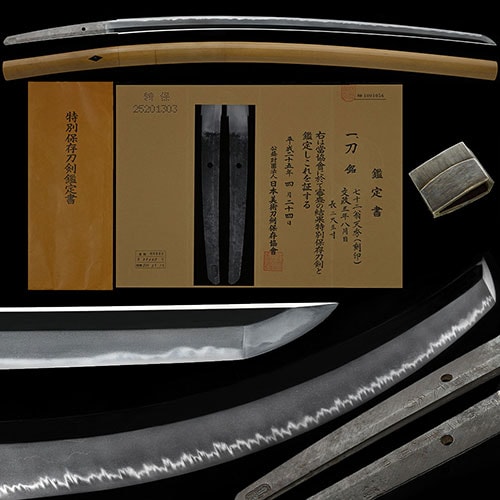
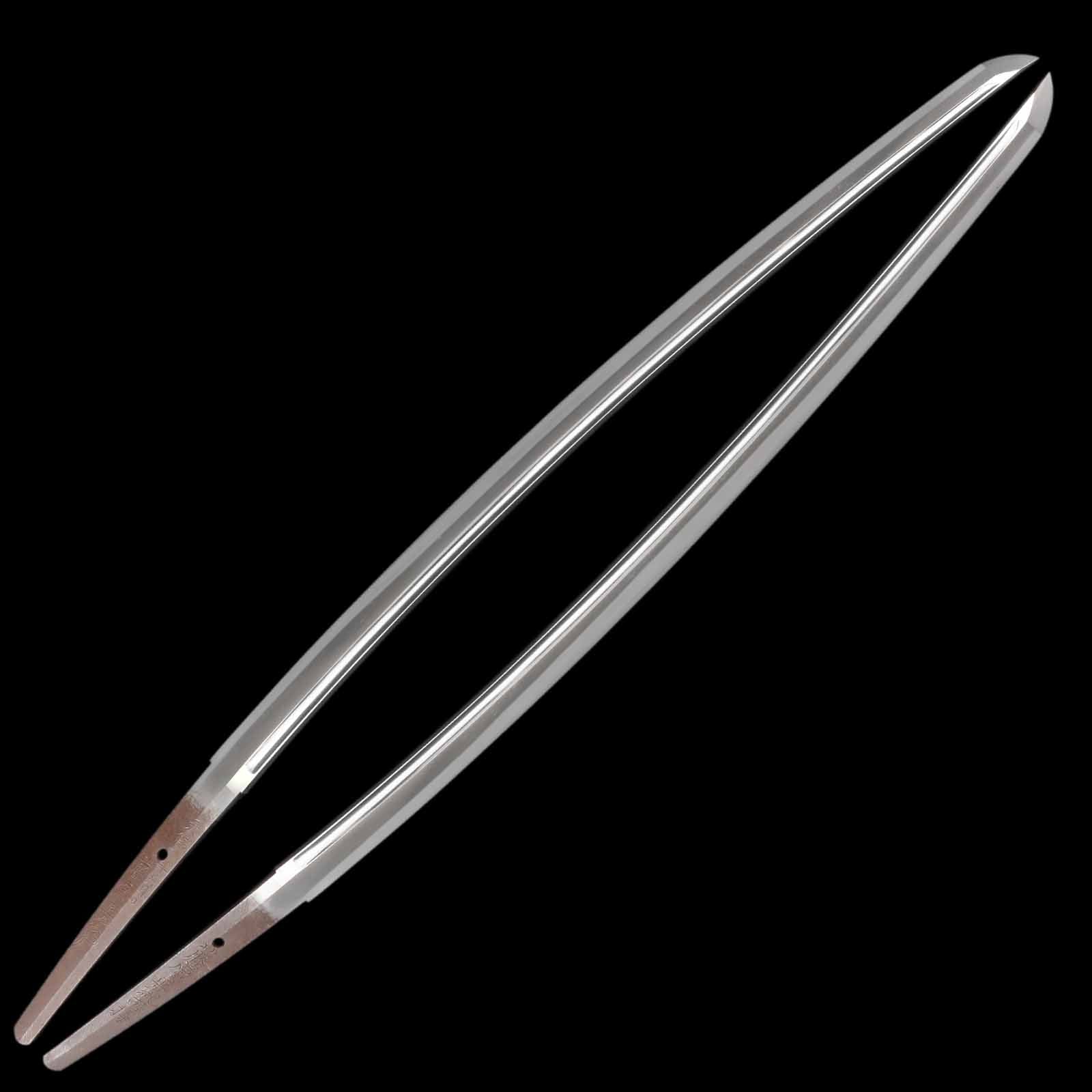
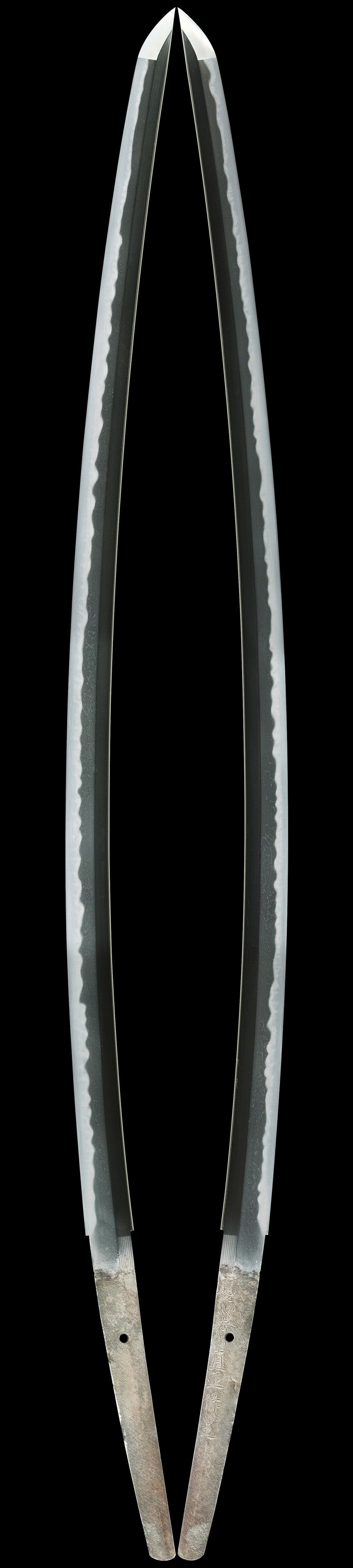
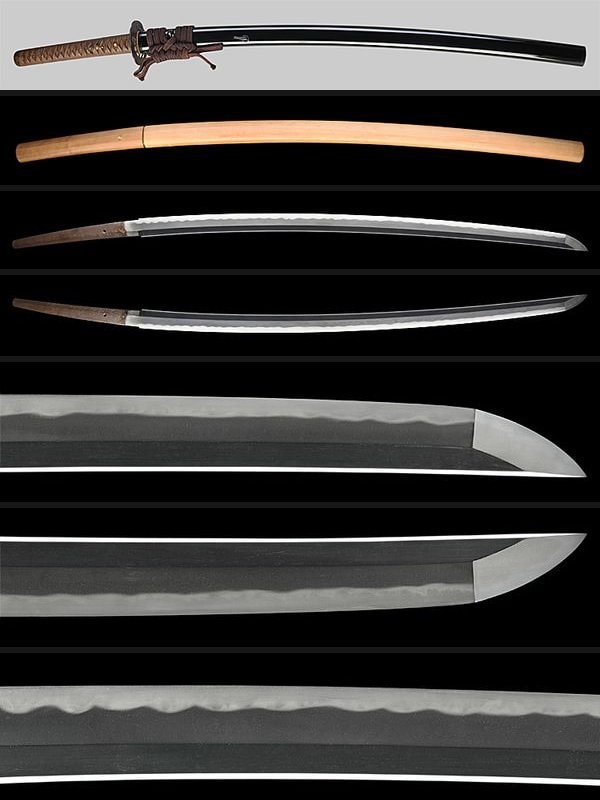
His characteristic hand is the -, the manner the published sources call his forte, and they state plainly that 「丁子乱れの巧みさは新々刀第一の定評がある」 (“the finesse of his carries the established reputation of being the foremost among ”). Over a tightly forged , at times -like, he tempers a into which he mixes angular , and , the long and entering so far that they run through toward the edge. The whole shows the reverse slant of the old line, the and the leaning back, the -dominant with and bright and clear. The shape evokes a , or rather high in curvature with a , and the published sources read the angular peaks and the reverse tendency as a conscious aim at the late- masters Kagemitsu and Kanemitsu.
The is the constant beneath this temper. It is a well-packed with , and on his finest - blades a rises distinctly near the , in the best pieces connecting upward into the of the temper. blades carry no genuine , so the deliberate revival of a is itself the tell that he was reaching back to old , and the published sources single it out as evidence of his model. Yet they are equally clear about what marks the work as rather than : on a - judged after Kanemitsu and Kagemitsu they note that it is 「純然たる匂出来ではな」 (“not a pure ”), appearing throughout the line, and they call this 「古作と新々刀との相達」, the very difference between the old works and the new. The runs , becoming pointed and turning back with , or to a .
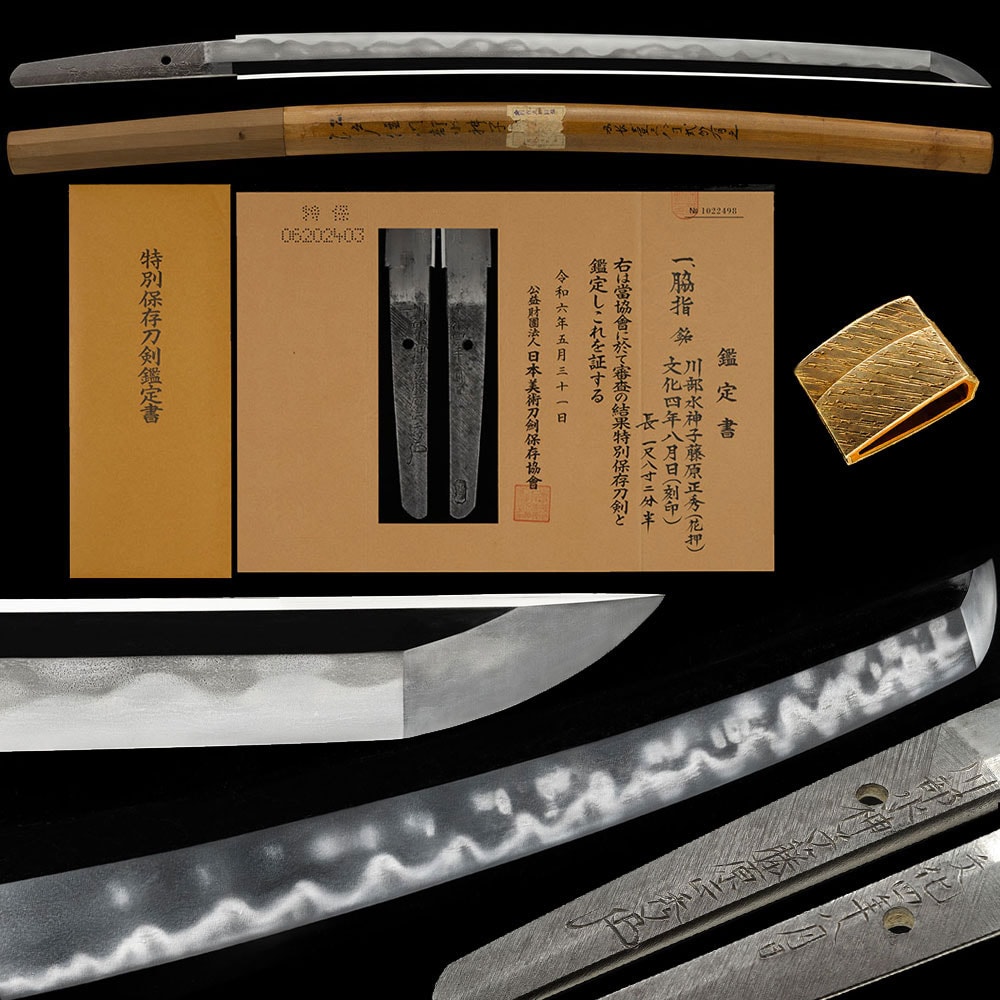
Naotane worked the several traditions, and his record divides into clear registers. His prized second manner is the -, rarer than the and modeled on Masamune, Sadamune and . Over a flowing mixed with , and in the strongest examples a distinctive whorled uzumaki- that the published sources name a point of interest in his Soden work, he sets a mixed with , the thick and entering, the gathering coarse and uneven, and running in stripes and the long. One judge calls a bold and faintly rustic, finding that 「野趣が感ぜら」 (“a rustic taste is felt”) in its uneven and frequent . A third, minor register survives in the calmer Yamato manner and in : one Tenpo the sources call relatively uncommon for him, a -tone in shallow with , and the Sanada whose long sword is an all- forging to which and are added, two traditions crossed in one blade. Being entirely a signed and frequently dated smith, the question with Naotane is never his attribution but his standing.
What sets him apart is what the judges themselves name. His bright , his reverse-leaning with its angular and , and his deliberate revival distinguish his - from the general run of smiths, who carry no and no such reverse slant; his - is told instead by the whorled uzumaki- and the coarse, striped activity. He stands directly downstream of Masahide and ahead of his own pupils: the carving on his blades is often by the Suishinshi-line carver Honjo Yoshitane, and his senior disciple Sawahara Shigetane and others carry the Daikei manner forward into the late . The published sources rank his best work at the head of his oeuvre, calling one - the piece that should be 「彼の備前伝の作中の筆頭に置くべきものである」 (“placed foremost among his - works”) and another, with a cut into its tang, a masterpiece among his masterpieces, while one Tenpo - is held to be the right wing of his oeuvre, surpassing even Masahide's own work.
For the collector Naotane is the great signed name of the revival. Fujishiro grades him Sai-jo , and the Toko Taikan values his work near the upper part of its scale. He has no National Treasures and no Important Cultural Properties on the record; his designations run instead through the prewar Bijutsuhin and the modern and tiers, with some forty designated works on record, all signed and dated across the Bunka to Kaei years. His blades are documented in distinguished hands attested by their own inscriptions and provenance: the Sanada transmitted in the Sanada family, a companion made by command for the Chancellor of the Realm and held in the Imperial collection, a commissioned by Watanabe Shu of the Tsu domain, and one made of carefully chosen iron for Ota Masayasu, a figure in iron production, that the published sources call 「会心の一口」, a blade of his full satisfaction. Among the prewar Bijutsuhin pieces are works held by Ide Keishiro, Suto Sojiro and Suzuki Seisuke. Because none of his work is locked away as designated cultural property and his output was large, a signed Naotane is more findable than a great name, yet his finest and blades are held far more often than they are traded; one comes to a private collector only from time to time, and a documented masterpiece in his -, the manner the published sources crown the finest of all the , remains a landmark when it appears.