Suishinshi Masahide's earliest dated blade, of An'ei 6 (1777), is signed "Gorō Masahide" in homage to Gorō Masamune, and the published sources call that date "the oldest year they have seen"[[c:1]]. He was born Kawabe Gihachirō in Kan'en 3 (1750) at Akayu in Dewa. He first signed Suzuki Takahide and then Eikoku, studied under the Shitahara smith Yoshihide of Musashi, and is said to have entered the school of Sōshū Tsunahiro as well. In An'ei 3 he took the name Masahide and the art name Suishinshi in the service of the Akimoto house of Yamagata, and later he moved to Hamachō in Edo. He trained many pupils and left many writings. His working life ran close to fifty years, from An'ei to Bunsei; in Bunsei 1 or 2, the sources differ, he took the lay name Tenshū, and he died in Bunsei 8 at seventy-six.
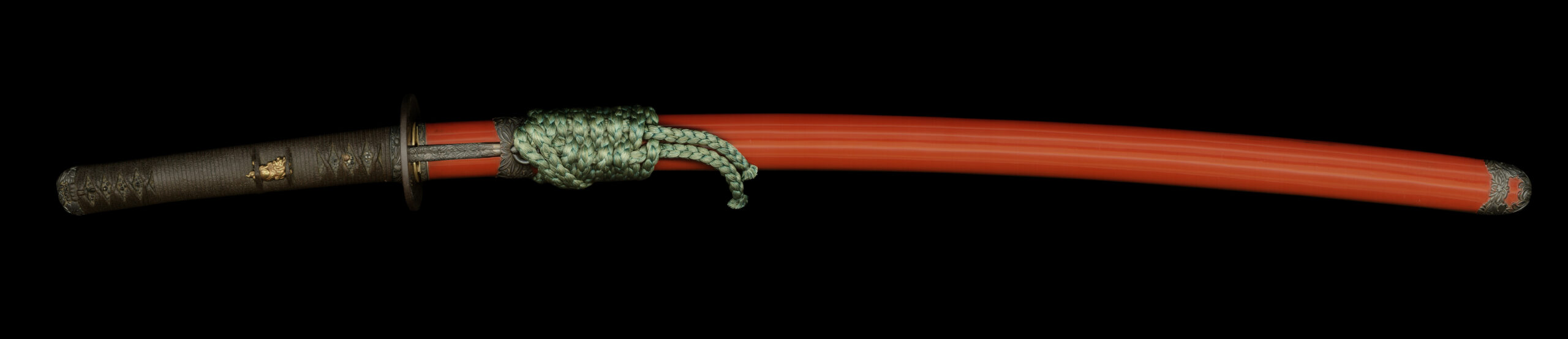
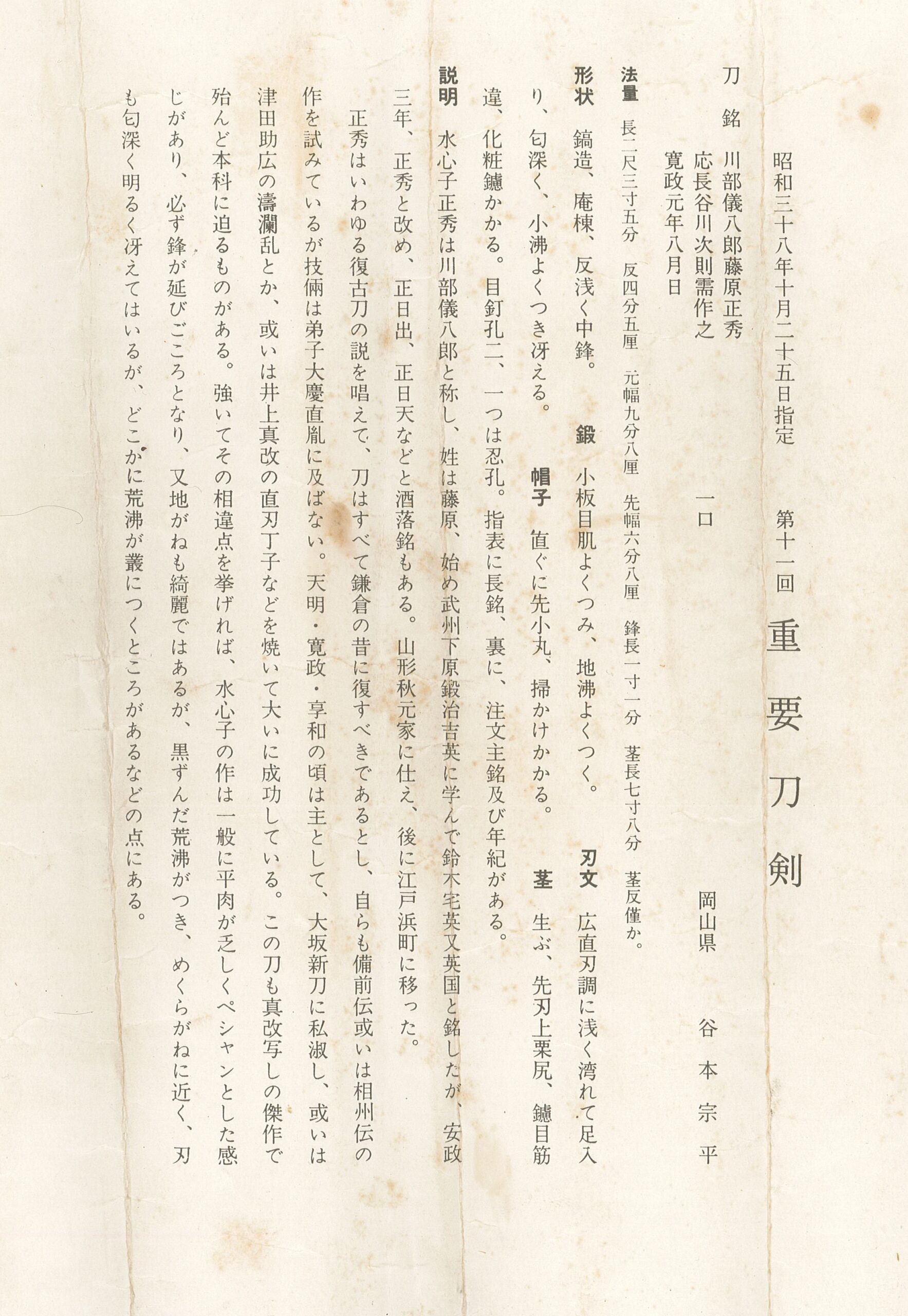
He is remembered as the theorist of the revival sword, who held that "all swords should return to the Kamakura of old"[[c:2]]. The published sources are candid that his own best work came before that theory. Through the Tenmei, Kansei and Kyōwa years he modelled himself on the Ōsaka shintō masters, tempering the surging tōran-midare of Tsuda Sukehiro or the suguha of Inoue Shinkai, and "it is rather in this period that his masterpieces are found"[[c:3]]. Over a tightly packed ko-itame that often tightens toward a plain, muji-like surface, thick ji-nie adheres. The tōran builds a large gunome into rolling waves from a long straight yakidashi, with heavy ashi, deep nioi and a bright nioiguchi. His Shinkai manner is a broad suguha deep in nie and nioi, and a few blades follow Ikkanshi Tadatsuna. The finest come so close that the record says they "all but reach the original"[[c:4]], and an early katana is called "an outstanding example of the so-called Ōsaka copy"[[c:5]].
The published sources state with equal precision what still separates him from the originals. His blades tend to scant hiraniku, "giving a flat feeling"[[c:6]], and the point always tends to stretch. His jigane is clean, yet "darkened coarse nie attach to it"[[c:7]] and it comes "close to mekura-gane"[[c:8]], the blind steel in which the hada does not show. Within the ha, too, coarse nie gathers here and there. On an Ikkanshi copy the commentary finds "blackish kazunoko-nie spilling over a muji-like forging, in which his habitual hand is seen"[[c:9]]. On a Sukehiro copy it is "coarse nie that mostly spills from within the ha into the ji"[[c:10]]. The bōshi generally runs straight to a ko-maru.
In his late years he put the theory into practice, and the published sources describe the result as a Bizen-den that is shallow-tempered from first to last, with Sōshū and Mino work also attempted. One late Bizen-den katana tempers a nioi-deki chōji-midare with abundant ashi and a tight, bright nioiguchi, "the chōji tempered without a flaw"[[c:11]], yet with an urumi at the koshimoto that marks his hand; its tang records that his son Sadahide did the forging. Honma's inventory of the Imperial collection follows the change through three dated blades. A katana of Kansei 10, made at forty-eight, "is still a work in the Osaka shintō manner"[[c:12]], a large notare with a bright nioiguchi and thick ko-nie. A wakizashi of Bunsei 1 is unhurried, with especially fine jigane, and the entry wonders whether it copies "Sadamune and the like"[[c:13]]. By Bunsei 2, at seventy, his work is mostly a ko-chōji mixed with gunome, the nioiguchi tight in a ko-nie deki over a muji-like jigane. The carving of these years, the entry adds, is "almost all by his pupil Honjō Yoshitane"[[c:14]].
Between the two phases the judges keep a clear order. Of the Kyōwa 3 katana recognised as a Jūyō Bijutsuhin they write that the later work matters for sword history as a sign of its age, but "in quality the better pieces are rather found among the former"[[c:15]]. Of the revival they say plainly that "his technique did not reach that of his pupil Taikei Naotane"[[c:16]]. His own signature varies: the Kyōwa mei is cut in block script and also in cursive, and he used punning forms of the name. From Kansei 10 he stamped his tangs with a seal of the characters Nichiten worked into a sword shape. Its state of wear and repair dates a blade and helps sort true work from false, and the Bunsei 2 seal is "the last of the five seals of his lifetime"[[c:17]]. Among his pupils the published sources name Taikei Naotane and Hosokawa Morihide, the later second Masayoshi.
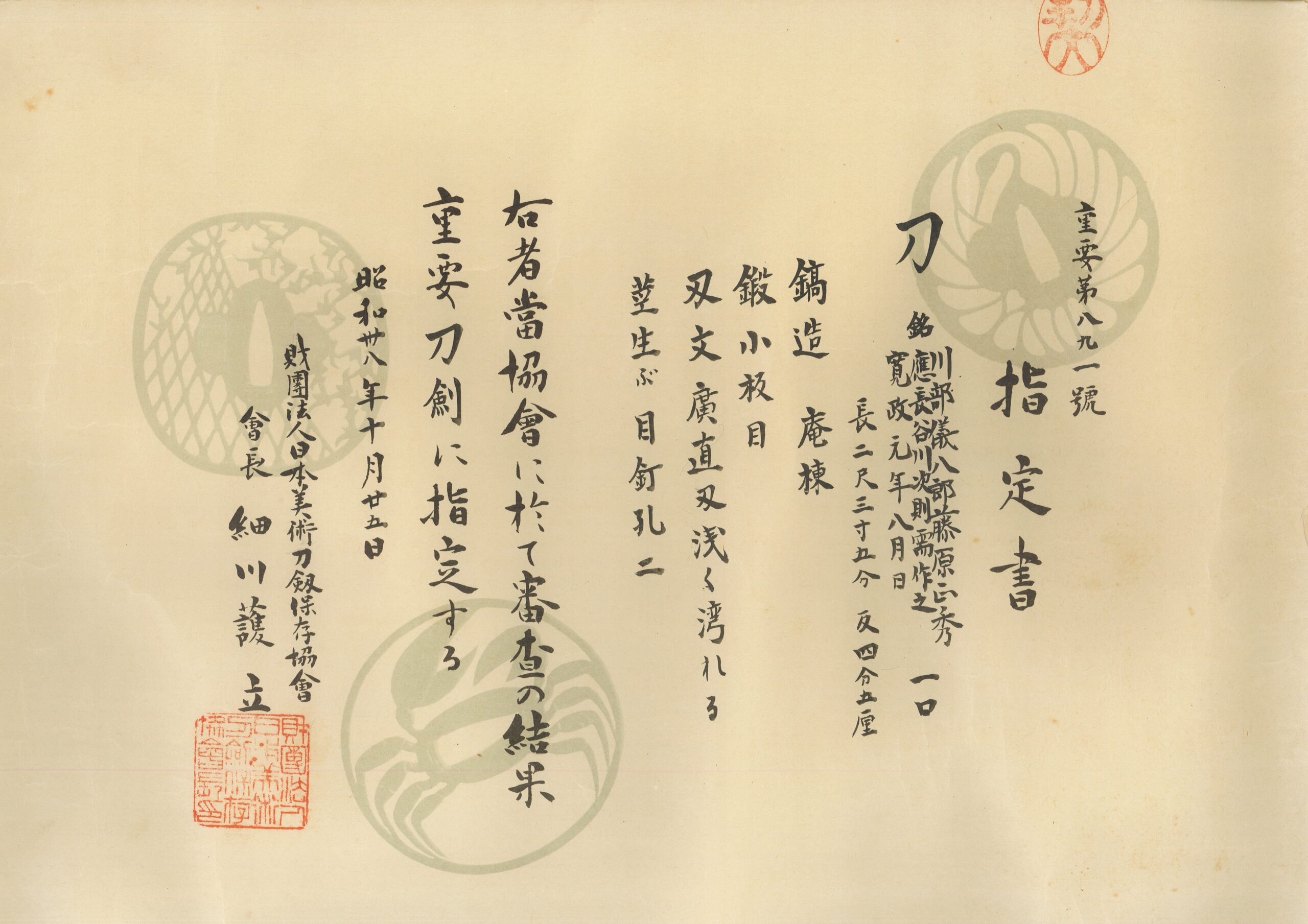
Masahide's record is entirely signed: twenty-four Jūyō blades, one prewar Jūyō Bijutsuhin and three blades in Honma's inventory of the Imperial collection, twenty-eight designated works on record. He has no National Treasure and no Important Cultural Property. The Jūyō Bijutsuhin katana, dated Kyōwa 3 (1803), was held by the Shimogō Kyōsaikai of Shiga when it was recognised in 1941. The commentary prizes his daishō, calling them "rare and valuable"[[c:18]], and his blades made jointly with pupils, among them the tenth-generation Sendai Kunikane. Of a katana signed with Hosokawa Morihide it writes that "a joint work by the two is extremely rare and good material"[[c:19]]. Because his work is signed, dated and comparatively numerous, a Masahide is not beyond a private collector's reach. A Jūyō example of his Ōsaka manner comes to market from time to time, and it carries the signed hand of the man who turned Edo swordmaking back toward the old models.