NihontoWatch Mon

NihontoWatch

MarketAuctions
Encyclopedia
NihontoWatch Mon

NihontoWatch

MarketAuctions
Encyclopedia

Description

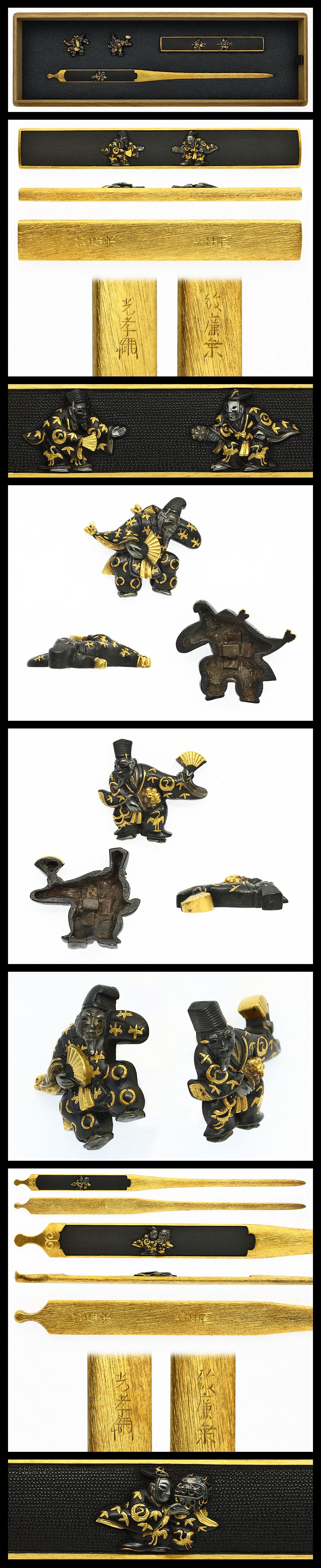
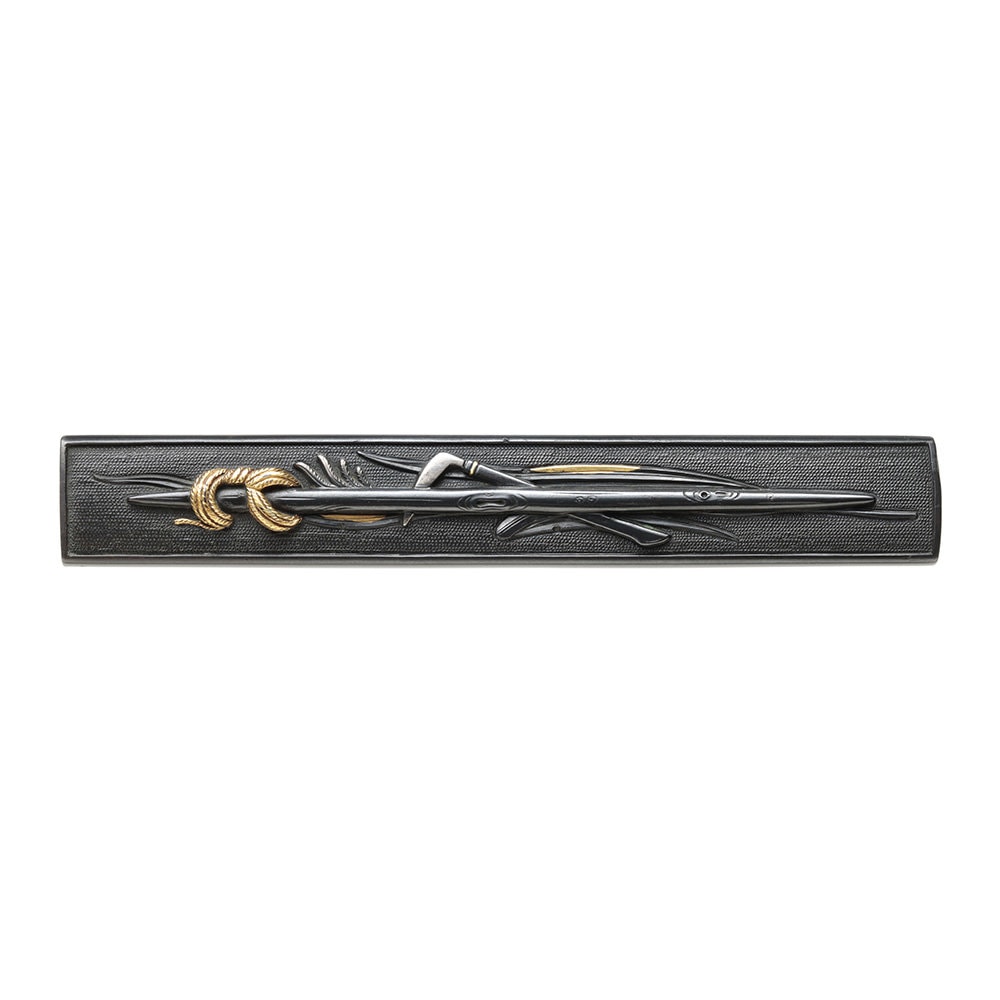
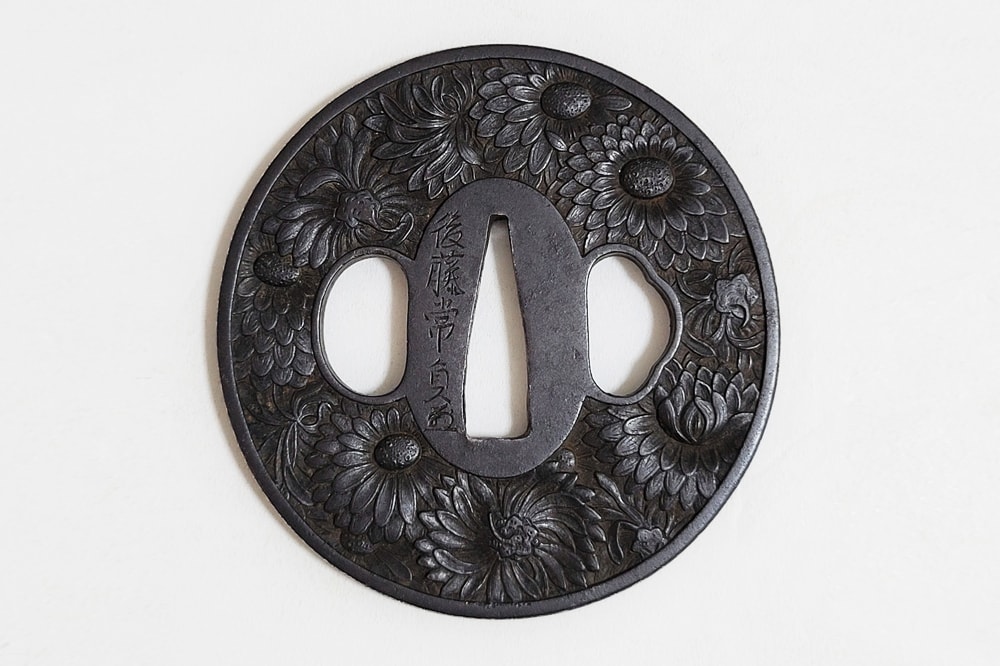
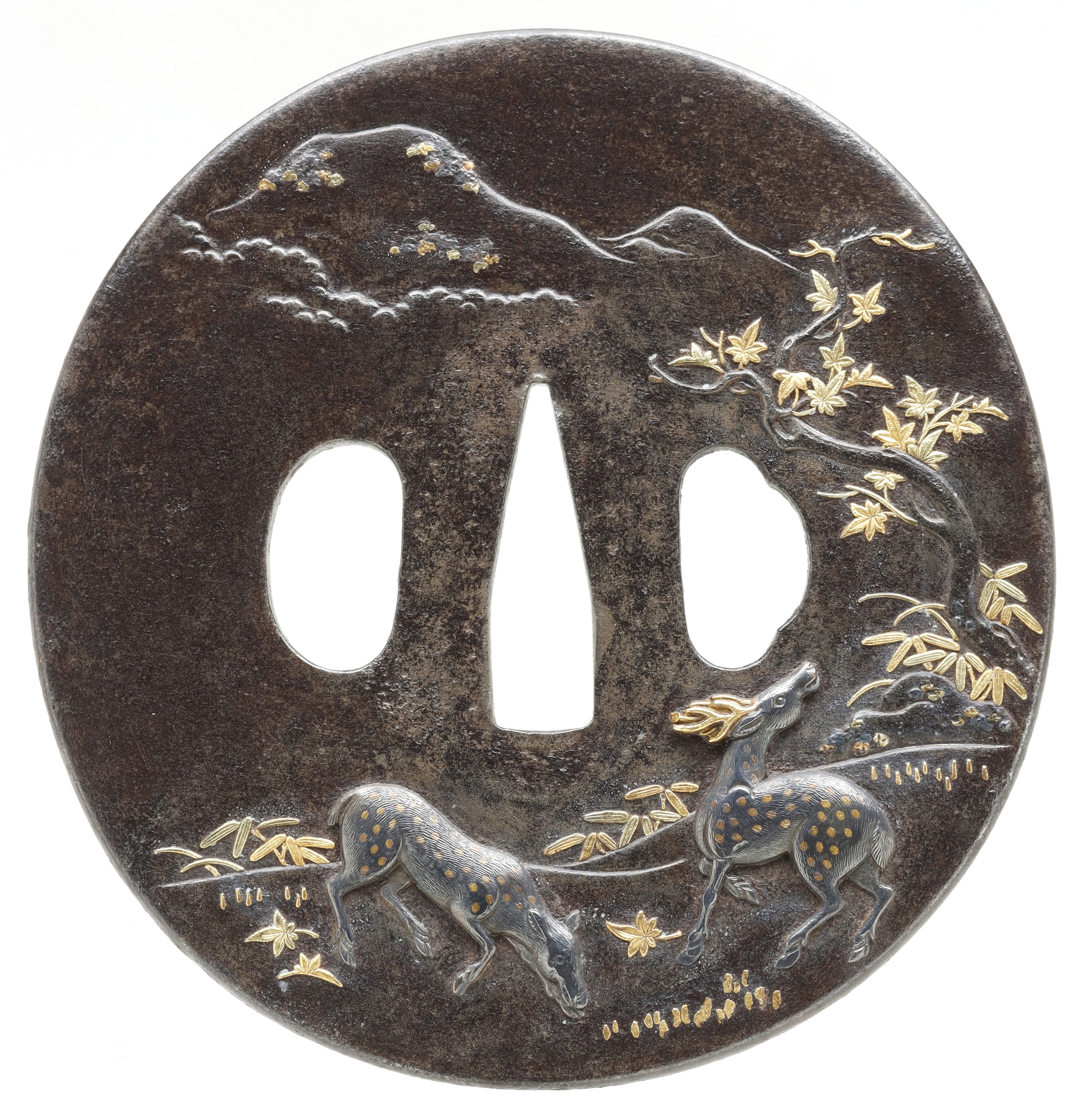
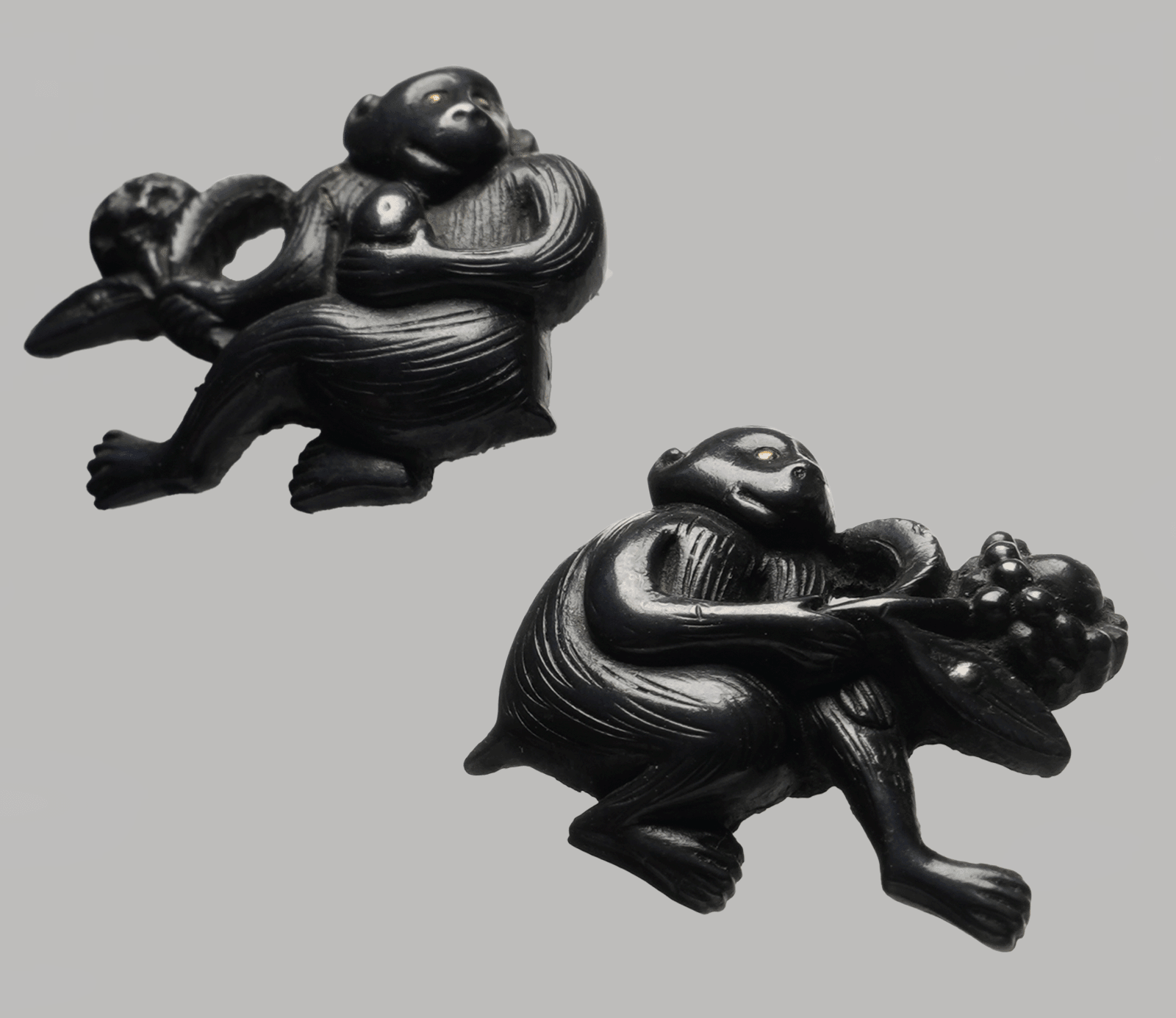
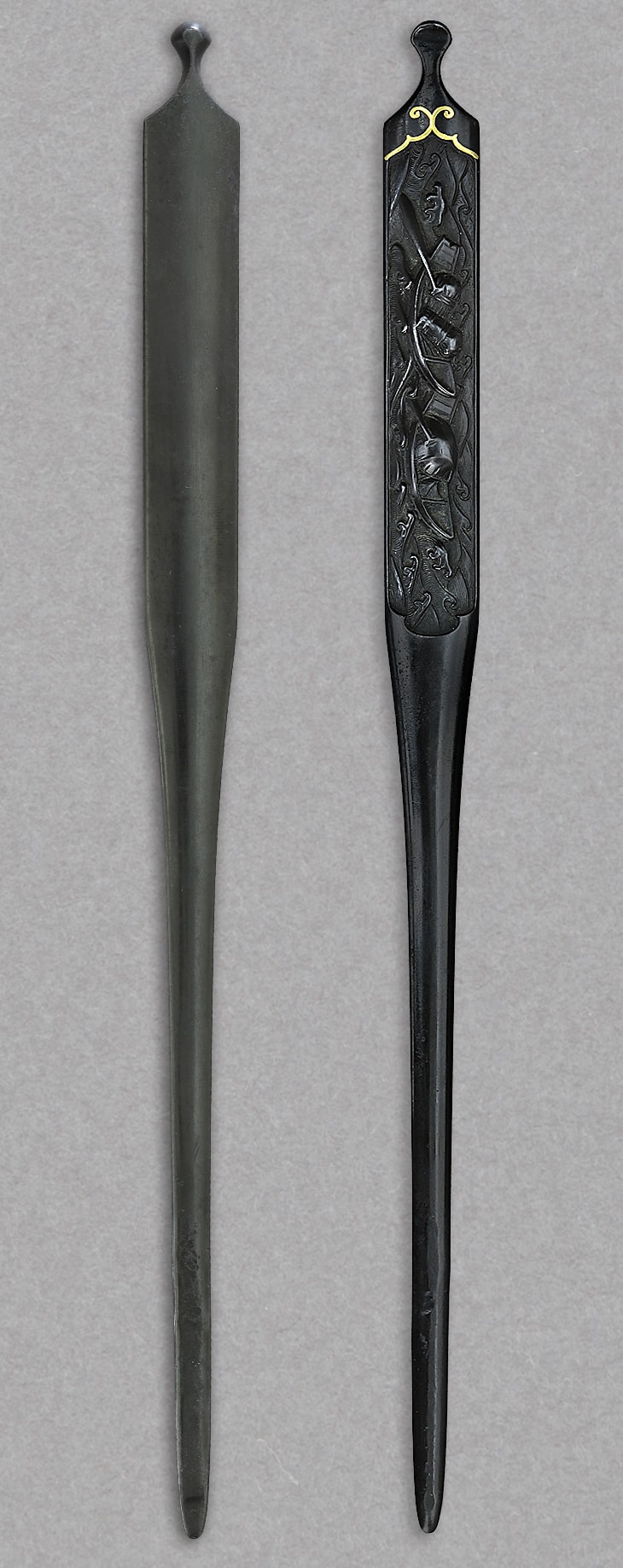
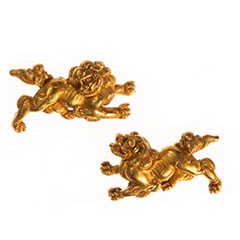
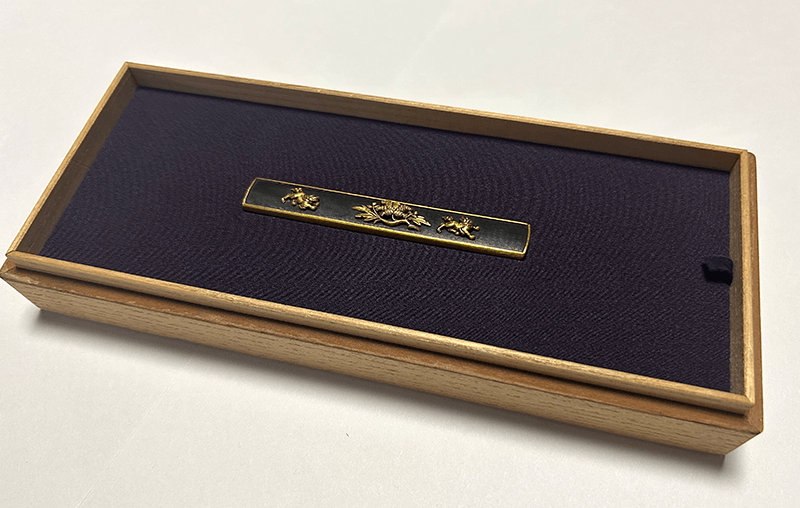
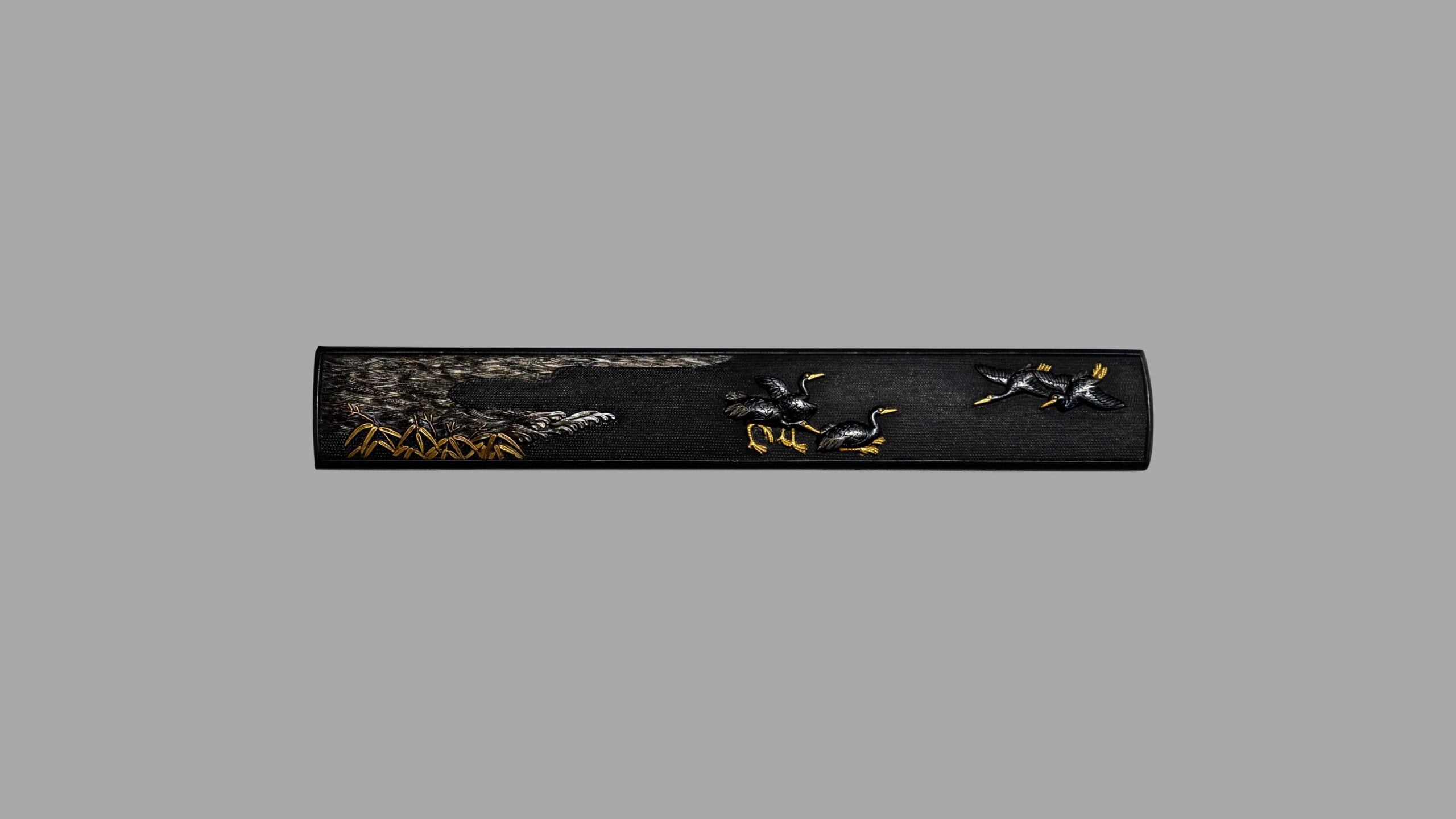
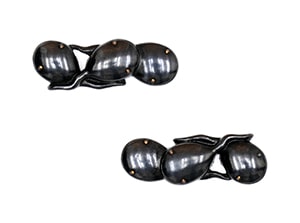
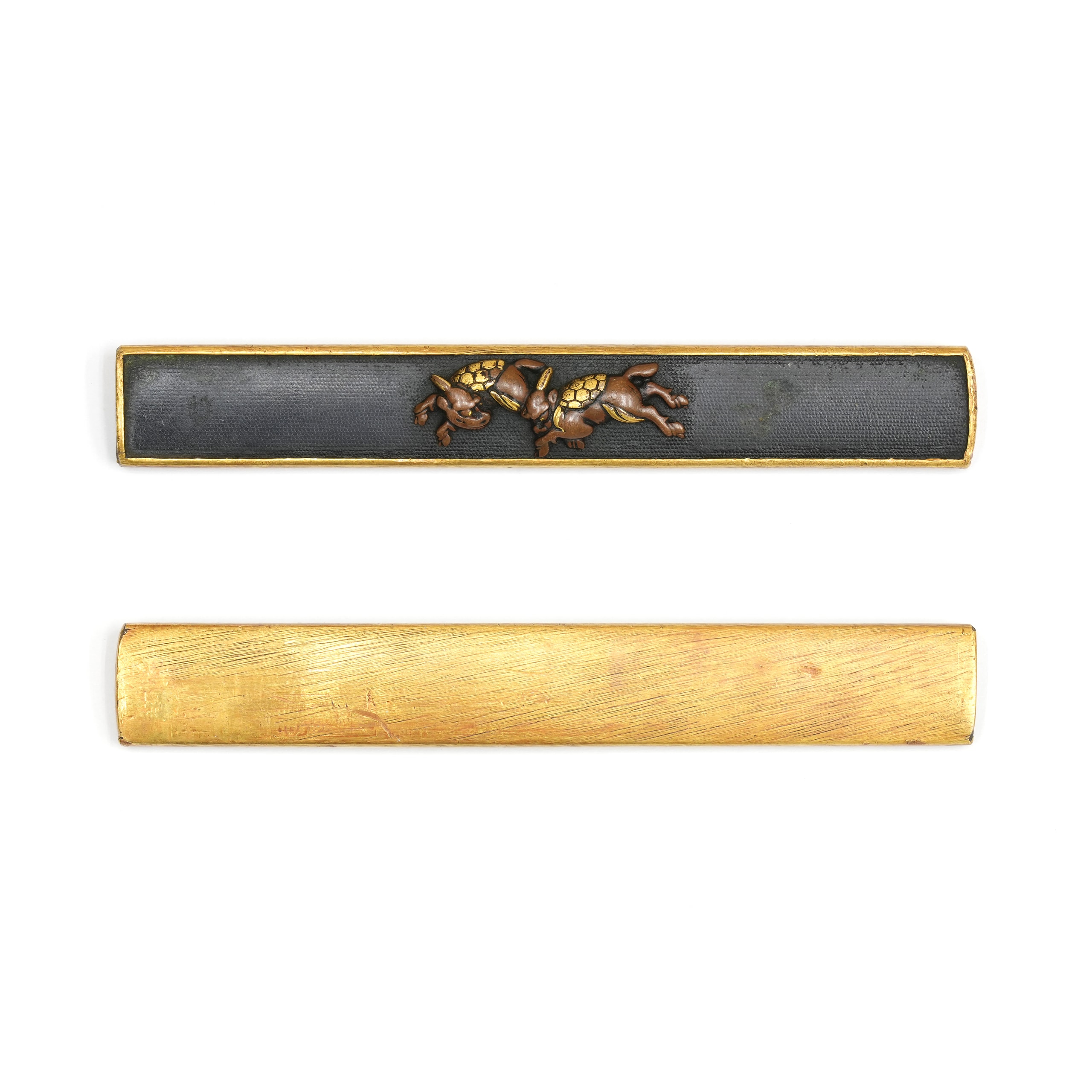
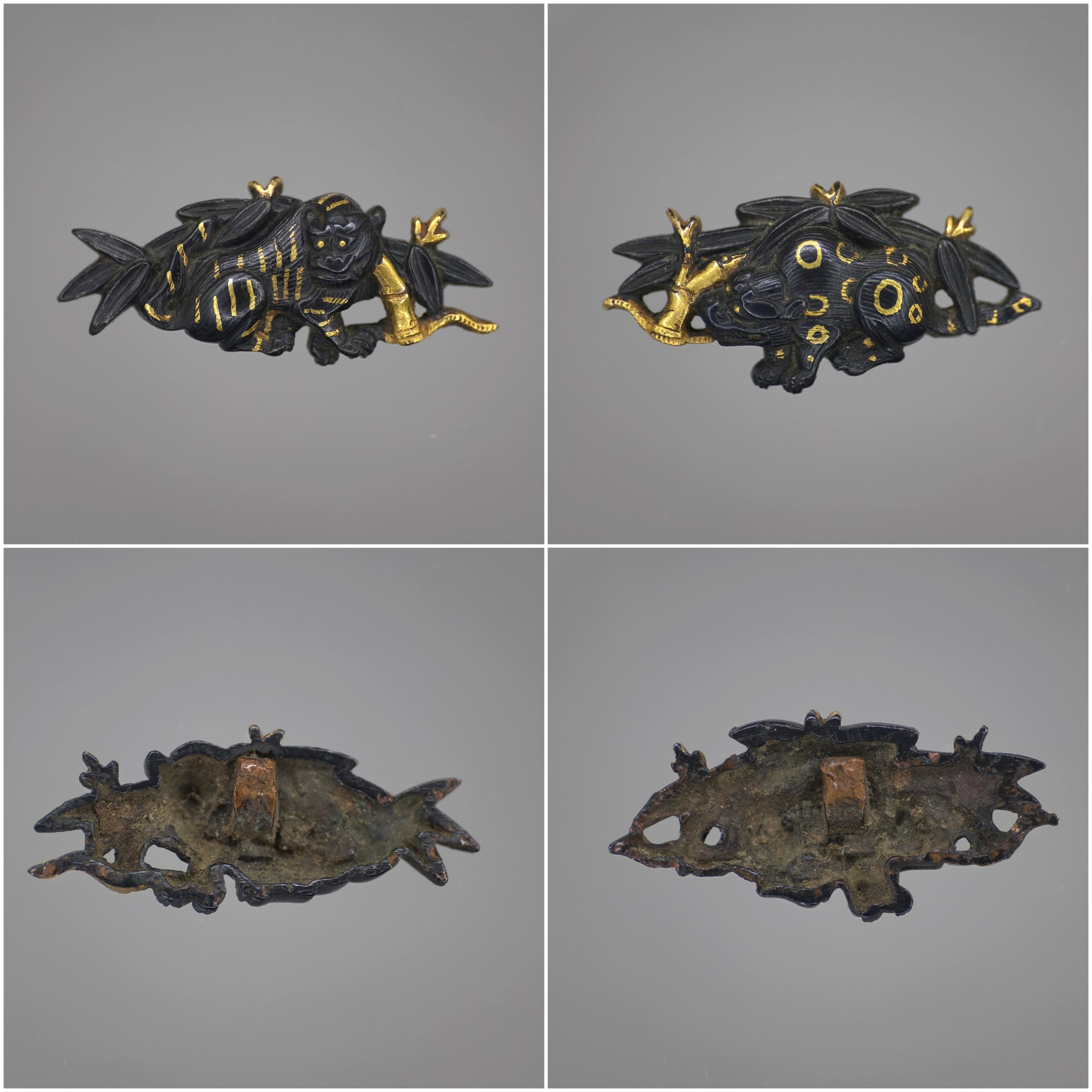
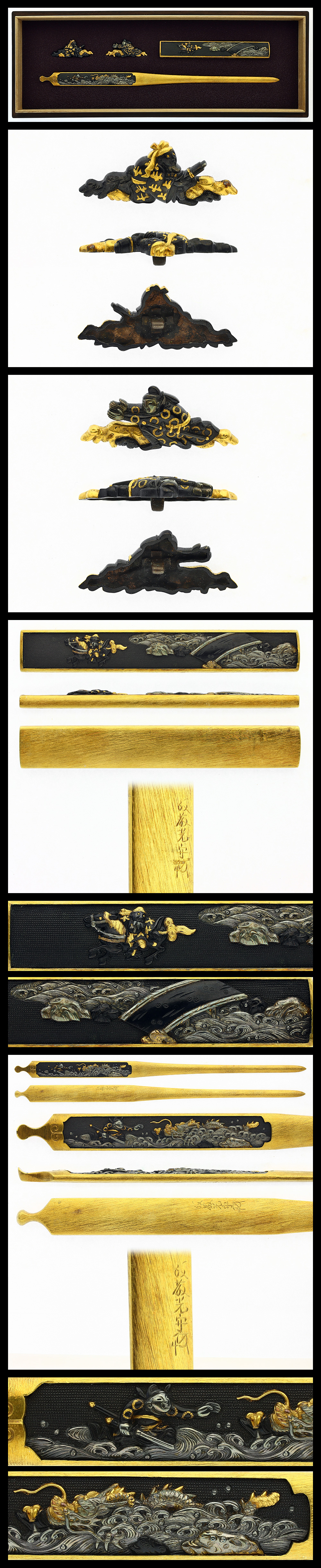
This is a mitokoromono set featuring a kozuka, kogai, and menuki, attributed to Goto Mitsumori. The set depicts the Chinese historical theme of Kōsekikō and Chōryō, crafted in high relief on a shakudo nanako ground with colored inlays. It is a Juyo Tosogu, 37th Designation, and comes with a paulownia wood box.

NBTHK Setsumei

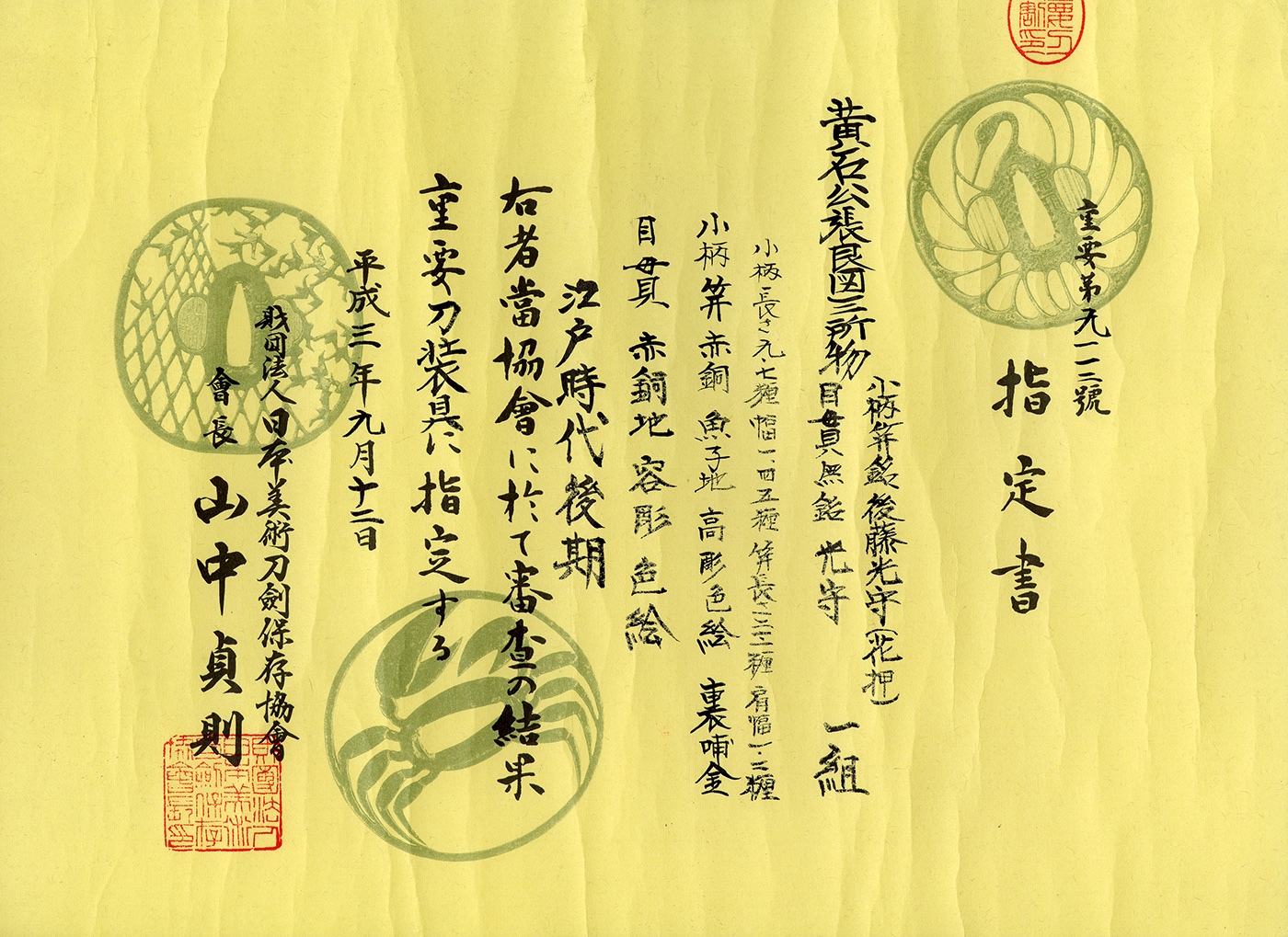
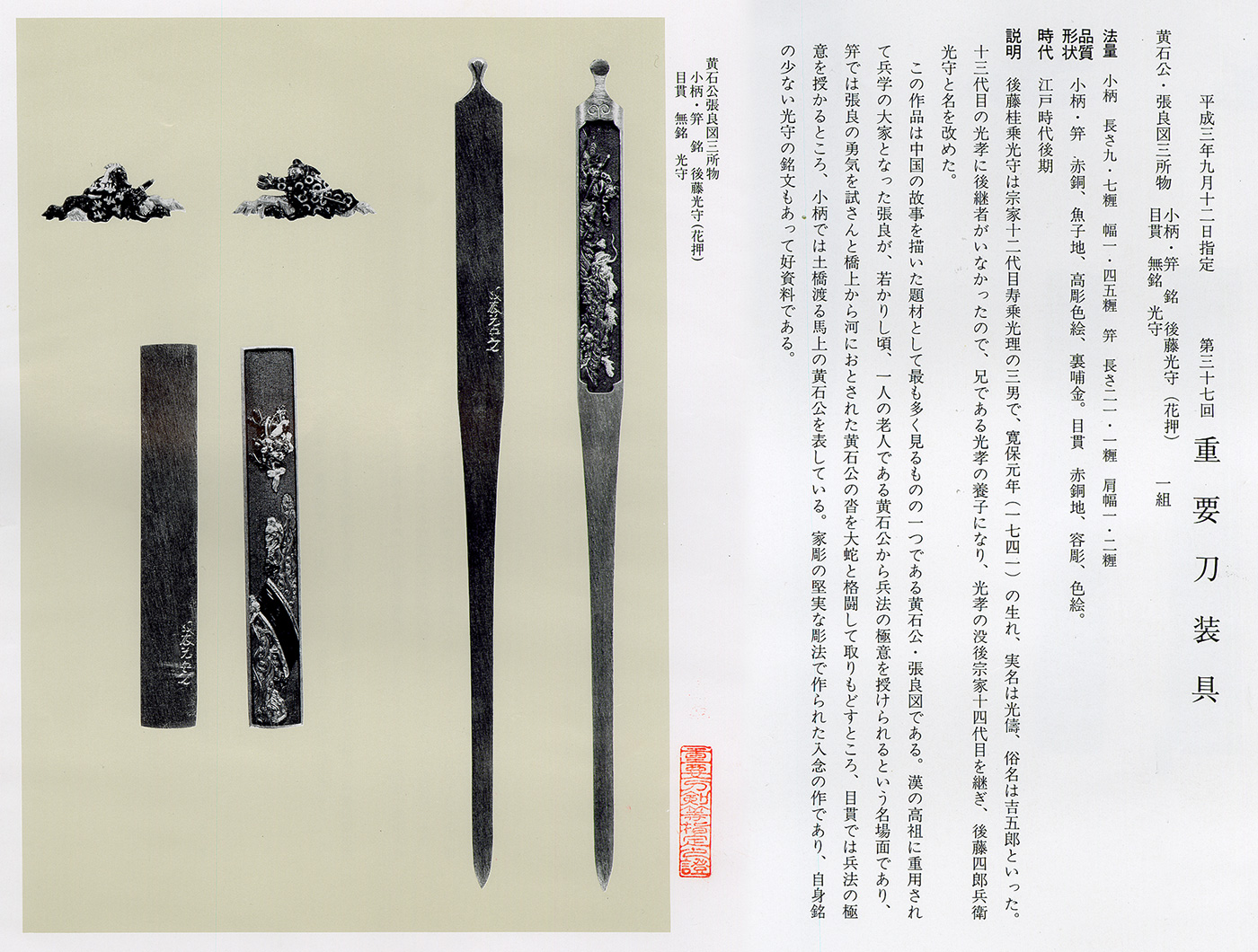
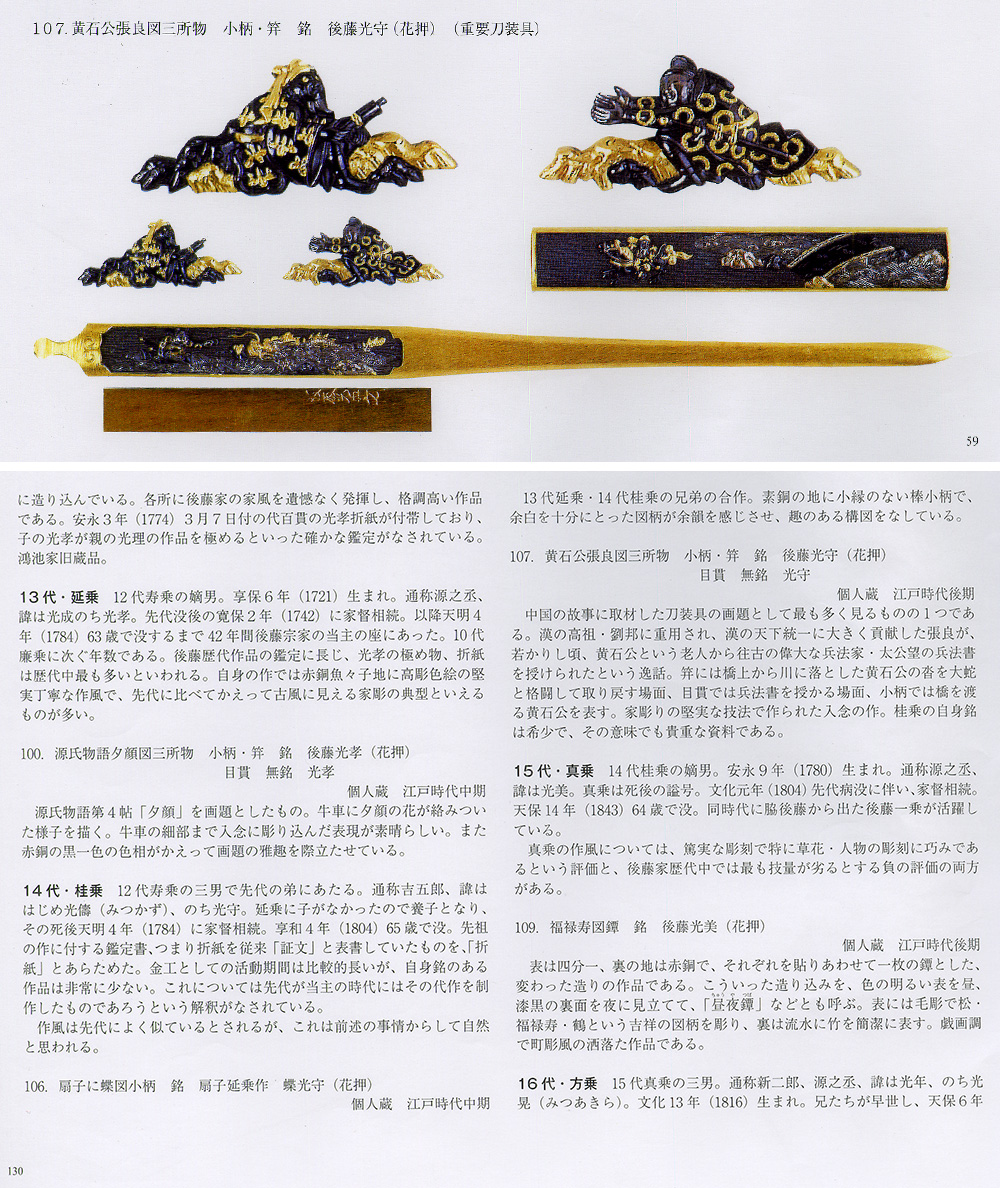
Jūyō-Tōsōgu, 37th Session — Designated September 12, 1991 Mitokoromono, mei: Gotō Mitsumori (後藤光守) Measurements - Kozuka (kogatana handle): length 9.7 cm; width 1.45 cm - Kogai: length 21.0 cm; shoulder width 1.2 cm Description Form: Mitokoromono (kozuka, kogai, and menuki) Material: - Kozuka and kogai: shakudō nanako-ji, back with kin’ura (gold lining) - Menuki: shakudō ground Design: “Huang Shigong and Zhang Liang” (黄石公・張良) Decoration: - Kozuka and kogai: takabori with iroe - Menuki: nikubori (rounded carving) with iroe Signature: - Kozuka and kogai: signed “Gotō Mitsumori” with kaō (後藤光守(花押)) - Menuki: mumei (attributed to Mitsumori) Artisan Gotō Mitsumori, art name Keijō (桂乗). Mainline Gotō house. Era Late Edo period. Explanation Gotō Keijō Mitsumori was the third son of the twelfth-generation head of the main Gotō line, Jujō Mitsumichi (宗家十二代目寿乗光理). He was born in Kanpō 1 (1741); his personal name was Mitsutomo (光儔), and his common name was Kichigorō (吉五郎). Because the thirteenth head, Mitsutaka (光孝), had no successor, Mitsumori became his elder brother’s adopted son. After Mitsutaka’s death, Mitsumori succeeded as the fourteenth head of the mainline and changed his name to Gotō Shirōbei Mitsumori (後藤四郎兵衛光守). This set depicts one of the most frequently encountered themes drawn from Chinese historical anecdotes: Huang Shigong and Zhang Liang. Zhang Liang—later heavily employed by Liu Bang (Emperor Gaozu of Han) and celebrated as a great authority on military strategy—encounters the elderly Huang Shigong in his youth and is taught the secrets of the art of war. The scenes are distributed across the three implements: the kogai shows Zhang Liang retrieving Huang Shigong’s shoe after it is thrown from a bridge into the river to test his courage, even struggling with a great serpent; the menuki depicts the moment of receiving the essential teachings; and the kozuka represents Huang Shigong on horseback crossing an earthen bridge. Executed with the solid and reliable carving manner characteristic of the Gotō house tradition (iebori), this is a painstaking work. Moreover, since works bearing Mitsumori’s own signature are comparatively few, the presence of his inscription makes this an important reference piece.
Certificate Reading

Certificate reading — 銘 小柄 笄 銘 後藤光守(花押) / 目貫 無銘 光守

NihontoWatch MonNihontoWatch
MarketAuctionsEncyclopedia
Fittings›Iebori›Goto›Goto Main Line›Goto Keijo›Mitokoromono Set (Kogai, Kozuka, Menuki): Goto Mitsumori (Kozuka and Kogai), Unsigned (Menuki, attributed to Mitsumori) (Juyo Tosogu, 37th Designation)
mitokoromonoJūyō
Goto Keijo

Mitokoromono Set (Kogai, Kozuka, Menuki): Goto Mitsumori (Kozuka and Kogai), Unsigned (Menuki, attributed to Mitsumori) (Juyo Tosogu, 37th Designation)

mumei · Goto · Edo

¥3,500,000
Visit seller website →
Goto Keijo — 1 of 4
Goto Keijo — 2 of 4
Goto Keijo — 3 of 4
Goto Keijo — 4 of 4
1 / 4
1 / 4
Goto Keijo — 1 of 4Goto Keijo — 2 of 4Goto Keijo — 3 of 4Goto Keijo — 4 of 4
Measurements & details
Maker

Goto Keijo

Era

Edo

Signature

Unsigned

Papers

Jūyō #37 (NBTHK)

Description

This is a mitokoromono set featuring a kozuka, kogai, and menuki, attributed to Goto Mitsumori. The set depicts the Chinese historical theme of Kōsekikō and Chōryō, crafted in high relief on a shakudo nanako ground with colored inlays. It is a Juyo Tosogu, 37th Designation, and comes with a paulownia wood box.

NBTHK Zufu Commentary

Juyo #37

AI translation — may contain errors

-Tōsōgu, 37th Session — Designated September 12, 1991

, : Gotō Mitsumori (後藤光守)

Measurements

  • (kogatana handle): length 9.7 cm; width 1.45 cm
  • : length 21.0 cm; shoulder width 1.2 cm

Description Form: (, , and ) Material:

  • and : , back with ’ (gold lining)
  • : ground Design: “Huang Shigong and Zhang Liang” (黄石公・張良) Decoration:
  • and : with
  • : nikubori (rounded carving) with Signature:
  • and : signed “Gotō Mitsumori” with (後藤光守(花押))
  • : (attributed to Mitsumori)

Artisan Gotō Mitsumori, art name Keijō (桂乗). Mainline Gotō house.

Era Late period.

Explanation Gotō Keijō Mitsumori was the third son of the twelfth-generation head of the main Gotō line, Jujō Mitsumichi (宗家十二代目寿乗光理). He was born in Kanpō 1 (1741); his personal name was Mitsutomo (光儔), and his common name was Kichigorō (吉五郎).

Because the thirteenth head, Mitsutaka (光孝), had no successor, Mitsumori became his elder brother’s adopted son. After Mitsutaka’s death, Mitsumori succeeded as the fourteenth head of the mainline and changed his name to Gotō Shirōbei Mitsumori (後藤四郎兵衛光守).

This set depicts one of the most frequently encountered themes drawn from Chinese historical anecdotes: Huang Shigong and Zhang Liang. Zhang Liang—later heavily employed by Liu Bang (Emperor Gaozu of Han) and celebrated as a great authority on military strategy—encounters the elderly Huang Shigong in his youth and is taught the secrets of the art of war. The scenes are distributed across the three implements: the shows Zhang Liang retrieving Huang Shigong’s shoe after it is thrown from a bridge into the river to test his courage, even struggling with a great serpent; the depicts the moment of receiving the essential teachings; and the represents Huang Shigong on horseback crossing an earthen bridge.

Executed with the solid and reliable carving manner characteristic of the Gotō house tradition (iebori), this is a painstaking work. Moreover, since works bearing Mitsumori’s own signature are comparatively few, the presence of his inscription makes this an important reference piece.

About the maker

Goto Keijo

後藤桂乗

Iebori · Yamashiro · around 1741-1804

2 pieces on the market now

›

Goto Mitsumori, art name Keijo, was the third son of the twelfth head of the main Goto line, Jujo Mitsusato. He was born in Kanpo 1 (1741), bearing the personal name Mitsutomo and the common name Kichigoro. Because the thirteenth head, Mitsutaka, left no heir, Mitsumori was adopted by his elder brother; after Mitsutaka's death, he changed his name to Shirobei Mitsumori and succeeded as the fourteenth head of the mainline Goto house. His position thus placed him at the summit of the most venerable metalworking lineage in the Japanese tradition, carrying forward the unbroken succession from Yujo through fourteen generations of service to the ruling authorities.

Mitsumori's oeuvre demonstrates the solid and reliable carving manner characteristic of the Goto house tradition (iebori), executed with painstaking attention throughout. His works are unified in a refreshing, pure black tonality of shakudo, rendered in both nanako-ji and migaki-ji grounds. He employed takabori, kebori with accents of kosuki-bori, and iroe in gold and silver, achieving compositions of ample volume and richly rounded high relief. His subjects encompassed traditional Goto themes — Kurikara, the legend of Huang Shigong and Zhang Liang, takara-zukushi, and kirin — while also extending to more pictorial compositions in a painting-like manner. The gold crests on his kozuka and kogai are noted for their large scale, excellent volume, and powerfully expressed presence.

The NBTHK characterizes Mitsumori's finest works as possessing a distinctive sense of "inner sumptuousness" achieved through restrained coloration and confident carving — a quality that brings forth his particular strengths to the fullest. Works bearing his own signature are comparatively few, lending additional significance to signed examples as important reference pieces. His mitokoromono sets are especially scarce and are counted among his representative achievements. Mitsumori's contribution resides in his faithful stewardship of the mainline Goto tradition during the latter half of the eighteenth century, demonstrating that the hereditary house manner retained its vitality and high standard into the late Edo period.

Historical importance

Where Goto Keijo stands among comparable artisans: across all of nihontō, and within tradition, era, and period. The tiers (Foremost · Leading · Major · Notable) weigh official designations from the NBTHK and Japan's Agency for Cultural Affairs, together with historical honors of lasting repute such as the Sansaku and Meibutsu-chō.

随一
Foremost
屈指
Leading
有数
Major
著名
Notable

Select a lens to see how it's measured.

Designation record
4 designated works
Jūyō
4
2 works by Goto Keijo on the market→
Goto Keijo — full profileIebori school
About the school

Goto

後藤

Iebori · Yamashiro

Phase: Goto Main Line後藤宗家· 1573–1900

312 pieces on the market now

›
61 recorded smiths775 designated works
Leading smiths
SmithEraDesignated
Goto Joshin後藤乗真1512-156268
Goto Yujo後藤祐乗1440-151241
Goto Kenjo後藤顕乗1586-166346
Goto Sojo後藤宗乗1461-153855
Goto Eijo後藤栄乗1577-161735
Explore the Goto school →
NBTHK Certificate
Jūyō Tōken重要刀剣
Important Sword
›

A blade of top-grade workmanship and condition, formally judged to rank with a nationally recognized Important Art Object (Jūyō Bijutsuhin). Awarded only at the NBTHK’s competitive annual examination.

Of Japan’s roughly 2.5 million registered swords, only 12,307 (about 1 in 203) have ever attained Jūyō.

Signed: 小柄 笄 銘 後藤光守(花押) / 目貫 無銘 光守 (Goto Keijo)
As written on the certificate
About the NBTHK›

The NBTHK (Nihon Bijutsu Tōken Hozon Kyōkai, the Society for the Preservation of Japanese Art Swords) is a public-interest incorporated foundation founded in 1948 and supervised by Japan’s Agency for Cultural Affairs (Bunkachō); it is based at the Japanese Sword Museum in Tokyo. Its expert panels physically examine each submitted work (shinsa) and issue a certificate (kanteishō) ranking it by artistic and historical merit. NBTHK papers are the most widely recognized standard of authentication for Japanese swords and fittings.

NBTHK official site→
Seller
A
Aoi Art
🇯🇵Ships from Japan
›
✓Verified dealeraoijapan.com
Settles in JPY
✓Ships worldwide✓English supportWire transferPayPalCredit card
Return policy

If you wish to return an item, please notify us within 3 days of receipt. After this period we cannot accept cancellations. Please ship the return to us within 5 business days. Cancellation is conditional on the item being kept in the same condition as at the time of sale, so please handle it with care.

View all of Aoi Art’s listings→View this item on the dealer’s site→

More works by Goto Keijo

View all →
Iida Koendo
Hozon
Tsuba - Hozon - by Goto Keijo - TosoguTsuba - Hozon - by Goto Keijo - Tosogu

Tsuba

ByGoto Keijo
¥1,650,000

Previously sold by Goto Keijo

Choshuya
Hozon
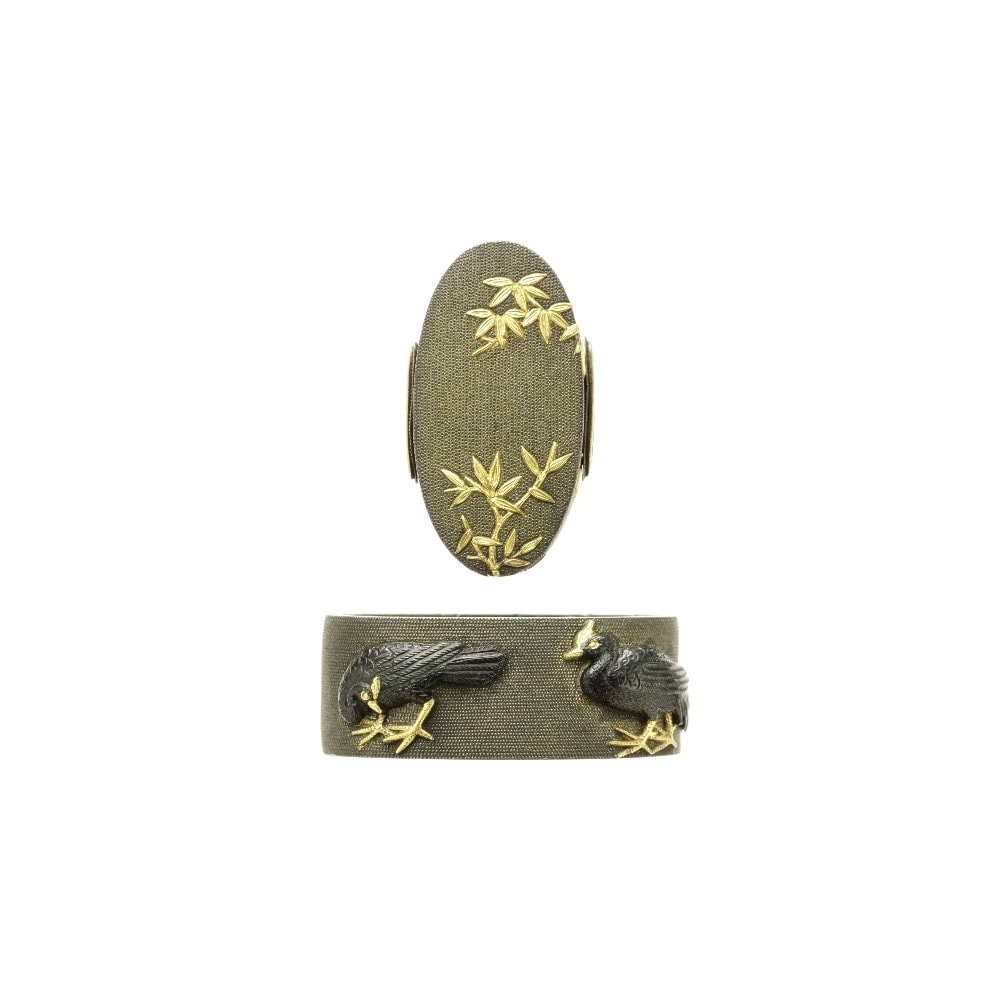
Fuchi-Kashira - Hozon - by Goto Keijo - Fuchi-Kashira with Bamboo Grove and Peacock Motif, Signed Goto Mitsutomo (Kao)Fuchi-Kashira - Hozon - by Goto Keijo - Fuchi-Kashira with Bamboo Grove and Peacock Motif, Signed Goto Mitsutomo (Kao)
Sold

Fuchi-Kashira

ByGoto Keijo
SOLD

More Goto Main Line works

View all →
Aoi Art
Tokuho
Kozuka - Tokuho - by Goto Tsujo - MitsuyoshiKozuka - Tokuho - by Goto Tsujo - Mitsuyoshi

Kozuka

ByGoto Tsujo
Starting Bid¥500,000
Aoi Art
Jūyō
Futatokoro - Jūyō - by Goto Kenjo - Nitokoro: Goto KenjoFutatokoro - Jūyō - by Goto Kenjo - Nitokoro: Goto Kenjo

Futatokoromono

ByGoto Kenjo
Starting Bid¥2,650,000
Nihontocraft
Jūyō
Mitokoromono - Jūyō - by Goto Hojo - Goto Hojo MitokoromonoMitokoromono - Jūyō - by Goto Hojo - Goto Hojo Mitokoromono

Mitokoromono

ByGoto Hojo
¥27,000
Token-Net
Jūyō
Fuchi-Kashira - Jūyō - by Goto Eijo - Futatokoro: Family Crest Scattered, Mumei EijoFuchi-Kashira - Jūyō - by Goto Eijo - Futatokoro: Family Crest Scattered, Mumei Eijo

Fuchi-Kashira

ByGoto Eijo
¥3,800,000
Soryu
Hozon
Fuchi-Kashira - Hozon - by Goto Teijo - Fuchikashira signed "Teijo Saku Mitsuyoshi" with NBTHK Hozon TosoguFuchi-Kashira - Hozon - by Goto Teijo - Fuchikashira signed "Teijo Saku Mitsuyoshi" with NBTHK Hozon Tosogu

Fuchi-Kashira

ByGoto Teijo
¥2,800
Tetsugendo
Tokuho
Mitokoromono - Tokuho - by Goto Kenjo - Goto Mainline Mitokoromono attributed to Goto KenjoMitokoromono - Tokuho - by Goto Kenjo - Goto Mainline Mitokoromono attributed to Goto Kenjo

Mitokoromono

ByGoto Kenjo
¥12,000
Tsuba Info
Hozon
Kozuka - Hozon - by Goto Eijo - A Goto Kozuka by EijoKozuka - Hozon - by Goto Eijo - A Goto Kozuka by Eijo

Kozuka

ByGoto Eijo
Ask
Nihontocraft
Tokuho
Kozuka - Tokuho - by Goto Eijo - Goto Eijo KozukaKozuka - Tokuho - by Goto Eijo - Goto Eijo Kozuka

Kozuka

ByGoto Eijo
¥3,850

More from the Goto school

View all →
Ginza Seikodo
Tokuho
Futatokoro - Tokuho - by Goto Ichijo - Fuchi-Kashira: Goto Hokyo Ichijo - Cranes in Flight motifFutatokoro - Tokuho - by Goto Ichijo - Fuchi-Kashira: Goto Hokyo Ichijo - Cranes in Flight motif

Futatokoromono

ByGoto Ichijo
¥1,900,000
Touken Matsumoto
Tokuho
Kogai - Tokuho - by Goto School - Kogai: Dancing Cranes DesignKogai - Tokuho - by Goto School - Kogai: Dancing Cranes Design

Kōgai

ByGoto School
¥250,000
Aoi Art
Tokuho
Mitokoromono - Tokuho - by Goto Ichijo - Nitokoro mono (matched pair of Kogai and Kozuka): Kijuo IchijoMitokoromono - Tokuho - by Goto Ichijo - Nitokoro mono (matched pair of Kogai and Kozuka): Kijuo Ichijo

Mitokoromono

ByGoto Ichijo
¥1,250,000
Touken Matsumoto
Hozon
Fuchi-Kashira - Hozon - by Goto School - Fuchi-Kashira: Flower and Bird DesignFuchi-Kashira - Hozon - by Goto School - Fuchi-Kashira: Flower and Bird Design

Fuchi-Kashira

ByGoto School
¥300,000
Yamasiroya
Tokujū
Koshirae - Tokuju - by Kaga-Goto Etsujo - Tachi Koshirae: Gold Nashiji Aoi-mon Scattered Gold Shell Maki-e Saya Itomaki Tachi Koshirae / Tsuba (Signed) Goto Etsujo (Kao)Koshirae - Tokuju - by Kaga-Goto Etsujo - Tachi Koshirae: Gold Nashiji Aoi-mon Scattered Gold Shell Maki-e Saya Itomaki Tachi Koshirae / Tsuba (Signed) Goto Etsujo (Kao)

Koshirae

ByKaga-Goto Etsujo
Ask
Iida Koendo
Tokuho
Tsuba - Tokuho - by Goto Ichijo - Tosogu: HakuoTsuba - Tokuho - by Goto Ichijo - Tosogu: Hakuo

Tsuba

ByGoto Ichijo
¥1,320,000
Mandarin Mansion
Tokuho
Koshirae - Tokuho - by Araki Tomei - Araki Tomei wakizashi koshiraeKoshirae - Tokuho - by Araki Tomei - Araki Tomei wakizashi koshirae

Koshirae

ByAraki Tomei
Ask
Katanahanbai
Tokuho
Futatokoro - Tokuho - by Goto Ichijo - Goto IchijoFutatokoro - Tokuho - by Goto Ichijo - Goto Ichijo

Futatokoromono

ByGoto Ichijo
¥2,200,000

More from the Iebori tradition

View all →
Aoi Art
Hozon
Tsuba - Hozon - by Yasuda School - Unsigned (Yasuda)Tsuba - Hozon - by Yasuda School - Unsigned (Yasuda)

Tsuba

ByYasuda School
Starting Bid¥150,000
Ginza Seikodo
Tokuho
Menuki - Tokuho - by Waki-Goto Tojo - Warikibata Mei Goto Tojo (kao)Menuki - Tokuho - by Waki-Goto Tojo - Warikibata Mei Goto Tojo (kao)

Menuki

ByWaki-Goto Tojo
¥650,000
Ginza Seikodo
Jūyō
Kozuka - Jūyō - by Ichijo Ikkin - Funada Ikkin kaoKozuka - Jūyō - by Ichijo Ikkin - Funada Ikkin kao

Kozuka

ByIchijo Ikkin
Ask
Katanahanbai
Tokuho
Menuki - Tokuho - by Araki Tomei - Araki Tomei - Millet Ear Design with Tanzaku MeiMenuki - Tokuho - by Araki Tomei - Araki Tomei - Millet Ear Design with Tanzaku Mei

Menuki

ByAraki Tomei
¥2,200,000
Katanahanbai
Tokuho
Menuki - Tokuho - by Ko-Goto School - Solid Gold Crawling Dragon Menuki, KogotoMenuki - Tokuho - by Ko-Goto School - Solid Gold Crawling Dragon Menuki, Kogoto

Menuki

ByKo-Goto School
¥750,000
Aoi Art
Hozon
Kozuka - Hozon - by Goto School - Teijo, MitsumoriKozuka - Hozon - by Goto School - Teijo, Mitsumori

Kozuka

ByGoto School
¥365,000
Token-Net
Jūyō
Mitokoromono - Jūyō - by Goto Yoshihide - Kozuka and Kogai signed Sonobe Yoshihide (with Kao), Menuki unsigned YoshihideMitokoromono - Jūyō - by Goto Yoshihide - Kozuka and Kogai signed Sonobe Yoshihide (with Kao), Menuki unsigned Yoshihide

Mitokoromono

ByGoto Yoshihide
¥4,800,000
Aoi Art
Jūyō
Mitokoromono - Jūyō - by Goto School - Set of Tosogu: Kozuka, Kōgai, MenukiMitokoromono - Jūyō - by Goto School - Set of Tosogu: Kozuka, Kōgai, Menuki

Mitokoromono

ByGoto School
¥2,500,000

Swords

  • Katana
  • Wakizashi
  • Tantō
  • Tachi
  • Naginata
  • Yari

Fittings

  • Tsuba
  • Fuchi-Kashira
  • Kozuka
  • Menuki

By Certification

  • Tokujū
  • Jūyō
  • Tokuho
  • Hozon

Resources

  • Dealer Directory
  • Artist Directory
  • Glossary
  • Browse All
Nihontowatch© 2026
TermsPrivacyCookiesAbout

Description

This is a mitokoromono set featuring a kozuka, kogai, and menuki, attributed to Goto Mitsumori. The set depicts the Chinese historical theme of Kōsekikō and Chōryō, crafted in high relief on a shakudo nanako ground with colored inlays. It is a Juyo Tosogu, 37th Designation, and comes with a paulownia wood box.

NBTHK Setsumei

Jūyō-Tōsōgu, 37th Session — Designated September 12, 1991 Mitokoromono, mei: Gotō Mitsumori (後藤光守) Measurements - Kozuka (kogatana handle): length 9.7 cm; width 1.45 cm - Kogai: length 21.0 cm; shoulder width 1.2 cm Description Form: Mitokoromono (kozuka, kogai, and menuki) Material: - Kozuka and kogai: shakudō nanako-ji, back with kin’ura (gold lining) - Menuki: shakudō ground Design: “Huang Shigong and Zhang Liang” (黄石公・張良) Decoration: - Kozuka and kogai: takabori with iroe - Menuki: nikubori (rounded carving) with iroe Signature: - Kozuka and kogai: signed “Gotō Mitsumori” with kaō (後藤光守(花押)) - Menuki: mumei (attributed to Mitsumori) Artisan Gotō Mitsumori, art name Keijō (桂乗). Mainline Gotō house. Era Late Edo period. Explanation Gotō Keijō Mitsumori was the third son of the twelfth-generation head of the main Gotō line, Jujō Mitsumichi (宗家十二代目寿乗光理). He was born in Kanpō 1 (1741); his personal name was Mitsutomo (光儔), and his common name was Kichigorō (吉五郎). Because the thirteenth head, Mitsutaka (光孝), had no successor, Mitsumori became his elder brother’s adopted son. After Mitsutaka’s death, Mitsumori succeeded as the fourteenth head of the mainline and changed his name to Gotō Shirōbei Mitsumori (後藤四郎兵衛光守). This set depicts one of the most frequently encountered themes drawn from Chinese historical anecdotes: Huang Shigong and Zhang Liang. Zhang Liang—later heavily employed by Liu Bang (Emperor Gaozu of Han) and celebrated as a great authority on military strategy—encounters the elderly Huang Shigong in his youth and is taught the secrets of the art of war. The scenes are distributed across the three implements: the kogai shows Zhang Liang retrieving Huang Shigong’s shoe after it is thrown from a bridge into the river to test his courage, even struggling with a great serpent; the menuki depicts the moment of receiving the essential teachings; and the kozuka represents Huang Shigong on horseback crossing an earthen bridge. Executed with the solid and reliable carving manner characteristic of the Gotō house tradition (iebori), this is a painstaking work. Moreover, since works bearing Mitsumori’s own signature are comparatively few, the presence of his inscription makes this an important reference piece.
Certificate Reading

Certificate reading — 銘 小柄 笄 銘 後藤光守(花押) / 目貫 無銘 光守

NihontoWatch MonNihontoWatch
MarketAuctionsEncyclopedia
Fittings›Iebori›Goto›Goto Main Line›Goto Keijo›Mitokoromono Set (Kogai, Kozuka, Menuki): Goto Mitsumori (Kozuka and Kogai), Unsigned (Menuki, attributed to Mitsumori) (Juyo Tosogu, 37th Designation)
mitokoromonoJūyō
Goto Keijo

Mitokoromono Set (Kogai, Kozuka, Menuki): Goto Mitsumori (Kozuka and Kogai), Unsigned (Menuki, attributed to Mitsumori) (Juyo Tosogu, 37th Designation)

mumei · Goto · Edo

¥3,500,000
Visit seller website →
Goto Keijo — 1 of 4
Goto Keijo — 2 of 4
Goto Keijo — 3 of 4
Goto Keijo — 4 of 4
1 / 4
1 / 4
Goto Keijo — 1 of 4Goto Keijo — 2 of 4Goto Keijo — 3 of 4Goto Keijo — 4 of 4
Measurements & details
Maker

Goto Keijo

Era

Edo

Signature

Unsigned

Papers

Jūyō #37 (NBTHK)

Description

This is a mitokoromono set featuring a kozuka, kogai, and menuki, attributed to Goto Mitsumori. The set depicts the Chinese historical theme of Kōsekikō and Chōryō, crafted in high relief on a shakudo nanako ground with colored inlays. It is a Juyo Tosogu, 37th Designation, and comes with a paulownia wood box.

NBTHK Zufu Commentary

Juyo #37

AI translation — may contain errors

-Tōsōgu, 37th Session — Designated September 12, 1991

, : Gotō Mitsumori (後藤光守)

Measurements

  • (kogatana handle): length 9.7 cm; width 1.45 cm
  • : length 21.0 cm; shoulder width 1.2 cm

Description Form: (, , and ) Material:

  • and : , back with ’ (gold lining)
  • : ground Design: “Huang Shigong and Zhang Liang” (黄石公・張良) Decoration:
  • and : with
  • : nikubori (rounded carving) with Signature:
  • and : signed “Gotō Mitsumori” with (後藤光守(花押))
  • : (attributed to Mitsumori)

Artisan Gotō Mitsumori, art name Keijō (桂乗). Mainline Gotō house.

Era Late period.

Explanation Gotō Keijō Mitsumori was the third son of the twelfth-generation head of the main Gotō line, Jujō Mitsumichi (宗家十二代目寿乗光理). He was born in Kanpō 1 (1741); his personal name was Mitsutomo (光儔), and his common name was Kichigorō (吉五郎).

Because the thirteenth head, Mitsutaka (光孝), had no successor, Mitsumori became his elder brother’s adopted son. After Mitsutaka’s death, Mitsumori succeeded as the fourteenth head of the mainline and changed his name to Gotō Shirōbei Mitsumori (後藤四郎兵衛光守).

This set depicts one of the most frequently encountered themes drawn from Chinese historical anecdotes: Huang Shigong and Zhang Liang. Zhang Liang—later heavily employed by Liu Bang (Emperor Gaozu of Han) and celebrated as a great authority on military strategy—encounters the elderly Huang Shigong in his youth and is taught the secrets of the art of war. The scenes are distributed across the three implements: the shows Zhang Liang retrieving Huang Shigong’s shoe after it is thrown from a bridge into the river to test his courage, even struggling with a great serpent; the depicts the moment of receiving the essential teachings; and the represents Huang Shigong on horseback crossing an earthen bridge.

Executed with the solid and reliable carving manner characteristic of the Gotō house tradition (iebori), this is a painstaking work. Moreover, since works bearing Mitsumori’s own signature are comparatively few, the presence of his inscription makes this an important reference piece.
About the maker

Goto Keijo

後藤桂乗

Iebori · Yamashiro · around 1741-1804

2 pieces on the market now

›

Goto Mitsumori, art name Keijo, was the third son of the twelfth head of the main Goto line, Jujo Mitsusato. He was born in Kanpo 1 (1741), bearing the personal name Mitsutomo and the common name Kichigoro. Because the thirteenth head, Mitsutaka, left no heir, Mitsumori was adopted by his elder brother; after Mitsutaka's death, he changed his name to Shirobei Mitsumori and succeeded as the fourteenth head of the mainline Goto house. His position thus placed him at the summit of the most venerable metalworking lineage in the Japanese tradition, carrying forward the unbroken succession from Yujo through fourteen generations of service to the ruling authorities.

Mitsumori's oeuvre demonstrates the solid and reliable carving manner characteristic of the Goto house tradition (iebori), executed with painstaking attention throughout. His works are unified in a refreshing, pure black tonality of shakudo, rendered in both nanako-ji and migaki-ji grounds. He employed takabori, kebori with accents of kosuki-bori, and iroe in gold and silver, achieving compositions of ample volume and richly rounded high relief. His subjects encompassed traditional Goto themes — Kurikara, the legend of Huang Shigong and Zhang Liang, takara-zukushi, and kirin — while also extending to more pictorial compositions in a painting-like manner. The gold crests on his kozuka and kogai are noted for their large scale, excellent volume, and powerfully expressed presence.

The NBTHK characterizes Mitsumori's finest works as possessing a distinctive sense of "inner sumptuousness" achieved through restrained coloration and confident carving — a quality that brings forth his particular strengths to the fullest. Works bearing his own signature are comparatively few, lending additional significance to signed examples as important reference pieces. His mitokoromono sets are especially scarce and are counted among his representative achievements. Mitsumori's contribution resides in his faithful stewardship of the mainline Goto tradition during the latter half of the eighteenth century, demonstrating that the hereditary house manner retained its vitality and high standard into the late Edo period.

Historical importance

Where Goto Keijo stands among comparable artisans: across all of nihontō, and within tradition, era, and period. The tiers (Foremost · Leading · Major · Notable) weigh official designations from the NBTHK and Japan's Agency for Cultural Affairs, together with historical honors of lasting repute such as the Sansaku and Meibutsu-chō.

随一
Foremost
屈指
Leading
有数
Major
著名
Notable

Select a lens to see how it's measured.

Designation record
4 designated works
Jūyō
4
2 works by Goto Keijo on the market→
Goto Keijo — full profileIebori school
About the school

Goto

後藤

Iebori · Yamashiro

Phase: Goto Main Line後藤宗家· 1573–1900

312 pieces on the market now

›
61 recorded smiths775 designated works
Leading smiths
SmithEraDesignated
Goto Joshin後藤乗真1512-156268
Goto Yujo後藤祐乗1440-151241
Goto Kenjo後藤顕乗1586-166346
Goto Sojo後藤宗乗1461-153855
Goto Eijo後藤栄乗1577-161735
Explore the Goto school →
NBTHK Certificate
Jūyō Tōken重要刀剣
Important Sword
›

A blade of top-grade workmanship and condition, formally judged to rank with a nationally recognized Important Art Object (Jūyō Bijutsuhin). Awarded only at the NBTHK’s competitive annual examination.

Of Japan’s roughly 2.5 million registered swords, only 12,307 (about 1 in 203) have ever attained Jūyō.

Signed: 小柄 笄 銘 後藤光守(花押) / 目貫 無銘 光守 (Goto Keijo)
As written on the certificate
About the NBTHK›

The NBTHK (Nihon Bijutsu Tōken Hozon Kyōkai, the Society for the Preservation of Japanese Art Swords) is a public-interest incorporated foundation founded in 1948 and supervised by Japan’s Agency for Cultural Affairs (Bunkachō); it is based at the Japanese Sword Museum in Tokyo. Its expert panels physically examine each submitted work (shinsa) and issue a certificate (kanteishō) ranking it by artistic and historical merit. NBTHK papers are the most widely recognized standard of authentication for Japanese swords and fittings.

NBTHK official site→
Seller
A
Aoi Art
🇯🇵Ships from Japan
›
✓Verified dealeraoijapan.com
Settles in JPY
✓Ships worldwide✓English supportWire transferPayPalCredit card
Return policy

If you wish to return an item, please notify us within 3 days of receipt. After this period we cannot accept cancellations. Please ship the return to us within 5 business days. Cancellation is conditional on the item being kept in the same condition as at the time of sale, so please handle it with care.

View all of Aoi Art’s listings→View this item on the dealer’s site→

More works by Goto Keijo

View all →
Iida Koendo
Hozon
Tsuba - Hozon - by Goto Keijo - TosoguTsuba - Hozon - by Goto Keijo - Tosogu

Tsuba

ByGoto Keijo
¥1,650,000

Previously sold by Goto Keijo

Choshuya
Hozon
Fuchi-Kashira - Hozon - by Goto Keijo - Fuchi-Kashira with Bamboo Grove and Peacock Motif, Signed Goto Mitsutomo (Kao)Fuchi-Kashira - Hozon - by Goto Keijo - Fuchi-Kashira with Bamboo Grove and Peacock Motif, Signed Goto Mitsutomo (Kao)
Sold

Fuchi-Kashira

ByGoto Keijo
SOLD

More Goto Main Line works

View all →
Aoi Art
Tokuho
Kozuka - Tokuho - by Goto Tsujo - MitsuyoshiKozuka - Tokuho - by Goto Tsujo - Mitsuyoshi

Kozuka

ByGoto Tsujo
Starting Bid¥500,000
Aoi Art
Jūyō
Futatokoro - Jūyō - by Goto Kenjo - Nitokoro: Goto KenjoFutatokoro - Jūyō - by Goto Kenjo - Nitokoro: Goto Kenjo

Futatokoromono

ByGoto Kenjo
Starting Bid¥2,650,000
Nihontocraft
Jūyō
Mitokoromono - Jūyō - by Goto Hojo - Goto Hojo MitokoromonoMitokoromono - Jūyō - by Goto Hojo - Goto Hojo Mitokoromono

Mitokoromono

ByGoto Hojo
¥27,000
Token-Net
Jūyō
Fuchi-Kashira - Jūyō - by Goto Eijo - Futatokoro: Family Crest Scattered, Mumei EijoFuchi-Kashira - Jūyō - by Goto Eijo - Futatokoro: Family Crest Scattered, Mumei Eijo

Fuchi-Kashira

ByGoto Eijo
¥3,800,000
Soryu
Hozon
Fuchi-Kashira - Hozon - by Goto Teijo - Fuchikashira signed "Teijo Saku Mitsuyoshi" with NBTHK Hozon TosoguFuchi-Kashira - Hozon - by Goto Teijo - Fuchikashira signed "Teijo Saku Mitsuyoshi" with NBTHK Hozon Tosogu

Fuchi-Kashira

ByGoto Teijo
¥2,800
Tetsugendo
Tokuho
Mitokoromono - Tokuho - by Goto Kenjo - Goto Mainline Mitokoromono attributed to Goto KenjoMitokoromono - Tokuho - by Goto Kenjo - Goto Mainline Mitokoromono attributed to Goto Kenjo

Mitokoromono

ByGoto Kenjo
¥12,000
Tsuba Info
Hozon
Kozuka - Hozon - by Goto Eijo - A Goto Kozuka by EijoKozuka - Hozon - by Goto Eijo - A Goto Kozuka by Eijo

Kozuka

ByGoto Eijo
Ask
Nihontocraft
Tokuho
Kozuka - Tokuho - by Goto Eijo - Goto Eijo KozukaKozuka - Tokuho - by Goto Eijo - Goto Eijo Kozuka

Kozuka

ByGoto Eijo
¥3,850

More from the Goto school

View all →
Ginza Seikodo
Tokuho
Futatokoro - Tokuho - by Goto Ichijo - Fuchi-Kashira: Goto Hokyo Ichijo - Cranes in Flight motifFutatokoro - Tokuho - by Goto Ichijo - Fuchi-Kashira: Goto Hokyo Ichijo - Cranes in Flight motif

Futatokoromono

ByGoto Ichijo
¥1,900,000
Touken Matsumoto
Tokuho
Kogai - Tokuho - by Goto School - Kogai: Dancing Cranes DesignKogai - Tokuho - by Goto School - Kogai: Dancing Cranes Design

Kōgai

ByGoto School
¥250,000
Aoi Art
Tokuho
Mitokoromono - Tokuho - by Goto Ichijo - Nitokoro mono (matched pair of Kogai and Kozuka): Kijuo IchijoMitokoromono - Tokuho - by Goto Ichijo - Nitokoro mono (matched pair of Kogai and Kozuka): Kijuo Ichijo

Mitokoromono

ByGoto Ichijo
¥1,250,000
Touken Matsumoto
Hozon
Fuchi-Kashira - Hozon - by Goto School - Fuchi-Kashira: Flower and Bird DesignFuchi-Kashira - Hozon - by Goto School - Fuchi-Kashira: Flower and Bird Design

Fuchi-Kashira

ByGoto School
¥300,000
Yamasiroya
Tokujū
Koshirae - Tokuju - by Kaga-Goto Etsujo - Tachi Koshirae: Gold Nashiji Aoi-mon Scattered Gold Shell Maki-e Saya Itomaki Tachi Koshirae / Tsuba (Signed) Goto Etsujo (Kao)Koshirae - Tokuju - by Kaga-Goto Etsujo - Tachi Koshirae: Gold Nashiji Aoi-mon Scattered Gold Shell Maki-e Saya Itomaki Tachi Koshirae / Tsuba (Signed) Goto Etsujo (Kao)

Koshirae

ByKaga-Goto Etsujo
Ask
Iida Koendo
Tokuho
Tsuba - Tokuho - by Goto Ichijo - Tosogu: HakuoTsuba - Tokuho - by Goto Ichijo - Tosogu: Hakuo

Tsuba

ByGoto Ichijo
¥1,320,000
Mandarin Mansion
Tokuho
Koshirae - Tokuho - by Araki Tomei - Araki Tomei wakizashi koshiraeKoshirae - Tokuho - by Araki Tomei - Araki Tomei wakizashi koshirae

Koshirae

ByAraki Tomei
Ask
Katanahanbai
Tokuho
Futatokoro - Tokuho - by Goto Ichijo - Goto IchijoFutatokoro - Tokuho - by Goto Ichijo - Goto Ichijo

Futatokoromono

ByGoto Ichijo
¥2,200,000

More from the Iebori tradition

View all →
Aoi Art
Hozon
Tsuba - Hozon - by Yasuda School - Unsigned (Yasuda)Tsuba - Hozon - by Yasuda School - Unsigned (Yasuda)

Tsuba

ByYasuda School
Starting Bid¥150,000
Ginza Seikodo
Tokuho
Menuki - Tokuho - by Waki-Goto Tojo - Warikibata Mei Goto Tojo (kao)Menuki - Tokuho - by Waki-Goto Tojo - Warikibata Mei Goto Tojo (kao)

Menuki

ByWaki-Goto Tojo
¥650,000
Ginza Seikodo
Jūyō
Kozuka - Jūyō - by Ichijo Ikkin - Funada Ikkin kaoKozuka - Jūyō - by Ichijo Ikkin - Funada Ikkin kao

Kozuka

ByIchijo Ikkin
Ask
Katanahanbai
Tokuho
Menuki - Tokuho - by Araki Tomei - Araki Tomei - Millet Ear Design with Tanzaku MeiMenuki - Tokuho - by Araki Tomei - Araki Tomei - Millet Ear Design with Tanzaku Mei

Menuki

ByAraki Tomei
¥2,200,000
Katanahanbai
Tokuho
Menuki - Tokuho - by Ko-Goto School - Solid Gold Crawling Dragon Menuki, KogotoMenuki - Tokuho - by Ko-Goto School - Solid Gold Crawling Dragon Menuki, Kogoto

Menuki

ByKo-Goto School
¥750,000
Aoi Art
Hozon
Kozuka - Hozon - by Goto School - Teijo, MitsumoriKozuka - Hozon - by Goto School - Teijo, Mitsumori

Kozuka

ByGoto School
¥365,000
Token-Net
Jūyō
Mitokoromono - Jūyō - by Goto Yoshihide - Kozuka and Kogai signed Sonobe Yoshihide (with Kao), Menuki unsigned YoshihideMitokoromono - Jūyō - by Goto Yoshihide - Kozuka and Kogai signed Sonobe Yoshihide (with Kao), Menuki unsigned Yoshihide

Mitokoromono

ByGoto Yoshihide
¥4,800,000
Aoi Art
Jūyō
Mitokoromono - Jūyō - by Goto School - Set of Tosogu: Kozuka, Kōgai, MenukiMitokoromono - Jūyō - by Goto School - Set of Tosogu: Kozuka, Kōgai, Menuki

Mitokoromono

ByGoto School
¥2,500,000

Swords

  • Katana
  • Wakizashi
  • Tantō
  • Tachi
  • Naginata
  • Yari

Fittings

  • Tsuba
  • Fuchi-Kashira
  • Kozuka
  • Menuki

By Certification

  • Tokujū
  • Jūyō
  • Tokuho
  • Hozon

Resources

  • Dealer Directory
  • Artist Directory
  • Glossary
  • Browse All
Nihontowatch© 2026
TermsPrivacyCookiesAbout
NihontoWatch Mon

NihontoWatch

MarketAuctions
Encyclopedia
NihontoWatch Mon

NihontoWatch

MarketAuctions
Encyclopedia