 NihontoWatchNihontoWatch
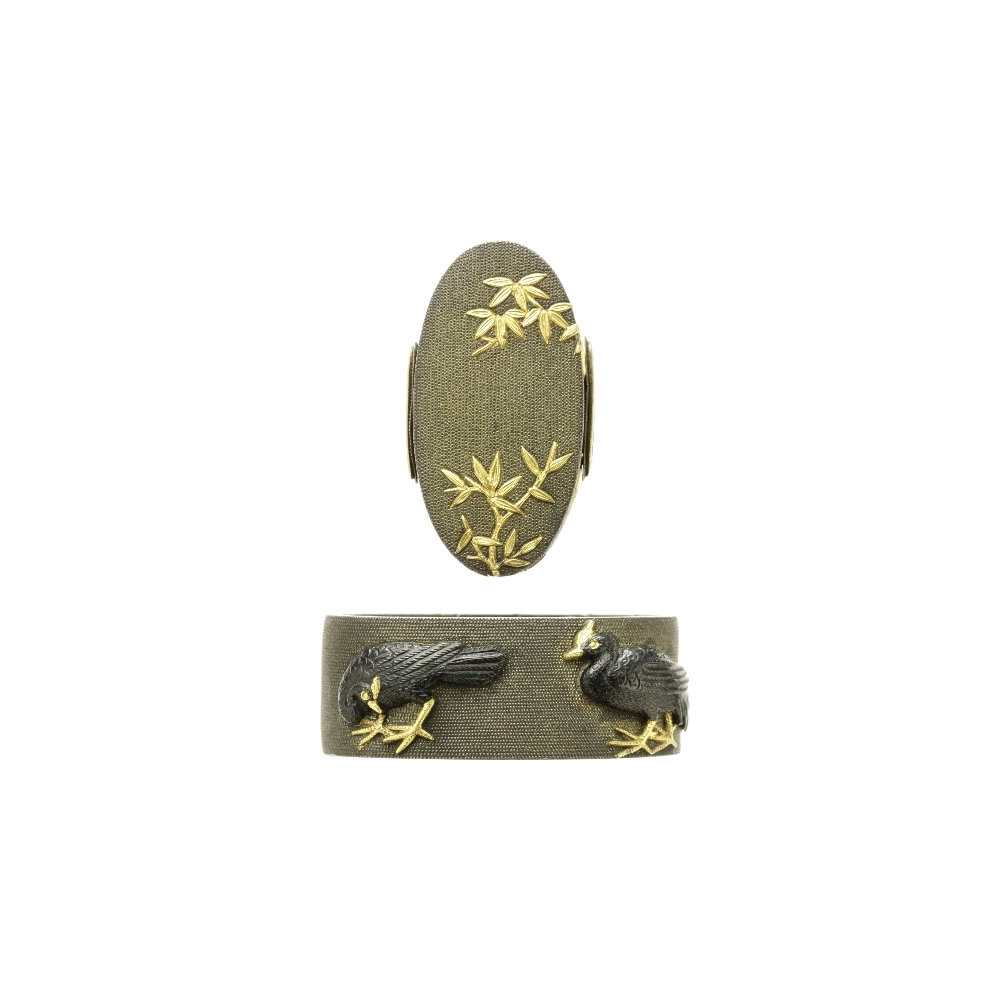
後藤宗家十四代光守は光理の子で元文五年に江戸京橋に生まれた。はじめ光儔と銘し、明和八年に兄光孝の養子となり、天明四年に宗家の家督を相続している。後藤家の伝統的な作風に加え、特別な注文によるものであろう縁頭の製作や町彫風の瀟洒な作品をも遺している。この縁頭が良い例で、下地は赤銅地を浮かび上がらせる性の良い朧銀地。綺麗に揃った魚子地に仕上げ、くっきりと彫り出した孔雀の身体は赤銅に金の色絵、背景の笹はすっきりとした彫口で、要所に施された金の色絵も鮮やか。 保存刀装具鑑定書
NihontoWatchGoto Keijo後藤桂乗
Offered by Choshuya
This piece has sold
Get an email when a new Goto Keijo piece hits the market.

Gotō
Edo
Musashi
Signed
Hozon (NBTHK)
As written by the shop
Iebori · Yamashiro · around 1741-1804
3 pieces on the market now
Goto Mitsumori, art name Keijo, was the third son of the twelfth head of the main Goto line, Jujo Mitsusato. He was born in Kanpo 1 (1741), bearing the personal name Mitsutomo and the common name Kichigoro. Because the thirteenth head, Mitsutaka, left no heir, Mitsumori was adopted by his elder brother; after Mitsutaka's death, he changed his name to Shirobei Mitsumori and succeeded as the fourteenth head of the mainline Goto house. His position thus placed him at the summit of the most venerable metalworking lineage in the Japanese tradition, carrying forward the unbroken succession from Yujo through fourteen generations of service to the ruling authorities.
Mitsumori's oeuvre demonstrates the solid and reliable carving manner characteristic of the Goto house tradition (iebori), executed with painstaking attention throughout. His works are unified in a refreshing, pure black tonality of shakudo, rendered in both nanako-ji and migaki-ji grounds. He employed takabori, kebori with accents of kosuki-bori, and iroe in gold and silver, achieving compositions of ample volume and richly rounded high relief. His subjects encompassed traditional Goto themes — Kurikara, the legend of Huang Shigong and Zhang Liang, takara-zukushi, and kirin — while also extending to more pictorial compositions in a painting-like manner. The gold crests on his kozuka and kogai are noted for their large scale, excellent volume, and powerfully expressed presence.
The NBTHK characterizes Mitsumori's finest works as possessing a distinctive sense of "inner sumptuousness" achieved through restrained coloration and confident carving — a quality that brings forth his particular strengths to the fullest. Works bearing his own signature are comparatively few, lending additional significance to signed examples as important reference pieces. His mitokoromono sets are especially scarce and are counted among his representative achievements. Mitsumori's contribution resides in his faithful stewardship of the mainline Goto tradition during the latter half of the eighteenth century, demonstrating that the hereditary house manner retained its vitality and high standard into the late Edo period.
Where Goto Keijo stands among comparable artisans: across all of nihontō, and within tradition, era, and period. The tiers (Foremost · Leading · Major · Notable) weigh official designations from the NBTHK and Japan's Agency for Cultural Affairs, together with historical honors of lasting repute such as the Sansaku and Meibutsu-chō.
Select a lens to see how it's measured.
Iebori · Yamashiro
Phase: Goto Main Line後藤宗家· 1573–1900
309 pieces on the market now
| Smith | Era | Designated |
|---|---|---|
| Goto Joshin後藤乗真 | 1512-1562 | 68 |
| Goto Yujo後藤祐乗 | 1440-1512 | 41 |
| Goto Sojo後藤宗乗 | 1461-1538 | 56 |
| Goto Kenjo後藤顕乗 | 1586-1663 | 46 |
| Goto Teijo後藤程乗 | 1603-1673 | 42 |
Certifies a genuine fitting worth preserving: a correct signature, or, if unsigned, an identifiable era and school, with recognized artistic and craft value.
The NBTHK (Nihon Bijutsu Tōken Hozon Kyōkai, the Society for the Preservation of Japanese Art Swords) is a public-interest incorporated foundation founded in 1948 and supervised by Japan’s Agency for Cultural Affairs (Bunkachō); it is based at the Japanese Sword Museum in Tokyo. Its expert panels physically examine each submitted work (shinsa) and issue a certificate (kanteishō) ranking it by artistic and historical merit. NBTHK papers are the most widely recognized standard of authentication for Japanese swords and fittings.
NBTHK official siteIf, due to our fault, the item differs significantly from its proper condition, the item may be returned. Cooling-off is within one week of the item's arrival.