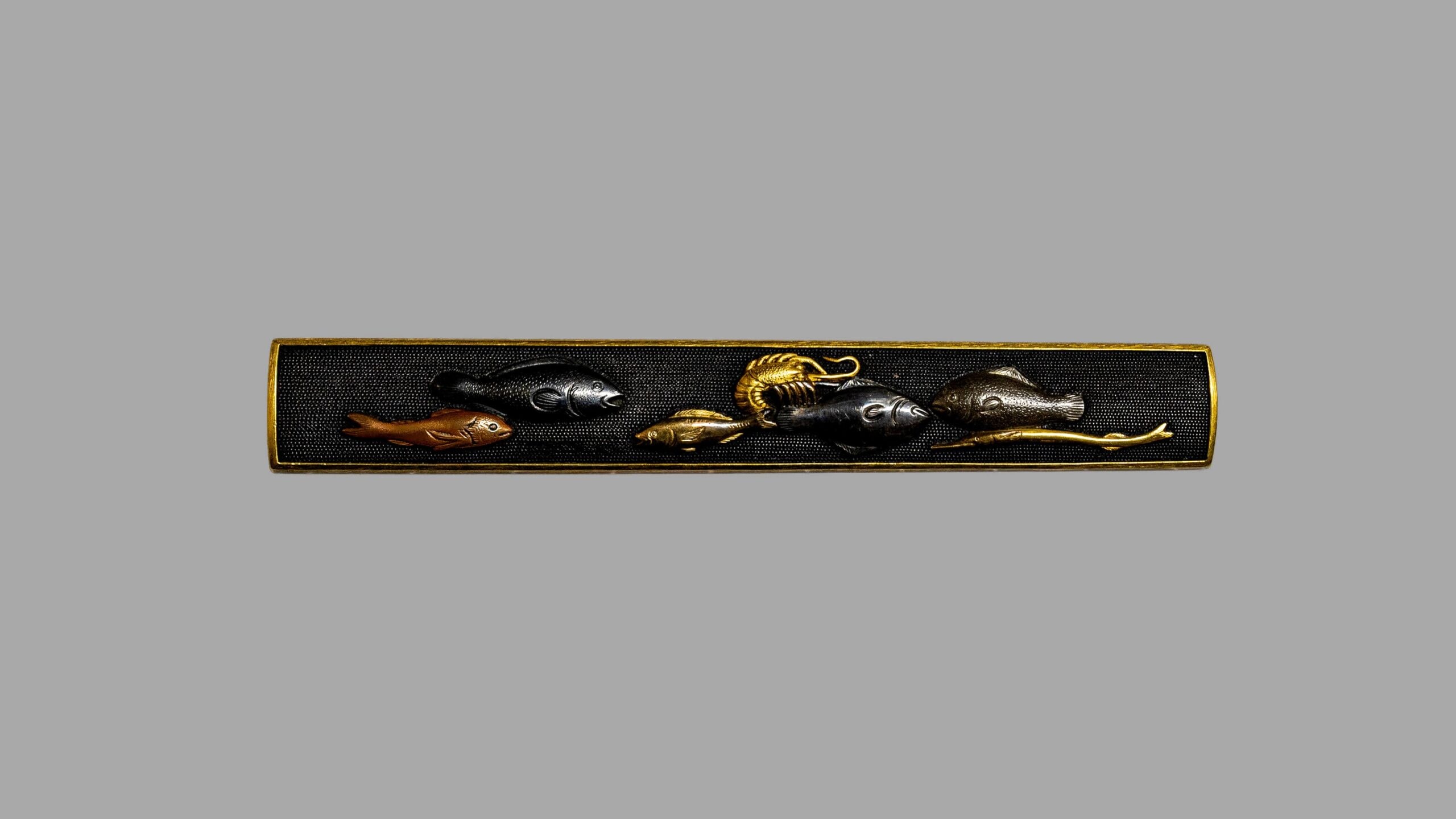
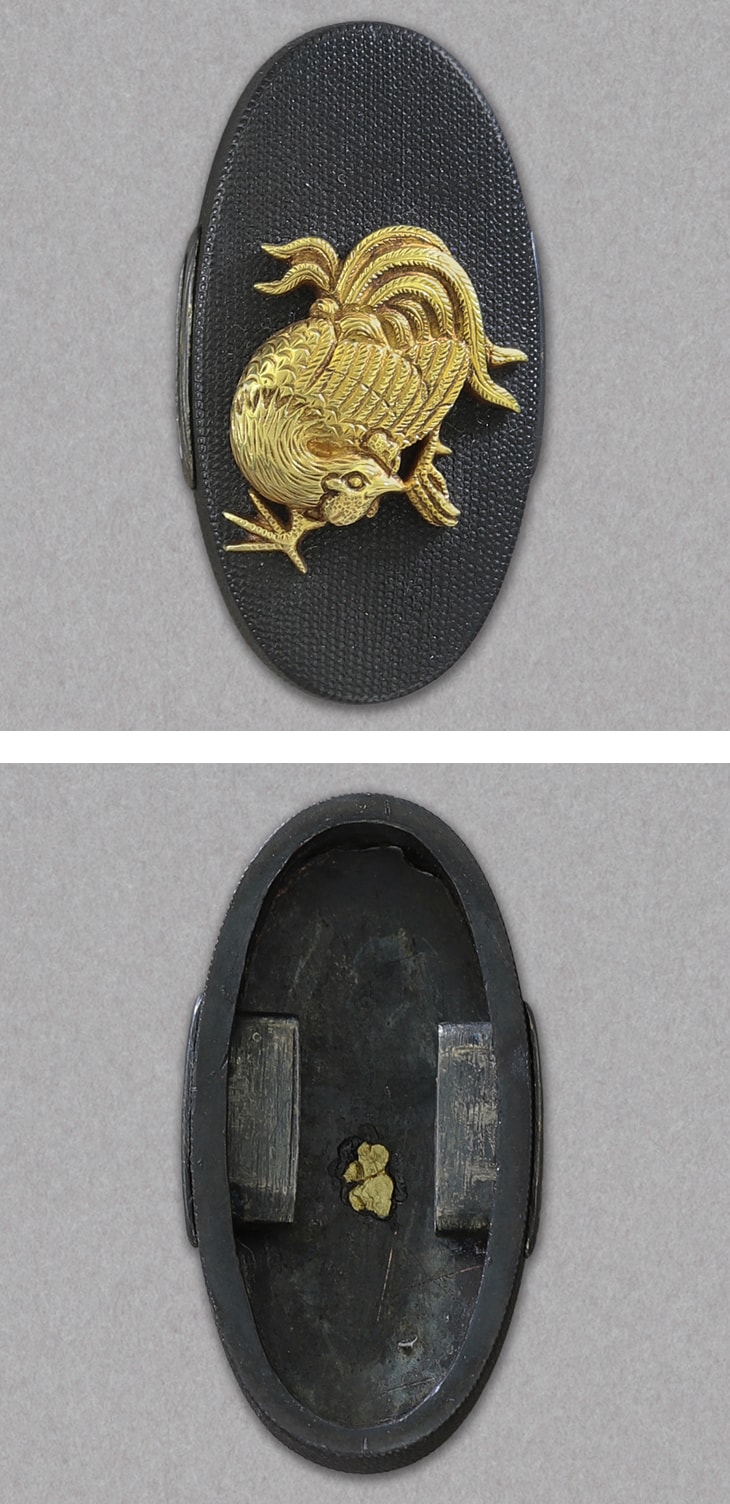
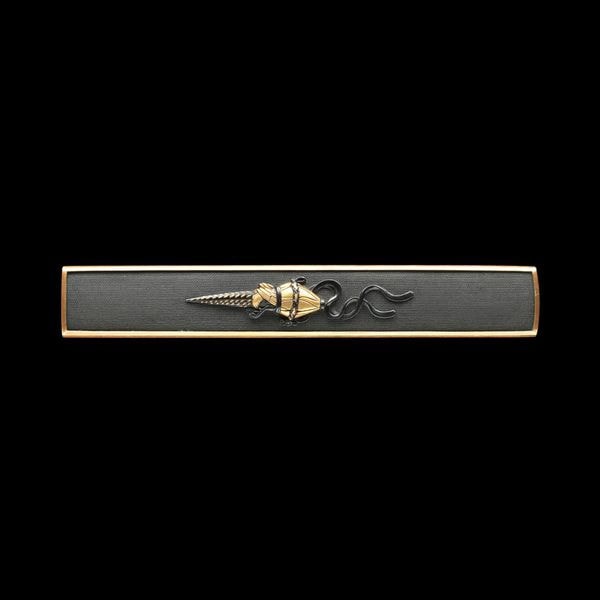
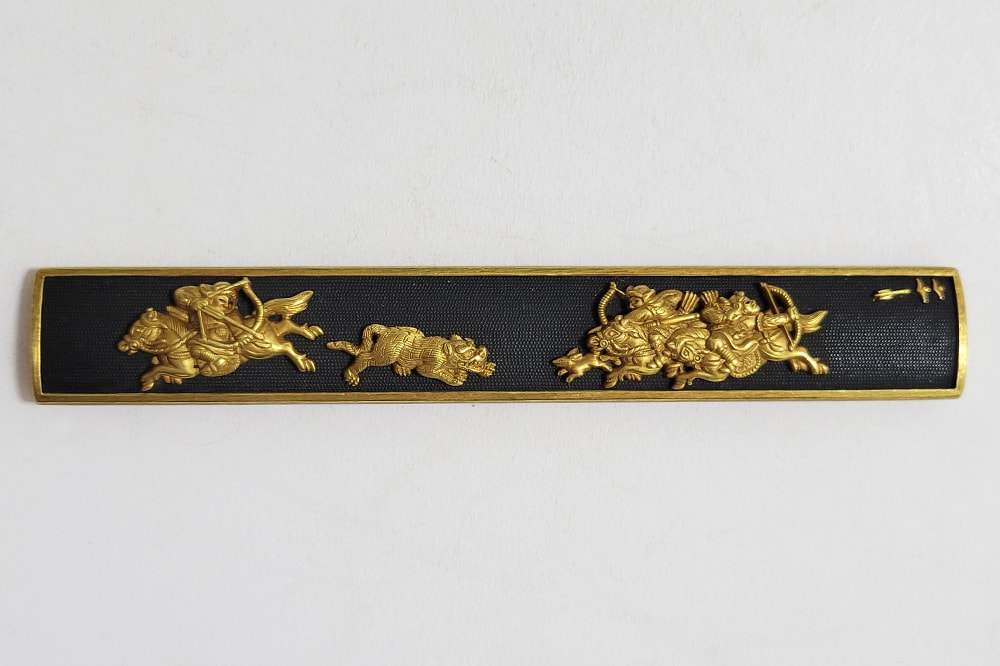
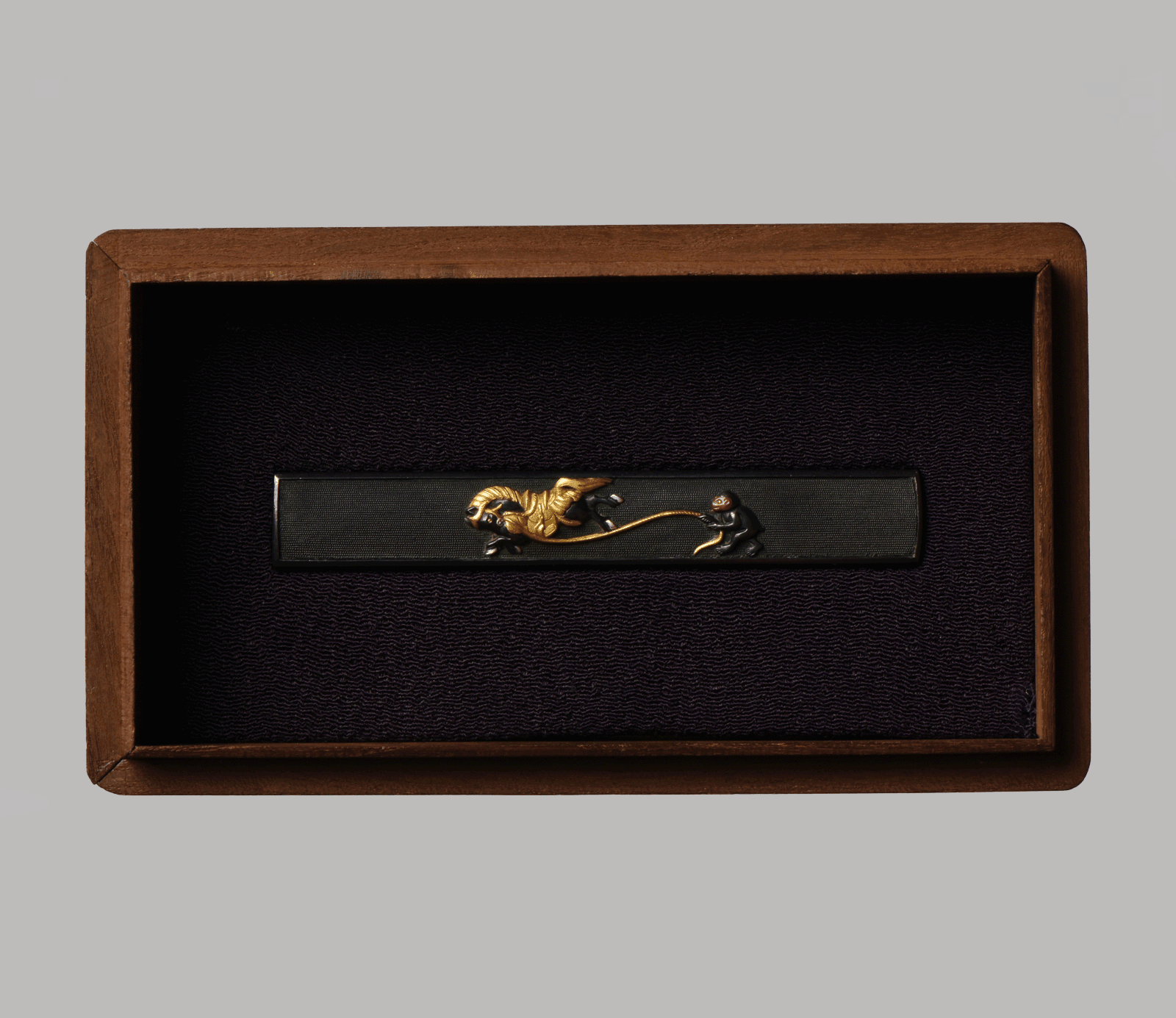
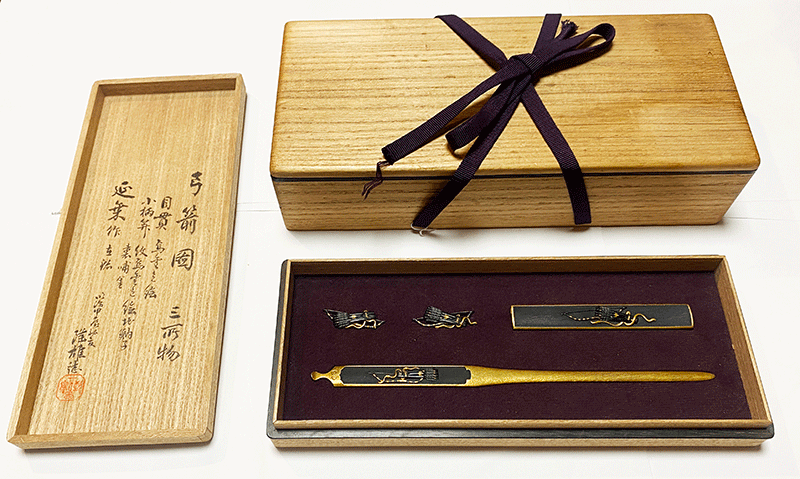
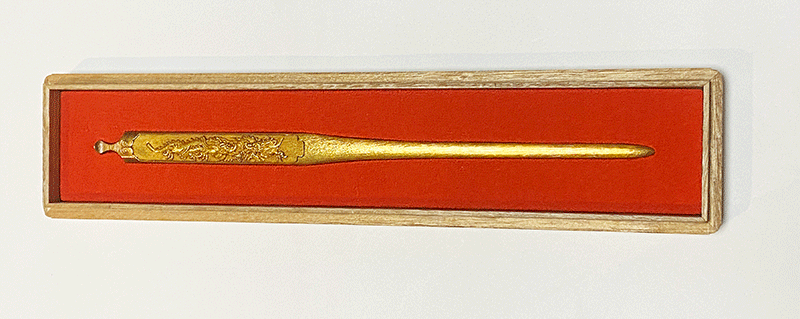
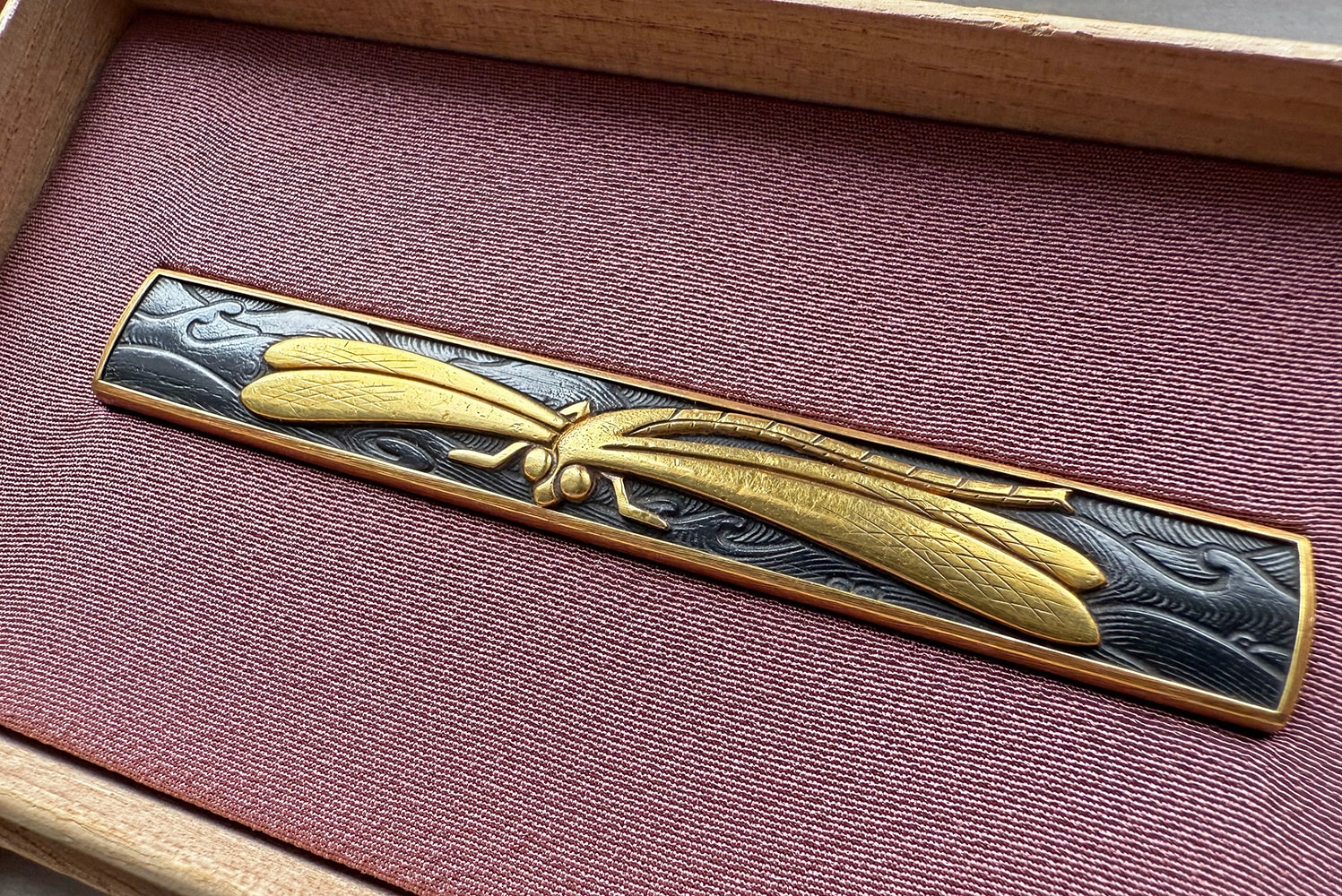
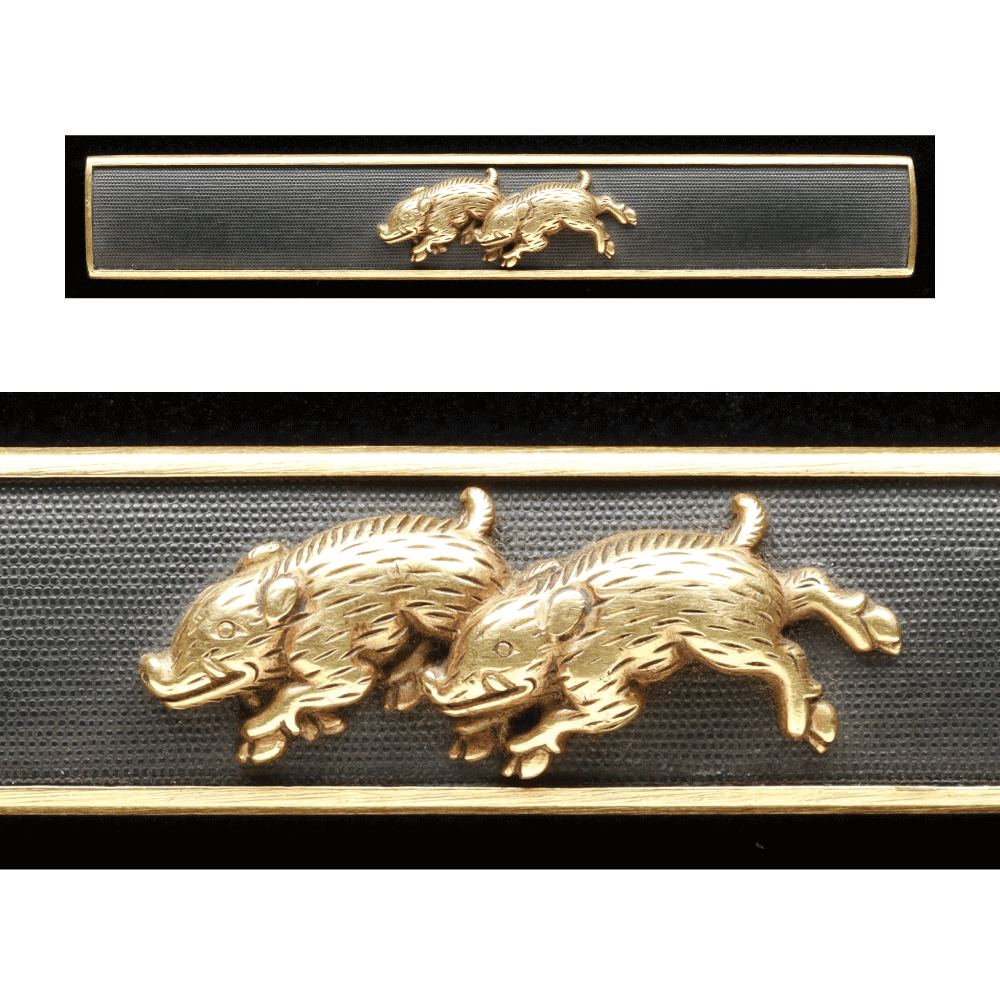
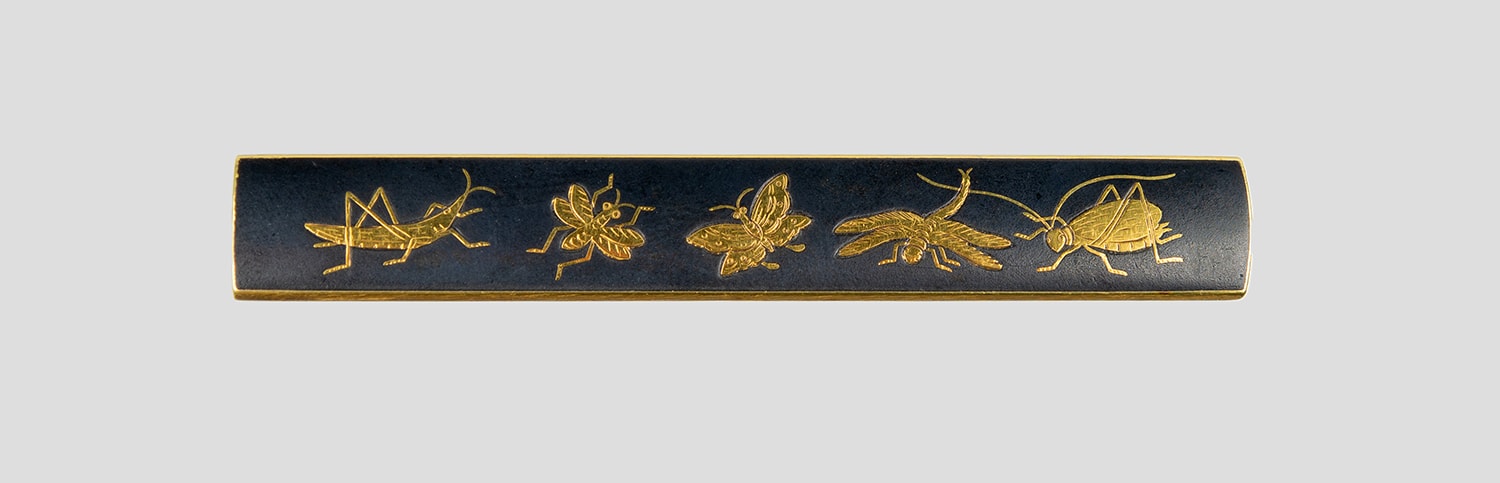
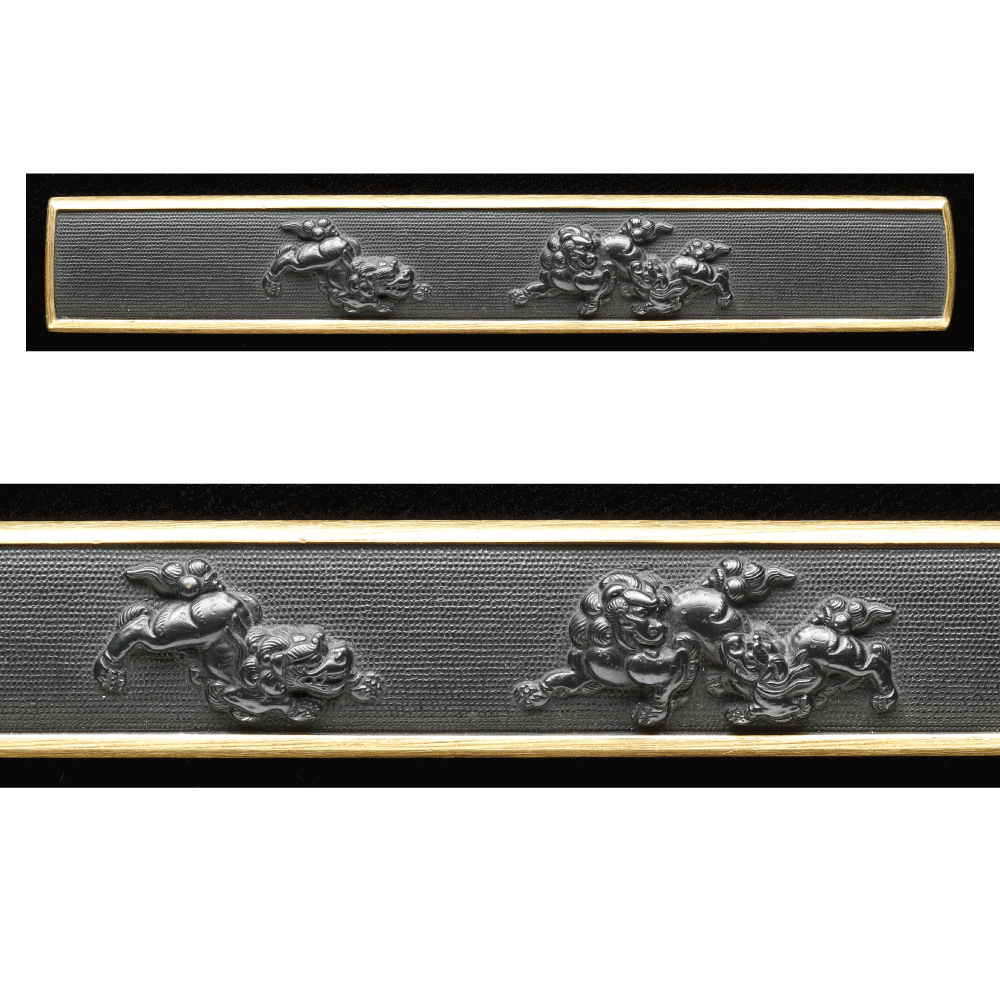
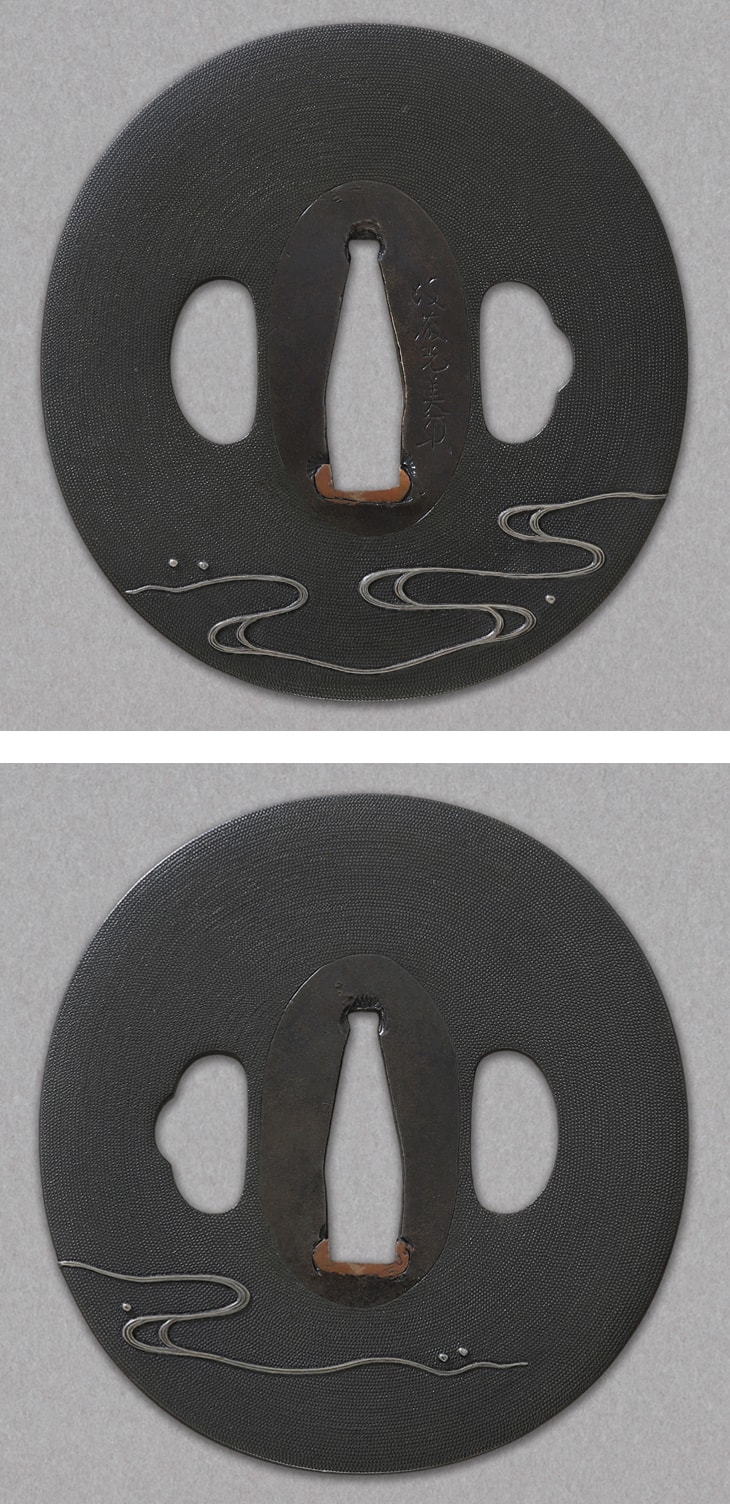
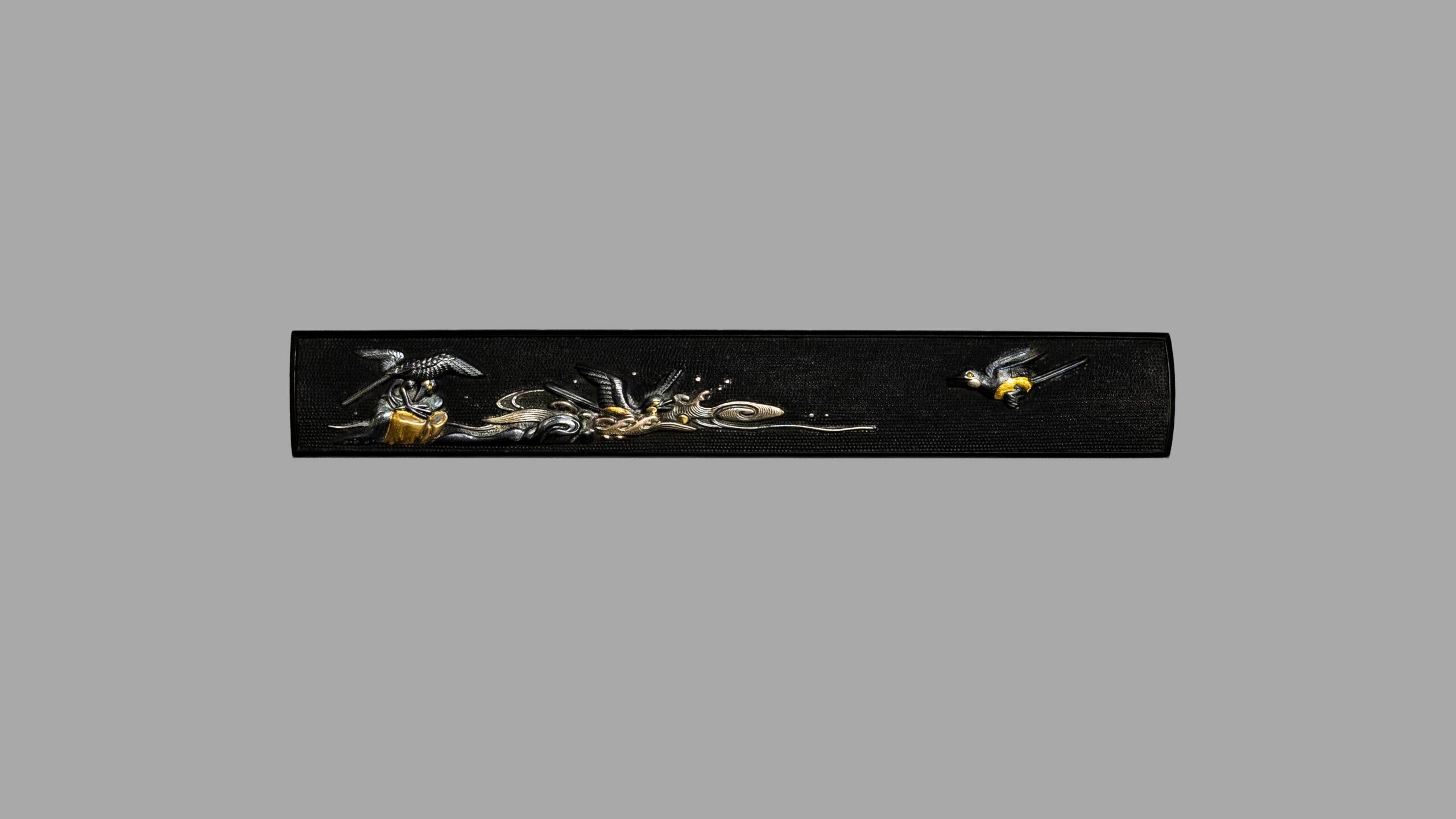
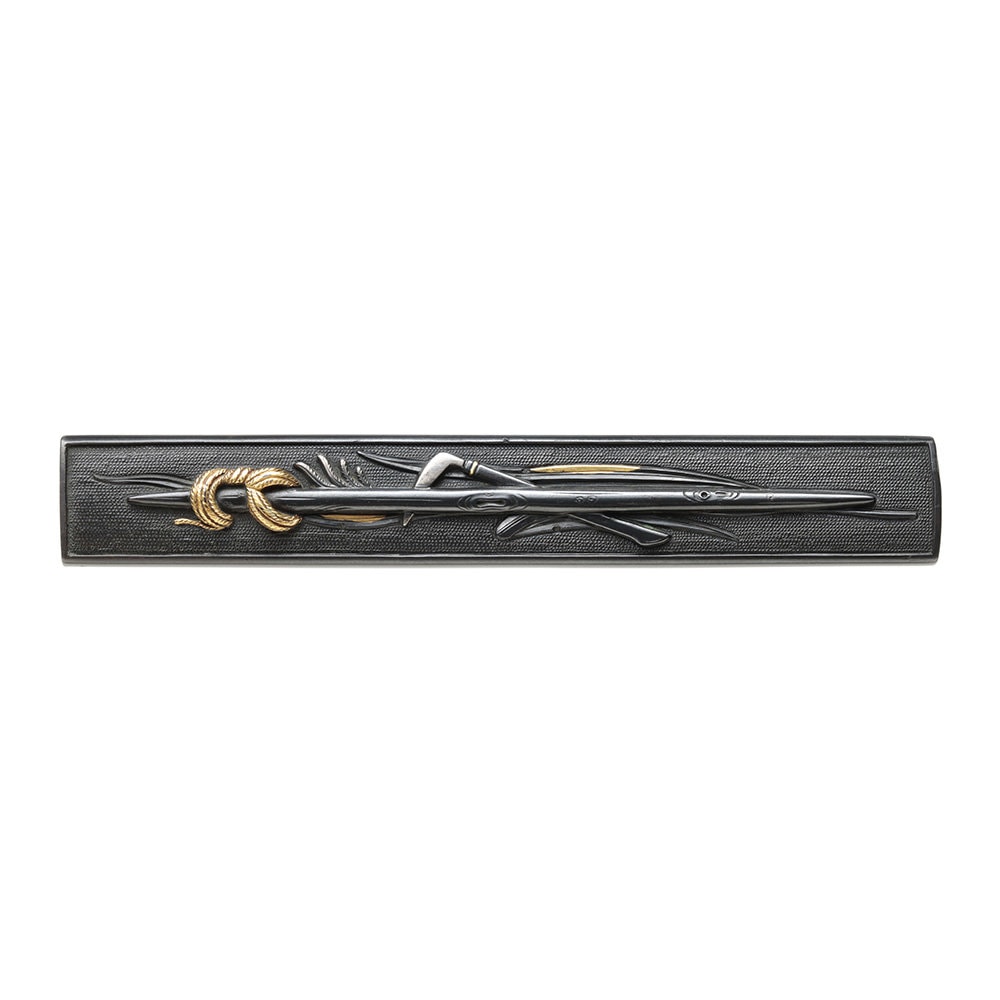
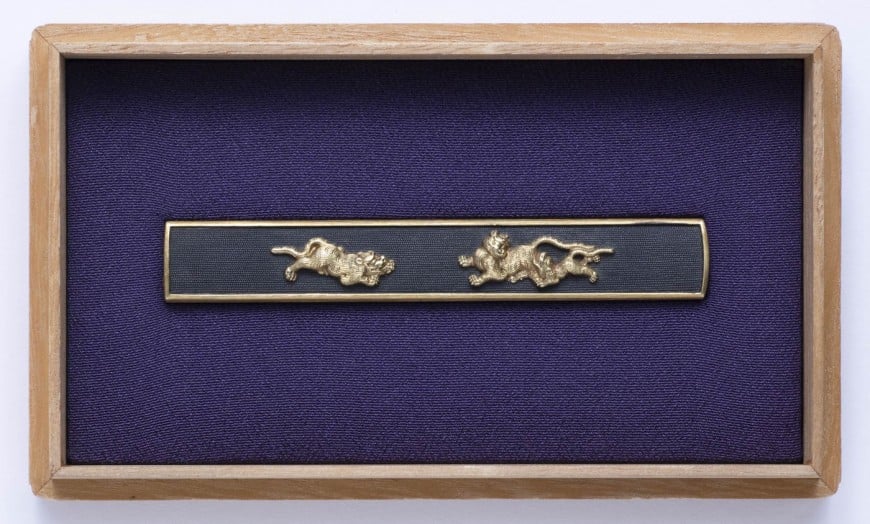
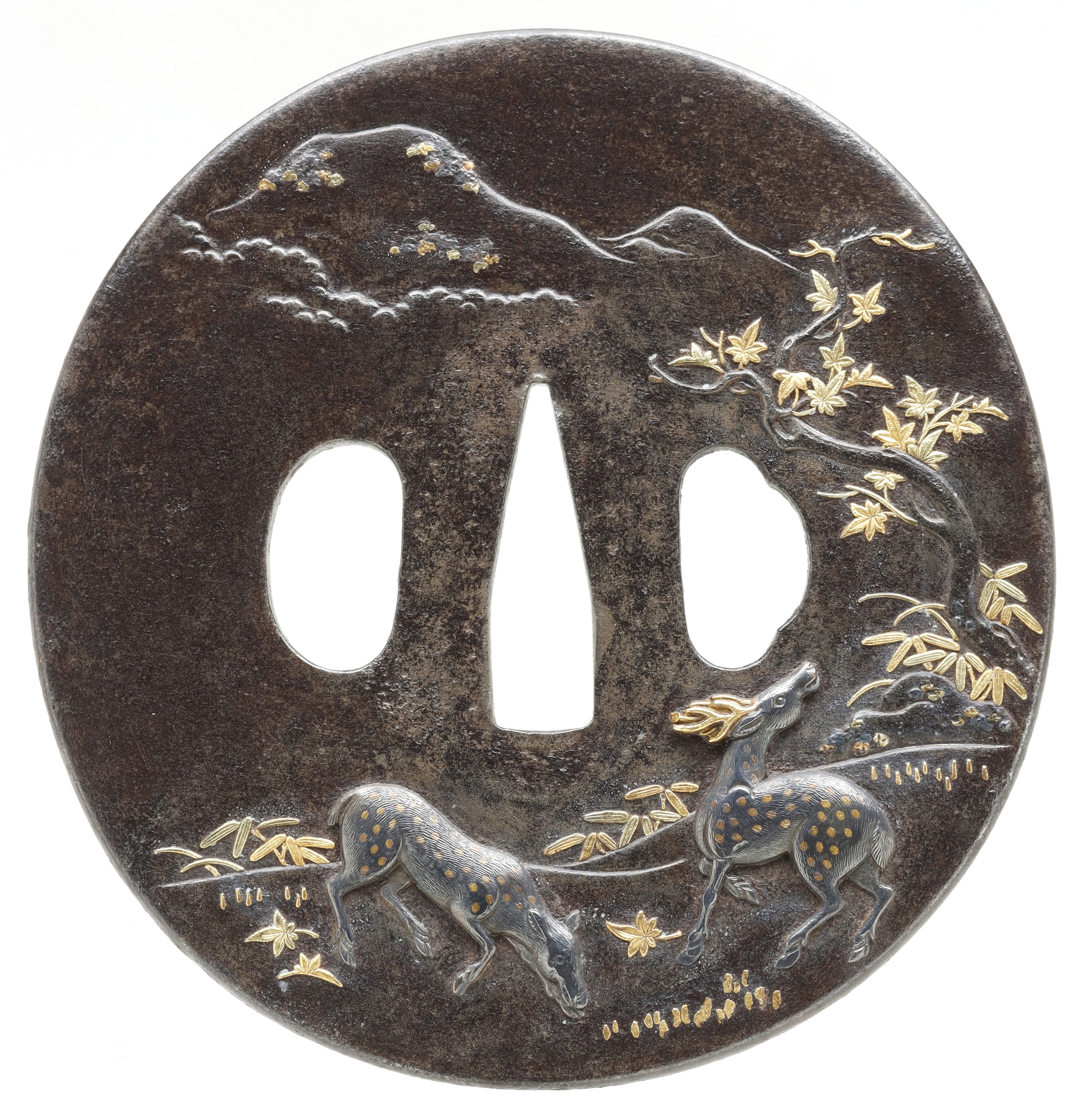
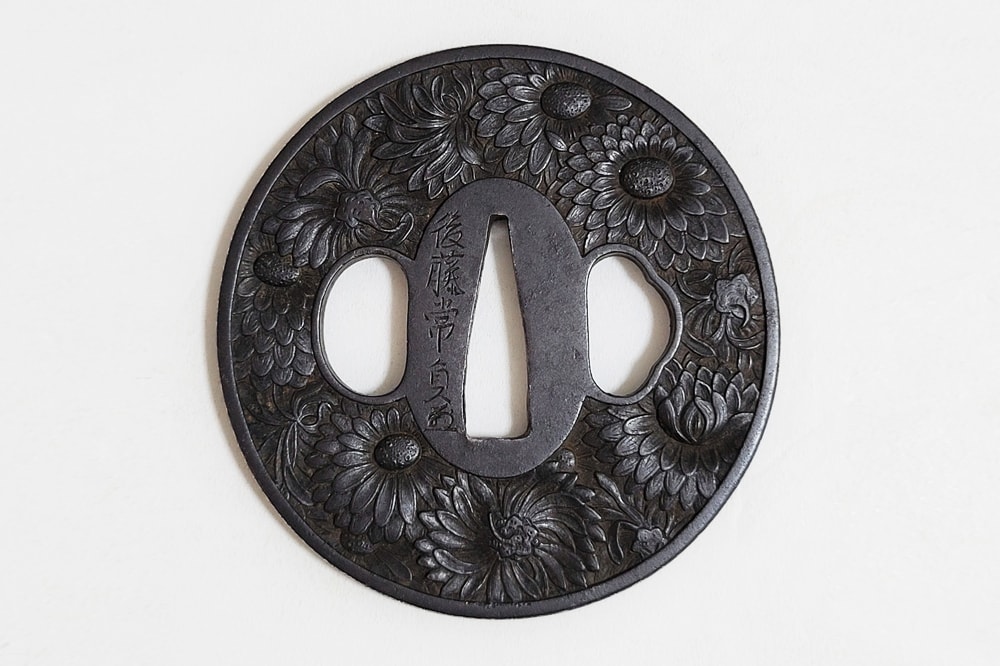
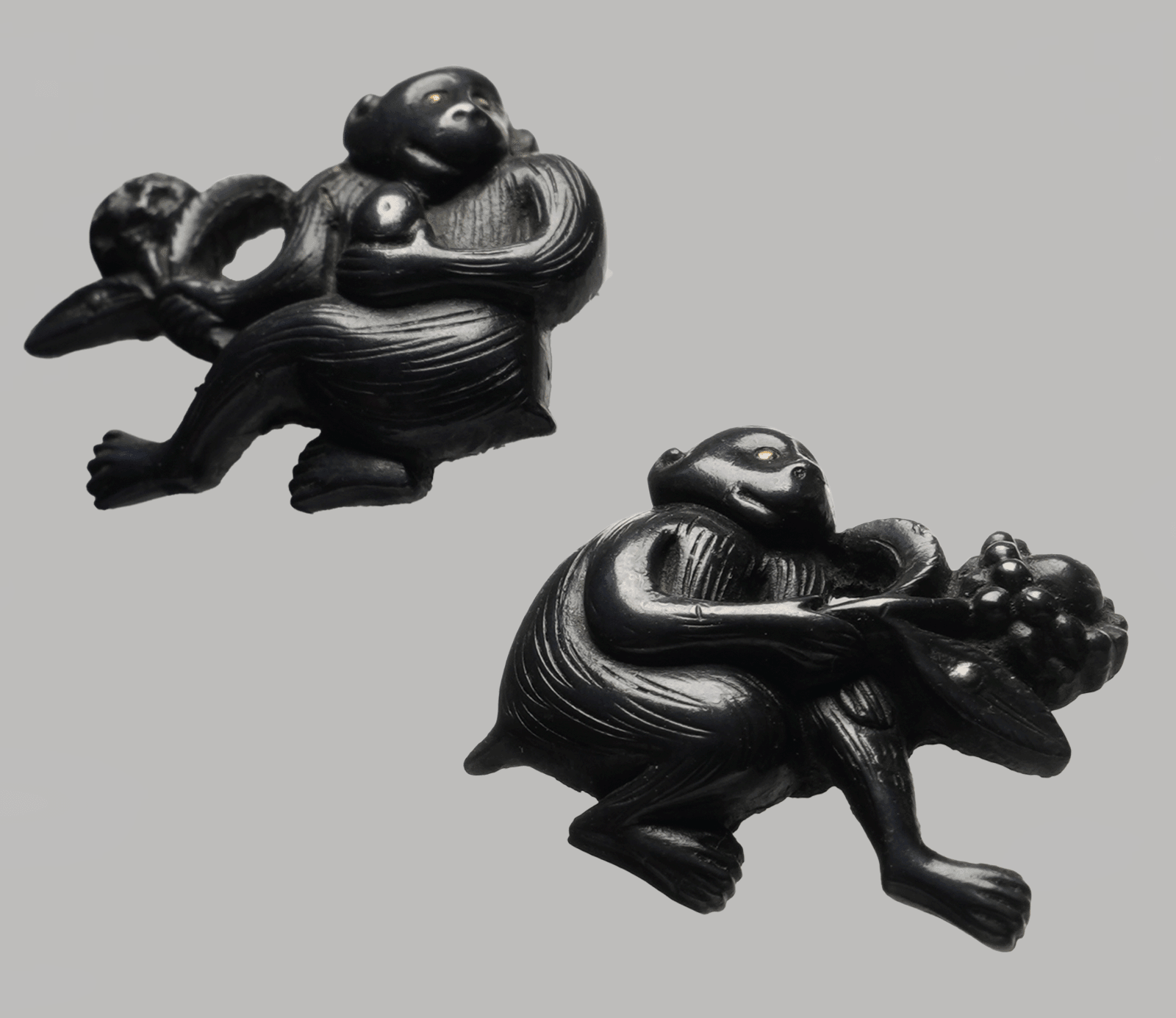
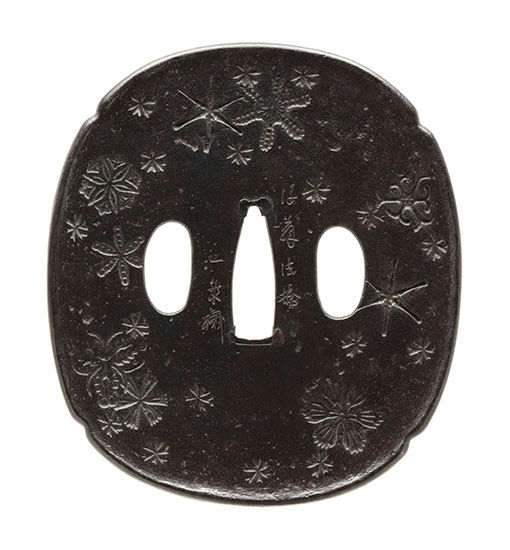
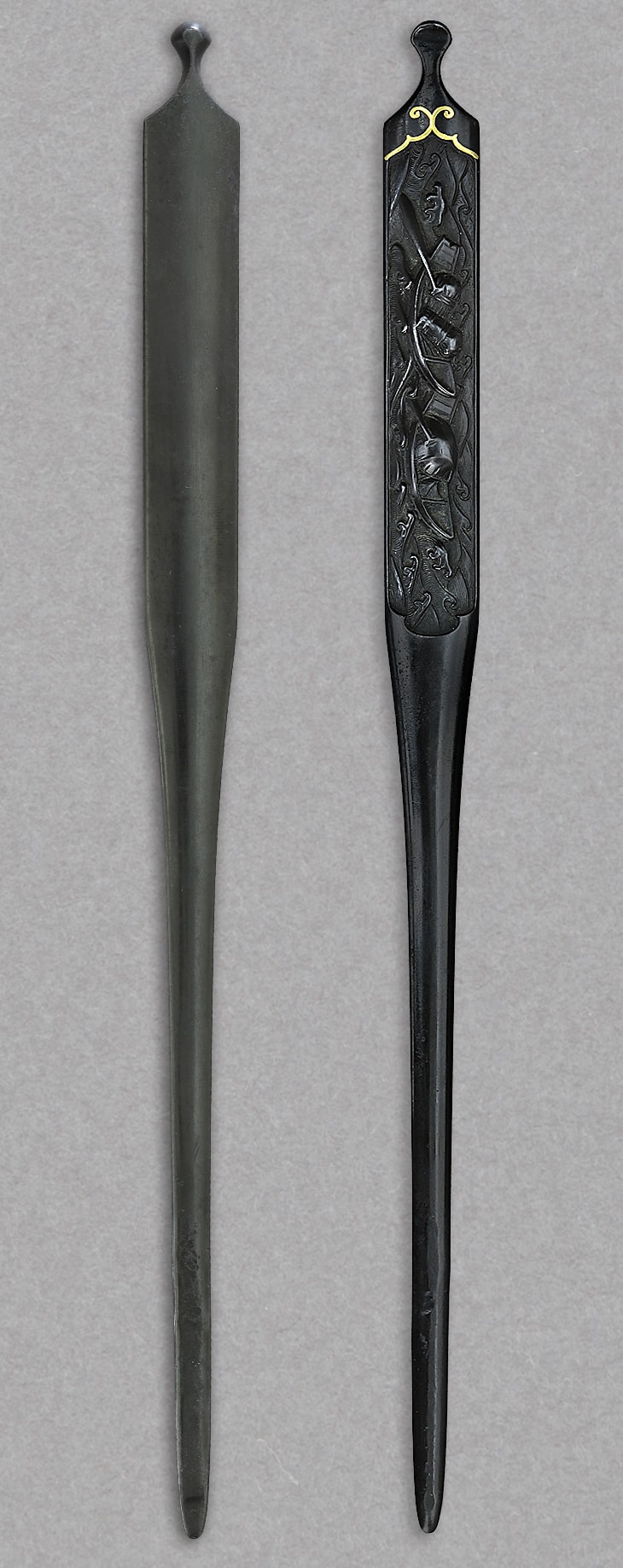
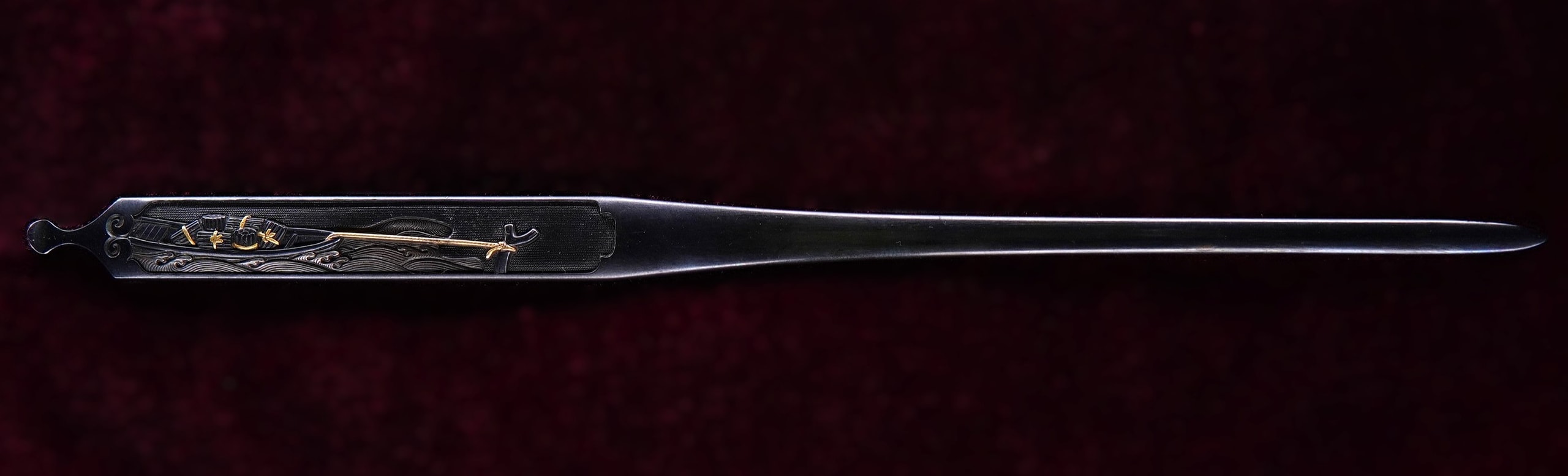
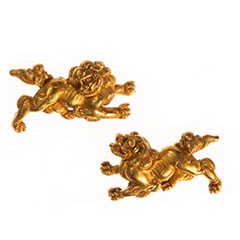
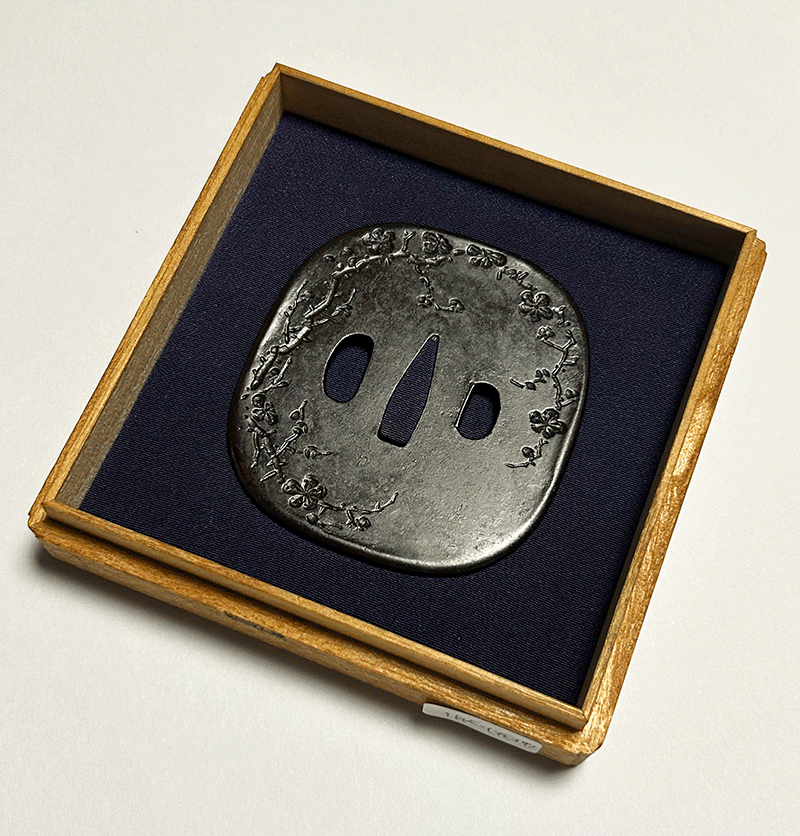
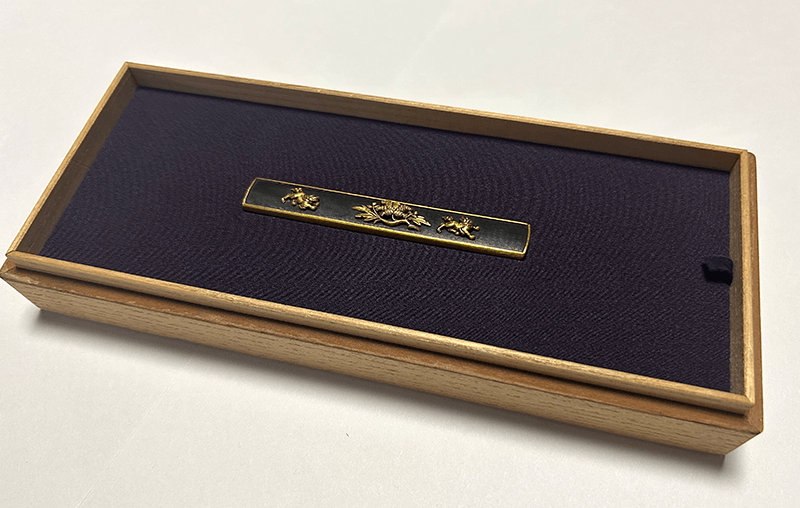
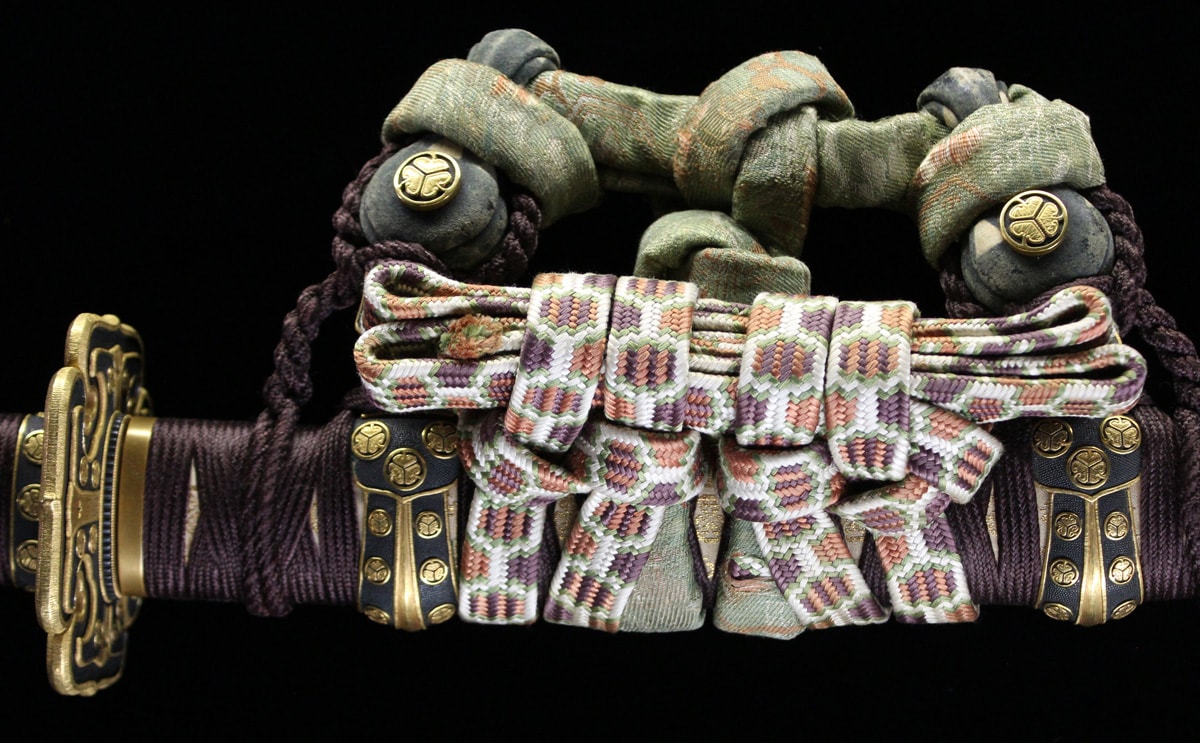
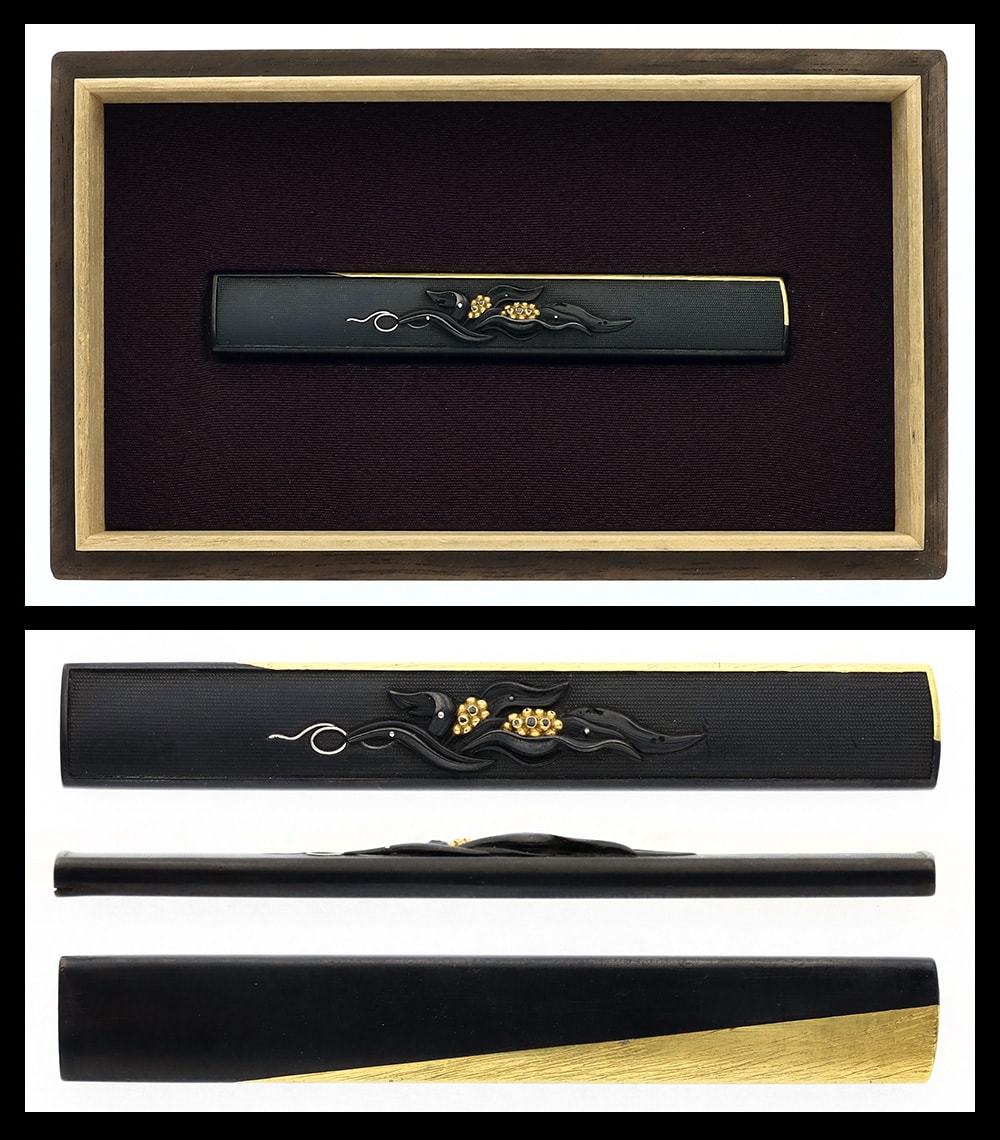
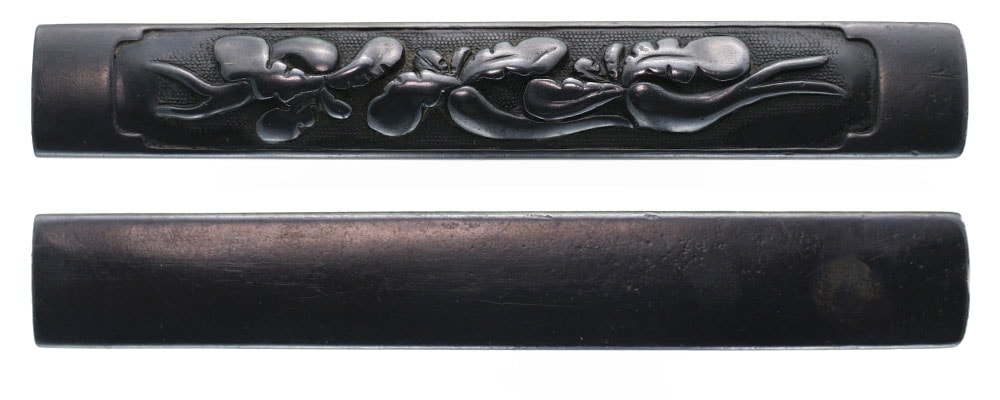
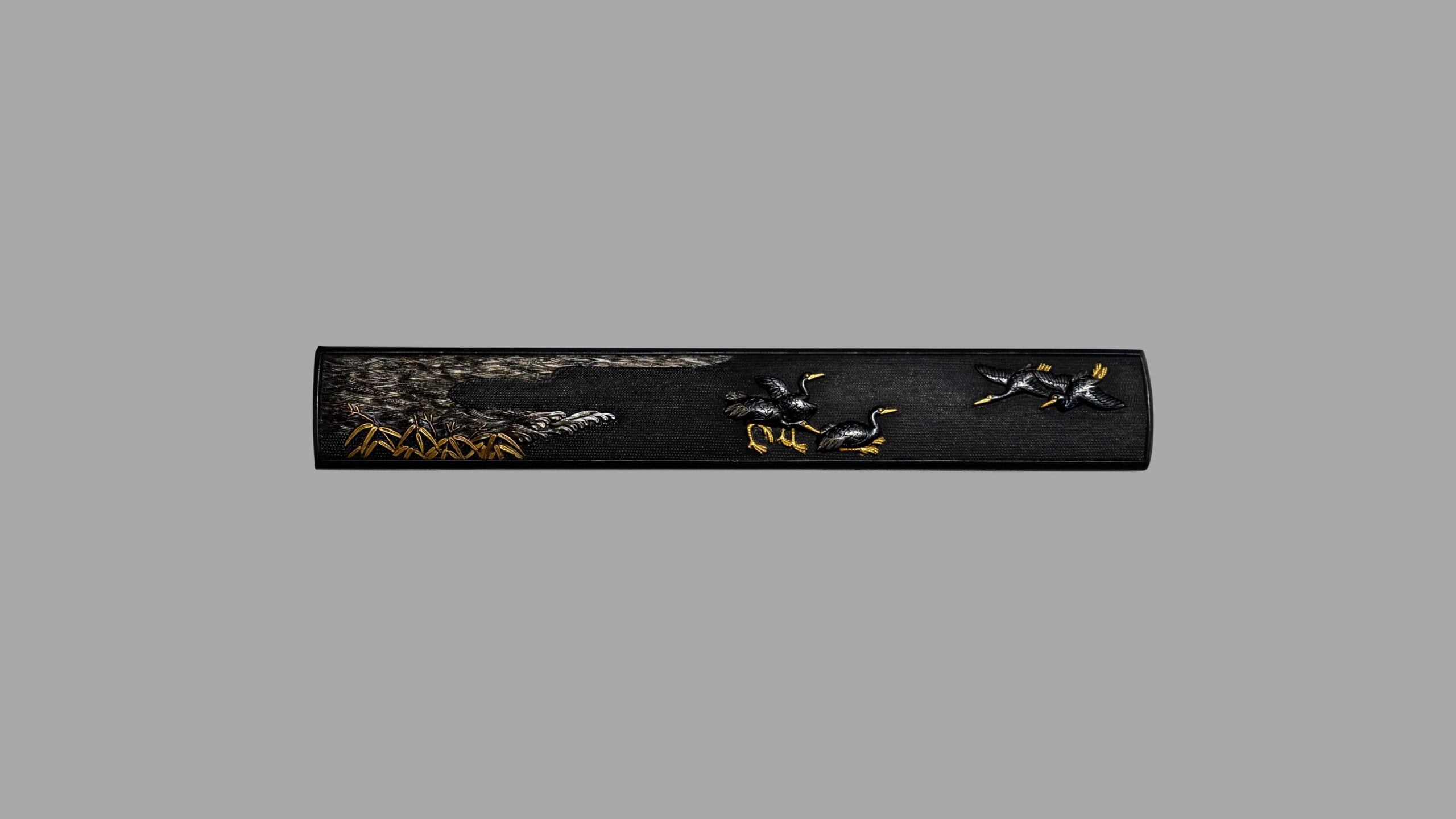
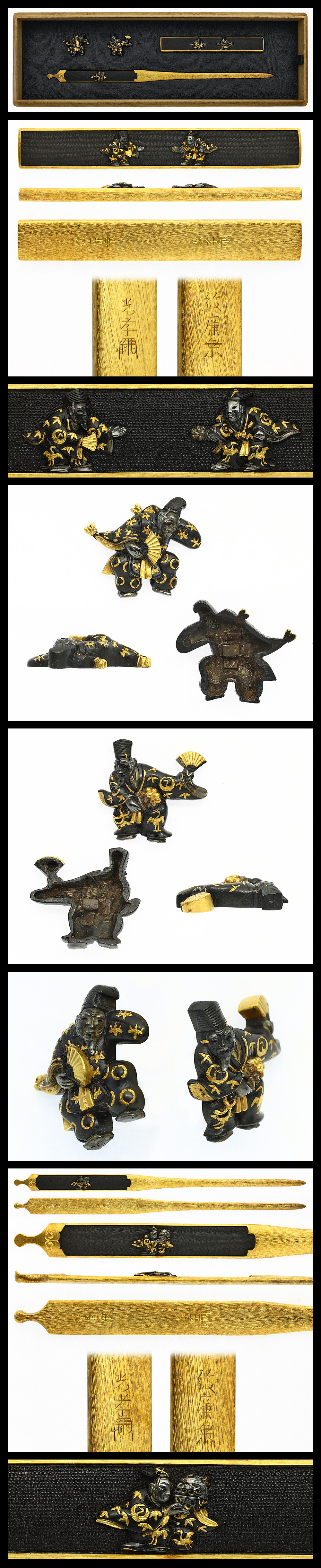
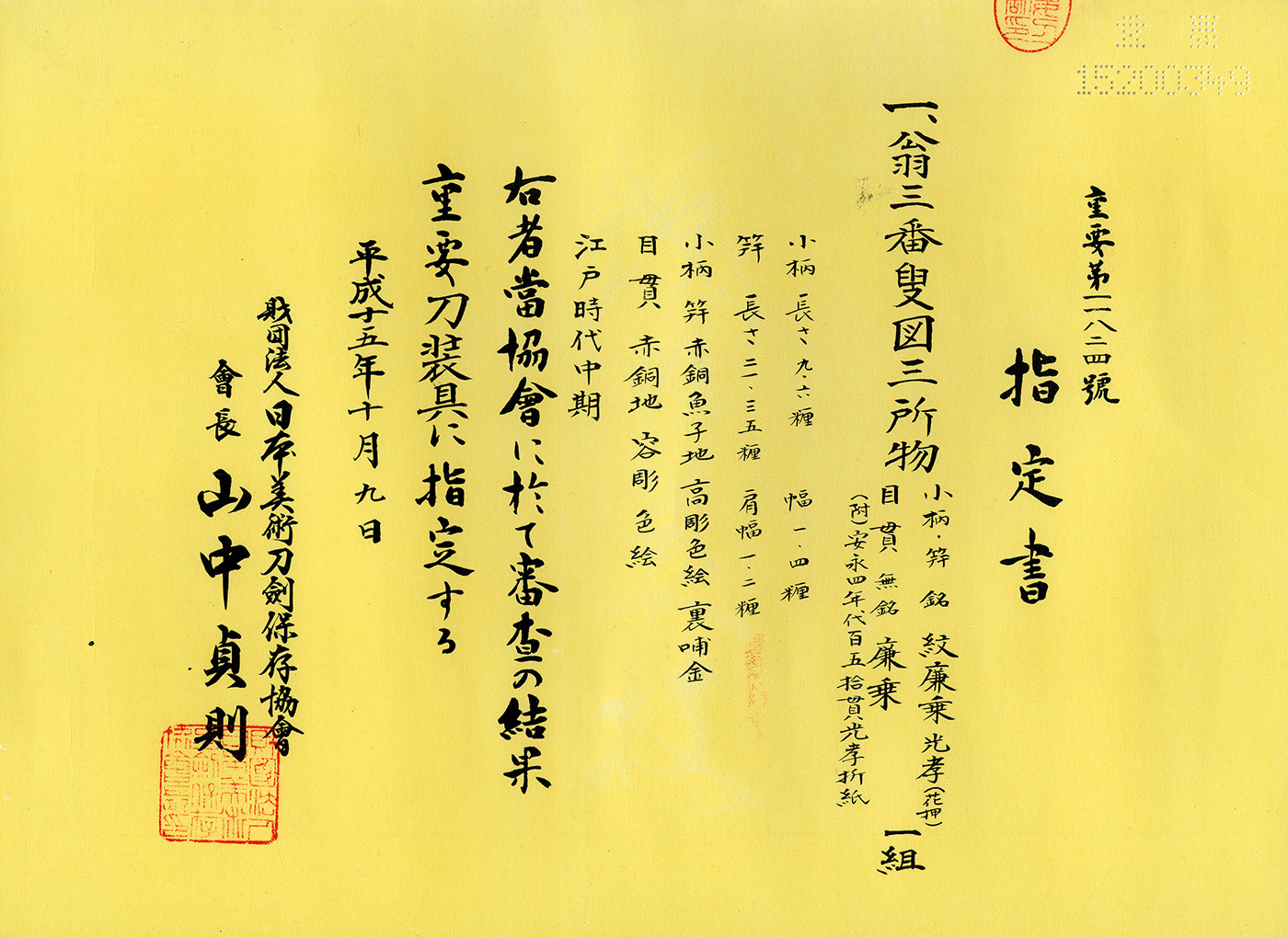
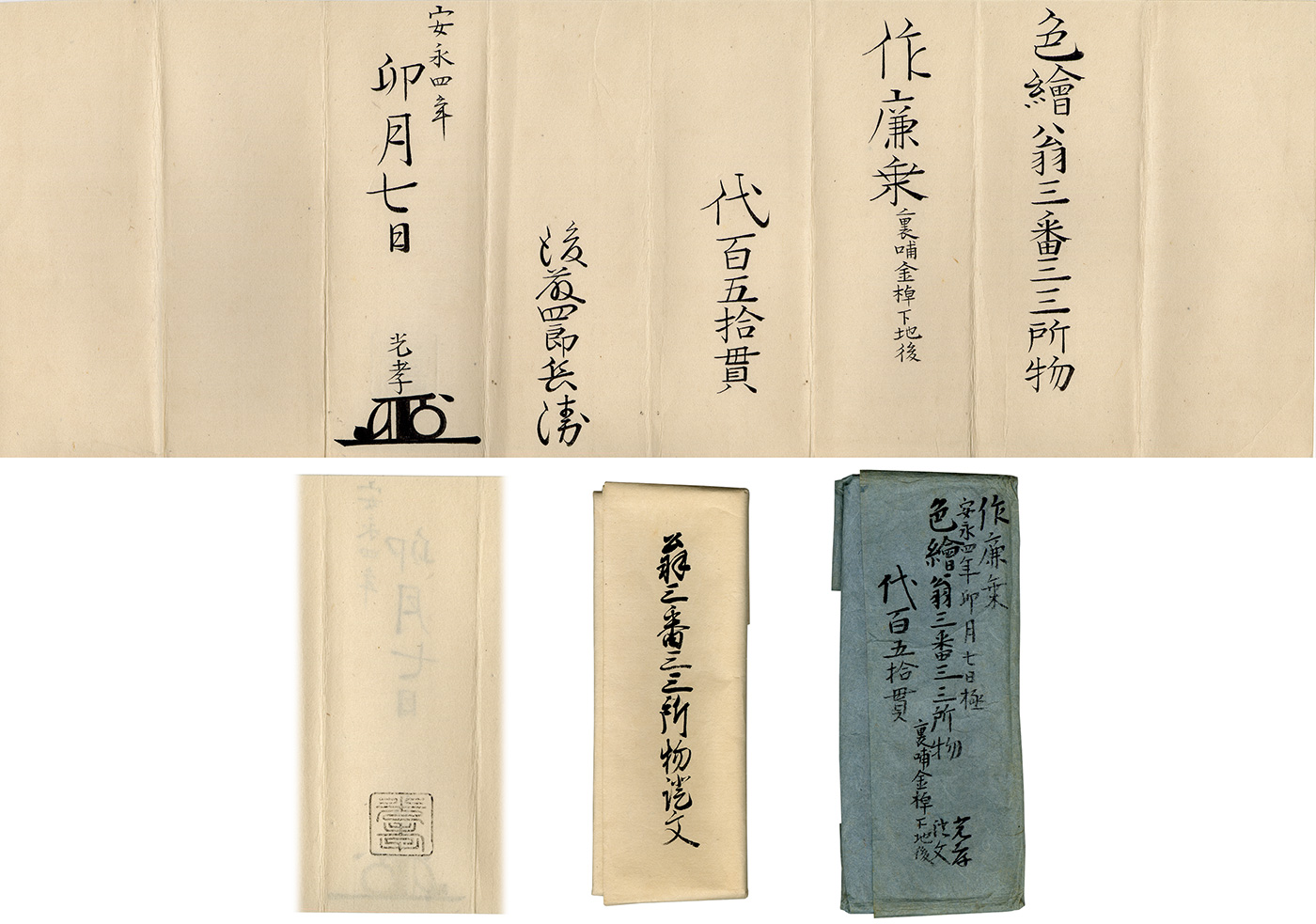
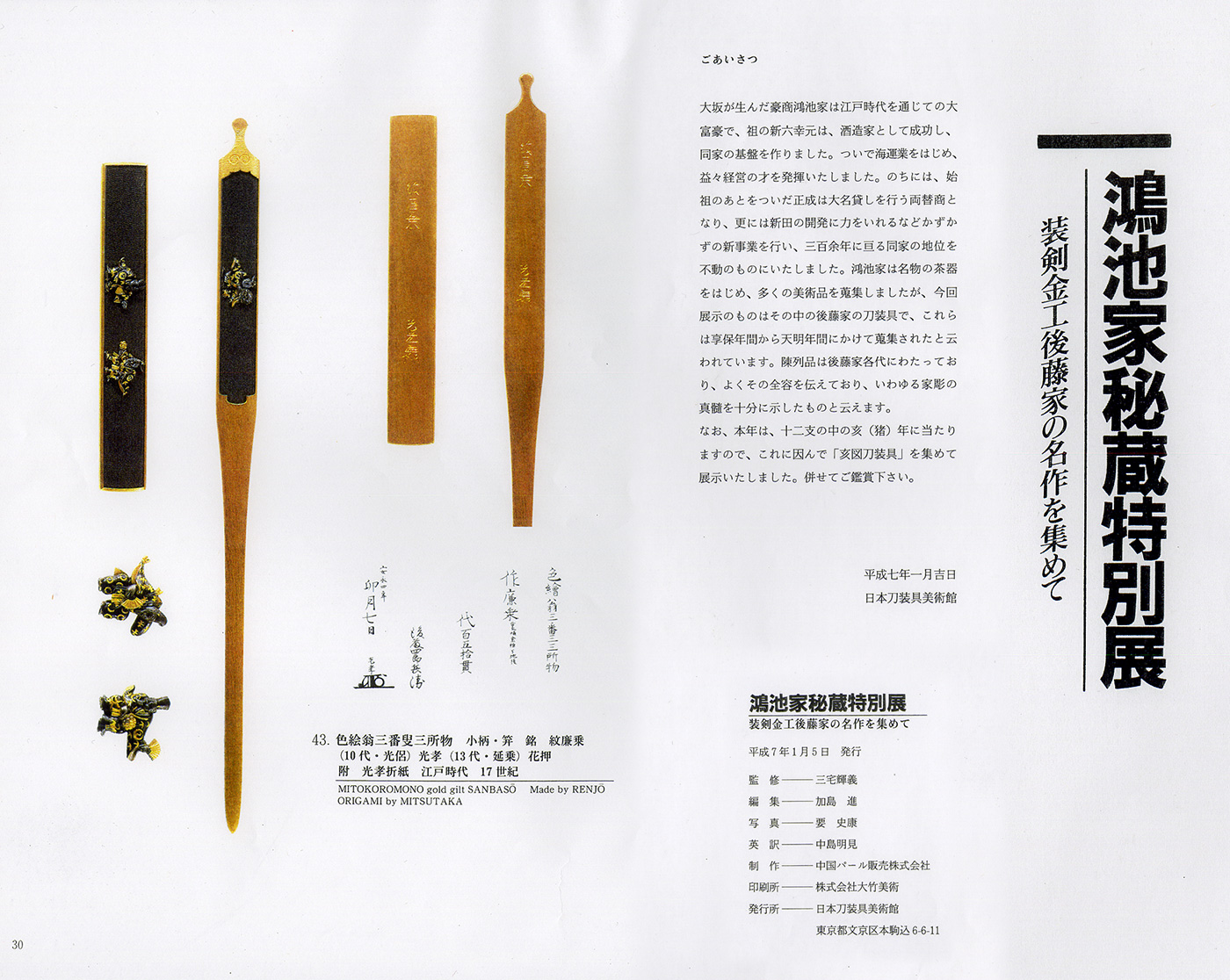
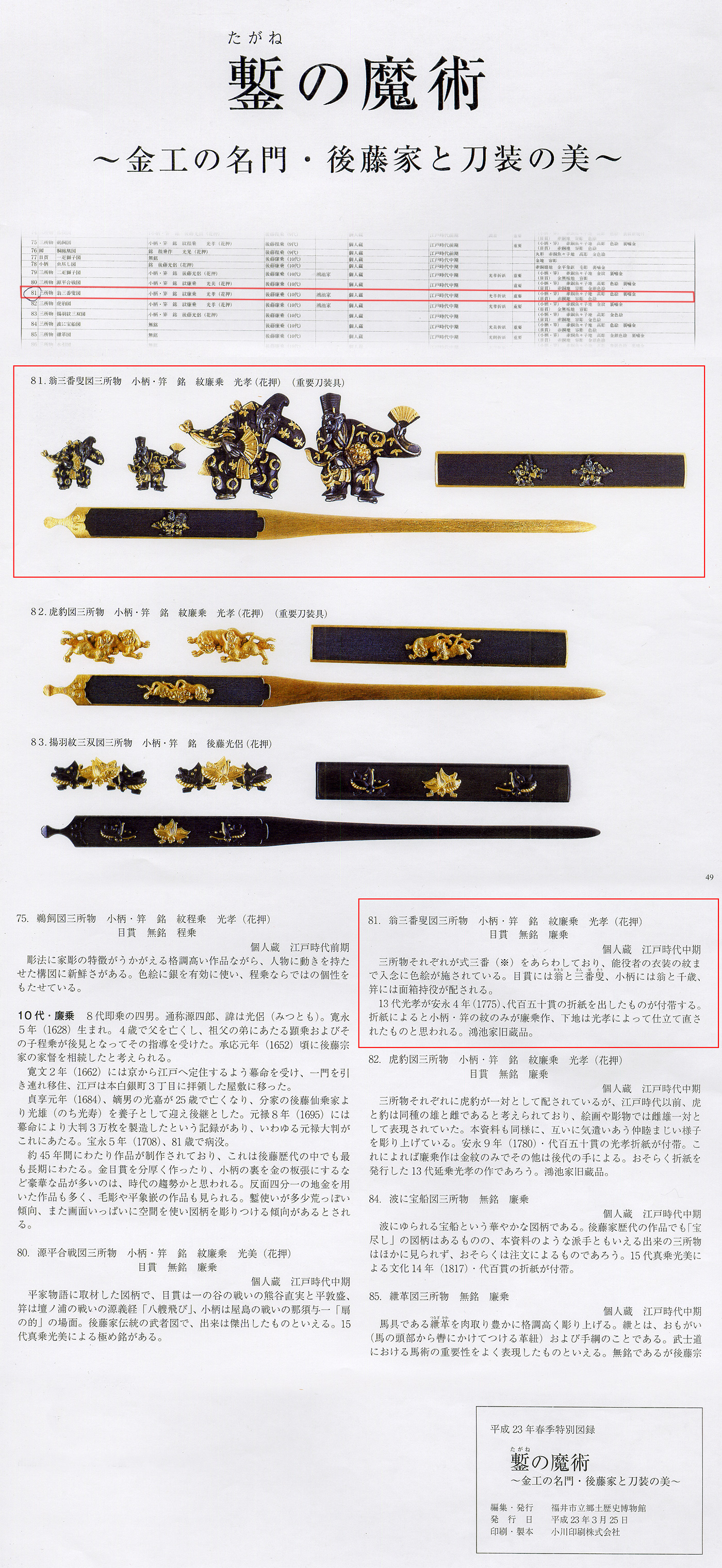
This is a matching set of sword fittings, including a kōgai, kozuka, and menuki, featuring an Okina Sanbasō design. The kōgai is unsigned but attributed to Renjō, while the kozuka and menuki are signed Mon Renjō Mitsutaka with kaō. The set is designated with a 49th Juyo certificate and comes from the former collection of the Kōnoike family, dating to the Mid-Edo Period.
 NihontoWatch
mei · Mon Renjo · Edo
Goto Enjo
Edo
Signed
Jūyō
Iebori · Yamashiro · around 1722-1784
4 pieces on the market now
Goto Mitsutaka (後藤光孝), bearing the art name Enjo (延乗), was the thirteenth-generation head of the mainline Goto house, the preeminent dynasty of sword-fitting makers who had served successive rulers since the Muromachi period. He was the eldest son and heir of the twelfth master, Goto Mitsusato, known as Jujo (寿乗). Born in Kyoho 7 (1722) with the childhood name Kameichi, he later used the name Mitsunari and the common name Gennojo. In Kanpo 2 (1742), upon the death of Mitsusato, he changed his name to Shirobei Mitsutaka and succeeded as the thirteenth head of the main line. His tenure proved to be the second-longest in the family's history, surpassed only by the tenth master Renjo (廉乗), and throughout this exceptionally extended period he remained highly active. Beyond his own creative output, Mitsutaka served as an authoritative appraiser, authenticating works by earlier masters including Sojo, Eijo, Kenju, and Sokujo, affixing kiwame-mei and issuing origami valuations that remain important records of Goto connoisseurship.
Mitsutaka's manner of work largely adheres to the established traditions of the Goto house, faithfully inheriting and transmitting its iebori techniques. His oeuvre is dominated by mitokoromono sets combining kozuka, kogai, and menuki, whereas his production of tsuba is comparatively scarce. The standard format employs shakudo with finely ordered nanako-ji as a ground, upon which motifs are rendered in takabori with gold and silver iroe; the menuki are typically executed in nikubori or yobori on solid gold. His reverse plates are consistently finished with gilt backing. The range of subjects drawn from the Goto canonical repertory is broad: lions, tigers, dragons, dancing cranes, roosters, paired oxen, the Twelve Zodiac Animals, rhinoceroses, sheep, the mythical baku, armored warriors of the Kumagai-Atsumori narrative, and literary scenes from the Tale of Genji. Whether rendering the full, ample modeling of the lion figure or the minute precision demanded by armored-warrior temamono, the carving is imbued with strength throughout, regulated with care down to the finest details of fur, feather, and ornamental metalwork. The jet-black tonality of the shakudo ground consistently supports the courtly elegance of his chosen themes, and his compositions maintain coherence and restraint even when distributing large numbers of figures across multiple components.
Mitsutaka's significance resides in his role as a conservator of the Goto mainline's authority during the mid-to-late Edo period. His works combine a calm dignity with martial boldness, manifesting the solemn formality that defined the house's official style. The takabori and iroe workmanship is consistently sound and firm in execution, and pieces from his early period in particular display a spirited vigor and notably meticulous carving skill. Among the successive heads of the Goto house, Mitsutaka stands as one whose patient, conscientious craftsmanship and prolonged stewardship ensured the unbroken transmission of the family's techniques, yielding works that fully convey the prestige and dignity of the mainline tradition.
Where Goto Enjo stands among comparable artisans: across all of nihontō, and within tradition, era, and period. The tiers (Foremost · Leading · Major · Notable) weigh official designations from the NBTHK and Japan's Agency for Cultural Affairs, together with historical honors of lasting repute such as the Sansaku and Meibutsu-chō.
Select a lens to see how it's measured.
Iebori · Yamashiro
Phase: Goto Main Line後藤宗家· 1573–1900
325 pieces on the market now
| Smith | Era | Designated |
|---|---|---|
| Goto Joshin後藤乗真 | 1512-1562 | 68 |
| Goto Yujo後藤祐乗 | 1440-1512 | 41 |
| Goto Kenjo後藤顕乗 | 1586-1663 | 46 |
| Goto Sojo後藤宗乗 | 1461-1538 | 55 |
| Goto Eijo後藤栄乗 | 1577-1617 | 35 |
A blade of top-grade workmanship and condition, formally judged to rank with a nationally recognized Important Art Object (Jūyō Bijutsuhin). Awarded only at the NBTHK’s competitive annual examination.
Of Japan’s roughly 2.5 million registered swords, only 12,307 (about 1 in 203) have ever attained Jūyō.
The NBTHK (Nihon Bijutsu Tōken Hozon Kyōkai, the Society for the Preservation of Japanese Art Swords) is a public-interest incorporated foundation founded in 1948 and supervised by Japan’s Agency for Cultural Affairs (Bunkachō); it is based at the Japanese Sword Museum in Tokyo. Its expert panels physically examine each submitted work (shinsa) and issue a certificate (kanteishō) ranking it by artistic and historical merit. NBTHK papers are the most widely recognized standard of authentication for Japanese swords and fittings.
NBTHK official siteIf you wish to return an item, please notify us within 3 days of receipt. After this period we cannot accept cancellations. Please ship the return to us within 5 business days. Cancellation is conditional on the item being kept in the same condition as at the time of sale, so please handle it with care.
¥4,000,000
This is a matching set of sword fittings, including a kōgai, kozuka, and menuki, featuring an Okina Sanbasō design. The kōgai is unsigned but attributed to Renjō, while the kozuka and menuki are signed Mon Renjō Mitsutaka with kaō. The set is designated with a 49th Juyo certificate and comes from the former collection of the Kōnoike family, dating to the Mid-Edo Period.
NihontoWatchmei · Mon Renjo · Edo
Goto Enjo
Edo
Signed
Jūyō
Iebori · Yamashiro · around 1722-1784
4 pieces on the market now
Goto Mitsutaka (後藤光孝), bearing the art name Enjo (延乗), was the thirteenth-generation head of the mainline Goto house, the preeminent dynasty of sword-fitting makers who had served successive rulers since the Muromachi period. He was the eldest son and heir of the twelfth master, Goto Mitsusato, known as Jujo (寿乗). Born in Kyoho 7 (1722) with the childhood name Kameichi, he later used the name Mitsunari and the common name Gennojo. In Kanpo 2 (1742), upon the death of Mitsusato, he changed his name to Shirobei Mitsutaka and succeeded as the thirteenth head of the main line. His tenure proved to be the second-longest in the family's history, surpassed only by the tenth master Renjo (廉乗), and throughout this exceptionally extended period he remained highly active. Beyond his own creative output, Mitsutaka served as an authoritative appraiser, authenticating works by earlier masters including Sojo, Eijo, Kenju, and Sokujo, affixing kiwame-mei and issuing origami valuations that remain important records of Goto connoisseurship.
Mitsutaka's manner of work largely adheres to the established traditions of the Goto house, faithfully inheriting and transmitting its iebori techniques. His oeuvre is dominated by mitokoromono sets combining kozuka, kogai, and menuki, whereas his production of tsuba is comparatively scarce. The standard format employs shakudo with finely ordered nanako-ji as a ground, upon which motifs are rendered in takabori with gold and silver iroe; the menuki are typically executed in nikubori or yobori on solid gold. His reverse plates are consistently finished with gilt backing. The range of subjects drawn from the Goto canonical repertory is broad: lions, tigers, dragons, dancing cranes, roosters, paired oxen, the Twelve Zodiac Animals, rhinoceroses, sheep, the mythical baku, armored warriors of the Kumagai-Atsumori narrative, and literary scenes from the Tale of Genji. Whether rendering the full, ample modeling of the lion figure or the minute precision demanded by armored-warrior temamono, the carving is imbued with strength throughout, regulated with care down to the finest details of fur, feather, and ornamental metalwork. The jet-black tonality of the shakudo ground consistently supports the courtly elegance of his chosen themes, and his compositions maintain coherence and restraint even when distributing large numbers of figures across multiple components.
Mitsutaka's significance resides in his role as a conservator of the Goto mainline's authority during the mid-to-late Edo period. His works combine a calm dignity with martial boldness, manifesting the solemn formality that defined the house's official style. The takabori and iroe workmanship is consistently sound and firm in execution, and pieces from his early period in particular display a spirited vigor and notably meticulous carving skill. Among the successive heads of the Goto house, Mitsutaka stands as one whose patient, conscientious craftsmanship and prolonged stewardship ensured the unbroken transmission of the family's techniques, yielding works that fully convey the prestige and dignity of the mainline tradition.
Where Goto Enjo stands among comparable artisans: across all of nihontō, and within tradition, era, and period. The tiers (Foremost · Leading · Major · Notable) weigh official designations from the NBTHK and Japan's Agency for Cultural Affairs, together with historical honors of lasting repute such as the Sansaku and Meibutsu-chō.
Select a lens to see how it's measured.
Iebori · Yamashiro
Phase: Goto Main Line後藤宗家· 1573–1900
325 pieces on the market now
| Smith | Era | Designated |
|---|---|---|
| Goto Joshin後藤乗真 | 1512-1562 | 68 |
| Goto Yujo後藤祐乗 | 1440-1512 | 41 |
| Goto Kenjo後藤顕乗 | 1586-1663 | 46 |
| Goto Sojo後藤宗乗 | 1461-1538 | 55 |
| Goto Eijo後藤栄乗 | 1577-1617 | 35 |
A blade of top-grade workmanship and condition, formally judged to rank with a nationally recognized Important Art Object (Jūyō Bijutsuhin). Awarded only at the NBTHK’s competitive annual examination.
Of Japan’s roughly 2.5 million registered swords, only 12,307 (about 1 in 203) have ever attained Jūyō.
The NBTHK (Nihon Bijutsu Tōken Hozon Kyōkai, the Society for the Preservation of Japanese Art Swords) is a public-interest incorporated foundation founded in 1948 and supervised by Japan’s Agency for Cultural Affairs (Bunkachō); it is based at the Japanese Sword Museum in Tokyo. Its expert panels physically examine each submitted work (shinsa) and issue a certificate (kanteishō) ranking it by artistic and historical merit. NBTHK papers are the most widely recognized standard of authentication for Japanese swords and fittings.
NBTHK official siteIf you wish to return an item, please notify us within 3 days of receipt. After this period we cannot accept cancellations. Please ship the return to us within 5 business days. Cancellation is conditional on the item being kept in the same condition as at the time of sale, so please handle it with care.
¥4,000,000